184
Open Access
Decreased Glomerular Filtration Rate is an Independent Predictor of In-Hospital Mortality in Patients With ST-Segment Elevation Myocardial Infarction Undergoing Primary
Percutaneous Coronary Intervention
Joon Young Kim, MD
1, Myung Ho Jeong, MD
2, Yong Keun Ahn, MD
2, Jae Hyun Moon, MD
1, Shung Chull Chae, MD
3, Seung Ho Hur, MD
4, Taek Jong Hong, MD
5, Young Jo Kim, MD
6, In Whan Seong, MD
7, In Ho Chae, MD
8,
Myeong Chan Cho, MD
9, Chong Jin Kim, MD
10, Yang Soo Jang, MD
11, Junghan Yoon, MD
12, Ki Bae Seung, MD
13, Seung Jung Park, MD
14, and Other Korea Acute Myocardial Infarction Registry Investigators
1
St. Carollo Hospital, Suncheon,
2Chonnam National University, Gwangju,
3Kyungpook National University, Daegu,
4
Keimyung University Dongsan Medical Center, Daegu,
5Pusan National University Hospital, Busan,
6
Yeungnam University Hospital, Daegu,
7Chungnam National University Hospital, Daejon,
8
Seoul National University Bundang Hospital, Seongam,
9Chungbuk National University, Cheongju,
10
Kyunghee University Hospital, Seoul,
11Yonsei University Hospital, Seoul,
12Wonju University Hospital, Wonju,
13
Catholic University Hospital, Seoul,
14Asan Medical Center, Seoul, Korea
ABSTRACT
Background and Objectives: Patients with renal dysfunction (RD) experience worse prognosis after myocardial infarction (MI). The aim of the present study was to investigate the impact of admission estimated glomerular filtration rate (eGFR) on clinical outcomes of patients undergoing primary percutaneous coronary intervention (PCI) for ST-segment elevation MI (STEMI). Subjects and Methods: We retrospectively evaluated 4,542 eligible patients from the Korea Acute Myocardial Infarction Registry (KAMIR). Patients were divided into three groups according to eGFR (mL/min/1.73 m
2): normal renal function (RF) group (eGFR ≥60, n=3,515), moderate RD group (eGFR between 30 to 59, n=894) and severe RD group (eGFR
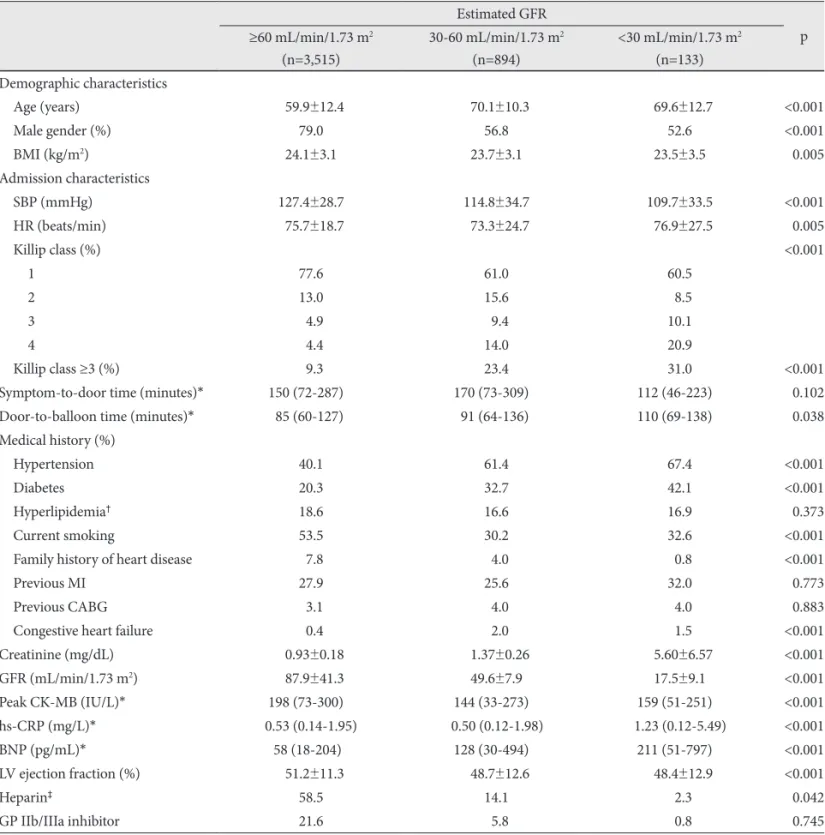
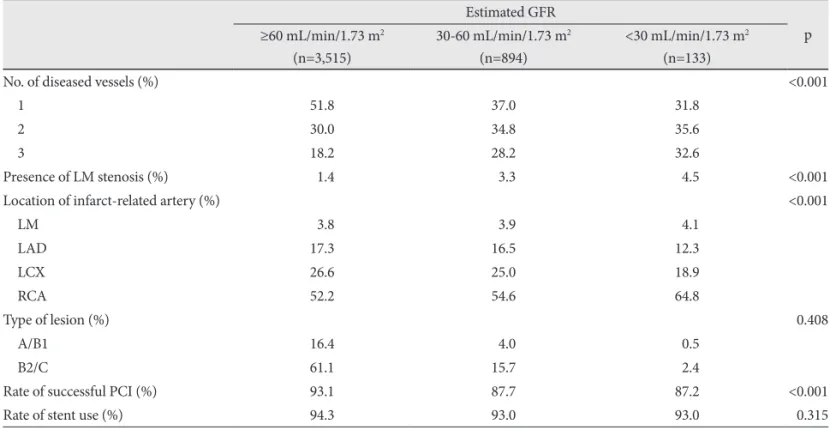
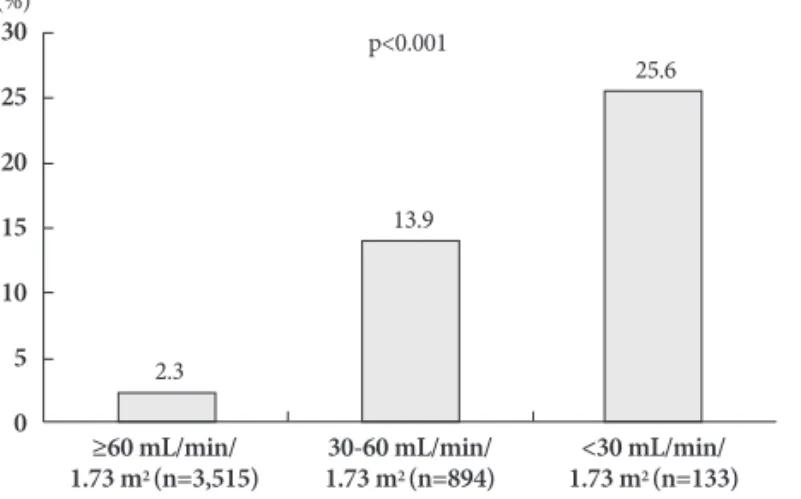
<30, n=133). Baseline characteristics, angiographic and procedural results, and in-hospital outcomes between the three groups were compared. Results: Age, gender, Killip class ≥3, hypertension, diabetes, congestive heart failure, peak creatine kinase-MB, high sensitivity C-reactive protein, B-type natriuretic peptide, left ventricle ejection fraction, multivessel disease, infarct-relat- ed artery and rate of successful PCI were significantly different between the 3 groups (p<0.05). With decline in RF, in-hospital complications developed with an increasing frequency (14.1% vs. 31.8% vs. 45.5%, p<0.0001). In-hospital mortality rate was significantly higher in the moderate and severe RD groups as compared to the normal RF group (2.3% vs. 13.9% vs. 25.6%, p<0.0001). Using multivariate logistic regression analysis, adjusted odds ratio for in-hospital mortality was 2.67 {95% confi- dence interval (CI) 1.44-4.93, p=0.002} in the moderate RD group, and 4.09 (95% CI 1.48-11.28, p=0.006) in the severe RD group as compared to the normal RF group. Conclusion: Decreased admission eGFR was associated with worse clinical courses and it was an independent predictor of in-hospital mortality in STEMI patients undergoing primary PCI. (Korean Circ J 2011;41:184-190)
KEY WORDS: Glomerular filtration rate; Acute myocardial infarction; Mortality; Percutaneous coronary intervention.
Received: May 5, 2010 / Revision Received: July 9, 2010 / Accepted: July 23, 2010
Correspondence: Myung Ho Jeong, MD, Principal Investigator of Korea Acute Myocardial Infarction Registry, The Heart Research Center Designated by Korea Ministry of Health and Welfares, Chonnam National University Hospital, 671 Jaebong-ro, Dong-gu, Gwangju 501-757, Korea
Tel: 82-62-220-6243, Fax: 82-62-228-7174, E-mail: [email protected]
• The authors have no financial conflicts of interest.
cc