• 검색 결과가 없습니다.

Relationship Between a New Functional Evaluation Model and the Fugle-Meyer Assessment Scale for Evaluating the Upper Extremities of Stroke Patients

N/A
N/A
Protected

Academic year: 2021

Share "Relationship Between a New Functional Evaluation Model and the Fugle-Meyer Assessment Scale for Evaluating the Upper Extremities of Stroke Patients"

Copied!
9
0
0

로드 중.... (전체 텍스트 보기)

전체 글

(1)

1)

| Abstract |

Purpose: The aim of this study was to investigate the relationship between a functional evaluation model and the Fugl-Meyer assessment (FMA) scale in evaluating the upper extremities of stroke patients

Methods: Thirty-eight stroke patients were evaluated using the FMA and performed reaching and grasping motions using a three-dimensional motion analysis (Qquas 1 series, Qualisys AB, Sweden). The participants sat on a chair with a backrest. The position of the cup was located at a distance of 80% to the front arm length. The markers were attached to the sternum, acromion, elbow lateral epicondyle, ulnar styloid process, three metacarpal heads, and the distal phalanges of the thumb and index finger.

The variables of the correlation between the functional evaluation model and the FMA scale were analyzed. Multiple regression (stepwise) was used to investigate the effect of the kinematic variables.

Results: A significant negative correlation was found between the movement time (p < 0.05), movement unit (p < 0.05), and trunk displacement values (p < 0.05) in the FMA total scores, while a positive correlation was found between the peak velocity (p < 0.05) and maximum grip aperture values (p < 0.05). As a result of the multiple regression analysis, the most significant factor was the movement unit, followed by the general movement assessment and trunk displacement. The explained FMA total score value was 62%.

Conclusion: This study presents a new functional evaluation model for assessing the reaching and grasping ability of stroke patients. The factors of the proposed functional evaluation model showed significant correlations with the FMA scale scores and confirmed that the new functional evaluation model explained the FMA by 67%. This suggests a new functional evaluation model for reaching and grasping stroke patients.

Key Words: Stroke, Kinetics, Upper extremity, Models

†Corresponding Author : Chang-Ho Song ([email protected])

Original Article Open Access

Relationship Between a New Functional Evaluation Model and the Fugle-Meyer Assessment Scale for Evaluating the Upper Extremities of Stroke Patients

Jung-Hyun Kim, P.T., M.Sc.⋅Hyun-Jin Kim, P.T, Ph.D.⋅Seung-Gu Lee, P.T., M.Sc.⋅

Chang-Ho Song, P.T., Ph.D.

Department of Physical Therapy, Sahmyook University Received: April 19, 2020 / Revised: May 22, 2020 / Accepted: May 25, 2020

ⓒ 2020 Journal of Korea Proprioceptive Neuromuscular Facilitation Association

This is an Open Access article distributed under the terms of the Creative Commons Attribution Non-Commercial License

(http://creativecommons.org/licenses/by-nc/3.0) which permits unrestricted non-commercial use, distribution, and reproduction

in any medium, provided the original work is properly cited.

(2)

Ⅰ. Introduction

Stroke is the major cause of morbidity, mortality, and long-term disability worldwide (Feigin et al., 2015;

Langhorne et al., 2011). Stroke symptoms vary, but motor impairment, including reduced upper extremity function, is common and affects approximately 50–70% of patients in the acute stage (Persson et al., 2012). Of these patients, 30% have severe upper extremity impairment (Houwink et al., 2013). Movement slowness is a direct consequence of brain lesion weakness (Sukal-Moulton et al., 2014), and hemiplegic upper extremity is a major residual defect in stroke patients (Patterson et al., 2011). This reduces the functional ability of the affected arm to an immovable level against gravity (Hayward et al., 2017). The inability to use the affected arms in activities of daily living limits the patient’s independence in the community (Lum et al., 2009). The recovery of upper limb function in patients after a stroke is often insufficient despite intensive physical therapy (Belda-Lois et al., 2011).

During daily activities, the movement of the upper limb is complex and requires close interaction between environmental and personal constraints, and coordination among multiple muscles, joints, and body segments (Gibson, 2014; Shumway-Cook & Woollacott, 2007).

Thus, various measurements have been used to evaluate complex functions after rehabilitation (Li et al., 2012;

Park et al., 2008).

Many different tools are available for evaluating the improvement of the upper extremity motor function, and each has its own characteristics. Unlike the Fugl-Meyer test, which focuses on movement, for example, the action research arm test and the box and block test are measures to assess the ability to handle large and small objects (Cromwell, 1976; Mathiowetz et al., 1985; Organization, 2001). Fugl-Meyer assessment (FMA), which is used to evaluate the motor state of stroke patients, is a

well-established stroke motor measure that iteratively determines active movement at each joint of the paretic extremity (van Wijck et al., 2001).

Although a various measurement tools and methods have been used in addition to assessment scales, kinematic analysis using motion analysis is highly relevant in the clinical measurement of sensorimotor impairment and activity capacity limitations, and allows for the detection of the effect of motor control in stroke patients (Massie et al., 2009; Wu et al., 2014; Wu et al., 2012). Kinematic analysis provides a meaningful objective assessment of motor function while functional tasks are performed and provides information on the movement pattern, quality, and strategy (Alt Murphy et al., 2011; Wu et al., 2011).

Kinematic variables using motion analysis show high reliability and validity in assessing reaching motion or pointing in stroke patients (Alt Murphy et al., 2011;

Patterson et al., 2011; Subramanian et al., 2010).

Kinematic variables, including movement trajectories, recruitment of joints, coordination between joints, and involvement of the trunk, are used to characterize the deficit, recovery, and treatment effects of control strategies during reaching motion in stroke patients (Massie et al., 2009; Wu et al., 2013; Wu et al., 2012). For example, stroke patients have deficits in endpoint control and disrupted joint recruitment and interjoint coordination. A damaged endpoint control present with a smaller movement amplitude, prolonged movement times, and more segmented movement trajectories (Dejong & Lang, 2012; Dipietro et al., 2009).

Motor performance aimed at the aspect of movement quality is evaluated as a temporal and spatial parameter factor, and is calculated by calculating joints, kinematic body segment, and endpoint positioning (de los Reyes-Guzman et al., 2014; Liebermann et al., 2010).

In addition, various kinematic variables reflect the

reaching movements of stroke patients. Studies are

(3)

underway to measure reaching and grasping to evaluate more functional and task-related movements, and the variables can be summarized as follows: Kinematic characteristics include movement time, peak velocity, movement unit, movement time where peak velocity occurs, and various upper extremity angles (Alt Murphy

& Häger, 2015). Characteristics of compensation are trunk displacement and shoulder abduction angle (McCrea et al., 2005). Task performance characteristics include maximum grip aperture (MGA), movement time where MGA occurs, lifting, and moving (Alt Murphy et al., 2011;

Patterson et al., 2011).

The goal of this study is to perform a three-dimensional motion analysis of the stroke patient’s reaching and grasping through the body surface markers used in the previous study and to confirm the relationship between the result of analysis and clinical evaluation scale. The clinical evaluation scale is FMA scale used the best established and commonly for reaching and grasping (van Wijck et al., 2001). In addition, based on this data, we propose a new functional evaluation model that can evaluate the reaching and grasping of stroke patients in three dimensions.

Ⅱ. Methods

1. Subjects

The participants were 38 stroke patients. The purpose and inclusion criteria of this study were promoted in our hospital from July 1, 2017, to November 30, 2017, to recruit study subjects. Prior to participation, the objective and methods of the study were explained to the subjects who then provided their written informed consent. The study was conducted after obtaining approval from the ethics committee of Sahmyook University and written

informed consent from all the participants. The inclusion criteria were as follows: had a first episode of unilateral stroke with hemiparesis (Yavuzer et al., 2008), had an ischemic or hemorrhagic stroke of <6 months (Lin et al., 2014), able to understand and follow simple verbal instructions (Yavuzer et al., 2008), had a Mini Mental State Examination-Korean Version score of ≥21 (Lee et al., 2014). The exclusion criteria were as follows: had a mental disorder or dementia, diagnosed as having an orthopedic condition such as an upper extremity fracture or neuropathy (Lee et al., 2014), and cannot perform the experiment.

2. Procedures

This is a cross-sectional study. Evaluation using motion analysis and the FMA scale were conducted by two experienced physiotherapists. All the participants were evaluated using the FMA scale, and their general characteristics were assessed. The participants sat in hip joint and knee joint 90 flexion on a chair with a backrest and adjustable height, with the feet touching the floor.

The patients sat at the table, with their hands on the table.

At this time, the height of the table was adjusted. The

patient’s elbow joint was placed in 90 flexion; forearm,

in neutral position; and wrist, parallel to the table edge,

with the thumb and index finger attached to the initial

position. The position of the cup is located at a distance

of 80% of the front arm length, and the cup is gripped

as fast as possible in accordance with the inspector’s

instructions (Bustren et al., 2017). Five measurements

were made, and the average value of three measurements

in the middle was analyzed. Six infrared cameras were

used for three-dimensional motion analysis (Qquas 1

series, Qualisys AB, Sweden). The markers were attached

to the sternum, acromion on the affected side, elbow lateral

epicondyle, ulnar styloid process, 3 metacarpal heads, and

(4)

the distal phalanges of the thumb and index finger. The captured parameters were analyzed using the Qualisys Track Manager (Qualisys AB, Sweden). This equipment’s intraclass correlation coefficient (ICC) ranged from 0.887 to 0.901 (Chen et al., 2016).

The kinematic variables of the reaching and grasping function evaluation model used in this study were as follows: Among the reaching motional analysis factors of stroke patients, from 1990 to 2014, more than 45%

of the 93 preliminary studies were selected as the kinematic and compensatory characteristics, and grips with task performance characteristics were selected (Bustren et al., 2017).

The definitions of the kinematic variables are as follows: movement time is the time between the beginning and end of the movement (Bustren et al., 2017), peak velocity is the highest value of motion velocity (Selles et al., 2014), trunk displacement is the distance traveled by the sternum marker (Wu et al., 2014), The Percentage of movement time where Peak Velocity occurs (PPV) was calculated as the time to peak velocity * 100/movement time (Aboelnasr et al., 2017), movement unit is one acceleration and one deceleration (Lin et al., 2007) that are extracted from the wrist position data, MGA is the maximum distance between the thumb and the index finger and Percentage of movement time where Maximum Grip Aperture occurs (PMGA) was calculated as the time to reach MGA * 100/movement time (Wu et al., 2007).

3. Data Analysis

The collected data were analyzed as follows using SPSS/WIN 20.0: The general characteristics of all the participants are presented as descriptive statistics. The variables of the functional evaluation model and FMA correlation were analyzed using Pearson correlation coefficients. To investigate the effect of the kinematic

variables of the functional evaluation model on the FMA, multiple regression (stepwise) was used. The level of significance used was P less than 0.05.

Ⅲ. Results

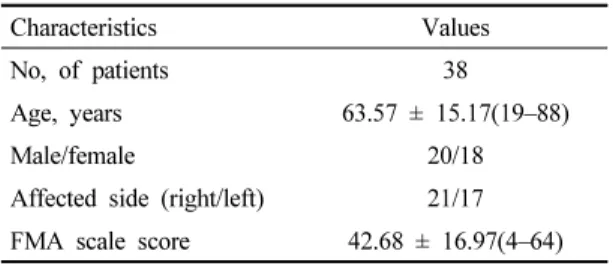
The general features of the 38 participants are listed in Table 1.

Characteristics Values

No, of patients 38

Age, years 63.57 ± 15.17(19–88)

Male/female 20/18

Affected side (right/left) 21/17 FMA scale score 42.68 ± 16.97(4–64) Values are n or mean±standard deviation (SD).

Ranges in parentheses are provided for continuous variables.

FMA: Fugl-Meyer assessment

Table 1. General characteristic measurements

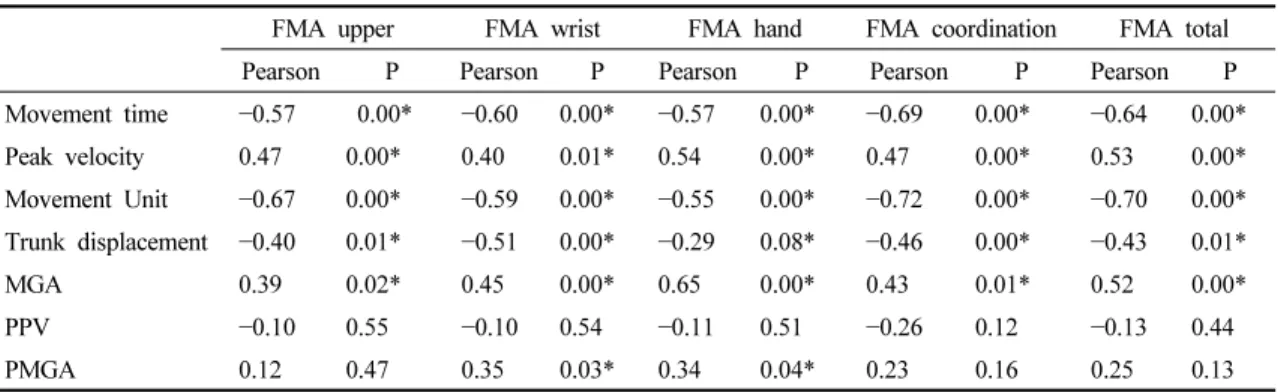
In the upper score of the FMA scale, a significant negative correlation was found between movement time (r=−0.57, P<0.05), movement unit (r=−0.67, P<0.05), and trunk displacement values (r=−0.40, P<0.05), and a significant positive correlation was found between peak velocity (r=0.47, P<0.05) and MGA (r=0.39, P<0.05).

FMA wrist score showed a significant negative correlation with movement time (r=−0.60, P<0.05), movement unit (r=−0.59, P<0.05), and trunk displacement (r=−0.51, P<0.05), and showed a significant positive correlation with peak velocity (r=0.40, P<0.05), MGA (r=0.45, P<0.05), and PMGA (r=0.35, P<0.05). FMA hand score also showed a significant negative correlation with movement time (r=−0.57, P<0.05), movement unit (r=−

0.55, P<0.05), and trunk displacement (r=−0.29, P<0.05).

Peak velocity (r=0.54, P<0.05), MGA (r=0.65, P<0.05),

(5)

and PMGA (r=0.34, P<0.05) also showed significant positive correlations. In FMA coordination score, significant negative correlations were found with movement time (r=−0.69, P<0.05), movement unit (r=−

0.72, P<0.05) and trunk displacement (r = −0.46, P<0.05).

Peak velocity (r=0.47, P<0.05) and MGA (r=0.43, P<0.05) showed significant positive correlations. FMA total score, which reflect all the scores, showed significant negative correlations with movement time (r=−0.64, P<0.05), movement unit (r=−0.70, P<0.05), and trunk displacement (r=−0.43, P<0.05). Significant positive correlations with peak velocity (r=0.53, P<0.05) and MGA

values (r=0.52, P<0.05) were also observed. Table 2 shows the results of the correlation between FMA scale and the functional evaluation model for assessing reaching and grasping in stroke patients.

Multiple regression analysis was performed using the stepwise method to investigate the effect of functional evaluation model except PPV and PMGA on the FMA total score among the factors of the new functional evaluation model designed on the basis of correlation analysis results. The Durbin-Watson independence (1.4) and collinearity were satisfied (1.07–1.13). As a result of the multiple regression analysis, the most significant FMA upper FMA wrist FMA hand FMA coordination FMA total

Pearson P Pearson P Pearson P Pearson P Pearson P

Movement time −0.57 0.00* −0.60 0.00* −0.57 0.00* −0.69 0.00* −0.64 0.00*

Peak velocity 0.47 0.00* 0.40 0.01* 0.54 0.00* 0.47 0.00* 0.53 0.00*

Movement Unit −0.67 0.00* −0.59 0.00* −0.55 0.00* −0.72 0.00* −0.70 0.00*

Trunk displacement −0.40 0.01* −0.51 0.00* −0.29 0.08* −0.46 0.00* −0.43 0.01*

MGA 0.39 0.02* 0.45 0.00* 0.65 0.00* 0.43 0.01* 0.52 0.00*

PPV −0.10 0.55 −0.10 0.54 −0.11 0.51 −0.26 0.12 −0.13 0.44

PMGA 0.12 0.47 0.35 0.03* 0.34 0.04* 0.23 0.16 0.25 0.13

FMA: Fugl-Meyer assessment scale MGA: maximum grip aperture

PPV: percentage of movement time where peak velocity occurs

PMGA: percentage of movement time where maximum grip aperture occurs

*P<0.05

Table 2. Correlation between the functional evaluation model and the FMA scale (n = 38)

B SE b R

2

△R

2

( P) F P

Contrast 52.11 6.27

1 −2.14 0.41 −0.56 0.49 34.03 0.00*

2 0.10 0.03 0.36 0.62 0.13 (0.00) 28.96 0.00*

3 −0.06 0.03 −0.22 0.67 0.05 (0.04) 22.70 0.00*

1: movement unit, 2: movement unit, MGA, 3: movement unit, MGA, and trunk displacement MGA: maximum grip aperture

B: unstandardised regression coefficient SE: standard error

b: standardised regression coefficient R: coefficient of multiple correlation

*P<0.05

Table 3. Multiple regression analysis between the functional evaluation model and the FMA scale (n = 38)

(6)

factor was movement unit (b = −0.56), followed by MGA (b = 0.46) and trunk displacement (b = −0.22). As the movement unit and trunk displacement values decreased and the MGA value increased, the FMA total value increased. The FMA total score was explained by the best movement unit (49%). When MGA was added, a significant increase of 13% (P <0.05) was observed, and the explained FMA total score was 62%. In addition, when trunk displacement was added, a significant increase of 5% (P < 0.05) was observed, and the explained FMA total score was 67%. The results of the multiple regression analysis are shown in Table 3, and Figure 1 shows the standardized predicted values.

Ⅳ. Discussion

In this study, a new functional evaluation model for reaching and grasping in stroke patients was developed, and data were collected and compared with FMA scale scores. The correlation between the functional evaluation model and the FMA was similar to those reported in previous studies. In previous studies, motion analysis of reaching in stroke patients revealed that the overall movement time was longer, and the deceleration was faster (Alt Murphy & Häger, 2015; Alt Murphy et al., 2011; Dejong & Lang, 2012; Dipietro et al., 2009). Peak velocity tends to decrease (Alt Murphy et al., 2011; van Vliet & Sheridan, 2007; Wu et al., 2011). The movement unit indicating the smoothness of the movement was high (Alt Murphy et al., 2011; Dejong & Lang, 2012; Dipietro et al., 2009), and compensation movement increased trunk displacement (Alt Murphy et al., 2011; McCrea et al., 2005; Roby-Brami et al., 2003). Moreover, as stroke rehabilitation progressed, MGA and PMGA increased (Edwards et al., 2012; Lin et al., 2007).

This study also shows that FMA total score

significantly negatively correlated with movement time, movement unit, and trunk displacement. Peak velocity and MGA showed significant positive correlations. PPV and PMGA were not significantly correlated but showed a positive correlation in previous studies. On the basis of this correlation, multiple regression by the stepwise method was performed with FMA total score as dependent variable for the variables of the new function evaluation model, namely movement time, peak velocity, movement unit, trunk displacement, and MGA, except for PPV and PMGA analysis. It is evident that the strength of the correlation between different kinematics variables and clinical scales can show some variations depending on which specific kinematic task. As a result of this study, the functional evaluation model explained the FMA scale score by 67%. In the multiple regression analysis, the factors that affected the FMA total score were movement unit, MGA, and trunk displacement. The movement units indicate the amount of error correction during reaching movement and is another indicator to infer the control strategy of reaching (Wu et al., 2007). Trunk displacement is used as an indicator of compensation movement (Alt Murphy et al., 2011; McCrea et al., 2005; Roby-Brami et al., 2003). In MGA, it is used as an indicator of various functions, indicating skillful grasping in comparison with the size of the object to be caught (Grosskopf &

Kuhtz-Buschbeck, 2006), and is also used as a functional variable as in this study (Edwards et al., 2012). By contrast, the FMA total score is influenced by the indicators of control strategy, compensation movement, and functional index of the hand. The new functional evaluation model also reflects these indicators.

Therefore, the new functional evaluation model in this

study can be used to evaluate the reaching and grasping

in stroke patients, instead of FMA total score. As

movement time, movement unit, and trunk displacement

factors decrease, the FMA total score of stroke patients

(7)

increases. The FMA total score of stroke patients increases as peak velocity, MGA, PPV, and PMGA factors increase.

In addition, the most important factors that affect the total score of FMA are movement unit, MGA, and trunk displacement.

There are some limitations in this study. First, a relatively small number of cases were recruited for this study. Second, the absence of variables for complex joint movements or kinetics.

This study presents a new functional evaluation model for assessing the reaching and grasping ability of stroke patients. The factors of the proposed functional evaluation model showed significant correlations with FMA scale score. Through a multiple regression analysis of the functional evaluation model and the FMA scale, we confirmed that the new functional evaluation model explained the FMA scale score by 67%.

Ⅴ. Conclusion

This suggests a new functional evaluation model for reaching and grasping in stroke patients, which allows us to evaluate the reaching and grasping abilities of stroke patients as a more objective and accurate tool. This may be helpful in future studies of reaching and grasping in stroke patients.

References

Aboelnasr EA, Hegazy FA, Altalway HA. Kinematic characteristics of reaching in children with hemiplegic cerebral palsy: A comparative study. Brain Injury.

2017;31(1):83-89.

Alt Murphy M, Häger CK. Kinematic analysis of the upper extremity after stroke–how far have we reached and

what have we grasped? Physical Therapy Reviews.

2015;20(3):137-155.

Alt Murphy M, Willen C, Sunnerhagen KS. Kinematic variables quantifying upper-extremity performance after stroke during reaching and drinking from a glass.

Neurorehabilitation and Neural Repair. 2011;

25(1):71-80.

Belda-Lois JM, Mena-del Horno S, Bermejo-Bosch I, et al.

Rehabilitation of gait after stroke: a review towards a top-down approach. Journal of Neuroengineering and Rehabilitation. 2011;8(1):66.

Bustren EL, Sunnerhagen KS, Alt Murphy M. Movement kinematics of the ipsilesional upper extremity in persons with moderate or mild stroke.

Neurorehabilitation and Neural Repair. 2017;

31(4):376-386.

Chen ZR, Peng HT, Siao SW, et al. Whole body vibration immediately decreases lower extremity loading during the drop jump. Journal of Strength and Conditioning Research. 2016;30(9):2476-2481.

Cromwell F. Occupational therapists manual for basic skill assessment: primary prevocational evaluation.

California. Fair Oaks Printing. 1976.

de los Reyes-Guzman A, Dimbwadyo-Terrer I, Trincado- Alonso F, et al. Quantitative assessment based on kinematic measures of functional impairments during upper extremity movements: a review. Clinical Biomechanics (Bristol, Avon). 2014;29(7):719-727.

Dejong SL, Lang CE. Comparison of unilateral versus bilateral upper extremity task performance after stroke. Topics in Stroke Rehabilitation. 2012;19(4):294-305.

Dipietro L, Krebs HI, Fasoli SE, et al. Submovement changes characterize generalization of motor recovery after stroke. Cortex. 2009;45(3):318-324.

Edwards DF, Lang CE, Wagner JM, et al. An evaluation of

the wolf motor function test in motor trials early

after stroke. Archives of Physical Medicine and

(8)

Rehabilitation. 2012;93(4):660-668.

Feigin VL, Krishnamurthi RV, Parmar P, et al. Update on the global burden of ischemic and hemorrhagic stroke in 1990-2013: The GBD 2013 study. Neuroepidemiology.

2015;45(3):161-176.

Gibson JJ. The ecological approach to visual perception. New York. Psychology Press. 2014.

Grosskopf A, Kuhtz-Buschbeck JP. Grasping with the left and right hand: a kinematic study. Experimental Brain Research. 2006;168(1-2):230-240.

Hayward KS, Schmidt J, Lohse KR, et al. Are we armed with the right data? Pooled individual data review of biomarkers in people with severe upper limb impairment after stroke. Neuroimage Clincal.

2017;13(1):310-319.

Houwink A, Nijland RH, Geurts AC, et al. Functional recovery of the paretic upper limb after stroke: Who regains hand capacity? Archives of Physical Medicine and Rehabilitation. 2013;94(5):839-844.

Langhorne P, Bernhardt J, Kwakkel G. Stroke rehabilitation.

Lancet. 2011;377(9778):1693-1702.

Lee D, Lee M, Lee K, et al. Asymmetric training using virtual reality reflection equipment and the enhancement of upper limb function in stroke patients: a randomized controlled trial. Journal of Stroke and Cerebrovascular Diseases. 2014;23(6):1319-1326.

Li KY, Lin KC, Wang TN, et al. Ability of three motor measures to predict functional outcomes reported by stroke patients after rehabilitation. NeuroRehabilitation.

2012;30(4):267-275.

Liebermann DG, Levin MF, McIntyre J, et al. Arm path fragmentation and spatiotemporal features of hand reaching in healthy subjects and stroke patients.

Conference Proceedings of the Annual International Conference of the IEEE Engineering in Medicine and Biology Society. 2010;2010(1):5242-5245.

Lin KC, Wu CY, Wei TH, et al. Effects of modified

constraint-induced movement therapy on reach- to-grasp movements and functional performance after chronic stroke: a randomized controlled study. Clinical Rehabilitation. 2007;21(12):1075-1086.

Lin KC, Huang PC, Chen YT, et al. Combining afferent stimulation and mirror therapy for rehabilitating motor function, motor control, ambulation, and daily functions after stroke. Neurorehabilitation and Neural Repair. 2014;28(2):153-162.

Lum PS, Mulroy S, Amdur RL, et al. Gains in upper extremity function after stroke via recovery or compensation:

potential differential effects on amount of real-world limb use. Topics in Stroke Rehabilitation. 2009;

16(4):237-253.

Massie C, Malcolm MP, Greene D, et al. The effects of constraint-induced therapy on kinematic outcomes and compensatory movement patterns: an exploratory study. Archives of Physical Medicine and Rehabilitation. 2009;90(4):571-579.

Mathiowetz V, Volland G, Kashman N, et al. Adult norms for the box and block test of manual dexterity.

American Journal of Occupational Therapy.

1985;39(6):386-391.

McCrea PH, Eng JJ, Hodgson AJ. Saturated muscle activation contributes to compensatory reaching strategies after stroke. Journal of Neurophysiology. 2005;94(5):

2999-3008.

Organization WH. International classification of functioning, disability and health: ICF. Geneva. World Health Organization. 2001.

Page SJ, Fulk GD, Boyne P. Clinically important differences for the upper-extremity Fugl-Meyer scale in people with minimal to moderate impairment due to chronic stroke. Physical Therapy. 2012;92(6):791-798.

Park SW, Wolf SL, Blanton S, et al. The excite trial: predicting a clinically meaningful motor activity log outcome.

Neurorehabilitation and Neural Repair. 2008;22

(9)

(5):486-493.

Patterson TS, Bishop MD, McGuirk TE, et al. Reliability of upper extremity kinematics while performing different tasks in individuals with stroke. Journal of Motor Behavior. 2011;43(2):121-130.

Persson HC, Parziali M, Danielsson A, et al. Outcome and upper extremity function within 72 hours after first occasion of stroke in an unselected population at a stroke unit. A part of the salgot study. BMC Neurology. 2012;12(1):162.

Roby-Brami A, Feydy A, Combeaud M, et al. Motor compensation and recovery for reaching in stroke patients. Acta Neurologica Scandinavica. 2003;107 (5):369-381.

Selles RW, Michielsen ME, Bussmann JB, et al. Effects of a mirror-induced visual illusion on a reaching task in stroke patients: Implications for mirror therapy training. Neurorehabilitation and Neural Repair.

2014;28(7):652-659.

Shumway-Cook A, Woollacott MH. Motor control: translating research into clinical practice, 3rd ed. Philadelphia.

Lippincott Williams & Wilkins. 2007.

Subramanian SK, Yamanaka J, Chilingaryan G, et al. Validity of movement pattern kinematics as measures of arm motor impairment poststroke. Stroke. 2010;41 (10):2303-2308.

Sukal-Moulton T, Krosschell KJ, Gaebler-Spira DJ, et al. Motor impairment factors related to brain injury timing in early hemiparesis. Part i: Expression of upper- extremity weakness. Neurorehabilitation and Neural Repair. 2014;28(1):13-23.

van Vliet PM, Sheridan MR. Coordination between reaching and grasping in patients with hemiparesis and healthy subjects. Archives of Physical Medicine and

Rehabilitation. 2007;88(10):1325-1331.

van Wijck FM, Pandyan AD, Johnson GR, et al. Assessing motor deficits in neurological rehabilitation: patterns of instrument usage. Neurorehabilitation and Neural Repair. 2001;15(1):23-30.

Wu CY, Lin KC, Chen HC, et al. Effects of modified constraint-induced movement therapy on movement kinematics and daily function in patients with stroke:

a kinematic study of motor control mechanisms.

Neurorehabilitation and Neural Repair. 2007;

21(5):460-466.

Wu CY, Chuang LL, Lin KC, et al. Randomized trial of distributed constraint-induced therapy versus bilateral arm training for the rehabilitation of upper-limb motor control and function after stroke. Neurorehabilitation and Neural Repair. 2011;25(2):130-139.

Wu CY, Yang CL, Chen MD, et al. Unilateral versus bilateral robot-assisted rehabilitation on arm-trunk control and functions post stroke: a randomized controlled trial.

Journal of Neuroengineering and Rehabilitation.

2013;10(1):35.

Wu CY, Liing RJ, Chen HC, et al. Arm and trunk movement kinematics during seated reaching within and beyond arm’s length in people with stroke: a validity study.

Physical Therapy. 2014;94(6):845-856.

Wu CY, Yang CL, Chuang LL, et al. Effect of therapist-based versus robot-assisted bilateral arm training on motor control, functional performance, and quality of life after chronic stroke: a clinical trial. Physical Therapy.

2012;92(8):1006-1016.

Yavuzer G, Selles R, Sezer N, et al. Mirror therapy improves

hand function in subacute stroke: a randomized

controlled trial. Archives of Physical Medicine and

Rehabilitation. 2008;89(3):393-398.

수치

Table  1.  General  characteristic  measurements
Table  2.  Correlation  between  the  functional  evaluation  model  and  the  FMA  scale                                          (n  =  38)

참조

관련 문서

Modern Physics for Scientists and Engineers International Edition,

If both these adjustments are considered, the resulting approach is called a bootstrap-BC a -method (bias- corrected-accelerated). A description of this approach

③ A student who attended Korean course at KNU Korean Language Program and holds TOPIK Level 3 or a student who completed Korean course Level 4 at the KNU Korean Language

· 50% exemption from tuition fee Ⅱ for the student with a TOPIK score of level 3 or higher or completion of level 4 or higher class of the Korean language program at the

14 For individuals with a triglyceride concentration of 200–499 mg/dL, pharmacological therapy should be considered to lower triglyceride concentration after

웹 표준을 지원하는 플랫폼에서 큰 수정없이 실행 가능함 패키징을 통해 다양한 기기를 위한 앱을 작성할 수 있음 네이티브 앱과

_____ culture appears to be attractive (도시의) to the

The key issue is whether HTS can be defined as the 6th generation of violent extremism. That is, whether it will first safely settle as a locally embedded group