The offshore Uljin, Korea, earthquake sequence of April 2006: seismogene- sis in the western margin of the Ulleung Basin
ABSTRACT: An unusual earthquake sequence comprising 11 events with magnitude range of ML 2.0 to 3.2 occurred off the east- ern coast of the southern Korean Peninsula in April 2006. Since there is no obvious mainshock in this sequence unlike a typical mainshock-aftershock sequence, the seismicity pattern shows the characteristics of swarm behavior. Focal mechanism of the largest event (ML 3.2) on the 29 of April is normal to strike-slip faulting.
Hypocenter relocations of nine events improve the epicenter loca- tions that fall within an area with a radius of about 0.7 km while depths are less well constrained with ranges of 1.6 km to 13.0 km.
We propose that a swarm behavior of the sequence is closely related to the marginal geometry of the Ulleung Basin and the regional stress regime. The fact that epicenters of the April 2006 sequence are at the same transitional zone of continental to rifted continental crust as that of the 29 May 2004, Mw 5.1, earthquake indicates that the Ulleung Fault is seismically active.
Key words: earthquake sequence, swarm behavior, Ulleung Basin, Ulleung Fault
1. INTRODUCTION
In April 2006, an earthquake sequence comprising 11 events occurred at a distance of about 60 km to the north- east of Uljin in the East Sea (Japan Sea). Korea Institute of Geoscience and Mineral Resources (KIGAM) catalog lists 10 events of the sequence with the magnitude range of ML
2.0 to 3.2 (http://quake.kigam.re.kr). Korea Meteorological Administration (KMA) assigned the magnitude range of ML 2.1 to 3.5 for the sequence (http://kmaneis.go.kr). In that the first event at 09:35 local time on 19 April has a magnitude of ML 2.2 (KIGAM), the earthquake sequence has a cluster type of pattern not showing a large mainshock preceding a series of small aftershocks.
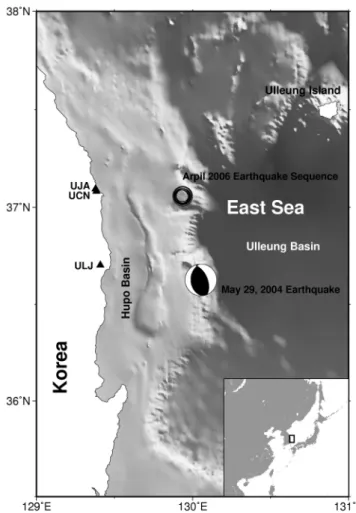
The cluster of the April 2006 earthquake sequence occurred at the transitional zone from continental to rifted continental crust in the East Sea (Fig. 1). Major tectonic elements in the zone are the N-S to NNE-SSW oriented faults represented by the Ulleung Fault along the western margin of the Ulle- ung Basin (Chough et al., 2000). Chough et al. also maintains that regional tectonic regime of the East Sea is compres- sional since about 10 to 7 Ma. The seismicity along the zone is relatively high compared to that in the inland of the
Korean Peninsula. On 29 May 2004, a moderate earthquake of Mw 5.1 occurred at about 50 km to the south of the April 2006 sequence (Fig. 1; Kang and Baag, 2004; Park and Mori, 2005). The in-depth analysis of the May 2004 earth- quake by Kang and Baag (2004) has suggested the possi- bility that an eastward-dipping thrust fault on a north-south trend is governed by the compressional tectonic regime in the East Sea and is directly related to the Ulleung Fault.
There is, however, still no definite evidence to distinguish whether faulting related to the May 2004 earthquake was on the eastward or westward dipping plane. The April 2006 sequence offers a good opportunity that may give a con- straint on the dual ambiguity of the fault planes responsible for the May 2004 earthquake. In this paper, we analyzed the April 2006 sequence with the goal to better understand the seismogenic structures that caused the recent seismic activ- ity in the offshore area of the eastern margin of the Korean Peninsula.
2. DATA SET
The April 2006 earthquake sequence was well recorded on the short-period and broadband stations within the mon- itoring networks operated by KMA, KIGAM, Korea Elec- tric Power Research Institute (KEPRI), Korea Institute of Nuclear Safety (KINS), and Universities. About 50 stations produced digital seismogram data with the sampling rate of 100 Hz. Information on the station distribution is given in Kang and Baag (2004). However, because the earthquake sequence occurred off the eastern coast of the Korean Pen- insula, the station coverage is confined to the left side of the sequence except for the station ULL (the Ulleung Island).
The waveform data utilized in this study consist of records of 11 earthquakes: six small (ML 2.0−2.8) events on the 19 April 2006 and five events of ML 2.4−3.2 occurred between 28 and 30 April 2006 (Table 1). Although the ML 2.0 event at 09:49:25.46 on 19 April 2006 is not shown in both the KMA and KIGAM catalogs, a close lookup of the seismo- grams for the ML 2.8 event at 09:49:34.31 on the same day reveals that a pair of phases in the seismograms corre- sponds to two separate events that occurred at times about 9 seconds apart (Fig. 2). Here we use magnitudes presented
Tae-Seob Kang*
Jin Soo Shin } Earthquake Research Center, Geological and Environmental Hazards Division, Korea Institute of Geoscience and Mineral Resources, Daejeon 305-350, Korea
*Corresponding author: [email protected]
their epicenters are located close together but their focal depths may vary.
3. FOCAL MECHANISM
Only the ML 3.2 event at 11:01:13.05 on 29 April 2006 of the sequence provided sufficient data for a well-constrained focal solution. For the event, a total of 13 polarities of the first motions were read from seismograms of the networks.
Eight polarities were from short-period vertical-component waveforms, and five were from broadband waveforms. Because the station coverage is incomplete, we cannot obtain a reli- able fault-plane solution using polarity information only.
Thus we add SH-wave polarities and amplitude ratios of SH to P waves at three stations closest to the epicenter. All the data prepared for focal mechanism analysis are listed in Table 2. This dataset is inverted for the focal mechanism using the grid search algorithm (FOCMEC) of Snoke et al.
(1984). Thus we find a well-constrained focal mechanism showing a combination of normal and strike-slip faulting along either a focal plane of strike 16°, dip 40° and rake 209°, or a plane of strike 263°, dip 72° and rake 306° (Fig. 4).
The normal sense is rather unusual compared to the regional tectonic environments of the Korean Peninsula
Fig. 1. Epicentral locations (open circles) of the April 2006 earth- quake sequence on a topographic relief map of the East Sea. Beach- ball shows the epicenter and lower hemisphere focal mechanism of the 29 May 2004, Mw 5.1, earthquake. Solid triangles indicate the closest three stations to the April 2006 sequence, and waveforms recorded at the stations are used to measure differential travel times for the hypocenter relocation of the sequence.
Fig. 2. Doublet observed on seismograms at the station UCN for the event 09:49:34.31 on 19 April 2006. Arrivals of P and S waves for the preceding event (09:49:25.46) are indicated by P1 and S1, respectively, while P2 and S2 correspond to the following event (09:49:34.31). The marks U, E, and N denote the vertical, east-west, and north-south components, respectively. The origin of time scale is aligned with the origin time of the second event 09:49:34.31. All the traces are normalized to the same scale.
under the ENE-WSW compressional regime. Thus we try to find focal solutions repeatedly without information on the amplitude ratios, considering a possibility of measure- ment errors. Because the motions of SH waves picked on the tangential components of the three stations (UCN, UJA, and ULJ) are clear, we include the polarities of SH waves in addition to those of P waves in the focal mechanism inversion to constrain the focal solution. The results are identical to the case of including the amplitude ratios. The pressure axis is oblique and oriented to the southwest with an azimuthal trend of 213° and a plunge of 50°. The trend is comparable to an approximate azimuthal trend (256° or 76°) of the 29 May 2004 earthquake with near-horizontal
plunge implying consistency with the regional tectonic regime in and around the Korean Peninsula.
The other events considered in this study are all too small for well-constrained focal solutions. However, we pay atten- tion to the fact that all of the first motions that can be read for those small events (specifically, on the seismograms of the closest stations UCN, UJA, and ULJ) are consistent with the first motions of the ML 3.2 event at 11:01:13.05 on 29 April 2006. This may suggest similar focal mechanisms for those smaller events.
4. HYPOCENTER RELOCATION
Accurate hypocenter locations of the cluster events are important to obtain information on geometry of the caus- ative fault and identification of the active fault plane of such a cluster. Accuracy of the locations depends on minimiza- tion of errors in arrival-time measurements and errors aris- ing from unmodeled velocity structure. If sources of events are collocated so that the effects of heterogeneous velocity structure along the ray path are negligible, we may skip the consideration on the unmodeled velocity structure. Then the cluster events on a fault may produce similar waveforms at a common station. In this case, a double-difference location algorithm using waveform cross-correlation can be effectively applied to high-precision relative hypocenter locations (Waldhauser and Ellsworth, 2000).
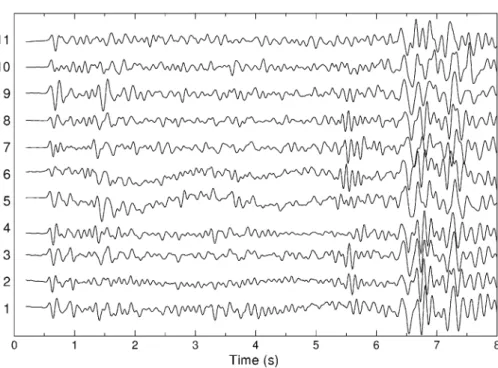
However, in the case of the April 2006 sequence, wave- form similarity between events is not so good (Fig. 3) and thus measurements of relative P- and S-wave arrival times using waveform cross-correlation can be unstable. For this reason, we choose to use a manual picking instead of cross- correlation method to measure the differential travel times
Fig. 3. Vertical component seismo- grams recorded at the station UCN for all the events of the April 2006 sequence listed in Table 1. The seis- mograms are aligned on the direct P arrivals and bandpass filtered between 0.1 and 10 Hz. The numbers on the left side denote the event number assigned in Table 1. All the traces are normal- ized to the same scale.
Table 1. List of events in the April 2006 earthquake sequence, off- shore Uljin, Korea. These are compiled from catalog of the Korea Institute of Geoscience and Mineral Resources (KIGAM, http://
quake.kigam.re.kr).
Event Number Origin Time
(local time: GMT+9hr) Magnitude (ML)
1 2006/04/19-09:35:10.54 2.2
2 2006/04/19-09:49:25.46* 2.0
3 2006/04/19-09:49:34.31 2.8
4 2006/04/19-10:57:55.88 2.4
5 2006/04/19-16:01:32.48 2.3
6 2006/04/19-16:18:11.93 2.0
7 2006/04/28-23:47:55.32 2.9
8 2006/04/28-23:54:57.64 2.5
9 2006/04/29-01:01:00.72 2.4
10 2006/04/29-11:01:13.05 3.2
11 2006/04/30-09:50:02.43 2.4
*This event is not reported in the KIGAM and KMA catalogs.
between events. The seismograms recorded at the stations UCN, UJA, and ULJ show clear arrivals of P wave in the vertical component and SH waves in the tangential com- ponent. Thus arrival times of P and SH waves could usu- ally be picked within about 0.02 and 0.05 seconds, respectively, for those stations. The catalog from the KIGAM for the April 2006 earthquake sequence is used as an input data of initial event locations for the double-dif- ference relocation (Waldhauser and Ellsworth, 2000). The differential travel times between events at the three stations mentioned earlier are equally weighted as unity for both P and S waves.
The events with origin times 09:35:10.54 and 16:18:11.93 on 19 April have phase arrivals at the station UCN only.
Thus nine events among a total of 11 events listed in Table 1 have a sufficient number of arrivals of at least five phases for relocations. We solve the forward problem for reloca- tions using this data set with a 1D layered P-wave velocity model (Table 3) assuming a Poisson’s solid. The velocity model is based on a joint analysis of regional broadband waveforms and travel times in southern Korea (Chang and Baag, 2006). Following receiver function studies of Chang and Baag (2005), depth to the Moho discontinuity under the station ULC (the old name of the station ULJ) is measured as 29.9 km. Thus we substitute this Moho depth for that of the original velocity model.
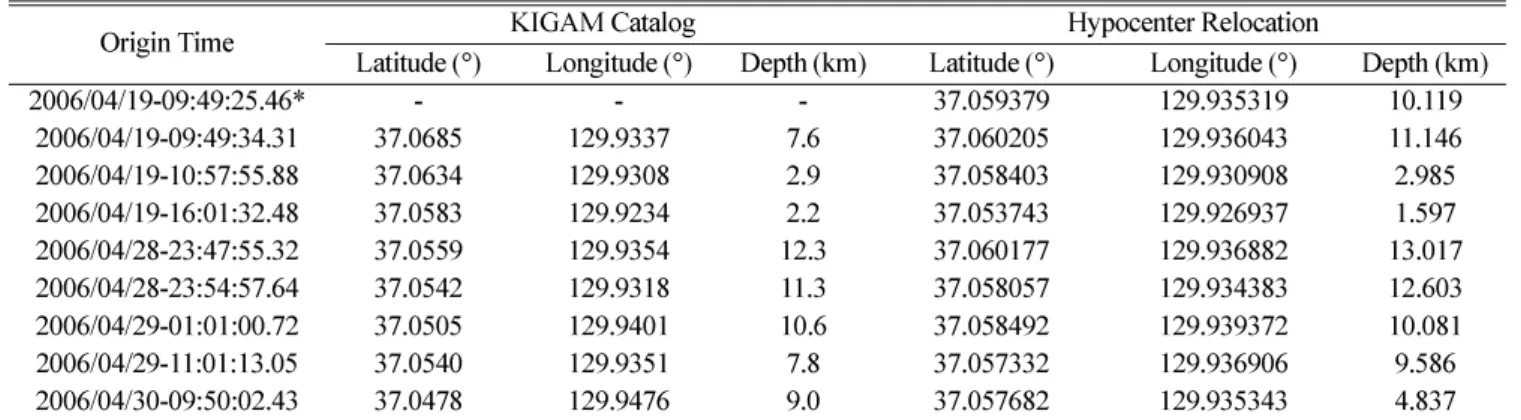
The relocated hypocenters are listed in Table 4, being compared with those from the original catalog of KIGAM.
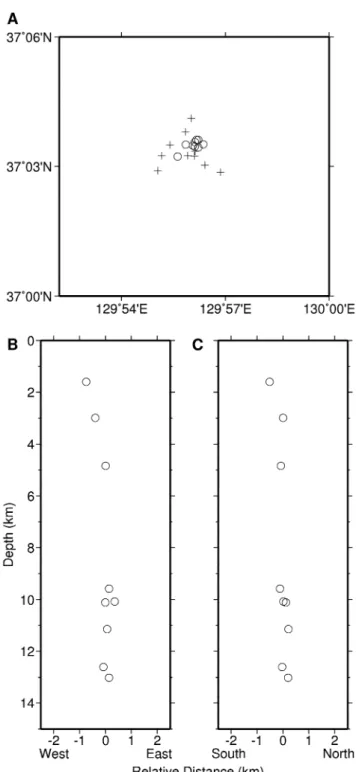
Figure 5 also shows the location of hypocenters in both map and cross-sectional view. We note that the relocation of the nine events greatly improves the epicenter locations that fall within an area with a radius of about 0.7 km. It seems that depths are less well constrained with ranges of
HDB 198.24 49.93 Down - -
DGY 302.52 49.93 Up - -
KMC 236.87 48.54 Down - -
KRB 198.23 48.54 Down - -
SKC 318.05 48.54 Up - -
WJU 283.50 48.54 Up - -
Table 3. Velocity model (Chang and Baag, 2006) used for relo- cation of events in this study.
Depth (km) P-Velocity (km/s) S-Velocity (km/s)
00.0 5.67 3.27
05.1 6.05 3.49
16.7 6.67 3.85
29.9 7.88 4.55
Table 4. Relocated hypocenters in comparison with hypocenters from the KIGAM catalog.
Origin Time KIGAM Catalog Hypocenter Relocation
Latitude (°) Longitude (°) Depth (km) Latitude (°) Longitude (°) Depth (km)
2006/04/19-09:49:25.46* - - - 37.059379 129.935319 10.119
2006/04/19-09:49:34.31 37.0685 129.9337 7.6 37.060205 129.936043 11.146
2006/04/19-10:57:55.88 37.0634 129.9308 2.9 37.058403 129.930908 2.985
2006/04/19-16:01:32.48 37.0583 129.9234 2.2 37.053743 129.926937 1.597
2006/04/28-23:47:55.32 37.0559 129.9354 12.3 37.060177 129.936882 13.017
2006/04/28-23:54:57.64 37.0542 129.9318 11.3 37.058057 129.934383 12.603
2006/04/29-01:01:00.72 37.0505 129.9401 10.6 37.058492 129.939372 10.081
2006/04/29-11:01:13.05 37.0540 129.9351 7.8 37.057332 129.936906 9.586
2006/04/30-09:50:02.43 37.0478 129.9476 9.0 37.057682 129.935343 4.837
*Initial location of the event 2006/04/19-09:49:25.46 for the relocation procedure is set to be the same as that of the event 2006/04/19- 09:49:34.31.
1.6 km to 13.0 km. However, as mentioned earlier, weak similarity of waveforms among events as shown in Figure 3 explains that rays from the sources at depths of a wide range sample responses of the Earth’s structure differ- ently.
In spite of taking uncertainty of depth distribution into consideration to some extent, the relocated nine events can be grouped in two sets according to depths: three events with range of 1.6 to 4.8 km, and six events with range of 9.6 to 13.0 km. This implies that the April 2006 sequence was triggered along the two subfault patches with diameters of 3.2−3.4 km which can be considered to be in maximum scales. Because the horizontal extent of epicenters is small compared to the vertical extent of depths, it is hard to deduce a horizontal trend (strike direction) of the fault patches. On the other hand, epicenters of the April 2006 sequence appear to be located on the northern end of the Ulleung Fault mapped by Chough et al. (2000) in the northwestern margin of the Ulleung Basin. We refer to Figure 12 in Kang and Baag (2004) on details of tectonic structures off the eastern coast of southern Korea.
We cannot make an inference on the question which one of the two focal planes of the event, ML 3.2, with origin time 11:01:13.05 on 29 April 2006 (Fig. 4) is a represen- tative of the fault patches, because such a small-sized earth- quake is mainly related to a posture of the existing microfault. However, the trend of the Ulleung Fault running to NNE direction at the northern end corresponds to the fault plane of strike 16°, dip 40° and rake 209° for the ML
3.2 event at 11:01:13.05 on 29 April 2006.
5. DISCUSSIONS AND CONCLUSIONS
Unlike a typical mainshock-aftershock sequence, there is no obvious mainshock in the April 2006 earthquake sequence.
Fig. 4. Focal mechanism (lower hemisphere projection) obtained by inversion of P and SHpolarities and SH/P amplitude ratios for the event 11:01:13.05 on 29 April 2006 (ML 3.2).
Fig. 5. Relocated hypocenters for the nine events of the April 2006 sequence. (A) epicenter map, (B) vertical cross-section along the east-west direction, and (C) vertical cross-section along the north- south direction. In (A), the relocated epicenters marked by open circles are compared to the epicenters (cross) from catalog pre- sented by the Korea Institute of Geoscience and Mineral Resources (http://quake.kigam.re.kr).
with volcanic regions with a few exceptions, their occur- rence has often been related to the movement of magma, and the focal mechanisms of swarms are typically normal slip or occasionally strike-slip (Lay and Wallace, 1995). In that the focal mechanism of the ML 3.2 event at the origin time 11:01:13.05 on 29 April 2006 is normal to strike-slip faulting (Fig. 4), these superficial characteristics of the April 2006 sequence seem to be similar to those of earth- quake sequence related to an igneous activity. However, in the present state, there is no obvious evidence related to the magma flow in the region, although there is an argument that the ancient tectonics associated with the opening of the East Sea were governed by magma movement (Cho et al., 2004).
An alternative explanation is also possible in the view- point of the marginal geometry of the Ulleung Basin and the regional stress regime. The northern and western edges in the northwestern margin of the Ulleung Basin form an approximately right angle (Fig. 1). And also pressure axis of NE-SW to ENE-WSW directions is aligned obliquely to the Ulleung Fault at the western margin of the Ulleung Basin. Then tension forces the faults in NE-SW direction to be normal slip including strike-slip component on the north- ern end of the Ulleung Fault at the northwestern margin of the Ulleung Basin. Faults trending NE-SW direction are not large or continuous under this stress regime. Thus magni- tude expected for a given earthquake is small. As shown in Figure 12 of Kang and Baag (2004), development of some small-sized normal faults in the continental region off the northwest of the Ulleung Basin supports these hypotheses strongly.
Cohesive microfaults accommodating strain accumula- tion can be developed into larger fault. The expected max- imum sizes (3.2−3.4 km) of fault patches related to the April 2006 sequence indicate that a moderate-sized earth- quake comparable to the 29 May 2004, Mw 5.1, earthquake
ACKNOWLEDGEMENTS: We thank KMA, KINS, and KEPRI for providing the seismic data. This work was funded by the Korea Mete- orological Administration Research and Development Program under Grant CATER 2006-5106.
REFERENCES
Chang, S.-J. and Baag, C.-E., 2005, Crustal structure in southern Korea from joint analysis of teleseismic receiver functions and surface-wave dispersion. Bulletin of the Seismological Society of America, 95, 1516−1534, doi:10.1785/0120040080.
Chang, S.-J. and Baag, C.-E., 2006, Crustal structure in southern Korea from joint analysis of regional broadband waveforms and travel times. Bulletin of the Seismological Society of America, 96, 856−870, doi:10.1785/0120040165.
Cho, H.-M., Kim, H.-J., Jou, H.-T., Hong, J.-K. and Baag, C.-E., 2004, Transition from rifted continental to oceanic crust at the southeastern Korean margin in the East Sea (Japan Sea). Geo- physical Research Letters, 31, L07606, doi:10.1029/2003GL019107.
Chough, S.K., Lee, H.J. and Yoon, S.H., 2000, Marine Geology of Korean Seas. 2nd ed., Elsevier, Amsterdam, p. 313.
Kang, T.-S. and Baag, C.-E., 2004, The 29 May 2004, Mw=5.1, off- shore Uljin earthquake, Korea. Geosciences Journal, 8, 115−123.
Lay, T. and Wallace, T.C., 1995, Modern Global Seismology. Academic Press, San Diego, p. 521.
Park, S.-C. and Mori, J., 2005, Source parameters of the May 29, 2004 South Korea earthquake (ML 5.2). Earth, Planets and Space, 57, 471−475.
Snoke, J.A., Munsey, J.W., Teague, A.G. and Bollinger, G.A., 1984, A program for focal mechanism determination by combined use of polarity and SV-P amplitude data. Earthquake Notes (Abstract), 55, 15.
Waldhauser, F. and Ellsworth, W.L., 2000, A double-difference earth- quake location algorithm: method and application to the northern Hayward fault, California. Bulletin of the Seismological Society of America, 90, 1353−1368.
Manuscript received May 12, 2006 Manuscript accepted June 20, 2006