Particle and Aerosol Research
Par. Aerosol Res. Vol. 9, No. 2: June 2013 pp. 111-125 http://dx.doi.org/10.11629/jpaar.2013.9.2.111
위해성 이차 PAHs 성분 측정 및 관리 방안
이지이1)*⋅홍지형2)⋅정창훈3)⋅김용표4)
1)조선대학교 환경공학과, 2)국립환경과학원 대기공학연구과,
3)경인여자대학교 보건의료관리과, 4)이화여자대학교 환경공학과 (2013년 5월 25일 투고, 2013년 6월 19일 수정, 2013년 6월 25일 게재확정)
Measurement and Control of Hazardous PAHs Reaction Products
Ji Yi Lee1)*, Ji Hyung Hong2), Chang Hoon Jung3), Yong Pyo Kim4)
1)Department of Environmental Engineering, Chosun University
2)Atmospheric Engineering Research Division, National Institute of Environmental Research
3)Department of Health Management, Kyungin Women’s College
4)Department of Environmental Science and Engineering, Ewha Womans University (Received 25 May 2013; Revised 19 June 2013; Accepted 25 June 2013)
Abstract
Among the hazardous air pollutions(HAPs), characteristics of secondary organic aerosols are not well understood. In this study, the current state for the measurement and analysis of representative secondary PAHs such as oxy-PAHs and nitro-PAHs are presented with the discussion of their toxicity. Also, further research directions for the secondary PAHs are suggested. It was found that the chemical reaction mechanisms and products of PAHs in the air are poorly identified and their toxicities are not well studied. Moreover ambient concentrations of those secondary PAHs are not well documented. Sampling methodologies of those secondary PAHs are similar with PAHs but the analytical protocols for those secondary PAHs are more complicated than PAHs. Future management directions are suggested along with future research directions.
Keywords:Oxy-PAHs, Nitro-PAHs, Toxicity, Secondary organic aerosols.
* Corresponding author.
Tel:+82-062-230-6629, E-mail:[email protected]
1. 서 론
대기에 존재하는 유해대기오염물질(Hazardous Air Pollutions; HAPs)은 폐를 통하여 인체에 흡수되는 유입과정으로 인하여 다른 매체의 유해물질보다 훨 씬 치명적이고 직접적인 영향을 미친다고 알려져 있다. 2004년 ‘특정대기유해물질 관리기본계획’이 수립된 이후, ‘유해대기물질 세부 종합관리계획’이 마련되었고, HAPs에 대한 관리를 강화하기 위해 2012년 5월 대기환경보전법을 개정하였다(MOE, 2012). 이 개정안에서는 유해성대기감시물질'에 관한 내용이 추가되었다. 유해성대기감시물질이란 대기 오염물질 중 심사・평가 결과 사람의 건강이나 동식 물의 생육에 위해를 끼칠 수 있어 지속적인 측정이 나 감시・관찰 등이 필요하다고 인정된 물질로서 환 경부령으로 정하는 것을 말한다. 또한 유해성대기 감시물질 중 심사・평가 결과 저농도에서도 장기적 인 섭취나 노출에 의하여 사람의 건강이나 동식물 의 생육에 직접 또는 간접으로 위해를 끼칠 수 있어 대기 배출에 대한 관리가 필요하다고 인정된 물질 로서 환경부령으로 정한 물질을 특정대기유해물질 로 정하였다. 국내에서는 현재 35종의 특정대기유해 물질을 지정하여 관리하고 있다. 이들은 중금속과 잔류성유기오염물질, 다환방향족탄화수소(Polycyclic Aromatic Hydrocarbons, PAHs) 등으로 대부분 특정 배출원으로부터 대기로 직접 배출되는 HAPs들이다 (NIER, 2012).
HAPs 중 유기오염물질들, 특히 PAHs 성분들은 대기로 배출된 후, 대기 중 여러 산화물질들과 함께 대기반응을 일으키면서 이차물질들을 생성한다 (Atkinson and Arey, 1994). 대기반응에 의해 생성된 이차물질들은 기존 PAHs에 산화기(-OH, -O)나 질산 화기(-NO2, -NO3)등이 결합되어 있는 산화성이나 질 화성 PAHs(oxygenated-PAHs와 nitro-PAHs) 형태를 형성한다. 이차물질들은 반응물질인 기체상 PAHs에 비해 분자량과 극성이 증가하기 때문에 대기 중에 기체에서 입자로의 상변환을 통해 대기 미세먼지, 즉, 이차유기에어로졸(Secondary Organic Aerosol, SOA)을 구성한다(Lee and Lane, 2009, 2010). 대기로 직접 배출되는 HAPs는 국가차원에서 특정대기유해 물질이라고 지정하여 지속적인 모니터링과 함께 관 리, 규제를 하고 있는 반면, 대기반응에 의해 생성되
어지는 이차오염물질들에 대한 유해성 평가 및 관 리는 거의 이루어지지 않고 있는 실정이다.
국제 암기구센터(International agency for research on cancer, IARC)에서는 총 953 종류의 화학물질에 대한 발암성 지표를 정리하였다. 이 중 산화성 PAHs는 총 25종이 등록되어 있고, 이 중 16종이 발 암가능성 그룹 2로 지정되어 있다(IARC, 2013).
IARC에 등록된 산화성 PAHs는 대부분 질산화기를 포함한 nitro-PAH 성분들이고, 산화기를 포함한 oxygenated-PAH는 주로 산소 두 개가 결합한 형태의 PAH-quinone 성분이 등록되어있다.
Nitro-PAHs 및 nitro-oxy-PAHs는 돌연변이성(muta- genicity)이 강한 오염물질로 분류되어 연구되어왔다 (WHO, 2003). 대기 중 nitro-PAHs의 주요 배출원은 디젤 자동차와 대기반응에 의한 이차형성이고(Arey et al., 1987), 대기에 분포하는 nitro-PAHs 중 돌연변 이성이 높은 nitro-PAHs는 디젤 자동차와 같은 일차 배출원의 영향보다는 이차생성물질로 더 많이 존재 한다고 보고되고 있다(Atkinson and Arey, 1994).
또한, 기체상 PAHs 들의 광화학 반응에 의해 생 성된 이차물질들에 의한 돌연변이성 분포가 실제 대기에서 포집된 기체와 입자 시료에서 추출한 오 염물질들의 돌연변이성 분포와 매우 밀접한 관계가 있다는 연구결과가 보고되기도 하였다(Atkinson and Arey, 1994).
HAPs로부터 인간건강을 지키기 위해서는 배출원 으로부터 직접 배출되는 HAPs의 관리뿐만 아니라 산화성 PAHs와 같이 대기반응에 의해 형성되는 이 차생성물질들에 대한 위해성 평가 및 관리방안이 필요하다. 따라서 본 연구에서는 대기반응에 의해 생성된 HAPs의 향후 관리방안을 위하여, PAHs 성 분의 대기에서의 광화학반응에 의해 생성된 이차 유기에어로졸에 대한 연구동향과 이들 현황을 파악 하기 위한 측정 및 분석방법, 마지막으로 이들을 관 리하기 위한 방안에 대해서 제시하였다.
2. 국내외 연구동향
2.1 국외 연구
HAPs, 그 중 PAHs의 대기 반응에 의해 생성된 이 차생성물들은 반응물질인 PAHs 보다 훨씬 독성이
강한 유해 성분을 구성한다는 연구결과가 발표됨에 따라(Atkinson and Arey, 1994), 어떠한 이차물질들이 얼마만큼 생성되어 인체 위해성에 어떠한 영향을 미치는지에 대한 연구가 1990년대부터 현재까지가 미국 UC Riverside(Atkinson and Arey, 1994; Sasaki et al, 1997; Nishino et al., 2009)와 캐나다 Environment Canada(Lane and Tang, 1994; Bunce et al., 1997; Lee and Lane, 2009, 2010) 두 곳을 중심으로 진행되어 오고 있다. PAHs의 대기반응에 의한 이차생성물질 의 인체 위해성의 연구는 크게 두가지로 나눌 수 있 다. 하나는 PAHs 광화학 반응에 의해 생성된 다양 한 이차물질들의 종류 및 특성을 파악하는 연구이 고, 다른 하나는 실제 대기에서 이차생성물질에 대 한 모니터링과 더불어 이 성분들이 인체 위해성에 어떻게 영향을 미치는지를 연구하는 것이다.
2.1.1 반응챔버 실험 연구
반응챔버를 이용하여 PAHs의 대기반응을 모사하 고, 대기반응에 따른 이차생성물질의 종류 및 특성 을 파악하는 연구는 주로 기체상 PAH 성분들(벤젠 고리 두 개로 구성된 naphthalene부터 벤젠고리 네 개로 구성된 benz(a)anthracene까지)에 대해서 1990년 대 초반부터 현재까지 진행되어오고 있다.
Sasaki et al.(1997)과 Bunce et al.(1997)은 기체상 PAHs 중 배출량이 가장 많은 naphthalene에 대한 대기반응에 따라 생성되는 이차물질들에 대한 종류 및 특성에 대한 연구를 발표하였다. 이 연구들에서 는 naphthalene의 대기반응에서 생성되는 주요 이차 물질들의 종류와 생성량, 또한 반응 메카니즘에 대 한 연구내용이 포함되어있다. naphthalene의 반응에 의한 주요 생성물은 2-formylcinnamaldehyde를 비롯 하여 nitro-naphthalene과 hydroxy-naphthalene, 1,4-na- phthoquinone들이였고, 이러한 성분들은 잠재적으로 위해성이 높은 물질들이라고 판단하여 이 성분들에 대한 생성 메카니즘 및 생성량에 대한 자세한 연구 결과를 제시하였다. Lee and Lane(2009)은 기존 gas chromatography with mass spectrometry(GC-MS)에서 발전된 형태의 two dimensional gas chromatography with time of flight mass spectrometry(GCxGC- TOFMS)의 분석기술을 활용하여 기존 발표된 naphthalene의 대기반응에 의한 이차생성물질들의 종류보다 더 다양한 성분들을 분석하였고, 이 성분
들에 대한 기체/입자 비율을 제공하였다. Lee and Lane(2009)에서는 기존에 검출되지 않았던 1,2- naphthoquinone을 naphthalene의 반응물질로 검출함 으로써 1,4-naphthoquinone과 함께 1,2-naphthoquinone 까지 포함하여 naphthalene의 이차생성물들의 위해 성 평가가 이루어져야 한다고 제안하였다. Fig. 1은 naphthalene의 대기 광화학반응에 의한 산화성 물질 을 생성하는 메카니즘을 묘사하고 있다. 현재까지 naphthelene의 대기반응에 의해 생성된 산화성 PAHs 의 위해성 평가는 주로 nitro-PAHs 중심으로 이루어 졌고(WHO, 2003), oxygenated PAHs에 대한 위해성 평가는 아직 잘 이루어지지 않은 상태이다.
Acenaphthene과 acenaphthylene의 대기반응 특성 연구는 Reisen and Arey(2005)에 의해 발표되었다.
이 연구에서는 대기반응에 따른 acenaphthene과 acenaphthylene의 주요 이차생성물질들의 종류 및 생 성량, 반응 메카니즘에 대해서 보고하고 있다. 이 가 운데 nitro-acenaphthene(C12H9NO2)는 위해성이 확증 되었으나, 다른 이차생성물질에 대해서는 아직 위해 성 지표 연구 결과가 없다(WHO, 2003).
기체상 Phenanthrene의 대기반응에 의한 연구는 1992년에 발표된 Helmig et al.(1992)에서 대기오염물 질들 중에서 nitro-PAHs에 산소기가 결합된 nitro- PAH lacton 형태(nitrodibenzopyranone)의 성분이 대 기오염물질들 중 돌연변이성에 큰 영향을 주는 물 질로, 이 성분들의 주요 배출원은 phenanthrene의 대 기반응에 의해 이차생성으로 밝혀졌다(Helmig and Harger, 1994). Helmig and Harger 1994)에서는 phenanthrene의 대기반응에 따른 주요이차생성물질 들의 종류 및 특성 연구를 발표하였고, Lee and Lane(2010)에서는 GCxGC-TOFSMS 분석기술을 적용 하여 보다 다양한 이차생성물질들의 종류 및 이들 의 기체/입자 비율에 대한 결과들을 보고하였다. 여러 이차생성물질 가운데 9-Nitrophenanthrene(C14H9NO2), 3-Nitrophenanthrene(C14H9NO2), 2-Nitrophenanthrene (C14H9NO2), 2-nitrodibenzopyranone(C13H7NO4), 4-nitro- dibenzopyranone(C13H7NO4)는 위해성이 확증되었으 나, 다른 이차생성물질에 대해서는 아직 위해성 지 표 연구 결과가 없다(WHO, 2003).
Aery et al.(1986)은 fluoranthene과 pyrene은 대기반 응에 의한 주요이차생성물질들은 nitro-를 포함한 다 양한 이성질체들이라고 보고하였다. Fluoranthene의
OH
H OH
O2 OH
HO2
H OH
H OO
H
H OH
OO
H OH
H O
O2
HO2
OH
H OH
O
OH O
O H2
O O O2
HO2
H
H OH
O
NO NO2 NO NO2
O2
HO2
OH
H OH
O
O H2
O OH
O2
HO2
O O
O2 O2
+
+
.
.
.
.
+
.
.
+
+
.
+ .
.
.
++
Fig. 1. Possible reaction pathway for Naphthalene and products(Lee and Lane, 2009).
경우에는 2-nitrofluoranthene이 가장 많이 형성되고, 그 밖에 7-nitrofluoranthene과 8-nitrofluoranthene이 형 성되었다. Pyrene은 2-nitropyrene이 주로 형성되었다.
Chrysene과 benz(a)anthracene에 대한 대기반응에 의
한 이차생성물질 생성 연구는 자세하게 다루어지지 않고 있다. 다만, Sasaki et al.(1995)에서 fluoranthene 과 pyrene과 더불어 이들 성분들의 광화학 반응에 의한 이차생성물들질에 대한 돌연변이 활성도 평가
Fig. 2. Chemical structure of nitro-benzopyranone which has high mutagenicity.
가 수행되었고, fluoranthene과 pyrene, chrysene의 이 차생성물들 중 nitro-를 포함한 생성물들이 높은 돌 연변이성을 보이는 것으로 밝혀졌고, benzo(a) anthracene의 이차생성물질들의 돌연변이 활성도는 크지 않았다.
즉, 반응챔버 실험결과를 통해 대기 중으로 배출 된 PAHs는 OH 또는 NO3와 같은 라디칼과 반응하 여 다양한 종류의 nitro-PAHs 또는 nitro-oxy-PAHs를 형성하고, 이 성분들은 대기오염물질들의 위해성과 관련해서 돌연변이 성질이 강한 오염물질들임을 밝 혀냈다(Atkinson and Arey, 1994). 여기서, 반응에 참 여한 PAHs 성분들은 위해성이 없거나 낮은 성분들 이여서 HAPs 관리대상에 고려되지 않는 성분들이 다. 하지만, 이러한 성분들이 대기 중에 배출되면 대 기화학 반응에 의해 위해성이 높은 HAPs를 생성하 게 된다. 따라서 대기오염물질들에 의한 보다 정확 한 인체 위해성 평가가 이루어지고, 대기오염물질로 부터 인간 건강을 지키기 위한 향후 관리를 위해서 는 위해성이 낮더라도 이차반응에 의해 HAPs를 생 성할 수 있는 대기오염물질들(HAPs 생성에 대한 포 텐셜이 큰 물질) 뿐만 아니라 위해성이 높은 이차 생성물질들을 반드시 고려되어야 할 것이다.
2.1.2 대기 모니터링
대기오염물질들 중 nitro-PAHs가 돌연변이성 활성 도가 높다는 연구결과가 발표됨에 따라(Arey et al., 1986), 대기 중 nitro-PAHs에 대한 모니터링 연구가 시작되었고(Arey et al., 1987, 1989; Sasaki et al, 1995; Reisen and Arey, 2005), 돌연변이성 활성도가 높은 nitro-PAHs들은 직접연소과정에서 배출되는 것 이 아니라 주로 대기 반응에 의해 형성된다는 사실 이 밝혀졌다(Arey et al., 1986, 1987, 1989). 즉, 대기
에서 검출된 nitro-PAHs는 주로 2-nitrofluoranthene과 2-nitropyrene로써, 이는 nitro-PAH의 주요 배출원인 디젤 자동차에서 배출되는 nitro-PAH 성분들과는 다 른 이성질체를 가진다는 것이다(Atkinson and Arey, 1994).
또한, 대기오염물질들 중 nitro-oxy-PAH 가 강한 돌연변이성 성질을 보였고, 그 성분은 nitro-PAH lacton의 한 종류인 nitro-benzopyranone(Fig. 2)으로 (Helmig et al., 1992; Atkinson and Arey, 1994), 이 성 분들의 기체상 phenanthrene의 대기반응에 의해 생성 되는 것으로 밝혀졌다(Helmig and Harger, 1994; Lee and Lane, 2010).
PAHs-quinone의 인체 위해성에 대한 관심이 높아 짐에 따라(Nel, 2005; Xia et al., 2004; Chung et al., 2006), 미국 캘리포니아를 중심으로 대기 중 PAH- quinone의 모니터링 연구와 주요 배출원 연구가(Cho et al., 2005, Valavanidis et al., 2006, Eiguren-Fernandez et al., 2008) 진행되었다. 또한 PAHs의 대기반응에 의한 PAH-quinone이 대기 중 PAH-quinone의 농도를
결정짓는 주요한 요인이라고 보고되고 있다
(Eiguren-Fernandez, 2008; Lee and Lane, 2009). PAH- quinone은 체내에서 산화-환원 순환과정을 거치면서 활성 산소(Reactive oxygen species, ROS) 를 형성하 고 체내의 거대분자들(지방, 단백질, DNA)과 결합하 여 심각한 산화성 스트레스를 유발하고, 이는 폐 세 포의 손상에 큰 영향을 미칠 수 있다고 보고되고 있 다(Li et al., 2003). 그 외의 oxygenated PAHs 에 대해 서는 아직 정확한 위해성 평가는 이루어지지 않고 있지만, oxygeanted PAHs의 인체 위해성 정도는 기 존 PAHs 보다 훨씬 높을 것으로 평가되고 있고(Yu, 2002), 이 성분들에 대한 위해성 정도를 평가하기 위 한 연구는 계속 진행 중에 있다.(Cho et al., 2005;
Name Formula
(M.W.) Structure Possible precursor
(E)-2-formylcinnamaldehyde C10H8O2
(160) Naphthalene
Phthalic anhydride C8H4O3
(148) Naphthalene
Phthalide C8H6O2
(134) Naphthalene
Dibenzopyranone C13H8O2
(196) Phenanthrene
9-Fluorenone C13H8O
(180) Phenanthrene
1,2-Naphthalic anhydride C12H6O3
(198) Phenanthrene
Table 1. Secondary PAHs generated though gas phase photochemical reactions of PAHs observed in the ambient PM2.5 at Seoul(Lee et al., 2012).
Lampi et al., 2006; Lundstedt et al., 2007). 그 밖에 산 화성 PAHs에 대한 대기 모니터링 연구는 유럽을 중 심으로 진행되어 왔다. Albinet et al.(2007) 에서는 프랑스 Marseille 지역에서 8종의 oxy-PAHs 의 농도 수준을 비교하였다. 그 결과, 시골 지역에 비해 도심 지역은 3-13배, 교외 지역은 2-8배 높은 농도를 보였 다. Albinet et al.(2008) 에서는 미세 먼지 내 다양한 산화성 PAHs 에 대해, 분자량에 따른 계절별 분포 양상을 연구하였다. 분자량이 202 g/mol 이하인 성 분들은 주로 가스 상(>50%)으로 존재하였고, 링 구 조를 4개 이상 갖는 성분들은 거의 대부분이 입자상 으로(>90%) 존재하였다. 또한 산화성 PAHs는 PAHs 와는 달리 기체/입자상 분배율에서 계절적인 영향이 크게 나타남을 확인하였는데, 특히 겨울철에 산화성 PAHs는 미세먼지에 흡착하는 경향이 강해진다. 일 반적으로 산화성 PAHs의 계절별 농도변화는 대기 온도가 높은 여름에 낮고, 겨울에 높은 특성을 나타 내고, 이는 난방이나 교통 등 계절에 따른 배출의 차이에서 비롯된다(Walgraeve et al., 2010).
2.2 국내 연구
국내에서는 기체상 PAHs의 대기반응에 의한 이차 생성물질들을 실제 대기에서 모니터링 한 연구가 최근에 발표되었다(Lee et al., 2012). Lee et al.(2012) 는 서울 대기에서 채취한 초미세먼지(PM2.5) 시료에 서 기체상 PAHs의 대표적 성분인 naphthalene과 phenanthrene의 대기반응에 의해 생성되어지는 이차 생성물질들 중 6종의 대표 물질들을 모니터링 하였 다. Tabe 1에 서울 대기에서 검출된 기체상 PAHs의 이차생성물질들을 정리하였다. 이 성분들 중 2-formylcinnamaldehyde는 돌연변이성 활성도가 클 것으로 예상되는 대표적 이차생성물질로 보고되고 있다 Nishino et al., 2009). 6종의 이차생성물질들의 연평균 농도(2.45-49.9 ng m-3)와 계절별 특성을 파악 하였다. 이 연구결과를 통해 겨울철에 PAHs의 대기 반응에 의한 이차물질 생성이 여름철과 더불어 중 요할 수 있다는 가능성을 제시하였다.
그 밖에 대기 중 oxygenated PAHs에 대한 모니터 링 연구가 광주에서 2001년 봄에 일부 진행되었고
Oxygenated PAH compound
Fall (n=33) Winter(n=24) Spring(n=15) Summer(n=15)
Mean STD Mean STD Mean STD Mean STD
1,4-Naphtoquione 9,10-Anthaquinone
9-Fluorenone Xanthone Perinaphthenone 7,12-Benz[a]anthraquinone
5,12-Naphthacenequinone
1.58 1.01 0.62 0.44 2.28 0.88 0.61
0.92 0.74 0.27 0.14 1.54 0.18 0.12
1.43 2.03 1.31 0.63 2.97 0.96 0.52
0.53 0.88 0.98 0.47 1.61 0.32 0.22
1.02 0.70 0.42 1.58 0.93
0.37 0.23 0.09 0.40 0.13
0.40 0.43 0.31 1.08
0.11 0.06 0.08 0.15
∑ Oxy-PAHs 7.41 3.91 9.98 4.75 4.66 1.23 2.24 0.41 Table 2. The seasonal average concentrations of seven oxygenated PAHs measured at Seoul between September 2006 and August 2007(Lee et al., in preparation).
(unit:ng m-3)
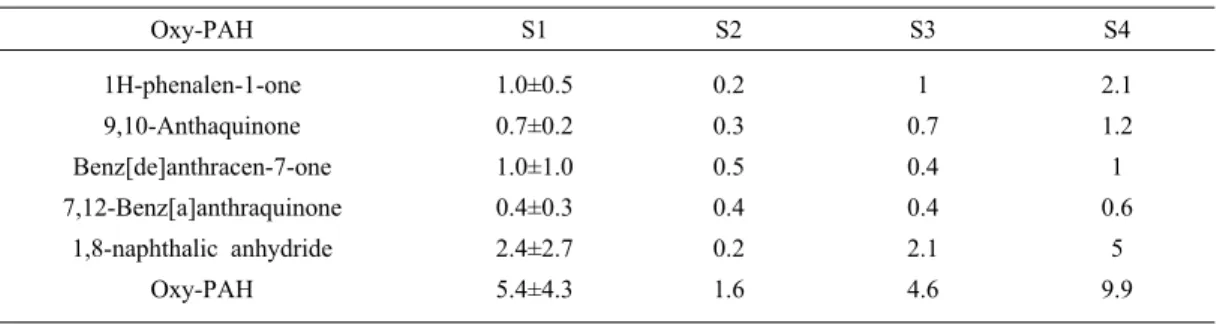
Oxy-PAH S1 S2 S3 S4
1H-phenalen-1-one 9,10-Anthaquinone Benz[de]anthracen-7-one 7,12-Benz[a]anthraquinone
1,8-naphthalic anhydride Oxy-PAH
1.0±0.5 0.7±0.2 1.0±1.0 0.4±0.3 2.4±2.7 5.4±4.3
0.2 0.3 0.5 0.4 0.2 1.6
1 0.7 0.4 0.4 2.1 4.6
2.1 1.2 1 0.6
5 9.9
* S1 indicates mixture of local and regional sources; S2 indicates mixture of local and regional sources +Asian dust; S3 indicates mixture of local and regional sources+Asian dust+biomass burning event; S4 indicates agricultural waste burning emissions.
Table 2. The concentration distribution of five oxygenated PAHs measured at Kwangju on spring 2001 depending on backward trajectories and emission sources(Park et al., 2006).
(unit:ng m-3)
(Park et al., 2006), 서울에서는 2006년 9월부터 2007 년 8월까지 일년동안 상시측정 결과가 보고되었다 (Lee et al., in preparation). Tabe 2은 광주지역에서 측 정한 oxygenated PAHs의 농도를 정리하였고, Tabe 3 은 서울 연건동에서 상시 측정한 7종의 oxygenated PAHs에 대한 계절별 농도분포를 보여주고 있다. 광주 지역에서 봄철 측정한 oxygenated PAHs 농도는 서울 봄철에 비해 낮은 농도를 보였고, 서울에서 측정된 7 종의 oxygenated PAH 성분들은 대체로 겨울철에 농 도가 높고 여름철에 낮은 계절적 특성을 보였고, 이 는 대기 중 PAHs 계절별 농도분포와 유사하다. 그 외의 산화성 PAHs 농도분포에 대한 모니터링은 진 행되지 않았고, 더불어 HAPs의 대기반응에 의한 이 차생성물질 형성 및 이들의 인체 위해성 평가에 대
한 연구도 아직 진행되고 있지 않고 있다.
3. 산화성 PAHs의 측정 및 분석 방법
3.1 측정
대기 중 산화성 PAHs의 측정은 PAHs 측정과 동 일하게 고유량공기채취기 또는 저유량공기채취기를 이용하여 측정한다. 또한, 산화성 PAH 성분들도 PAHs와 마찬가지로 이들의 분자량에 따라 기체와 입자상으로 동시에 존재하는 SVOCs 성질을 가지고 있기 때문에, 산화성 PAHs의 총농도를 측정하기 위 해서는 기체상과 입자상을 구분지어서 측정해야 한 다. 기체상 성분들은 PUF 또는 XAD-4 resin, Tenax,
Carbnoate등의 흡착제를 이용해서 포집하고, 입자상 성분들은 유리섬유여과지 또는 석영여과지, 테플론 여과지등을 이용하여 포집한다(Reisen and Arey, 2005; Lee and Lane, 2009,10; Walgraeve et al., 2010).
산화성 PAH 성분들을 채취시 발생하는 측정오차 는 크게 두 가지로 구분되어진다. 우선, 시료를 채취 하는 동안 채취기 안에 PAH 성분들과 오존 및 OH 라디칼과 같은 산화제들과의 반응을 통해 산화성 PAH를 생성할 수 있다. 이러한 실험오차는 산화성 PAH 성분들의 실제 대기 농도보다 과대평가하게 된다. 이를 해결하기 위하여 Liu et al.(2006)은 오존 디누더를 개발하여 저유량공기채취기 앞에 오존 디 누더를 설치함으로써 채취기 내로 유입되는 산화 제들을 제거하였고, 산화성 PAH 성분들 중 11H- benzo[a]fluorene-11-one과 11H-benzo[b]fluorene-11- one, 7Hbenzo[de]anthracene-7-one, 7,12-benzo[a]anth- raquinone들은 오존 디누더를 장착했을 경우와 그렇 지 않은 경우의 농도차이가 10-40%를 보였다. 이를 통해 시료채취기간 동안 오존에 의한 PAH 성분들 의 반응 및 산화성 PAH 생성이 빈번하게 발생하는 것을 파악하였다.
또 하나의 실험오차로는 산화성 PAH의 SVOCs 성질에 기인한 오차이다. SVOCs 성분들은 기체와 입자상 성분들을 각각 채취시, 기체상 성분들이 흡 착체에서 탈착되어 입자상 성분들을 포집하는 필터 에 흡착될 가능성이 있다. 이러한 오차를 positive artifact라 한다. 반면, 입자상 성분들 포집시에는 입 자상 성분들이 재휘발 되어 기체상 성분들을 포집 하는 흡착제에 흡착되어질 수 있다. 이러한 오차를 negative artifact라 하고, 이 오차들은 대상성분들에 따라 차이를 보이지만, PAHs의 경우 10-30%의 측정 오차를 유발할 수 있다고 보고되고 있다(Lee et al., 2006). 이 측정 오차는 산화성 PAH 성분들의 기체/
입자 농도 비율의 차이를 가져올 수 있지만, 대기 총 농도에는 영향을 미치지 않는다.
3.2 분석
산화성 PAH 성분들은 nitro기를 포함하는지 여부 에 따라 분석방법의 차이를 보이게 된다. 우선, oxygenated PAHs와 nitro-PAHs는 GC 또는 HPLC로 분석시 크로마토그램이 동일한 시간대에 겹쳐서 나 오고(co-eluting problem), 일반적으로 oxygenated
PAHs 성분들이 nitro-PAHs 보다 농도가 높기 때문 에 nitro-PAHs의 크로마토그램 피크를 구분하기가 힘들어진다. 또한, nitro기를 포함한 성분들은 일반 GC 및 HPLC의 검출기에 대한 감응이 낮기 때문에, nitro기에 대한 감응이 높은 별도의 검출기를 요구한 다. 따라서, 산화성 PAHs 성분들을 분석할 때에는 oxygenated와 nitro 성분들 각각에 대한 분석방법이 구분되어 있다.
3.2.1 oxygenated PAHs
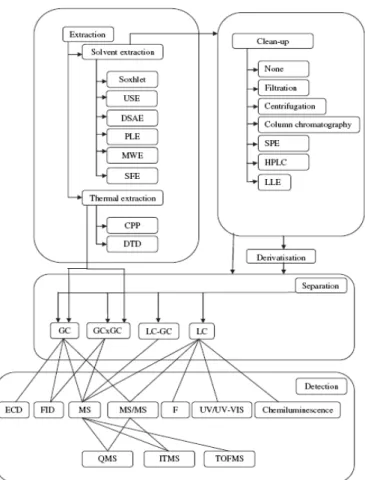
Walgraeve et al.(2010)은 oxygenated PAHs 분석에 적 용되는 다양한 방법들에 대한 전체적인 모식도를 제시하였다(Fig. 3). Oxgenated PAH 분석은 추출, 정 제, 기기분석의 세 단계의 분석과정이 진행되고, 이 는 PAHs와 nitro-PAHs 분석시에도 동일한 단계가 적용된다.
3.2.1.1 추출(Extraction)
대기 시료로부터 oxygenated PAH를 추출하는 가 장 보편적인 방법은 유기용매를 이용한 추출법 (Solvent extraction, SE)방법이다. SE 방법에서는 soxhlet과 초음파(ultrasonic) 추출을 가장 많이 활용 하고 있고, 최근 들어서는 추출시간을 단축시키면서 추출효율을 높이기 위한 방법들, pressurized liquild extraction(PLE)와 supercritical fluid extraction(SFE), microwave extraction(MWE) 방법들이 적용되고 있다 (Albinet et al., 2006; Lintelmann et al., 2005). 하지만, 이 방법들은 추출과정에서 PAHs보다 열적, 화학적 불안정성이 상대적으로 큰 oxygenated PAH들이 다 른 성분들로 변환되는 분석오차가 발생하는 경우가 빈번하기 때문에, 일반적인 oxygenated PAH 성분들 을 효과적으로 추출하는데는 한계가 있다(Linte- lmann et al., 2005). oxygenated PAHs를 SE로 추출할 때 가장 중요한 요소는 추출에 사용되는 용매의 종 류와 추출 온도이다(Walgraeve et al., 2010). SE 추출 에 가장 많이 사용되는 용매로는 dichloromethan (DCM)과 DCM과 methanol 또는 acetone의 혼합 형 태이다. 최근 Limtelmann et al.(2005)은 DCM 대신 ethylacetate 용매를 사용하고 초음파 추출의 온도를 높였을 때 9,10-phenanthrenedione과 5,6-chrysendione 등의 추출효율이 크게 향상된 반면, benzo(a) pyrenedione의 효율은 감소하였다고 보고하고 있다.
Fig. 3. Schematic diagram of the analytic methods for oxygenated-PAH(USE: ultrasonic extraction, DSAE:
dynamic sonication assisted extraction, PLE: pressurized liquidextraction, MWE: microwave extraction, SFE: supercritical fluid extraction, CPP: curie point pyrolysis, DTD: direct thermal desorption, SPE: solid phase extraction, LLE: liquid-liquid extraction, ECD: electron capture detector, FID: flame ionization detector, MS: mass spectrometry, UV-VIS: ultraviolet and visible light spectroscopy, F: fluorescence detector, QMS: quadrupole MS, ITMS: ion trap MS, TOFMS: time of flight MS, GC: gas chromatography,(HP)LC:(high performance) liquid chromatography).(Walgraeve et al., 2010).
따라서, 분석 대상 oxygenated PAH 성분들에 따른 추출 용매 및 온도의 선택이 중요한 요소임을 알 수 있다.
SE의 단점들을 보완하고, 친환경적인 추출법 개발 을 위해 열탈착 추출법(Thermal extraction, TE)을 활 용한 연구들이 진행되고 있다(Chow et al., 2007;
Schnelle-Kreis et al., 2007). TE의 장점은 유기성분들 의 추출시간이 짧고, 유기용매를 사용하지 않으며, 별도의 정제과정이 필요 없다는 점이다. 따라서, 열 적 안정성이 큰 PAHs와 n-alkanes 에 대한 추출에서
는 TE 가 성공적으로 적용된 연구결과들이 보고되 고 있다(Chow et al., 2007; Schnelle-Kreis et al., 2007). 하지만, PAHs에 비해 상대적으로 열적 안정 성이 약한 oxgenated PAHs 에 대해서는 TE 적용시 다른 성분들로의 변환작용이 일어나는 경우가 빈번 하다 예를들어, 9,10-phenanthrenedione은 TE 적용시 9-fluoranthenone으로 변환되어진다. 따라서 TE 기술 을 활용한 oxygenated PAH 추출방법은 아직까지는 여러 문제점을 가지고 있고, 보다 다양한 개발이 필 요한 상황이다.
3.2.1.2 정제(Cleanup)
정제과정은 추출방법에 따라 사용하지 않거나, 분 석시간을 단축하기 위하여 단순 filtration 또는 centrifugation 방법을 활용하기도 하지만, 보편적으 로는 대기시료 및 다른 성분들의 방해요소로부터 효과적으로 oxygenated PAH 성부들을 분리하기 위 하여 open-column liquid chromatography with silica gel or alumina 기술을 적용한다(Walgraeve et al., 2010). 그밖에 최신 정제기술로서는 solid phase extraction(SPE)이 사용되고 있다(Albinet et al., 2006, 2007, 2008).
3.2.1.3 기기분석(Instrumental analysis)
Oygenated PAHs 분석에는 gas chromatography with mass spectrometry(GC-MS)가 가장 보편적으로 사용 되고 있지만, GC-MS 적용시 여러 분석문제가 보고 되고 있다. 예를들면, GC 주입구의 높은 온도 때문 에 9,10-phenanthrenedione이 9-fluorenone으로 변환되 어진다. 따라서, 효과적인 oxygenated PAHs를 분석 하기 위하여 다양한 분석기기를 활용한 분석방법 연구가 진행되고 있다(Albinet et al., 2006, 2007, 2008; Nicol et al., 2001; Hamilton et al., 2004;
Schnelle-Kreis et al., 2005). Nicol et al.(2001)은 기존 의 MS에서 oxygenated PAH 성분들의 정교한 mass spectrum을 얻기 힘들었던 단점을 보완하기 위하여 tandem ion trap-MS(ITMS)를 이용한 기술을 성공적 으로 적용하였고, Hamilton et al.(2004)와 Schnelle- Kreis et al.(2005)는 빠른 속도로 mass spectrum을 획 득할 수 있는 time-of-MS(TOFMS)를 적용하였다. 또 한, 이 연구결과에서는 GC의 분리능을 향상시키기 위하여 multidimentional GC(GCxGC)기술을 도입하 였다. 또한, GC에서의 oxygenated PAHs의 불안정성 을 해결하기 위하여 PAH-quinone과 같은 일부 oxygenated PAH 성분들을 분석할 때 성분치환 (derivatization) 방법이 개발되었다(Cho et al., 2005).
하지만, derivatization은 oxygenated PAH 성분들의 치 환기에 따라 적용방법이 다르기 때문에, 전체적인 oxygenated PAH 성분들을 분석하는데에는 한계가 있다(Walgraeve et al., 2010).
GC를 이용한 분석방법이 보편적일지라도, liquid chromatography(LC) 기술은 oxygenated PAH 분석에 있어서 여러 가지 장점을 가지고 있다. 그 중 가장
큰 장점은 LC는 열적으로 불안정하고, 극성이 강하 며, 휘발성이 낮은 성분들에 대해서 우수한 분석능 이 있다는 것이다. 따라서, 여러 연구결과들에서 oxygenated PAHs는 LC로 분석하는 것이 보다 바람 직하다고 추천하고 있다(Delhomme et al., 2008;
Valavanidis et al., 2006). LC로 분리한 oxygenated PAHs는 다양한 검출기들을 활용하여 검출된다.
oxygenated PAHs 분석에 적용되는 대표적 검출기로 는 fluorescence detector, ultraviolet and visible light spectroscopy(UV/UV-VIS), chemiluminescence등이 있 다. 최근들어서는 보다 다양한 검출기를 이용한 분 석기법이 개발되고 있는데, 대표적으로 atmospheric pressure chemical ionization(APCI)와 atmospheric pre- ssure photo ionization(APPI), electrospray ionization (ESI) 등이 있다(Grosse and Letzel, 2007).
3.2.2 Nitro-PAHs
Nitro-PAH 성분들의 분석에서는 nitro기의 위치에 따른 생물학적 독성정도 및 배출원과 생성과정이 달라지기 때문에 이성질체들의 분석이 필수적으로 이루어져야한다. nitro-PAH 분석의 어려움 중 하나 가 미량의 nitro-PAHs 농도에 감응도가 민감한 분석 기기의 부족과 회수율 보정을 위한 대체표준물질의 부족에 있다(Chiu and Miles, 1996). 일반적으로 nitro-PAHs의 분석단계는 PAHs 및 oxygenated PAHs 와 동일하게 크게 세 단계로 진행되어진다.
3.2.2.1 추출(Extraction)
Nitro-PAHs 추출에 가장 보편적으로 사용하는 방 법은 soxhlet에 DCM 용매를 사용하여 16시간이상 추출하는 방법이다. 장시간 soxhlet로 추출할 때, nitro-PAH 성분들이 빛에 반응할 수 있는 점을 고려 하여 빛을 차단하기 위한 방법(알루미늄 호일로 soxhlet 장치를 덮기)을 고려해야 한다(Chiu and Miles, 1996). 추출용매 중 DCM이 nitro-PAH를 포함 한 돌연변이 활성도가 큰 오염물질들에 대한 추출 효율이 가장 큰 용매로 알려져 있고(Montreuil et al., 1992), 그 밖에 톨루엔도 nitro-PAHs 추출에 효과적 인 용매로 알려져 있다(Vincenti et al., 1996).
3.2.2.2 정제(Cleanup)
다양하고 복잡한 대기시료로부터 nitro-PAHs 부분
을 분리하기 위한 여러 정제 방법들이 시도되고 있 다(WHO, 2003). 이들은 open-column liquid chromato- graphy with silica gel or alumina(지방족과 방향족, 극 성이 중간과 매우 높은 성분들, 네 가지로 분리할 수 있고, nitro-PAHs은 중간정도의 극성 부분에서 검 촐된다. 하지만, 이 부분에는 oxygenated PAH 성분 들도 같이 검출되기 때문에 nitro-PAHs를 보다 효과 적으로 분리하기 위해서는 아래의 NP-LC방법이 많 이 활용되고 있다), normal-phase high-performance liquid chromatography(NP-LC), solid-phase micro- extraction 등이다.
3.2.2.3 기기분석(Instrumental analysis)
Nitro-PAHs를 분석하기 위한 가장 일반적인 기기 분석 방법들은 nitrogen-phosphorus selective detector (NPD), chemiluminescence-based thermal energy analyser(TEA), electron capture detector(ECD)등의 검 출기가 장착된 GC나, fluorescence(FL), chemilumine- scence(CL), electrochemical 검출기가 장착된 HPLC, 또는 electron impact(EI), chemical ionization(CI) electron capture(EC) 검출기가 장착된 GC-MS이다.
최근에는 다양한 분석기기의 발전으로 nitro-PAH 분석에 대한 민감도가 향상되었다. 예를 들어, multidimensional gas chromatography with time of flight mass spectrometry(GCxGC-TOFMS)를 이용한 다양한 nitro-PAH 성분들의 이성질체 분석이 용이해 졌고(Lee and Lane, 2009, 2010), ion trap detector MS 를 활용한 방법(Feiberg et al., 2001), particle beam LC-MS with CI mode(Bonfanti et al., 1996) 방법이 있 다. 고해상도 negative ion CI(NICI) 검출기는 기존 EI 방법보다 nitro-PAH 검출 민감도가 20배정도 높다고 보고되고 있다(Chiu and Miles, 1996). 그밖에, tandem MS/MS, HPLC-MS등을 활용한 nitro-PAHs 분 석방법이 개발, 적용되고 있고, 향후 GC-MS보다는 LC-MS를 활용한 nitro-PAHs 분석방법이 보다 효과 적으로 활용될 것으로 예상하고 있다(Zielinska and Samy, 2006).
4. 이차대기오염물질 관리방안
이차대기오염물질의 인체 위해성 평가와 더불어
이차대기오염물질로부터 인간 건강을 지키기 위한 관리방안으로서는 우선, 이차대기오염물질을 만들 어 내는 반응대기오염물질, 즉 직접 대기로 배출되 는 대기오염물질들의 배출량이 감소되어야 한다고 판단된다. 예를 들면 다양한 nitro-PAHs 및 oxy- PAHs를 형성하는 PAHs에 대한 대기 농도를 저감시 킨다면, 이에 따른 이차대기오염물질의 농도도 상대 적으로 저감될 것이고, 이는 궁극적으로 이차대기오 염물질의 위해성에 대한 영향도 적어질 것이다.
다음으로는 다양한 형태의 이차대기오염물질에 대한 위해성 평가가 보다 적극적으로 진행되어서 구체적이고 정확한 위해성 자료가 생산되어야 한다.
현재, IARC와 미국 환경보호청의 IRIS(Integrated Risk Information System)을 중심으로 다양한 화학물 질들에 대한 발암성 및 위해성 평가에 대한 자료들 이 등록 및 업데이트 되고 있다. 하지만, 이 두 기관 에 등록된 대기오염물질들은 대부분이 직접 연소에 의해 배출되거나 사용되는 물질들로 구성되어 있다.
2장에서 제시한 PAHs의 광화학 반응에 의해 생성된 다양한 이차대기오염물질들은 nitro-PAHs를 제외하 고는 거의 등록되어 있지 않은 실정이다. 따라서, 이 차대기오염물질들에 대한 위해성 평가가 보다 적극 적으로 수행되어야 한다. 이를 위해서는 우선적으로 이차대기오염물질들에 대한 대기 모니터링이 이루 어져서, 대기 중에 주요 이차대기오염물질들의 종류 및 대기 농도 수준을 파악해야 한다. 2장에서 살펴 본 바와 같이, 이차대기오염물질들에 대한 반응챔버 실험연구는 다양하게 진행된 것에 비해, 이들에 대 한 실제 대기에서의 모니터링 연구는 매우 드물게 진행되어 왔다. 따라서 3장에서 제시된 바와 같이 다양한 측정 및 분석방법을 활용하여 이차대기오염 물질들에 대한 지속적인 대기 모니터링을 통하여 주요 이차대기오염물질들의 특성 및 대기 중 농도 수준을 파악하여야 하고, 또한, 대기 모니터링의 정 확성이 확보되기 위해서는 이차오염물질들에 대한 대기 공정시험방법이 마련되어야 한다. 이를 바탕으 로 대기오염물질의 위해성을 평가하는 연구기관에 서는 위해성 평가작업을 진행하여, 이들로부터 인간 의 건강을 지키기 위한 관리대책을 수립해야 한다.
사사
이 논문은 2012년도 정부(교육과학기술부)의 재원 으로 한국연구재단(No. 2012-0005208)과 국립환경과 학원의 지원(도시지역 유해대기오염물질(HAPs) 관 리 전략 수립 연구, 특정대기유해물질 관리정책방향 설정 및 로드맵 수립 연구)으로 작성되었습니다.
Reference
Albinet, A., Leoz-Garziandia, E., Budzinski, H., ViIlenave, E.(2006) Simultaneous analysis of oxygenated and nitrated polycyclic aromatic hydrocarbons on standard reference material 1649a(urban dust) and on natural ambient air samples by gas chromatographyemass spec- trometry with negative ion chemicalionisation.
Journal of Chromatography A 1121, 106-113.
Albinet, A., Leoz-Garziandia, E., Budzinski, H., ViIlenave, E(2007) Polycyclic aromatic hydro- carbons(PAHs), nitrated PAHs and oxygenated PAHs in ambient air of the Marseilles area(South of France): concentrations and sources. Science of the Total Environment 384, 280-292.
Albinet, A., Leoz-Garziandia, E., Budzinski, H., Villenave, E., Jaffrezo, J.L.(2008) Nitrated and oxygenated derivatives of polycyclic aromatic hydrocarbons in the ambient air of two French alpine valleys e part 1: concentrations, sources and gas/particle partitioning. Atmospheric Environment 42, 43-54.
Arey, J, Zielinska, B, Atkinson, R, Winer, A. M., Ramdahl, T., Pitts, Jr J. N. (1986) The for- mation of nitro-PAH from the gas-phase re- actions of fluoranthene and pyrene with the OH radical in the presence of NOx.
Atmospheric Environment 20, 2339–2345.
Arey, J., Zielinska, B., Atkinson, R., Winer, A. M.(1987) Polycyclic aromatic hydrocarbon and nitro- arene concentrations in ambient air during a
wintertime high-NO2 episode in the Los Angeles basin. Atmospheric Environment 21, 1437-1444.
Arey, J., Atkinson, R., Zielinska, B., McElroy, P.
A.(1989) Diurnal concentrations of volatile polycyclic aromatic hydrocarbons and nitro- arenes during a photochemical air pollution ep- isode in Glendora, California. Environmental Science and Technology 23, 321–327.
Atkinson, R., Arey, J.(1994) Atmospheric chemistry of gas-phase polycyclic aromatic hydrocarbons:
Formation of atmospheric mutagens. Enviro- nmental Health Perspectives 102, 117-126.
Bonfanti, L., Careri, M., Mangia, A., Manini, P., Maspero, M.(1996) Simultaneous identification of different classes of hydrocarbons and deter- mination of nitro-polycyclic aromatic hydro- carbons by means of particle beam liquid chro- matography–mass spectrometry. Journal of Chromatography A, 728, 359–369.
Bunce, N. J., Liu, L., Zhu, J. Lane, D. A.(1997) Reaction of naphthalene and its derivatives with hydrox- yl radicals in the gas phase. Environmental Science and Technology 31, 2252-2259.
Chiu, C., Miles, W.(1996) An improved method for ni- tro-PAH analysis. Polycyclic Aromatic Compound 9, 307–314.
Cho, A.K., Sioutas, C., Miguel, A.H., Kumagai, Y., Schmitz, D.A., Singh, M., Eiguren-Fernandez, A., Froines, J.R.(2005) Redox activity of air- borne particulate matter at different sites in the Los Angeles Basin. Environmental Research 99, 40-47.
Chow, J. C., Yu, J. Z., Watson, J. G., Ho, S. S. H., Bohannan, T. L., Hays, M. D., Fung, K.
K.(2007) The application of thermal methods for determining chemical composition of car- bonaceous aerosols: A review. Journal of Environmental Science and Health-Part A Toxic / Hazardous Substances and Environ- mental Engineering 42, 1521-1541.
Chung, M. Y., Lazaro, R. A., Lim, D., Jackson, J., Lyon,
J., Rendulic, D., Hasson, A. S.(2006).
“Aerosol-borne quinones and reactive oxygen species generation by particulate matter extracts.” Environmental Science and Techno- logy 40, 4880-4886.
Delhomme, O., Millet, M., Herckes, P.(2008) Deter- mination of oxygenated polycyclic aromatic hydrocarbons in atmospheric aerosol samples by liquid chromatography-tandem mass spectrometry. Talanta 74, 703-710.
Eiguren-Fernandez, A.,Miguel, A. H., Di Stefano, E., Schmitz, D. A., Cho, A. K., Thurairatnam, S., Avol, E. L., Froines, J. R.(2008)Atmospheric distribution of gas- and particle-phase Quinones in Southern California. Aerosol Science and Technology 42, 854-861.
Feilberg, A., Poulsen, M. B., Nielsen, T., Skow, H.(2001) Occurrence and sources of particulate nitro-polycyclic aromatic hydrocarbons in am- bient air in Denmark. Atmospheric Environment 35, 353–366.
Grosse, S., Letzel, T.(2007) Liquid chromatog- raphy/atmospheric pres sure ionization mass spectrometry with post-column liquid mixing for the efficient determination of partially oxi- dized polycyclic aromatic hydrocarbons.
Journal of Chromatography A 1139, 75-83.
Hamilton, J. F., Webb, P. J., Lewis, A. C., Hopkins, J.
R., Smith, S., Davy, P.(2004) Partially oxidised organic components in urban aerosol using GCXGC-TOF/MS. Atmospheric Chemistry and Physics 4, 1279-1290.
Helmig, D., Lopezcancio, J., Arey, J., Harger, W. P., Atkinson, R.(1992) Quantification of ambient nitrodibenzopyranones e further evidence for atmospheric mutagen formation. Environmental Science and Technology 26, 2207-2213.
Helmig, D. and Harger, W. P.(1994) OH radical-initiated gas-phase reaction products of phenanthrene.
Science of the Total Environment 148, 11-21.
International Agency for Research on Cancer(IARC)(2013) Agents classified by the
IARC monographs, volume 1-107, available at http://monographs.iarc.fr/ENG/Classification/in dex.php.
Lampi, M. A., Gurska, J., McDonald, K. I. C., Xie, F.
L., Huang, X. D., Dixon, D. G., Greenberg, B.
M.(2006) Photoinduced toxicity of polycyclic aromatic hydrocarbons to Daphnia magna: ul- traviolet-mediated effects and the toxicity of polycyclic aromatic hydrocarbon photo- products. Environmental Toxicology and Chemistry 25, 1079-1087.
Lane, D. A. and Tang, H.(1994) Photochemical Degradation of Polycyclic Aromatic Com- pounds. I. Naphthalene. Polycyclic Aromatic Compounds 5, 131-138.
Lee, J. Y. and Lane, D. A.(2009) Unique products from the reaction of naphthalene with the hydroxyl radical. Atmospheric Environment 43, 4886- 4893.
Lee, J. and Lane, D. A.(2010) Formation of oxidized products from the reaction of gaseous phenan- threne with the OH radical in a reaction chamber. Atmospheric Environment 44, 2469- 2477.
Lee, J. Y., Kim, Y. P., Kang, C. H., Ghim, Y. S., Kaneyasu, N.(2006) Temporal trend and long-range transport of particulate polycyclic aromatic hydrocarbons at Gosan in northeast Asia between 2001 and 2004. Journal of Geophysical Research D: Atmospheres 111, D11303, doi:10.1029/2005JD006537.
Lee, J. Y., Lane, D. A., Heo, J. B., Yi, S. M., Kim, Y.
P.(2012) Quantification and seasonal pattern of atmospheric reaction products of gas phase PAHs in PM2.5. Atmospheric Environment 55, 17-25.
Li, N., Sioutas, C., Cho, A., Schmitz, D., Misra, C., Sempf, J., Wang, M. Y., Oberley, T., Froines, J., Nel, A.(2003) Ultrafine particulate pollu- tants induce oxidative stress and mitochondrial damage. Environmental Health Perspectives 111, 455-460.
Lintelmann, J., Fischer, K., Karg, E., Schroppel, A.(2005) Determination of selected polycyclic aromatic hydrocarbons and oxygenated poly- cyclic aromatic hydrocarbons in aerosol sam- ples by high-performance liquid chromatog- raphy and liquid chromatographyetandem mass spectrometry. Analytical and Bioanalytical Chemistry 381, 508-519.
Liu, Y., Sklorz, M., Schnelle-Kreis, J., Orasche, J., Ferge, T., Kettrup, A., Zimmermann, R.(2006) Oxidant denuder sampling for analysis of poly- cyclic aromatic hydrocarbons and their oxy- genated derivates in ambient aerosol: evalua- tion of sampling artefact. Chemosphere 62, 1889-1898.
Lundstedt, S., White, P. A., Lemieux, C. L., Lynes, K.
D., Lambert, L. B., Oberg, L., Haglund, P., Tysklind, M.(2007) Sources, fate, and toxic hazards of oxygenated polycyclic aromatic hy- drocarbons(PAHs) at PAH-contaminated sites.
Ambio 36, 475-485.
MOE, Ministry of Environment, Korea(2012) www.me.go.kr.
Montreuil, C. N., Ball, J. C., Gorse, J. R. A., Young, W. C.(1992) Solvent extraction efficiencies of mutagenic components from diesel particles.
Mutation Research 282, 89–92.
Nel, A.(2005) Air pollution-related illness: Effects of particles. Science 308, 804-806.
Nicol, S., Dugay, J., Hennion, M.C.(2001) Determination of oxygenated polycyclic aromatic compounds in airborne particulate organic matter using gas chromatography tandem mass spectrometry.
Chromatographia 53, S464-S469.
NIER, National Institute of Environmental Research, Korea(2012) Development of control strategy against urban HAPs, Final Report..
Nishino, N., Arey, J., Atkinson, R.(2009) Formation and reactions of 2-formylcinnamaldehyde in the OH radical-initiated reaction of naphthalene.
Environmental Science and Technology 43, 1349-1353.
Park, S. S., Bae, M.-S., Schauer, J. J., Kim, Y. J., Cho,
Y. S., Kim, S. J.(2006) Molecular composition of PM2.5 organic aerosol measured at an urban site of Korea during the ACE-Asia campaign.
Atmospheric Environment 40, 4182-4198.
Reisen, F. and Arey, J.(2005) Atmospheric reactions in- fluence seasonal PAH and nitro-PAH concen- trations in the Los Angeles basin.
Environmental Science and Technology 39, 64-73.
Sasaki, J., Arey, J., Harger, W.(1995) Formation of mu- tagens from the photooxidations of 2–4-ring PAH. Environmental Science and Technology 29, 1324–1335.
Sasaki, J., Aschmann, S. M., Kwok, E. S. C., Atkinson, R., Arey, J.(1997). Products of the gas-phase OH and NO3 radical-initiated reactions of naphthalene. Environmental Science and Technology 31, 3173-3179.
Schnelle-Kreis, J., Sklorz, M., Orasche, J., Stolzel, M., Peters, A., Zimmermann, R.(2007) Semi vola- tile organic compounds in ambient PM2.5.
Seasonal trends and daily resolved source contributions. Environmental Science and Technology 41, 3821-3828.
Valavanidis, A., Fiotakis, K., Vlahogianni, T., Papadi- mitriou, V., Pantikaki, V.(2006) Determination of selective quinones and quinoid radicals in airborne particulate matter and vehicular ex- haust particles. Environmental Chemistry 3, 118-123.
Vincenti, M., Minero, C., Pelizzetti, E., Fontana, M., De Maria, R.(1996) Sub-parts-per-billion determi- nation of nitro-substituted polynuclear aromatic hydrocarbons in airborne particulate matter and soil by electron capture–tandem mass spectrometry. Journal of the American Society for Mass Spectrometry 7, 1255–1265.
Walgraeve, C., Demeestere, K., Dewulf, J., Zimmer- mann, R., Van Langenhove, H.(2010) Oxygenated polycyclic aromatic hydrocarbons in atmospheric particulate matter: Molecular characterization and occurrence. Atmospheric
Environment 44, 1831-1846.
WHO, World Health Organization(2003) Environmental Health Criteria 229, Selected nitro- and nitro- oxy-polycyclic aromatic hydrocarbons. Volume 1-IV.
Xia, T., Korge, P., Weiss, J.N., Li, N., Venkatesen, M.I., Sioutas, C., Nel, A.(2004) Quinones and aromatic chemical compounds in particulate matter induce mitochondrial dysfunction: implications for ul- trafine particle toxicity. Environmental Health Perspectives 112, 1347-1358.
Yu, H.T.(2002) Environmental carcinogenic polycyclic aromatic hydrocarbons: photochemistry and phototoxicity. Journal of Environmental Science and Health Part C-Environmental Carcinogenesis and Ecotoxicology Reviews 20, 149-183.
Zielinska, B., Samy, S.(2006) Analysis of nitrated poly- cyclic aromatic hydrocarbons. Analytical and Bioanalytical Chemistry 386, 883-890.