279 https://doi.org/10.9713/kcer.2017.55.3.279
PISSN 0304-128X, EISSN 2233-9558
총 설
Evaluation of Various Synthesis Methods for Calcite-Precipitated Calcium Carbonate (PCC) Formation
Chilakala Ramakrishna, Thriveni Thenepalli* and Ji Whan Ahn*,†
Department of R&D Team, Hanil Cement Corporation, 302, Maepo-ri, Maepo-eup, Danyang, Chungbuk, 27003, Korea
*Mineral Processing Division, Korea Institute of Geoscience and Mineral Resources (KIGAM), 124, Gwahak-ro, Yuseong-gu, Daejeon, 34132, Korea
(Received 7 December 2016; Received in revised form 23 January 2017; accepted 31 January 2017)
Abstract − This review paper evaluates different kinds of synthesis methods for calcite precipitated calcium carbon- ates by using different materials. The various processing routes of calcite with different compositions are reported and the possible optimum conditions required to synthesize a desired particle sizes of calcite are predicted. This paper mainly focuses on that the calcite morphology and size of the particles by carbonation process using loop reactors. In this regard, we have investigated various parameters such as CO2 flow rate, Ca (OH)2 concentration, temperature, pH effect, reaction time and loop reactor mechanism with orifice diameter. The research results illustrate the formation of well-defined and pure calcite crystals with controlled crystal growth and particle size, without additives or organic solvents.
The crystal growth and particle size can be controlled, and smaller sizes are obtained by decreasing the Ca (OH)2 con- centration and increasing the CO2 flow rate at lower temperatures with suitable pH. The crystal structure of obtained cal- cite was characterized by using X-ray diffraction method and the morphology by scanning electron microscope (SEM).
The result of x-ray diffraction recognized that the calcite phase of calcium carbonate was the dominating crystalline structure.
Key words: Calcium carbonate, Calcite, Carbonation, Solution process, Loop reactor, Orifice 1. Introduction
Calcium carbonate is one of the most abundant naturally occur- ring minerals in the earth’s crust. Compared with other inorganic materials, CaCO3 has shown promising potential for the develop- ment of smart carriers for anticancer drugs because of its biocompat- ibility, biodegradability, and pH-sensitive properties, which enable it to be used for controlled degradability both in vitro and in vivo [1-3].
It has been used as a vector to deliver genes, peptides, proteins, and drugs [4]. Furthermore, CaCO3 can be used as filler in separation technology, coatings, paintings, plastics, pharmaceuticals, and agro- chemicals [5]. CaCO3 is found in three crystalline polymorphs: cal- cite, aragonite, and vaterite. Calcite can appear in an amorphous form (ACC), and the others two are in hydrated forms (CaCO3·6H2O and CaCO3·H2O). The hydrated ACC is the least stable form, and it read- ily transforms into the anhydrous form and then to a crystalline poly- morph [6,7].
Calcium carbonate particles can be produced by either mechanical (milling) or chemical routes. The mechanical route often produces a mixture of calcite, aragonite, and vaterite and requires a long processing time to reduce particle sizes below 1 μm. The chemical route has several
advantages over the mechanical route such as lower energy con- sumption, simpler instruments, and better control over the product characteristics and purity. The particles obtained from the chemical route have a narrow size distribution, even below 500 nm, unlike most mechanical routes. Two systems are commonly used in the pre- cipitation of CaCO3: (i) the liquid-liquid system, which involves a direct reaction between Ca2+ and CO32− ions in an aqueous solution (i.e., reaction of CaCl2 and Na2CO3) [7,8]; and (ii) the liquid-gas sys- tem, which involves bubbling of CO2 gas through the solution of Ca(OH)2 [9-12]. The liquid-liquid system is a very fast reaction employing a rapid mixing under turbulent conditions, and the precip- itation occurs in a short time. The liquid-gas system is widely used because of its high yield, high purity simplicity and economy, and it can be regarded as a ecofriendly process to consuming CO2 gas.
CaCO3 usually precipitates in scalenohedral morphology with parti- cle size bigger than 2 μm. Additives and organic solvents are used to control the particle size and morphology, but they can affect the structure (polymorph) and the characteristics of the calcite crystals only [8].
In this paper, we mention clearly different methods and processes for calcite form of calcium carbonate synthesis from concentrated Ca(OH)2 slurries. Recently, this process has been more interesting for industrial purposes to produce large quantities of calcite. The optimum conditions of the calcite synthesis in various sizes from micrometer size particles to nanosize particles, with and without using additives are well defined. Calcite crystals were synthesized by controlling the reaction conditions via the amount of CaO/Ca(OH)2 in aqueous solu- tion and the CO2 gas flow rates.
†To whom correspondence should be addressed.
E-mail: [email protected]
‡This article is dedicated to Prof. Choon Han on the occasion of his retirement from Kwangwoon University.
This is an Open-Access article distributed under the terms of the Creative Com- mons Attribution Non-Commercial License (http://creativecommons.org/licenses/by- nc/3.0) which permits unrestricted non-commercial use, distribution, and reproduc- tion in any medium, provided the original work is properly cited.
on a stable basis in an H2O reaction system [13]. Ultra-fine calcium carbonate powders with the size of 0.05~0.1 μm and the calcite phase were synthesized by the nozzle spouting method [14,15] which could be only obtained when high calcium ion concentration within slurry was maintained at the beginning of the reaction. It was possi- ble to synthesize ultra-fine particles (~0.05 μm) in the regions of low Ca(OH)2 concentration (~0.5 wt%) with high CO2 flow rate, if at the high concentration of Ca(OH)2 (~5 wt%), from which cannot be obtained the fine calcium carbonate powder.
Mono dispersed calcite with 0.1 μm size was synthesized by car- bonation process at pH 11 [16]. The synthesis of plate shape precipi- tated calcium carbonate with Ca(OH)2-CO2-H2O system by the continuous drop method of Ca(OH)2 slurry into the solution containing CO2(aq) [17]. When the flow rate of CO2 gas increased and the concentration of Ca(OH)2 slurry became low, the absorptions rate of CO2 gas became faster than the dissolution rate of Ca(OH)2; consequently, the growth of 1.0 μm rhombohedral calcite crystal was synthesized. On the other hand, when the flow rate of CO2 gas decreased and the concentra- tion of Ca(OH)2 slurry became high, new nuclei like 1.0 μm of pris- matic calcite were synthesized.
Amorphous calcium carbonate (ACC) was synthesized by the reaction of the Ca(OH)2-C2H5OH-CH2OHCH2OH-CO2 systems [18];
at the initial stage of the reaction, electric conductivity increased rapidly according to the increasing solubility of Ca(OH)2, but gradually decreased according to the increasing rate of solubility, which was slower than the forming rate of calcium carbonate. Ceramic bubble plate reactor [19] was used in preparation of calcium carbonate, by using Ca(OH)2 sus- pension with C2H5OH, and the electrical conductivity was continu- ously monitored during the reaction with CO2 gas. Results showed that the intermediate and final products were vaterite, aragonite and calcite. The vaterite can be synthesized under ambient pressure and temperature in a C2H5OH system by morphology control. Even through the vaterite was meta-stable phase and could be changed to calcite easily.
3. Reaction mechanism of calcite precipitation
Calcite was synthesized by carbonation method in which gaseous CO2 is injected into a Ca2+ ion solution/slurry to precipitate calcium carbonate. The general carbonation mechanism in water can be
Scanning electron microscopy (SEM) and X-ray diffraction (XRD) were used to characterize the morphology and the crystal structure of calcite form of CaCO3.
4. Parameters affecting on formation of calcite phase
Calcite precipitated calcium carbonate products have been recog- nized as functional fillers in plastic and paper industries and calcite morphology; particle size is influenced by several parameters such as CO2 flow rate, Ca(OH)2 concentration, temperature, pH effect, reaction time and loop reactor mechanism with orifice.
4.1. Effect of CO2 flow rates
The driving force for CaCO3 precipitation is supersaturation, deter- mined by the product of the ionic concentration of calcium and car- bonate ions. Precipitation involves four steps: (i) dissolution of Ca(OH)2 or CaO, (ii) mass transfer between the CO2 phase and the water phase and the formation of carbonate ions, (iii) chemical reaction, and (iv) crystal growth is relatively highly absorbed in water with respect to other similar compounds [20].
The reason behind this is, explained by the electrostatic forces of water molecules, which can be polarized CO2 molecules, increasing their ability to penetrate the water phase. On the other hand, the reagent CO2 must enter the phase containing the Ca2+ ions, and mass transport resistance is therefore also a very important parameter. The resistance of CO2 to penetrate water can be stated in terms of viscosity. Com- pressed CO2 is to some extent more viscous than atmospheric CO2, but still considerably less viscous than water.
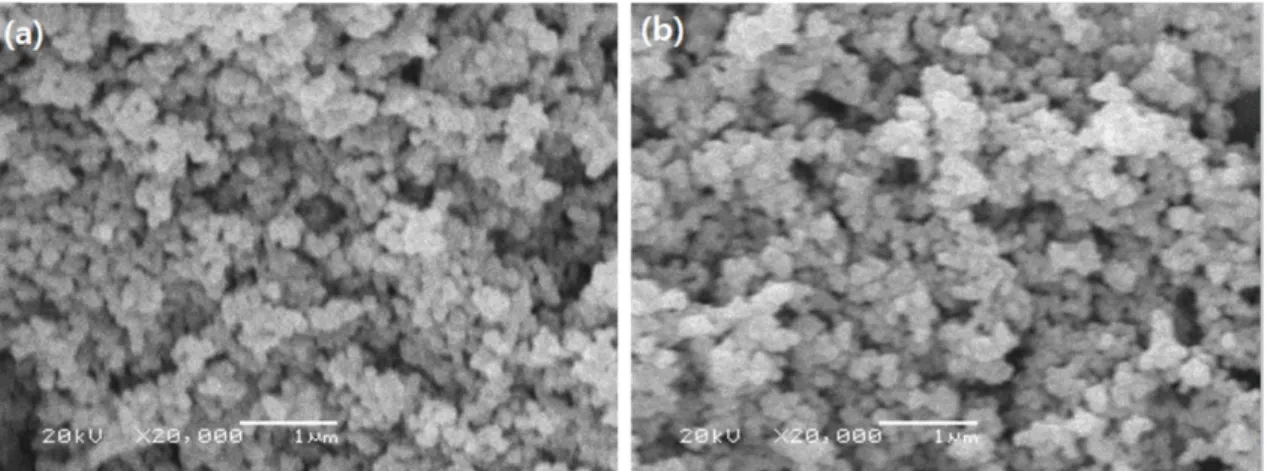
After CO2 is absorbed in water it hydrates to form CO2(aq) or car- bonic acid (H2CO3) for the most part. H2CO3 subsequently yields bicarbonate ions (HCO3−) and carbonate ions (CO32−) (Eq. 1). These transformations are fast but only about 1% of the absorbed CO2 is transformed into carbonate ions [21]. In this carbonation process, to obtain precipitated nano-sized calcium carbonate by using an orifice plate through loop reactor with CO2 flow rate 5 L/min for 30 min reaction is enough to synthesize nano calcite form of CaCO3 is clearly shown in Fig. 1 for the effect of CO2 flow rates on the morphology of nano PCC (a) 5 Lit/min (b) 7 Lit/min [22]. The major advantages of loop systems over conventional batch systems are increased mass transfer and enhanced of carbonation efficiency.
Scalenohedral calcite was synthesized by carbonation process through open vessel system with different CO2 gas flow rates (20 mL/
min to 100 mL/min) at 45oC. At a lower CO2 gas flow rate of 20 mL/
min, the un-reacted calcium hydroxide crystals were embedded and another calcium carbonate polymorph aragonite phase appeared. Car- bondioxide flow rate at 60 to 80 mL/min carbonation process is suit- able for the synthesis of calcite phase with different size. Fig.2, shows the particle size of scalenohedral PCC at different CO2 flow rates. However, after a certain limit, increasing the flow rate no longer had any effect. This was due to the higher mobility of CO2 molecules with respect to water, resulting in CO2 bypassing the solution [23].
4.2. Effect of Ca(OH)2 concentration
Ca(OH)2 is sparingly soluble in an aqueous solution; in Eq. (2) is the Ca(OH)2 solubility product. The dissolution process proceeds through two steps: (i) the Ca(OH)2 particles first chemically dissolve on the surface and (ii) then Ca2+ ions diffuse away from the surface. As a function of the stirring efficiency, Ca(OH)2 dissolution can be diffu- sion controlled.
Basic calcium carbonate (BCC) was synthesized by carbonation
process [24], through electric conductivity and consecutive measure- ments of pH under 3.0~5.0 wt% of Ca(OH)2 concentration with reac- tion temperature of 10~20oC and CO2 gas flow rate of 100~250 ml/
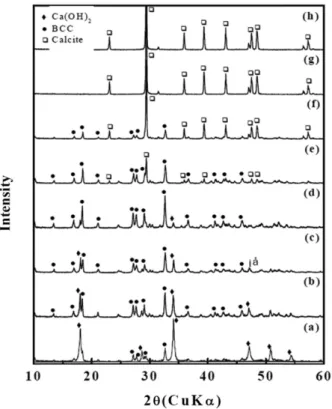
min. A Ca(OH)2 concentration of 5.0 wt% was considered the opti- mum for the synthesis of BCC with a CO2 gas flow rate of 150 ml/min, generally. Electric conductivity and pH changes were measured with carbonation reaction time. Fig. 3 shows at CO2 gas flow rate of 150 ml/min at 15oC, only a primary and secondary drop appeared in the electric conductivity curve. But if the flow rate of CO2 gas became lower, another drop (hereinafter referred to as B point drop from B of BCC) appeared between the primary and secondary drop. It was pre- dictable that other reaction mechanisms could appear according to the flow rate. BCC could also be synthesized, but there seemed to be a limitation to form BCC reproductively by gaining the same elec- tric conductivity curve. Fig. 4 shows calcite morphologies of point (a) to (h) and Fig. 5 shows X-ray diffraction patterns of specimens obtained at each point in electric conductivity curve indicated in Fig.
3. At point (a), large particles shaped like the lump of hydrated Ca(OH)2 and fine particles near the large particles were distributed.
At point (b), it came to grow into crystals of plate shape with a small width and thickness of 0.1 μm. At point (c), the plate-shaped crystals Fig. 1. Effect of CO2 flow rates on the morphology of nano PCC (a) 5lit/min (b) 7lit/min.
Fig. 2. Particle size analysis of scalenohedral calcite PCC at different CO2 flow rates on the morphology of (a) 20 mL/min, (b) 40 mL/
min, (c) 60 mL/min, (d) 80 mL/min, and (e) 100 mL/min.
Fig. 3. Electrical conductivity and pH changes during carbonation of 5.0 wt% Ca(OH)2 slurry at 15oC
grew a little in thickness, but the growth of the lateral surface was prominent. The point (d) was formed with only an agglomerated plate shape of thickness of 0.2 μm and width of 0.5~1.0 μm. At point (e), the plate shape did not grow any more, and an agglomerated shape was maintained in that state. At point (f) decomposition of plate shape occurred, and therefore the width decreased. At point (g), decomposi- tion of the plate shape occurred completely, and only an equal cubic phase with a new shape of 0.5~1.0 μm remained at point (h). The change of shapes according to time flight did not occur again until the completion of the carbonation reaction.
Scalenohedral calcite PCC growth rate was observed in different concentrations (i.e., from 0.01 mole/L~0.2 mole/L) of calcium hydrox- ide with 80 mL/min CO2 flow rate at 45oC for 3 h reaction time. As
seen in Fig. 6, the optimum concentration of calcium hydroxide was determined to be 0.2 mole/L and this was more suitable for obtain- ing scalenohedral calcite PCC. At this concentration the particle size was more than 5 μm [23].
4.3. Effect of pH and temperature
To analyze temperature effects, the liquid and gas states were more intensively studied. The effects of temperature on supersaturation are complex. Increasing temperature negatively affects the calcite mor- phology. In contrast, lower temperature positively affects the mor- phology and is favorable for higher precipitation of CaCO3.
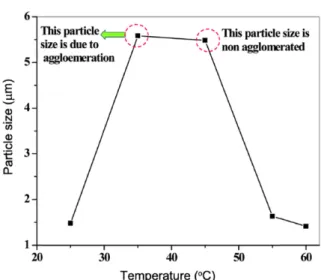
Scalenohedral calcite PCC was synthesized at different tempera- tures (25oC, 35oC, 45 oC, 55 oC and 65 oC). The optimum temperature was determined to be 45 oC, at which the average particle size length was close to 5.5 μm. Fig. 7 shows the effect of particle size at differ- ent temperatures [23].
Temperature and pH play a key role for the synthesis of stable calcite from Ca(OH)2 in ethanol-ethylene glycol solvent by carbonation process.
Fig. 8 shows the curves of pH and temperature variations during the Fig. 4. SEM photographs of calcium carbonate during carbonation process in each point of electric conductivity curve.
Fig. 5. X-ray diffraction patterns of specimens obtained at each point in electric conductivity curve.
Fig. 6. Scalenohedral PCC particle size at different Ca(OH)2 con- centrations (a) 0.01 M, (b) 0.02 M, (c) 0.03 M, (d) 0.04 M, (e) 0.05 M, (f) 0.1 M, and (g) 0.2 M.
carbonation in ethanol-ethylene glycol reactions. These reactions takes more time to start the carbonation process because the amount of water formed from the Ca(OH)2 is so small that it takes more time to start and complete the carbonation. Therefore, the reaction pH was kept at about for the initial few minutes. After injecting CO2 gas for 5 min, the pH decreased drastically. From this state, the injected CO2 gas was ionized into CO32− and then calcium carbonate started to be precipitated. The temperature of the solvent was found to increase from 14oC to 27oC in 32 min by the exothermic nature of the car- bonation. This indicates that about 30 min is enough to complete the carbonation of Ca(OH)2 in the organic solvent.
The XRD patterns of calcium hydroxide carbonated for 8 min and 25 min in ethanol-ethylene glycol are shown in Fig. 9; when the reacting solution pH dropped within 8min, the particles in suspen- sion were found to be composed of calcite and vaterite as well as un- reacted Ca(OH)2. However, at 25 min, all the Ca(OH)2 feed was completely transformed to calcium carbonate, precipitating as stable calcite and metastable vaterite was synthesized [25].
Morales et al. [26] reported that the initial pH of the carbonation reaction determines the induction time, which is related to the onset
of the precipitation. As the initial pH was low, induction time increased and metastable vaterite was synthesized rather than stable calcite. Another result about the pH effect was published by Spanos [27], who presented that pH does not affect the phase transformation but the solution supersaturation. Han [28] reported the pH effect on the crystallization of CaCO3 in which ammonia was added to control the pH with influenced by the CO2 gas ionization and the supersatu- ration changed to form of carbonate ions.
In the carbonation process, Ca(OH)2 ionizes in reactor chamber, then the pH reaches values of above 12.6; when CO2 gas is injected into the reactor, the amount of Ca+2 and CO32- ions in water decreases with reaction. This means that dissolved ions are nucleated into CaCO3 within 10 min to form stable calcite crystals. Fig. 10 shows the pH changes of the reaction solution which is added ammonium hydroxide. The reaction time increases as the reaction pH is low, though NH4OH solution is weak base, which is almost dissociated into the NH3 and H2O in aqueous solution. It makes the solution pH remain basic for longer time during carbonation reaction. A small amount of it ionizes into NH4+ and OH− ions and then it indicates Fig. 7. Effect of particle size by different temperatures.
Fig. 8. pH and temperature profiles with time during the carbon- ation.
Fig. 9. XRD patterns of particle collected from reaction solution during carbonation.
Fig. 10. pH of the reaction solution controlled with NH4OH.
weak base [29]. H+ ions exist excessively in reaction solution because CO2 gas is injected at constant flow rate and it is dissociated like Equation (1) and excess H+ ions react with NH3 in solution.
NH4OH → NH3+H2O (5)
NH3+H+ ↔NH4+ (6)
The pH decreasing of the reaction solution moderates because of the limitation of H+ ion increasing like Equation (1).
The reaction pH affects the synthesis of calcium carbonate in car- bonation when the NH4OH is added to control the pH of the solu- tion. The size of calcium carbonate increases and the surface of the particles takes the clear form of step-like shape as the reaction pH decreases. Fig. 11 shows SEM images of the shape and size of parti- cles which are precipitated at constant pH level. The CaCO3 synthe- sized at pH 12 is almost 100 nm size and well dispersed. The growth of the particle progresses toward the most stable shape of calcite, which is rhombohedral, so that the particle is an ellipsoid, but the surface of the particle reveals step-like shape. Consequently, oxida- tion of ammonia induces H+ ion generation and H+ ion dissolves CaCO3. Concentration of Ca2+ ion is high, re-precipitation occurs on the surface of the large particles and calcite grows to 2 μm. The reac- tion pH affects the synthesis of calcium carbonate in carbonation when the NH4OH is added to control the pH of the solution. The size of cal- cium carbonate increases and the surface of the particles takes the clear form of step-like shape as the reaction pH decreases [30].
4.4. Nano calcite synthesis by carbonation through Loop reactor The carbonation process goes through closed loop nozzle system to form diffusion happening when mixing Ca(OH)2 solution with
CO2 gas from a nozzle. There are two phases in the loop reactor: liq- uid and gas. When the liquid passes through the orifice, it acceler- ates the natural pressure. In a short time the gas and liquid particles mix together at a time and form turbulence for optimum mass trans- fer; finally it leads to form a crystal. Nozzle length and orifice diame- ter control the particle size and morphology.
The carbonation reaction rate was much faster with an orifice compared to the rate absence of an orifice. In general, through the loop reactors, nucleation is enhanced by hydrodynamic cavitation and also enhanced is the rate of precipitation. Nishida and Shirish et al., [31,32] observed that acoustic cavitation generated a physical effect of micro streaming that influenced the precipitated calcium carbonate. Fig. 12 shows nano-sized PCC with the average particle size 50~100 nm was observed by the effect of orifice plate com- pared to without an orifice plate at 0.2M Ca(OH)2 for 30 min carbon- ation.
5. Conclusion
We reviewed the detailed process of calcite synthesis by various methods and processes. The effects of different optimum parameters on the calcite phase purity and morphology were investigated.
The calcite form of precipitated calcium carbonate (PCC) by a car- bonation process of slaked lime was produced in a bench-scale glass reactor with the chosen range of process parameters, such as CO2 gas flow rates and mass concentration of Ca(OH)2 suspension. An experimental analysis of the obtained data suggests that mass concen- tration of Ca(OH)2 suspension and CO2 gas flow rates significantly influence the calcite morphology. At obtained parameters, submicro- Fig. 12. Effect of orifice diameter on the morphology of nano PCC (a) without orifice (b) with orifice at 0.2 M Ca(OH)2.
metric and nano calcite can be produced. These results emphasize the role of the liquid - gas phase interface on the physical chemical properties of precipitated calcium carbonate.
The purpose of the present review was on the synthesis of micro and nano size calcite precipitated calcium carbonate by carbonation process with decreasing the Ca(OH)2 concentration and increasing the CO2 flow rate at lower temperatures with suitable pH with exist- ing synthetic methods. Finally, we conclud, in the last two decades cal- cite has been used as a filler to plastics that are used in light weight vehicles for automobile industry and paper industries. So calcite is a good and more suitable functional mineral filler for plastics and papers.
References
1. Ajikumar, P. K., Wong, L. G., Subramanyam, G., Lakshminarayanan, R. and Valiyaveettil, S., “Synthesis and Characterization of Mono- dispersed Spheres of Amorphous Calcium Carbonate and Calcite Spherules,” Cryst. Growth Des., 5(3), 1129-1134(2005).
2. Wei, W., Ma, G. H., Hu, G., Yu, D., McLeish, T., Su, Z. G. and Shen, Z. Y., “Preparation of Hierarchical Hollow CaCO3 Particles and the Application as Anticancer Drug Carrier,” J. Am. Chem. Soc., 130(47), 15808-15810(2008).
3. Helmlinger, G., Yuan, F., Dellian, M. and Jain, R. K., “Interstitial pH and pO2 Gradients in Solid Tumors in vivo: High-resolution Measurements Reveal a Lack of Correlation,” Nat. Med., 3, 177- 182(1997).
4. He, X. W., Liu, T., Chen, Y. X., Cheng, D. J., Li, X. R., Xiao, Y.
and Feng, Y. L., “Calcium Carbonate Nanoparticle Delivering Vascular Endothelial Growth Factor-C siRNA Effectively Inhibits Lymphangiogenesis and Growth of Gastric Cancer in vivo,” Cancer Gene. Ther., 15(3), 193-202(2008).
5. Thomas, J. A., Seton, L., Davey, R. J. and DeWolf, C. E., “Using a Liquid Emulsion Membrane System for the Encapsulation of Organic and Inorganic Substrates Within Inorganic Microcap- sules,” Chem. Commun., 10, 1072-1073(2002).
6. El-Sheikh, S. M., Barhoum, A., El-Sherbiny, S., Morsy, F., El- Midany, A. A. and Rahier, H., “Preparation of Superhydrophobic Nanocalcite Crystals Using Box-Behnken Design,” Arabian J.
Chem., DOI: 10.1016/j.arabjc.2014.11.003 (2014).
7. Kimura, T. and Koga, N., “Thermal Dehydration of Monohydrocal- cite: Overall Kinetics and Physico-geometrical Mechanisms,” J.
Phys. Chem. A., 115, 10491-10501(2011).
8. Kim, I. W., Robertson, R. E. and Zand, R., “Effect of Some Non- ionic Polymeric Additives on the Crystallization of Calcium Car- bonate,” Cryst. Growth Des., 5, 513-522(2005).
9. Barhoum, A., Rahier, H., Esmail Abou-Zaied, R., Rehan, M., Dufour, T., Hill, G. and Dufresne, A., “Effect of Cationic and Anionic Surfac- tants on the Application of Calcium Carbonate Nanoparticles in Paper Coating,” ACS Appl. Mater. Interfaces., 6, 2734-2744(2014).
10. El-Sheikh, S. M., El-Sherbiny, S., Barhoum, A. and Deng, Y., “Effects of Cationic Surfactants During the Precipitation of Calcium Car- bonate,” Colloids Surf. A., 422, 44-49(2013).
11. Wen, Y., Xiang, L. and Jin, Y., “Synthesis of Plate Like Calcium Carbonate via Carbonation Route,” Mater. Lett., 57, 2565-2571(2003).
12. Morsy, F. A., El-Sheikh, S. M. and Barhoum, A., “Nano-silica and SiO2/CaCO3 Nanocomposite Prepared from Semi-burned Rice Straw Ash as Modified Papermaking Fillers,” Arab J. Chem., DOI: 10.1016/j.arabjc.2014.11.032 (2014).
13. Ahn, J. W. and Park, C. H., “Controlling Factors of Particle Size Distribution During Formation of Cubic and Colloidal Calcium Car- bonate Compounds,” J. of Korean Inst. of Resources Recycling, 5(3), 65-72(1996).
14. Ahn, J. W., Park, C. H., Kim, J. H., Lee, J. K. and Kim, H., “Synthe- sis of Ultrafine Calcium Carbonate Powders from High Concen- trated Calcium Hydroxide Solution,” Journal of Korean Association of Crystal Growth, 6(4), 509-520(1996).
15. Ahn, J. W., Park, C. H., Kim, J. H., Lee, J. K. and Kim, H., “Synthe- sis of Ultrafine Calcium Carbonate Powders by Nozzle Spouting Method,” Journal of Korean Ceramic Society, 33(11), 1276-1284 (1996).
16. Park, M. J., Ahn, J. W. and Kim, H., “Study on the Dispersion Stability of Precipitated Calcium Carbonate Suspensions,” Jour- nal of Korean Ceramic Society, 38(4), 343-350(2001).
17. Ahn, J. W., Lee, J. S., Joo, S. M., Kim, H. S., Kim, J. K., Han, C.
and Kim, H., “Synthesis of Precipitated Calcium Carbonate in Ca(OH)2-CO2-H2O System by the Continuous Drop Method of Ca(OH)2 Slurry,” Journal of the Korean Ceramic Society, 39(4), 327-335(2002).
18. Ahn, J. W., Park, J. K., Lee, S. B., Cho, H. C., Han, C. and Kim, H., “Synthesis of Amorphous Calcium Carbonate in Ethanol and its Crystallization in the Aqueous Solution,” Geosystem. Eng., 6(4), 106-111(2003).
19. Ahn, J. W. and Park, C. H., “Formation and Crystallization of Calcium Carbonate in C2H5OH-Ca(OH)2-CO2 System by Ceramic Bubble Plate Reactor,” J. of Korean Inst. of Resources Recycling., 5(3), 56-64(1996).
20. Yang, Y., Ma, C. Y. and Wang, X. Z., “Optimisation and Closed-loop Control of Crystal Shape Distribution in Seeded Cooling Crys- tallisation of L-Glutamic Acid,” The Int. Federation of Automatic Control., 216-221(2012).
21. Montes-Hernandez, G., Fernandez-Martinez, A., Charlet, L., Tis- serand, D. and Renard, F., “Textural Properties of Synthetic Nano- calcite Produced by Hydrothermal Carbonation of Calcium Hydrox- ide,” J. Cryst. Growth 310(11), 2946-2953(2008).
22. Thriveni, T., Ramakrishna, C. H., Ahn, Y. J., Han, C. and Ahn, J.
W., “Synthesis of Nano Precipitated Calcium Carbonate by Using a Carbonation Process Through a Closed loop Reactor,” J. Korean Phys. Soc., 68(1) 131-137(2016).
23. Thriveni, T., Um, N., Nam, S. Y., Ahn, Y. J., Han, C. and Ahn, J.
W., “Factors Affecting the Crystal Growth of Scalenohedral Cal- cite by a Carbonation Process,” J. Korean Ceram. Soc., 51(2), 107-114 (2014).
24. Ahn, J. W., Joo, S. M., Kim, H. S., Kim, D. H., Kim, J. P. and Kim, H., “Influence of Final Crystal with Synthesis of Basic Calcium Carbonate by Carbonation Process,” Materials Science Forum., 439, 244-253(2003).
25. Ryu, M., Ahn, J. W., You, K., Goto, S. and Kim, H., “Synthesis of Calcium Carbonate in Ethanol-ethylene Glycol Solvent,” Jour- nal of the Ceramic Society of Japan., 117(1), 106-110(2009).
26. Morales, J. G., Burgues, J. T. and Clemente, R. R., “Nucleation of Calcium Carbonate at Different Initial pH Conditions,” J. Cryst.