775 http://dx.doi.org/10.9713/kcer.2014.52.6.775
PISSN 0304-128X, EISSN 2233-9558
Micellar Enhanced Ultrafiltration (MEUF) and Activated Carbon Fiber (ACF) Hybrid Processes for the Removal of Cadmium from an Aqueous Solution
Rahman Faizur Rafique* and Seunghwan Lee†,*
* Department of Environmental Engineering, Kumoh National Institute of Technology, 1 Yangho-dong, Gumi 730-701, Korea (Received 17 April 2014; Received in revised form 1 June 2014; accepted 5 June 2014)
Abstract − Micellar enhanced ultrafiltration (MEUF) was used to remove cadmium from an aqueous solution using sodium dodecyl sulfate (SDS) as a surfactant. Operational parameters such as initial permeate flux, retentate pressure, initial cadmium concentration, pH solution, molecular weight cut-off (MWCO), and molar ratio of cadmium to SDS were investigated. Removal efficiency of cadmium from an aqueous solution increased with an increase of retentate pressure, pH solution and molar ratio of cadmium to SDS, and decreased with an increase of initial permeate flux.
Higher removal efficiency of cadmium from the aqueous solution was achieved using lower MWCO (smaller mem- brane pore size). Under optimized experimental condition, cadmium removal efficiency reached 74.6 % within an hour.
Using MEUF-ACF hybrid process the removal efficiency of both cadmium and SDS was found to be over 90%.
Key words: Micellar Enhanced Ultrafiltration, Activated Carbon Filter, Cadmium, Sodium Dodecyl Sulfate, Heavy Metal Removal
1. INTRODUCTION
Heavy metals are among the most dangerous anthropogenic environ- mental pollutants, due to their toxicity, bioaccumulation, persistence in the environment, and biomagnification in the food chain [1]. Cad- mium (Cd) is widely used in numerous industries, and wastewater containing this metal can contaminate soil and subsequently seep into groundwater. If directly discharged into the sewage system, such contaminated water may not only seriously damage the opera- tion of biological treatment plants, but may also render the acti- vated sludge generated unsuitable for application to agricultural land [2]. The potential human health impacts of cadmium are vari- ous and include the following: carcinogen, developmental toxicant, reproductive toxicant, cardiovascular or blood toxicant, endocrine toxicant, immunotoxicant, kidney toxicant, neurotoxicant, and respira- tory toxicant [3]. At present, popular techniques for treating cad- mium-bearing wastewater are chemical precipitation, adsorption, bleaching powder oxidation, ferrite process, ions exchange and bio- technology. These techniques have their limitations, such as secondary pollution of deposition, inconvenient operation, high cost, difficulty of recycling cadmium and others [4].
Micellar enhanced ultrafiltration (MEUF) has shown to be a promising technique for the removal of lower molecular weight substances, as it combines the efficiency of reverse osmosis (RO) and the high flux of surfactant based ultrafiltration (UF) [5]. In the
process, surfactant with a charge opposite to the target ion is added to the wastewater containing metal ions. The surfactant molecules will aggregate and form spherical micelles (around 50-150 of monomer molecule) when the surfactant concentration in the wastewater is at a concentration greater than critical micelle concentration (CMC) [6,7]. A large fraction of the metal ions is therefore electrostati- cally attached to the micelle surface. The wastewater can then be ultrafiltered through an ultrafiltration membrane with a pore size smaller than the micelle size, in order to reject the micelles. At the same time, cadmium ions adsorbed onto the micelles are rejected and the permeation quality is adequate for reuse or direct discharge.
Addition of surfactant to the MEUF system results in release of some of the surfactant in the permeate. One of the major draw- backs of the MEUF process is thus the production of surfactant-rich effluent, which needs to be treated before discharge to the environment, as this may otherwise cause secondary pollution. Adsorption tech- nology is commonly used for the removal of surfactants [8] as well for the removal of trace heavy metals from an aqueous solution.
Commonly used media for adsorption processes are powdered acti- vated carbon (PAC), granular activated carbon (GAC) and activated car- bon fiber (ACF). Among these, ACF has a uniform micro-pore structure, faster adsorption kinetics and lower pressure drop [9,10]. In the MEUF-ACF hybrid process, heavy metals are effectively removed by the MEUF unit, and surfactant-rich MEUF effluent containing trace heavy metals is treated with the ACF unit. Our main objective was to investigate the optimal operational condition for the MEUF process for the removal of cadmium from wastewater using SDS, and to investigate the performance of the MEUF-ACF hybrid pro- cess for SDS removal, as well as for the removal of trace cadmium from the MEUF effluent.
†To whom correspondence should be addressed.
E-mail: [email protected]
This is an Open-Access article distributed under the terms of the Creative Com- mons Attribution Non-Commercial License (http://creativecommons.org/licenses/by- nc/3.0) which permits unrestricted non-commercial use, distribution, and reproduc- tion in any medium, provided the original work is properly cited.
prepared by mixing stoichiometric amounts of SDS surfactant and cadmium in eight liters of distilled water for an hour with 100 rpm.
Hollow fiber membrane (Chemicore Ltd., Korea), having two kinds of MWCO (molecular weight cut-off) sizes, was used for the experi- ment. Ultrafiltration is a cross-flow type of filtration process, in which the rejected permeate is re-circulated into the feed tank and permeate water is collected at the separation tank.
The experimental module consisted of a feed tank, ultrafiltration membrane, wash out tank and permeate tank as shown in Fig. 1.
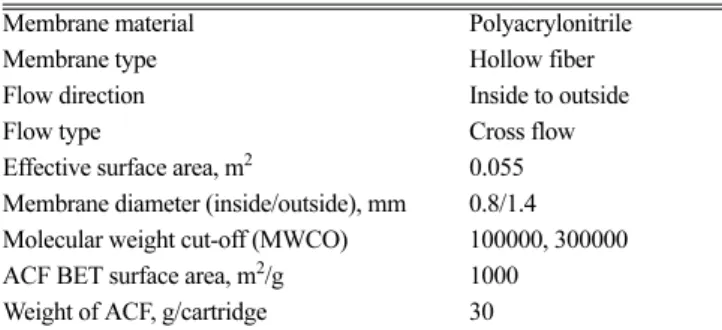
The ACF unit consisted of a cartridge filter (CF) connected to a feed tank to prolong the life span of the ACF. Characteristics of the membrane used in this process are presented in Table 2. In addition to the CF, two sets of ACF cartridge units were connected in series.
ACF was purchased from ACF Korea Ltd., whose cartridge code no. is FC-B. Bulk density and iodine number of ACF were 0.2 kg/m3 and 1,500 mg/g, respectively. After each series of experiments, UF membrane was flushed and backwashed with the distilled water and cleaned with 0.1M NaOH and 0.5 % HCl. CF and ACF were cleaned with distilled water before soaking in 0.1M of NaOH and
2% of HCl for a day. Cadmium concentration was measured using inductively coupled plasma (ICP, Varian OES-720) with a wave- length of 214.4 nm. Samples of MEUF were pretreated according to standard methods for the examination of water and wastewater [11]. SDS was measured using chemical oxygen demand (COD) as per Standard Methods. Cadmium and SDS removal efficiencies were calculated using Eq. 1.
R = (1-Cp/Ci)*100 (1)
where, R = rejection (%); Cp = permeate concentration (mg/L); Ci = influent concentration (mg/L).
3. RESULTS AND DISCUSSION 3-1. Effect of permeate flux on cadmium removal
A series of experiments was conducted in various permeate fluxes. Fig. 2 shows the removal characteristics of cadmium at various permeate fluxes. Average cadmium removal efficiency was 43.0%
with permeate flux of 31.3 L/m2·h, while it was 41.1%, 36.9% and 30.9% with the initial permeate fluxes of 42.9 L/m2·h, 55.3 L/m2·h and 65.5 L/m2·h, respectively. This implies that cadmium removal efficiency decreased with an increase of permeate flux within the operational experimental range. In surfactant-based ultrafiltration (UF) process, an increase in permeate flux led to an increase in concentration polarization (CP) on the membrane surface [12].
Fig. 1. Experimental set-up for MEUF-ACF hybrid processes.
Fig. 2. Effect of permeate flux on cadmium removal efficiency (Retentate pressure = 0.2 MPa, initial concentration of cadmium = 0.1621 mM, molar ratio of cadmium to SDS = 1:5, MWCO of membrane = 100,000 Dalton).
Table 1. Details of MEUF experimental operating conditions Retentate pressure, MPa 0.2, 0.24, 0.28
pH 3, 5, 7, 8.6
Initial cadmium concentration, mM 0.065, 0.1621, 0.1784, 0.3242 Molar ratio of Cadmium to SDS 1:2, 1:5, 1:10, 1:12
Sampling time, min 5, 10, 20, 30, 40, 50, 60 Initial flux (distilled water), L/m2h 31.3, 42.9, 55.3, 65.5
Flux decline is the main bottle-neck of this process. This is mainly caused by concentration polarization, fouling and adsorption [13].
Considering the higher removal efficiency of cadmium (43.0%) achieved at this value, 31.3 L/m2·h was found to be the optimum initial permeate flux in this study.
3-2. Effect of retentate pressure
The effect of initial retentate pressure on cadmium removal was investigated under various initial retentate pressures. As shown in Fig. 3, average cadmium removal was 34.4% with initial retentate pressure of 0.2 MPa, whereas it was 39.2% and 39.6% at the initial pressures of 0.24 MPa and 0.28 MPa, respectively. Cadmium removal increased with an increase in initial retentate pressure similar to that obtained in previous studies [12]. With an increase in retentate pressure, transmembrane pressure (TMP) also increased. The oper- ation of membrane processes at low transmembrane pressure is an important issue in terms of minimizing operating costs. An increase in pressure actually increases the gel layer thickness, in turn increasing rejection of the metal-micelle complex. Moreover, after 40 min- utes of operation (Fig. 3) the cadmium removal became linear for all three cases. For these reasons, the optimum retentate pressure was found to be 0.2 MPa.
3-3. Effect of molar ratio of cadmium to SDS
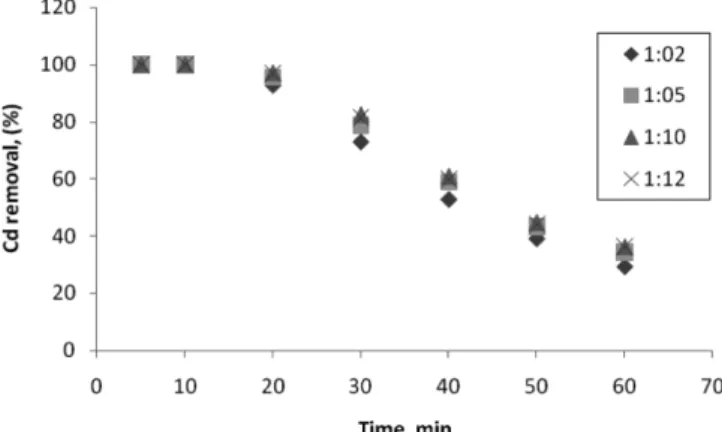
To find the effect of molar ratio of cadmium to SDS, another series of experiments was conducted at different molar ratios of cadmium to SDS. Fig. 4 shows that average cadmium removal was 74.6% for a molar ratio of 1:10. Removal efficiency decreased to 72.9% and 69.5%, at molar ratios of 1:5 and 1:2, respectively. Cadmium removal increased with increase in molar ratio. Cadmium removal efficiency was higher with higher initial SDS concentration that produces more micelles, making more micelle surface area available for electrostatic attraction of cadmium ions. Cadmium ions were retained on the membrane surface along with the micelles [2]. After surfactant concentration reaches critical micelle concentration (CMC),
all the surfactant added is converted to micelles. It then provides more available surface area for electrostatic attraction. Surfactant monomers cannot form micelles unless these reach CMC, and mono- mers pass through the membrane together with pollutant [14]. This results in a large micelle surface area being available for electro- static attraction of cadmium ions. As a result, a higher quantity of cadmium is removed together with the micelles.
3-4. Effect of pH
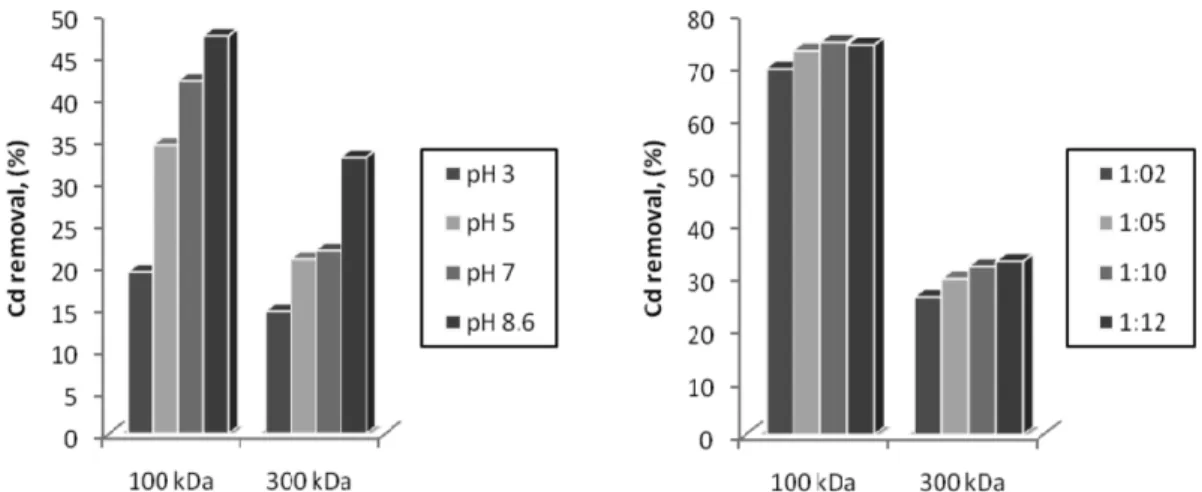
A series of experiments was performed to investigate the effect of pH on cadmium removal. As shown in Fig. 5, average cadmium removal efficiency was 19.3% and 34.4% for feed solution pH values of 3 and 5, respectively, while it was 42.1% and 47.4% for pH values of 7 and 8.6, respectively. Cadmium removal increased with an increase in the pH of the feed solution. At lower pH, cadmium needs to compete with H+ ions for the micelle surface. Under acidic conditions, due to competition with H+ ions, less cadmium was adsorbed onto the micelle surface leading to a reduction in cadmium removal.
On the contrary, at higher pH, H+ bound with functional groups Fig. 3. Effect of retentate pressure on cadmium removal efficiency
(Permeate flux = 42.91 L/m2.hr, initial concentration of cadmium = 0.1621 mM, molar ratio of cadmium to SDS = 1:5, MWCO of membrane = 100,000 Dalton).
Fig. 4. Effect of molar ratio of cadmium to SDS on cadmium removal efficiency (Permeate flux = 42.91 L/m2.hr, retentate pressure
= 0.2 MPa, initial concentration of cadmium = 0.1621 mM, MWCO of membrane = 100,000 Dalton).
Fig. 5. Effect of pH on cadmium removal efficiency (Permeate flux
= 42.91 L/m2.hr, retentate pressure = 0.2 MPa, initial concentration of cadmium = 0.1621 mM, molar ratio of cadmium to SDS
= 1:5, MWCO of membrane = 100,000 Dalton).
can be dissociated easily, and the deprotonated functional groups can bind with cadmium ions [15]. Previous research has also shown that copper removal increased with the increased acidity of the feed solution [16]. The effect of pH depends on the type of metals used in the solution, and specifically on whether H+ ions compete with the metal during electro-static adsorption on micelles.
3-5. Effect of initial concentration of cadmium
Another series of experiments was conducted with SDS concen- tration of 0.3242 mM at various initial cadmium concentrations in feed solution as shown in Fig. 6. Average cadmium removal effi- ciency was 58.7% for 0.065 mM concentration of cadmium. For initial cadmium concentration of 0.1621 mM, 0.1784mM and 0.3242 mM, average cadmium removal was 41.7%, 33.8% and 28.3%, respectively. Cadmium concentration in permeate increased with an increase in initial concentration mainly due to less micelle sur- face area being available for electrostatic adsorption of higher con- centrations [14]. Average permeate flux remained almost the same for the given surfactant concentration, and the charge surface avail- able for cadmium on the micelle surface remained constant for con-
membrane was 14.6%, 20.8%, 21.8% and 32.9% for the same pH values, respectively (Fig. 7a). On the other hand with different molar ratios (cadmium to SDS) of 1:2, 1:5, 1:10 and 1:12, average cadmium removal efficiency using 100,000 Dalton MWCO membrane was found to be 69.5%, 72.9%, 74.6% and 74.1%, respectively, while with the same molar ratios, removal efficiency using the 300,000 Dalton MWCO membrane reduced to 26.1%, 29.6%, 31.9% and 32.9%, respectively (Fig. 7b). Similar results were obtained in pre- vious studies on the removal of anionic pollutants through MWCO of 100,000 and 300,000 Daltons [17].
3-7. Removal of cadmium by MEUF without SDS
An experiment was conducted without surfactant (SDS), in feed solution containing initial cadmium concentration of 20 mg/L (0.065 mM). As shown in Table 3, cadmium removal percentage was 22.2%
Fig. 6. Effect of initial concentration of cadmium on cadmium removal efficiency (Permeate flux = 42.91 L/m2·hr, retentate pressure
= 0.2 MPa, SDS concentration = 0.3242 mM, MWCO of membrane
= 100,000 Dalton).
Fig. 7. Effect of MWCO of membrane on cadmium removal efficiency (a) in various pH (Permeate flux = 42.91 L/m2·hr, retentate pressure = 0.2 MPa, MWCO of membrane = 100,000 & 300,000 Dalton) and (b) in various molar ratios of cadmium to SDS (Permeate flux = 31.27 L/m2·hr, retentate pressure = 0.2 MPa, MWCO of membrane = 100,000 & 300,000 Dalton).
Table 3. Cadmium removal without using SDS Time
(min)
Permeate conc.
(ppm)
Removal efficiency (%)
Flux rate L/m2·hr
30 3.66 68.2 31.3
40 6.36 44.8 31.3
50 8.0 30.6 31.3
60 8.96 22.2 31.3
Initial cadmium concentration = 20 mg/L, initial retentate pressure = 0.2 MPa, initial permeate flux = 31.27 L/m2·hr, MWCO of the membrane = 100,000 Da
during the 60 minutes of operation. This strongly indicates ineffi- ciency of UF alone in removing of cadmium ions from feed solu- tion. In the MEUF process, the removal of pollutants is primarily due to the screening action of the UF membrane and adsorption of micelle-metal complexes on the membrane surface as well as inside the pore walls of the membrane [18].
3-8. Performance of MEUF-ACF hybrid process
A series of experiments was conducted to investigate the removal of excess cadmium ions present in the MEUF permeate by coupling with activated carbon fiber (ACF). Further, comparative analysis was carried out regarding the average cadmium removal percentage from various units of MEUF-ACF hybrid process such as MEUF, cartridge filter (CF), and two ACF units (ACF1 and ACF2), at con- stant initial SDS concentration and initial cadmium concentration of 0.065 mM (20 mg/L) and 0.3242 mM (93.48 mg/L), respectively.
As shown in Table 4, the 100,000 Da UF membrane has shown an average cadmium removal percentage of 68.5% for initial cad- mium concentration of 0.065 mM during 1 hr operational time.
Average cadmium removal percentage reached 99.6% when cou- pled with ACF units. On the other hand, the 300,000 Da UF mem- brane produced an average cadmium removal percentage of 36.4%, and the cadmium removal percentage reached 99.5% after being combined with the ACF units. Furthermore, average cadmium removal percentages from the MEUF, CF and two ACF units were higher when using 100,000 Da UF membrane than when using 300,000 Da UF membrane.
One of the major drawbacks of the MEUF process is the leakage of surfactant monomers in the filtrate or permeate, possibly inducing secondary pollution. Thus, a series of experiments was conducted to investigate the removal of excess SDS monomers present in the MEUF permeate by coupling with ACF. Furthermore, comparative analysis was carried out regarding SDS removal percentage from various units of MEUF-ACF hybrid process such as MEUF, cartridge filter (CF), and two ACF units (ACF1 and ACF2), at constant initial
SDS concentration, and initial cadmium concentrations of 0.065 mM (20 mg/L) and 0.3242 mM (93.48 mg/L), respectively.
As shown in Table 5, SDS removal percentage was 34.6% and 31.3% for 100,000 Da and 300,000 Da UF membranes, respec- tively. After coupling with the ACF units, SDS removal percent- age reached to 91.0% and 89.9% for 100,000 Da and 300,000 Da UF membranes, respectively. In conclusion, the SDS removal per- centage was much higher in the MEUF-ACF hybrid process as compared to results obtained when using MEUF alone. This was the case with both 100,000 Da and 300,000 Da membranes. As seen in Table 4, SDS removal percentage decreased with an increase in MWCO of UF membrane. This can be corroborated as larger pore-sized membranes caused earlier development of concentration polariza- tion (CP) and reduced the release of surfactant in the permeate [19].
4. CONCLUSION
In the MEUF process, the removal of cadmium from aqueous solution at various initial permeate flux, retentate pressure, pH, molar ratios of SDS to cadmium and initial cadmium concentra- tion has been investigated using an anionic surfactant SDS. Average cadmium removal efficiency under optimum operating conditions (permeate flux of 31.3 L/m2.h, retentate pressure of 0.2 MPa, cad- mium to SDS molar ratio of 1:10 and initial cadmium concentration of 0.065 mM) was 74.6% at neutral pH. Furthermore, cadmium removal efficiencies for 100,000 Dalton MWCO membrane were found to be 19.3%, 34.4%, 42.1%, 47.4% where for 300,000 Dalton MWCO membrane, removal efficiencies were lower such as 14.6%, 20.8%, 21.8%, 32.9% with pH values of 3, 5, 7, 8.6, respectively. With dif- ferent molar ratios (cadmium to SDS) of 1:2, 1:5, 1:10 and 1:12, the average cadmium removal efficiency for 100,000 Dalton MWCO membrane was found to be 69.5%, 72.9%, 74.6% and 74.1%, respectively, while with same molar ratios, for 300,000 Dalton MWCO membrane, removal efficiency declined to 26.1%, 29.6%, 31.9%
and 32.9%, respectively. The 100,000 Dalton MWCO membrane is a better choice for higher cadmium removal efficiency. During 60 minutes of ultrafiltration without SDS, the cadmium removal percentage was 22.2%. In the MEUF-ACF hybrid process, removal efficiency of cadmium and SDS at the end effluent was 99.6% and 91.0% with 100,000 Dalton membrane, whereas 99.5% and 89.9%
with 300,000 Dalton membrane, respectively.
ACKNOWLEDGMENTS
The authors are grateful for the support from the research fund of Korea Research Foundation, Korea (Research project number:
2013-218-017).
REFERENCES
1. Frontasyeva, M. V., Perelygin, V. P. and Vater, P., Radionuclides Table 4. Comparative cadmium removal percentage from various units
of MEUF-ACF hybrid process
100,000 Da 300,000 Da
MEUF CF ACF1 ACF2 MEUF CF ACF1 ACF2
68.5 69.7 78.5 99.6 36.4 41.3 64.6 99.5
Molar ratio of SDS to cadmium = 1:5, initial retentate pressure = 0.2 MPa, initial permeate flux = 31.27 L/m2·hr, pH = neutral, operation time = 5 hr, MWCO = 100,000 Da and 300,000 Da
Table 5. Comparative SDS removal percentage from various units of MEUF-ACF hybrid process
100,000 Da 300,000 Da
MEUF CF ACF1 ACF2 MEUF CF ACF1 ACF2
34.6 41.5 70.8 91.0 31.3 40.4 63.2 89.9
Molar ratio of SDS to cadmium = 1:5, initial retentate pressure = 0.2 MPa, initial permeate flux = 31.27 L/m2·hr, pH = neutral, operation time = 5 hr, MWCO = 100,000 Da and 300,000 Da
Model for Micellar Enhanced Ultrafiltration of Eosin Dye,” J.
colloid interface sci., 207, 496-506(2004).
6. Christian, S. D., Scamehorn, J. F., Ellington, R. T. and Harwell, J. H. (Eds.), Surfactant based separation processes, Marcel Dek- ker. New York, (chapter 1), (1989).
7. Scamehorn, J. F., Harwell, J. H., Wason, D. T., Ginn, M. F. and Shah, D. O., Surfactants in chemical process engineering. Mar- cel Dekker, New York, (chapter 3), (1998).
8. Basar, C. A., Karagunduz, A., Cakici, A. and Keskinler, B.,
“Removal of Surfactants by Powdered Activated Carbon and Microfiltration,” Water Res., 38, 2117-2124(2004).
9. Li, J. W., Yu, Z., Gao, M. and Cai, Z., “Trihalomethanes Adsorption on Activated Carbon Fiber and Granular Activated Carbon,”
Water Air Soil Pollut., 97, 367-378(1997).
10. El-Sharkawy, I. I., Saha, B. B., Koyama, S. and Ng, K. C., “A Study on the Kinetics of Ethanol-activated Carbon Fiber: Theory and Experiments,” Int. J. Heat Mass Transf., 49, 3104-3110(2006).
11. APHA, American Public Health Association, Washington D.C.
of Cobalt in Clay: Effect of Humic Acids,” Korean J. Chem. Eng., 21, 989(2004).
16. Bade, R. and Lee, S. H., “Micellar Enhanced Ultrafiltration and Activated Carbon Fibre Hybrid Processes for Copper Removal From Wastewater,” Korean J. Chem. Eng., 24(2), 239-245(2007).
17. Channarong, B., Lee, S. H., Bade, R. and Shipin, O. V., “Simul- taneous Removal of Nickel and Zinc from Aqueous Solution by Micellar Enhanced Ultrafiltration and Activated Carbon Fibre Hybrid Process,” Desalination, 262, 221-227(2010).
18. Qu, Y. H., Zeng, G. M., Huang, J. H., Li, M., Fang, Y. Y. and Zhang, Z., “Change Regulation of SDS Critical Micelle Concen- tration in Micellar Enhanced Ultrafiltration,” Ind. Water Wastewater (in China), 37(6), 12-15(2006).
19. Boelchini, F., Pagananelli, F., Michelis, I. D. and Veglio, F., “Treatment of Concentrated Arsenic (V) Solutions by Micellar Enhanced Ultrafiltration with High Molecular Weight Cut-off Membrane,” J.
Hazard. Mater., 148(1-2), 116-121(2007).