치매 간호 표준 개발
하주영
부산대학교 간호대학 조교수
Development of Dementia Care Standards
Ha, Ju Young
Assistant Professor, College of Nursing, Pusan National University, Yangsan, Korea
Purpose: This study was done to develop standards for dementia care as a baseline for professional nurses to provide a framework for dementia care evaluation Methods: The dementia care standards were developed through a literature review and focus group discussions. According to the Delphi method, the data analysis was conducted using the Content Validity Index (CVI). Results: The final set of 18 standards on dementia care was developed through one round of CVI.
The standards included four structural standards: ‘Organization of nursing system’, ‘Operating system’, ‘Management of human resources’, ‘Management of material resources’, 13 procedural standards: ‘Advanced assessment’, ‘Nursing diag- nosis’, ‘Nursing plan’, ‘Advanced nursing implementation’, ‘Evaluation’, ‘Education’, ‘Research’, ‘Consultation’, ‘Counsel- ing and cooperation’, ‘Development of specialty’, ‘Utilizing resources’, ‘Nursing quality assurance’, ‘Ethics’, and one stan- dard concerning outcome (‘Evaluation of nursing tasks in care of patients with dementia’). The final set of 55 criteria on care of patients with dementia was confirmed through two rounds of CVI. The final 171 indicators were confirmed through four rounds of CVI. Conclusion: These dementia care standards provides a framework that allows registered nurses to clari- fy their roles and tasks in the care of patients with dementia and provides evaluation criteria.
Key words:Dementia, Standards
주요어 :치매, 표준
*본 논문은 하주영의 박사학위논문을 수정하여 작성한 것임.
*This article is a revision of the first author’s doctoral thesis from Ewha Womans University.
Address reprint requests to : Ha, Ju-Young
College of Nursing, Pusan National University, Beomeo-ri, Mulgeum-eup, Yangsan 626-870, Korea Tel: 82-51-510-8332 Fax: 82-51-510-8308 E-mail: [email protected]
투고일 : 2009년 9월 2일 심사의뢰일 : 2009년 9월 3일 게재확정일 : 2010년 10월 14일
서 론 1. 연구의 필요성
급속한 고령화 추세로 인하여 평균수명이 연장되면서 노년기 건강문제가 새로운 관심으로 떠오르고 있는 가운데, 21세기를 살 아가는 현대인에게 가장 두려운 노인성 질환 중 하나가 치매이다.
2008년 전 세계 치매인구는 3천만 명으로 매 7초당 한 명 즉 매 년 4백 6십만 명의 새로운 치매환자가 발생하고 있는데(Alzheimer Disease International, 2008), 미국에서는 860만 명이 치매를
앓고 있고(Alzheimer’s Association, 2008), 국내의 경우 65세 이상 노인인구의 8.4%인 421,387명이 치매인구로 추정되어 2030년에는 약 114만 명으로 증가할 것으로 예상된다(Min- istry for Health, Welfare and Family Affairs [MHWFA], 2008). 이처럼 전 세계적인 문제로 대두되고 있는 치매는 뇌의 만성 또는 진행성 질환에 의한 증후군으로, 진단 초기에는 언어 장애나 시공간 혹은 실행 장애와 같은 인지 장애 중 한 가지 이 상의 증상과 기억력 감소가 나타나고 증상이 진행됨에 따라 흥 분, 공격성, 정신증과 같은 행동증상과 정신 심리증상이 나타나 간호제공자들에게 소진을 경험하게 하고 막대한 의료비용의 지
출과 함께 삶의 질을 저하시키면서 환자들을 시설에 입소하게 하는 주요 원인이 된다(Fitten, 2006).
치매 환자 간호의 궁극적 목적은 가능한 한 환자 기능의 최적 수준을 유지∙촉진시켜 최대한 독립적인 역할을 할 수 있도록 하며 환자가 만족스러운 사회적 관계를 유지하도록 하는 것이 다(Kwon et al., 2002). 따라서 치매 간호를 수행하는 간호사 는 치매의 특성과 치매환자의 특별한 요구도를 이해하고 치매 환자의 인지적, 정서적 요구에 맞춰 의사소통을 시도하며 일상 생활의 독립성을 증진시키고 문제행동들을 인식∙예방∙관리 해야 한다. 뿐만 아니라 치매환자와 가족의 요구를 이해하고 이 를 바탕으로 최상의 환경을 조성하며 치매환자 간호 중 발생할 수 있는 윤리적 문제를 인식하면서 간호를 수행하는 대인적, 지 식적, 기술적, 도덕적 업무 능력이 필요하다(Williams, Hyer, Kelly, Leger-Krall, & Tappen, 2005). 더불어 인지기능의 장 애를 갖는 노인들을 돌봄에 있어서 개별화된 간호 사정과 간호 계획을 통해 다양한 다학제적 간호 프로그램을 제공해야 하며 치매환자의 퇴행을 늦추도록 신체적, 심리적, 사회적 활동에 가 족들의 적극적인 참여 기회를 제공하고 작업요법, 물리치료, 치료 레크리에이션과 같은 활동을 통합하여 만족스런 간호중재 를 제공받도록 해야 한다(Jablonski, Reed, & Maas, 2005).
즉 만성적이며 점진적인 질환으로 장기간의 관리가 요구되는 치매질환의 경우 전문적인 간호의 제공이 필요한데, 이러한 간 호의 질을 향상시키기 위해서는 간호표준을 선정하여 실무기 준을 작성한 후 실행여부를 측정할 수 있는 지표를 만들어 간호 업무를 평가하고 수정, 보완하는 주기적인 순환과정이 필수적 이다. 이는 간호 표준이 환자에게 제공된 간호의 질을 평가하는 근거를 제공하며, 지속적으로 유지할 수 있고 측정 가능한 기본 적인 수준을 제시하기 때문이다(Adamczyk, Lorencowicz, Flis, Zajko, & Niezbecka, 2001). 따라서 치매 간호의 표준 개발은 치매환자에게 제공되는 간호의 근거를 마련하게 하고 궁극적으로 치매간호의 질을 향상시킬 수 있을 것이다.
치매환자 간호표준과 관련된 국내∙외 선행연구를 살펴보면, 호주의 경우 요양시설 관리자를 위해 관리 체계, 신체적∙심리적∙
정서적 개별 간호, 환경과 안전 관리 등에 관한 치매 간호 표준 이 마련되어 있고(Alzheimer’s Australia, 2007), 유럽에서는 European Dementia Consensus Network (EDCON) Group 에서 실시한 연구를 통해 18개 유럽 국가의 치매 간호를 소개 하고 치매 간호 표준을 활용하고 있다(Burn, 2005). 그러나 국 내의 경우 실무표준도 마련되어 있지 않은 상태이며 현재 개발 된 노인 간호 표준에서도 치매 간호에 대한 내용은 구체적으로 제시되어 있지 않다. 이는 미국의 경우도 유사한데, 미국간호협
회의 전문간호 표준(American Nurses Association [ANA], 1997) 이나 노인 간호 표준(ANA, 2001)에서도 포괄적인 노인 간호 표 준만 제시하고 있을 뿐 치매 간호에 대해서는 구체적인 내용이 제시되어 있지 않다.
따라서 치매 간호의 특성을 반영하고 연구, 교육, 지도 등의 전문성을 갖추어 질적인 치매간호를 제공하기 위해서는 치매 간호 표준의 개발이 필요할 것으로 사료된다.
2. 연구 목적
본 연구의 목적은 치매 및 노인전문병원의 치매간호 업무를 확인하고 이를 토대로 치매 간호의 표준과 기준 및 지표를 개발 하는 것이다.
3. 용어 정의
1) 간호 표준
간호표준은 간호전문직의 책임을 기술한 권위있는 진술문으 로(ANA, 1999), 본 연구에서는 Donabedian (1980)의 개념틀 에 근거한 구조적, 과정적, 결과적 측면의 치매환자 간호에 대 한 진술문을 의미한다.
2) 기준
기준은 표준과 관련된 행위, 환경, 업무에 대한 만족과 긍정 및 업무 숙달 등의 상태를 나타내는 진술이다(Korean Nurses Association [KNA], 2003). 본 연구에서는 개발된 치매환자 간호 표준에 대한 성취정도를 평가할 수 있는 문항을 말한다.
3) 지표
지표는 특정 기준의 성취정도를 객관적으로 측정할 수 있게 하는 관찰 및 측정가능한 객관적인 변수나 특성으로(Lee, 1998), 본 연구에서는 기준의 수행 성취정도를 평가하기 위한 치매환 자 간호 기준의 하위문항을 말한다.
연구 방법
1. 연구 설계본 연구는 치매 간호 표준을 개발하기 위한 방법론적 연구이다.
2. 연구과정
국제간호협의회(ICN)에서는“간호 표준은 사회의 요구와 자원 에 따른 변화와 개선에 적용할 수 있도록 융통성을 가져야 하며 국민과 간호전문직 그리고 실무간호사와 관련되는 합리적이며, 명확하고 적절한 진술이어야 한다.”고 제시하고 있다(KNA, 2003).
이러한 간호 표준 개발 기본원리에따라 문헌고찰, 초점집단, 전 문가합의와 현장조사를 통해 치매 간호 업무와 활동을 규명하고 규명된 업무와 활동을 토대로 간호 표준(안), 기준(안), 지표(안) 에 대해 내용 타당도 검증을 거쳐 치매 간호 표준을 개발하였다.
1) 문헌고찰과 초점집단을 통한 치매환자 간호 업무 확인 치매환자 간호 업무를 파악하기 위해 의료법에 나타난 업무 와 활동을 확인하고 국내 간호활동 기술서와 국외 노인전문간 호사 교육과정 프로그램, 노인 실무전문 간호사 가이드라인, 치매환자 간호 프로토콜 및 기타 치매환자 간호 관련 문헌에 나 타난 간호 업무를 확인하였다. 또한 현재 치매환자를 간호하고 있는 간호사를 통해 치매환자 간호 업무를 확인하고자 목적적 표집방법을 이용하여 서울, 경기, 부산, 인천, 대구, 광주, 울 산, 전북, 경북 지역의 13개 치매 및 노인전문병원에 근무하는 간호사 23인을 초점집단으로 선정하여 개방형 질문지를 이용 하여 e-mail과 우편을 통해 의견을 수렴하였다. 의료법 시행 규칙 제54조 2항에 의하면 해당분야 3년 이상 실무 경력자에 게 전문간호사 자격을 부여하고 있는데, 이는 해당분야의 업무 를 충분히 파악하고 수행할 능력이 있음을 의미하므로 이에 준 하여 치매환자 간호경력 3년 이상인 간호사로 초점집단 대상자 를 제한하였다. 문헌고찰과 초점집단을 통해 확인된 25개 간호 업무와 94개 간호활동은 실무와 학계의 치매간호 관련 전문가 집단에게 확인하였는데, 실무전문가 4인과 노인전문간호사 과 정이 개설되어 있는 간호대학의 노인간호학 전공 교수 2인, 총 6인의 전문가 합의를 통해 27개 업무와 104개 간호활동으로 정리되었다. 정리된 업무와 간호활동은 전국 36개 치매 및 노 인전문병원의 간호사 195명을 대상으로 설문조사를 실시하여 수행여부와 필요성을 확인하고 수행도와 필요성이 높은 항목 을 선정하여 간호 표준(안) 개발 시 내용으로 반영하였다.
2) 치매환자 간호 표준(안) 개발
확인된 치매환자 간호 업무와 활동의 내용을 토대로 Don- abedian (1980)의 개념틀에 맞춰 치매환자 간호 제공자 및 조 직체계에 관한 구조적 측면과 치매환자 간호업무 수행과 관련 된 과정적 측면, 치매환자 간호 수행결과에 대한 결과적 측면의
치매환자 간호 표준(안)을 개발하였다. 구조적 측면의 4개의 표 준(안), 과정적 측면의 13개의 표준(안), 결과적 측면의 1개의 표 준(안)이 개발되었으며 총 18개의 표준(안) 각각에 대하여 달성 정도를 평가할 수 있는 업무를 중심으로 55개의 치매환자 간호 기준(안)과 총 55개의 기준(안) 각각에 대하여 달성 정도를 평 가할 수 있는 활동을 중심으로 175개의 지표(안)이 개발되었다.
3) 치매 간호 표준(안) 내용 타당도 검증
치매 간호표준(안)에 대한 내용 타당도를 검증하기 위해 전문 가 패널을 구성하여 델파이 방법을 이용하였다. 전문가 패널 선 정과 내용 타당도 검증 절차는 다음과 같다.
(1) 전문가 패널
본 연구에서는 치매 간호 표준(안)에 대한 내용 타당도를 조 사하기 위해 목적적 표집방법을 이용하여 다음과 같은 선정기 준 중 대표성을 확보할 수 있도록 3가지 이상을 충족하는 사람 으로 전문가 패널을 선정하였다. 내용 타당도 조사에 참여하는 전문가는 최소 3명에서 최대 10명을 넘지 않아야 하므로(Lynn, 1986) 선정기준을 충족하는 사람 중 실무, 학계, 기관을 고려하 여 본 연구에 대한 참여의사를 확인하고 사전동의를 얻어 5명 을 선정하였다.
∙노인의료시설의 책임자로 기관을 운영한 경험이 있는 사람
∙치매환자 간호 경력이 5년 이상으로 현재 노인의료시설의 간호책임자로 있는 사람
∙노인전문간호사 과정이 개설된 대학의 노인전공교수로 치 매 및 노인 간호교육 과정을 개발하고 치매환자 간호 혹은 노인 간호 관련 저서나 논문을 발간한 경험이 있는 사람
∙치매 및 노인 간호 관련 단체의 임원으로 관련 정책 개발, 교육프로그램 개발 및 연구에 참여한 경험이 있는 사람
∙정부나 민간단체의 치매 및 노인 간호 관련 사업을 개발하 고 참여한 경험이 있는 사람
(2) 내용 타당도 검증
본 연구의 치매환자 간호표준(안)에 대한 내용 타당도 조사는 5인의 전문가 패널을 대상으로 구조화된 4점 척도 설문지를 이 용하여 각 문항이 타당한지 여부에 대해‘매우 타당하다’4점,
‘타당하다’3점, ‘타당하지 않다’2점, ‘매우 타당하지 않다’1 점으로 응답하게 하였으며 삭제 및 추가 또는 수정되어야 할 내 용을 직접 서술할 수 있도록 하였다. 내용 타당도 검증은 표준 (안), 기준(안), 지표(안)에 대해 순차적으로 시행하되 합의가 이 루어질 때까지 실시하였는데, 표준(안)에 대한 내용 타당도 조
사는 2006년 10월 30일부터 11월 2일까지 1회 실시되었고, 기 준(안)에 대한 내용 타당도 조사는 2006년 11월 3일부터 11일 까지 2회, 지표(안)에 대한 내용 타당도 조사는 2006년 11월 15 일부터 12월 4일까지 총 4회 실시되었다.
3. 자료분석
내용 타당도 조사에 참여하는 전문가의 수가 5명 이하일 때 모든 전문가가 내용타당성에 동의해야 합리적이다(Lynn, 1986).
본 연구에서는 전문가 패널의 수가 5명이므로 4단계에서 실시 한 내용 타당도 조사에 있어 각 문항에 대해 3점과 4점으로 응
답한 전문가의 비율을 계산하여 내용 타당도 지수(Content Val- idity Index, CVI)를 산출한 후 CVI 1.0인 항목을 채택하였다.
연구 결과
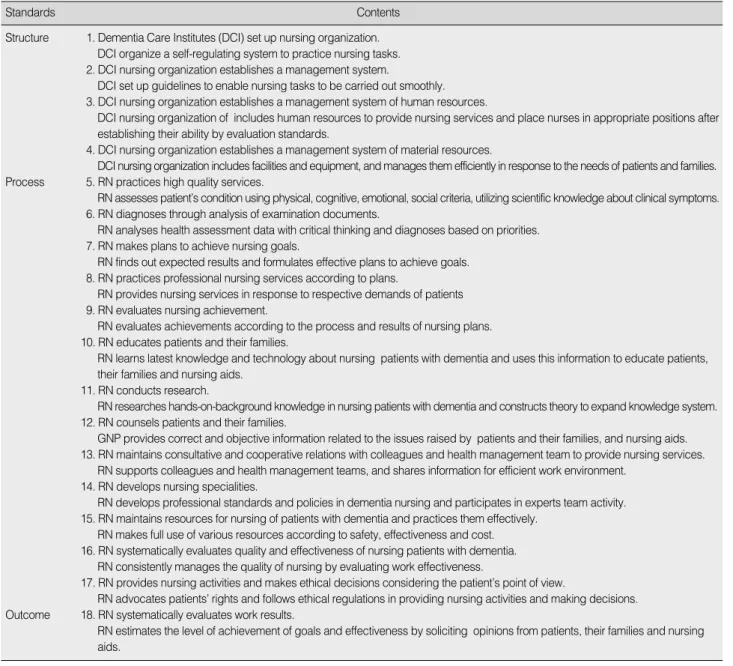
1. 치매환자 간호 표준문헌고찰과 전문가 패널에 의한 내용 타당도 검증과정을 통 해 구조적, 과정적, 결과적 측면을 포함하는 총 18개의 치매환 자 간호 표준이 개발되었다(Table 1). 구조적 측면으로는‘간호 조직 구성’, ‘운영체계’, ‘인적자원의 관리체계’, ‘물적자원의
RN=Registered Nurse.
Standards Contents
Structure 1. Dementia Care Institutes (DCI) set up nursing organization.
DCI organize a self-regulating system to practice nursing tasks.
2. DCI nursing organization establishes a management system.
DCI set up guidelines to enable nursing tasks to be carried out smoothly.
3. DCI nursing organization establishes a management system of human resources.
DCI nursing organization of includes human resources to provide nursing services and place nurses in appropriate positions after establishing their ability by evaluation standards.
4. DCI nursing organization establishes a management system of material resources.
DCI nursing organization includes facilities and equipment, and manages them efficiently in response to the needs of patients and families.
Process 5. RN practices high quality services.
RN assesses patient’s condition using physical, cognitive, emotional, social criteria, utilizing scientific knowledge about clinical symptoms.
6. RN diagnoses through analysis of examination documents.
RN analyses health assessment data with critical thinking and diagnoses based on priorities.
7. RN makes plans to achieve nursing goals.
RN finds out expected results and formulates effective plans to achieve goals.
8. RN practices professional nursing services according to plans.
RN provides nursing services in response to respective demands of patients 9. RN evaluates nursing achievement.
RN evaluates achievements according to the process and results of nursing plans.
10. RN educates patients and their families.
RN learns latest knowledge and technology about nursing patients with dementia and uses this information to educate patients, their families and nursing aids.
11. RN conducts research.
RN researches hands-on-background knowledge in nursing patients with dementia and constructs theory to expand knowledge system.
12. RN counsels patients and their families.
GNP provides correct and objective information related to the issues raised by patients and their families, and nursing aids.
13. RN maintains consultative and cooperative relations with colleagues and health management team to provide nursing services.
RN supports colleagues and health management teams, and shares information for efficient work environment.
14. RN develops nursing specialities.
RN develops professional standards and policies in dementia nursing and participates in experts team activity.
15. RN maintains resources for nursing of patients with dementia and practices them effectively.
RN makes full use of various resources according to safety, effectiveness and cost.
16. RN systematically evaluates quality and effectiveness of nursing patients with dementia.
RN consistently manages the quality of nursing by evaluating work effectiveness.
17. RN provides nursing activities and makes ethical decisions considering the patient’s point of view.
RN advocates patients’ rights and follows ethical regulations in providing nursing activities and making decisions.
Outcome 18. RN systematically evaluates work results.
RN estimates the level of achievement of goals and effectiveness by soliciting opinions from patients, their families and nursing aids.
Table 1. Dementia Care Standards
관리체계’에 관한 4개의 표준이 개발되었고 과정적 측면으로 는‘상급건강사정’, ‘간호진단’, ‘간호계획’, ‘전문간호수행’,
‘평가’, ‘교육’, ‘연구’, ‘상담’, ‘자문 및 협동관계’, ‘전문성 개발’, ‘자원활용’, ‘간호의 질 관리’, ‘윤리’에 관한 13개 표준 이 개발되었으며 결과적 측면으로는‘치매환자 간호업무에 대 한 평가’에 관한 1개 표준이 개발되어 평가의 범위와 대상을 확 대하고 평가 내용을 직무에 반영하도록 하였다.
2. 치매환자 간호 기준
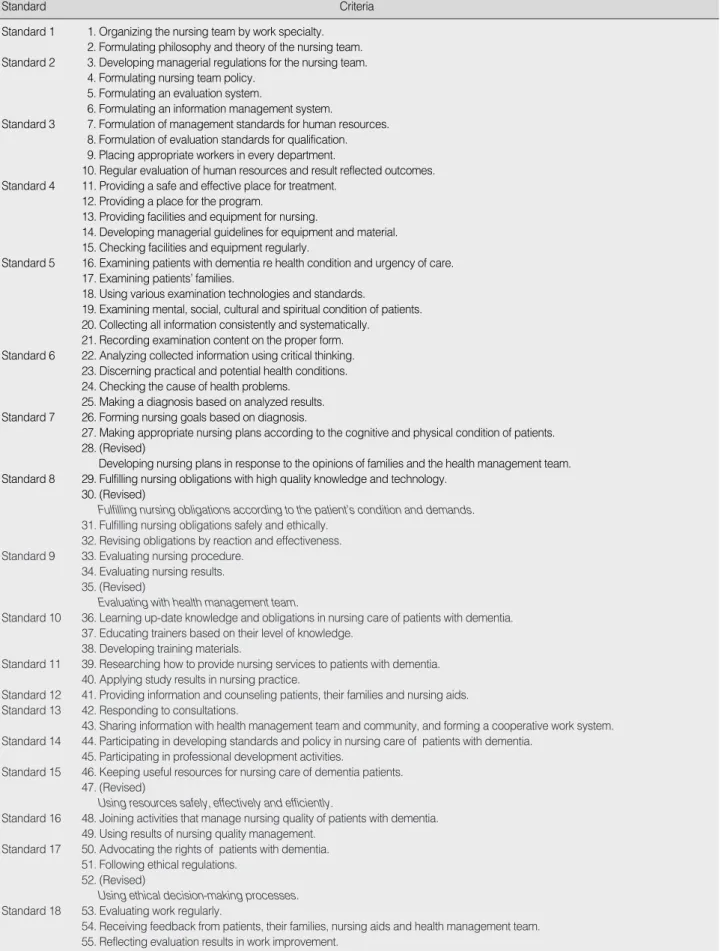
치매환자 간호 기준(안)에 대한 2회에 걸친 내용 타당도 검증 결과, 28, 30, 35, 47, 52 기준(안)이 수정, 채택되어 총 55개의 기준이 개발되었다(Table 2).
3. 치매환자 간호 지표
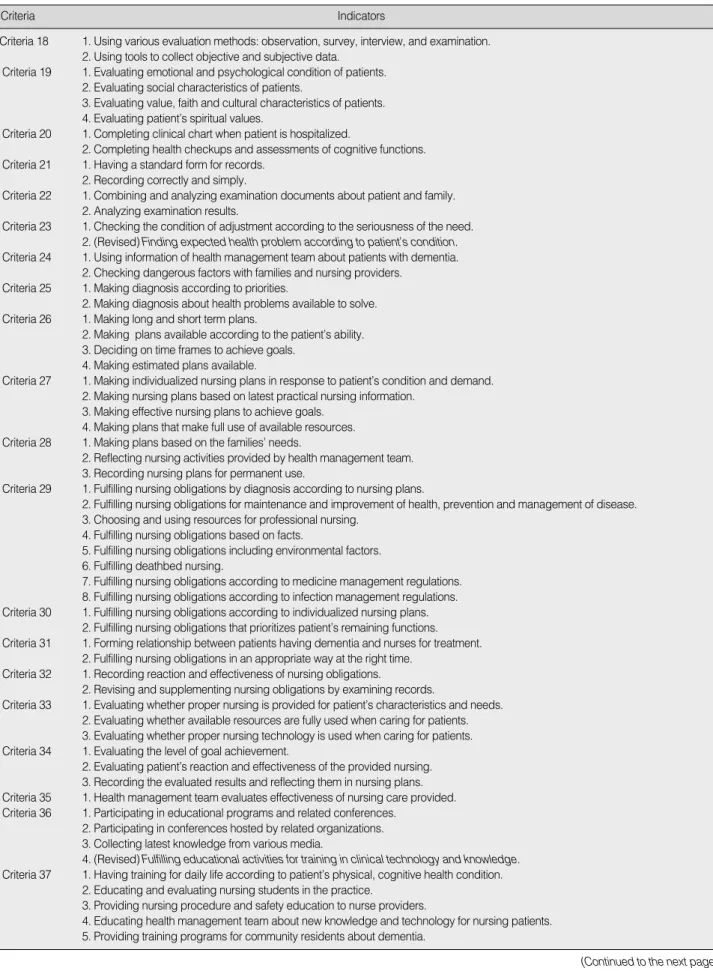
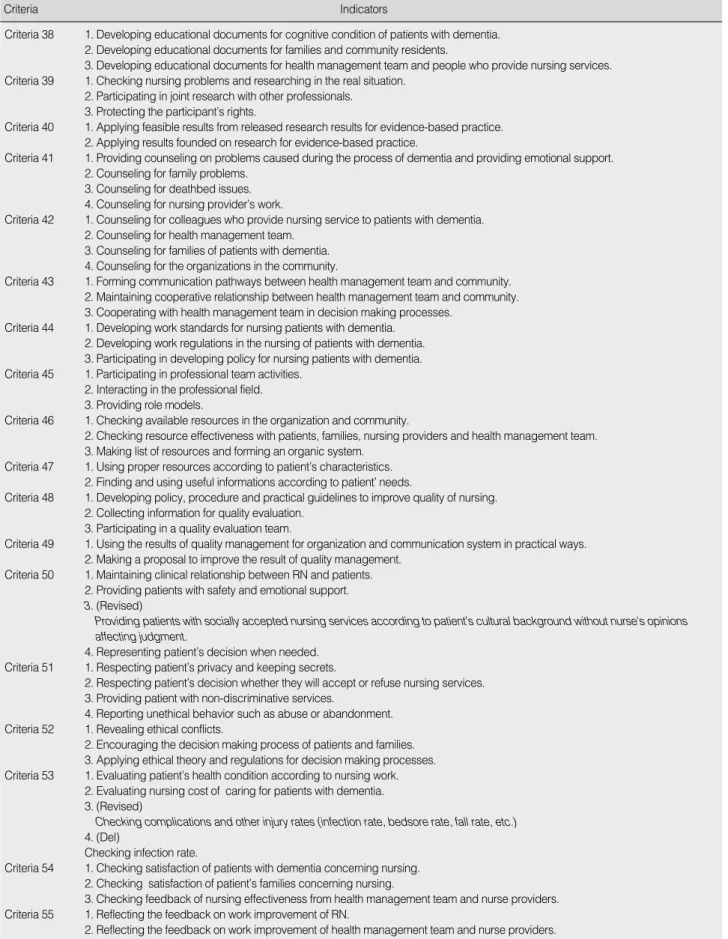
치매환자 간호 지표(안)에 대하여 4회의 내용 타당도 검증 결 과, 175개 지표(안) 중 4개 지표가 삭제되고 6개 지표가 수정되 어 최종 171개 지표가 개발되었다(Table 3).
논 의
본 연구에서는 Donabedian (1980)의 구조-과정-결과 모델 에 근거하여 문헌고찰과 초점집단을 통해 치매 간호 표준(안)을 개발하고 전문가 패널의 내용 타당도 검증을 거쳐‘간호조직 구성’, ‘운영체계’, ‘인적자원의 관리체계’, ‘물적자원의 관리 체계’에 대한 4개의 구조적 표준과‘상급건강사정’, ‘간호진 단’, ‘간호계획’, ‘전문간호수행’, ‘평가’, ‘교육’, ‘연구’, ‘상 담’, ‘자문 및 협동관계’, ‘전문성 개발’, ‘자원활용’, ‘간호의 질 관리’, ‘윤리’에 대한 13개의 과정적 표준 및 치매환자 간호 업무에 대한 평가를 위한 1개의 결과적 표준으로 구성된 18개 의 치매환자 간호 표준과 55개의 기준 및 171개의 지표를 개발 하였다.
구조적 측면의 간호표준은 치매간호를 제공하는 기관에서 간 호업무 수행과 조직편성을 위한 운영지침을 마련하고 이를 통 해 적절하게 인력을 확보하고 배치하며 양질의 치매간호를 위 한 설비를 갖추고 관리하도록 하기 위해 간호조직의 구성과 운 영체계 그리고 인적, 물적 자원의 관리체계에 대한 내용으로 구 성하였다. 이는 중환자 간호업무 표준개발을 위한 Jang (2000) 의 연구에서 중환자실의 환경, 의사소통 체계, 정책과 절차, 장 비와 물품 관리, 감염 관리 프로그램에 관한‘중환자 간호서비
스의 조직-환경’이라는 구조적 측면의 표준을 제시한 것과 유 사하였는데, 운영지침이나 물품 관리 외에 의사소통 체계나 감 염 관리 프로그램을 추가한 것은 중환자 간호의 특성을 반영한 것으로 여겨진다. 그러나 간호단체의 분야별 실무표준이나 개 발된 실무간호표준의 경우 구조적 측면에 관한 표준은 제시하 고 있지 않아 본 연구와 상이한 결과를 보였는데, 이는 의료시 설의 특정 부서에서 제공되는 간호과정에 초점을 맞추어 개발 되었기 때문으로 사료된다.
과정적 측면의 간호표준은 간호실무 표준과 전문직 수행표 준으로 구분하였다. 먼저, 간호실무 표준은 간호과정을 충실히 이행하는 내용으로‘상급건강사정’, ‘간호진단’, ‘간호계획’,
‘전문간호수행’, ‘평가’로 구성되어 있다. 이는 ANA (2001)의 간호표준과 Hospital Nurses Association (HNA) (2006)의 노 인 간호표준에서 제시하는 내용과 유사하였으나, 본 연구와 달 리 ANA (2001)의 간호표준에서는‘결과확인’에 대한 표준을 추가로 제시하여 간호계획을 개발하기에 앞서 기대되는 결과 를 먼저 규명하고자 하였으며, HNA (2006)의 노인 간호표준 에서는‘목표설정’이라는 표준을 추가로 제시하여 간호계획 수 립 이전에 개별화된 간호목표를 설정하고자 하였는데, 이는 간 호계획과 장∙단기 목표설정과정을 분리한 결과로 여겨진다.
다음으로, 전문직 수행표준은 전문직으로서의 치매 간호의 질 을 향상시키기 위한 내용으로‘교육’, ‘연구’, ‘상담’, ‘자문 및 협동관계’, ‘전문성 개발’, ‘자원활용’, ‘간호의 질 관리’, ‘윤 리’로 구성되어 있다. 이는 ANA (2005)의 표준에‘단결’, ‘동 료간 협력’, ‘협동’과 같은 업무 협조에 관한 표준이 강조되고 있으며 특히 ANA (1997) 간호표준에서‘리더십’에 관한 표준 을 제시하고 있는데 비해 본 연구에서는 치매 간호에 있어 환자 의 가족과 간호제공자를 포함하여 지지와 정보를 제공하기 위 한‘상담’에 관한 표준이 추가되었다. 이러한 차이는 국내의 경 우 협력이나 리더십보다는 상담 활동을 많이 하는 것으로 나타 난 현장조사 결과의 반영에 따른 것으로 여겨진다. 그러나 효율 적인 업무 수행을 위해 다양한 부서와 협력적인 관계를 유지하 고, 부서에서 리더십을 발휘해야 하는 일이 증가할 것으로 예상 되므로 추후 표준 검증 연구결과를 통해 수정, 보완할 필요가 있을 것으로 사료된다. 또한 전문직 수행표준 중 본 연구 결과
‘전문성 개발’에 관한 표준이 제시되었는데 이는 치매환자 간 호 분야가 전문간호사로 제도화되지 않은 분야이기는 하나 표 준을 정립하고 관련 정책개발에 좀 더 활발히 참여함으로써 치 매환자 간호에 대한 전문성을 확보하고자 한 것으로 기존 간호 표준과 차별화된다고 볼 수 있다.
결과적 측면의 표준으로는‘치매환자 간호 업무에 대한 평
Standard Criteria Standard 1 1. Organizing the nursing team by work specialty.
2. Formulating philosophy and theory of the nursing team.
Standard 2 3. Developing managerial regulations for the nursing team.
4. Formulating nursing team policy.
5. Formulating an evaluation system.
6. Formulating an information management system.
Standard 3 7. Formulation of management standards for human resources.
8. Formulation of evaluation standards for qualification.
9. Placing appropriate workers in every department.
10. Regular evaluation of human resources and result reflected outcomes.
Standard 4 11. Providing a safe and effective place for treatment.
12. Providing a place for the program.
13. Providing facilities and equipment for nursing.
14. Developing managerial guidelines for equipment and material.
15. Checking facilities and equipment regularly.
Standard 5 16. Examining patients with dementia re health condition and urgency of care.
17. Examining patients’ families.
18. Using various examination technologies and standards.
19. Examining mental, social, cultural and spiritual condition of patients.
20. Collecting all information consistently and systematically.
21. Recording examination content on the proper form.
Standard 6 22. Analyzing collected information using critical thinking.
23. Discerning practical and potential health conditions.
24. Checking the cause of health problems.
25. Making a diagnosis based on analyzed results.
Standard 7 26. Forming nursing goals based on diagnosis.
27. Making appropriate nursing plans according to the cognitive and physical condition of patients.
28. (Revised)
Developing nursing plans in response to the opinions of families and the health management team.
Standard 8 29. Fulfilling nursing obligations with high quality knowledge and technology.
30. (Revised)
Fulfilling nursing obligations according to the patient’s condition and demands.
31. Fulfilling nursing obligations safely and ethically.
32. Revising obligations by reaction and effectiveness.
Standard 9 33. Evaluating nursing procedure.
34. Evaluating nursing results.
35. (Revised)
Evaluating with health management team.
Standard 10 36. Learning up-date knowledge and obligations in nursing care of patients with dementia.
37. Educating trainers based on their level of knowledge.
38. Developing training materials.
Standard 11 39. Researching how to provide nursing services to patients with dementia.
40. Applying study results in nursing practice.
Standard 12 41. Providing information and counseling patients, their families and nursing aids.
Standard 13 42. Responding to consultations.
43. Sharing information with health management team and community, and forming a cooperative work system.
Standard 14 44. Participating in developing standards and policy in nursing care of patients with dementia.
45. Participating in professional development activities.
Standard 15 46. Keeping useful resources for nursing care of dementia patients.
47. (Revised)
Using resources safely, effectively and efficiently.
Standard 16 48. Joining activities that manage nursing quality of patients with dementia.
49. Using results of nursing quality management.
Standard 17 50. Advocating the rights of patients with dementia.
51. Following ethical regulations.
52. (Revised)
Using ethical decision-making processes.
Standard 18 53. Evaluating work regularly.
54. Receiving feedback from patients, their families, nursing aids and health management team.
55. Reflecting evaluation results in work improvement.
Table 2. Dementia Care Criteria
Criteria Indicators Table 3. Dementia Care Indicators
Criteria 1 1. Forming education, administration and ward department.
2. Establishing committee.
Criteria 2 1. Providing purposes and goals of nursing patients with dementia.
2. Providing the vision, duty and value of nursing.
Criteria 3 1. Designating patients having dementia (Del)
2. Establishing nursing procedures for the care of patients with dementia.
3. Providing a range of nursing care for patients with dementia.
4. Defining rules and obligations of RN who care patients with dementia.
Criteria 4 1. Choosing assignments to develop organization.
2. Regularly improving state of nursing . 3. Evaluating how goals are being achieved.
4. Developing marketing strategy. (Del) Criteria 5 1. Developing regulations for evaluation.
2. Regularly evaluating regulations.
3. Documenting results.
4. Use of results in organizational development.
Criteria 6 1. Choosing and collecting information about dementia.
2. Developing computerized programs to analyze database. (Del) 3. Managing information by analyzing and combining data.
Criteria 7 1. Developing management regulations for human resources.
2. Allocating proper human resources to each field.
3. Developing orientation programs for new recruits.
4. Developing practical training programs for each aspect of nursing care.
Criteria 8 1. RN refresher training once a year.
2. RN team provides job training more than once a month.
3. (Revised) RN team provides job training for aids more than once a month.
Criteria 9 1. Estimating personnel supply and demand from job analysis.
2. Putting proper personnel in the right position according to medical regulations.
Criteria 10 1. Identifying the characteristics of nursing work force.
2. Regular counseling for personnel.
3. Regular evaluation of nurses.
Criteria 11 1. Making the nurse office accessible.
2. Providing a space for easy treatment.
3. Providing a space for diagnosis.
4. Providing a space for counselling and conferences.
5. Providing an office.
Criteria 12 1. Providing an office for programming.
2. Providing a safe electronic circuit.
3. Providing outdoor space for treatment (garden, walking road, etc.) Criteria 13 1. Having medical and official supplies readily available.
2. Having equipment available for patients with dementia.
3. Having adequate storage for equipment and supplies.
Criteria 14 1. Providing forms to record the condition of maintenance and repair.
2. Providing forms for supplies and payment request.
Criteria 15 1. Evaluating and recording the conditions of facilities regularly.
2. Evaluating and recording supplies regularly.
Criteria 16 1. Inspecting medical history of patients with dementia.
2. Having health checkup for patients with dementia.
3. Determining how well patients can manage daily life.
4. Checking patient’s cognitive functions.
5. Checking for factors that pose a danger to patients.
6. Checking patient’s abnormal behavior.
7. Checking for improper use of medicine.
8. (Revised) Checking examination for diagnosis of patients having dementia.
Criteria 17 1. Evaluating family’s characteristics.
2. Evaluating family’s support.
3. Evaluating family’s faith and behavior toward health.
4. Evaluating family’s cultural characteristics and values.
5. Evaluating the decision making process of the patients’ family.
(Continued to the next page)
Criteria Indicators
Criteria 18 1. Using various evaluation methods: observation, survey, interview, and examination.
2. Using tools to collect objective and subjective data.
Criteria 19 1. Evaluating emotional and psychological condition of patients.
2. Evaluating social characteristics of patients.
3. Evaluating value, faith and cultural characteristics of patients.
4. Evaluating patient’s spiritual values.
Criteria 20 1. Completing clinical chart when patient is hospitalized.
2. Completing health checkups and assessments of cognitive functions.
Criteria 21 1. Having a standard form for records.
2. Recording correctly and simply.
Criteria 22 1. Combining and analyzing examination documents about patient and family.
2. Analyzing examination results.
Criteria 23 1. Checking the condition of adjustment according to the seriousness of the need.
2. (Revised) Finding expected health problem according to patient’s condition.
Criteria 24 1. Using information of health management team about patients with dementia.
2. Checking dangerous factors with families and nursing providers.
Criteria 25 1. Making diagnosis according to priorities.
2. Making diagnosis about health problems available to solve.
Criteria 26 1. Making long and short term plans.
2. Making plans available according to the patient’s ability.
3. Deciding on time frames to achieve goals.
4. Making estimated plans available.
Criteria 27 1. Making individualized nursing plans in response to patient’s condition and demand.
2. Making nursing plans based on latest practical nursing information.
3. Making effective nursing plans to achieve goals.
4. Making plans that make full use of available resources.
Criteria 28 1. Making plans based on the families’ needs.
2. Reflecting nursing activities provided by health management team.
3. Recording nursing plans for permanent use.
Criteria 29 1. Fulfilling nursing obligations by diagnosis according to nursing plans.
2. Fulfilling nursing obligations for maintenance and improvement of health, prevention and management of disease.
3. Choosing and using resources for professional nursing.
4. Fulfilling nursing obligations based on facts.
5. Fulfilling nursing obligations including environmental factors.
6. Fulfilling deathbed nursing.
7. Fulfilling nursing obligations according to medicine management regulations.
8. Fulfilling nursing obligations according to infection management regulations.
Criteria 30 1. Fulfilling nursing obligations according to individualized nursing plans.
2. Fulfilling nursing obligations that prioritizes patient’s remaining functions.
Criteria 31 1. Forming relationship between patients having dementia and nurses for treatment.
2. Fulfilling nursing obligations in an appropriate way at the right time.
Criteria 32 1. Recording reaction and effectiveness of nursing obligations.
2. Revising and supplementing nursing obligations by examining records.
Criteria 33 1. Evaluating whether proper nursing is provided for patient’s characteristics and needs.
2. Evaluating whether available resources are fully used when caring for patients.
3. Evaluating whether proper nursing technology is used when caring for patients.
Criteria 34 1. Evaluating the level of goal achievement.
2. Evaluating patient’s reaction and effectiveness of the provided nursing.
3. Recording the evaluated results and reflecting them in nursing plans.
Criteria 35 1. Health management team evaluates effectiveness of nursing care provided.
Criteria 36 1. Participating in educational programs and related conferences.
2. Participating in conferences hosted by related organizations.
3. Collecting latest knowledge from various media.
4. (Revised) Fulfilling educational activities for training in clinical technology and knowledge.
Criteria 37 1. Having training for daily life according to patient’s physical, cognitive health condition.
2. Educating and evaluating nursing students in the practice.
3. Providing nursing procedure and safety education to nurse providers.
4. Educating health management team about new knowledge and technology for nursing patients.
5. Providing training programs for community residents about dementia.
Table 3. (Continued from the previous page) Dementia Care Indicators
(Continued to the next page)
Criteria Indicators
Criteria 38 1. Developing educational documents for cognitive condition of patients with dementia.
2. Developing educational documents for families and community residents.
3. Developing educational documents for health management team and people who provide nursing services.
Criteria 39 1. Checking nursing problems and researching in the real situation.
2. Participating in joint research with other professionals.
3. Protecting the participant’s rights.
Criteria 40 1. Applying feasible results from released research results for evidence-based practice.
2. Applying results founded on research for evidence-based practice.
Criteria 41 1. Providing counseling on problems caused during the process of dementia and providing emotional support.
2. Counseling for family problems.
3. Counseling for deathbed issues.
4. Counseling for nursing provider’s work.
Criteria 42 1. Counseling for colleagues who provide nursing service to patients with dementia.
2. Counseling for health management team.
3. Counseling for families of patients with dementia.
4. Counseling for the organizations in the community.
Criteria 43 1. Forming communication pathways between health management team and community.
2. Maintaining cooperative relationship between health management team and community.
3. Cooperating with health management team in decision making processes.
Criteria 44 1. Developing work standards for nursing patients with dementia.
2. Developing work regulations in the nursing of patients with dementia.
3. Participating in developing policy for nursing patients with dementia.
Criteria 45 1. Participating in professional team activities.
2. Interacting in the professional field.
3. Providing role models.
Criteria 46 1. Checking available resources in the organization and community.
2. Checking resource effectiveness with patients, families, nursing providers and health management team.
3. Making list of resources and forming an organic system.
Criteria 47 1. Using proper resources according to patient’s characteristics.
2. Finding and using useful informations according to patient’ needs.
Criteria 48 1. Developing policy, procedure and practical guidelines to improve quality of nursing.
2. Collecting information for quality evaluation.
3. Participating in a quality evaluation team.
Criteria 49 1. Using the results of quality management for organization and communication system in practical ways.
2. Making a proposal to improve the result of quality management.
Criteria 50 1. Maintaining clinical relationship between RN and patients.
2. Providing patients with safety and emotional support.
3. (Revised)
Providing patients with socially accepted nursing services according to patient’s cultural background without nurse's opinions affecting judgment.
4. Representing patient’s decision when needed.
Criteria 51 1. Respecting patient’s privacy and keeping secrets.
2. Respecting patient’s decision whether they will accept or refuse nursing services.
3. Providing patient with non-discriminative services.
4. Reporting unethical behavior such as abuse or abandonment.
Criteria 52 1. Revealing ethical conflicts.
2. Encouraging the decision making process of patients and families.
3. Applying ethical theory and regulations for decision making processes.
Criteria 53 1. Evaluating patient’s health condition according to nursing work.
2. Evaluating nursing cost of caring for patients with dementia.
3. (Revised)
Checking complications and other injury rates (infection rate, bedsore rate, fall rate, etc.) 4. (Del)
Checking infection rate.
Criteria 54 1. Checking satisfaction of patients with dementia concerning nursing.
2. Checking satisfaction of patient’s families concerning nursing.
3. Checking feedback of nursing effectiveness from health management team and nurse providers.
Criteria 55 1. Reflecting the feedback on work improvement of RN.
2. Reflecting the feedback on work improvement of health management team and nurse providers.
Table 3. (Continued from the previous page) Dementia Care Indicators
RN=Registered Nurse.
가’1개의 표준이 개발되었는데, 이는 기존 연구에서 결과적 측 면의 표준으로 단지 환자의 만족도만을 평가하고 있으나(Kee et al., 2005; Maldonado, Hanke, Neff, & Mor, 2004) 본 연 구에서는 결과 표준의 평가 내용에 있어서는 치매환자 간호업 무를 통해 목적의 달성 정도와 효과를 파악하고자 하였고 평가 대상으로 치매환자, 가족, 간호제공자 및 기타 간호인력을 포 함하여 일반적, 질병 특성적 결과를 모두 측정하고자 함으로써 평가 내용과 대상을 확대한 점에서 차이가 있다고 볼 수 있다.
본 연구를 통해 개발된 치매환자 간호 표준은 개별적 간호활 동에 대한 구체적인 평가항목을 제시하기에는 제한점이 있다.
그러므로 치매환자 간호의 질과 전문성을 향상시키기 위해서 는 간호 표준에 근거한 간호 업무를 수행하고 치매환자의 인지 기능과 일상생활 수행기능 및 신체적 장애에 따른 구체적 간호 중재에 대해 실무지침이나 가이드라인, 프로토콜 등을 마련하 여 보완하여야 할 것으로 사료된다.
본 연구는 국내에서는 처음으로 문헌고찰과 현장조사를 통 해 치매 환자 간호 업무와 활동을 파악하고 이를 토대로 치매환 자 간호 표준을 개발한 점에서 의의가 있다. 또한 개발된 치매 환자 간호 표준은 현재 치매간호 업무를 수행하는 기관에서 구 조적, 과정적, 결과적 측면의 간호 질 평가 근거 및 치매간호 업 무 수행의 근거로 활용될 수 있으므로 간호실무적 의의를 갖는 다. 더불어 치매환자 간호 표준에 근거한 간호업무 평가결과는 치매환자 간호 관련 정책개발의 기초자료로 활용될 수 있으므 로 이러한 점에서 본 연구의 간호정책적 의의를 찾을 수 있다.
끝으로 본 연구를 통해 개발된 치매환자 간호 표준은 노인 간호 학 교과과정 중 치매환자 간호에 대한 이론 강의와 실습 교육 자료로 활용될 수 있으므로 간호교육적 의의가 있다.
결 론
본 연구는 치매 및 노인전문병원의 치매 간호 표준을 개발함 으로써 치매환자 간호에 대한 전문적 평가 기준을 마련하고 궁 극적으로 치매환자 간호의 질을 향상시키고자 시도되었다.
질적인 치매 간호를 제공하기 위해서는 표준을 정립하고 이 에 근거하여 간호실무나 간호학적 지식의 변화를 반영할 수 있 는 기준을 마련해야 하며, 이러한 기준의 달성 정도를 파악할 수 있도록 지표를 제시하고 이에 따라 적절한 간호를 제공하는 것이 바람직할 것이다. 따라서 본 연구에서 개발된 치매 간호 표준을 이용하여 치매 및 노인전문병원과 요양시설 및 지역사 회 장∙단기 보호시설 등과 같은 치매간호 관련 기관의 치매간 호 업무를 평가하는 후속연구를 실시할 것을 제언하다.
REFERENCES
Adamczyk, K., Lorencowicz, R., Flis, D., Zajko, A., & Niezbecka, J. (2001). Evaluation of nursing care standard in a neurological ward. Annales Universitatis Mariae Curie-Sklodowska. Sectio D:
Medicina, 56, 333-338.
Alzheimer’s Association. (2008). 2008 Alzheimer’s disease facts. Retri- eved January 20, 2010, from http://www.alz.org/national/doc- uments/ topicsheet_2008_facts_figures.pdf
Alzheimer’s Australia. (2007). Quality Dementia Care Standards. Re- trieved January 20, 2010, from http://www.alzheimers.org.au/
upload/ QDC21.pdf
Alzheimer Disease International. (2008). The Prevalence of dementia
worldwide. Retrieved January 20, 2010, from http://www.alz.co.uk/
adi/pdf/prevalence.pdf
American Nurses Association. (1997). Scope and Standards of Advanced
Practice Registered Nursing (3rd ed.). Washington, DC: Author.
American Nurses Association. (1998). Standards of Clinical Nursing
Practice (2nd ed.). Georgia: Author.
American Nurses Association. (2001). Scope and standards of geron-
tological nursing practice (2nd ed.). Washington, DC: Author.
American Nurses Association. (2005). Scope and standards of clinical
nursing practice (2nd ed.). Washington, DC: Author.
Burn, A. (2005). Standards in dementia care. New York, NY: Taylor
& Francis Group.
Donabedian, A. (1980). The definition of quality and approaches to
its assessment. Michigan: Health Administration Press.
Fitten, L. J. (2006). Editorial: Management of behavioral and psy- chiatric symptoms in dementia. Journal of Nutrition, Health &
Aging, 10, 409.
Hospital Nurses Association. (2006). Nursing Standard (2nd ed.). Seoul:
Author.
Jablonski, R. A., Reed, D., & Maas, M. L. (2005). Care intervention for older adults with alzheimer’s disease and related dementia.
Journal of Gerontological Nursing, 31, 39-48.
Jang, B. H. (2000). A study on critical care nursing practice and devel-
opment of standards for critical care nursing practice. Unpublished
master’s thesis, Yonsei University, Seoul.Kee, C. C., Foley, B. J., Dudley, W. N., Jennings, B. M., Minick, P., & Harvey, S. S. (2005). Nursing structure, processes, and patient outcomes in army medical centers. Western Journal of
Nursing Research, 27, 1040-1058.
Korean Nurses Association. (2003). Nursing Standard-Nursing Activi-
ties-. Seoul: Parkmungak.
Kwon, J. D., Ko, H. J., Lee, S. H., Yim, S. E., Kang, W, S., & Lee, Y. S. (2002). Dementia and Family. Seoul: Hakjisa.
Lee, B. S. (1998). Development of an evaluation tool for the quality of nursing care in abdominal surgery patients. Journal of Korean
Nursing Administration Academic Society, 4, 107-127.
Lynn, M. R. (1986). Determination and quantification of content
validity. Nursing Research, 35, 382-385.
Maldonado, R. W., Hanke, L. M., Neff, M. C., & Mor, V. (2004).
Nurse staffing patterns and quality of care in nursing homes.
Health Care Management Review, 29, 107-116.
Ministry for Health, Welfare and Family Affairs. (2008). Current sta-
tus of welfare facilities for older adults. Seoul: Author.
Williams, C. L., Hyer, K., Kelly, A., Leger-Krall, S., & Tappen, R.
M. (2005). Development of nurse competencies to improve dementia care. Geriatric Nursing, 26, 98-105.