ISSN: 2233-601X (Print) ISSN: 2093-6516 (Online)
− 477 −
Received: June 1, 2017, Revised: August 9, 2017, Accepted: August 10, 2017, Published online: December 5, 2017
Corresponding author: Seyed Mahmood Nouraei, Thoracic and Cardiovascular Surgery Department, Faculty of Medicine, Mazandaran University of Medical Sciences, Artesh Boulevard, Sari, Mazandaran, Iran
(Tel) 98-1133326262 (Fax) 98-1133268915 (E-mail) [email protected]
© The Korean Society for Thoracic and Cardiovascular Surgery. 2017. All right reserved.
This is an open access article distributed under the terms of the Creative Commons Attribution Non-Commercial License (http://creativecommons.org/
licenses/by-nc/4.0) which permits unrestricted non-commercial use, distribution, and reproduction in any medium, provided the original work is properly cited.
What Are the Optimal Dose of Administration and Time of Drainage for Topical Tranexamic Acid in Patients
Undergoing Cardiac Surgery?
Seyed Mahmood Nouraei, M.D.
Thoracic and Cardiovascular Surgery Department, Faculty of Medicine, Mazandaran University of Medical Sciences
Despite technological advances in cardiac surgery, bleeding and blood transfusion during cardiac oper- ations are still among the most important challenges facing cardiac surgeons. In recent years, the use of antifibrinolytic agents such as tranexamic acid (TXA) in patients undergoing cardiac surgery has been re- markably effective in reducing blood loss and the need for blood transfusions. TXA, in an intravenous form, has a class IA recommendation for preventing blood loss and decreasing the need for blood trans- fusion and reexploration. However, the associated postoperative complications have limited its applic- ability [1].
To reduce postoperative complications such as seizure, thromboembolism, and early graft occlusion, many cardiac surgeons use the topical form of T XA instead of the systemic intravenous form, or they use a combination of these two forms. However, the opti- mal dose, time of administration, and time of drain- age required to reduce blood loss and the need of blood transfusion, as well as avoid postoperative complications, have yet to be determined.
T here is considerable diversity among published studies regarding the dose, time of topical TXA ad- ministration, and drainage time, as the basis of the dosage used in those studies is unknown. For exam- ple, Nouraei et al. diluted 2 g of TXA in 500 mL of saline at 37
oC and poured it into the pericardial cavity. The solution was removed 5 minutes before the sternotomy closure. According to Nouraei et al.
[2], topical TXA, in addition to significantly reducing blood loss and the frequency of blood transfusions, did not cause any complications such as mortality, myocardial infarction, cerebrovascular accident, seiz- ure, reexploration, or renal failure in patients under- going cardiac surgery. Patel et al. [3] administered 20 mg/kg of TXA intravenously after sternotomy, as well as another 50 mg/kg of T XA in 20 mL of saline intrapericardially before sternal closure, and let it re- main for 20 minutes before drainage. They reported that simultaneously using intravenous and topical TXA reduced blood loss and the frequency of trans- fusions [3]. Taksaudom et al. [4] dissolved 1 g of TXA in 100 mL of normal saline and administered it intrapericardially during sternal closure in patients undergoing on-pump cardiac surgery. They reported no significant difference in postoperative bleeding or the frequency of blood transfusions between the pa- tients who received T XA and those who did not [4].
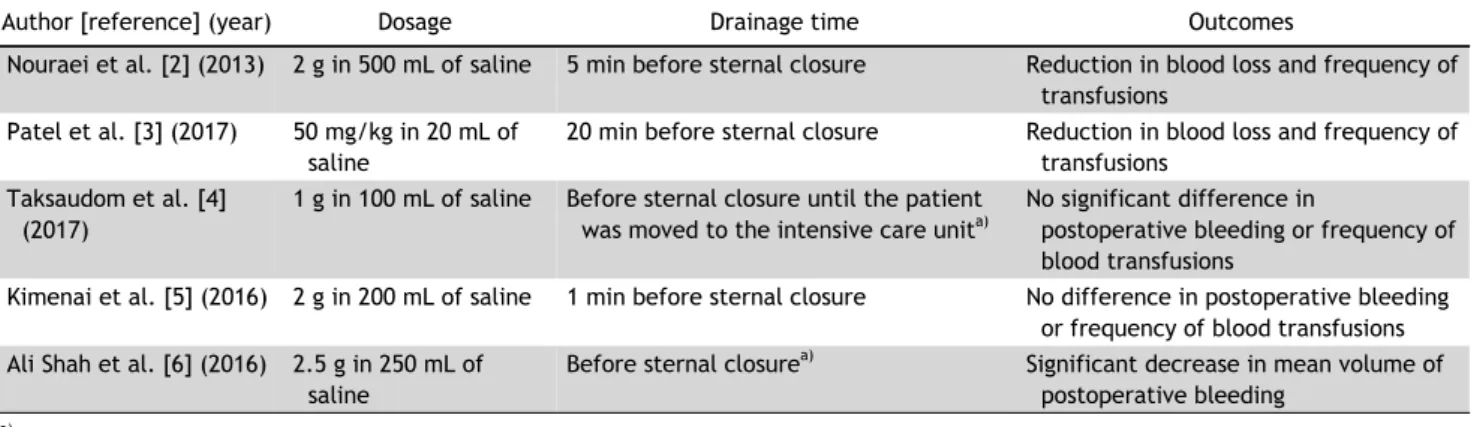
Kimenai et al. [5] administered 2 g of TXA intra- venously before making the sternal incision and 2 g of T XA diluted in 200 mL of saline intrapericardially before sternal closure, as well as 2 g of T XA after surgery. They found no difference in postoperative blood loss depending on whether T XA was ad- ministered [5]. Ali Shah et al. [6] poured a solution of 2.5 g of T XA in 250 mL of normal saline into the pericardial cavity before sternal closure and found a significant decrease in mean volume of postoperative bleeding. T able 1 summarizes the various dosages
Korean J Thorac Cardiovasc Surg 2017;50:477-478 □ Brief Communication □
https://doi.org/10.5090/kjtcs.2017.50.6.477
Seyed Mahmood Nouraei
− 478 −
Table 1. Various reported dosages of tranexamic acid, drainage times, and outcomes
Author [reference] (year) Dosage Drainage time Outcomes
Nouraei et al. [2] (2013) 2 g in 500 mL of saline 5 min before sternal closure Reduction in blood loss and frequency of transfusions
Patel et al. [3] (2017) 50 mg/kg in 20 mL of saline
20 min before sternal closure Reduction in blood loss and frequency of transfusions
Taksaudom et al. [4]
(2017)
1 g in 100 mL of saline Before sternal closure until the patient was moved to the intensive care unit
a)No significant difference in
postoperative bleeding or frequency of blood transfusions
Kimenai et al. [5] (2016) 2 g in 200 mL of saline 1 min before sternal closure No difference in postoperative bleeding or frequency of blood transfusions Ali Shah et al. [6] (2016) 2.5 g in 250 mL of
saline
Before sternal closure
a)Significant decrease in mean volume of postoperative bleeding
a)