ABSTRACT
Background and Objectives: Atrial fibrillation (AF) is associated with a higher long-term risk of major cardiovascular events. However, its clinical implications with respect to peri-operative cardiovascular outcomes in patients undergoing non-cardiac surgery is unclear. We tried to examine the association between pre-operative AF and peri-operative cardiovascular outcomes.
Methods: We retrospectively analyzed data from 26,501 consecutive patients who underwent comprehensive preoperative cardiac evaluations for risk stratification prior to receiving non- cardiac surgery at our center. Preoperative AF was diagnosed in 1,098 patients (4.1%), and their cardiovascular outcomes were compared with those of patients without AF. The primary outcome was the rate of major adverse cardiac and cerebrovascular events (MACCE) during immediate post-surgery period (<30 days).
Results: Patients with AF were older and had higher proportion of male sex, higher rate of extra-cardiac comorbidities, higher CHA
2DS
2-VASc score, and higher revised cardiac risk index (RCRI) compared with those without AF. The rate of MACCE was significantly higher in AF patients compared to non-AF patients (4.6% vs. 1.2%, p<0.001). Preoperative AF was associated with higher risk of MACCE, even after multivariable adjustment (odds ratio, 2.97;
95% confidence interval, 2.13–4.07, p<0.001). The relative contribution of AF to MACCE was larger in patients with lower RCRI (p for interaction=0.010). The discriminating performance of RCRI was significantly enhanced by addition of AF.
Conclusions: In patients undergoing non-cardiac surgery, preoperative AF was associated with a higher risk of peri-operative cardiovascular outcomes.
Keywords: Atrial fibrillation; Stroke; Surgery; Risk assessment
Original Article
Received: Jul 8, 2019 Revised: Sep 10, 2019 Accepted: Oct 25, 2019 Correspondence to
Jun Kim, MD, PhD
Department of Cardiology, University of Ulsan College of Medicine, Asan Medical Center, 88, Olympic-ro 43-gil, Songpa-gu, Seoul 05505, Korea.
E-mail: [email protected]
*Min Soo Cho and Cheol Hyun Lee contributed equally to this article.
Copyright © 2020. The Korean Society of Cardiology
This is an Open Access article distributed under the terms of the Creative Commons Attribution Non-Commercial License (https://
creativecommons.org/licenses/by-nc/4.0) which permits unrestricted noncommercial use, distribution, and reproduction in any medium, provided the original work is properly cited.
ORCID iDs
Min Soo Cho
https://orcid.org/0000-0001-9867-4991 Cheol Hyun Lee
https://orcid.org/0000-0003-4203-1457 Jun Kim
https://orcid.org/0000-0002-3573-638X Jung-Min Ahn
https://orcid.org/0000-0003-4031-391X Minkyu Han
https://orcid.org/0000-0002-5639-3494 Gi-Byoung Nam
https://orcid.org/0000-0003-4391-5406 Kee-Joon Choi
https://orcid.org/0000-0002-9055-049X You-Ho Kim
https://orcid.org/0000-0003-0063-6300
Min Soo Cho , MD, PhD
1,*, Cheol Hyun Lee , MD
2,*, Jun Kim , MD, PhD
1, Jung-Min Ahn , MD
1, Minkyu Han , PhD
3, Gi-Byoung Nam , MD, PhD
1, Kee-Joon Choi , MD, PhD
1, and You-Ho Kim , MD, PhD
11
Department of Cardiology, University of Ulsan College of Medicine, Asan Medical Center, Seoul, Korea
2
Division of Cardiology, Department of Internal Medicine, Keimyung University Dongsan Hospital, Daegu, Korea
3
Department of Clinical Epidemiology and Biostatistics, University of Ulsan College of Medicine, Asan Medical Center, Seoul, Korea
Clinical Implications of Preoperative Nonvalvular Atrial Fibrillation
with Respect to Postoperative
Cardiovascular Outcomes in Patients
Undergoing Non-Cardiac Surgery
Conflict of Interest
The authors have no financial conflicts of interest.
Author Contributions
Conceptualization: Cho MS, Lee CH, Kim J, Ahn JM, Kim YH; Data curation: Cho MS, Kim J, Ahn JM; Formal analysis: Cho MS, Han M;
Investigation: Cho MS, Kim J; Methodology:
Cho MS, Lee CH, Kim J, Han M; Project administration: Cho MS, Kim J, Ahn JM;
Resources: Lee CH, Kim J, Ahn JM; Software:
Lee CH; Supervision: Kim J, Nam GB, Choi KJ, Kim YH; Validation: Cho MS, Kim J, Nam GB, Choi KJ, Kim YH; Visualization: Kim J; Writing - original draft: Cho MS, Kim J.
INTRODUCTION
Atrial fibrillation (AF) is the most common form of clinical arrhythmia associated with various cardiac and cerebrovascular events, and its prevalence is continuously increasing in societies with aging population.
1)Patients are especially vulnerable in perioperative periods to such events resulting from factors such as hemodynamic changes, increased sympathetic tone, tendency for myocardial ischemia, surgery-induced stress, and cessation of anticoagulants.
2)3)Despite the development in many aspects of perioperative management, reduction of major adverse cardiovascular and cerebrovascular event (MACCE) after
noncardiac surgery has been modest at best.
4)Therefore, better tools for defining the high- risk group for perioperative adverse events need to be developed.
AF is closely associated with the cardioembolic strokes which result in permanent
neurologic deficits and mortality.
5)Moreover, AF is also related to the overall postoperative cardiac and cerebrovascular events.
6)7)However, AF itself is currently not included in routine perioperative risk assessments,
8)9)and its overall impact on postoperative cardiac or cerebrovascular events remains unclear.
10-12)We hypothesized that preoperative AF is an independent risk factor for perioperative cardiovascular event, and tested our hypothesis in a large-sized retrospective cohort that underwent both non-cardiac surgery and comprehensive preoperative cardiac evaluation.
METHODS
Study population
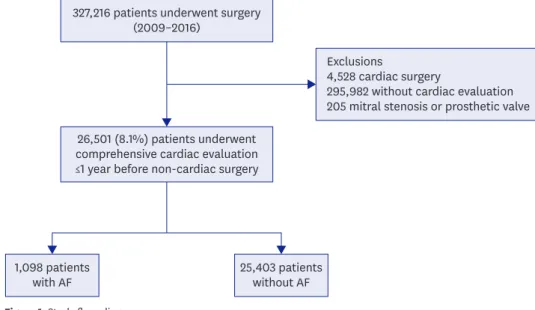
Of 327,216 patients who underwent surgery from November 2009 to March 2016 at Asan Medical Center in Seoul, Korea, we excluded patients who 1) underwent cardiac surgery (n=4,528); 2) did not undergo a comprehensive cardiac evaluation (n=295,982); or 3) has mitral stenosis or prosthetic valve (n=205). The main study population therefore comprised 26,501 (8.1%) patients who received comprehensive cardiac evaluation prior to undergoing non-cardiac surgery. This study conformed to the ethical guidelines of the 1975 Declaration of Helsinki and was approved by the Institutional Review Board of Asan Medical Center (2018- 1445), which waived the need for informed consent due to the retrospective nature of the study.
Data collection and definition of variables
The comprehensive cardiac evaluation for risk stratification included a 12-lead
electrocardiogram (ECG), routine chest radiography, transthoracic echocardiography, and myocardial perfusion imaging (MPI). At our institution, patients scheduled for elective non- cardiac surgery were initially evaluated by the attending surgeon in the respective outpatient clinic or during hospitalization. The initial evaluation consisted of a dedicated investigation of the patient's medical history, comorbidities, and functional capacity. If the patient's functional capacity could not be measured or if relevant clinical risk factors for peri-operative cardiovascular outcomes existed, non-invasive testing was performed.
8)9)By considering the expected cardiovascular risk, the attending surgeon made the decision to proceed with surgery, with consensus from cardiologists, neurologists, and anethesiologists.
ECGs were recorded at a gain of 10 mm/mV and paper speed of 25 mm/seconds. All ECGs
were reviewed for AF by an independent cardiologist blinded to the outcomes. Patients were
considered to have AF when AF was documented in any ECG taken before the index surgery.
Persistent or permanent AF was defined as documented AF on 2 consecutive ECGs which taken at least 7 days apart according to the guideline.
13)Transthoracic echocardiography was performed to assess the size and function of the cardiac chambers and the presence of valvular heart disease (VHD). All measurements and functional assessments of each chamber and valve were made according to the practice guideline of the major echocardiography societies, and the results were confirmed by an imaging specialist.
14)Moderate to severe left atrial enlargement was defined as left atrial anterior posterior diameter of ≥47 mm in men and ≥43 mm in women, according to the aforementioned guideline.
MPI was performed using thallium-201 as a radioactive tracer according to a standardized protocol. MPI was acquired during adenosine-stress and post-stress period with a 2-head gamma camera. A perfusion defect of >10% of the total myocardium in the MPI was determined to be clinically significant, because this threshold is large enough to assign a patient to the high-risk group.
15)Two clinical risk scoring systems—the revised cardiac risk index (RCRI) and the CHA
2DS
2-VASc score—were used according to their original definitions to determine the additional clinical implications of preoperative AF.
12)16)The definition of high-risk surgery was in line with the definition in the RCRI (i.e., intraperitoneal, intrathoracic, or suprainuninal vascular procedures). The medication status just before the admission for surgery, including regular anticoagulation, were gathered. The decision for withholding anticoagulation or application of heparin bridging were made by the attending surgeon.
All study data were acquired from the Asan BiomedicaL research Environment (ABLE) system, which is a big data solution that provides anonymized form of all medical
information recorded at our institution, including electronic medical records, medications, laboratory or imaging findings, and surgical records. The researchers had access to the information under the approval of the Institutional Review Board.
Study outcome
The primary study outcomes was the rate of MACCE (composite of death, ischemic strokes, and myocardial infarctions [MIs]) during the immediate postoperative period (before discharge or ≤30 days after the index surgery). The secondary outcome was the rate of ischemic stroke during the same period. The date and cause of death were recorded by an independent researcher blinded to the study group assignment. Ischemic stroke was defined as an acute episode of focal or global neurological dysfunction by ischemic injury of the brain, spinal cord, or retinal vasculature.
17)Diagnosis of ischemic stroke was primarily based on diffusion-weighted magnetic resonance imaging (MRI) and clinical presentation. All the postoperative brain MRI images taken in the hospitalization for surgery were reviewed and the diagnosis of the ischemic stroke was verified by independent neuroradiologists. The MRI imaging in the perioperative period was performed in 4.8% (1,268/26,501) of sutduy population, based on the clinical symptom and signs of ischemic stroke as well as attening surgeon or nerologist's discretion. Diagnosis of MI was made primarily based on elevation of the cardiac enzyme (creatine kinase-myocardial band) or troponin I to above the upper range limit with ischemic symptoms, ECG changes, and other invasive or non-invasive investigations according to the third universal definition of MI.
18)All clinical outcomes were verified and adjudicated by an independent researcher.
Statistical analysis
All statistical analyses were performed using R software version 3.3.1 software (R Foundation
for Statistical Computing, Vienna, Austria; www.r-project.org). All p values were 2-sided and
p values <0.05 were considered statistically significant. Continuous variables are presented as either means with standard deviation or median values with interquartile ranges. Categorical variables are presented as frequency and percentage. Continuous variables were compared using Student's t-test or Wilcoxon rank-sum test, and categorical variables using χ
2test or Fisher's exact test, as appropriate.
Multivariable logistic regression was used to determine the independent predictors of outcome variables. The baseline characteristics of the patients and results of cardiac evaluations with clinical relevance were selected as potential risk-adjusting variables.
Variables with p values <0.10 in the univariable analysis or with clinical relevance were included in the multivariable analysis. The model calibration was assessed using the Hosmer-Lemeshow test. We made two types of multivariable models to validate the pre- existing risk stratification models and assess the consistency of implication of AF to the study outcomes. In model 1, components of the pre-existing models (RCRI for MACCE;
CHA
2DS
2-VASc score for stroke) were individually included in the multivariable model. In model 2, risk stratification score (RCRI and CHA
2DS
2-VASc) were included to assess the increased risk according to the increment of the score. The final model was created using a backward elimination procedure. Multicollinearity was assessed using the variance inflation factor (VIF) and no significant multicollinearity was found. Incremental discriminating performance value with addition of AF to the preexisting models was assessed using the receiver-operating characteristics (ROC) analysis. Pairwise comparisons between ROC curves were made using the method of Delong.
RESULTS
From March 2009 through December 2016, a total of 327,216 patients underwent surgery at our center (Figure 1). Among those patients, 26,501 (8.1%) underwent comprehensive cardiac evaluation within 1 year before surgery; AF was found in 1098 patients (4.1%), approximately two-thirds of whom had persistent/permanent AF (n=709, 65.6%) and another one-third
327,216 patients underwent surgery (2009–2016)
26,501 (8.1%) patients underwent comprehensive cardiac evaluation
≤1 year before non-cardiac surgery
1,098 patients
with AF 25,403 patients
without AF
Exclusions
4,528 cardiac surgery
295,982 without cardiac evaluation 205 mitral stenosis or prosthetic valve
Figure 1. Study flow-diagram.
AF = atrial fibrillation.
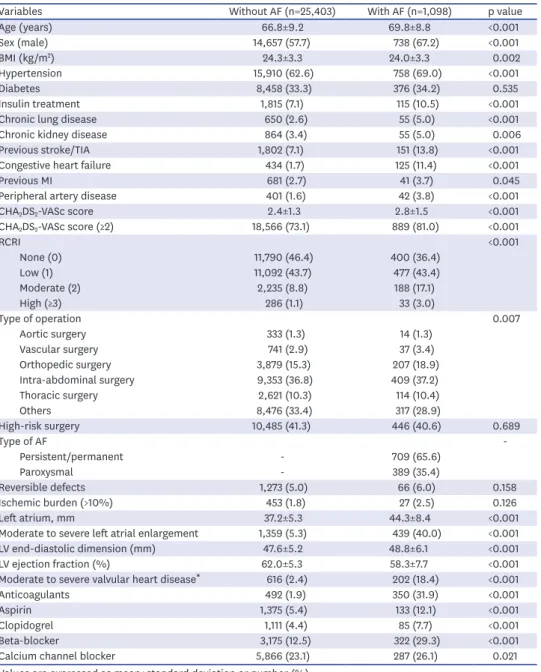
had paroxysmal AF (n=389, 35.4%). The baseline characteristics of the symptomatic and asymptomatic patients are shown in Table 1. Patients with AF generally had higher clinical risk profiles such as a higher mean age, higher prevalence of hypertension, chronic lung or kidney disease, prior stroke, heart failure, MI, and peripheral artery disease. The higher risk profiles resulted in a significantly higher revised cardiac risk index as well as higher CHA
2DS
2- VASc score. Distribution of the surgery type showed some differences, but the rate of high- risk surgery was similar between the two groups.
In the myocardial perfusion scan, presence of reversible defect did not significantly differ between the 2 groups, but ischemic burden (≥10%) was more common in patients with
Table 1. Baseline characteristics
Variables Without AF (n=25,403) With AF (n=1,098) p value
Age (years) 66.8±9.2 69.8±8.8 <0.001
Sex (male) 14,657 (57.7) 738 (67.2) <0.001
BMI (kg/m
2) 24.3±3.3 24.0±3.3 0.002
Hypertension 15,910 (62.6) 758 (69.0) <0.001
Diabetes 8,458 (33.3) 376 (34.2) 0.535
Insulin treatment 1,815 (7.1) 115 (10.5) <0.001
Chronic lung disease 650 (2.6) 55 (5.0) <0.001
Chronic kidney disease 864 (3.4) 55 (5.0) 0.006
Previous stroke/TIA 1,802 (7.1) 151 (13.8) <0.001
Congestive heart failure 434 (1.7) 125 (11.4) <0.001
Previous MI 681 (2.7) 41 (3.7) 0.045
Peripheral artery disease 401 (1.6) 42 (3.8) <0.001
CHA
2DS
2-VASc score 2.4±1.3 2.8±1.5 <0.001
CHA
2DS
2-VASc score (≥2) 18,566 (73.1) 889 (81.0) <0.001
RCRI <0.001
None (0) 11,790 (46.4) 400 (36.4)
Low (1) 11,092 (43.7) 477 (43.4)
Moderate (2) 2,235 (8.8) 188 (17.1)
High (≥3) 286 (1.1) 33 (3.0)
Type of operation 0.007
Aortic surgery 333 (1.3) 14 (1.3)
Vascular surgery 741 (2.9) 37 (3.4)
Orthopedic surgery 3,879 (15.3) 207 (18.9)
Intra-abdominal surgery 9,353 (36.8) 409 (37.2)
Thoracic surgery 2,621 (10.3) 114 (10.4)
Others 8,476 (33.4) 317 (28.9)
High-risk surgery 10,485 (41.3) 446 (40.6) 0.689
Type of AF -
Persistent/permanent - 709 (65.6)
Paroxysmal - 389 (35.4)
Reversible defects 1,273 (5.0) 66 (6.0) 0.158
Ischemic burden (>10%) 453 (1.8) 27 (2.5) 0.126
Left atrium, mm 37.2±5.3 44.3±8.4 <0.001
Moderate to severe left atrial enlargement 1,359 (5.3) 439 (40.0) <0.001
LV end-diastolic dimension (mm) 47.6±5.2 48.8±6.1 <0.001
LV ejection fraction (%) 62.0±5.3 58.3±7.7 <0.001
Moderate to severe valvular heart disease
*616 (2.4) 202 (18.4) <0.001
Anticoagulants 492 (1.9) 350 (31.9) <0.001
Aspirin 1,375 (5.4) 133 (12.1) <0.001
Clopidogrel 1,111 (4.4) 85 (7.7) <0.001
Beta-blocker 3,175 (12.5) 322 (29.3) <0.001
Calcium channel blocker 5,866 (23.1) 287 (26.1) 0.021
Values are expressed as mean±standard deviation or number (%).
AF = atrial fibrillation; BMI = body mass index; LV = left ventricle; MI = myocardial infarction; RCRI = revised cardiac risk index; TIA = transient ischemic accident; VHD = valvular heart disease.
*
Except mitral stenosis or prosthetic valves.
AF. Baseline echocardiography showed that patients with AF had larger left atrium, left ventricular (LV) end-diastolic dimension, higher rate of moderate-to-severe VHD, and lower mean LV ejection fraction. Medications related to AF management such as antiplatelets, anticoagulants, beta-blockers, and calcium channel blockers were more frequently prescribed in the AF group.
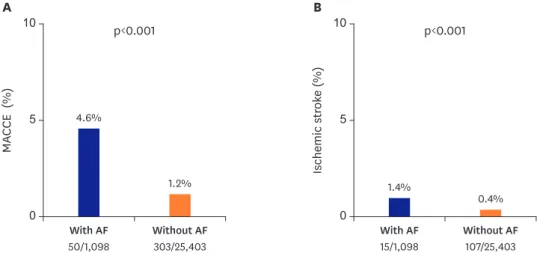
During the 30 days after the index surgery, MACCE and ischemic stroke occurred in 353 (1.3%) and 122 (0.5%) patients, respectively (Table 2). In the crude analysis, the patients with AF had a significantly higher rate of MACCE (4.6% vs. 1.2%, p<0.001) and ischemic stroke (1.4% vs. 0.4%, p<0.001, Figure 2). Chronic anticoagulation therapy and heparin bridging therapy were prescribed in 350 (31.9%) and 73 (6.6%) patients with AF, respectively. The rate of MACCE (2.7% [2/73] vs. 2.9% [8/277], p=0.946) or ischemic stroke (0% [0/73] vs. 1.4%
[4/277], p=0.584) did not significantly differ between patients with heparin bridging and those without. Of those AF patients with ischemic stroke (n=15), 11 patients (73.3%) did not receiving anticoagulants and 4 patients (26.7%) taken anticoagulants before surgery but temporarily withheld at the time of ischemic stroke.
The predictors of MACCE according to univariable and multivariable analyses are summarized in Table 3. In the univariable analysis, preoperative AF (odds ratio [OR], 3.95; 95%
confidence interval [CI], 2.88–5.31; p<0.001) was associated with significantly higher odds of postoperative MACCE, together with all components of RCRI and variables from non-invasive
Table 2. Crude event rates according to the presence of AF and risk stratificationVariable Without AF With AF p value
Overall population 25,403 1,098
MACCE 303 (1.2) 50 (4.6) <0.001
Death 80 (0.3) 21 (1.9) <0.001
Stroke 107 (0.4) 15 (1.4) <0.001
MI 141 (0.6) 19 (1.7) <0.001
CHA
2DS
2-VASc score (0–1) 6,837 209
MACCE 79 (1.2) 6 (2.9) 0.025
Death 25 (0.4) 5 (2.4) 0.002
Stroke 11 (0.2) 0 (0) 0.718
MI 48 (0.7) 1 (0.5) >0.99
CHA
2DS
2-VASc score (≥2) 18,566 889
MACCE 224 (1.2) 44 (4.9) <0.001
Death 55 (0.3) 16 (1.8) <0.001
Stroke 96 (0.5) 15 (1.7) <0.001
MI 93 (0.5) 18 (2.0) <0.001
RCRI (0) 11,790 400
MACCE 62 (0.5) 13 (3.3) <0.001
Death 24 (0.2) 5 (1.2) 0.002
Stroke 16 (0.1) 3 (0.8) 0.023
MI 27 (0.2) 7 (1.8) <0.001
RCRI (1) 11,092 477
MACCE 151 (1.4) 21 (4.4) <0.001
Death 40 (0.4) 11 (2.3) <0.001
Stroke 54 (0.5) 5 (1.0) 0.005
MI 66 (0.6) 7 (1.5) 0.039
RCRI (≥2) 2,521 221
MACCE 90 (3.6) 16 (7.2) 0.007
Death 16 (0.6) 5 (2.3) 0.023
Stroke 37 (1.5) 7 (3.2) 0.054
MI 48 (1.9) 5 (2.3) 0.613
AF = atrial fibrillation; MACCE = major adverse cardiac and cerebrovascular events; MI = myocardial infarction;
RCRI = revised cardiac risk index.
risk stratification evaluations. The higher odds of AF (OR, 2.96; 95% CI, 2.11–4.08; p<0.001) for MACCE was consistent in the final multivariable model 1, after backward-elimination procedure. The AF was also an independent predictor of MACCE in the model 2, in which the RCRI itself was included as a continuous variable. There was a differential implication of AF on MACCE when the patients were stratified according to the RCRI (Figure 3). AF was associated with a higher odd for MACCE for all RCRI groups, but the OR was higher in the patients with a lower RCRI (OR, 2.11; 95% CI, 1.17–3.56; p= 0.007 for ≥2 RCRI risk factors; OR, 3.34; 95% CI, 2.04–5.20; p<0.001 for 1 RCRI risk factor; OR, 6.35; 95% CI, 3.32–11.27; p<0.001 for no RCRI risk factor; p for interaction=0.010).
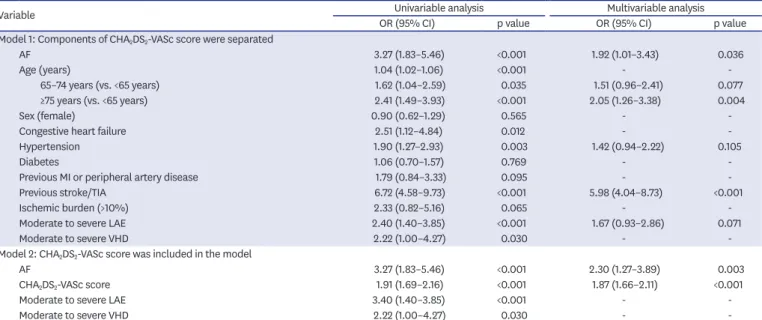
The same procedure was performed for secondary outcome of ischemic stroke (Table 4). The preoperative AF was significant predictor in univariable analysis (OR, 3.27; 95% CI, 1.83–
5.46; p<0.001) and multivariable model 1 (OR, 1.92; 95% CI, 1.01–3.43; p=0.036) adjusted 10
5
0 With AF Without AF
303/25,403 50/1,098
1.2%
4.6%
MA CCE (%)
A
p<0.001 10
5
0 With AF Without AF
107/25,403 15/1,098
1.4% 0.4%
Ischemic str ok e (%)
B
p<0.001
Figure 2. Rate of MACCE (A) and ischemic strokes (B) during the immediate postoperative period.
AF = atrial fibrillation; MACCE = major adverse cardiac and cerebrovascular events.
Table 3. Predictors of postoperative major coronary and cerebrovascular events
Variable Univariable analysis Multivariable analysis
OR (95% CI) p value OR (95% CI) p value Model 1: Components of RCRI were separated
AF 3.95 (2.88–5.31) <0.001 2.96 (2.11–4.08) <0.001
Sex (female) 0.70 (0.56–0.87) <0.001 0.81 (0.64–1.01) 0.064
Age (per 10 years) 1.03 (0.92–1.14) 0.630 - -
High-risk surgery 1.52 (1.24–1.88) <0.001 1.61 (1.30–1.99) <0.001 History of ischemic heart disease 3.28 (2.49–4.26) <0.001 2.74 (2.05–3.62) <0.001 Congestive heart failure 3.14 (2.08–4.58) <0.0001 1.48 (0.95–2.23) 0.072 Previous stroke/TIA 2.62 (1.96–3.45) <0.001 2.15 (1.60–2.85) <0.001 Pre-operative treatment with insulin 2.08 (1.51–2.79) <0.001 1.58 (1.13–2.16) 0.005 Pre-operative creatinine (>2 mg/dL) 2.36 (1.66–3.27) <0.001 1.83 (1.26–2.59) 0.001 Ischemic burden (>10%) 2.10 (1.14–3.53) 0.009 1.69 (0.91–2.87) 0.073 Moderate to severe VHD 2.44 (1.57–3.60) <0.001 1.54 (0.97–2.35) 0.053 Model 2: RCRI was included in the model
AF 3.95 (2.88–5.31) <0.001 2.97 (2.13–4.07) <0.001
Sex (female) 0.70 (0.56–0.87) <0.001 0.81 (0.64–1.01) 0.065
Age (per 10 years) 1.03 (0.92–1.14) 0.630 - -
RCRI 2.27 (1.99–2.57) <0.001 2.13 (1.87–2.42) <0.001
Ischemic burden (>10%) 2.10 (1.14–3.53) 0.009 1.70 (0.91–2.87) 0.069
Moderate to severe VHD 2.44 (1.57–3.60) <0.001 1.49 (0.94–2.27) 0.073
AF = atrial fibrillation; CI = confidence interval; OR = odd ratio; RCRI = revised cardiac risk index; TIA = transient
ischemic accident; VHD = valvular heart disease.
for the components of CHA
2DS
2-VASc score and result of evaluations. The AF was also an independent predictor of ischemic stroke in the model 2 (OR, 2.30; 95% CI, 1.27–3.89;
p=0.003) in which the CHA
2DS
2-VASc score itself was included. When patients were stratified according to the CHA
2DS
2-VASc score, a higher stroke rate of AF patients was noted only in those patients with a CHA
2DS
2-VASc score ≥2 (1.7% vs. 0.5%, p<0.001, Figure 4). The rate of a stroke was almost negligible in the patients with lower CHA
2DS
2-VASc scores (0–1, 0% vs 0.2%, p=0.718), regardless of the AF status.
We assumed that the AF has as much influence as 1 point of RCRI (for MACCE) or CHA
2DS
2- VASc score (for ischemic stroke), since OR of AF were similar to that of 1-point increment of each scoring system (Tables 3 and 4). In the ROC analysis, addition of AF to the RCRI
Table 4. Predictors of ischemic stroke
Variable Univariable analysis Multivariable analysis
OR (95% CI) p value OR (95% CI) p value
Model 1: Components of CHA
2DS
2-VASc score were separated
AF 3.27 (1.83–5.46) <0.001 1.92 (1.01–3.43) 0.036
Age (years) 1.04 (1.02–1.06) <0.001 - -
65–74 years (vs. <65 years) 1.62 (1.04–2.59) 0.035 1.51 (0.96–2.41) 0.077
≥75 years (vs. <65 years) 2.41 (1.49–3.93) <0.001 2.05 (1.26–3.38) 0.004
Sex (female) 0.90 (0.62–1.29) 0.565 - -
Congestive heart failure 2.51 (1.12–4.84) 0.012 - -
Hypertension 1.90 (1.27–2.93) 0.003 1.42 (0.94–2.22) 0.105
Diabetes 1.06 (0.70–1.57) 0.769 - -
Previous MI or peripheral artery disease 1.79 (0.84–3.33) 0.095 - -
Previous stroke/TIA 6.72 (4.58–9.73) <0.001 5.98 (4.04–8.73) <0.001
Ischemic burden (>10%) 2.33 (0.82–5.16) 0.065 - -
Moderate to severe LAE 2.40 (1.40–3.85) <0.001 1.67 (0.93–2.86) 0.071
Moderate to severe VHD 2.22 (1.00–4.27) 0.030 - -
Model 2: CHA
2DS
2-VASc score was included in the model
AF 3.27 (1.83–5.46) <0.001 2.30 (1.27–3.89) 0.003
CHA
2DS
2-VASc score 1.91 (1.69–2.16) <0.001 1.87 (1.66–2.11) <0.001
Moderate to severe LAE 3.40 (1.40–3.85) <0.001 - -
Moderate to severe VHD 2.22 (1.00–4.27) 0.030 - -
AF = atrial fibrillation; CI = confidence interval; LAE = left atrial enlargement; MI = myocardial infarction; OR = odd ratio; TIA = transient ischemic accident; VHD = valvular heart disease.
10
5
0
Without AF With AF
151/11,092
p for interaction=0.010
21/477
1.4%
4.4%
MA CCE (%)
10
5
0
Without AF With AF
90/2,521 16/221
3.6%
7.2%
MA CCE (%)
p<0.001 OR 3.34 (2.04–5.20) 10
5
0
Without AF With AF
62/11,790 13/400
0.5%
MA CCE (%) 3.3%
No risk factor 1 risk factor ≥2 risk factor
p<0.001
OR 6.35 (3.32–11.27) p=0.007
OR 2.11 (1.17–3.56)
Figure 3. Rate of MACCE by the AF status, stratified by the revised cardiac risk.
AF = atrial fibrillation; CI = confidence interval; MACCE = major adverse cardiac and cerebrovascular events; OR = odds ratio.
significantly enhance the discriminating performance (area under curve [AUC] 0.667 [95%
CI, 0.640–0.693] to AUC 0.688 [95% CI, 0.662–0.714], p<0.001, Supplementary Table 1 and Supplementary Figure 1). However, for ischemic stroke, addition of AF to the CHA
2DS
2-VASc score showed only trend of enhanced discrimination without statistical significance (AUC 0.733 [95% CI, 0.685–0.781] to AUC 0.739 [95% CI, 0.690–0.787], p=0.165).
DISCUSSION
In this retrospective study, we report significant findings regarding the implication of AF with respect to perioperative cardiovascular outcomes: 1) preoperative AF was an independent risk factor of MACCE and ischemic stroke, independent of the prior risk evaluation systems and cardiac evaluation results; 2) relative contribution of AF status to MACCE was the largest in patients with low RCRI; and 3) the discriminating performance of RCRI was significantly enhanced by the addition of AFs.
The risk of supraventricular arrhythmias, which was included in the original cardiac risk index,
19)was eliminated in its revised version for subsequent studies indicated a lower level of risk.
12)Nevertheless, considering the increasing prevalence of AF and the advancement in the prevention methods against AF-related complications, the clinical implication of preoperative AF is being highlighted. Kaatz et al.
6)demonstrated an increased risk of stroke in patients with AF, and van Diepen et al.
20)showed that AF patients had a higher risk of mortality compared with coronary artery disease patients. Although these studies have epidemiologic implications outcomes were not adequately adjudicated in these analysis of claim data based studies. McAlister et al.
10)showed that AF patients had a higher risk of stroke by directly assessing stroke outcomes from prospective registry data; however, the authors did not sufficiently incorporate the data from preoperative cardiac evaluations. In this regard, our study has major advantages over prior studies in the following regard: as the main outcome of ischemic strokes was directly assessed from imaging studies, our study provides a more precise incidence of the outcomes than did the previous studies; in addition, as we analyzed patients who underwent comprehensive cardiac evaluations, we were able
p for interaction=0.976
10
5
0
Without AF With AF
11/6,837 0/209
0% 0.2%
Ischemic str ok e (%)
p=0.718
CHA
2DS
2-VASc score 0 – 1
10
5
0
Without AF With AF
96/18,566 15/889
0.5%
Ischemic str ok e (%) 1.7%
CHA
2DS
2-VASc score ≥2 p<0.001
Figure 4. Rate of ischemic strokes by the AF status stratified by the CHA2
DS
2-VASc score.
AF = atrial fibrillation.
to incorporate the clinical implication of these evaluations, which were not incorporated in prior risk stratification systems. Taken together, our study is an important extension of prior studies that examined the independent clinical implications of AF in cardiac and cerebrovascular outcomes.
The association between AF status and perioperative overall MACCE was not well-evaluated in prior studies, although the association between myocardial injury after non-cardiac surgery and AF was demonstrated in the Vascular events In noncardiac Surgery patIents cOhort evaluatioN (VISION) study, whose results are in line with our findings.
21)Such association may be partially explained by decrease in cardiac output from the loss of the atrial contraction and decrease in ventricular filling time, which may be exaggerated by surgical stress.
22)Our results showed that AF was an independent predictor of MACCE and significantly increased the discriminating performance, even with the consideration of the established risk scores and cardiac evaluations. In addition, a subgroup analysis demonstrated that the odd ratio of AF was the highest in patients with lower RCRI risks.
This reversed trend implies that the contribution of AF on MACCE is diluted in patients with multiple risk factors, but maximized in those without risk factors. Therefore, our study demonstrates that AF has clinical utility in defining the high-risk patients, especially in those with lower clinical risk scores; thus, we suggest that AF be incorporated in peri- operative risk stratification.
In our analysis, both CHA
2DS
2-VASc score and AF were significantly associated with perioperative ischemic stroke. Defining high-risk group for ischemic stroke is of clinical significance as the rate of perioperative ischemic stroke is increasing, which is in contrary to the decreasing rate of MI or overall mortality.
4)Our finding implies that the CHA
2DS
2-VASc score could be used for assessing the risk of stroke in not only AF patients but in overall population as well. Specifically, the negligible rate of ischemic stroke in patients with low CHA
2DS
2-VASc scores (0–1) indicates that this group should be designated as a truly low- risk group. On the contrary, AF may be used as a useful marker for high-risk group for ischemic stroke, considering its independent association with both cardiac and non-cardiac comorbidities as well as higher CHA
2DS
2-VASc score. Therefore, although the addition of AF did not significantly enhance the discriminating performance, our results suggest that the presence of preoperative AF may have clinical utility in refining risk assessment.
There were several limitations in this study. The retrospective observational design of the study entails inherent selection bias. As all patients enrolled in the analysis were those whom functional capacities cannot be measured or with clinically risk factors, the study population was fundamentally high-risk patients assessed by the attending surgeons. Therefore, generalization of the current findings should be done with caution as it could be a selected high-risk population. As the patients were enrolled over 10 years of period, indication for the anticoagulation was not consistent which could influence the study outcomes. As the current analysis was in retrospective nature, although general principle of preoperative evaluations of our center was given, detailed indications of each evaluation cannot be fully assessed. In its original description, the targeted outcome of RCRI was not MACCE or ischemic stroke;
however, as both main study outcomes had been commonly used in recent studies, our
findings still hold clinical significance. Lastly, although we analyzed a relatively large-sized
population, we could not develop a new prediction model because the number of clinical
events was small. The small number of events also led to the limited number of significant
predictors in the final multivariable models.
In conclusion, preoperative AF was a clinically important independent predictor of peri- operative MACCE and ischemic stroke. We suggest that preoperative AF be incorporated into future risk assessment models in order to better predict cardiovascular events after non- cardiac surgery.
ACKNOWLEDGMENTS
We are grateful to Mr. John Martin and Dr. Joon Seo Lim for editing this article. This research did not receive any specific grant from funding agencies in the public, commercial, or not- for-profit sectors.
SUPPLEMENTARY MATERIALS
Supplementary Table 1
Discriminating performance for addition of AF to the conventional scoring systems Click here to view
Supplementary Figure 1
ROC curve analysis on MACCE (A) and ischemic stroke (B).
Click here to view
REFERENCES
1. Stewart S, Hart CL, Hole DJ, McMurray JJ. A population-based study of the long-term risks associated with atrial fibrillation: 20-year follow-up of the Renfrew/Paisley study. Am J Med 2002;113:359-64.
PUBMED | CROSSREF
2. Priebe HJ. Triggers of perioperative myocardial ischaemia and infarction. Br J Anaesth 2004;93:9-20.
PUBMED | CROSSREF
3. Grau AJ, Eicke M, Burmeister C, Hardt R, Schmitt E, Dienlin S. Risk of ischemic stroke and transient ischemic attack is increased up to 90 days after non-carotid and non-cardiac surgery. Cerebrovasc Dis 2017;43:242-9.
PUBMED | CROSSREF
4. Smilowitz NR, Gupta N, Ramakrishna H, Guo Y, Berger JS, Bangalore S. Perioperative major adverse cardiovascular and cerebrovascular events associated with noncardiac surgery. JAMA Cardiol 2017;2:181-7.
PUBMED | CROSSREF
5. Longstreth WT Jr, Bernick C, Fitzpatrick A, et al. Frequency and predictors of stroke death in 5,888 participants in the Cardiovascular Health Study. Neurology 2001;56:368-75.
PUBMED | CROSSREF
6. Kaatz S, Douketis JD, Zhou H, Gage BF, White RH. Risk of stroke after surgery in patients with and without chronic atrial fibrillation. J Thromb Haemost 2010;8:884-90.
PUBMED | CROSSREF
7. Urbanek C, Palm F, Buggle F, et al. Recent surgery or invasive procedures and the risk of stroke. Cerebrovasc Dis 2014;38:370-6.
PUBMED | CROSSREF
8. Gupta PK, Gupta H, Sundaram A, et al. Development and validation of a risk calculator for prediction of cardiac risk after surgery. Circulation 2011;124:381-7.
PUBMED | CROSSREF
9. Kristensen SD, Knuuti J, Saraste A, et al. 2014 ESC/ESA Guidelines on non-cardiac surgery:
cardiovascular assessment and management: The Joint Task Force on non-cardiac surgery: cardiovascular assessment and management of the European Society of Cardiology (ESC) and the European Society of Anaesthesiology (ESA). Eur Heart J 2014;35:2383-431.
PUBMED | CROSSREF
10. McAlister FA, Jacka M, Graham M, et al. The prediction of postoperative stroke or death in patients with preoperative atrial fibrillation undergoing non-cardiac surgery: a VISION sub-study. J Thromb Haemost 2015;13:1768-75.
PUBMED | CROSSREF
11. Hollenberg M, Mangano DT, Browner WS, et al. Predictors of postoperative myocardial ischemia in patients undergoing noncardiac surgery. JAMA 1992;268:205-9.
PUBMED | CROSSREF
12. Lee TH, Marcantonio ER, Mangione CM, et al. Derivation and prospective validation of a simple index for prediction of cardiac risk of major noncardiac surgery. Circulation 1999;100:1043-9.
PUBMED | CROSSREF
13. January CT, Wann LS, Alpert JS, et al. 2014 AHA/ACC/HRS guideline for the management of patients with atrial fibrillation: a report of the American College of Cardiology/American Heart Association Task Force on Practice Guidelines and the Heart Rhythm Society. J Am Coll Cardiol 2014;64:e1-76.
PUBMED | CROSSREF
14. Baumgartner H, Hung J, Bermejo J, et al. Echocardiographic assessment of valve stenosis: EAE/ASE recommendations for clinical practice. Eur J Echocardiogr 2009;10:1-25.
PUBMED | CROSSREF
15. Fihn SD, Gardin JM, Abrams J, et al. 2012 ACCF/AHA/ACP/AATS/PCNA/SCAI/STS guideline for the diagnosis and management of patients with stable ischemic heart disease: a report of the American College of Cardiology Foundation/American Heart Association Task Force on Practice Guidelines, and the American College of Physicians, American Association for Thoracic Surgery, Preventive Cardiovascular Nurses Association, Society for Cardiovascular Angiography and Interventions, and Society of Thoracic Surgeons. J Am Coll Cardiol 2012;60:e44-164.
PUBMED | CROSSREF
16. Lip GY, Nieuwlaat R, Pisters R, Lane DA, Crijns HJ. Refining clinical risk stratification for predicting stroke and thromboembolism in atrial fibrillation using a novel risk factor-based approach: the euro heart survey on atrial fibrillation. Chest 2010;137:263-72.
PUBMED | CROSSREF
17. Hicks KA, Tcheng JE, Bozkurt B, et al. 2014 ACC/AHA key data elements and definitions for
cardiovascular endpoint events in clinical trials: a report of the American College of Cardiology/American Heart Association Task Force on Clinical Data Standards (Writing Committee to Develop Cardiovascular Endpoints Data Standards). J Am Coll Cardiol 2015;66:403-69.
PUBMED | CROSSREF
18. Thygesen K, Alpert JS, Jaffe AS, et al. Third universal definition of myocardial infarction. Eur Heart J 2012;33:2551-67.
PUBMED | CROSSREF
19. Goldman L, Caldera DL, Nussbaum SR, et al. Multifactorial index of cardiac risk in noncardiac surgical procedures. N Engl J Med 1977;297:845-50.
PUBMED | CROSSREF
20. van Diepen S, Bakal JA, McAlister FA, Ezekowitz JA. Mortality and readmission of patients with heart failure, atrial fibrillation, or coronary artery disease undergoing noncardiac surgery: an analysis of 38 047 patients. Circulation 2011;124:289-96.
PUBMED | CROSSREF
21. Botto F, Alonso-Coello P, Chan MT, et al. Myocardial injury after noncardiac surgery: a large, international, prospective cohort study establishing diagnostic criteria, characteristics, predictors, and 30-day outcomes. Anesthesiology 2014;120:564-78.
PUBMED | CROSSREF
22. Raymond RJ, Lee AJ, Messineo FC, Manning WJ, Silverman DI. Cardiac performance early after cardioversion from atrial fibrillation. Am Heart J 1998;136:435-42.
PUBMED | CROSSREF