• 검색 결과가 없습니다.

Short-term Outcomes of Aortic Wrapping for Mild to Moderate Ascending Aorta Dilatation in Patients Undergoing Cardiac Surgery

N/A
N/A
Protected

Academic year: 2021

Share "Short-term Outcomes of Aortic Wrapping for Mild to Moderate Ascending Aorta Dilatation in Patients Undergoing Cardiac Surgery"

Copied!
7
0
0

로드 중.... (전체 텍스트 보기)

전체 글

(1)

http://dx.doi.org/10.5090/kjtcs.2012.45.3.148 ISSN: 2233-601X (Print) ISSN: 2093-6516 (Online)

Department of Thoracic and Cardiovascular Surgery, Konkuk University Medical Center, Konkuk University School of Medicine Received: September 24, 2011, Revised: November 3, 2011, Accepted: November 22, 2011

Corresponding author: Je-Kyoun Shin, Department of Thoracic and Cardiovascular Surgery, Konkuk University Medical Center, Konkuk University School of Medicine, 120 Neungdong-ro, Gwangjin-gu, Seoul 143-729, Korea

(Tel) 82-2-2030-7595 (Fax) 82-2-2030-7749 (E-mail) [email protected]

C

The Korean Society for Thoracic and Cardiovascular Surgery. 2012. All right reserved.

CC
This is an open access article distributed under the terms of the Creative Commons Attribution Non-Commercial License (http://creative- commons.org/licenses/by-nc/3.0) which permits unrestricted non-commercial use, distribution, and reproduction in any medium, provided the original work is properly cited.

Short-term Outcomes of Aortic Wrapping for Mild to Moderate Ascending Aorta Dilatation in Patients Undergoing Cardiac Surgery

Ji Young Park, M.D., Je-Kyoun Shin, M.D., Jin Woo Chung, M.D., Jun Seok Kim, M.D., Hyun Keun Chee, M.D., Meong-Gun Song, M.D.

Background: The adequate management of mild to moderate dilatation of the ascending aorta during cardiac oper- ations remains controversial. In this study, we present the short-term outcomes of 90 patients undergoing ascending aortic wrapping with a Dacron graft during other cardiac operations. Materials and Methods: From March 2008 to January 2011, 90 consecutive patients underwent treatment for ascending aortic aneurysm using the external wrap- ping technique during the concomitant procedure. The study group consisted of 49 male and 41 female patients with a mean age of 58.7±13 years. The primary cardiac surgical procedures were coronary artery bypass grafting (CABG) in 3, aortic valve replacement in 2, and aortic valvuloplasty in 85 patients (isolated in 62 and combined with CABG or mitral valvuloplasty in 23). The ascending aorta diameter was measured using a computed tomog- raphy scan within 4 weeks after surgery, and was compared with the preoperative value. Results: The diameters of the ascending aorta wrapped with the Dacron graft were significantly reduced within a month after surgery from 46.4±4.3 mm to 33.0±3.5 mm (p<0.05). There was no early mortality or major surgical complication. During the mean follow-up period of 15.4±5.2 months, there was only one late death caused by septic multiorgan failure.

Conclusion: Dacron wrapping of the ascending aorta offers excellent results with very low mortality and morbidity, and it can be regarded as a safe and effective method for the treatment of moderately dilated ascending aorta in selected patients.

Key words: 1. Aorta, surgery 2. Aortic aneurysm

INTRODUCTION

Ascending aortic aneurysm is generally treated by resection and replacement of the aneurysm. Replacement of the ascend- ing aorta is the most frequently performed procedure for thoracic aortic aneurysm [1]. However, this operation is still associated with substantial perioperative mortality and mor- bidity [2,3]. Moreover, the management of mild to moderate dilatation of the ascending aorta of less than 5 cm is contro-

versial. In these cases, some surgeons favour a “watch and wait” approach, until surgery is indicated. A less radical oper- ation than graft replacement, such as reduction aortoplasty with excision of the aneurismal wall and external wrapping of the ascending aorta, was reported by Robicsek in 1982 [4]

as one of the treatments for dilatation of the ascending aorta.

This procedure is generally advocated for combined con-

comitant cardiac surgery. However, there is little information

on the natural history of the remaining aorta following such

(2)

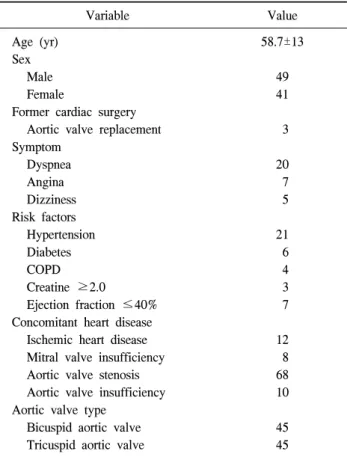
Table 1. Main preoperative characteristics of all 90 patients

Variable Value

Age (yr) Sex

Male Female

Former cardiac surgery Aortic valve replacement Symptom

Dyspnea Angina Dizziness Risk factors

Hypertension Diabetes COPD Creatine ≥2.0

Ejection fraction ≤40%

Concomitant heart disease Ischemic heart disease Mitral valve insufficiency Aortic valve stenosis Aortic valve insufficiency Aortic valve type

Bicuspid aortic valve Tricuspid aortic valve

58.7±13

49 41

3

20 7 5

21 6 4 3 7

12 8 68 10

45 45 COPD, chronic obstructive pulmonary disease.

Table 2. Concomitant surgeries performed

Type of surgery No. of patients AVP

AVP+CABG AVP+MVP

AVP+MVPZ+CABG AVR

CABG Total

62 8 13 2 2 3 90

AVP, aortic valvuloplasty; CABG, coronary artery bypass graft;

MVP, mitral valvuloplasty; AVR, aortic valve replacement.

procedures. The purpose of this study was to report on the short-term outcomes and clinical experience of the wrapping of the ascending aorta in patients with mild to moderately di- latated ascending aortic aneurysm who required concomitant cardiac surgery.

MATERIALS AND METHODS 1) Patients

This study involved a retrospective review of the medical records, surgical notes, echocardiograms, cardiac computed to- mography (CT), and outpatient record of all patients under- going Dacron wrapping of the ascending aorta combined with another cardiac procedure at our institution.

From March 2008 to January 2011, 90 consecutive patients underwent treatment of ascending aortic aneurysm with the Dacron wrapping technique during a concomitant procedure.

Patients with documented ascending aortic dilatation of 3.5 to

5.5 cm on CT were identified as part of their pre-operative cardiac surgery workup. The diameters of the coronary sinus, sinotubular junction, tubular portion, and proximal arch were measured on the CT image.

In these patients, the wrapping of the ascending aorta was performed as described below as an additional procedure to other cardiac operations. All the patients included in this study underwent a CT scan during their routine follow-up within four weeks after surgery. Likewise, the diameters of the four portions of the aorta previously described were com- pared with the diameters measured before surgery.

There were 49 male and 41 female patients. The mean age at operation was 58.7±13 years (range, 24 to 81 years), and the mean body weight was 54±10.5 kg (range, 41 to 79 kg).

Three patients received aortic-valve replacement due to aortic stenosis, 20 complained of dyspnoea due to congestive heart failure, seven complained of angina, five complained of dizzi- ness, and the others were asymptomatic. Detailed character- istics of the patients are described in Table 1. The primary cardiac surgical procedures were coronary artery bypass graft- ing (CABG) in 3, aortic valve replacement in 2, and aortic valvuloplasty in 85 patients (isolated in 62 and combined with CABG or mitral valvuloplasty in 23) (Table 2).

2) Surgical technique

The heart and the ascending aorta were exposed through

the usual median sternotomy. Except for the two patients who

underwent only CABG, the planned open-heart surgery was

performed after a cardiopulmonary bypass (CPB) by employ-

ing the usual method. Following the initiation of car-

diopulmonary bypass, the ascending aorta was freed from its

(3)

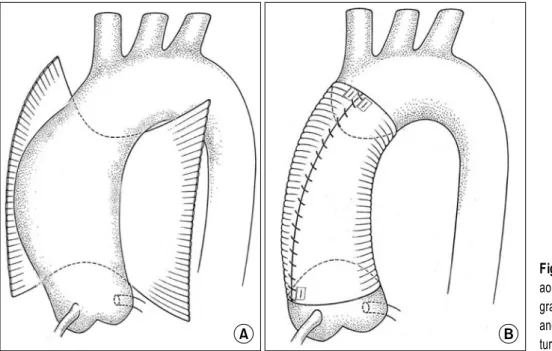
Fig. 1. Wrapping of the ascending aorta with the Dacron graft. The graft is pulled below the aorta (A) and oversewn with a continuous su- ture (B).

pericardial reflection proximally from the sinotubular junction (STJ) and as far up to the origin of the innominate arterial trunk. After completing the main procedure of cardiac surgery under general CPB, just before coming off CPB, a Dacron graft of 25 to 35 mm diameter was cut longitudinally and passed around the ascending aorta to cover the entire length from the STJ to the innominate artery (Fig. 1). The ascending aorta was reduced to the diameter of the Dacron graft by ap- proximating the edges of the Dacron with a continuous 3/0 Prolene suture. In most of the cases, wrapping was completed while increasing the body temperature to reduce the size of the ascending aorta to a diameter less than 35 mm. The size and length of the Dacron graft were decided based on the re- sults of the intraoperative measurement of the ascending aorta from the STJ to the right innominate artery. When the saphe- nous vein graft was anastomosed to the aorta in the patients who had undergone CABG, the region starting from the point immediately above the anastomosed point was wrapped.

3) Follow-up

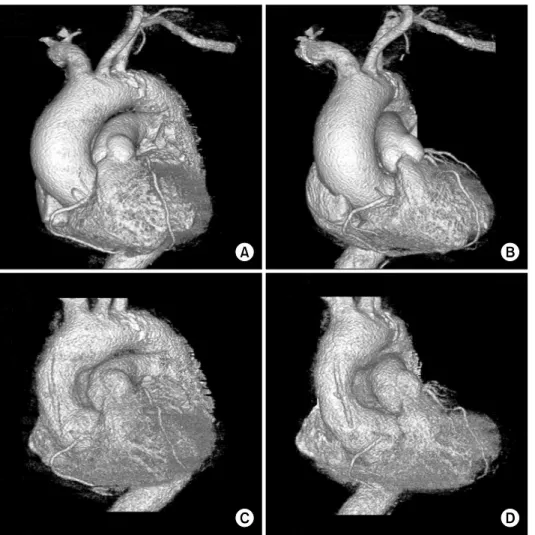
The incidences of late mortality, adverse clinical events, and dilatation of the ascending aorta during the follow-up pe- riod were investigated. The follow-up period was 15.4±5.2 months (range, 10 to 28 months). We evaluated the diameter of the ascending aorta using cardiac CT at three points: be-

fore surgery, within a month postoperatively, and 12 months postoperatively (Fig. 2).

4) Statistical analysis

All continuous data and results were expressed as the mean±standard deviation and the significance of the differ- ences between the preoperative and postoperative data was assessed by one-way analysis of variance. A value of p less than 0.05 was considered statistically significant.

RESULTS

There were no perioperative or early postoperative deaths

and no bleeding complications requiring exploration. For one

patient with a 30% preoperative ejection fraction, intra-aortic

balloon insertion was performed because cardiopulmonary by-

pass weaning was difficult to perform. In this patient, the in-

tra-aortic balloon pump was removed without any particular

complications at postoperative day 2, and then the patient

was discharged. No other major surgical complication was

observed. There was only one late mortality (1.1%) as a re-

sult of septic multiple-organ failure at the second post-

operative year. No other late complications occurred. CT was

performed on all 90 patients both before surgery and within

four weeks after surgery. External wrapping of the ascending

(4)

Fig. 2. Preoperative computed tomo- graphic scan (A, B). Postoperative computed tomographic scan (C, D) of the same patient showing a de- crease in the diameter of the as- cending aorta.

Fig. 3. Mean values of the dimensions. A.aorta, ascending aorta tubular portion; STJ, sinotubular junction; Proximal arch, proximal aortic arch; D, diameter.

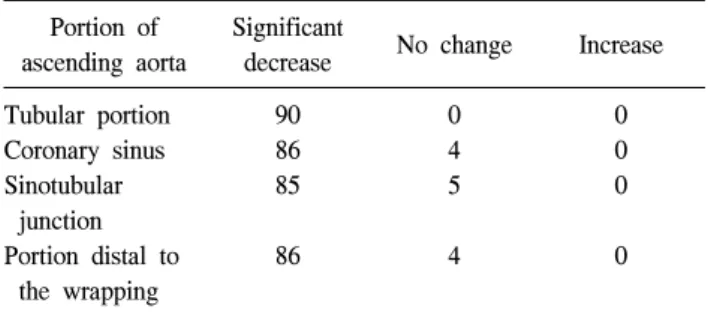
aorta resulted in a significant reduction of the ascending aorta in all patients. The maximal diameter of the ascending aorta significantly decreased from preoperative 46.4±4.3 mm to postoperative 33.0±3.5 mm (p=0.01). Interestingly, the diame- ter of the coronary sinuses were also significantly reduced from 36.9±4.2 mm before surgery to 33.3±5.1 mm after the aortic wrapping (p=0.001). The STJ size also significantly de- creased from preoperative 33.1±4.8 mm to postoperative 30.8±4.6 mm (p=0.02). The changes in the dimensions of the aorta distal to the wrapping also significantly decreased from preoperative 35.1±3.5 mm to postoperative 33.1±3.2 mm (p=0.01) (Fig. 3). The number of patients who showed a sig- nificant decrease in the diameter, insignificant decrease in the diameter, and increase in the diameter are presented by re- gion in Table 3. In addition, 78 (86.7%) of the 90 patients underwent CT at postoperative 12 months; the maximal diam- eter of the ascending aorta was 33.1±2.5 mm (p=0.34), while

that of the coronary sinuses was 33.5±2.1 mm (p=0.42), and

the STJ size was 33.4±3.3 (p=0.44). Compared to the diame-

(5)

Table 3. The number of patients according to the degree of change in each region of the ascending aorta (within post- operative 4 weeks)

Portion of ascending aorta

Significant

decrease No change Increase Tubular portion

Coronary sinus Sinotubular

junction Portion distal to

the wrapping

90 86 85

86

0 4 5

4

0 0 0

0

ter measured on early postoperative CT, no significant differ- ence was observed and there were no findings that suggested redilatation.

DISCUSSION

Even in the current time of advanced surgical procedures and alternative endovascular techniques for the treatment of aortic pathologies, ascending aortic aneurysms remain a chal- lenging problem for every cardiac surgeon. Although graft re- placement for an ascending aortic aneurysm is now performed relatively safely and remains the accepted surgical procedure, we cannot ignore the hospital mortality rates of 4.5% to 20%

and the morbidity related to such extended operations [2,3].

A more physiological technique that is safe, effective, and causes less injury would be an attractive option. Of the surgi- cal procedures that have been devised toward this end, reduc- tion aortoplasty, which was first described by Robicsek [4], is the least radical. This technique consists of decreasing the aortic diameter by excising the oval segment of the ascending aorta after longitudinal aortotomy followed by placing a well-tailored Dacron vascular graft around the aorta. This sur- gical procedure is meaningful in that it is simple and easy to perform, and above all, it can preserve the endothelial lining.

Since the introduction of this procedure, many surgeons have reported indications for reduction of aortoplasty and its surgi- cal outcomes. In particular, in a meta-analysis of the surgical outcomes of a total of 716 patients from 13 studies on reduc- tion aortoplasty, Gill and Dunning [5] reported that only 25 (3%) of the 716 patients had to undergo redilatation during follow-up, and the others had good postoperative outcomes.

In addition, Gill and Dunning [5] presented a recom- mendation on which patients are suitable for reduction aortoplasty. In light of these previous studies, we prepared a set of guidelines for the wrapping of the ascending aorta.

First, the size of the ascending aorta should be 4 cm or more and 6 cm or less. In this hospital, CT was performed on every patient who underwent cardiac surgery, and wrap- ping was performed if the diameter of the ascending aorta was 4.0 cm or more. Coady et al. [6] reported that the aortic size should be less than 6 cm to avoid late redilatation.

Second, the intraoperative reduction of the aorta should be less than 35 mm. After follow-up, at a mean of 40 months following reduction aortoplasty in patients with a bicuspid aortic valve, Bauer et al. [7] reported that significant re- dilatation did not occur in the patient group whose ascending aorta had a maximal diameter of 35 mm or less, but occurred in the patient group whose ascending aorta had a maximal di- ameter of 40 mm or more. Third, the aneurysm should be limited to the ascending aorta. Fourth, patients with con- nective-tissue diseases, including Marfan’s syndrome, or acute or chronic dissection should be excluded. Lastly, wrapping of the ascending aorta is ideal for patients who have multiple co-morbidities and for whom a prolonged operative time would significantly increase their mortality risk.

Surgeons have diversified the surgical procedures for re-

duction aortoplasty [8]. When reduction aortoplasty was first

introduced by Robicsek [4], the procedure consisted of excis-

ing the ascending aorta into an oval shape, and then external

wrapping with a Dacron graft was performed depending on

the situation. Since then, surgeons have tended to perform ex-

ternal wrapping to prevent redilatation, and as a result, the

aortic-clamp time decreased. In South Korea, a good surgical

outcome was reported after using the suture plication techni-

que without excising the ascending aorta, according to the

method described by Baek et al. [8], in 14 patients. In addi-

tion, Ang et al. [9] reported 14 cases of good surgical out-

comes that only had Dacron wrapping performed, without

aortic excision, in patients who underwent aortic-valve

replacement. In this study, we chose the surgical procedure

that would reduce the diameter of the ascending aorta by on-

ly the wrapping of the ascending aorta, without excision of

the ascending aorta.

(6)

Wrapping alone does not require the opening of the aorta or the extension of the aortic cross-clamp time. It can be per- formed relatively quickly within 5 to 10 minutes, and it is safe, with no significant morbidity or mortality. Moreover, re- duction aortoplasty without external wrapping could not pre- vent the recurrence of redilatation, but recurrence can be pre- vented if external wrapping is also performed [4,7].

The optimum surgical timing for dilatation of the ascend- ing aorta remains under debate. It is unknown whether a mild to moderately dillatated ascending aorta would cause prob- lems later for a patient. We aimed to ascertain the benefits of the wrapping procedure that is performed concomitantly with CABG or open-heart surgery in patients who require CABG or open-heart surgery, rather than the benefits of only per- forming the wrapping procedure.

In this study, the diameter of the ascending aorta for which wrapping was performed was significantly decreased, and re- dilatation was not found in the CT that was performed within one year after operation. This indicates that without aortic dissection, wrapping alone is sufficient to decrease the diame- ter of the dilatated aorta.

Additionally, it should be noted that the diameter of the as- cending aorta can decrease in the dilated site as well as in the regions proximal and distal to the aortic-wrapping site.

Although the follow-up period was short, the reduction in the diameter at different aortic sites was statistically significant.

This suggested that correcting the dimensions of a dilated as- cending aorta at an early stage, and before irreversible ana- tomical changes occur, results in the rapid reverse remodeling of the rest of the aorta, and is probably due to the restoration of normal blood flow hemodynamics. This reversibility en- ables the prevention of future dilatation of the remaining aor- ta through early intervention in a mild to moderately dilated ascending aorta [9].

Although operative complications did not occur in this study, other studies on the wrapping of the aorta have re- ported complications. Neri et al. [10] reported on two patients who developed false aneurysm of the ascending aorta 7 and 11 years, respectively, after wrapping. Histologic examination of the aortic wall underlying the reinforcement cuff revealed extensive wall degeneration [10]. Bauer et al. [11] reported a case wherein after reduction aortoplasty, the dislocated wrap

caused erosion of the ascending aorta. However, this type of complication is very rare.

This study has the following limitations: no control group was used, and the follow-up period was too short to allow the identification and explanation of possible complications, such as redilatation of the ascending aorta, which may occur during the long-term follow-up period. Thus, a prospective randomized study with long-term follow-up and a bigger pop- ulation sample is required to ascertain the safety and benefits of wrapping the ascending aorta.

CONCLUSION

The results of this study indirectly suggest that the wrap- ping procedure was associated with the early reversed remod- eling of the remaining proximal and distal aorta. Although a long-term study on a larger sample population is needed to confirm the benefits of this procedure, if the procedure is performed well on eligible patients, it can prove to be a safe and simple surgical method. Moreover, it can also decrease postoperative mortality and morbidity, and can serve as an al- ternative for conventional graft replacement.

REFERENCES

1. Gillum RF. Epidemiology of aortic aneurysm in the United States. J Clin Epidemiol 1995;48:1289-98.

2. Zierer A, Melby SJ, Lubahn JG, Sicard GA, Damiano RJ Jr, Moon MR. Elective surgery for thoracic aortic aneurysms:

late functional status and quality of life. Ann Thorac Surg 2006;82:573-8.

3. Atik FA, Navia JL, Svensson LG, et al. Surgical treatment of pseudoaneurysm of the thoracic aorta. J Thorac Cardiovasc Surg 2006;132:379-85.

4. Robicsek F. A new method to treat fusiform aneurysms of the ascending aorta associated with aortic valve disease: an alternative to radical resection. Ann Thorac Surg 1982;34:

92-4.

5. Gill M, Dunning J. Is reduction aortoplasty (with or without external wrap) an acceptable alternative to replacement of the dilated ascending aorta? Interact Cardiovasc Thorac Surg 2009;9:693-7.

6. Coady MA, Rizzo JA, Hammond GL, et al. What is the ap- propriate size criterion for resection of thoracic aortic aneurysms? J Thorac Cardiovasc Surg 1997;113:476-91.

7. Bauer M, Pasic M, Schaffarzyk R, et al. Reduction aorto-

(7)

plasty for dilatation of the ascending aorta in patients with bicuspid aortic valve. Ann Thorac Surg 2002;73:720-3.

8. Baek MJ, Na CY, Oh SS, et al. Reduction aortoplasty with suture plication technique for dilatation of the ascending aorta associated with aortic valve disease. Korean J Thorac Cardiovasc Surg 2005;38:221-8.

9. Ang KL, Raheel F, Bajaj A, Sosnowski A, Galinanes M.

Early impact of aortic wrapping on patients undergoing aortic valve replacement with mild to moderate ascending

aorta dilatation. J Cardiothorac Surg 2010;5:58.

10. Neri E, Massetti M, Tanganelli P, et al. Is it only a mechan- ical matter? Histologic modifications of the aorta underlying external banding. J Thorac Cardiovasc Surg 1999;118:1116- 8.

11. Bauer M, Grauhan O, Hetzer R. Dislocated wrap after pre-

vious reduction aortoplasty causes erosion of the ascending

aorta. Ann Thorac Surg 2003;75:583-4.

수치

Table 2. Concomitant surgeries performed
Fig. 1. Wrapping of the ascending  aorta with the Dacron graft. The  graft is pulled below the aorta (A)  and oversewn with a continuous  su-ture (B).
Fig. 2. Preoperative computed tomo- tomo-graphic scan (A, B). Postoperative  computed tomographic scan (C, D)  of the same patient showing a  de-crease in the diameter of the  as-cending aorta.
Table 3. The number of patients according to the degree of  change in each region of the ascending aorta (within  post-operative 4 weeks)

참조

관련 문서

Long-term outcomes of short dental implants supporting single crowns in posterior region: a clinical retrospective study of 5-10 years.. Osteotome sinus

The purpose of this study was to identify the frequency and related factors of advanced airway management for patients with cardiac arrest by the

Kim DM, Yu KD, Lee JH, Kim HK, Lee SH:Controlled trial of a 5-day course of telithromycin versus doxycycline for treatment of mild to moderate scrub typhus. Scrub

Result: During the study period, 482 patients had elevated cardiac troponin-T levels. The positive predictive value for the.. The diagnostic importance of

“Transition-based dependency parsing with stack long short-term memory”, Proceedings of the 53 rd Annual Meeting of the Association for Computational

n Types of integer variable: bool, char, short, int, long (ascending order in data size).. n There are two kind of integers; signed

In Table 4, for the problems with 10, 20, and 30 nodes, the computational results of tabu search are shown with a recency based short term memory, a frequency based long term

Abstract: This study aimed to review the oral hygiene status, oral care guidelines, and outcomes of oral care in intensive care unit (ICU) patients from a dental