• 검색 결과가 없습니다.

Conjunction of a Fungus Ball and a Pulmonary Tumourlet in a Bronchiectatic Cavity

N/A
N/A
Protected

Academic year: 2021

Share "Conjunction of a Fungus Ball and a Pulmonary Tumourlet in a Bronchiectatic Cavity"

Copied!
4
0
0

로드 중.... (전체 텍스트 보기)

전체 글

(1)

ISSN: 2233-601X (Print) ISSN: 2093-6516 (Online)

− 138 −

Received: November 13, 2017, Revised: January 7, 2018, Accepted: January 23, 2018, Published online: April 5, 2018

Corresponding author: Serkan Yazgan, Department of Thoracic Surgery, University of Health Sciences, Dr Suat Seren Chest Diseases and Surgery Medical Practice and Research Center, Izmir, Turkey

(Tel) 90-536-5835085 (Fax) 90-2324587262 (E-mail) [email protected]

© The Korean Society for Thoracic and Cardiovascular Surgery. 2018. All right reserved.

This is an open access article distributed under the terms of the Creative Commons Attribution Non-Commercial License (http://creativecommons.org/

licenses/by-nc/4.0) which permits unrestricted non-commercial use, distribution, and reproduction in any medium, provided the original work is properly cited.

Conjunction of a Fungus Ball and a Pulmonary Tumourlet in a Bronchiectatic Cavity

Serkan Yazgan, M.D. 1 , Soner Gürsoy, Ph.D. 1 , Figen Türk, M.D. 1 , Zekiye Aydoğdu Dinç, M.D. 2

Departments of

1

Thoracic Surgery and

2

Pathology, University of Health Sciences Dr Suat Seren Chest Diseases and Surgery Medical Practice and Research Center

Herein, we describe the case of a 67-year-old female patient who presented with cough and haemoptysis.

Chest computed tomography revealed destruction of the left lower lobe and multiple fungus balls in a bron- chiectatic cavity. A left lower lobectomy was performed via thoracotomy. Histopathological examination of the lung showed a concomitant aspergilloma and multiple tumourlets in the large bronchiectatic cavity.

Pulmonary intracavitary aspergilloma and concomitant tumourlets are quite rare. Our report presents this in- teresting case that manifested with haemoptysis.

Key words: 1. Pulmonary aspergilloses 2. Bronchiectasis

3. Fungus 4. Hemoptysis 5. Mycetoma

Case report

A 67-year-old woman with a medical history of tu- berculosis was referred to our department for re- current pulmonary infection and haemoptysis. The patient was a non-smoker. She suffered from hyper- tension and was taking nebivolol and olmesartan.

Auscultation revealed rales in the left lower zone.

The results of spirometry and laboratory tests were normal. Computed tomography (CT) demonstrated multiple fungus balls in a large cavity located in the left lower lobe; however, pathologic enlargement of the lymph nodes was not seen in CT images (Fig. 1).

Left lower lobectomy and mediastinal lymph node sampling were performed via thoracotomy. In the pathological examination of the specimen; a cavity

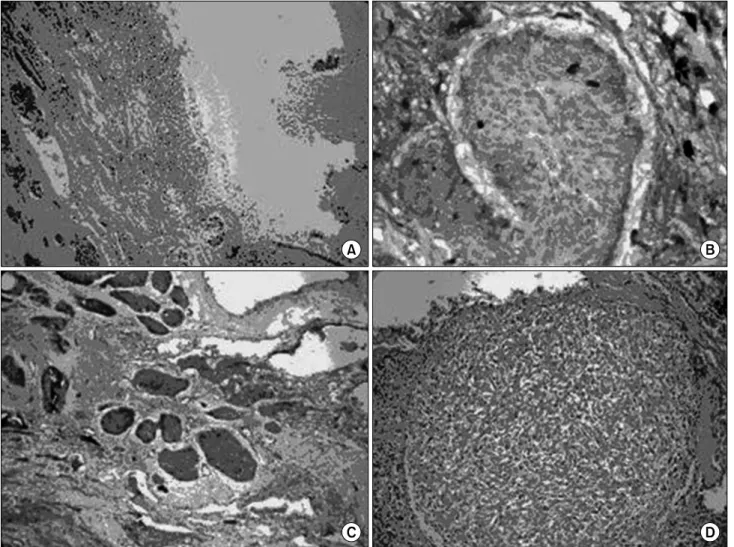
measuring 4.5 cm in diameter was found in the su- perior segment. The material inside the cavity was brown, necrotic, and compatible with aspergilloma. In the samples taken from the cavitated bronchial wall, groups of uniform cells and others scattered through- out a microscopic focus of less than 0.5 cm in diame- ter were detected. Immunohistochemical staining for CD56 and thyroid transcription factor-1 was positive, synaptophysin and P63 were negative, and the Ki67 level was 2% in these cells (Fig. 2). There was nei- ther atypia nor mitosis. There was no metastasis in the lymph nodes that were examined pathologically.

The lesion contained the focal area of a tumourlet and areas of diffuse multiple endocrine neoplasia.

The final histopathological diagnosis was aspergillo- ma, multiple tumourlets, and diffuse idiopathic pul-

Korean J Thorac Cardiovasc Surg 2018;51:138-141 □ CASE REPORT □

https://doi.org/10.5090/kjtcs.2018.51.2.138

(2)

Surgical Treatment of a Pulmonary Tumourlet

− 139 −

Fig. 2. (A) Fungus balls, neuroendocrine tumour cell groups, and bronchial wall in the cavitated large bronchial lumen (H&E, ×40). (B) Using immunohistochemistry, Ki67 positivity was found in the neuroendocrine cells (Dako, ×100). (C) Using immunohistochemistry, syn- aptophysin positivity was found in the neuroendocrine cells (Dako, ×60). (D) Tumourlet (H&E, ×60).

Fig. 1. The fungus balls in the large cavity and areas of destruc- tion in the left lower lobe.

monary neuroendocrine cell hyperplasia (DIPNECH) in a bronchiectatic lung cavity. No radiologic abnor- malities were found on a follow-up CT exam, and 7 months after the operation, the patient remained alive without any notable medical problems.

Discussion

Also known as intracavitary mycetoma or a fungus

ball, aspergilloma is the result of a saprophytic in-

fection of a cavitary diseased lung [1]. The most

common symptom is haemoptysis [1]. After a fungus

ball has formed in a cavity, antifungal treatment is

inefficient because antifungal drugs cannot penetrate

through the non-perfused wall of the cavity. Hence, a

(3)

Serkan Yazgan, et al

− 140 − cure can be achieved only by surgical treatment.

Additionally, pulmonary tumourlets are a rare pathol- ogy, defined as nodular proliferations of neuro- endocrine cells less than 0.5 cm in diameter [2].

They are usually detected incidentally in areas of lung destruction that are removed surgically or in cases of bronchiectasis. The coexistence of a fungus ball and a pulmonary neuroendocrine tumourlet has rarely been observed.

DIPNECH, pulmonary tumourlets, and typical carci- noid tumours are distinct subsets of neuroendocrine tumours that have several characteristics in common [3]. Tumourlets are nodular proliferations of neuro- endocrine cells (Kulchitsky) that are normally pres- ent in the airways. For unknown reasons, these cells sometimes become hyperplastic in certain lung diseases. Tumourlets are usually nodular pro- liferations smaller than 5 mm in diameter and are often multiple. Larger tumours are called carcinoids [2-5]. They are asymptomatic and common incidental findings in scarred lungs, but they may also be found in normal lungs [4]. They also lack mitotic activity;

necrosis and cellular atypia are not observed. In re- cent studies, DIPNECH and tumourlets have been re- garded as preneoplastic lesions that rarely convert to carcinoid tumours [5,6]. Lymph node metastases have been noted in several case reports [7]. Nodal metastasis generally occurs in the hilar or peribron- chial lymph nodes. Tumourlets are generally encoun- tered in patients between 60 and 70 years of age, and are more common in female patients than in male patients (male to female ratio, 1:>4) [2].

Tumourlets should be included in the differential di- agnosis when a patient complains of dyspnoea and small nodules are identified on a chest CT scan;

however, positron emission tomography/CT is not the best method to diagnose this entity [2]. There are no well-established guidelines for the treatment and management of DIPNECH. Currently, there is no known method to prevent DIPNECH, but various steps can be taken to help decrease the risk of its occurrence, such as complete smoking cessation, physical activity, avoiding exposure to certain materi- als and chemicals (including asbestos, arsenic, chro- mium, nickel, and tar), and limiting alcohol con- sumption. S everal medications have been studied as potential treatments for DIPNECH, such as octreotide, 18F-DOPA amino acid analogues, inhaled cortico-

steroids, and short-acting beta agonists [2,6].

Some previous case reports have reported pulmo- nary tumourlets associated with diffuse bron- chiectasis and intralobar sequestration, in pulmonary sequestration with bronchiectasis after breast cancer, or associated with marginal zone B-cell lymphoma [8]. Pulmonary tumourlets often occur in patients with chronic lung damage, such as pulmonary fib- rosis, chronic or granulomatous inflammation, bron- chiectasis, or giant cell pneumonia [3]. However, the association of aspergilloma with tumourlets or DIPNECH in a bronchiectatic cavity has not yet been reported. In this report, we present a case where both a tumourlet and aspergilloma were detected in the left lower lobe of a previous tuberculosis patient with a bronchiectatic cavity in a destroyed lobe. We think that there may be a pathological relationship between aspergilloma and DIPNECH. Although the patient did not receive any postoperative medical treatment, recurrence or metastasis has not occurred during the follow-up period.

There is also no consensus regarding the timing or type of surgery needed for aspergilloma. Surgical re- section is risky and difficult due to the presence of an underlying chronic disease and the negative ef- fects of infection on the lung. However, the coex- istence of a large bronchiectatic cavity, aspergilloma, and tumourlet in our case suggests that such lung diseases also provide a basis for premalignant le- sions, as well as for complications such as haemopt- ysis and recurrent infections.

In conclusion, surgical treatment can therefore pre- vent both the recurrence of symptoms and the devel- opment of premalignant lesions.

Conflict of interest

No potential conflict of interest relevant to this ar- ticle was reported.

References

1. Jheon SH, Lee JT, Kim KT. Surgical treatment of pulmo- nary aspergillosis. Korean J Thorac Cardiovasc Surg 1989;22:170-5.

2. Kallianos A, Velentza L, Zarogoulidis P, et al. Progressive

dyspnea due to pulmonary carcinoid tumorlets. Respir

Med Case Rep 2017;21:84-5.

(4)

Surgical Treatment of a Pulmonary Tumourlet

− 141 −

3. He P, Gu X, Wu Q, Lin Y, Gu Y, He J. Pulmonary carcinoid tumorlet without underlying lung disease: analysis of its relationship to fibrosis. J Thorac Dis 2012;4:655-8.

4. Churg A, Warnock ML. Pulmonary tumorlet: a form of pe- ripheral carcinoid. Cancer 1976;37:1469-77.

5. Hendifar AE, Marchevsky AM, Tuli R. Neuroendocrine tu- mors of the lung: current challenges and advances in the diagnosis and management of well-differentiated disease.

J Thorac Oncol 2017;12:425-36.

6. Wirtschafter E, Walts AE, Liu ST, Marchevsky AM. Diffuse

idiopathic pulmonary neuroendocrine cell hyperplasia of the lung (DIPNECH): current best evidence. Lung 2015;

193:659-67.

7. D’Agati VD, Perzin KH. Carcinoid tumorlets of the lung with metastasis to a peribronchial lymph node: report of a case and review of the literature. Cancer 1985;55:2472-6.

8. Dewan M, Malatani TS, Osinowo O, al-Nour M, Zahrani ME.

Carcinoid tumourlets associated with diffuse bron-

chiectasis and intralobar sequestration. J R Soc Promot

Health 2000;120:192-5.

수치

Fig. 1. The fungus balls in the large cavity and areas of destruc- destruc-tion in the left lower lobe.

참조

관련 문서

Forces exerted by a flowing fluid on a pipe bend, enlargement, or contraction in a pipeline may be computed by a application of the impulse-momentum principle...

A and E, In control group, a small amount of new bone was observed at the margin of bone defect (40×); B and F, In experimental group 1, a large amount of new bone was formed

[r]

Urban freeway plays a key role in the urban transportation system and also takes a lot of share in the urban traffic generated in the big city. However,

Since every classical or virtual knot is equivalent to the unknot via a sequence of the extended Reidmeister moves together with the forbidden moves, illustrated in Section 2,

This book contains hundreds of complete, working examples illustrating many common Java programming tasks using the core, enterprise, and foun- dation classes APIs.. Java Examples

The index is calculated with the latest 5-year auction data of 400 selected Classic, Modern, and Contemporary Chinese painting artists from major auction houses..

1 John Owen, Justification by Faith Alone, in The Works of John Owen, ed. John Bolt, trans. Scott Clark, "Do This and Live: Christ's Active Obedience as the