ISSN 2234-3806 • eISSN 2234-3814
390 www.annlabmed.org http://dx.doi.org/10.3343/alm.2016.36.4.390 Ann Lab Med 2016;36:390-392
http://dx.doi.org/10.3343/alm.2016.36.4.390
Letter to the Editor
Clinical Microbiology
First Case of Human Brucellosis Caused by Brucella melitensis in Korea
Hyeong Nyeon Kim, M.D.1, Mina Hur, M.D.1, Hee-Won Moon, M.D.1, Hee Sook Shim, M.T.1, Hanah Kim, M.D.1, Misuk Ji, M.D.1, Yeo-Min Yun, M.D.1, Sung-Yong Kim, M.D.2, Jihye Um, B.S.3, Yeong Seon Lee, Ph.D.3,
and Seon Do Hwang, Ph.D.3
Departments of Laboratory Medicine1 and Internal Medicine2, Konkuk University School of Medicine, Seoul; Division of Zoonoses3, Center for Immunology and Pathology, Korea National Institute of Health, Korea Centers for Disease Control and Prevention, Cheongju, Korea
Dear Editor,
Human brucellosis is the most common zoonosis worldwide and is caused by gram-negative bacteria, Brucella spp. [1].
Among the Brucella spp., B. abortus, B. canis, B. melitensis, and B. suis can cause human brucellosis. Human brucellosis involves various organs including bone marrow (BM), shows non-specific clinical manifestations including fever, fatigue, back pain, and arthralgia, and can progress to septicemia or multi-organ failure [1, 2]. In Korea, since the first case of hu- man brucellosis in 2002 [3], all reported 747 cases have been caused by B. abortus, and the majority were related to the out- break of bovine brucellosis in mid-2000 [4]. We report the first Korean case of human brucellosis caused by B. melitensis.
A 34-yr-old man presented with high fever (39.2°C), signifi- cant weight loss (10 kg/month), and back pain that persisted for three weeks. He was a Korean resident living in northwestern China (Yanji, Jilin) who had been working on a stock farm in Py- eongchang, Gangwon Province, Korea for two months before visiting our hospital. He had hepatosplenomegaly, elevated ami-
notransferases, and pancytopenia. His complete blood count showed the following: hemoglobin, 8.8 g/dL; white blood cells, 2.1×10⁹/L; and platelets, 43×109/L. His BM was normocellular with intact trilineage hematopoiesis, and neither granuloma nor necrosis was present. Plasma cells (CD19+/CD56-) were ele- vated (11.7%), and polyclonal gammopathy was detected via serum protein electrophoresis. A magnetic resonance imaging to evaluate back pain revealed pyogenic spondylitis at L3-4.
The first two blood cultures yielded gram-negative bacilli, which were identified as B. melitensis by using Vitek 2 (bioMéri- eux, Marcy-l’Etoile, France). In a microagglutination test (MAT), the antibody titer was 1:80. The patient received doxycycline and rifampicin for three weeks and was discharged with no symp- toms except mild leukopenia. The MAT titer was not rechecked during the recovery period, because he declined further treat- ment.
The Vitek 2 system database has a limitation in identifying Brucella spp.: it misidentifies B. abortus as B. melitensis. There- fore, the identification result of B. melitensis was further con-
Received: November 17, 2015 Revision received: December 22, 2015 Accepted: February 22, 2016 Corresponding author: Mina Hur
Department of Laboratory Medicine, Konkuk University School of Medicine, Konkuk University Hospital, 120-1 Neungdong-ro, Gwangjin-gu, Seoul 05030, Korea
Tel: +82-2-2030-5581, Fax: +82-2-2636-6764, E-mail: [email protected] Co-corresponding author: Seon Do Hwang
Division of Zoonoses, Center for Immunology and Pathology, Korea National Institute of Health, Korea Centers for Disease Control and Prevention, 187 Osongsaengmyeong 2-ro, Osong-eup, Heungdeok-gu, Cheongju 28159, Korea
Tel: +82-43-719-8465, Fax: +82-43-719-8489, E-mail: [email protected]
© The Korean Society for Laboratory Medicine.
This is an Open Access article distributed under the terms of the Creative Commons Attribution Non-Commercial License (http://creativecommons.org/licenses/by-nc/3.0) which permits unrestricted non-commercial use, distribution, and reproduction in any medium, provided the original work is properly cited.
Kim HN, et al.
First Korean case of B. melitensis
http://dx.doi.org/10.3343/alm.2016.36.4.390 www.annlabmed.org 391
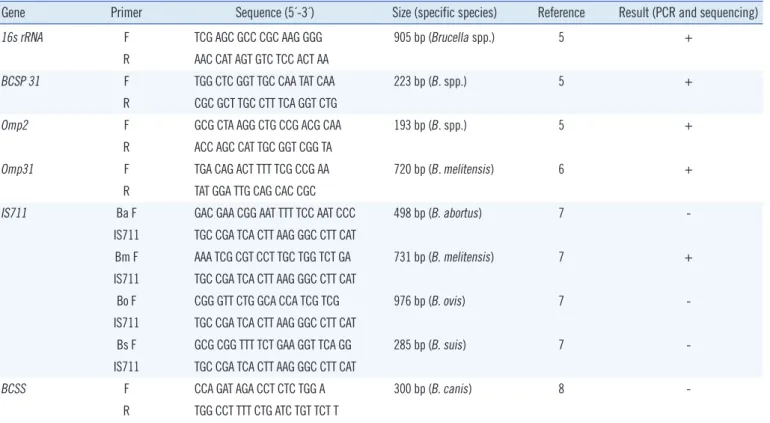
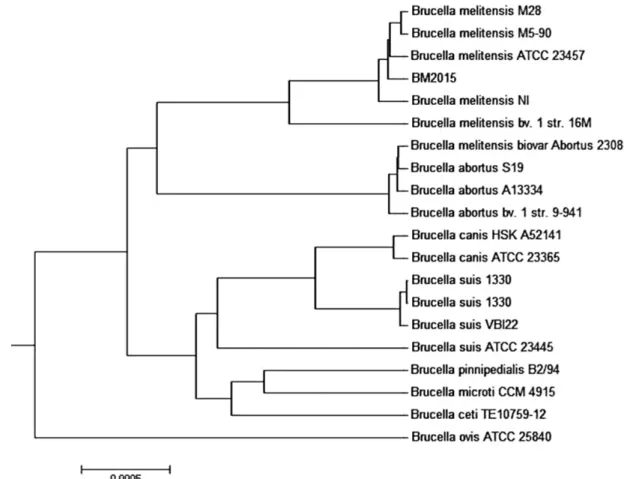
firmed at the Division of Zoonoses at the Korea Centers for Dis- ease Control and Prevention after the approval of the Institu- tional Review Board of Konkuk University Medical Center, Seoul, Korea. After a blood culture, the cultivated product was streaked on both a blood agar plate and a Brucella agar plate and incu- bated at 37°C and 5% CO2 atmosphere. After several passages through the Brucella agar plate, the pure culture product (the isolate) tested negative for H2S production and positive for oxi- dase and urease. DNA was extracted from the isolate to amplify the Brucella-specific genes (16S rRNA, BCSP31, and Omp2) [5]. PCR targeting Omp31, IS711, and BCSS confirmed this isolate as B. melitensis [6-8] (Table 1). Draft whole genome se- quence analysis assembled by CLC bio CLC Genomics Work- bench 7.5.1 (Waltham, MA, USA) revealed that the isolate was B. melitensis (Fig. 1).
To identify Brucella spp. when brucellosis is suspected, a careful and complete history should be taken of the patient’s occupation, travel, and unpasteurized diet history [9]. The pres- ent patient had worked on a sheep farm for two months before admission and experienced nonspecific symptoms (fever, weight loss, and back pain) for three weeks, indicating B. meli- tensis infection. Before he was in Korea, he had lived in north- western China, where B. melitensis has been dominant [10]. It
is not clear whether he had raw food from infected animals in China or in Korea, or whether he acquired brucellosis occupa- tionally by direct skin contact or inhalation of aerosolized in- fected particles [9]. Although the clinical history appears insuffi- cient, considering that he had been healthy before developing these clinical symptoms, it is unlikely that he already had bru- cellosis in China.
In the present case, H2S was negative, and oxidase and ure- ase were positive in the biochemical analysis, suggesting the possibility of B. melitensis infection together with the patient’s working history on the sheep farm. However, H2S production can be also negative in the other Brucella spp., and molecular identification is necessary to confirm the diagnosis. We used multiple gene targets to detect the Brucella genus using a com- mon PCR assay [5] and also used Omp31, IS711, and BCSS gene targets to distinguish B. melitensis from the other Brucella spp. [6-8] (Table 1).
Conclusively, this is the first official case of human brucellosis caused by B. melitensis in Korea that was confirmed by using molecular methods. Careful recording of patient history and mo- lecular identification are necessary in patients with suspected brucellosis to confirm the causative Brucella spp.
Table 1. Primers used in this study and the results of PCR and sequencing
Gene Primer Sequence (5´-3´) Size (specific species) Reference Result (PCR and sequencing)
16s rRNA F TCG AGC GCC CGC AAG GGG 905 bp (Brucella spp.) 5 +
R AAC CAT AGT GTC TCC ACT AA
BCSP 31 F TGG CTC GGT TGC CAA TAT CAA 223 bp (B. spp.) 5 +
R CGC GCT TGC CTT TCA GGT CTG
Omp2 F GCG CTA AGG CTG CCG ACG CAA 193 bp (B. spp.) 5 +
R ACC AGC CAT TGC GGT CGG TA
Omp31 F TGA CAG ACT TTT TCG CCG AA 720 bp (B. melitensis) 6 +
R TAT GGA TTG CAG CAC CGC
IS711 Ba F GAC GAA CGG AAT TTT TCC AAT CCC 498 bp (B. abortus) 7 -
IS711 TGC CGA TCA CTT AAG GGC CTT CAT
Bm F AAA TCG CGT CCT TGC TGG TCT GA 731 bp (B. melitensis) 7 +
IS711 TGC CGA TCA CTT AAG GGC CTT CAT
Bo F CGG GTT CTG GCA CCA TCG TCG 976 bp (B. ovis) 7 -
IS711 TGC CGA TCA CTT AAG GGC CTT CAT
Bs F GCG CGG TTT TCT GAA GGT TCA GG 285 bp (B. suis) 7 -
IS711 TGC CGA TCA CTT AAG GGC CTT CAT
BCSS F CCA GAT AGA CCT CTC TGG A 300 bp (B. canis) 8 -
R TGG CCT TTT CTG ATC TGT TCT T
Kim HN, et al.
First Korean case of B. melitensis
392 www.annlabmed.org http://dx.doi.org/10.3343/alm.2016.36.4.390
Acknowledgments
This study was supported by Konkuk University and the Korea Na- tional Institute of Health (4837-301-210-13, 4838-303-210-13).
We are grateful to Chunlab, Inc., for analyzing and providing an ANI tree from whole genome sequencing of this isolate.
Authors’ Disclosures of Potential Conflicts of Interest
No potential conflicts of interest relevant to this article were re- ported.
REFERENCES
1. Corbel MJ. Brucellosis: an overview. Emerg Infect Dis 1997;3:213-21.
2. Buzgan T, Karahocagil MK, Irmak H, Baran AI, Karsen H, Evirgen O, et al. Clinical manifestations and complications in 1028 cases of brucello-
sis: a retrospective evaluation and review of the literature. Int J Infect Dis 2010;14:e469-78.
3. Park MS, Woo YS, Lee MJ, Shim SK, Lee HK, Choi YS, et al. The first case of human brucellosis in Korea. Infect Chemother 2003;35:461-6.
4. Korea Centers for Disease Control and Prevention. Disease web statis- tics system. http://is.cdc.go.kr/dstat/jsp/stat/stat0001.jsp. (accessed on Dec 15, 2015).
5. Yu WL and Nielsen K. Review of detection of Brucella spp. by poly- merase chain reaction. Croat Med J 2010;51:306-13.
6. Gupta VK, Verma DK, Singh K, Kumari R, Singh SV, Vihan VS. Single- step PCR for detection of Brucella melitensis from tissue and blood of goats. Small Rumin Res 2006;66:169-74.
7. Bricker BJ and Halling SM. Differentiation of Brucella abortus bv. 1, 2, and 4, Brucella melitensis, Brucella ovis, and Brucella suis bv. 1 by PCR. J Clin Microbiol 1994;32:2660-6.
8. Kang SI, Lee SE, Kim JY, Lee K, Kim JW, Lee HK, et al. A new Brucella canis species-specific PCR assay for the diagnosis of canine brucello- sis. Comp Immunol Microbiol Infect Dis 2014;37:237-41.
9. Versalovic J, Carroll KC, et al. eds. Manual of clinical microbiology. 10th ed. Washington, DC: ASM Press, 2011:759-64.
10. Zhong Z, Yu S, Wang X, Dong S, Xu J, Wang Y, et al. Human brucellosis in the People’s Republic of China during 2005-2010. Int J Infect Dis 2013;17:e289-92.
Fig. 1. Average nucleotide identity tree of Brucella melitensis. The genome tree was constructed by using BM2015 (the isolate) and related Brucella spp.