ISSN 2234-3806 • eISSN 2234-3814
https://doi.org/10.3343/alm.2019.39.6.587 www.annlabmed.org 587
Ann Lab Med 2019;39:587-589
https://doi.org/10.3343/alm.2019.39.6.587
Letter to the Editor
Clinical Microbiology
First Case of Aureimonas altamirensis Bacteremia in Korea
Namsu Kim , M.D.1, Jeong-Hwan Hwang, M.D.2,3, Yong Gon Cho , M.D.1,3, Dal Sik Kim , M.D.1,3, Hye Soo Lee , M.D.1,3, and Jaehyeon Lee , M.D.1,3
Departments of 1Laboratory Medicine and 2Internal Medicine, Chonbuk National University Medical School and Hospital, Jeonju, Korea; and 3Research Institute of Clinical Medicine, Chonbuk National University-Biomedical Research Institute, Chonbuk National University Hospital, Jeonju, Korea
Dear Editor,
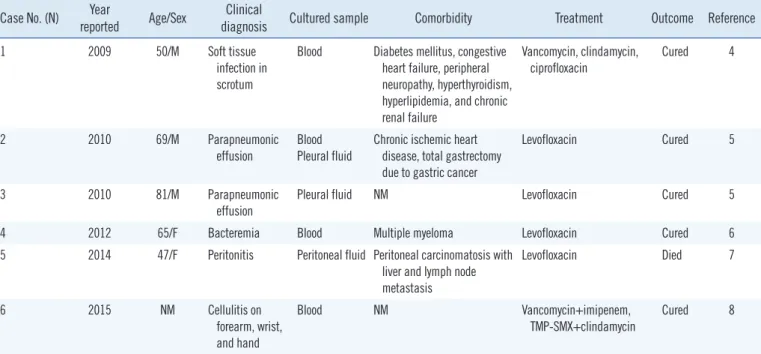
Aureimonas altamirensis, a gram-negative, nonmotile bacterium that grows in strictly aerobic environments, was isolated from the subterranean environment of Altamira Cave in Spain in 2006 and was designated Aurantimonas altamirensis [1]; however, it was reclassified as Aureimonas altamirensis with other Auran- timonas species. In 2008, it was first isolated from clinical sam- ples [2]. A. altamirensis has usually been implicated as a con- taminant originating from the environment, such as water sources [2], and is reported as an agent of canine infection [3]. To date, only a few cases of human infections have been reported (Table 1) [4-8]. We report the first case of bacteremia by A. altamiren- sis in Korea. The Institutional Review Board of Chonbuk National University Hospital, Jeonju, Korea, determined that this study has a low ethical load and did not require informed consent from the patient (IRB No. CUH 2018-03-028).
A 65-year-old male presented to the emergency room of Chon- buk National University Hospital because of fever and general weakness in January 2015. Five and 10 years previously, he had been diagnosed as having diabetes mellitus and a stroke, respectively, but had been well prior to admission. On initial physical examination, the patient exhibited no unusual features, and his vital signs were normal except for a body temperature of
38.9°C. His white blood cell count was 19×109/L (neutrophils 96%), Hb level was 12.3 g/L, and platelet count was 380×109/L.
Total bilirubin and direct bilirubin levels were elevated at 49.26 and 43.27 μmol/L, respectively. His AST level was 0.99 μkat/L, ALT level was 1.00 μkat/L, glycated Hb (HbA1c) level was 6.5%, and C-reactive protein level was 1,971.47 nmol/L in initial blood tests. Abdominal computed tomography showed unremarkable findings. Two sets of blood culture (FA Plus, FN Plus, BacT/Alert 3D system, bioMérieux, Durham, NC, USA) were done asepti- cally, and one of them was positive. From the subculture on blood agar plate incubated on 35°C with non-CO2 condition for 24 hours, grayish colonies were observed. They were gram-neg- ative bacilli that were catalase- and oxidase-positive. The isolate did not grow well in a 5% CO2 condition; it grew well on both blood agar and MacConkey agar plates under non-CO2 condi- tions but did not produce any colonies on MacConkey agar plates when incubated with 5% or 10% CO2 for 24 hours. The Vitek 2 system (bioMérieux Inc., Hazelwood, MO, USA) identified this organism as Acinetobacter lwoffii (96% probability), while the Vitek MS system (bioMérieux, Marcy L’Étoile, France) could not identify the organism. 16S ribosomal RNA sequencing (Gen- Bank, MK749933) showed 99.6% (1,361/1,366) homology with Aureimonas altamirensis (GenBank, NR_043764.1), and the %
Received: February 19, 2019 Revision received: April 5, 2019 Accepted: May 27, 2019
Corresponding author: Jaehyeon Lee, M.D., Ph.D.
Department of Laboratory Medicine, Chonbuk National University Medical School and Hospital, 20 Geonji-ro, Deokjin-gu, Jeonju 54907, Korea Tel: +82-63-250-2693, Fax: +82-63-250-1200
E-mail: [email protected]
© Korean Society for Laboratory Medicine
This is an Open Access article distributed under the terms of the Creative Commons Attribution Non-Commercial License (http://creativecommons.org/licenses/by-nc/4.0) which permits unrestricted non-commercial use, distribution, and reproduction in any medium, provided the original work is properly cited.
1 / 1 CROSSMARK_logo_3_Test
2017-03-16 https://crossmark-cdn.crossref.org/widget/v2.0/logos/CROSSMARK_Color_square.svg
Kim N, et al.
Aureimonas altamirensis bacteremia in Korea
588 www.annlabmed.org https://doi.org/10.3343/alm.2019.39.6.587 difference with the second most highly matched organism, Au-
reimonas frigidaquae (GenBank, NR_044195.1), was 98.4%
(1,357/1,379). A phylogenetic tree analysis with representative
Aurantimonas strains downloaded from BLAST (http://www.
ncbi.nlm.nih.gov/blast) was performed using MEGA X (https://
www.megasoftware.net) based on the 16S ribosomal RNA se- Table 1. Invasive Aureimonas altamirensis infections in humans
Case No. (N) Year
reported Age/Sex Clinical
diagnosis Cultured sample Comorbidity Treatment Outcome Reference
1 2009 50/M Soft tissue
infection in scrotum
Blood Diabetes mellitus, congestive heart failure, peripheral neuropathy, hyperthyroidism, hyperlipidemia, and chronic renal failure
Vancomycin, clindamycin, ciprofloxacin
Cured 4
2 2010 69/M Parapneumonic
effusion
Blood Pleural fluid
Chronic ischemic heart disease, total gastrectomy due to gastric cancer
Levofloxacin Cured 5
3 2010 81/M Parapneumonic
effusion
Pleural fluid NM Levofloxacin Cured 5
4 2012 65/F Bacteremia Blood Multiple myeloma Levofloxacin Cured 6
5 2014 47/F Peritonitis Peritoneal fluid Peritoneal carcinomatosis with liver and lymph node metastasis
Levofloxacin Died 7
6 2015 NM Cellulitis on
forearm, wrist, and hand
Blood NM Vancomycin+imipenem,
TMP-SMX+clindamycin Cured 8 Abbreviations: M, male; F, female; NM, not mentioned; TMP-SMX, trimethoprim-sulfamethoxazole.
Fig. 1. Phylogenetic tree analysis based on 16S ribosomal RNA gene sequences. The tree was constructed using the neighbor-joining method with bootstrap resampling (1,000 replicates). The tree was rooted with Fluvimarina pelagi HTCC 2615 as the outgroup. Bootstrap values are expressed as percentages of 1,000 replications, and bars represent 0.010 substitutions per nucleotide position. GenBank data- base accession numbers are provided near the species names.
Kim N, et al.
Aureimonas altamirensis bacteremia in Korea
https://doi.org/10.3343/alm.2019.39.6.587 www.annlabmed.org 589
quences [5, 9]. The results showed that our isolate formed a clade with the other A. altamirensis strains (Fig. 1).
Intravenous moxifloxacin was empirically administered, and the patient’s condition improved. We performed positron emis- sion tomography-computed tomography with [18F]-fluorodeoxy- glucose to investigate the possible causes of fever. However, the results were normal, and repeated physical examinations and imaging studies showed that the patient did not have any other infection. In addition, the follow-up blood cultures were all nega- tive, and the patient showed a good clinical response to empiri- cal antibiotics. Therefore, we believed that the patient had pri- mary A. altamirensis bacteremia according to the clinical infor- mation obtained from 16S ribosomal RNA sequencing. The fe- ver subsided approximately two weeks after antibiotic treatment, and the patient was discharged.
We performed an antimicrobial susceptibility testing using the E-test (bioMérieux, Marcy L’Étoile, France) after receiving the 16S ribosomal RNA sequencing result. The minimum inhibitory concentrations for amoxicillin/clavulanic acid, gentamicin, imi- penem, and trimethoprim/sulfamethoxazole were 1/0.5, 2, 0.125, and >32/608 μg/mL, respectively. A. altamirensis was suscepti- ble to amoxicillin/clavulanic acid and imipenem, according to the non-species related breakpoints specified by the European Committee on Antimicrobial Susceptibility Testing guidelines [10].
A PubMed Medline search identified six cases of invasive hu- man infection by A. altamirensis from blood, pleural fluid, and peritoneal fluid. All patients clinically improved with antibiotics, and only one patient died because of underlying comorbidities [7].
To date, the clinical relevance of A. altamirensis remains un- certain [5]. However, based on previous reports and our study, it is difficult to negate its potential pathogenic significance in hu- mans. Information on the susceptibility of A. altamirensis to most antibiotics is limited, and clinicians rely on only a few case re- ports and empirical treatments. However, most clinical isolates were susceptible to the major antibiotics used for gram-negative bacteria, except quinolone, and showed successful treatment responses [2, 4, 5, 7].
In conclusion, although there is limited information on human infections, A. altamirensis should be considered an opportunis- tic pathogen, especially in immunocompromised patients. Addi- tionally, laboratory physicians should be careful when there are discrepancies between identification results from automated systems and biochemical tests with growth conditions.
Authors’ Disclosures of Potential Conflicts of Interest
No potential conflicts of interest relevant to this article were re- ported.
Acknowledgment
This paper was supported by the Fund of Biomedical Research Institute, Chonbuk National University Hospital.
ORCID
Namsu Kim https://orcid.org/0000-0003-3147-5634 Yong Gon Cho https://orcid.org/0000-0003-3011-6875 Dal Sik Kim https://orcid.org/0000-0001-7467-2086 Hye Soo Lee https://orcid.org/0000-0001-9391-2532 Jaehyeon Lee https://orcid.org/0000-0003-3211-8903
REFERENCES
1. Jurado V, Gonzalez JM, Laiz L, Saiz-Jimenez C. Aurantimonas altami- rensis sp. nov., a member of the order Rhizobiales isolated from Altami- ra Cave. Int Syst Evol Microbiol 2006;56:2583-5.
2. Luong ML, Békal S, Vinh DC, Lauzon D, Leung V, Al-Rawahi GN, et al.
First report of isolation and characterization of Aurantimonas altamiren- sis from clinical samples. J Clin Microbiol 2008;46:2435-7.
3. Reilly TJ, Calcutt MJ, Wennerdahl LA, Williams F 3rd, Evans TJ, Gan- jam IK, et al. Isolation of Aureimonas altamirensis, a Brucella canis-like bacterium, from an edematous canine testicle. J Vet Diagn Invest 2014;
26:795-8.
4. Mendes RE, Denys GA, Fritsche TR, Jones RN. Case report of Auranti- monas altamirensis bloodstream infection. J Clin Microbiol 2009;47:514-5.
5. Téllez-Castillo CJ, González Granda D, Bosch Alepuz M, Jurado Lobo V, Saiz-Jimenez C, Juan JL, et al. Isolation of Aurantimonas altamirensis from pleural effusions. J Med Microbiol 2010;59:1126-9.
6. García-Lozano T, Aznar Oroval E, Juan Bañón JL. First isolation in Spain of Aurantimonas altamirensis in a blood culture from a port-a-cath in a patient with Bence-Jones type multiple myeloma. Enferm Infecc Micro- biol Clin 2012;30:217-8.
7. Schröttner P, Rudolph WW, Taube F, Gunzer F. First report on the isola- tion of Aureimonas altamirensis from a patient with peritonitis. Int J In- fect Dis 2014;29:71-3.
8. Eshaghi A, Shahinas D, Patel SN, Kus JV. First draft genome sequence of Aureimonas altamirensis, isolated from patient blood culture. FEMS Microbiol Lett 2015;362.
9. Kumar S, Stecher G, Li M, Knyaz C, Tamura K. MEGA X: molecular evo- lutionary genetics analysis across computing platforms. Mol Biol Evol 2018;35:1547-9.
10. The European Committee on Antimicrobial Susceptibility Testing.
Breakpoint tables for interpretation of MICs and zone diameters. Ver- sion 9.0, 2019. http://www.eucast.org. (Updated on Jan 2019)