Multicenter Study for the Frequency of 23S rRNA Point Mutations Associated with Clarithromycin Resistance in
Helicobacter pylori in Korea
Hae Kyung Lee1, Hiun Suk Chae2, Jung Oak Kang3, Mi-Kyung Lee4, Heungsup Sung5, Mi-Na Kim5, Jongwook Lee6, Miae Lee7, Ki-Nam Shim8
Departments of
1Laboratory Medicine,
2Internal Medicine, The Catholic University of Korea College of Medicine,
3
Department of Laboratory Medicine, Hanyang University College of Medicine,
4Department of Laboratory Medicine, Chung-Ang University College of Medicine,
5Department of Laboratory Medicine,
Asan Medical Center, University of Ulsan College of Medicine,
6Hanaro Medical Foundation,
Departments of
7Laboratory Medicine,
8Internal Medicine, Ewha Womans University School of Medicine, Seoul, Korea
Background: Clarithromycin resistance in Helicobacterpylori is a major cause of eradication therapy failure.
The objective of this study was to determine the fre- quency and type of mutations in the 23S rRNA gene in Korea, which are associated with clarithromycin resistance.
Methods: From January 2008 to March 2008, 353 gastric biopsy specimens were collected from five university hospitals in Seoul and Kyunggido. H. pylori infection was defined as showing a positive result in at least one of the following three tests: a micro- aerophilic culture, a CLO test, and a Giemsa/silver stain. The frequencies of A2143G, A2142G, and the wild type of 23S rRNA and the presence of H. pylori were determined by Seeplex ClaR-H. pylori PCR (Seegene Inc., Seoul, Korea). Twenty-nine culture isolates were tested for susceptibility to clari- thromycin by E-test (AB Biodisk, Solna, Sweden) or the CLSI (Clinical and Laboratory Standards Institute) disk diffusion test.
Results: From 176 H. pylori PCR-positive specimens, 23S rRNA gene mutations were detected in 38 iso- lates (21.6%), including 27 isolates of A2143G and 11 isolates of A2142G. Total mutation rates varied from 15.8% to 31.3% with the frequency of A2143G mutation alone varying from 8.5% to 25.0% among the five hospitals studied. There were 10 clari- thromycin-resistant isolates found by susceptibility test and they were all positive for A2143G mutation.
But, 3 of the 19 susceptible isolates were also pos- itive for either A2143G or A2142G mutation.
Conclusion: In Korea, the overall frequency of clari- thromycin-resistant H. pylori was 21.6%; however, the type and frequency of the 23S rRNA mutations varied from hospital to hospital. (Korean J Clin Microbiol 2008;11:84-89)
Key Words: Clarithromycin resistance, Helicobacter pylo- ri, 23S rRNA mutation, Korea
Received 8 August, 2008, Accepted 2 October, 2008
Correspondence: Miae Lee, Department of Laboratory Medicine, Ewha Womans University, 911-1, Mok-dong, Yangcheon-gu, Seoul 158-050, Korea. (Tel) 82-2-2650-5222, (Fax) 82-2-2650-5222, (E-mail) [email protected]
84 서 론
Helicobacter pylori는 위염과 소화성 궤양 등을 유발하며 위 암의 원인으로 생각되고 있다[1-3]. 감염률은 개발도상국가에 서 인구의 70∼80%, 미국이나 서유럽은 25∼50%, 한국은 60%
로 알려져 있다[4,5]. H. pylori의 제균 요법은 proton pump in- hibitor (PPI), amoxicillin (AMO) 및 clarithromycin (CLA) 삼제 요법이 가장 효과적인 것으로 되어있다[6]. 한국에서 H. pylori 의 CLA 약제내성률은 10% 이하로 보고된 바 있으나[7], mac-
rolides의 광범위한 사용으로 CLA의 내성균주가 점차 증가하 고 있어 심각한 문제가 되고 있다[8]. H. pylori 균주에 대한 삼 제요법의 제균성공률은 CLA 감수성 균주는 81∼95%, CLA 내 성 균주는 0∼48%로 보고되어 있어 CLA 내성이 치료 실패에 중요한 원인이 되므로 이를 확인하는 것이 중요하다[9]. 이에 본 연구는 국내 5개 대학병원에서 수집한 H. pylori 균주를 대 상으로 CLA 내성률과 CLA 내성과 연관되어 있는 23S rRNA 유전자 점돌연변이의 유형과 빈도를 밝히고자 하였다.
재료 및 방법
1. 대상2008년 1월부터 3월까지 서울 및 경기지역의 5개 대학병원
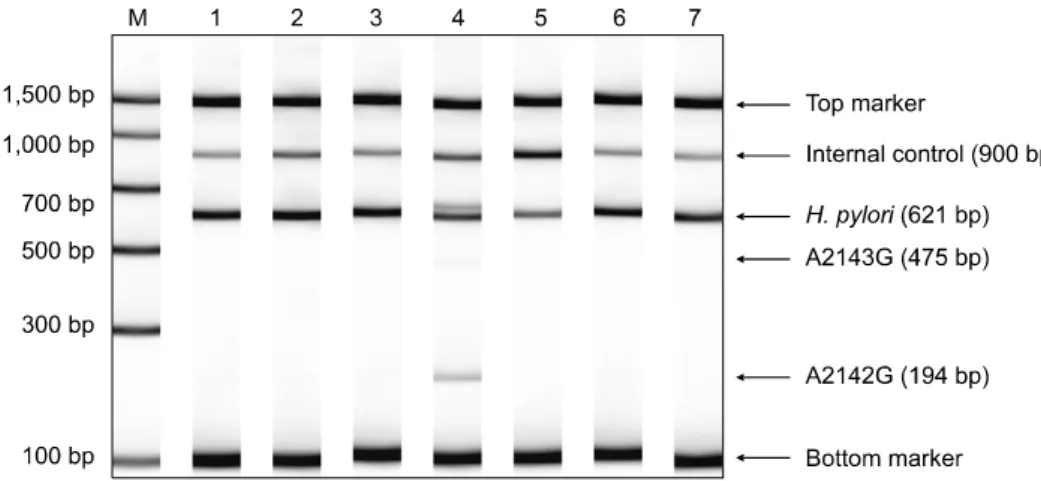
Fig. 1. Detection of the point mutations at 2143 (A to G) and 2142 (A to G) in 23S rRNA gene by polymerase chain reaction products. Lane M, DNA ladder;
lane 1-3 and 5-7, wild type; lane 4, mutant type of A2142G.
(A, B, C, D, E) 소화기내과 외래에 내원한 환자중 H. pylori 감 염이 의심되는 환자 353명(위염 271명, 위궤양 57명, 위샘종/위 폴립 6명, 위암 19명)을 대상으로 하였다. 검사는 위 전정부 또 는 위체부에서 채취한 생검조직을 수송배지(20% glycerol이 첨 가된 brucella broth)에 넣거나 바로 -80oC에 냉동보관하여 진단 검사의학과에서 시행하였다.
2. H. pylori 감염 진단
H. pylori 감염은 미호기성배양, CLO 검사(신속요소분해검 사) 및 조직의 H&E/Giemsa/silver 염색을 시행하여, 이중 하나 라도 양성인 경우 H. pylori에 감염된 것으로 정의하였고, 모든 검사에서 음성인 경우 음성군으로 정의하였다.
3. CLA 내성유전자 검사
1) DNA 추출: 위 생검조직에서 DNA 분리는 QIAamp DNA mini Kit (Qiagen inc., Valencia, CA, USA)를 사용하여 제조사 의 키트 설명서에 따라 시행하였다. 위 생검 조직을 micro- centrifuge tube에 담고, 단백질을 제거하기 위해 ATL buffer 180μL와 proteinase K 20μL를 넣어준 후 56oC에서 완전히 용해될 때까지 방치하였다. AL buffer에 proteinase K 200μL 를 넣은 후 70oC에서 10분간 반응시켰다. 100% 에탄올 240μL 를 첨가하여 15분간 섞어준 후 QIAamp spin column에 넣어 8,000 rpm에서 1분간 원심분리하였다. 세척을 위하여 column 에 AW1 buffer 500μL를 넣고 8,000 rpm에서 1분간 원심분리 하고, 2차로 AW2 buffer 500μL를 넣어 14,000 rpm에서 3분간 원심분리하였다. Column에 붙어있는 DNA를 분리하기 위해 AE buffer 200μL를 넣어 1분간 방치한 후 8,000 rpm에서 1분 간 원심분리하였다. 분리된 DNA는 자외선 분광광도계(Beck- man, CA, USA)를 이용하여 정량하고 사용하기 전까지 -80oC 에서 보관하였다.
2) 내성유전자 변이 검사: Dual priming oligonucleotide sys- tem (DPO) 기법을 도입하여 개발된 Seeplex ClaR-H. pylori
PCR 키트(Seegene Inc., Seoul, Korea)의 Seeplex Home-brew primer mix를 이용하여 유전자를 증폭하였다. DNA의 증폭은 GeneAmp PCR system 9600 (Perkin-Elmer Branchburg, NJ, USA)을 이용하였으며, 94oC에서 15분 동안 변성시킨 후 94oC 에서 30초, 65oC에서 30초, 72oC에서 1분으로 40회 증폭하였 다. 마지막으로 72oC에서 5분간 연장반응을 시켰다.
3) 결과의 판정: 증폭된 DNA 산물 5μL를 2% 아가로스 겔 을 이용하여 100 volt에서 30분간 전기 영동한 후 ethidium bro- mide로 염색하여 자외선 투과조명기에서 밴드를 확인하였다.
621 bp 산물이 관찰되면 H. pylori 양성으로 해석하였다. H. py- lori 양성 검체에서 194 bp와 475 bp의 변이형 밴드가 관찰되지 않으면 야생형(wild type)으로, 194 bp 산물이 확인되면 A2142G 변이형으로, 475 bp 산물이 보이면 A2143G 변이형으 로 해석하였다(Fig. 1).
4. 항균제 감수성 검사
29균주에 대해서 CLSI (Clinical and Laboratory Standards Institute) 디스크확산법(14균주)이나 E-test (15균주) (AB Biodisk, Solna, Sweden)로 CLA 감수성 검사를 시행하였다. 디 스크 확산법은 균 집락을 멸균된 식염수에 부유시켜 Mc- Farland 2.0 탁도로 맞추어 5% blood Mueller-Hinton agar에 접 종후 CLA 15μg disk를 배지 위에 놓고 37oC 미호기성 환경에 서 72시간 동안 배양후 억제대 직경이 22 mm 미만인 경우 내 성으로 판독하였다[10]. E-test는 스트립을 배지위에 놓고, 37oC 미호기성 환경에서 72시간 동안 배양후 최소억제농도가 1μg/
mL 이상이면 내성으로 판정하였다[11].
5. 통계분석
통계처리는 SPSS (ver 11.5)를 이용하였다. 5개 병원사이의 야생형과 변이형의 빈도 차이를 카이제곱검정(chi-square anal- ysis)을 시행하여 비교하였다. P값이 0.05 이하인 경우를 통계 적으로 유의한 차이가 있는 것으로 판정하였다.
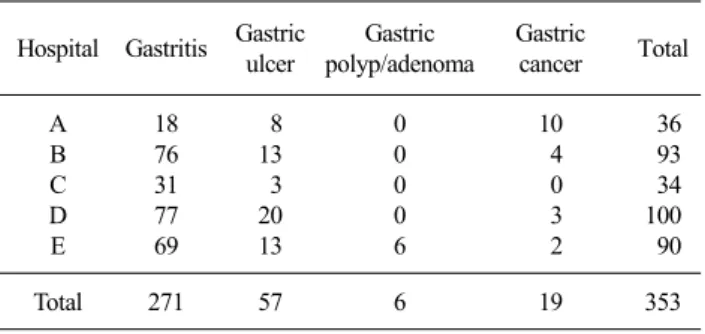
Table 1. Endoscopic diagnosis of patients at 5 university hospitals in Korea
Hospital Gastritis Gastric ulcer
Gastric polyp/adenoma
Gastric
cancer Total A
B C D E
18 76 31 77 69
8 13 3 20 13
0 0 0 0 6
10 4 0 3 2
36 93 34 100 90
Total 271 57 6 19 353
Table 2. Comparison of Seeplex ClaR-H. pylori PCR and other methods
Seeplex ClaR- H. pylori PCR
CLO or Giemsa/silver stain or culture
Positive Negative Positive
Negative
163* 31*
13* 146*
Total 194* 159*
Abbreviations: ClaR-H. pylori, clarithromycin-resistant Helicobacter pylori
*The concordance rate of Seeplex ClaR-H. pylori PCR and other methods was 87.5% (309/353).
Table 3. Allele frequencies of A2143G and A2142G at five university hospitals in Korea
Hospital Wild type Mutations (%) of 23S rRNA gene
A2142G A2143G Total
A B C D E
30 32 48 11 17
4 (9.5)0 0 (0.0)0 6 (10.1) 1 (6.3)0 0 (0.0)0
8 (19.0) 6 (15.8) 5 (8.5)0
4 (25.0) 4 (19.0)
12 (28.5) 6 (15.8) 11 (18.6) 5 (31.3) 4 (19.0) Total 138 11 (6.3)0 27 (15.3) 38 (21.6)
Table 4. Comparison of genotype and phenotype to detect clarithromycin resistance
23S rRNA genotype
Phenotype of clarithromycin susceptibility
Susceptible (n=19) Resistant (n=10) Wild type
A2143G A2142G
16 1 2
0 10 0
Total 19 10
결 과
1. 대상 환자의 임상 특성환자들의 내시경 진단은 만성위염 271명(77%), 소화성궤양 57명(16%), 위샘종/위폴립 6명(2%) 및 위암 19명(5%)이었다 (Table 1).
2. 대상 환자군의 H. pylori 양성률
H. pylori 양성률은 353 검체중 207 검체에서 한가지 방법 이 상 양성을 보여 58.6%이었다. Seeplex ClaR-H. pylori PCR은 353 검체 중 176 검체에서 양성을 보여 양성률이 49.9%였다.
Seeplex ClaR-H. pylori PCR의 민감도는 84.0% (163/194), 특이 도는 91.8% (146/159)이었으며, 다른 3가지 검사(CLO 검사, Giemsa/silver 염색, 배양)와의 일치율은 87.5%이었다(Table 2).
3. CLA 내성 유전형 빈도
H. pylori PCR 양성을 보인 176 검체중 38 검체가 23S rRNA 유전자의 변이를 보여 21.6%의 빈도를 나타내었다. 병원에 따 라 내성유전자의 변이 빈도는 15.8%에서 31.3%로 다양하였다.
A2143G 변이 빈도는 총 15.3%이었고 병원에 따라 8.5%에서
25.0%로 나타났으며 A2142G 변이 빈도는 총 6.3%이었고, 병 원에 따라 0%에서 10.1%로 나타났다(Table 3). 5개 병원사이의 야생형과 변이형의 빈도는 통계적으로 유의한 차이가 없었다 (P=0.786).
4. CLA 내성 유전형과 표현형의 비교
CLA에 E-test나 디스크확산법으로 내성을 보인 10균주는 모 두 A2143G 변이형을 나타내었고, 감수성을 보인 19균주중 16 균주는 야생형이었으나, 1균주는 A2143G 변이형을, 2균주는 A2142G 변이형을 나타내었다(Table 4).
고 찰
국내 H. pylori의 CLA 내성률은 1994년 2.8∼4.8%, 1996년 2.2%, 1999년 7.7%, 2003년 13.8%로 점차 증가하였고, 2005년 3차 대학병원에서 17.2%로 보고하였다[12-14]. 본 연구에서 H.
pylori의 CLA 내성과 연관된 23S rRNA 내성빈도는 21.6%로 나타났으나 CLA 내성의 유전형과 표현형이 일치하지 않는 경 우도 있어 기존의 항균제감수성결과에 따른 내성률과 비교하 기는 어렵다.
본 연구에서 H. pylori의 감염과 CLA 내성 유형의 진단에 사 용한 Seeplex ClaR-H. pylori PCR은 353 검체중 309 검체에서
기존의 방법(CLO test, Giemsa/silver 염색, 배양)과 결과가 일 치하여, 일치율 87.5%를 나타내었고 위 세가지 검사와 비교하 여 민감도 84.0%와 특이도 91.8%로 진단검사로 유용할 것이 다.
H. pylori의 CLA 내성 기전은 리보좀(ribosome)에 CLA 약제 의 결합이 저하되는 것으로 알려져 있으며[15], 이는 23S rRNA의 점돌연변이와 연관이 있는 것으로 보고되고 있다[16].
점 돌연변이의 위치는 주로 염기서열 2142와 2143 위치에 ad- enine이 guanine으로 치환되는 경우가 대부분이며[17], 드물게 2142위치에 adenine이 cytosine으로 치환되는 경우도 보고되고 있다[18]. H. pylori의 23S rRNA 유전자의 점돌연변이는 유럽 과 미국은 A2142G, A2143G, A2142C 변이 빈도가 높고[15, 19-21], 일본은 A2143G, A2144G[22, 23], 홍콩은 A2144G 변 이 빈도가 높은 것으로 보고되고 있다[24]. 한국은 2004년 Kim 등[12]이 CLA 내성인 10균주 중 7균주에서 A2143G 변이를 보 고하였다. van Doorn 등[19]은 129 변이 균주중 44.1%가 A2143G이고 32.6%가 A2142G 변이형이었다고 하면서, 이러 한 변이가 세계적으로 내성균의 대부분을 차지한다고 하였다.
또한 네덜란드, 프랑스, 오스트레일리아, 벨기에, 스위스 및 브 라질의 6개 국가간에 빈도 차이가 없다고 하였다. 본 연구에서 는 176개의 H. pylori PCR 양성 검체중 23S rRNA 변이가 38균 주에서 관찰되어 21.6%를 차지하였으며, 병원간 변이 빈도는 15.8%에서 31.3%로 다양하였다. 변이형 38균주중 71.1%가 A2143G 변이형이었고, 28.9%가 A2142G 변이형으로 나타나 서 Kim 등의 국내 보고[12]와 비슷한 결과이었으나 van Doorn 등[19]과는 다른 결과를 보였다. A2143G 변이형과 A2142G 변 이형의 빈도는 병원에 따라 다양하였으나 통계학적으로 유의 한 차이는 없었다(P>0.05). B와 E 병원의 경우 A2142G 변이 형은 전혀 검출되지 않았고 A2143G 변이형은 15.8% 및 19.0%
로 나타났다. 다른 병원은 A2143G 변이형이 A2142G보다 높은 빈도를 보였으나 C병원의 경우만 A2142G 변이형 10.1%로 A2143G 변이형 8.5%에 비해 높은 빈도로 검출되었다. 이와 같 이 지역에 따라 변이형의 빈도가 다양한 것은 좀더 많은 연구 를 통해 확인해야 될 것이다.
van Doorn 등[19]은 CLA 내성 130균주 중 127균주(97.7%) 는 23S rRNA 변이가 있었고 CLA 감수성 169균주 중 167균주 (98.8%)는 야생형으로 CLA 감수성 검사 결과와 23S rRNA 변 이와의 사이에 강한 연관성이 있다고 보고하였다. 본 연구에서 도 CLA 감수성 검사 결과와 23S rRNA 변이와의 연관성이 있 었는데, CLA 내성 10균주 중 10균주(100%) 모두 A2143G 변 이형을 나타내었고, CLA 감수성을 보인 19균주 중 16균주 (84.2%)에서 야생형을 나타내었다. 3균주(15.8%)는 불일치를 보였는데, 이는 감수성 검사 결과의 부정확성이 배제된다면 야 생형과 변이형이 같이 있는 hetero-resistance 균주이거나 감수 성검사에서 감수성인 균주가 유전형검사에서 야생형과 변이형
이 혼합되어 있는 예로 추정할 수 있겠다[19,25].
본 연구에 진한 A2142G 밴드와 매우 약한 A2143G의 밴드 를 보였던 1예가 포함되었는데(Fig. 1) A2142G 변이형으로 해 석하였다. 그러나 일부 균주는 여러가지 변이형이 같이 있는 경우가 보고되고 있어서[19] 추후 이런 균주의 염기서열분석 등을 통해 두가지 변이형이 같이 있는 것인지 진한 밴드의 변 이형만이 있는지 확인이 필요할 것이다.
한국에서 CLA 내성과 관련있는 23S rRNA 변이의 빈도는 21.6%로 비교적 높았으며 연구기관에 따라 15.8∼31.3%로 다 양하였고, 내성형 유형도 다양하였다. 이에 H. pylori 감염의 박 멸을 위해서는 치료 실패의 원인이 되는 H. pylori 균주의 CLA 내성 검사가 필요할 것이다.
감사의 글
본 연구를 위해 Seeplex ClaR-H. pylori PCR 키트를 제공해 주신 생명과학 Seegene 연구소에 감사를 드립니다.
이 연구는 대한임상미생물학회 2007년 연구지원비에 의한 것임.
참 고 문 헌
1. Anand BS and Graham DY. Ulcer and gastritis. Endoscopy 1999;31:215-25.
2. Parsonnet J, Friedman GD, Vandersteen DP, Chang Y, Vogelman JH, Orentreich N, et al. Helicobacter pylori infection and the risk of gastric carcinoma. N Engl J Med 1991;325:1127-31.
3. Suerbaum S and Michetti P. Helicobacter pylori infection. N Engl J Med 2002;347:1175-86.
4. Pounder RE and Ng D. The prevalence of Helicobacter pylori infection in different countries. Aliment Pharmacol Ther 1995;9:33-9.
5. Yim JY, Kim N, Choi SH, Kim YS, Cho KR, Kim SS, et al.
Seroprevalence of Helicobacter pylori in South Korea. Helicobacter 2007;12:333-40.
6. Chung WC, Cho YS, Jeong JJ, Lee IS, Kim SW, Yang JM, et al.
Eradication rate of Helicobacter pylori according to the diseases and therapeutic regimens, and reinfection rate after successful eradication in a tertiary clinic. Korean J Gastroenterol 2003;41:1-8.
7. Kim JJ, Reddy R, Lee M, Kim JG, EI-Zaatari FA, Osato MS, et al. Analysis of metronidazole, clarithromycin and tetracycline resistance of Helicobacter pylori isolates from Korea. J Antimicrob Chemother 2001;47:459-61.
8. Kim ES, Kang JO, Han D, Park PW, Park IK, Choi TY.
Comparison of modified broth microdilution method, E test and disk diffusion method for antimicrobial susceptibility testing of Helicobacter pylori. Korean J Clin Pathol 1998;18:559-64.
9. Houben MH, van de Beek D, Hensen EF, Craen AJ, Rauws EA, Tytgat GN. A systematic review of Helicobacter pylori eradication therapy-the impact of antimicrobial resistance on eradication rates.
Aliment Pharmacol Ther 1999;13:1047-55.
10. Grignon B, Tankovic J, Mégraud F, Glupczynski Y, Husson MO, Conroy MC, et al. Validation of diffusion methods for macrolide
susceptibility testing of Helicobacter pylori. Microb Drug Resist 2002;8:61-6.
11. Clinical and Laboratory Standards Institute. Performance standards for antimicrobial susceptibility testing; eighteenth informational supplement. M2-A9 and M7-A7, M100-S18. Wayne, PA; CLSI, 2008.
12. Kim JM, Kim JS, Jung HC, Kim N, Song IS. Antibiotic resistance of Helicobacter pylori isolated from Korean patients in 2003.
Korean J Gastroenterol 2004;44:126-35.
13. Kim JM, Kim JS, Jung HC, Kim N, Kim YJ, Song IS. Distribution of antibiotic MICs for Helicobacter pylori strains over a 16-year period in patients from Seoul, South Korea. Antimicrob Agents Chemother 2004;44:4843-7.
14. Sung H, Chung HJ, Kim MN, Lee GH. Clinical usefulness of antimicrobial susceptibility test for Helicobacter pylori. Korean J Lab Med 2006;26:179-84.
15. Occhialini A, Urdaci M, Doucet-Populaire F, Bébéar CM, Lamouliatte H, Mégraud F. Macrolide resistance in Helicobacter pylori: rapid detection of point mutations and assays of macrolide binding to ribosomes. Antimicrob Agents Chemother 1997;
41:2724-8.
16. Versalovic J, Shortridge D, Kibler K, Griffy MV, Beyer J, Flamm RK, et al. Mutations in 23S rRNA are associated with clarithromycin resistance in Helicobacter pylori. Antimicrob Agents Chemother 1996;40:477-80.
17. Taylor DE, Ge Z, Purych D, Lo T, Hiratsuka K. Cloning and sequence analysis of two copies of a 23S rRNA gene from Helicobacter pylori and association of clarithromycin resistance with 23S rRNA mutations. Antimicrob Agents Chemother 1997;41:2621-8.
18. Alarcón T, Domingo D, Prieto N, López-Brea M. PCR using
3’-mismatched primers to detect A2142C mutation in 23S rRNA conferring resistance to clarithromycin in Helicobacter pylori clinical isolates. J Clin Microbiol 2000;38:923-5.
19. van Doorn LJ, Glupczynski Y, Kusters JG, Mégraud F, Midolo P, Maggi-Solca N, et al. Accurate prediction of macrolide resistance in Helicobacter pylori by a PCR line probe assay for detection of mutations in the 23S rRNA gene: multicenter validation study.
Antimicrob Agents Chemother 2001;45:1500-4.
20. Stone GG, Shortridge D, Versalovic J, Beyer J, Flamm RK, Graham DY, et al. A PCR-oligopeptide ligation assay to determine the prevalence of 23S rRNA gene mutations in clarithromycin- resistant Helicobacter pylori. Antimicrob Agents Chemother 1997;41:712-4.
21. Mégraud F, Lehn N, Lind T, Bayerdörffer E, O’Morain C, Spiller R, et al. Antimicrobial susceptibility testing of Helicobacter pylori in a large multicenter trial: the MACH 2 study. Antimicrob Agents Chemother 1999;43:2747-52.
22. Umegaki N, Shimoyama T, Nishiya D, Suto T, Fukuda S, Munakata A. Clarithromycin-resistance and point mutations in the 23S rRNA gene in Helicobacter pylori isolates from Japan. J Gastroenterol Hepatol 2000;15:906-9.
23. Maeda S, Yoshida H, Matsunaga H, Ogura K, Kawamata O, Shiratori Y, et al. Detection of clarithromycin-resistant Helico- bacter pylori strains by a preferential homoduplex formation assay.
J Clin Microbiol 2000;38:210-4.
24. Wang WH, Wong BCY, Mukhopadhyay AK, Berg DE, Cho CH, Lai KC, et al. High prevalence of Helicobacter pylori infection with dual resistance to metronidazole and clarithomycin in Hong Kong. Aliment Pharmacol Ther 2000;14:901-10.
25. Lee MA. Antimicrobial resistance of Helicobacter pylori. Korean J Clin Microbiol 2001;4:73-7.
=국문초록=
한국에서
Helicobacter pylori
균주의 Clarithromycin 내성 23S rRNA 유전자 점돌연변이의 빈도에 대한 다기관 연구가톨릭대학교 의과대학 1진단검사의학교실, 2내과학교실, 3한양대학교 의과대학 진단검사의학교실,
4중앙대학교 의과대학 진단검사의학교실, 5울산대학교 의과대학 서울아산병원 진단검사의학과,
6하나로 의료재단, 이화여자대학교 의과대학 7진단검사의학교실, 8내과학교실 이혜경1, 채현석2, 강정옥3, 이미경4, 성흥섭5, 김미나5, 이종욱6, 이미애7, 심기남8
배경: Clarithromycin (CLA)내성은 Helicobacter pylori 감염의 박멸 치료 실패의 중요한 원인이다. 본 연구에서는 한국에서 CLA 내성과 연관이 있는 23S rRNA 유전자 변이의 빈도와 유형을 분석하고자 하였다.
방법: 2008년 1월부터 2008년 3월까지 서울과 경기도 소재 5개 대학병원에 내원한 환자 353명으로부터 위생검조직을 채취하였다. H. pylori의 검출에서 3가지 방법(미호기성배양, 신속요소분해효소검사, Giemsa/silver 염색)중 한가지라도 양 성인 경우 H. pylori에 감염된 것으로 정의하였다. 모든 검체에 Seeplex ClaR-H. pylori PCR (Seegene Inc., Seoul, Korea)을 시행하여 H. pylori 감염여부, 23S rRNA의 야생형, A2143G 및 A2142G 변이형의 빈도를 조사하였다. 29균주에 대해서는 E-test (AB Biodisk, Solna, Sweden)나 CLSI (Clinical and Laboratory Standards Institute) 디스크확산법으로 CLA 감수성 검사 를 시행하였다.
결과: 176개의 Seeplex ClaR-H. pylori PCR양성 검체중 23S rRNA 변이가 38균주(A2143G 27균주, A2142G 11균주)에서 관찰되어 변이 빈도 21.6%를 보였다. 총 변이 빈도는 15.8%에서 31.3%로 병원에 따라 다양하였다. A2143G 변이 빈도는 5 병원에서 8.5%에서 25.0%로 다양하였다. CLA 감수성 검사에서 10균주가 내성을 나타내었는데 모두 A2143G 변이를 나타내었다. CLA 감수성 검사에서 감수성을 나타내었던 19균주중 3주가 변이형이었다.
결론: 한국에서 CLA 내성빈도는 21.6%이었으나 내성과 관련있는 23S rRNA 유전자 변이는 연구기관에 따라 빈도와 유 형이 다양하였다. [대한임상미생물학회지 2008;11:84-89]
교신저자 : 이미애, 서울특별시 양천구 목동 911-1 이화여자대학교 의과대학 진단검사의학교실 Tel: 02-2650-5222, Fax: 02-2650-5222 E-mail: [email protected]