A St udyo nt heFa c t o r st ha tI nf l ue nc et he Sur g i c a lOut c o me so fCho l e do c ha lCy s t
i nChi l dr e n*
Jong-kyuKim,M.D.,GyoungTaeNoh,M.D.,Seok-kiMin,M.D.,Kum-jaChoi,M.D.
DepartmentofSurgery,EwhaWomansUniversitySchoolofMedicine, Seoul,Korea
*Abstractpresentedatthe62ndannualcongressofthe KoreanSurgicalSociety,SeoulKorea,November2010. Submission:12/1/25 Acceptance:12/6/13 Correspondence:Kum-jaChoi,M.D.
Department of Surgery, Ewha Womans University SchoolofMedicine,1071Anyangcheon-ro,Yangcheon -gu,Seoul158-710,Korea
Tel:02)2650-5554,Fax:02)2644-7984 E-mail:kumchoi@ewha.ac.kr
INTRODUCTION
Cysticdilatationofthebiliaryduct,also known as choledochal cyst is an uncommon disease entity. In case of serious condition, it requires surgical treatment.It is more frequent in East Asians,females and children ratherthan Westerners,malesandadults1-3.
In patients with choledochal cyst,an anomalous pancreatic duct-biliary duct junction (APBDJ)is often seen in both pediatric and adult patients4-6. The anomalous junction causes pressure gradient and results in a reflux of pancreaticjuiceinto thebileduct,where
the activated pancreatic enzymes damage the bile duct wall and result in cyst formation.Otheretiologiesincludesphinc- ter dysfunction,innervations deficit and obstruction ofdistalcholedochusofeither congenital or acquired in nature7-11. Choledochalcysts are currently classified into five major subtypes based on anatomicalfindings12.The mostcommon subtype in both children and adult is dilatation of extrahepatic biliary tree, representing50-80% ofallcases13.Classic symptom triads of choledochalcyst are abdominal pain, jaundice and palpable abdominalmass.According to the recent reports, abdominal pain is the most frequent symptom, especially in adult patients14.Meanwhile,adult patients less likely present jaundice and rarely abdominalmass15.Unliketheadultpatients, jaundice is mostfrequentsymptom and the appearance ofallsymptom triad is
morecommoninchildren16.Ifleftuntreated, choledochalcystscancausemorbidity and mortality from recurrent cholangitis, pancreatitis, sepsis, liver abscesses and cholangiocarcinoma. Therefore, early diagnosis via ultrasonography and chol- angiography is considered essential and mostofsurgeonscurrently agreethatall patientsrequirecompletecystexcisionand hepaticoenterostomy17.However,there are many reported cases of continued problems for long period following surgery18.
In this study, we reviewed clinical findings and results of treatment in pediatric patient undergone surgical management of choledochal cyst to investigate the factors affecting the surgicaloutcomes and determine optimal timingforsurgery.
MATERIALS andMETHODS
From 1995 to 2009,32 patients under the age of18 diagnosed as choledochal cyst were enrolled in this study. All patients included in this study were undergone surgical treatment at our hospitaland their medicalrecords were reviewed and analyzed retrospectively.
Patients’sex,ageatthetimeofsurgery, preoperative clinicalsymptoms,laboratory findings and anatomicaltypeofthecyst were recorded. The diagnosis was
confirmed by radiological methods of abdominalultrasonography(US),computed tomography (CT),ormagnetic resonance cholangiopancreatography (MRCP). The surgicalmethod was cystexcision with cholecystectomyandRoux-en-Y hepatico- jejunostomy. To evaluate the surgical outcomes,weanalyzedmeanoperationtime, incidence of postoperative complications, duration of hospital stay and re- hospitalizationrate.
The analysis ofresults was conducted by SPSS 12.0 (Statistical Package for SocialSciences)whilemethodsoft-test, chi-square test, Fisher's exact test, multiple linear regression analysis and binary logistic regression analysis.
Statistical significance was determined basedonaP-valueof0.05.
RESULTS
Of32patientswithcholedochalcyst,10 patientsweremaleand 22 patientswere female.Themeanageatoperationis5.4
±5.2 (range:2 weeks∼17 years) years.
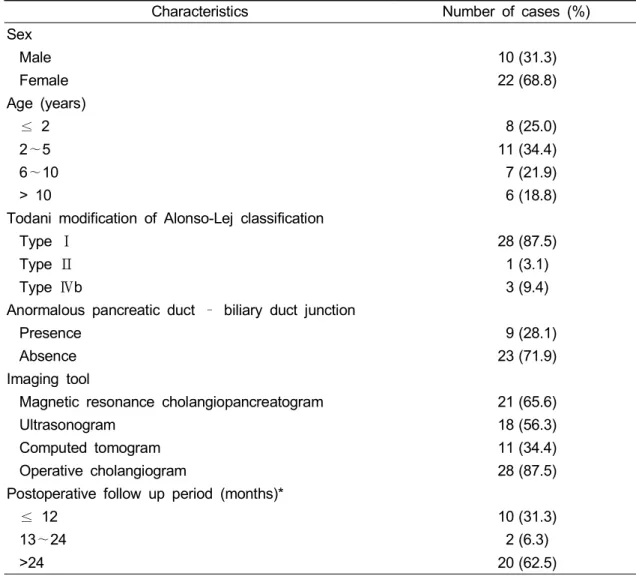
Among the enrolled patients,8 patients (25.0%) undergone surgery under two yearsold,11(34.4%)werepreschoolage (2∼5years),7 (21.9%)wereschoolage (6∼10years)and6patients(18.8%)were adolescence (above 10 years).Of the 8 patients undergone surgery under two yearsold,1patienthadbeendiagnosedas
Table 1. Demographic Characteristics of Patients
Characteristics Number of cases (%)
Sex
Male 10 (31.3)
Female 22 (68.8)
Age (years)
≤ 2 8 (25.0)
2∼5 11 (34.4)
6∼10 7 (21.9)
> 10 6 (18.8)
Todani modification of Alonso-Lej classification
Type Ⅰ 28 (87.5)
Type Ⅱ 1 (3.1)
Type Ⅳb 3 (9.4)
Anormalous pancreatic duct – biliary duct junction
Presence 9 (28.1)
Absence 23 (71.9)
Imaging tool
Magnetic resonance cholangiopancreatogram 21 (65.6)
Ultrasonogram 18 (56.3)
Computed tomogram 11 (34.4)
Operative cholangiogram 28 (87.5)
Postoperative follow up period (months)*
≤ 12 10 (31.3)
13∼24 2 (6.3)
>24 20 (62.5)
* mean: 34.6 ± 35.4 (range : 1/2∼123) months choledochal cyst during prenatal period andperformedsurgeryatageof2month.
According to Todani’s classification of choledochal cyst, all of the patients showed extrahepaticcyst,type I,Ⅱ and
Ⅳb.Of32 patients,28 patients (87.5%) exhibited type I and 3 patients (9.4%) showed type IVb. There was only 1 patient(3.1%)as typeⅡ.Type Ⅲ,Ⅳa andV notexhibitedinanypatient.Inour study,APBDJ was seen in 9 patients
(28.1%).The mostcommon preoperative imagingtoolinthisstudywasMRCP(21 patients,65.6%),and abdominalUS (18 patients,56.3%) and abdominalCT (11 patients,34.4%)were in order.And 28 patients (87.5%) were taken operative cholangiogram.Themeanfollow-upperiod after operation is 34.6±35.4 (range: 2 weeks∼123 month) months.Allpatients came to hospitalatleast1 month after operationexceptonepatient(Table1).
Table 2. Preoperative Symptoms
Symptoms Number of cases (%)
Symptomatic Group 30 (93.8)
Abdominal pain 19 (63.3)
Jaundice 12 (40.0)
Vomiting 7 (23.3)
Abdominal mass 5 (16.7)
Fever 5 (16.7)
Pruritus 2 (6.7)
Diarrhea 2 (6.7)
Asymptomatic Group 2 (6.3)
Table 3. Preoperative Laboratory Findings
Abnormal Laboratory Findings Number of cases (%)
Increased AST* and ALT† 18 (56.3)
Hyperbilirubinemia 8 (25.0)
Leukocytosis 7 (21.9)
* AST: aspartate aminotransferase
† ALT: alanine aminotransferase
+ normal range: AST; 0∼40 IU/L ALT; 0∼40 IU/L Bilirubin;0.2∼1.2 mg/dl
WBC; 5000∼17500/L (<1 year) 6000∼17000/L (1∼2 years) 5000∼14500/L (2∼5 years) 4500∼13500/L (6∼11 years) 4000∼10000/L (>12 years)
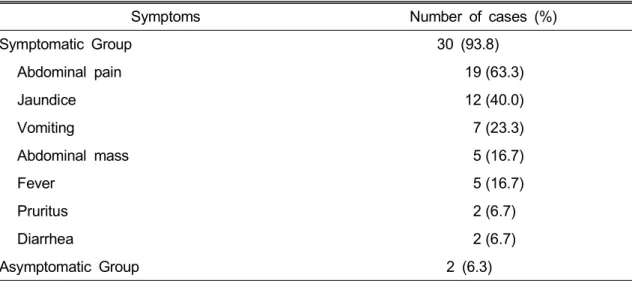
Of 32 patients, 30 patients (93.8%) presented symptoms preoperatively but2 patients (6.3%) did not show any symptoms.Amongthepresentedsymptoms, abdominalpainwasthemostfrequent(63.3%), followed by jaundice (40.0%), vomiting (23.3%),abdominalmass(16.7%)andfever (16.7%). There were no patients with symptom triad such as abdominalpain, jaundiceandpalpableabdominalmass,while
9patientsexhibitedtwosymptomsamong symptom triad(Table2).
Investigating preoperative laboratory findings,aspartateaminotransferase(AST) and alanineaminotransferase(ALT)were elevated in 18 patients (56.3%).Hyper- bilirubinemia was exhibited in 8 patients (25.0%)and 7 patients (21.9%)showed leukocytosis(Table3).
Allpatientsunderwentsurgicaltreatment
Table 4. Postoperative Complications and Hospital Stay
Course Number of cases (%)
Postoperative complication 5 (15.6)
Cholangitis 2
Anastomosis site stricture 1
Postoperative bleeding 1
Intestinal obstruction 1
Postoperative hospital stay (weeks)*
≤ 1 4
1∼2 21
> 2 7
Re-admission during follow up period 3 (9.0)
* Mean hospital stay : 12.2 ± 5.8 (range ; 5∼30) days
of cyst excision, cholecystectomy and Roux-en-Y hepaticojejunostomy. Mean operationtimewas246.5±55.7(range:185
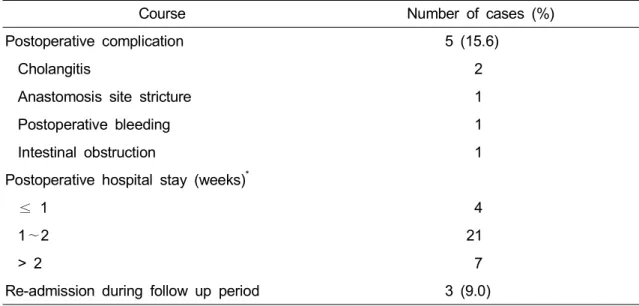
∼450)minutes,andmean bloodlosswas 122±172(range:10∼700)ml.Postoperative complicationswerenotedin5patients(15.6
%).Twopatientswerecholangitisand1 patient was anastomotic site stricture.
Another 2 patients showed postoperative bleeding and intestinalobstruction.Mean postoperative hospitalstay was 12.2±5.8 (range:5∼30)days.The3patientswere re-hospitalized during follow-up period.
Twopatientswereowingtocholangitisand another patient was owing to intestinal obstruction.The above 3 patients were improved with conservative treatment (Table4).
In orderto search forthefactorsthat couldinfluencethesurgicaloutcomessuch
asoperationtime,complication,postoperative hospital stay and re-admission, we performed the univariate analysis.As a result, the presence of symptoms prolonged the duration of postoperative hospitalstay with statistically significant value (p=0.010).Also,the presence of APBDJ increased re-admission rate significantly, too (p=0.005). Another analyzing the factors by multivariate analysis,increased age at the time of operation prolonged the mean operation timeandthedurationofhospitalstay(p=
0.004, 0.028). Symptomatic patients had longer postoperative hospital stay than asymptomatic patients (p=0.001). The presenceofAPBDJincreased readmission rate,too(p=0.005).Gender,typeofcyst and preoperative laboratory findings did notaffectedtheoutcomes(Table5).
Table 5. Factors that Influence on Surgical Outcomes Prognostic Factors
(n=number of cases)
Mean Op Times (mins)
p - value
Complica- tion Cases
(%)
p - value
Mean Postop Hospital Stay
(days)
p - value
Re-admis- sion Cases
(%)
p - value Sex
Male (n=10) 231.7 ± 44.2
0.833 1 (10.0)
0.484 11.6 ± 5.4
0.322 0 (0.0)
0.194
Female (n=22) 253.9 ± 60.5 4 (18.2) 12.5 ± 6.1 3 (13.6)
Age
<2 years (n=8) 215.0 ± 23.8
0.004
1 (12.5)
0.785
13.5 ± 8.0
0.028
0 (0.0)
0.868 2∼5 years (n=11) 230.0 ± 28.4 2 (18.2) 11.4 ± 4.2 2 (18.2) 6∼10 years (n=7) 225.8 ± 11.1 1 (14.3) 9.7 ± 2.4 1 (14.3) Over 10 years (n=6) 325.8 ± 65.8 1 (16.7) 14.8 ± 7.7 0 (0.0)
Clinical Finding
Symptomatic (n=30) 247.8 ± 57.5
0.665 4 (13.3)
0.234 11.3 ± 4.8
0.001 3 (10.0) 0.603 Asymptomatic (n=2) 230.0 ± 28.3 1 (50.0) 25.0 ± 7.1 0 (0.0)
Types of Cyst
Type I (n=28) 246.1 ± 57.4 0.665
4 (14.3) 0.484
12.2 ± 6.1
0.642
2 (7.1)
0.194
Type II (n=1) 240.0 ± 0.00 0 (0.0) 8.0 ± 0.0 0 (0.0)
Type IVb (n=3) 250.0 ± 50.7 1 (33.3) 13.3 ± 4.9 1 (33.3)
APBDJ*
Presence (n=9) 236.3 ± 29.2
0.637 3 (33.3)
0.099 11.3 ± 3.7
0.642 3 (33.3) 0.005
Abscence (n=23) 250.8 ± 64.0 2 (8.7) 12.5 ± 6.5 0 (0.0)
Laboratory Data (n=27)
Increased AST†,
ALT+(n=18) 239.2 ± 60.7 0.774
2 (11.1) 0.161
11.1 ± 5.0
0.899
2 (11.1) 1.000 Normal AST†,
ALT+(n=9) 261.1 ± 43.6 3 (33.3) 13.7 ± 8.2 1 (11.1)
Hyperbilirubinemia
(n=8) 256.9 ± 83.6
0.596
2 (25.0) 0.574
13.5 ± 6.6
0.935
2 (25.0) 0.136 Normal Bilirubin
(n=19) 242.1 ± 41.2 3 (15.8) 11.3 ± 6.1 1 (5.3)
Leukocytosis
(n=7) 264.3 ± 87.4
0.278
2 (28.6) 0.426
13.9 ± 7.0
0.612
2 (28.6) 0.088 Normal WBC¶
(n=20) 240.3 ± 41.0 3 (15.0) 11.3 ± 5.9 1 (5.0)
* APBDJ : anormalous pancreatic duct-biliary duct junction
† AST : aspartate aminotransferase
+ ALT : alanine aminotransferase
¶ WBC : white blood cell
DISCUSSION
The prevalence ofcholedochalcystis higherin Asia than in western countries and most cases are reported in Japan, where they occurin one ofevery 1,000 livebirths1,7.Theincidenceofcholedochal cyst in Republic of Korea is on the increaseduetotherecentdevelopmentin the diagnostic technology and a rapid growth in the subclinicalpatientthrough health examinations by means of abdominalUS,abdominalCT,andMRCP etc.Choledochalcystis characterized by itsremarkablehigherincidencein female patients together with the regional preference.In this study,we also found more cases of female patients (68.8%). Though the distribution of occurrence according to the age varies to a great extent,it is reported that most of the patients areinfantsorchildren below 10 year-old19-21.In this study investigating patients under age of 18 year-old, 26 patients (81.3%)were underthe age of 10,too.
The classifying method of choledochal cystinthisstudywasTodanimodification ofAlonso-Lejclassificationthatiscurrently usedbymostsurgeons.Accordingtothis classification, Yamaguchi1 reported that Type Ioccupy 77.7% ofallcholedochal cystsandTypeⅡ,Ⅲ constituteonly2.0%
and 1.4%.And,TypeⅣ occupies22.9%
whilereportedcasesofTypeV arevery rare.Inthisstudy,theresultwassimilar with this report that type Iwas most frequentwiththefractionof87.5% followed by9.4% oftypeⅣ and3.1% oftypeⅡ.
As an etiology and pathophysiology, APBDJtheory iscommonly accepted and explainsthefurthercomplicationssuchas cholangitis,biliarymalignancy,pancreatitis and pancreatic cancer4,22,23.In our study, there were only 28.1% ofpatients with APBDJ confirmed by operative cholan- giogram withmorethan15mm ofcommon channellength.Thisresultsuggestedthat choledochalcystin pediatric patients can arise without APBDJ and congenital anomalycanbesuspectedasthecauseof choledochalcyst.
Previousstudiesshowedthattheclassic triad of jaundice, abdominal pain and abdominal mass was often seen in pediatric patients than in adults1,7.More specifically,adultpatients were prone to have the symptom of abdominal pain, while pediatric patients tended to have jaundice24.In this study,there was no patientwithallclassicsymptom triadand abdominal pain was the most common symptom withtheincidenceof63.3% that is more frequentthan jaundice (40.0%). The reason of no patients with all symptom triad can be suggested that earlier visits to hospital and early detection through advanced diagnostic
tools possible with improved levels of national medical consciousness. And in this study, the leading symptom was abdominal pain in pediatric patients paradoxically. This result is probably owing to the smallnumber of enrolled patients and the wide range of age distribution,from birthtothe18year-old.
Severalstudiessuggestedthatintermittent jaundiceismostly noticed in neonatesor infants, whereas abdominal pain is commoninchildrenandadults25,26.Further investigation with additional pediatric patients would be needed for the age specificdata.
The treatmentmodality ofcholedochal cysthad been debated and selection of surgicalmethod was differentdepending ontheage,generalconditionsofpatients, and location and type of choledochal cyst27. Since 1980, total resection of choledochalcysthasbeenregardedasthe basictreatmentmethod28.But,theoptimal timeofsurgeryforasymptomaticpediatric patients diagnosed before birth or on health examinations is stillcontroversal29,
30.
Inthisstudy,allthepatientsunderwent total excision of choledocal cyst with cholecystectomy and hepaticojejunostomy.
Therecentstudyreportedthatshort-term and long-term postoperativecomplications for choledochal cyst in children had decreased26,andin thisstudy,therewere
postoperative complications in 15.6% of cases,among whichcholangitiswasmost frequentwith2cases.Therewerealso3 cases of re-admission during following period. And, with the results of multivariateanalysis,wecouldidentifythe factors that have affected treatment outcomes.Theyoungerthepatientswere atthe time atsurgery,the shorter the operation time and postoperative hospital stay.Additionally,patientswithsymptoms and APBDJ showed longer duration of postoperative hospital stay and re- admission rate after. These results suggestthatas the time goes on with choledochalcystespeciallyassociatedwith ABPDJ, the progression of pathological changeofpancreato-biliary system would worsetheprognosisofpatients.
Conclusively,gender,type ofcystand preoperative laboratory findings did not affectedtheoutcomes.Butthepresenceof APBDJ can increase readmission rate.If choledochalcystis resected as soon as possible, operation time and length of hospitalstaywouldbeshortened.
REFERENCES
1. Yamaguchi M: Congenital choledochal cyst. Analysis of 1433 patients in the Japanese literature. Am J Surg 140:
653-657, 1980
2. de Vries JS, de Vries S, Aronson DC, Bosman DK, Rauws EA, Bosma A, Heij
HA, Gouma DJ, van Gulik TM:
Choledochal cysts: age of presentation, symptoms, and late complications related to Todani's classification. J Pediatr Surg 37:1568-1573, 2002
3. Soreide K, Korner H, Havnen J, Soreide JA: Bile duct cysts in adults. Br J Surg 91:1538-1548, 2004
4. Babbitt DP, Starshak RJ, Clemett AR:
Choledochal cyst: a concept of etiology.
Am J Roentgenol Radium Ther Nucl Med 119:57-62, 1973
5. Ono J, Sakoda K, Akita H: Surgical aspect of cystic dilatation of the bile duct. An anomalous junction of the pancreaticobiliary tract in adults. Ann Surg 195:203-208, 1982
6. Shi LB, Peng SY, Meng XK, Peng CH, Liu YB, Chen XP, Ji ZL, Yang DT, Chen HR: Diagnosis and treatment of congenital choledochal cyst: 20 years’
experience in China. World J Gastroenterol 7:732-734, 2001
7. Lipsett PA, Pitt HA: Surgical treatment of choledochal cysts. J Hepatobiliary Pancreat Surg 10:352-359, 2003
8. Craig AG, Chen LD, Saccone GT, Chen J, Padbury RT, Toouli J: Sphincter of Oddi dysfunction associated with choledochal cyst. J Gastroenterol Hepatol 16:230-234, 2001
9. Davenport M, Basu R: Under pressure:
choledochal malformation manometry. J Pediatr Surg 40:331-335, 2005
10. Matsufuji H, Araki Y, Nakamura A, Ohigashi S, Watanabe F: Dynamic study of pancreaticobiliary reflux using secretin -stimulated magnetic resonance cholan- giopancreatography in patients with choledochal cysts. J Pediatr Surg 41:1652-1656, 2006
11. Han SJ, Hwang EH, Chung KS, Kim MJ, Kim H: Acquired choledochal cyst
from anomalous pancreatobiliary duct union. J Pediatr Surg 32:1735-1738, 1997 12. Alonso-Lej F, Rever WB, Pessagno DJ:
Congenital choledochal cyst, with a report of 2 and an analysis of 94 cases.
Int Abstr Surg 108:1, 1959
13. Todani T, Watanabe Y, Narusue M, Tabuchi K, Okajima K: Congenital bile duct cysts. Classification, operative procedures, and review of thirty weven cases including cancer arising from choledochal cyst. Am J Surg 134:263, 1977
14. Kahng KW, Lee OC, Goo GS, Hahm JS, Rhee JC, Lee MH, Kee CS, Park KN: A clinical analysis of choledochal cyst.
Korean J Gastrointest Endosc 12:285-291, 1992
15. Lipsett PA, Pitt HA, Colombani PM, Boitnott JK, Cameron JL: Choledochal cyst disease. A changing pattern of presentation. Ann Surg 220:644-52, 1994 16. Tan KC, Howard ER: Choledochal cyst:
A 14-year surgical experience with 36 patients. Br J Surg 75:892, 1988
17. Hung MH, Lin LH, Chen DF, Huang CS: Choledochal cysts in infants and children: experiences over a 20-year period at a single institution. Eur J Pediatr 170:1179-1185, 2011
18. Metcalfe MS, Wemyss-Holden SA, Maddern GJ: Management dilemmas with choledochal cysts. Arch Surg 138:333- 339, 2003
19. Gertler JP, Cahow CE: Choledochal cyst in the adult. J Clin Gastroenterol 10:315- 319, 1988
20. Guelrud M, Morera C, Rodriquez M, Prados J, Jaen D: Normal and anomalous pancreaticobiliary union in children and adolescents. Gastrointestinal Endoscopy 50:189-193, 1999
21. O’Neill JA Jr, Templeton JM Jr,
Schnaufer L, Bishop HC, Ziegler MM, Ross AJ 3rd: Recent experience with choledochal cyst. Ann Surg 205:533-540, 1987
22. Shimada K, Yanagisawa J, Nakayama F:
Increased lysophospatidylcholine and pancreatic enzyme content in bile of patients with anomalous pancreaticobiliary ductal junction. Hepatology 13:438-444, 1991
23. The Japanese Study Group on Pancreati- cobiliary Maljunction (JSPBM): The Committee of JSPBM for Diagnostic Criteria: Diagnostic criteria of pancreati- cobiliary maljunction. J Hep Bil Panc Surg 1:219-221, 1994
24. Edil BH, Cameron JL, Reddy S, Lum Y, Lipsett PA, Nathan H, Pawlik TM, Choti MA, Wolfgang CL, Schulick RD: Cho- ledochal cyst disease in children and adults: a 30-year single-institution experience.
J Am Coll Surg 206:1000-1006, 2008 25. Suh SJ, Choi SO, Park WH: Clinical
analysis of choledochal cyst in childhood.
J Korean Surg Soc 65:564-571, 2003 26. Nam YH, Jung JH, Song YT: Clinical
analysis of choledochal cysts in children.
J Korean Surg Soc 75:328-335, 2008 27. Howard ER: Choledochalcyst. In Schwartz
and Ellis(eds): Maingot's Abdominal Operation (ed 9), Appleton & Lange, East Norwalk. 1990, Pp1365
28. Ono J, Sakoda K, Akita H: Surgical aspect ot cystic dilatation of the bile duct. An anomalous junction of the pancreaticobiliary tract in adults. Ann Surg 195:203-208, 1982
29. Howell CG, Templeton JM, Weiner S, Glassman H, Betts JM, Witzleben CL:
Antenatal diagnosis and early surgery for choledochal cyst. J Pediatr Surg 18:387- 393, 1983
30. Dhupar R, Gulack B, Geller DA, Marsh JW, Gamblin TC: The changing pre- sentation of choledochal cyst disease: an incidental diagnosis. HPB Surg 2009;
2009:103739, Epub 2009 Oct 19
소아에서 담관 낭종의 수술 성적에 영향을 주는 요인에 대한 연구
이화여자대학교 의학전문대학원 외과학교실
김종규 ·노경태 ·민석기 ·최금자
담관 낭종은 흔하지는 않지만,외과적 절제가 필요한 주요 질환이다.절제하지 않고 남겨두면 다른 질환으로의 이환이나 다양한 합병증에 의한 사망까지도 야기할 수 있기 때문에 적절한 수술 적 치료가 필수적이다.최근 수술에 따른 다양한 문제들이 계속 보고되고 있으며,출생 전이나 건 강 검진 시 발견되는 무증상의 담관 낭종의 수술 시기에 대해서도 아직 논란이 되고 있다.저자들 은 1995년부터 2009년까지 담관 낭종으로 수술 받은 환자 중 수술 받을 당시의 연령이 18세 이하 인 32명 환자의 임상 양상과 수술 기록을 후향적으로 분석하여,수술 성적에 영향을 주는 요인들 을 알아보고자 하였다.전체 32명 중 남자 10명,여자 22명이었으며,수술 당시의 평균 연령은 5.4 세였다.췌담관 합류이상은 9명(28.1%)이었으며,평균 추적 관찰 기간은 34.6개월이었다.술 전 증상을 호소한 환자는 30명(93.8%)이었으며,복통(63.3%),황달(40.0%),구토(23.3%),복부종물 (16.7%),발열(16.7%)등의 순서였다.술 전 혈액 검사에서 AST/ALT의 상승이 18명(56.3%),고 빌리루빈혈증이 8명,백혈구 증가증이 7명(21.9%)이었다.술 후 합병증은 5명(15.6%)에서 나타났 는데,2명은 담관염이었고,나머지 3명은 문합부 협착,술 후 출혈,장 폐쇄가 각각 1명 있었다.술 후 평균 재원 기간은 12.2일 이었으며,추적 관찰 기간 중 3명(9.0%)이 재입원 하였다.수술 성적 에 영향을 미치는 요인으로,수술 당시의 나이가 많을수록 평균 수술 시간과 재원 기간이 증가하 였다(p=0.004,p=0.028).증상이 있었던 환자군에서 무증상 환자군보다 재원 기간이 더 길었다 (p=0.001).또한 췌담관 합류이상이 있었던 환자군에서 재입원율이 유의하게 높았다(p=0.005).소아 의 담관 낭종은 진단이 되면 증상 발현 전이라도 조기에 수술하는 것이 수술 시간 및 재원 기간을 단축시킬 수 있으며,췌담관 합류이상이 동반된 경우에는 술 후에 재입원할 가능성이 높으므로 주 의깊게 추적 관찰하는 것이 바람직할 것이다.
(J KorAssoc PediatrSurg 18(1):1~11),2012.
IndexWords:담관 낭종,수술 성적,예후,소아
교신저자:최금자
(158-710)서울특별시 양천구 안양천로 1071,이화여자대학교 의과대학 A동 804호 Tel:02)2650-5554,Fax:02)2644-7984
E-mail:kumchoi@ewha.ac.kr