27
ISSN: 2288-2766 © 2021 KODISA & EABEA. http://eajbe.jams.or.kr
doi: http://dx.doi.org/10.20498/eajbe.2021.9.1.27
Studies on Change of Logistics Concept and Introduction of 4PL
*11Jin-Hwan KIM
Professor, Department of International Trade, Korea National Open University, Korea.
E-mail: [email protected]
Received: February 03, 2021. Revised: February 15, 2021. Accepted: February 22, 2021.
Abstract
Purpose – According to the actual change of the logistics concept, the outsourcing activities of companies are actively progressing, and this is proceeding to third-party logistics and fourth-party logistics. This change in logistics situation raises the need for an in-depth understanding of four-party logistics.
Research design, data, and methodology – In this study, first of all, the theoretical aspects of changes in the logistics concept are identified, along with the outsourcing and third-party logistics. Finally, the concept of four-party logistics, the background of its introduction, and future prospects will be explored.
Result – The meaning of physical distribution is now passing through the existing three-party logistics and entering the era of four-way logistics. In addition, cost reduction and improvement of customer service through advanced logistics strategy can be said to be the company's competitiveness. Through this study, it can be seen that the conceptual change of logistics and the introduction of four-party logistics are closely related to the survival of the company's deficit in the market.
Conclusion – In modern society, logistical competitiveness is the competitiveness of a company, and logistical activities of a company can be achieved through the process of entering the four-party logistics from the existing third-party logistics based on outsourcing. Then more customer-oriented service can be provided.
Keywords: Logistics, Outsourcing, Model, Third Party Logistics, Fourth Party Logistics JEL Classification Code: D30, M10, M31
* This thesis was conducted by Academic Research Fund of Korea National Open University (2020.03-2021.02). ⓒ Copyright: The Author(s)
This is an Open Access article distributed under the terms of the Creative Commons Attribution Non-Commercial License (http://Creativecommons.org/licenses/by-nc/4.0/) which permits unrestricted noncommercial use, distribution, and reproduction in any medium, provided the original work is properly cited.
28
1. Introduction
It is no exaggeration to say that this is the age of logistics and distribution. The process of material circulation as an intermediate area between production and consumption provides additional value-added opportunities beyond the physical process. In particular, as existing logistics functions are increasingly added, the added value of logistics services is increasing. We can see the diverse needs of logistics service users in the market and the efforts of logistics service providers to meet them. Therefore, logistics services are also gradually expanding the process or area of the service from the 1st logistics to the 4th logistics. In this process, it is becoming more common to build the company's logistics services in the form of outsourcing. A typical case for this is third-party logistics. However, it is also important to understand the various net functions of third-party logistics, but its limitations are also unavoidable. It is the fourth-party logistics that was introduced in this process.
The background of this study can be fully explained in consideration of what is actually going on in the field, that is, the aforementioned contents. First of all, higher requirements for customer logistics services are premised, and the process of efforts by companies to satisfy them will be the background of this study. On the one hand, the necessity of analyzing and diagnosing these realistic trends from an academic perspective is sufficiently required. The implications from this research result will be advice for better logistics activities of companies, and by recognizing these research results well and incorporating them into the field's logistics activities, more competitive logistics activities will be possible. In addition, while existing studies have generally analyzed and studied one logistics activity, this study emphasized the necessity of four-party logistics through comparison with third-party logistics, and especially examined four-party logistics in more depth.
In this research paper, an in-depth study was conducted on outsourcing, third-party logistics, and four-way logistics. In other words, the study was conducted in the form of examining the background and development process of four-party logistics, and the types and future of four-four-party logistics.
2. Change of Logistics Concept
2.1. Change in Logistics Service
In the current logistics market, various demands for the service have been continuously raised. Providers and consumers of logistics services often demand and provide higher quality services from a relative standpoint for these services. First of all, each logistics company is doing its best to provide logistics services at this level. In the case of FEDEX, it responds to various needs of consumers, and it provides services such as same day, first overnight, priority overnight, standard overnight, 2 day, and express saver. In the case of UPS and RPS, rather than overly diverse services, they are using a service strategy that accurately meets the scheduled time. This is also called a money back guarantee (CSCMP, 2021).
In the scope of service expansion, third party logistics is providing End of Runway, a total agency service such as stock exchange, value-added service order acceptance, and order delivery. On the one hand, the concept of Fourth party logistics is emerging to respond to various needs.
2.2. Change in Logistics Stage
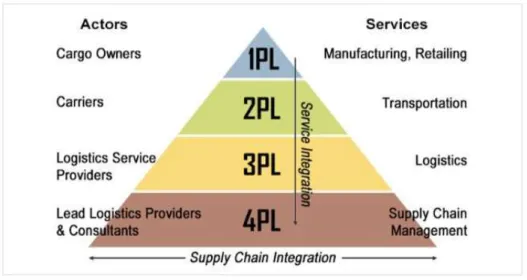
2.2.1. 1 PL
A logistics service with the concept of internally performing the logistics work generated by the company. In this case, the logistics business is resolved through the in-house department without the process of receiving services by entrusting external companies.
2.2.2. 2 PL
Logistics service in the case of carrying out the logistics work generated by the company through a separate subsidiary or affiliate. In this case, it is common for a department in charge of logistics within the company to become independent and become a subsidiary, and it is a logistics service that is a good method for large corporations to have a subsidiary.
29
2.2.3. 3 PL
It means receiving logistics services by outsourcing the logistics work generated by the company to an external logistics company. Originally, 3PL started from the concept of outsourcing logistics, but while outsourcing logistics focuses on cost reduction through the transfer of logistics business to external companies, 3PL not only reduces costs, but also forms a long-term partnership and provides a wide range of comprehensive services. It refers to a service of a more advanced concept than outsourcing logistics in that it can create more strategic and high-level effects such as, etc.
2.2.4. 4 PL
As a logistics service that provides an integrated solution including IT and consulting to the existing 3PL, a concept that is one step further than 3PL. 4PL is defined as an integrated system that combines and manages resources, capabilities, and technologies of service providers and weekly organizations in various sectors to provide comprehensive SCM through a separate organization established as a joint venture or a long-term contract of about 10 years. In line with the specialized modern society, logistics services are no longer limited to physical tasks such as transport, storage, unloading and packaging, but the provision of services incorporating the latest information and communication technologies and management of a wide supply chain organization. This is the result of development into a concept that includes the provision of consulting services for customers (Lim, 2006).
Source: CSCMP (2021)
Figure 1: 3 PL vs 4PL
2.3. Development of Logistics Stage
The logistics system has changed its shape in the direction of developing more efficient, providing more services and developing in line with the changes of the times. However, it should be noted that even though 3PL or 4PL is a more advanced type of distribution system, the existing 1PL or 2PL type system is still being used in society. It can be said that this is because each company has a different logistics service delivery method optimized for them according to factors such as the characteristics of the industry, the size and structure of the company. However, it is true that 3PL, which is a much developed form in the modern society, but does not contain an unexplored field, is being used by the most companies.
30 The logistics service, which started at the stage where the shipper companyperforms the necessary logistics business using its own infrastructure,is not large in size and the distance from the consumers who request the company’s products is not very high. Not far away, it was common for the company that made the product to handle the process from the completion stage to the consumer. However, as the scale of the 1PL-type logistics service has grown and the shipper company has dealt with more customers, it has become more specialized and complicated to handle in some departments within the company. Accordingly, companies gradually chose the 2PL method to provide logistics services by independently creating subsidiaries with specialized functions that can be in charge of logistics work. 2.3.2. 2 PL to 3 PL
The way large-scale shipper companies receive logistics services through subsidiaries was a more advanced form compared to the existing 1PL, but this also indicates that subsidiaries lack expertise in logistics business, and shippers’ companies are involved in main business such as manufacturing due to subsidiary management. There were limitations, such as being disturbed by the concentration. As companies gradually became aware of these limitations, the need to receive logistics services from companies that are more specialized in logistics business than subsidiaries they manage has gradually emerged among companies. As a result, the 3PL method of receiving logistics services from third-party companies that have no separate relationship with the shipper has emerged. With the advent of 3PL, companies have been able to reduce the cost incurred in logistics business, and by concentrating on the main business such as manufacturing, the quality of products can be improved.
As a result, the scope of commercial activities can be expanded by supplying products to a wider range. Became possible. However, it should be noted that 3PL is more advanced than 2PL, but the 2PL method is still adopted and used by many companies. Even if the size of the company is small or large, it is not necessary to receive logistics services from a third-party company due to the business structure. In case of unreasonable adoption of the 3PL method, it is rather a business activity due to the cost to be provided to the third-party company. This is because it may adversely affect Therefore, it is unlikely that 3PL will be the preferred alternative to 2PL in all cases. However, considering the development of information technology and globalization, the need for companies to transport products in a wider range and in a shorter time is increasing, and accordingly, it is true that the 3PL method is more adopted and used than the 2PL method
2.3.3. 3 PL to 4 PL
3PL, which was evaluated as an excellent system over time, also revealed its limitations as society became more complex and specialized. Companies feel the need for more efficient and cost-effective logistics services to survive in the fierce competitive environment, and the existing 3PL method has found limitations in efficiency and effectiveness in this respect. This is because the logistics service itself covers a wide range of areas such as storage, transportation, unloading, and assembly, so it is difficult for one company in charge of logistics services to excel in all areas. So, in recent years, when a single logistics company cannot satisfy all of the various requirements of shippers, companies that can provide optimal services for each function of the supply chain participate as partners to provide the best service to customers and participate (Kim, 2001).
As partners began to share profits, the 4PL method was born.With the advent of this 4PL method, companies have been provided with excellent services for individual logistics tasks. For example, according to the 4PL method, when a shipper company A requests a logistics company B to provide logistics services, company B provides logistics services to company a, which is excellent in transportation, company b, which is excellent in stevedoring, and company c, which is excellent in packaging. Participation in this will provide Company A with a comprehensive logistics service with excellent efficiency in each business field. This can be said to be the most advanced logistics service in that it overcomes partial imperfections that existed in logistics services at all stages, starting from the logistics of own and subsidiaries to third-party logistics.
3. Outsourcing
3.1 Concept
Outsourcing of logistics functions has been greatly active in the United States since the 1980s, and its market size is expected to more than double within five years. As such, individual companies are striving to improve competitiveness through cost reduction and service improvement by pursuing outsourcing except for core functions
31 (Hofer et al. ,2015).
The outsourcing technique is a term derived from the competition theory, and is said to be part of the management strategy of' delegating tasks such as building management and restaurant management to the outside because each company has limitations in manpower, capital and facilities. Outsourcing is conceptually somewhat different from outsourcing, subcontracting, and spin-off that companies have traditionally performed. Outsourcing is where the outsourcing supplier is in charge of planning, management, and operation of the business. Similar concepts of outsourcing include subcontracting, outsourcing, manpower dispatch, consulting, business agency, and spin-off, and the differences are shown in the described in Table 1. Subcontractors entrust part of their work to the outside, which includes a general construction company ordering some of the functions, such as electric work, to an outside company. In a broad sense, it can be called outsourcing, but it differs from outsourcing in that it is limited to the operating sector. Outsourcing is in charge of subcontracting and operation of business. Spin-off is a behavior that separates a part of a company into a separate company, and provides services only to the parent company by utilizing management resources owned by the company.
Table 1: Outsourcing Form and Purpose
Cost-saving Outsourcing Non-critical Features to Cut Costs Outsourcing
Company separation outsourcing
profit-center Outsourcing to increase profitability by externalizing functions that are not very important in-house, but with their own expertise
spin-off Business by spin-off of certain technologies and capabilities owned by the company. However, the core competency itself is not outsourced.
Network type outsourcing
Outsourcing all functions other than core competencies and forming a network with these suppliers to enhance synergy. A co-sourcing form in which multiple subjects share management resources with each other and use them complementarily
Core competencies
outsourcing Outsourcing to further increase the competitiveness of core businesses by externalizing core competencies and exposing them to competition
Source: Lim, 2006
Figure 2: Development of Outsourcing
Logistics outsourcing was initially limited to simple transportation, warehouse, and material management, but recently, it has included direct customer services such as EDI information exchange, order receipt, transportation
32 company selection, packaging, labeling, and product assembly. The target areas of logistics outsourcing are sales and transportation, warehouse transportation, procurement transportation, delivery, part of the manufacturing division, labeling, packaging, and freight payment, but are highly utilized in order receipt, processing, customer service management, inventory management, product assembly, and information systems is low in utilization.
3.2 Outsourcing Strategy
3.2.1. Concept
Outsourcing strategy refers to the outsourcing strategy by concentrating all resources on the areas or core competencies that are strategically important and best able to do the best among the various activities performed by them, and outsourcing all of the remaining activities from planning to operation to the world's best specialized companies in the field. It can be said to be a strategy to enhance the competitiveness of a company.
In other words, it is a strategy to maximize the synergy effect of the entire company by interconnecting the company's core competencies with the supplier's core competencies through the network. Having the ability to strategically utilize outsourcing is a fundamental condition for the future super-strong company and the first step toward successful network and virtual companies. On the other hand, when deciding on a logistics outsourcing strategy, it is important to be able to solve the following fundamental questions from a zero-base perspective
(
Mello et al., 2008).- Can the quality be maintained without directly controlling the logistics function? - Can you afford to internally build a global logistics organization?
- Does it provide an advantage to customers in the long term?
- Do logistics outsourcing help companies strengthen their core competencies? - Is there a technology that can control these while focusing on the core competencies
and using more specialized companies for logistics functions?
- Is it necessary to directly control the logistics assets within the company?
3.2.2. Advantage of Outsourcing
Outsourcing strategies should focus on ways to improve a company's operational efficiency and achieve a competitive advantage. With the economic downturn and negative economic growth, there is continuing pressure to transform into a productive organization to reduce total logistics costs and increase profits. For this reason, a logistics outsourcing strategy must be successfully established. In addition, the benefits of outsourcing are not limited to reduced logistics costs, but can be expected to improve service and productivity (Bolumole, 2007).
- Over a long period of time, a single third-party logistics outsourcing increases efficiency. This is because the cooperative relationship between the shipper company and the third-party logistics company becomes closer and information sharing becomes easier.
- Supply Chain Management Outsourcing's single provider can be more reliable, predict logistics flow better, and improve the service level of only channels.
- Reliable outsourcing partners improve the quality of service for customers.
- Providing logistics facilities such as vehicles and warehouses reduces the asset investment cost of the shipper and improves the liquidity of the funds.
- It is possible to receive support for advanced information technology and systems than individual companies develop themselves.
3.2.3. Disadvantage of Outsourcing
First, the ability to coordinate and control other sectors and functions within a company may be lost. Logistics requires a cooperative relationship between production, sales, finance, and other functions within a company. However, when the logistics function is outsourced, it is necessary to examine how to maintain the cooperative relationship (A bdul et al., 2020).
33 is executed, the number of internal personnel and organizational reorganization are followed. However, effective countermeasures such as conversion and distribution and reduction of personnel are required. In particular, domestic companies with strong labor unions need to be thoroughly reviewed in advance as they may be subject to disputes between labor and management, which may prevent their operations from operating normally.
Third, there is a concern that in-house secrets and operating know-how will be leaked. The extent of in-house information opening should be determined to ensure that there is no overlap in business areas between the shipper and the outsourcing partner.
Fourth, an outsourcing partner may be incorrectly selected and the effect may not meet expectations. In selecting an outsourcing partner, it is necessary to take measures against causing adverse effects on the company by selecting a partner that provides low service by considering the cost part of the evaluation factors as important.
Logistics outsourcing strategies have many advantages, such as lower capital costs and improved services, as well as risk factors such as loss of control and reliability of outsourcing partners. For this reason, companies need to make rational decisions before implementing their logistics outsourcing strategy.
4. The Third Party Logistics
4.1. Concept
The name Logistics is now becoming a name that is not difficult to hear throughout our society. In this way, corporate activities that were carried out individually from the procurement of raw materials to production and sales of products are integrated and managed from the perspective of the total supply chain to better meet customer needs and significantly reduce overall cost. Because it is being revealed that it can be done. Therefore, it can be seen that there are a number of companies that perform logistics-related tasks that were previously performed individually by purchasing/procurement, production, or sales departments with a separate department in charge of logistics or logistics (Mathong et al., 2020).
Third Party Logistics allows the shipper to designate all or part of the supply chain for the purpose of improving customer service, reducing logistics-related costs, and improving operational efficiency for logistics activities. It refers to outsourcing to a specialized company. In general, outsourcing refers to outsourcing a part of the work to the outside, meaning that it is a way to reduce the company's cost and improve productivity by having an external specialized company act as an agent for auxiliary peripheral work other than the company's core business. It is mainly used. However, this has a stronger meaning of reducing costs through subcontracting, and outsourcing in the true sense is a management technique that focuses management capabilities on the task for which the company is aimed by efficiently utilizing external expertise.
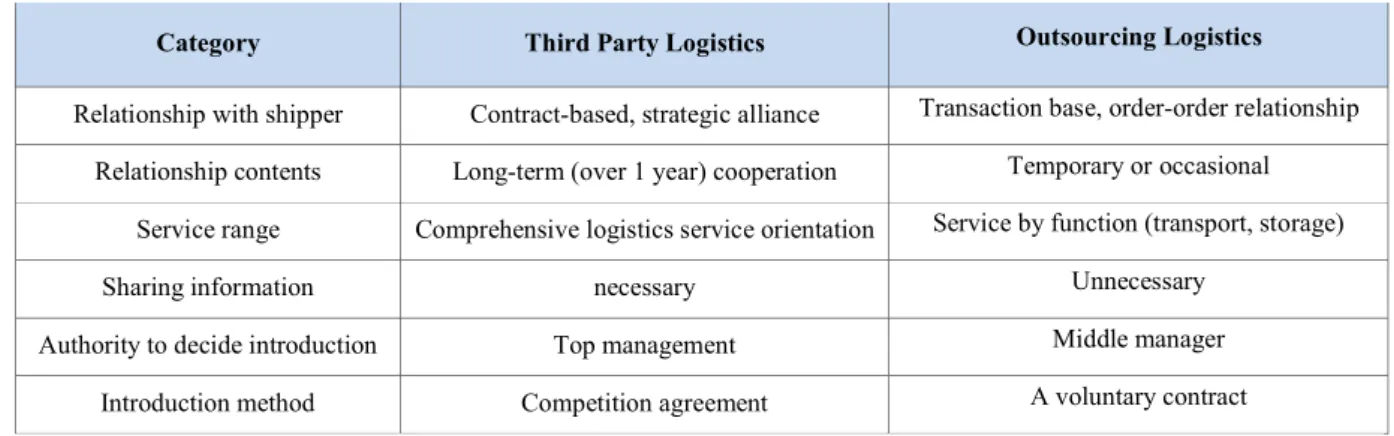
Often, the term outsourcing logistics is used when referring to logistics outsourcing, but outsourcing logistics should be viewed as an intermediate step in the transition to third-party logistics, mainly focusing on expanding the cost reduction effect in terms of operation. Third-party logistics can be said to be to achieve more than cost reduction, such as obtaining competitive advantage from a strategic point of view.
Table 2: Comparison between 3PL and Outsourced Logistics
Category Third Party Logistics Outsourcing Logistics
Relationship with shipper Contract-based, strategic alliance Transaction base, order-order relationship Relationship contents Long-term (over 1 year) cooperation Temporary or occasional
Service range Comprehensive logistics service orientation Service by function (transport, storage)
Sharing information necessary Unnecessary
Authority to decide introduction Top management Middle manager
34
4.2 Limits of 3rd Party Logistics
There are many advantages to using a specialized logistics company, but there are many cases where it is difficult to achieve the effect as expected. For example, in the recent 4th annual survey on professional logistics company services jointly conducted by the University of Tennessee, Exel Logistics, and Ernst & Young, US shippers are a problem when using specialized logistics companies. First, the promised service level is sufficiently maintained. Second, 45% of respondents said they were unsatisfied with the transition to outsourcing at the time of contract execution. Each 40% of the respondents said they did not.
In addition, according to a 1994 survey of 250 companies in the UK by Anderson Consulting, one-third of companies said that the effect of using specialized logistics companies did not meet expectations. The reason is that it takes a lot of time to manage specialized logistics companies, and there are no specialized logistics companies that can independently meet the logistics service requirements required by companies. Many specialized logistics companies provide logistics services such as warehousing, transportation, and delivery management, but specialized logistics companies that provide logistics services in all areas of SCM, including development and management of logistics information technology, customer service, and order management, etc. Few. The fact that there is no specialized logistics company that provides logistics services in all areas means that from the perspective of manufacturers or distributors who will outsource logistics services, what tasks will be performed within the company and which tasks will be outsourced to efficiently manage SCM It means that there is a need to foster. In other words, it means that a manufacturer or distributor has to put a lot of time and effort into managing a specialized logistics company (Lieb,1999).
In addition, if there is no long-term and common goal between a specialized logistics company and a customer company, it may be felt that it is effective initially from a financial point of view, but as time passes, the effect of using a specialized logistics company decreases. In the worst case, the customer company suspects that the specialized logistics company is not making its best efforts to reduce costs, or, conversely, the specialized logistics company thinks whether the customer company is trying to minimize its own profits. In fact, re-establishing business processes and improving and maintaining customer SCM inefficiencies is a difficult task for the past specialized logistics companies. However, it is obvious that if the work process cannot be rebuilt or if it is not possible to improve productivity and reduce costs by outsourcing the logistics function, the results of SCM cannot be obtained at a global level. In developed countries, the emergence of 4PL (Fourth Party Logistics), in which the role or function of a specialized logistics company, is advanced is being discussed.
5. Spread of Fourth Logistics Provider
5.1 Definitions
Fourth-party logistics (4PL) is a connection with management resources, capabilities and technologies of other companies that can make up for the shortcomings of logistics service providers to provide a comprehensive supply chain solution to shippers. Thus, it can be defined as a supply chain integrator that provides a more complete supply chain solution. Four-party logistics are also defined as LLP (Lead Logistics Providers) and general contractors. It is a single contract point that aims to effectively connect various organizations and functions to plan and manage all activities in the supply chain (Saglietto,2013).
First, 4PL refers to a service method in which logistics companies, consulting companies, and IT companies form virtual organizations and provide integrated services throughout the supply chain with a single contract. Second, 4PL aims to provide world-class strategy, technology, and business management. Third, one organization performs all logistics activities that occur in the supply chain, from procurement of raw materials to sales to criminal customers.
5.2. Background of 4 PL Introduction
During that time, the field of activities of specialized logistics companies (3PL) has been continuously expanded, centering on advanced countries, and has recently been spreading to developing countries. This is due to the globalization of economic activities, technological innovation in the fields of information, communication, and transportation, and Due to intensifying competition between companies and countries, cost reduction and improvement of customer service through advanced logistics strategies are recognized as the sources of superiority in competition, and companies are essential in their activities, but in maintaining competitive advantage. It can be seen
35 that this is due to the rapid increase in the rate of outsourcing their logistics services from specialized logistics companies (3PL), which are recognized as not being the basis.
In addition, the main reason why companies outsourcing their logistics services to specialized logistics companies (3PL) is increasing mainly because companies focus their capabilities on core sectors, but in order to retain the capability to provide them, they have enormous capital such as logistics facility costs and related labor costs. This required logistics service is provided to a specialized logistics company (3PL) with capabilities to reduce costs and secure an edge in competition with other companies. However, there is no limit to the use of specialized logistics companies (3PL), which can be attributed to the limitations of the capabilities of specialized logistics companies (3PL).
Many specialized logistics companies provide logistics services such as warehouse, transport, and delivery management services outsourced from companies, but they provide logistics services in all areas of the supply chain, including development and management of logistics information technology, customer service, and order management. The fact that there are few 3PLs that can be covered is the limit.
In other words, manufacturers or distributors outsourcing logistics services to 3PL want to receive all logistics services from the relevant specialized logistics company through ONE-STOP SREVICE in order to efficiently manage the supply chain, but logistics services in all areas that will meet the demand. Since there is no specialized logistics company that provides the company, a new organizational form that overcomes the limitations of the existing specialized logistics company (3PL) and brings excellent and continuous improvement effect on the supply chain is now appearing in developed countries. It is 4PL (Fourth Party Logistics), with its role or function going one step further (Marti et al., 2014).
5.3. Introduction of Four-Party Logistics
During that time, the field of activities of specialized logistics companies (3PL) has been continuously expanded, centering on advanced countries, and has recently been spreading to developing countries. This is due to the globalization of economic activities, technological innovation in the fields of information, communication and transportation, and in major markets. Due to intensifying competition between companies and countries, cost reduction and improvement of customer service through advanced logistics strategies are recognized as the sources of superiority in competition, and companies are essential in their activities, but in maintaining competitive advantage. It can be said that this is due to the rapid increase in the rate of outsourcing their logistics services from specialized logistics companies (3PL), which are recognized as not being the basis (Lee,2006).
Source: Renewal Folklift (2020)
Figure 3: Logistics Outsourcing and Development of Four-Party Logistics
In addition, the main reason why companies outsourcing their logistics services to specialized logistics companies (3PL) is increasing mainly because companies focus their capabilities on core sectors, but in order to retain the
36 capability to provide them, they have enormous capital such as logistics facility costs and related labor costs. This required logistics service is provided to a specialized logistics company (3PL) with capabilities to reduce costs and secure an edge in competition with other companies.
However, there is no limit to the use of specialized logistics companies (3PL), which can be attributed to the limitations of the capabilities of specialized logistics companies (3PL). Many specialized logistics companies provide logistics services such as warehouse, transport, and delivery management services outsourced from companies, but they provide logistics services in all areas of the supply chain, including development and management of logistics information technology, customer service, and order management. The fact that there are few 3PLs that can be covered is the limit (Oh, 2015).
In other words, manufacturers or distributors outsourcing logistics services to 3PL want to receive all logistics services from the relevant specialized logistics company through ONE-STOP SREVICE in order to efficiently manage the supply chain, but logistics services in all areas that will meet the demand. Since there is no specialized logistics company that provides the company, a new organizational form that overcomes the limitations of the existing specialized logistics company (3PL) and brings excellent and continuous improvement effect on the supply chain is now appearing in developed countries. It is 4PL (Fourth Party Logistics), with its role or function going one step further.
5.4. Four-party Logistics Operation Model
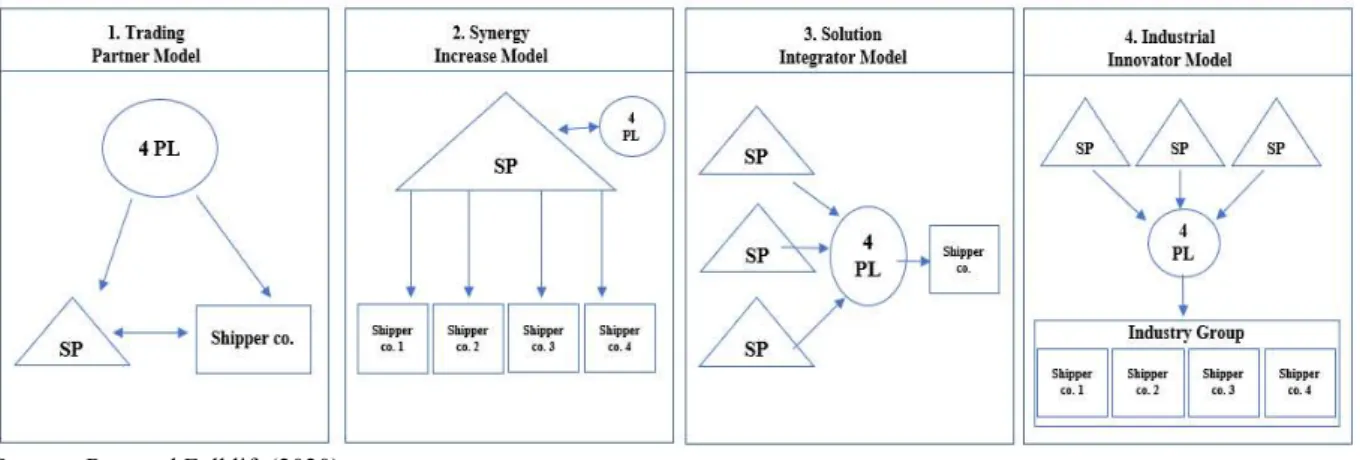
The operation model of the four-party logistics is divided into the following four operation models depending on how to provide comprehensive logistics services, that is, IT and consulting, which are necessary in addition to the main logistics outsourcing business (Skender, 2017).
1) Trading Partner Model
A fourth-party logistics company is a model that provides logistics services to customers by engaging appropriate service providers that can complement their work as trading partners.
2) Synergy rising model
This is a model in which 4PL operates within the 3PL organization. The two organizations depend on each other, and the capabilities and markets of each organization are mutually allied.
3) Solution integrator model
Four-party logistics companies will integrate multiple service providers to operate an integrated solution for the entire supply chain for one customer from start to finish.
4) Industrial innovator model
With a complex operation model, the four-party logistics company integrates several service providers (SPs) to develop and operate supply chain solutions for companies belonging to specific industries.
Four-party logistics companies promote industrial efficiency through supply chain operation techniques and operation strategies.
Source : Renewal Folklift (2020).
Figure 4: Four-party Logistics Operation Model
Note : SP refers to a service provider, and collectively refers to companies that provide IT and consulting including 3PL's logistics operation.
37
5.5. Comparison between 3PL 4PL
Many experts are raising opinions that question whether there is a need to distinguish between third-party logistics and fourth-party logistics. Looking at the development stage of third-party logistics, It is the first stage of outsourcing by simple logistics functions such as transportation (transport, delivery), storage, unloading, and packaging (called outsourcing logistics) and integration of these logistics functions. Here, in order to further develop third-party logistics, a single or multiple third-party logistics companies, single or multiple customers, IT companies, and consulting companies form a new organization to provide logistics services do (Ji, 2009).
However, the problem with third-party logistics is that first, the cost reduction effect is not continuous but temporary. Existing third-party logistics have limitations in pursuing cost reduction or efficiency in continuous supply chain management because the optimal combination of technology, warehouse management, and transportation service cannot be created. On the other hand, since the fourth-party logistics can optimize each field of logistics, it can be seen that it is in an optimal position to integrate various logistics services in the management of the entire supply chain. The second is that it does not focus on improving the flow of the supply chain necessary for optimizing the management of subcontractors. This is because third-party logistics lacks high-level operational and strategic skills that can provide simultaneous supply chain services. In contrast, the fourth-party logistics provides comprehensive supply chain services with integrated and concurrent engineering technologies required for supply chain optimization. In general, it is known that there is more room for profits from more integrated suppliers such as fourth-party logistics (Sumantri, 2020).
In addition, the fourth-party logistics use computer S/W and knowledge-based technology to integrate and manage the customer's supply chain. Therefore, it requires great flexibility and creativity. Instead of owning trucks, warehouses and containers like third-party logistics, they design a logistics management system and outsource services such as transport and containers to operate this system. As such, the fourth-party logistics that do not have fixed assets can be changed at any time in response to the changing speed of the market.
Table 3: Differences from General Outsourcing, 3PL and 4PL
Division Transportation/Distribution Contract Logistics Outsourcing (3PL) Integrated SCM Outsourcing (4PL)
Service Single function Multiple functions (individual) Multifunctional (integrated), complex processor increasing Relation Temporary contract Long-term agreement Strategic Partnership and Megasize Contract
Range Regional Multiple regional Global, door-to-door
Competitive
advantage Fragmentary Integrated/Cooperative Large-scale cooperation divided into small parts and niche provision Ability Large amounts of assets, Process execution Moving from asset-based to information-based Focus on information/knowledge, integrated information technology solution
Effect Cost down Cost reduction, geographical expansion, potential for
additional improvement Optimized cost and service
The fourth-party logistics is a specialized logistics company integrating the advantages of outsourcing and insourcing, and is an organization to obtain maximum management performance. The advantages of the fourth-party logistics when outsourcing include improvement of customer service, financial effects, and simplification of labor problems. It has the advantage of being able to directly manage customer service level and logistics costs, and directly grasp and improve the reality of customer service levels and difficulties through direct contact with customers.
6. The Future Market of 4PL
The 4PL Market is Growing Exponentially. According to a study by The Insight Partners, the global 4PL market was valued in terms of revenue at $56,472.1 million USD in 2019. It is predicted to reach $78,981.5 million USD by 2027, growing at a CAGR of 4.5 percent between 2020 and 2027. The study cautions that lockdowns and quarantines associated with the Coronavirus are expected to affect the revenues of the global 4PL market players in the short term.
38 However, growth is expected to normalise from 2021 onwards (O’Byrne, 2020).
The market is also growing across a wide range of commercial sectors, including the following:
6.1. Food and Perishables
Transporting and storing perishable food requires advanced logistics that is beyond the reach of many companies. In looking for supply chain expertise to oversee their food logistics and transportation, businesses invariably turn to 3PL or 4PL companies. For larger concerns with mountains of foodstuffs to transport and store, specialised 4PLs, with their broad and comprehensive supply chain expertise, are usually better placed to ensure wastage is minimised.
6.2. Medical Equipment Supply
In normal times, there is a constant need for medical equipment to be shipped from manufacturers to health workers and hospitals at short notice. Such need is dramatically intensified during a pandemic. Making sure that sensitive equipment doesn’t end up in the wrong hands is a complex process that relies on vigilant tracking through the transportation process. While 3PLs have the expertise to provide such a service, 4PL companies specialise in meeting tight turnaround times and seemingly impossible schedules, while applying the most advanced technologies to monitor supply chain movements in real time.
6.3. Ecommerce and Multi-Channel Retail
With the surge in demand for fast delivery that was spurred by Covid-linked lockdowns and quarantines, it has become more important than ever for retailers and e-commerce companies to provide next-day and same-day delivery. While 3PLs can meet customers’ needs by offering speedy delivery services, 4PLs, because they take care of a client’s entire supply chain, are better placed to meet rapid delivery demands, reduce missed opportunities, and, importantly, to oversee same-day and next-day replenishment. With e-commerce companies proliferating, it is essential that businesses keep up with what customers expect. Missed delivery deadlines or depletion of stock without replenishment quickly sends out a negative signal and chases customers away.
6.4. Industry
Industrial companies are increasingly discovering the benefits of handing over control of their logistics operations to a 4PL company, which not only provides logistics and transportation services but also takes charge of vital reporting, usually through a supply chain dashboard that tracks KPIs and metrics in a single display.
7. Conclusion
From the traditional perception that logistics is part of the distribution process in the element of management, it can now be said to be a very important factor that determines the fate of a company. The competitiveness of a company can be determined by how well a company utilizes these logistics activities and operates strategically. In reality, the demands of logistics service users vary day by day, and companies must provide high-quality logistics services through more value-added outsourcing activities. This can be said to be directly connected to the survival of the company.
Outsourcing represents the company's logistics activities, and it is also linked to party logistics. Through third-party logistics activities, companies' logistics activities have been developed more towards service users, and this net function is also the key to improving the competitiveness of companies. However, third-party logistics also have its limitations, so it is the fourth-party logistics that emerged as an alternative to this.
In addition to the existing third-party logistics services, expansion of e-commerce and global sourcing, rapid demand for logistics services, and expansion of supply chain management systems are required. It is expected that the fourth-party logistics will play a role in the demand for such a wider variety of logistics services.
In addition to the existing third-party logistics services, global sourcing, demand for rapid logistics services, and expansion of supply chain management systems are required. It is expected that fourth-party logistics will play a role in the demand for such a wider variety of logistics services. However, in the case of four-way logistics, the part that can be pointed out as a limitation may be loss of control capability for each function such as overall logistics, optimal
39 technology, warehouse management, and transportation service. In addition, 4PL companies' efficiency decline and cost increase can be pointed out as problems.
References
Abdul et al. (2020). Logistics capability, logistics outsourcing and firm performance in manufacturing companies in Pakistan. Journal of Asian Finance, Economics and Business, 7(8), 435–444.
Bolumole, Y.A (2007). Developing a theoretical framework for logistics outsourcing. Transportation Journal, 46(2), 35-54.
CSCMP (2021). 3PL vs 4PL: The academic definitions from CSCMP. CSCMP, Council of Supply Chain Management Professionals’ glossary, 2021(1), 1-17.
Hofer et al. (2015). Achieving and exceeding logistics outsourcing expectations in Brazil: a replication study. Transportation Journal, 54(3), 339-367.
Ji, G. J. (2009).Study on 4PL as coordinating and constructing agent for supply chain systems: transaction cost theory approach and wave-particle duality. Journal of International Logistics and Trade, 7(1),71-105.
Kim, H. J. (2001). A comparative study on Third Party logistics and Fourth Party logistics in the information era. The Korea Logistics Research Association, 11(2), 149-169.
Lee, S. K (2006). The introduction of Fourth Party logistics through supply chain management. Korea Academy of Commodity Science and Technology, 24(1), 203-224.
Lieb, R. C. (1999). Use of third-party logistics services by large US manufacturers in 1997 and comparisons with previous years. Transport Reviews, 19(2), 103-115.
Lim, S. M. (2006). View of 3PL and 4PL, The Korea Logistics Research Association, 16(1), 89-112.
O’Byrne, R. (2020). Why large companies increasingly Opt for 4PL Services. Logistics Burea, 9(2), 11-21.
Martí, L., Puertas, R., & Garcia, L. (2014). The importance of the Logistics Performance Index in international trade. Applied Economics, 46 (24), 2982-2992.
Mathong, P., Sureeyatanapas, P., Arunyanart, S., & Niyamosoth, T. (2020). The assessment of service quality for third-party logistics providers in the beverage industry. Cogent Engineering, 7(1), 1-17.
Mello, J., Stank, T., & Esper, T. (2008). A Model of logistics outsourcing strategy. Transportation Journal, 47(4), 5-25.
Oh, M. K. (2015). Promotional plans of Fourth-Party logistics in Korea: applicability in entering the Chinese logistics market. Journal of Distribution Science, 13(2), 25-33.
Renewal Folklift (2020). The Fourth Logistics. Renewal Folklift, 2(1), 1-9.
Saglietto, L. (2013). Towards a classification of Fourth Party Logistics (4PL). Universal Journal of Industrial and Business Management, 1(3), 104-116.
Skender, H. P. (2017). The role of the 4PL Model in a contemporary supply chain. Pomorstvo, 31(2), 96-101. Sumantri, Y. (2020). Analyzing the three supply chain flows in the maritime logistics and distribution industry.