Immunogenicity and Safety of a Live Attenuated Zoster Vaccine
(ZOSTAVAX
TM
) in Korean Adults
A live attenuated zoster vaccine (ZOSTAVAXTM, Merck & Co., Inc.) was approved by the
Korea Ministry of Food and Drug Safety in 2009. However, the immunogenicity and safety of the vaccine has not been assessed in Korean population. This is multi-center, open-label, single-arm study performed with 180 healthy Korean adults ≥ 50 yr of age. The geometric mean titer (GMT) and geometric mean fold rise (GMFR) of varicella zoster virus (VZV) antibodies were measured by glycoprotein enzyme-linked immunosorbent assay (gpELISA) at 4 weeks post-vaccination. Subjects were followed for exposure to varicella or herpes zoster (HZ), the development of any varicella/varicella-like or HZ/HZ-like rashes, and any other clinical adverse experiences (AEs) for 42 days post-vaccination. For the 166 subjects included in the per-protocol population, the GMT at Day 1 was 66.9. At 4 weeks post-vaccination, the GMT for this population was 185.4, with a GMFR of 2.8 (95% CI, 2.5-3.1). Of the 180 subjects vaccinated, 62.8% experienced ≥ 1 AE, with 53.3% of subjects reporting injection-site AEs. The most frequently reported injection-site AEs were erythema (45.0%) with the majority being mild in intensity. Overall, 44 (24.4%) subjects experienced ≥ 1 systemic AE, 10 (5.5%) subjects experienced a systemic vaccine-related AE, and 3 (1.7%) subjects experienced ≥ 1 serious AE not related to vaccine. No subjects reported a VZV-like rash. There was no subject of death and no subject discontinued due to an adverse event. A single dose of zoster vaccine induced VZV-specific gpELISA antibody response and was generally well-tolerated in healthy Korean adults ≥ 50 yr of age (registry at www. clinicaltrial.gov No. NCT01556451).
Keywords: Immunology; Adverse Effects; Aged; Herpes Zoster Vaccine; Humans; Republic
of Korea Won Suk Choi,1 Jung-Hyun Choi,2
Jun Yong Choi,3 Joong Sik Eom,4
Sang Il Kim,2 Hyunjoo Pai,5
Kyong Ran Peck,6 Jang Wook Sohn,1
and Hee Jin Cheong1
1Division of Infectious Diseases, Department of Internal Medicine, Korea University College of Medicine, Seoul;2Department of Internal Medicine, The Catholic University of Korea College of Medicine, Seoul;3Department of Internal Medicine, Yonsei University College of Medicine, Seoul;
4Department of Internal Medicine, Hallym University College of Medicine, Chuncheon;5Department of Internal Medicine, Hanyang University College of Medicine, Seoul;6Department of Internal Medicine, Samsung Medical Center, Sungkyunkwan University School of Medicine, Seoul, Korea
Received: 24 April 2015 Accepted: 17 September 2015 Address for Correspondence: Hee Jin Cheong, MD
Division of Infectious Disease, Department of Internal Medicine, Korea University Guro Hospital, 148 Gurodong-ro, Guro-gu, Seoul 08308, Korea
Tel: +82.2-2626-3050, Fax: +82.2-2626-1105 E-mail: [email protected]
Funding: This work was supported by Merck Sharp & Dohme Corp. (sponsor), a subsidiary of Merck & Co., Inc (V211-034).
http://dx.doi.org/10.3346/jkms.2016.31.1.13 • J Korean Med Sci 2016; 31: 13-17
INTRODUCTION
Herpes zoster (HZ) is a disease occurring after first infection by varicella-zoster virus (VZV), due to reactivation of latent viruses remaining in sensory ganglion of cranial or spinal nerves. HZ causes pain and vesicular skin lesions along the unilateral der-matome. The cumulative lifetime incidence of HZ is as high as about 10%-30% (1,2). The incidence of HZ increases with age (3-9). The incidence of complications, such as post-herpetic neuralgia (PHN), increases in the elderly (4,5,10). The occur-rence of HZ considerably lowers the quality of life and exacts high socioeconomic cost (8,11-14).
A live attenuated zoster vaccine (ZOSTAVAXTM, Merck & Co.,
Inc.) has been developed for the prevention of HZ and its com-plications, especially herpes zoster associated pain and PHN. The Shingles Prevention Study (SPS) performed with subjects ≥ 60 yr of age demonstrated that the use of the HZ vaccine duced the incidence of HZ and PHN by 51.3%, and 66.5%,
re-spectively (15). The Zostavax Efficacy and Safety Trial (ZEST) performed with subjects 50-59 yr of age showed the vaccine re-duced the risk of developing zoster by 69.8% (16).
ZOSTAVAXTM was approved by the Korea Ministry of Food
and Drug Safety in 2009 for the prevention of HZ in adults ≥ 60 yr of age, with an expanded indication for adults ≥ 50 yr of age in 2011. This study (NCT01556451; V211-034) evaluated the im-munogenicity, safety, and tolerability of the vaccine when ad-ministered to Korean adults ≥ 50 yr of age.
MATERIALS AND METHODS
Study design
This was a multi-center (9 sites in Korea) open-label, single-arm, phase 4 study conducted from April 2012 to October 2012. Study population
Healthy adults ≥ 50 yr of age on the day of signed informed
sent were eligible. All subjects were afebrile (< 38.0°C) on the day of vaccination and any underlying chronic illness needed to be stable. All females were postmenopausal or had a nega-tive urine pregnancy test. Subjects were excluded if they had previous vaccination with any VZV-containing vaccine, history of hypersensitivity reaction to any vaccine component, history of HZ, immunodeficiency associated with illness or medical treatments, known or suspected active untreated tuberculosis, received immunoglobulin or any blood products during the 5 months prior to vaccination or expected during 4 weeks post-vaccination period, received any other live virus vaccine within 4 weeks prior to vaccination or expected during 6 weeks post-vaccination period, received any inactivated vaccine within 7 days prior to vaccination or expected during 6 weeks post-vac-cination period, or used any non-topical antiviral therapy with activity against herpes viruses. Subjects who received any pneu-mococcal polysaccharide vaccine within 4 weeks prior to vacci-nation or expected to receive any pneumococcal vaccine poly-valent during the 42-day duration of the study were also excluded. Study procedure
Subjects were vaccinated with the zoster live vaccine (ZOSTA-VAXTM, Merck & Co., Inc.) on day 1 and followed for exposure to
varicella or HZ or development of any varicella/varicella-like or HZ/HZ-like rashes, as well as any other clinical adverse experi-ences for 42 days post-vaccination. Blood samples were obtain-ed from all subjects immobtain-ediately before vaccination and at 4 weeks post-vaccination. Injection-site reactions, rashes, other adverse experiences, other concomitant medications, and con-comitant vaccinations were recorded by the subject on a Vacci-nation Report Card (VRC). This study was supported using the Merck Research Laboratories (MRL), One Merck Drive, P.O. Box 100, Whitehouse Station, NJ 0889-0100 USA, for procedures relative to initiation, monitoring, data handling, clinical supply management, safety management, and clinical study result re-porting.
Immunologic measurements
The key immunogenicity outcome measures were the geomet-ric mean fold rise (GMFR) of subjects’ VZV antibody titers from pre-vaccination to 4 weeks post-vaccination and geometric mean titer (GMT) at 4 weeks postvaccination. The VZV anti-body titer was assessed by glycoprotein enzyme-linked immu-nosorbent assay (gpELISA) at a central laboratory. The method detected antibodies to VZV glycoprotein (gp), purified from MRC-5 cells infected with the KMcC strain of VZV by lectin af-finity chromatography. The reactivity of sera to the gp antigens from uninfected MRC-5 cells, denoted as tissue culture control (TCC) wells, was substracted from the reactivity of the sera to the gp antigens purified from VZV-infected MRC-5 cells. For the gpELISA, VZV gp or TCC antigen was absorbed to
polysty-rene microtiter wells and used as the solid phase antigen. Ex-perimental, control, and standard curve sera (serum sample for reference standard curve) were incubated in VZV gp-coated and TCC-coated wells. Regarding standard curve performance, a single human serum sample with a high titer was used as a standard in the gpELISA. Within each validation run, the stan-dard was tested in nine, twofold serial dilutions, ranging in con-centration from 0.3125 to 80 gpELISA units/mL. For each se-rum sample, a delta optical density (DOD) was calculated as the difference between the average optical density (OD) of the 2 VZV antigen wells and the average OD of the 2 TCC wells. Quantitation was performed by comparison of sample DOD with a standard curve.
Safety measurements
Safety and tolerability data was collected for all subjects for 42 days post-vaccination. Each subject was given a VRC to docu-ment injection-site adverse events (AEs), systemic clinical AEs, concomitant medications, and oral temperatures (only if feel-ing feverish) noted durfeel-ing the 42-day post-vaccination period. All serious adverse events occurring through day 42 post-vacci-nation were to be reported by the investigator within 24 hr of first notification to the study site personnel.
Severity of injection-site AEs except erythema and swelling, were classified as mild, moderate, and severe. Mild AE was de-fined as an event causing no or minimal interference with usual social and functional activities. Moderate AE was defined as an event causing greater than minimal interference with usual so-cial and functional activities. Severe AE was defined as an event causing inability to perform usual social and functional activi-ties. Injection site erythema and swelling was measured to es-tablish the maximum size.
Subjects who develop suspected varicella/varicella-like or HZ/HZ-like rashes were to notify the investigator immediately. The subjects were planned to be seen by the investigator at the study site within 72 hr of rash onset (preferably within 24 hr) for clinical evaluation. Polymerase chain reaction assay was planned to detect VZV and herpes simplex virus (HSV) deoxy-ribonucleic acid (DNA) in specimens obtained from subjects suspected of having varicella or HZ.
Statistical methods
This study was descriptive and no hypothesis was tested. The immunologic analysis was based on a per-protocol population, which included all subjects who received the vaccine and did not have major deviations from the protocol procedure or Good Clinical Practices (GCP) violation. If 162 subjects (90% of the 180 subjects enrolled) were included in the pre-protocol population, the half-width of the 95% confidence interval (CI) for GMFR would be 0.15 in the natural log scale, assuming the standard deviation of the natural log of the fold rise was 1.0. All
subjects who were vaccinated and had safety follow-up were included in the safety analysis. If no vaccine-related serious AEs were observed among the 180 subjects, this provided 97.5% confidence that the true vaccine-related serious AE rate was ≤ 2.03%.
Ethics statement
The study was approved by the institutional review boards at all study sites: Korea University Guro Hospital Institutional Review Board (KUGH11261-001), Korea University Ansan Hospital In-stitutional Review Board (AS11200), Korea University Anam Hospital Institutional Review Board (ED11308), Yonsei Univer-sity Severance Hospital Institutional Review Board (4-2011-0913), Kangdong Sacred Heart Hospital Institutional Review Board/ Ethics Committee (12-2-008), The Catholic University of Korea Seoul St. Mary’s Hospital Institutional Review Board (XC12MS-MV0011K), Hanyang University Seoul Hospital Institutional Review Board (HYUH IRB 2012-C-15), and Samsung Medical Center Institutional Review Board (2012-01-051). Written in-formed consent was obtained from each subject prior to any study procedure. This study was registered at www.clinicaltrial. gov as NCT01556451.
RESULTS
Characteristics of the study subjects
One hundred eighty subjects were enrolled from April 2012 to October 2012. Each study site enrolled 20 subjects. The demo-graphic characteristics are shown in Table 1. The mean age at enrollment was 60.6 ± 6.1 yr. Among the subjects, 91 (50.6%) were ≥ 60 yr of age and 136 (75.6%) were female. Approximate-ly 64% of subjects had one or more underApproximate-lying medical condi-tions. The most common underlying condition was vascular disorders (32.2%), followed by metabolism and nutrition ders (21.7%), and musculoskeletal and connective tissue disor-ders (17.2%). Throughout the study the most frequently report-ed concomitant prescription mreport-edications were analgesics (21.1%), agents acting on the renin–angiotensin system (20.0%), lipid-modifying agents (19.4%), and calcium channel blockers (13.9%). Two subjects were administered influenza vaccine between days 1 and 42.
Immunogenicity
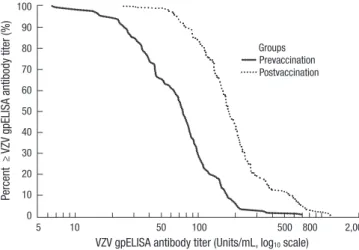
Protocol deviation or GCP violation occurred in 14 (7.8%) sub-jects among the 180 subsub-jects vaccinated. As a result, the immu-nologic analysis was performed with 166 subjects. The GMT at Day 1 was 66.9 (Table 2). At 4 weeks post-vaccination, the GMT for this population was 185.4, with a GMFR of 2.8 (95% CI, 2.5-3.1). The inverse cumulative distribution of VZV antibody titer is shown in Fig. 1. In subgroup analysis according to the age group, the GMT for subjects 50-59 yr of age at 4 weeks post-vac-cination was 173.0, with a GMFR of 2.9 (95% CI, 2.5-3.4). The GMT for subjects ≥ 60 yr of age at 4 weeks post-vaccination was 199.2, with a GMFR of 2.6 (95% CI, 2.3-3.0). The inverse cu-mulative distribution of gpELISA fold rise at 4 weeks post-vacci-nation according to the age group is shown in Fig. 2.
Safety
Table 3 summarizes AEs that occurred during the 42 days after Table 1. Baseline characteristics of the study subjects
Characteristics Total (n = 180) No. % Gender Female 136 75.6 Male 44 24.4 Age (yr) 50-59 89 49.4 ≥ 60 91 50.6 ≥ 70 12 6.7 Median (range) 60 (50-82)
Underlying medical conditions 115 63.9
Vascular disorders 58 32.2
Hypertension 55 30.6
Metabolism and nutritional disorders 39 21.7
Hyperlipidemia 26 14.3 Diabetes mellitus 16 8.9 Musculoskeletal diseases 31 17.2 Osteoarthritis 5 2.8 Osteoporosis 5 2.8 Spinal stenosis 5 2.8 Gastrointestinal diseases 21 11.7 Colonic polyp 6 3.3
Gastroesophageal reflux disease 5 2.8
Gastritis 4 2.2
Nervous system disorders 14 7.8
Renal and urinary disorders 5 2.8 Cardiac disorders (excluding hypertension) 5 2.8
Respiratory disorders 4 2.2
With one or more concomitant vaccinations 2 1.1
Influenza vaccine 2 1.1
Table 2. Varicella-zoster virus antibody geometric mean titers and geometric mean fold rise in the per-protocol population
Age group subjectsNo. of Results* 95% CI†
Overall GMT (units/mL) Day 1 166 66.9 59.2-75.5 Week 4 166 185.4 167.0-205.9 GMFR Week 4 166 2.8 2.3-3.1 50-59 yr GMT (units/mL) Day 1 84 58.7 49.6-69.4 Week 4 84 173.0 149.2-200.6 GMFR Week 4 84 2.9 2.5-3.4 ≥ 60 yr GMT (units/mL) Day 1 82 76.4 64.1-91.2 Week 4 82 199.2 171.5-231.3 GMFR Week 4 82 2.6 2.3-3.0
*Antibody measured as gpELISA units/mL; †95% CI for GMFR and GMT was
comput-ed bascomput-ed on the t-distribution. CI, confidence interval; GMT, geometric mean titer in gpELISA units/mL; GMFR, geometric mean fold rise.
the vaccinations. Of the 180 subjects vaccinated, 113 (62.8%) subjects experienced ≥ 1 AE, with 96 (53.3%) of subjects re-porting injection-site AEs. The most frequently reported injec-tion-site AEs were erythema (45.0%) (Table 4). All injecinjec-tion-site AEs except for one were determined to be related to the vac-cine. Most (85.7%) of injection-site AEs were mild in intensity and there was no severe event. Most of the injection-site ery-thema (93.8%) and swelling (95.6%) were ≤ 3 inches in size and no case exceeded 5 inches. The injection-site AEs were more frequent in subjects 50-59 yr of age (58.4%) than those ≥ 60 yr of age (48.4%). Overall, 44 (24.4%) subjects experienced ≥ 1 sys-temic AE and 10 (5.5%) subjects experienced a syssys-temic vac-cine-related AE. The most frequently reported systemic AEs were rash (3.9%). The systemic AEs were slightly more frequent in subjects 50-59 yr of age (25.8%) than those ≥ 60 yr of age (23.1%). Three (1.7%) subjects experienced ≥ 1 severe adverse
Table 3. Adverse events among all study subjects
Adverse events Total (n = 180)
No. % 95% CI†
Subjects with one or more AEs 113 62.8 55.3-69.9 With one or more injection site AEs 96 53.3
With systemic AEs 44 24.4
Subjects with AEs related to the vaccine* 97 53.9 46.3-61.3 With one or more injection site AEs 95 52.8
With no injection site AEs 10 5.6
Subjects with one or more SAEs 3 1.7 0.4-4.8 Subjects with SAEs related to the vaccine 0 0.0 0.0-0.0 *As determined by the investigator to be related to the vaccine; †95% CI based on
exact binomial distribution. CI, confidence interval; AE, adverse event; SAE, severe adverse event.
Table 4. Classification of adverse events among all study subjects
Adverse events Total (n = 180)
No. % 95% CI* Subjects with one or more injection site AEs 96 53.3 45.8-60.8
Erythema 81 45.0 37.6-52.6 Swelling 68 37.8 30.7-45.3 Pain 50 27.8 21.4-34.9 Tenderness 5 2.8 0.9-6.4 Pruritus 5 2.8 0.9-6.4 Feeling hot 2 1.1 0.1-4.0 Rash 1 0.6 0.0-3.1 Sensation of heaviness 1 0.6 0.0-3.1 Subjects with one or more systemic AEs 44 24.4 18.4-31.4
General disorders and administration site conditions 50 27.8 21.4-34.9 Skin and subcutaneous tissue disorders 15 8.3 4.7-13.4 Infections and infestations 9 5.0 2.3-9.3 Gastrointestinal disorders 9 5.0 2.3-9.3 Musculoskeletal and connective tissue disorders 7 3.9 1.6-7.9
Eye disorders 3 1.7 0.4-4.8
Nervous system disorders 3 1.7 0.4-4.8
Psychiatric disorders 3 1.7 0.4-4.8
Respiratory, thoracic and mediastinal disorders 3 1.7 0.4-4.8 Injury, poisoning and procedural complications 1 0.6 0.0-3.1 *95% CI based on exact binomial distribution. CI, confidence interval.
event (SAE): gastric polyp, anal fissure, and spinal compression fracture. None of these SAEs were classified as related to the vaccine. Most (> 90%) of the AEs, except SAEs, subsided in 2 days. No subjects reported a VZV-like rash. There were no deaths and no subjects discontinued due to an adverse event.
DISCUSSION
This study was performed to evaluate the safety, tolerability, and immunogenicity of ZOSTAVAXTM in Korean adults ≥ 50 yr
of age. Because previous studies did not specifically target Ko-rean subjects for enrollment, this is the first study to evaluate the characteristics of the zoster vaccine in Korean adults. All subjects were completely followed up for 42 days and reliable results were obtained.
In immunologic analysis performed in the per-protocol pop-Fig. 1. Inverse Cumulative Distribution of Varicella-zoster Virus (VZV) Antibody Titer in
the per-protocol (PP) group. VZV glycoprotein enzyme-linked immunosorbent assay (gpELISA) antibody titers (units/mL) were observed clearly increased after the vacci-nation with ZOSTAVAXTM in the PP group.
Percent ≥
VZV gpELISA antibod
y titer (%)
VZV gpELISA antibody titer (Units/mL, log10 scale)
5 10 50 100 500 800 2,000 100 90 80 70 60 50 40 30 20 10 0 Prevaccination Groups Postvaccination
Fig. 2. Inverse cumulative distribution of glycoprotein enzyme-linked immunosorbent assay (gpELISA) fold rise at 4 weeks post-vaccination according to the age group.
Percent ≥ fold rise (%)
gpELISA fold rise at 4 weeks postvaccination (log10 scale)
0.1 0.4 0.8 1.0 2.0 5.0 10.0 20.030.0 100.0 100 90 80 70 60 50 40 30 20 10 0 Age group 50 to 59 yr Groups Age group ≥ 60 yr
ulation, the GMT was 66.9 at pre-vaccination and 185.4 at 4 weeks post-vaccination, with a GMFR of 2.8 (95% CI, 2.5-3.1). In sub-group analysis, the GMFR at 4 weeks post-vaccination was 2.9 (95% CI, 2.5-3.4) for subjects 50-59 yr of age and 2.6 (95% CI, 2.3-3.0) for those ≥ 60 yr of age. The GMFR observed in this study is higher than previous studies. ZEST, performed with subjects 50-59 yr of age, showed a GMFR of 2.3 (95% CI, 2.2-2.4) (16). SPS, performed with subjects ≥ 60 yr of age, showed a GMFR of 1.7 (95% CI, 1.6-1.8) (15). The most important reason for the difference is considered to be the difference between the timing of post-vaccination blood sampling. In two prior studies, the VZV-specific immune responses were measured at 6 weeks post-vaccination (15,16). Racial difference might be another reason for study differences; the previous two studies did not include Asian countries. Although this study showed that the immunogenicity of the zoster vaccine is good in Korean adults, the efficacy and the effectiveness of the vaccine for pre-venting zoster should be assessed with further studies.
In the safety analysis performed on all subjects, most of the AEs were due to local injection-site reactions and their intensity was mild. The safety profile of the vaccine in Korean adults was similar to previous studies.
In conclusion, a single dose of zoster vaccine induced VZV-specific gpELISA antibody response and was generally well-tol-erated in healthy Korean adults ≥ 50 yr of age. These findings are consistent with data previously observed in the clinical de-velopment program.
DISCLOSURE
This work was supported by Merck Sharp & Dohme Corp. (sponsor), a subsidiary of Merck & Co., Inc. This study was de-signed, executed, and analyzed by the sponsor. Although the sponsor reviewed a draft, the opinions expressed are those of the authors and may not necessarily reflect those of the spon-sor. All co-authors approved the final version of the manuscript.
AUTHOR CONTRIBUTION
Acquisition of data: Choi WS, Choi JH, Choi JY, Eom JS, Kim SI, Pai HJ, Peck KR, Sohn JW, and Cheong HJ. Interpretation of data: Choi WS, Cheong HJ. Writing and revision of the manu-script: Choi WS. Study supervision: Cheong HJ.
ORCID
Won Suk Choi http://orcid.org/0000-0001-5874-4764 Jun Yong Choi http://orcid.org/0000-0002-2775-3315 Hyunjoo Pai http://orcid.org/0000-0003-4143-035X Kyong Ran Peck http://orcid.org/0000-0002-7464-9780 Hee Jin Cheong http://orcid.org/0000-0002-2532-1463
REFERENCES
1. Katz J, Cooper EM, Walther RR, Sweeney EW, Dworkin RH. Acute pain
in herpes zoster and its impact on health-related quality of life. Clin In-fect Dis 2004; 39: 342-8.
2. Cohen JI. Clinical practice: Herpes zoster. N Engl J Med 2013; 369:
255-63.
3. Reid JS, Ah Wong B. Herpes zoster (shingles) at a large New Zealand
general practice: incidence over 5 years. N Z Med J 2014; 127: 56-60.
4. Kawai K, Gebremeskel BG, Acosta CJ. Systematic review of incidence
and complications of herpes zoster: towards a global perspective. BMJ Open 2014; 4: e004833.
5. Hillebrand K, Bricout H, Schulze-Rath R, Schink T, Garbe E. Incidence
of herpes zoster and its complications in Germany, 2005-2009. J Infect 2015; 70: 178-86.
6. Pinchinat S, Cebrián-Cuenca AM, Bricout H, Johnson RW. Similar
her-pes zoster incidence across Europe: results from a systematic literature review. BMC Infect Dis 2013; 13: 170.
7. Mullooly JP, Riedlinger K, Chun C, Weinmann S, Houston H. Incidence
of herpes zoster, 1997-2002. Epidemiol Infect 2005; 133: 245-53.
8. Choi WS, Noh JY, Huh JY, Jo YM, Lee J, Song JY, Kim WJ, Cheong HJ.
Disease burden of herpes zoster in Korea. J Clin Virol 2010; 47: 325-9.
9. Kim YJ, Lee CN, Lim CY, Jeon WS, Park YM. Population-based study of
the epidemiology of herpes zoster in Korea. J Korean Med Sci 2014; 29: 1706-10.
10. Mick G, Gallais JL, Simon F, Pinchinat S, Bloch K, Beillat M, Serradell L, Derrough T. Burden of herpes zoster and postherpetic neuralgia:
Inci-dence, proportion, and associated costs in the French population aged 50 or over. Rev Epidemiol Sante Publique 2010; 58: 393-401.
11. Lin YH, Huang LM, Chang IS, Tsai FY, Lu CY, Shao PL, Chang LY; Vari-cella-Zoster Working Group; Advisory Committee on Immunization Practices, Taiwan. Disease burden and epidemiology of herpes zoster in
pre-vaccine Taiwan. Vaccine 2010; 28: 1217-20.
12. Levi M, Bellini I, Capecchi L, Pieri L, Bechini A, Boccalini S, Callaioli S, Gasparini R, Panatto D, Tiscione E, et al. The burden of disease of
Her-pes Zoster in Tuscany. Hum Vaccin Immunother 2015; 11: 185-91.
13. Song H, Lee J, Lee M, Choi WS, Choi JH, Lee MS, Hashemi M, Rampak-akis E, Kawai K, White R, et al. Burden of illness, quality of life, and
health-care utilization among patients with herpes zoster in South Korea: a pro-spective clinical-epidemiological study. Int J Infect Dis 2014; 20: 23-30.
14. Choi WS, Kwon SS, Lee J, Choi SM, Lee JS, Eom JS, Sohn JW, Choeng HJ. Immunity and the burden of herpes zoster. J Med Virol 2014; 86:
525-30.
15. Oxman MN, Levin MJ, Johnson GR, Schmader KE, Straus SE, Gelb LD, Arbeit RD, Simberkoff MS, Gershon AA, Davis LE, et al. A vaccine to
prevent herpes zoster and postherpetic neuralgia in older adults. N Engl J Med 2005; 352: 2271-84.
16. Schmader KE, Levin MJ, Gnann JW Jr, McNeil SA, Vesikari T, Betts RF, Keay S, Stek JE, Bundick ND, Su SC, et al. Efficacy, safety, and
tolerabili-ty of herpes zoster vaccine in persons aged 50-59 years. Clin Infect Dis 2012; 54: 922-8.
17. Hammond O, Wang Y, Green T, Antonello J, Kuhn R, Motley C, Stump P, Rich B, Chirmule N, Marchese RD. The optimization and validation of
the glycoprotein ELISA assay for quantitative varicella-zoster virus (VZV) antibody detection. J Med Virol 2006; 78: 1679-87.