저작자표시-비영리-변경금지 2.0 대한민국 이용자는 아래의 조건을 따르는 경우에 한하여 자유롭게 l 이 저작물을 복제, 배포, 전송, 전시, 공연 및 방송할 수 있습니다. 다음과 같은 조건을 따라야 합니다: l 귀하는, 이 저작물의 재이용이나 배포의 경우, 이 저작물에 적용된 이용허락조건 을 명확하게 나타내어야 합니다. l 저작권자로부터 별도의 허가를 받으면 이러한 조건들은 적용되지 않습니다. 저작권법에 따른 이용자의 권리는 위의 내용에 의하여 영향을 받지 않습니다. 이것은 이용허락규약(Legal Code)을 이해하기 쉽게 요약한 것입니다. Disclaimer 저작자표시. 귀하는 원저작자를 표시하여야 합니다. 비영리. 귀하는 이 저작물을 영리 목적으로 이용할 수 없습니다. 변경금지. 귀하는 이 저작물을 개작, 변형 또는 가공할 수 없습니다.
A DISSERTATION FOR THE DEGREE OF DOCTOR OF
PHILOSOPHY
People
’s Dependence on Forests
and their Participation in Forest
Conservation in Myanmar
산촌 주민의 산림의존과 산림 보전에의 참여 :
미얀마 사례
August 2019
Graduate School, Seoul National University
Department of Forest Sciences
Forest Environmental Science Major
Khaing Thandar Soe
People
’s Dependence on Forests
and their Participation in Forest
Conservation in Myanmar
A Dissertation as a Partial Requirement for Ph.D.
Degree in
Forest Environmental Science
Seoul National University
Graduate School
Written by
Khaing Thandar Soe
August 2019
Under Supervision of
Professor YOUN Yeo-Chang
Approved by the Examining Committee:
Chair
KIM Seong-il (Seal)
Vice Chair YOUN Yeo-Chang (Seal)
Examiner
AN Donghwan (Seal)
Examiner
PARK Mi Sun (Seal)
Examiner
Nathaniel Anderson (Seal)
i
Abstract
Involvement of local communities in forest conservation has been recognized as a key strategy employed worldwide in the conservation of natural resources and development. However, the efficacy of participatory forest management (PFM) with the involvement of local communities in achieving ecological and socioeconomic goals is highly different; a significant factor preventing their success is a lack of consideration and understanding of related social systems. This is particularly true for PFM in Myanmar; where the information regarding the perceptions and potential responses of local communities to the participatory conservation programs is neither available nor used in the forest management planning process. Despite a large recognitions of the critical role of local communities in meeting the goal of conservation, and the need to better understand and incorporate socioeconomic factors into the forest management, socioeconomic factors and perceptions of local communities continue to be treated as inferior to the ecological factors. Given the ongoing expansion of reforestation and forest conservation with the involvement of local communities globally, there is a pressing need to better understand and incorporate socioeconomic factors into the design and management of forests.
The overarching goal of this research is to improve our understanding of livelihood dependency on NTFPs, and socio-economic factors related to participatory forest management, and to provide guidance on how this knowledge can be incorporated into forest conservation and reducing deforestation and forest degradation. Focusing on Taungoo District, Myanmar, three research objectives was set out to achieve this goal, which address the knowledge gap related to the problem statement in the study areas focusing on dependency on NTFPs and how the perceptions and potential responses of forest-dependent communities on government incentive schemes are related to the participatory
ii
conservation program. The three objectives are to: 1) examine factors determining local communities’ dependence on NTFPs and how these can be cooperated into policy implications, 2) observe perceptions of forest-dependent communities toward participation in forest conservation, and 3) investigate which policy instruments would be necessary to motivate their participation.
The first objective seeks to provide understanding of the interaction between ecological system and social system by exploring the underlying forces of overexploitation of non-timber forest products (NTFPs), particularly in relation to local communities’ dependency on NTFPs. This objective was addressed by examining factors determining local communities’ dependency on NTFPs and their contribution to households’ income. The findings highlighted the significance of households’ poverty, food insecurity, fuelwood usage, land ownership, and education to NTFPs dependence.
The second objective seeks to contribute to our limited understanding of the factors affecting local communities’ perception associated with forest resources use and participation in forest conservation. This objective was addressed by examining how local communities perceive government programs. The research pointed out which factors need to be considered most to have higher participation in different geographical areas.
The third objective seeks to support the limited understanding on how the governance system could contribute between social and ecological system to achieve win-win situation. The research aims to fill the gap of knowledge on the government intervention that could motivate local communities’ participation in forest conservation programs. An interdisciplinary approach was conducted drawing from literature on human behavior and motivations to incentive mechanisms. The research proved the suggestive evidence that participation of local communities can be different according to their preferences on incentives related with the socioeconomic characteristics.
iii
This thesis highlights that better understanding of the interaction between the social, ecological and governance systems, and incorporation of socioeconomic considerations in design and management of forests will help ensure this conservation contributes to the well-being of local communities in long-term. In addition, it provides the key messages that incentives need to be thoughtfully designed using good scientific information about the targeted population. To increase participation of local communities in the forest conservation programs, Government needs to find a way how to interact with local communities by understanding how they are interacting with their surrounding forests.
Keyword : communities; forest dependency, participation; incentives; conservation; Myanmar
i
This is for you, Mom and Dad.
Thanks for always being there for me.
i
Table of Contents
Abstract
………. ... i
List of figures ... v
List of tables ... vi
Chapter 1. Introduction ... 1
1.1 Significance of the Study ...1
1.2 Problem Statement ...4
1.3 Reserch Questions...7
1.4
Thesis Goal and Objective ...7
1.5 Thesis Structure ...8
Chapter 2. Theoretical Framework and Hypotheses ... 11
2.1 Theoretical Framework ... 11
2.1.1 Concept of Social-Ecological Systems (SES) ... 11
2.1.1.1
Framework
for
Analyzing
Social-Ecological
Systems ... 13
2.1.2 Incentive Theory of Motivation ... 15
2.2 Thesis Theoretical Framework ... 17
2.3 Hyotheses of the Study ... 20
Chapter 3. Literature Review ... 22
3.1 Non-Timber Forest Products and Forest Degradation .. 23
3.1.1 Forest Law and Status of Non-Timber Forest
Products in Forest Management of Myanmar ... 26
3.2 Participatory Forest Management (PFM) ... 28
Chapter 4. Livelihood Dependency on Non-Timber Forest
Products: Implications for Policies and Measures ... 20
4.1 Introduction ... 33
4.1.1 Research Background ... 33
4.1.2 Rationale of the Study ... 36
4.2 Methods: case study description, data collection and
analysis 38
ii
4.2.1 Case Study Description ... 38
4.2.2 Data Collection ... 40
4.2.2.1 Variable Descriptions ... 41
4.2.3 Methods ... 45
4.2.3.1 Empirical Model ... 46
4.3 Results
………..47
4.3.1 Descriptive Analysis of the Livelihood of
Forest-Dependent Communities ... 47
4.3.1.1 Household Annual Subsistence Level and Cash
Income from NTFPs ... 52
4.3.1.2 Relative Annual Household Income ... 54
4.3.2 Livelihood Dependence Estimation ... 55
4.4 Discussion ... 60
4.4.1 Factors Affecting NTFP Dependence by
Forest-Dependent Communities ... 60
4.4.2 Implications for Policies and Measures ... 64
4.4.3 Suggestions for Developing Potential Policies and
Measures (PAMs) ... 71
4.5 Conclusion ... 75
4.6 Summary ... 77
Chapter 5. Perceptions of Forest-Dependent Communities
toward Participation in Forest Conservation: A Case Study in
Bago Yoma, South-Central Myanmar ... 79
5.1 Introduction ... 80
5.1.1 Theoretical Framework ... 84
5.2 Methods: Case Study Description, Data Collection and
Analysis
………87
5.2.1 Case Study Description ... 87
5.2.2 Methods: Data Collection and Analysis ... 88
5.2.2.1 Socioeconomic Factors ... 89
5.2.2.2 Perceptions Regarding the Benefits of Forests and
Deforestation ... 91
5.2.2.3 Perceptions on Forest Conservation ... 91
iii
5.3 Results ... 97
5.3.1 Characteristics of Forest-Dependent Communities
Living in Low and High Mountainous Areas ... 97
5.3.2
Analysis
of
Forest-Dependent
Communities’
Perceptions Concerning Forest Benefits and
Deforestation ... 98
5.3.3
Analysis
of
Forest-Dependent
Communities’
Willingness to Participate in Forest
Conservation ... 101
5.3.3.1 Participation Factors in Relation to Forest
Conservation ... 101
5.3.3.2 Differences in Factors Affecting Participation in
Forest Conservation According to Geographical Areas ... 105
5.3.3.3 Willingness to Participate in Forest Conservation
According to Incentive Preferences ... 108
5.4 Discussion ... 111
5.4.1 Forest-Dependent Communities’ Characteristics and
Perceptions Concerning Forest Benefits ... 111
5.4.2
Forest-Dependent
Communities’ Willingness to
Participate in Forest Conservation ... 113
5.4.2.1 Willingness to Participate ... 113
5.4.2.2 Willingness to Participate According to Each
Potential Incentive Schemes... 116
5.5 Conclusion ... 118
5.6 Summary ... 120
Chapter 6. Conclusion ... 122
6.1 Summary ... 123
6.1.1 Achievement of Thesis Objectives and Policy
Implications ... 123
6.1.2 Limitations of the Study ... 127
6.1.3 Further Research ... 128
Bibliography ... 129
iv
Appendix II 157
Acknowledgement ... 159
Abstract in Korean... 161
v
List of Figures
Figure 1.1 Trend of forest cover area in Myanmar,
(1990-2015)
……….. ...5
Figure 1.2 Thesis structure ... 10
Figure 2.1 Social-ecological system consisting of social
(human) and ecological (biophysical) subsystems, and
integrated by two-way feedbacks through institutions or
governance ... 13
Figure 2.2 Conceptual framework of two data-based
researches ... 14
Figure 2.3 Diagram showing theory of motivation by incentives
and needs ... 17
Figure 2.4 Theoretical framework of thesis ... 19
Figure 4.1 The demand and estimated production of bamboo in
Taungoo District (2015-16) ... 37
Figure 4.2 Taungoo District in the Bago Region, Myanmar... 39
Figure 4.3 Production of studied NTFPs in Taungoo District,
(2006-07~2015-16) ... 40
Figure 4.4 NTFP utilization pattern by sample households .... 52
Figure 4.5 Relative annual household income by income source
(n=330), Taungoo District, 2016 ... 54
Figure 4.6 Illustration of potential combined package of PAMs
to solve main problems of NTFPs overexploitation ... 72
Figure 5.1 Research conceptual framework ... 86
Figure 5.2 Land utilization in Taungoo district ... 88
Figure
5.3
Income
compositions
of
forest-dependent
communities ... 98
Figure 5.4 Forest benefits valued by forest-dependent
households...99
Figure 5.5 How forest-dependent households noticed
deforestation ... 100
Figure 5.6 Drivers of deforestation perceived by
vi
List of tables
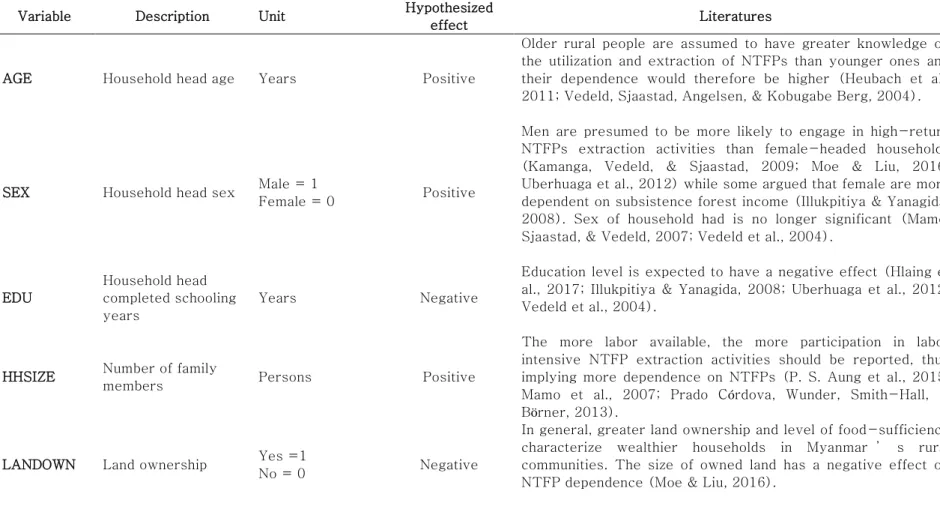
Table 4.1 Description of the explanatory variables ... 43
Table 4.2 Descriptive statistics for the categorical
socio-economic characteristics of sampled households ... 49
Table 4.3 Description of socio-economic characteristics of
sampled households ... 51
Table 4.4 Household annual income from NTFPs, absolute and
relative (%), Taungoo District, 2016... 53
Table 4.5 Estimation results: All samples.. ... 57
Table 4.6 Estimation results: Landowners ... 58
Table 4.7 Estimation results: Landless ... 59
Table 5.1 Descriptive statistics for the explanatory variables
used in the binary logit model and their expected relationship
with the response variable (willingness to participate in
forest conservation) ... 94
Table 5.2 Predicting the odds ratios of forest-dependent
communities ’ willingness to participate in forest
conservation ... 103
Table 5.3 Comparison of forest-dependent communities ’
willingness to participate in forest conservation (by
geographical area) ... 106
Table 5.4 Forest-dependent communities ’ willingness to
participate in forest conservation according to their incentive
preferences ... 108
Table 5.5 Comparison of forest-dependent communities ’
willingness to participate in forest conservation in terms of
incentive preference ... 110
1
Chapter 1. Introduction
1.1. Significance of the Study
Being complex ecosystems that are related to many species on our planet, forests play many crucial roles, not only in mitigating climate change by acting as the greatest terrestrial carbon sinks (Bonan, 2008; Houghton, 2002; Pan et al., 2011) and as participants in the carbon exchange between the atmosphere and the land surface (Hendrikson, 1990). As well as they are a home for biodiversity and act as resource banks for humanity by providing numerous ranges of goods and services (Godoy, Lubowski, & Markandya, 2013; Secretariat of the Convention on Biological Diversity, 2001).
Since prehistoric times, millions of people from different cultures and livelihood systems living in or adjacent to tropical forests have been dependent on the direct goods and services provided by forests but not having much in common (Isager, Theilade, & Thomsen, 2002a). Traditional forest users lack secure property rights, and those property rights should be secured both on paper and in practice to achieve sustainability in forest management (Kanninen et al., 2007). In many tropical countries, because of different types of forest use and no secure land tenure systems, the debates among government and environmental conservation organizations and social and human rights organizations and the conflicts between government and forest-dependent people have been sparking due to plans for the development of a “green economy” (Meijaard et al., 2013).
Unsustainable practices and policies at multiple scales, from global to local, continue to threaten forests and people who are dependent upon them. They have impacts on the forests that can be local, such as overexploitation of forest products to meet the local
2
and global demand, and global, as in the wood and agricultural products trade associated with changing consumption patterns in the developed countries. Forest resources extraction can drive up local economic development (Sayer et al., 2012), but environmental degradation can, in turn, get worse because of modern economic growth proven by the environmental Kuznets curve (Shafik, 1994). Several studies have investigated that most tropical forests in developing countries have been facing deforestation and forest degradation by a mixture of socio-economic factors (Angelsen & Kaimowitz, 1999; Boucher et al., 2011; Geist & Lambin, 2002; Kissinger, Almeida, & Coello, 2006; MEA, 2005; Weatherley-Singh & Gupta, 2015).
Forest degradation is a global phenomenon and has become a serious social, environmental, and economic problem [4]. This global problem calls for a comprehensive set of actions to address its drivers. According to Decision 1/CP.16, para 72, Cancun agreements (UNFCCC, 2011), UNFCCC (the United Nations Framework Convention on Climate Change) requests that the developing countries participating in the UN-REDD program (United Nations collaborative initiative on Reducing Emissions from Deforestation and forest Degradation) develop and implement national strategies or action plans. The intention is to address the safeguards where “ensuring the full and effective participation of relevant stakeholders, inter alia, indigenous peoples and local communities in REDD+” is one of them. Moreover, these Cancun Agreements encourage the developing countries parties to undertake REDD+ by taking the needs for sustainable livelihoods of local communities into account while incentivizing the protection and conservation of natural forests and their ecosystem services (UNFCCC, Decision 1/CP.16, Appendix I, 2011). Being one of the countries implementing REDD+, Myanmar is contributing to green development by protecting environmental resources, promoting reforestation and forest restoration, improving livelihoods of forest-dependent communities, and raising awareness and
3
adaptation to climate change. The Government of Myanmar was designated to increase the national permanent forest estate (PFE) by increasing reserved forest (RF) and protected public forest (PPF) to 30% and protected area systems (PAS) to 10% of the total national land area by 2030 (Myanmar INDC, 2015). Each district in Myanmar produces a 10-year forest management plan to meet the overall goals, including decreasing the rate of deforestation and preserving natural forest cover to maintain biodiversity and ecosystems. Meanwhile, Myanmar is implementing the rehabilitation and restoration of degraded land and reserved forest through community participation to not only mitigate climate change but also for the socio-economic development of local communities.
Participatory forest conservation is a management strategy that strengthens the involvement of local communities into forest conservation and has the capacity to reach sustainability in forest management. Local communities’ participation in government forest conservation programs is critical to the success of sustainable forest management in Myanmar, where many people are heavily dependent on forest products for their livelihoods. The forest conservation projects without local communities’ participation and without considering the alternative to forest resources or compensation for forest-dependent people will not be effective and may fail.
While REDD+ goes beyond deforestation and forest degradation and includes the roles of conservation, sustainable management of forests and enhancement of forest carbon stocks, in the ongoing stage to achieve its goals, the understanding of forest-dependent communities’ perceptions of forest conservation, their awareness of a changing forest environment and how their livelihoods are interconnecting with the forests are essential to meet the targeted actions. There are relatively few studies on perceptions of local communities related with protected area management, plantations and community forestry, and people participation in forest
4
management in Myanmar (H. Aung, Roachanakanan, Sucharitakul, & Pumijumnong, 2010; N. Z. Htun, Mizoue, & Yoshida, 2012; Maung & Yamamoto, 2008; Soe & Yeo-Chang, 2019), and the contribution of forests to rural livelihoods (P. S. Aung, Adam, Pretzsch, & Peters, 2015; Hlaing, Kamiyama, & Saito, 2017; Moe & Liu, 2016; Toe & Kanzaki, 2017). However, the studies on the possibility of local communities’ participation taking into account the potential government incentive schemes are still limiting. This study, therefore, estimates local communities’ perceptions on participation in forest conservation, and investigates potential policies and measures through examining their livelihood dependency on non-timber forest products as a case study in Myanmar.
1.2. Problem Statement
Myanmar is a country with 44.2% forested land and stands as the country with the third highest annual net loss of forest area within 2010-2015 (FAO, 2016). In the early 1990s, Myanmar’s forest cover was approximately 57.9% of the total land area, being one of the most forested tropical countries in mainland South-East Asia, but it declined to 51.5% in the early 2000s and 44.2% in 2015 (See figure 1.1) (FAO, 2015). With an increasing population, the increased demand for timber and forest products, both locally and globally, has been putting pressure on Myanmar forests. Subsistence needs of local people and commercial interests of local and non-local people continue to motivate extraction of forest resources (Myint Aung, 2007). Approximately 70% of country population live in rural areas depending on forest resources and this makes the rehabilitation of the country’s forests and conservation of forest ecosystems an important matter for the livelihoods of forest-dependent communities, as well as a challenging one.
In accordance with the forest policy imperatives in Myanmar, people’s participation in forestry activities has been promoting by
5
implementing community plantations, and conservation programs through raising public awareness to provide basic needs for the local communities from the forest. However, not all participatory forest conservation programs are succeed due to the absence of the long-term development program for local people (Maung & Yamamoto, 2008) while protecting and conserving the forests, thus their encroachment to the reserved forests have been a big challenge to deal with sustainable forest management in Myanmar.
Figure 1.1 Trend of forest cover area in Myanmar, (1990-2015) Source: (FAO, 2016)
The increasing deforestation and forest degradation rate reveals the depleting forest and forest products. The study area in Bago Mountain Ranges is famous for Myanmar teak and has been managed especially for timber and non-timber forest products production (Forest Department of Myanmar, 2015). Mon, Kajisa, Mizoue, & Yoshida, (2010) reported that forest degradation was much severe than deforestation in some reserved forests in Bago mountain area within 1989-2006. They postulated that those reserved forests are adjacent to the communities’ settlements and are susceptible to fuelwood collection and encroachment by
6
surrounding communities. Moreover, the study area has the tendency of more forest degradation in the future due to increasing fuelwood demand (Win, Mizoue, Ota, Kajisa, & Yoshida, 2018). Combined with those activities, the forests have been depleted and degraded due to illegal logging, overexploitation of forest resources, and shifting cultivation, agriculture expansion, mining, hydro power and infrastructure establishments (Kissinger, San, Arnold, Mon, & Min, 2017).
Myanmar joined UN-REDD program in 2011 and the REDD+ readiness roadmap was approved by the Government of Myanmar in 2013. Reducing deforestation or forest degradation, promoting the sustainable management of forests, the conservation of existing forests and the establishments of new forests are the main activities to mitigate climate change and remove greenhouse gases under the REDD+ mechanism. While Myanmar is on its way of adapting this mechanism, it is important to understand the underlying causes of deforestation and forest degradation to have effective participation of local people in forest conservation programs. As well as the information on how local people perceive government’s forest conservation programs, and their perceptions on participation are essential to have a long-term management.
Although there is the strong forest policy, governmental institutions, and management systems, inadequate information and planning is still one of the constraints to enhance the contribution of the forestry sector toward socioeconomic development of Myanmar in a sustainable manner. It is important that decision makers possess sufficient information on the local communities to guide the implementation of policy for future forest management. It is necessary to consider the information on the interactions between forests and local communities, how they value their surrounding forests, their perception on conservation programs while designing and implementing the required management strategies and policies for forest restoration and rehabilitation. This research set out to provide that information to address the above challenge and fill the
7
knowledge gap that needs to bridge between local communities and conservation processes.
1.3. Research Questions
The main research questions addressed in this study include: 1) What makes local communities to depend on NTFPs?
2) What are the influencing factors for local communities to participate in government’s forest conservation program? 3) Which kind of policy instrument could motivate local
communities’ participation?
1.4. Thesis Goal and Objectives
The overarching goal of this research is to improve our understanding of livelihood dependency on NTFPs, and socio-economic factors related to participatory forest management, and to provide guidance on how this knowledge can be incorporated into forest conservation and reducing deforestation and forest degradation. I set out to achieve this goal through three research objectives, which address the knowledge gap related to the problem statement in the study area focusing on dependency on NTFPs and how the perceptions and potential responses of forest-dependent communities on government incentive schemes are related to the participatory conservation program. The three objectives are to:
1. Examine factors determining local communities’ dependence on NTFPs and how these can be cooperated into policy implications
2. Observe perceptions of forest-dependent communities toward participation in forest conservation and
3. Investigate which policy interventions would be necessary to motivate their participation
8
1.5. Thesis Structure
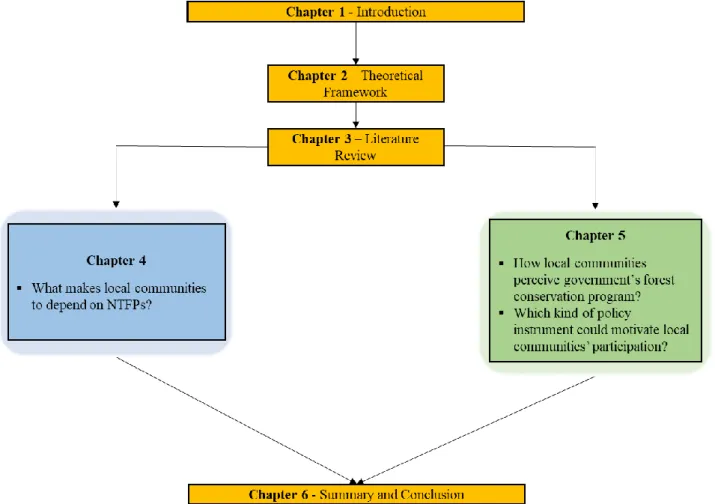
The three objectives of this thesis was conducted through two data-based research chapters, which are presented in this thesis as a series of manuscripts formatted for publication in peer-reviewed journals. Thus, this thesis consists of 6 chapters (Figure 1.2). Chapter 1 (this chapter) provides the rationale for the goal and objectives of the thesis. In this chapter, the relevance of the study and the problem statement were highlighted.
Chapter 2 describes theoretical framework on which the research was designed. It includes the concept of social-ecological systems, framework for analyzing social-ecological systems, and incentive theory of motivation. Hypotheses of the study were described and the theoretical framework of the thesis was explained in this chapter.
Chapter 3 presents the former and the current state of the research. It includes the brief context of forest conservation and people participation, the studies on non-timber forest products and forest degradation, and the theory of participatory forest management.
Chapter 4 addresses Objective 1. In this chapter, the question on “How much local communities depend on NTFPs and what are the driving forces for that?”was addressed. To address this question, local communities’ dependence on non-timber forest products and factors determining their dependence on those products in Taungoo District, south-central Myanmar was examined. Moreover, the policy implications on reducing overexploitation of NTFPs were provided. The results of chapter 4 provide insights into the underlying reasons related to socioeconomic characteristics behind the overexploitation of NTFPs. Thus, this chapter helps address the weak evidence base for socioeconomic impacts on NTFP dependence and incorporate into
9
designing policies and measures to reduce deforestation and forest degradation.
Chapter 5 addresses Objective 2 and 3. In this chapter, the questions on “Are the geographical locations of villages, and household socioeconomic characteristics and their environmental knowledge related to forest-dependent communities’ willingness to participate in forest conservation?” “Are forest-dependent communities’ willingness to participate in forest conservation different according to their preferences on different government incentive schemes?”were addressed. To address these questions, the same case study in Chapter 4 was employed. The integrated approach to investigating socioeconomic factors related to participation was performed, and the literature on behaviorist theories and policy instruments was drawn to support the study design. Local communities’ participation in forest conservation programs in Taungoo District, South-central Myanmar was examined. In addition, their participation was estimated by providing possible incentive mechanisms. The results of this chapter 5 contribute to building our limited knowledge of the perceptions and potential responses of local communities to the participatory conservation programs, which is an important knowledge gap needed to be considered in the forest management planning process.
Chapter 6 provides a description of how these data-based research chapters (chapter 4 and 5) addressed the three objectives of this thesis, including policy implications. Further, some shortcoming of this work and opportunities for further research were highlighted.
10
11
Chapter 2. Theoretical Framework and Hypotheses
2.1. Theoretical Framework
An interdisciplinary approach was conducted to examine the livelihood dependency on non-timber forest products and investigate the factors related to forest-dependent communities’ participation in forest conservation by drawing on multiple cases of empirical and theoretical literature on nature and human interactions, human behavior developed in economics, natural and social sciences. Specifically the social-ecological framework (Ostrom, 2009), the incentive theory of motivation promoted by the behavioral psychologist, Burhus Frederic Skinner and the theory of participatory forest management were employed.
2.1.1. Concept of Social-Ecological Systems (SES)
“Social-ecological systems are integrated complex systems that include social (human) and ecological (biophysical) subsystems in a two-way feedback relationship through institutions or governance” (Berkes, 2011). “The system outputs are returned to the system as an input, either to oppose the initial input (negative feedback), or to enhance it (positive feedback)” (Berkes et al., 2016).
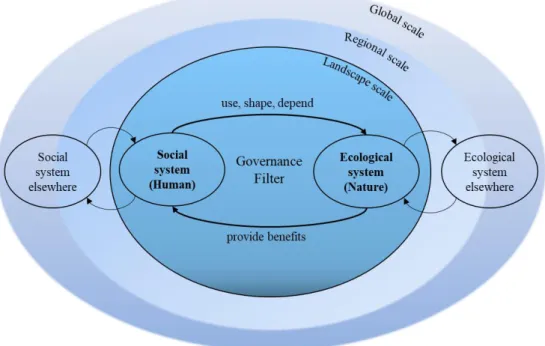
Forest ecosystems provide a wide range of services to human well-being by several means (Díaz et al., 2015; MEA, 2005). Human not only benefit from the ecosystems but they are part of the ecosystems impacting and shaping their capacities to generate ecosystem services for human well-being and societal development from local to global scales (Fischer et al., 2015; Kalaba, 2014). This mutual relationship occurs whenever people interact with their environment (Berkes et al., 2016), where social systems are
12
affected by changes in the functions of ecosystems; while human behaviors could alter the capacities of ecosystems in providing their services (Berkes, 2011; Díaz et al., 2015; IPBES, 2016; MEA, 2005)(Berkes, 2011; Díaz et al., 2015; IPBES, 2016; MEA, 2005). Figure 2.1 explains the two-way interaction between the two sub-systems of a coupled social-ecological system, the term used by (Berkes & Folke, 1998), where governance filter serves as a mediate between human actions and ecological systems (Kotchen & Young, 2007). Governance filter could be institutions, environmental values, ecological knowledge, culture and worldview (Berkes, 2011). People and nature interact reciprocally and form complex feedback loops (Liu et al., 2007), besides, the dynamics of these systems are influenced by many factors including organizations, institutions, networks, system of rules and government policies (Berkes et al., 2016).
Overexploitation of forest resources is increasingly threatening the world’s forest ecosystems. The search for the social causes of this crisis has often focused on inappropriate approaches to governance and lack of incentives for conservation (Arun Agrawal & Gupta, 2005; Isager et al., 2002a; Nguyen, Bauer, & Uibrig, 2010). If forest management does not fit within these social-ecological systems coherently, failure in terms of conservation and in the development of both systems can occur (DeCaro & Stokes, 2013; Folke, Pritchard, Berkes, Colding, & Svedin, 2007; Sarkki, Rantala, & Karjalainen, 2015). Implementing the appropriate and applicable management systems would help to fill this gap (Arun Agrawal & Gupta, 2005; Arun Agrawal, Smith, & Li, 1997). Applying the integrated SES thinking, participatory forest management has been described as a link connecting local people (social system) and forests (ecological system) (Sarkki et al., 2015), in which win-win situation can be achieved if careful analysis and understanding of the context of both systems in the specific area could be conducted.
13
Figure 2.1 Social-ecological system consisting of social (human) and ecological (biophysical) subsystems, and integrated by
two-way feedbacks through institutions or governance (adapted from (Berkes, 2011; Fischer et al., 2015))
People are part of the ecosystem; they use, shape and depend on ecological system and they provide benefits to social system, from
local to global scales.
2.1.1.1. Framework for Analyzing Social-Ecological Systems (SES) Elinor Ostrom’s SES framework provides an understanding of the complex processes of the loss of natural resources that lead to improvements in or sustainability in SES (Ostrom, 2009). It conceptualizes the ecological system from an anthropocentric perspective; the ecological system is seen as a service provider for the human well-being (Ostrom, 2010). This general framework for analyzing sustainability of social-ecological systems explains the relationship among four subsystems of an SES that affect each other as well as link with social, economic, and political settings and
14
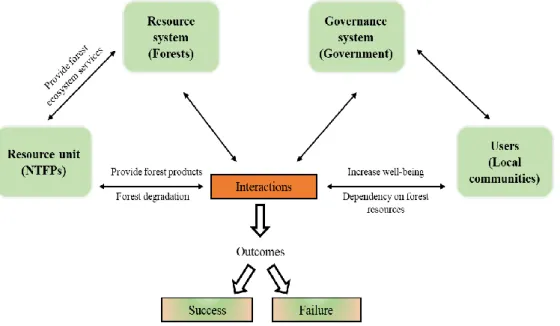
related ecosystems. The subsystems are (i) resource systems (e.g., forests, marine ecosystems), (ii) resource units (e.g., trees, fish), (iii) governance systems (e.g., institutions, management systems, rules), and (iv) users (e.g., loggers, fishers); all of them link each other through interactions producing outcomes (Ostrom, 2009).
To explain the logical linkage between two researches, I adapted Elinor Ostrom’s social-ecological system framework (Figure 2.2) (Ostrom, 2009). The outcomes can be success or failure according to the interactions. Here, the expected outcome of the research is to reduce deforestation and forest degradation, and foster conservation through participatory forest management. The subsystems denoted in this research are (i) resource systems- (forests), (ii) resource units-(forest resources, NTFPs), (iii) governance systems- (government), and (iv) users- (local communities); all of them link each other through interactions producing the above mentioned outcome.
Figure 2.2 Conceptual framework of two data-based researches (adapted from framework for social-ecological systems of (Ostrom,
15
Integrating Ostrom’s SES framework into forest conservation can provide the nuanced social considerations into participatory forest conservation planning in the specific local conditions because it explicitly address the reciprocity between the social and ecological systems (Ostrom, 2010). By understanding the interactions among four subsystems, integrated and multi-faceted management strategies would be able to develop under the forest resource governance systems.
Forests are (resource systems) which provide forest products such as NTFPs (resource units) to local people (resource users). They are common property resources and if people have open access to them without restriction, this can lead to overexploitation and degradation (Hardin, 1968). Accordingly, the livelihoods of local people depending on those forest resources were also affected. This explains the interaction of coupled human and natural systems in a two-way feedback relationship influenced by government policies (Berkes et al., 2014; Liu et al., 2007). In applying social-ecological system to forest conservation, it is crucial to understand which governance system can promote conservation that sustains forest ecosystem services and human well-being as outcomes (Berkes et al., 2016).
2.1.2. Incentive Theory of Motivation
Motivation is the reason for people’s actions, willingness and goals. A person’s motivation may be influenced by intrinsic (internal or inherent) motivation or extrinsic (external) motivation (Ryan & Deci, 2000). Intrinsically motivational behaviors are performed if a person carries out an activity for no reward but for its own satisfactory, while extrinsic motivation refers to the performance of an activity that provides external rewards (Ryan & Deci, 2000). Thus, intrinsic motivation represents engagement in an activity for its own sake. Extrinsic motivators are often used to
16
impact someone who shows little interest in a potentially positive activity.
Implementing participatory forest management needs to promote motivation for the participants. Such motivation can either be intrinsic which is inherent to an individual, and may relate to a sense of enjoyment, satisfaction, accomplishment, responsibility and obligation or be extrinsic which is directed by payments or sanctions (Reeson, 2008).
Incentive theory is a specific theory of motivation, derived from the behaviorist theories, which concerns an incentive or motive by the behaviorist principles of reinforcement. It proposes the idea that a person’s behavior is usually motived by the beliefs that they will obtain something profitable by engaging in certain activities. Incentive theory is promoted by the behavioral psychologist, Burhus Frederic Skinner, known as B.F. Skinner. This theory treats motivation and behavior of the individual as they are influenced by beliefs, such as engaging in activities that are expected to be profitable. A person is more likely to continue a behavior if the consequences are positive and less likely to continue if the consequences are negative.
Maslow A.H., (1943) proposed the idea of human motivations affected by deficiency needs and growth needs. His hierarchy of needs include ‘physiological’, ‘safety’, ‘belonging and love’, ‘social needs’ or ‘esteem’, and ‘self-actualization’. He expressed that a human’s motivation was effected initially by deficiency needs which are the first four levels. Maslow considered the physiological needs (such as food, water, shelter, cloths) the most important and all other needs are secondary until these needs are met.
The incentive theory of motivation, and Maslow’s hierarchy of needs show how humans behave related to the incentives, how their behavior is motivated and which factors would be the effective motivators. Based on these two theories of motivation, I observed which potential incentives would motivate local communities to
17
participate in forest conservation and how their participation differ according to their physiological needs and preferences on incentives (Figure 2.3).
Figure 2.3 Diagram showing theory of motivation by incentives and needs (adopted from B.F. Skinner; Maslow A.H., 1943)
2.2. Thesis Theoretical Framework
Based on the theoretical background and state of research, a theoretical framework for my thesis was constructed. To accomplish the research objectives, two researches were conducted; (1) livelihood dependency on non-timber forest products: implications for REDD+, and (2) perceptions of forest-dependent communities toward participation in forest conservation.
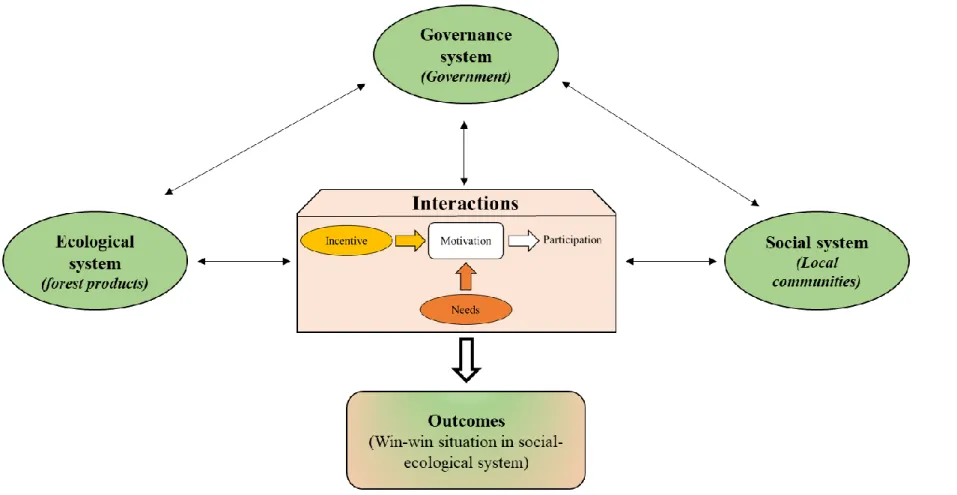
Figure 2.4 presents the theoretical framework of thesis to explain the interaction among social, ecological and governance systems. This framework explains how government interacts with local communities to have win-win situation between forest conservation and social development. The systems denoted in this framework are (i) ecological system- (forest products), (ii) social system-(local communities), and (iii) governance system-
18
(government); all of them link each other through interactions – (i.e. government provides incentives to increase local communities’ participation) producing the above mentioned outcomes.
This framework proposes the idea that in the two-way interaction between social (local communities) and ecological (forest products) systems, governance filter (government) serves as a mediate. Local communities interact with their surrounding forests by depending on forest resources for their livelihoods. However, overexploitation and the extraction of forest resources in an unsustainable way lead to the degradation of forests. If government could take the nuanced social considerations of local communities into forest conservation programs by exploring their dependency on forest products and providing incentive mechanisms, there is high possibility of increasing their participation. As a consequence, this could lead to reduce forest degradation and have win-win situation between social and ecological systems.
19
20
2.3. Hypotheses of the study
Based on the problem statement of forest resources utilization and participatory forest management, and the concept of the above interdisciplinary approach, the following hypotheses were tested in this research.
1.1 The lower the education level, and the poorer the households, the higher is the dependency on NTFPs.
1.2 Landowners are less dependent on NTFPs compared to landless households.
The relative share of income from NTFPs in total household income is defined here as the dependency on NTFPs by the households. The aim is to test how much is this NTFPs share of income and if the determinants for the dependence related to the socio-economic characteristics of the households.
2.1 The higher the relative NTFPs income, the more willing to participate in forest conservation.
2.2 Households living in high mountainous areas are more willing to participate in forest conservation compared to those living in low mountainous areas.
2.3 Households who are aware of deforestation have more willingness to participate than those who are not.
2.4 Households who prefer direct payment are more willing to participate compared to other two incentives.
A person’s behavior is usually motived by what will be gained, such as recognition or rewards, and that motivation depends on their deficiency needs (Maslow A.H., 1943). This study focused on two financial incentives to motivate forest-dependent communities’ participation in forest conservation, namely, direct payment and providing income opportunities, and; one non-financial incentive, namely, providing land tenure security or temporary land use rights to cultivate crops in forest lands. Analysis will be conducted if forest-dependent communities’
21
willingness to participate in forest conservation are different according to their preferences on the above incentives.
22
Chapter 3. Literature Review
Westoby, (1989) has shown that “the starting point for policy formulation must be the social objectives and the creation of a forest policy is a process which should involve all groups and institutions who have a direct or indirect say in the forest or responsibility for implementing policy”. Nilsson, (2003) also explained forest sector policy making “as a process by which we formulate what society wants from the forest sector and forestry in the future”.
Until a few years ago, forest management practices were focusing on the production and protection of environmental resources with less focus on social robustness, thus it fails to achieve sustainability in forest management. Several mechanisms have been established to mitigate climate change by means of protecting forests and reducing emissions from deforestation and forest degradation. To meet the increasing global environmental conservation regulations, the national policies have been maintaining a state-defined land tenure system with little recognition of local customary rights that restrict forest resources use by local communities (Roe, Nelson, & Sandbrook, 2009). This is how the conflicts between governments and forest-dependent peoples begin (Meijaard et al., 2013). The integrated solution or participatory approach often comes with community forestry where effective conservation and sustainable resource use is vital for securing local people’s economic and social benefits through participatory processes (Jeanrenaud, 2002).
In line with the goals of sustainable forest management; “to maintain and enhance the economic, social and environmental values of all types of forests, for the benefit of present and future generations” described by (UN, 2008), forest management should be multidimensional while maintaining and enhancing forest values through human interventions.
23
The conservation without local participation can be a failure and the outcome much depends not only on the legal framework but also on the education and interests of local people (Isager, Theilade, & Thomsen, 2002b). Increasing their interests needs the incentives. In recent decades, policy scientists, social theorists and policy makers have been facing the challenge of how to influence people’s attitudes and behaviors and develop numerous policy instruments. Finding out the locally effective incentives for the specific social conditions needs a careful consideration of local communities’ needs and perceptions toward their participation in forest conservation and their awareness about changing forest environments. Building incentives could help to increase local people’s support of conservation, and the initial agreement should be made revealing that the output benefits can fulfill their needs and ease their pressure in sustainably utilizing the natural resources (Tisdell, 1995).
To obtain higher effectiveness, participants’ preferences over the type of incentive should be considered as they would respond more positively to those matching their wants and desires. There are several approaches for such schemes, and they differ from place to place and time to time (Isager et al., 2002a). Some alternatives can increase local people’s income and reduce their pressure on the forests at the same time (Leach, Mearns, & Scoones, 1997), while others can be subsidized for undertaking target-oriented activities and fiscal incentives with careful assessment, revision and design (Kissinger et al., 2006).
3.1. Non-Timber Forest Products and Forest Degradation
In this study, we used the definition of NTFPs (DeBeer & McDermott, 1996), which is compatible with the features of NTFPs in Myanmar. Thus, NTFPs are products that encompass “all biological materials other than timber which are extracted from forests for human use” (DeBeer & McDermott, 1996). The NTFPs
24
used by local communities include firewood, charcoal, poles, thatching grass, bamboo, rattan, resins, ornamental plants, wildlife (products and live animals), fibers, animal fodder, fruits, mushrooms, and other food and medicinal plants (Angelsen et al., 2014; DeBeer & McDermott, 1996).
The contributions of forest ecosystem services to the livelihood of the local communities have been highlighted by several studies (A. Agrawal et al., 2013; Angelsen et al., 2014; Costanza et al., 1998; McElwee, 2008; Reddy & Chakravarty, 1999; Schaafsma et al., 2014; Sunderlin et al., 2005). In most developing countries, forest provisioning services are especially important in terms of providing direct benefits to the local communities and, thus, represent a major part of the total economic value of their livelihoods (Mullan, 2014). In addition to its role as a resource for house construction, NTFPs are also used to generate biomass and energy, as well as they provide basic needs: food, clothing, and shelter. At first, the value of forests was recognized primarily in terms of timber production at the national level. Later on, NTFPs became significant not only at the local level but also at the national level. There is growing evidence that NTFPs contribute significantly to rural livelihoods in developing countries, but are frequently underrepresented at the national level in terms of economic reporting because they are often part of the informal economy (Akanni & State, 2013; Croitoru, 2007; DeBeer & McDermott, 1996; Heubach, Wittig, Nuppenau, & Hahn, 2011; Uberhuaga, Smith-Hall, & Helles, 2012). Literature on the factors influencing forest dependence indicated that off-farm employment opportunities, agricultural income, and access to markets have a negative relationship with forest dependence (Adam, Mirghani, & Tayeb, 2014; Hegde & Enters, 2000).
The literature on the interaction between forests and people has focused on the contribution of forest resources to the livelihood of rural people. Several studies reported the benefits of NTFPs to the livelihood of local communities (Akanni & State, 2013; Angelsen
25
et al., 2014; DeBeer & McDermott, 1996; Heubach et al., 2011; Uberhuaga et al., 2012; Vedeld, Angelsen, Bojö, Sjaastad, & Kobugabe Berg, 2007). Some others argued that the commercialization of NTFPs adds to the value of forest products by helping the conservation and development of local communities while contributing to the regulation of forest services such as carbon sequestration, hydrological regulation, and biodiversity conservation (Norman Myers, 1988; Solomon, 2016). However, several works also confirmed the negative effects of overexploitation and unsustainable extraction (Chidumayo & Gumbo, 2013; Datta & Sarkar, 2012; Murali, Shankar, Shaanker, Ganeshaiah, & Bawa, 1996; Ndangalasi, Bitariho, & Dovie, 2007; Shankar, Murali, Shaanker, & Ganeshaiah, 2018). The disadvantages included altered regeneration, species composition (Murali et al., 1996; Ndangalasi et al., 2007), and change in population structure and density of NTFP species, floristic diversity (Dao & Hölscher, 2018; Murali et al., 1996; Shankar et al., 2018), and forest degradation (Chidumayo & Gumbo, 2013; Datta & Sarkar, 2012). These studies supported the notion that the higher the dependence on NTFPs, the higher the forest degradation. This is consistent with the current state of forest degradation in Myanmar arising from the overexploitation of NTFPs.
To address the drivers of deforestation and forest degradation, the developing countries participating in the UN-REDD program (United Nations collaborative initiative on Reducing Emissions from Deforestation and forest Degradation) are encouraged to develop and implement PAMs to support climate change mitigation and adaptation actions. Similar to other participant countries, government bodies in Myanmar formulate PAMs as part of a national strategy and implement them to meet the country’s mitigation targets. Studies on developing REDD+ PAMs are relatively limited and this analysis is further complicated by the fact that the development and selection of appropriate PAMs depends on region-specific deforestation and forest degradation drivers,
26
national circumstances, and the purposes of the national REDD+ strategy. Scriven, (2012)provided contextual data and information to aid the development of PAMs targeted to the Peruvian Amazon and reported that care must be taken to build and structure practical PAMs in the local context. As only a few countries have submitted their national REDD+ strategy to the UNFCCC REDD+ platform, their strategies, approaches and national programs are the only illustrations of PAM development available.
3.1.1. Forest Law and Status of Non-Timber Forest Products in Forest Management of Myanmar
Forest resources have been increasingly recognized as taking part in a significant role for rural communities not only for subsistence, but also for commercial used in Myanmar. The Myanmar Selection System(forest management system) described under the National Code of Harvesting Practices has been set the bounds of annual allowable cut for the timber and the Myanmar Forest Certification System has been developing to promote sustainable forest management and timber legality certification. In addition, a legal framework was developed to control the timber trade, under which all wood or wood produce is considered legal if it has the stamps of Myanmar Timber Enterprise under the permission of the Ministry of Environmental Conservation and Forests), and is exported through Yangon city harbor (Woods, 2013). Although the regulations and certification systems for timber has been developing, the regulations on NTFPs harvest systems, conservation and management is still lacking and at the same time the research on NTFPs is limited.
Illegal logging is not only environmental matter but also criminal act in Myanmar. According to Forest Law (2018), forest produce may only be extracted after obtaining a permit from forest department. Any harvest, transportation, and sale of teak and reserved trees in violation of laws is illegal logging in Myanmar.
27
However, in the case of subsistence used for agricultural or fishery enterprise, forest produce may be extracted in an amount not exceeding the stipulated quantity, without obtaining a permit (The Pyidaungsu Hluttaw, 2018). Teak and other trees reserved under this law are not allowed to be cut for both commercial and substance used. Forest Department (FD) shall use the competitive bidding system for commercial usage except the production is done by national enterprise. However, the commercial production of NTFPs does not need to use the competitive bidding system. Though the extraction and production of NTFPs commercially is legal, making and producing charcoal needs permission from the FD. In addition, the transportation of forest products or furniture from one district to another also needs the permission if it is more than the stipulated quantity. Myanmar has five self-administered zones and division (including Shan state and Sagaing division), which have some of the largest of relatively untouched forest. Illegal timber trade from those areas to neighbor countries is the highest (UNODC, 2015), and thus, they contribute the highest for the deforestation and forest degradation in Myanmar (Brunner, Talbott, & Elkin, 1998).
Due to the crucial role of non-timber forest products in the rural communities’ livelihoods, the Myanmar National Forest Policy 1995 acknowledged the importance of NWFPs and stated a policy measure to recognize their socio-economic role as one of the priorities for forest development. FD set the strategic objectives for the sustainable management of forest; notably one of them is “to develop and exploit the potential of non-wood forest products for meeting local needs and supporting small-scale rural forest-based industries for providing employment and off-farm income to the rural population” (Ministry of Forestry, 1995). In addition, to promote the forest regeneration and afforestation, the strategies on the implementation of management programs to provide the growing needs of NWFPs in Myanmar was also developed. Particularly, to reduce market constraints in NWFPs
28
trade and to enhance their important roles in both national and local economies, the strategies for assembling, synthesizing and documenting the existing knowledge of various NWFPs were designed.
One of the effective forest management that the government of Myanmar incorporates the issue of NTFPs is community forestry (CF) management. Under the instructions of community forestry (CFI), addressing the basic needs of timber and NTFPs for local people is embedded together with enhancing environmental services for climate change mitigation and adaptation through conservation of deforestation and forest degradation by promoting participatory forest management (Union Minister, 2016). However, due to the overexploitation and ineffective implementation of regulations on NTFPs, the availability of these products are diminishing in certain areas. Therefore, under the 10-year district management plan for the period of 2016-17 to 2025-26, the working circles for the production of NTFPs was planned to manage in each district to have a sustainable production of NTFPs for local communities and to protect the natural forests from the over exploitation by the local communities (Forest Department of Myanmar, 2015). In addition, monitoring and follow-up activities, and providing technologies and extension services to the local communities related with the extraction of NTFPs in the sustainable way were also one of the activities to be conducted.
3.2. Participatory Forest Management (PFM)
Participatory approaches to forest management have been evolving regulatory forest policies using top-down approaches for decision making. These approaches have been embraced by academics, institutions and governments over recent decades, and have operated in differing ways according to varying situations in terms of geographical diversity, socioeconomic conditions, cultural values, traditional beliefs, general attitudes, policies implemented
29
and specific institutional frameworks (Worah, 2008). The definition of participation and the range of levels understood as entailing participation have varied (Arun Agrawal & Ostrom, 2001). Some scholars (e.g., Clarke, 2008; White, 1996) see participation as the inclusion of suitably empowered people who can express their views, stand up for their rights, and influence the creation and development of institutional arrangements and policies, while their participation may vary according to the nature of people's interests. Agarwal, (2001) also identified six different levels of participation, ranging from simple involvement as a member of an interest group working for a decision maker to active participation in decision making. Michener, (1998) describes two levels of participation, involving “genuine participation” where local people have effective authority, and “pseudo participation” in which local people play a minimal role (e.g. information sharing). In general, PFM has operated as an umbrella term involving several approaches such as joint forest management (JFM), community forestry (CF), social forestry (SF), community-based natural resource management, and community-based forest management (CBFM). These diverse PFM approaches pursued by different countries have differing implications for the forest ecosystems and livelihoods of the people involved; thus, the outcomes of PFM practices differ according to the approach adopted (Rasul, Thapa, & Karki, 2011a). The complex interaction of natural (ecological) systems and social systems can produce strongly contrasting demands (Herring, 1988), and if forest management does not fit within these systems coherently, failure in terms of conservation and in the development of both systems can occur (DeCaro & Stokes, 2013; Folke et al., 2007; Sarkki et al., 2015). As participation has been demonstrated to be a bridge between local residents and conservation processes (Sarkki et al., 2015), providing effective and suitable policy instruments for social and ecological systems could aid with a more efficient exploration of opportunities for social-ecological innovation.
30
To manage forests sustainably, the following should occur, namely, the implementation of three-attribute cooperation (social, economic, and environmental) through increasing the benefits available to ensure that society's needs and the conservation and maintenance of forest ecosystems are advanced. Additionally, a balance between these attributes must be attained to protect the forest resources and prosperity of forest-dependent communities. To attain a balance in participatory processes, local social conditions need to be explored, acknowledged (Sarkki et al., 2015), and incorporated into management plans aiming to enhance social innovation.
Forest management that involves local people requires a change in local people's attitudes, after a careful analysis and understanding of the context of existing social and ecological systems in the relevant area. Policy scientists, social theorists, and policymakers have been faced with the challenge of how to influence public attitudes and behavior, and develop policy instruments. A policy instrument is “a deliberate structured effort by a governing body to solve a policy problem by modifying the actions of the governed” (Brukas & Sallnäs, 2012) that works to link governing institutions and society in general through technical and social intermediaries (Lascoumes & Le Gales, 2007), and which is intended to provide optimum solutions through a careful balancing of interests (Bemelmans-Videc, Rist, & Vedung, 2011).
The effects of a policy instrument depend on its effectiveness, efficiency, legality, and democratic extent (Bemelmans-Videc et al., 2011); thus, a legitimate human-oriented environmental conservation program is likely to include a combination of policy instruments, including incentives to enhance social and environmental benefits (i.e., social-ecological innovations) to help change attitudes. Because stakeholders’ priorities change depending on their attitudes, the identification of attitudes in relation to changing the condition of forests could facilitate the design of policy measures and management decisions (Nijnik et al.,
31
2017). A bottom-up approach through attitudes-based policy instruments could be the key to changing local communities' attitudes and perceptions regarding government forest programs and increasing motivation to participate in these programs.
32
Chapter 4. Livelihood Dependency on Non-Timber
Forest Products: Implications for Policies and
Measures
In chapter 4, local communities’ dependence on non-timber forest products and factors determining their dependence on those products in Taungoo District, south-central Myanmar was examined. This chapter contributes to providing insights into the underlying reasons related to socioeconomic characteristics behind the overexploitation of NTFPs. Chapter 4 is published in Forests.①
The research question for this chapter was developed, data was analyzed, and the chapter was written by me. The study design, coordination and the data collection was collected by the author (with research assistants). YOUN provided advice in the development of the research question, and assisted with structuring and editing the manuscript.
① Soe, & Yeo-Chang. (2019). Livelihood Dependency on Non-Timber Forest Products: Implications for REDD+. Forests, 10(5), 427. https://doi.org/10.3390/f10050427