© Korean Powder Metallurgy Institute 1284
-Improvement in the Super Low Core-loss Soft Magnetic Materials
Toru Maeda1, a, Atsushi Sato1,b , Yasushi Mochida1,c ,Haruhisa Toyoda1,d , Koji Mimura1,e and Takao Nishioka1,f 1 Sumitomo Electric Industries, ltd.
1-1-1 Koya-Kita Itami, Hyogo, 664-0016 Japan
a [email protected], b [email protected], c [email protected] d [email protected], e [email protected], f [email protected]
Abstract
We reported a P/M soft magnetic material with core loss value of W10/1k = 68 W/kg, which is lower than that of
0.35mm-thick laminated material, by using high purity gas-atomized iron powder. Lack of mechanical strength and hi gh cost of powder production are significant issues for industrial use. In order to achieve both low core loss and high strength by using inexpencive powder, the improvement of powder shape and surface morphology and binder strength w as conducted. As the result, the material based on water-atomized powder with 80 MPa of TRS and 108 W/kg of core loss (W10/1k) was achieved.
Keywords : soft magnetic material, core loss, strength, iron powder, insulation layer
1. Introduction
In recent years, there has been a pronounced trend of adopting electric drive systems and electronic control systems to achieve automation and multi-functionality in products such as automobiles and appliances. Development of soft magnetic material is strongly demanded due to realize higher speed, larger magnetic flux and better drive efficiency. Additionary, adequate mechanical properties are also demanded for applications including moving parts.
In the previous work, we tried to produce Soft Magnetic Composite with super low core loss [1]. By using high purity sphere-shaped (gas-atomized) iron powder with good heat -proof insulated layer and binder resin, the core loss of W10/1k=68 W/kg, which is lower than that of 0.35mm-thick
conventional laminated steel sheets at frequency range over 200Hz, was achieved. This material was able to be heat -treated at 973 K, which temperature is adequate to relax distortions which induced under compressing, due to the heat-proof property of the insulation layer.
But this developed material has some problems in mechanical property to be applied as moving parts. For example, the value of transverse rupture strength (TRS) was around 20MPa. This is attributed to the fact that inter-particle necking and strength of binder resin are lacked in the developed material. In this work, we tried to strike a balance between low core loss and high strength. And, commercially available water-atomized iron powder was used as starting material of Soft Magnetic Composite in anticipation with industrial production.
As the conventional water-atomized iron powders have irregular shape, adequate heat-proof property under compressing
process is not expected. So the smoothing effect of powder sufface was investigated firstly, in order to reduce the damage of insulation layer under compressing process. Secondly, the enhancement of binder strength was examined. To satisfy both low core loss and high strength, organic -inorganic intermediate composite binder or mixture binder were examined.
2. Experimental and Results
Water atomized pure iron powder (ABC100.30 produced by Höganäs AB) was used as starting material. The powder surface was modified by tumbling mill treatment. Then, powder was annealed in hydrogen atomosphere at 1150 K in order to reduce mechanical/chemical damage. Next, a phosphate insulation coating and a silicone-resin binder coating was applied.
The obtained powder was pressed using a hydraulic press at compacting pressures from 800 to 1300 MPa. Troidal shaped specimens (34φ x 20φ x 5 mm) were used for evaluation of magnetic characteristics, and rectangular shaped specimens (55 x 10 x 10 mm) were used for 3-point bending transverse testing. The compacted body was heat treated in a nitrogen gas / air flow at 473-973 K for 1 hour.
Figure.1 shows optical microscope images of ABC100.30 powder, (a) without tumbling mill treatment and (b) with tumbling mill treatment. This treatment was conducted for 17 hours at room temperature without any milling media. It is seen that the sharp projections are well removed after the treatment. Smoothing level of each powder was quantitated into the value determined by following equation.
2006 POWDER METALLURGY World Congress
© Korean Powder Metallurgy Institute 1285
-Fig. 1 Optical microscopy image of powder (a) befo re milling treatment and (b) after milling treatment.
circle
C D
D
K = max (1)
, where Dmax means maximum diameter of projection
shape of particles and Dcircle means circle-corresponding
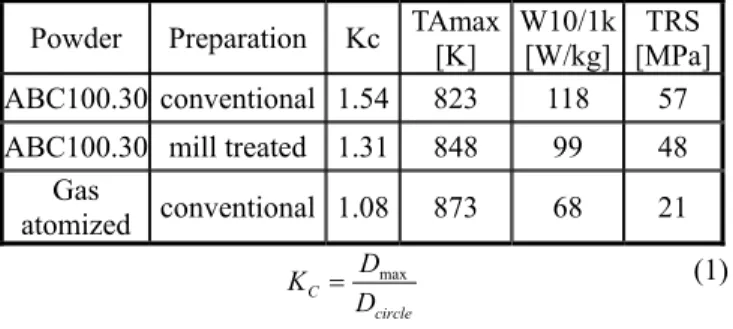
diameter of projection shape of particles. Kc value becomes 1.0 for spherical powder, and it becomes larger than 1.0 for irregular shape particle. As a result of analysis, Kc=1.31 for mill-treated powder was obtained. This value was obviously smaller than that of the non-treated powder (Kc= 1.54).
The magnetic properties and mechanical properties are shown in Table 1. For these samples, silicone resin was used as binder. Here, TAmax corresponds to a temperature
limit of heat-treatment of compacted body, which is determeined by insulation property. TAmax of the sample
based on mill-treated powder was 25 K higher than that of the sanple based on non-treated powder. And Eddy current loss (We10/1k) was 4 W/kg smaller. As the result, total iron
loss (W10/1k) was 20 % reduced by surface smoothing
treatment.
As shown in Table 1, Soft Magnetic Composite sample of the mill-treated ABC100.30 powder is poor in mechanical property. It is considered that binder material need to be harder in order to enhance mechanical strength. However, overhard resin is not available for insulation layer, because the layer is expected to be destroyed under compacting process. So we tried to mix derivatives into the conventional silicone resin. This mixture shows damage-relaxation effect under compressing process and the pencile hardness of this mixture after hardening process is over 4H.
Fig. 2 shows transverse rupture strength, white and black data bar correspond to the sample contains conventional resin and developed mixture, respectively. Values in the data bar correspond to W10/1k of each sample.
As the result, samples of developed mixture showed double strength in comparison with samples of conventional resin. TRS value of 81 MPa was achieved in the sample based on the mill-treated ABC100.30 powder. In contrast, iron loss was slightly increased. It is considered that the enhancement of damage to the insulation layer under compressing process led to increment of iron loss. In such a light, this mixture has to be required additional improvement. Table 1. Characteristics of samples made from surfa ce smoothed powder.
Fig. 2 Transverse rupture strength of samples, consi st of conventional resin and developed mixture. (val ues in the data bar correspond to W10/1k)
3. Summary
Using tumbling mill treatment and improoving insulate layer material, both smaller iron loss and larger strength in powder magnetic core based on water-atomized commercial iron powder were achieved, in comparison with the conventional ABC100.30 based sample. Iron loss (W10/1k)
was reduced from 118W/kg to 108W/kg and TRS was enhanced from 57 MPa to 81 MPa.
4. References
1. T.Maeda et al. :Proc.PM2TEC2005 part 9, p.121.(2005) Powder Preparation Kc TAmax [K] W10/1k[W/kg] [MPa]TRS
ABC100.30 conventional 1.54 823 118 57 ABC100.30 mill treated 1.31 848 99 48
Gas