Subtypes of Sleep Disturbance in Parkinson’s Disease Based
on the Cross-Culturally Validated Korean Version
of Parkinson’s Disease Sleep Scale-2
Hui-Jun Yanga*, Han-Joon Kimb*, Seong-Beom Kohc, Joong-Seok Kimd, Tae-Beom Ahne, Sang-Myung Cheonf,
Jin Whan Chog, Yoon-Joong Kimh, Hyeo-Il Mah, Mee Young Parki, Jong Sam Baikj, Phil Hyu Leek, Sun Ju Chungl,
Jong-Min Kimm, In-Uk Songd, Ji-Young Kimn, Young-Hee Sungo, Do Young Kwonp, Jae-Hyeok Leeq, Jee-Young Leer,
Ji Seon Kims, Ji Young Yunt, Hee Jin Kimu, Jin Yong Hongv, Mi-Jung Kimw, Jinyoung Young, Ji Sun Kimg,
Eung Seok Ohx, Won Tae Yoony, Sooyeoun Youz, Kyum-Yil KwonA, Hyung-Eun Parkd, Su-Yun Leef,
Younsoo Kimg,B, Hee-Tae KimC, Sang Jin KimD,E
a Department of Neurology, Ulsan University Hospital, University of Ulsan College of Medicine, Ulsan, Korea
b Deparment of Neurology, Seoul National University Hospital, Seoul National University College of Medicine, Seoul, Korea c Department of Neurology, Korea University Guro Hospital, Korea University College of Medicine, Seoul, Korea d Department of Neurology, College of Medicine, The Catholic University of Korea, Seoul, Korea
e Department of Neurology, Kyung Hee University College of Medicine, Seoul, Korea f Department of Neurology, Dong-A University College of Medicine, Busan, Korea
g Department of Neurology and Neuroscience Center, Samsung Medical Center, Sungkyunkwan University School of Medicine, Seoul, Korea h Department of Neurology, Hallym University College of Medicine, Anyang, Korea
i Department of Neurology, Yeungnam University College of Medicine, Daegu, Korea
j Department of Neurology, Sanggye Paik Hospital, Inje University College of Medicine, Seoul, Korea k Department of Neurology, Severance Hospital, Yonsei University College of Medicine, Seoul, Korea
l Department of Neurology, Parkinson/Alzheimer Center, Asan Medical Center, University of Ulsan College of Medicine, Seoul, Korea m Department of Neurology, Seoul National University Bundang Hospital, Seoul National University College of Medicine, Seongnam, Korea n Department of Neurology, Seoul Paik Hospital, Inje University College of Medicine, Seoul, Korea
o Department of Neurology, Gachon University Gil Hospital, College of Medicine, Gachon University, Incheon, Korea p Department of Neurology, Korea University Ansan Hospital, Korea University College of Medicine, Ansan, Korea q Department of Neurology, Pusan National University Yangsan Hospital, Yangsan, Korea
r Department of Neurology, Seoul Metropolitan Government-Seoul National University Boramae Medical Center, College of Medicine, Seoul National University,
Seoul, Korea
s Department of Neurology, Chungbuk National University School of Medicine, Chungbuk National University Hospital, Cheongju, Korea t Department of Neurology, Ewha Womans University Seoul Hospital, Ewha Womans University College of Medicine, Seoul, Korea. u Department of Neurology, Konkuk University Medical Center, Konkuk University School of Medicine, Seoul, Korea
v Department of Neurology, Yonsei University Wonju College of Medicine, Wonju, Korea w Department of Neurology, Bobath Memorial Hospital, Seongnam, Korea
x Department of Neurology, Chungnam National University School of Medicine, Chungnam National University Hospital, Daejeon, Korea y Department of Neurology, Kangbuk Samsung Hospital, Sungkyunkwan University School of Medicine, Seoul, Korea
z Department of Neurology, Keimyung University School of Medicine, Daegu, Korea
A Department of Neurology, Soonchunhyang University Seoul Hospital, Soonchunhyang University School of Medicine, Seoul, Korea B Department of Neurology, Samsung Changwon Hospital, Sungkyunkwan University School of Medicine, Changwon, Korea C Department of Neurology, Hanyang University College of Medicine, Seoul, Korea
D Department of Neurology, Busan Paik Hospital, Inje University College of Medicine, Busan, Korea E Dementia and Neurodegenerative Disease Research Center, Inje University, Busan, Korea
pISSN 1738-6586 / eISSN 2005-5013 / J Clin Neurol 2020;16(1):66-74 / https://doi.org/10.3988/jcn.2020.16.1.66
Received May 27, 2019 Revised September 2, 2019 Accepted September 2, 2019 Correspondence
Sang Jin Kim, MD, PhD, Department of Neurology, Busan Paik Hospital, Inje University College of Medicine, 75 Bokji-ro, Busanjin-gu, Busan 47392, Korea Tel +82-51-890-6425, Fax +82-51-895-6367, E-mail [email protected]
*These authors contributed equally to this work.
cc This is an Open Access article distributed under the terms of the Creative Commons Attribution Non-Commercial License (https://creativecommons.org/ licenses/by-nc/4.0) which permits unrestricted non-commercial use, distribution, and reproduction in any medium, provided the original work is properly cited.
Yang HJ et al.
JCN
INTRODUCTION
Sleep-related problems in Parkinson’s disease (PD) have re-ceived increasing attention in past years due to their occur-rence in early stages of the disease, as well as their clinical in-fluence on morbidity, disability, and the health-related quality of life (HRQoL) of patients with advanced disease.1-4 Par-kinson’s Disease Sleep Scale (PDSS) is a patient-reported in-strument recommended by the Movement Disorder Society task force, and is designed to rate overall sleep problems in the PD population.5,6 A revision of PDSS (PDSS-2) was re-cently published that places particular emphasis on improv-ing scale properties and encompassimprov-ing nocturnal symptoms that were not previously included (e.g., restless leg syndrome, sleep apnea, akinesia, and nocturnal pain).7 PDSS-2 has been successfully applied in several clinical trials as a reliable pa-tient-reported outcome measure.7-11 This prompted us to trans-late and adapt PDSS-2 to Korean individuals and evaluate its clinimetric properties in the assessment of sleep disturbances among Korean-speaking patients with PD.
This study also sought to determine the discriminatory capacity of the new Korean version of PDSS-2 (K-PDSS-2) by conducting latent class analysis (LCA) to characterize sub-types of sleep disturbance in PD. Several studies have applied LCA in PD populations to address depression-anxiety sub-types12,13 and neurocognitive subtypes.14 The potential causes of sleep disturbances vary widely, and have been suggested
to include primary insomnia, depression, rapid-eye-move-ment sleep-behavior disorder (RBD), restless leg syndrome, nocturnal motor symptoms, antiparkinsonian drug side ef-fects, nocturia, and sleep-related breathing disorders, all of which frequently co-occur.1,3,4 However, few studies have at-tempted to empirically outline the clinical heterogeneity of sleep-related problems in patients with PD. LCA has previous-ly been used to identify subtypes of sleep disturbance in pa-tients with Alzheimer’s disease.15 An empirical search for latent homogeneous subgroups of patients who experience similar patterns in sleep-related problems and nocturnal disabilities could help to elucidate the pathophysiology of these condi-tions and lead to the development of more-targeted man-agement strategies. To our knowledge, the present study is the first to document the application of an LCA approach for identifying subtypes of sleep disturbance in patients with PD.
METHODS
Subjects
This study, which had a test–retest design, recruited patients who met the United Kingdom Parkinson’s Disease Society Brain Bank criteria for PD between August 2014 and Sep-tember 2015 from 31 different movement-disorder centers in Korea. All of the patients included in the study were required to be on a known and stable antiparkinsonian medication for the 4 weeks prior to study commencement. Patients with
Background and Purpose This study aimed to determine the clinimetric properties of the
Korean version of Parkinson’s Disease Sleep Scale-2 (K-PDSS-2) and whether distinct subtypes of sleep disturbance can be empirically identified in patients with Parkinson’s disease (PD) us-ing the cross-culturally validated K-PDSS-2.
Methods The internal consistency, test–retest reliability, scale precision, and convergent validi-ty of K-PDSS-2 were assessed in a nationwide, multicenter study of 122 patients with PD. Latent class analysis (LCA) was used to derive subgroups of patients who experienced similar patterns of sleep-related problems and nocturnal disabilities.
Results The total K-PDSS-2 score was 11.67±9.87 (mean±standard deviation) at baseline and 12.61±11.17 at the retest. Cronbach’s α coefficients of the total K-PDSS-2 scores at baseline and follow-up were 0.851 and 0.880, respectively. The intraclass correlation coefficients over the 2-week study period ranged from 0.672 to 0.848. The total K-PDSS-2 score was strongly corre-lated with health-recorre-lated quality of life measures and other corresponding nonmotor scales. LCA revealed three distinct subtypes of sleep disturbance in the study patients: “less-troubled sleepers,” “PD-related nocturnal difficulties,” and “disturbed sleepers.”
Conclusions K-PDSS-2 showed good clinimetric attributes in accordance with previous stud-ies that employed the original version of the PDSS-2, therefore confirming the cross-cultural usefulness of the scale. This study has further documented the first application of an LCA ap-proach for identifying subtypes of sleep disturbance in patients with PD.
Key Words Parkinson disease, sleep,Parkinson’s Disease Sleep Scale-2, Korean version, validity, latent class analysis.
Validation of K-PDSS-2
JCN
secondary parkinsonism, atypical parkinsonian syndrome, concomitant treatment with hypnotics and/or antipsychotics, a score of <20 on the Korean version of the Mini-Mental State Examination (K-MMSE), or those aged 40 years or younger at disease onset were excluded. Written informed consent was obtained from all of the study participants, and the study protocol was approved by the Institutional Review Boards at the participating centers (IRB No. 2014-08-029). This inves-tigation formed part of a larger nationwide program study-ing the cultural adaptation and clinimetric validation of dif-ferent scales for nonmotor manifestations of PD in Korea.2,16
Translation and cross-cultural adaptation of
K-PDSS-2
The original questionnaire was translated from English into Korean by two independent bilingual translators. A transla-tion committee consisting of movement disorder experts re-viewed both translated versions to reconcile a single forward-translated version, which was then backward forward-translated from Korean to English by another independent bilingual transla-tor who was blinded to the previous steps. The back-translat-ed version was comparback-translat-ed to the original English question-naire, and forward–backward amendments were made by the translation committee based on consensus. The amend-ed translatamend-ed version was pretestamend-ed on four patients with PD who were not a part of this study in order to assess its inter-pretation of items, ease of comprehension, and cross-cultur-al relevance. These processes produced the fincross-cultur-al harmonized version of the K-PDSS-2 instrument.5,9,11
Study procedure
Both demographics and clinical data were collected for all study patients. The overall severity of disease was evaluated using Hoehn and Yahr (H-Y) staging and parts I–III of the Unified Parkinson’s Disease Rating Scale (UPDRS). The mo-tor phenotype was classified based on the ratio of UPDRS items proposed by Jankovic et al.17 We administered the Ko-rean version of the Non-Motor Symptoms Scale (K-NMSS) consisting of the following nine domains to quantify the range of nonmotor manifestations of the disease: cardiovascular, sleep/fatigue, mood, perceptual problems, attention/mem-ory, gastrointestinal, urinary, sexual function, and miscella-neous.18 The disease-specific HRQoL was investigated using the Korean version of the 39-item Parkinson’s Disease Ques-tionnaire (K-PDQ-39).19 The Korean version of the Mont-gomery-Åsberg Depression Rating Scale (K-MADRS) was used to assess depressive symptoms, while K-MMSE and the Korean version of the Montreal Cognitive Assessment (Mo-CA-K) were administered to evaluate cognitive function.20,21 Sleep-related problems and nocturnal disabilities among the
study patients were globally addressed using the K-PDSS-2 instrument obtained from the above-described cross-cultural adaptation process. The test–retest reliability was measured by applying the K-PDSS-2 questionnaire twice over an inter-val from 10 to 14 days.
Statistical analysis
Clinimetric properties were statistically evaluated using IBM SPSS (version 19, IBM Corporation, Armonk, NY, USA) for internal consistency, test–retest reliability, convergent validi-ty, and scale precision for measurement errors. Cronbach’s α coefficients for total scores and item-total correlations for individual items were calculated to assess internal consisten-cy.5 Cronbach’s α coefficients >0.70 and item-total correla-tion coefficients >0.30 were used to tentatively define an ac-ceptable level of consistency.9,11,16 Test–retest reliability was measured with the intraclass correlation coefficient (ICC) us-ing a two-way random model and a criterion of >0.60.7,22 The scale precision for measurement errors was tested through the standard error of the mean (SEM) using the ICC as the reli-ability coefficient. The measurement errors of K-PDSS-2 were considered sufficiently low if the SEM was less than half of the standard deviation (SD).7,9 Convergent validity with the K-NMSS sleep/fatigue domain score and other nonmotor measures of PD were evaluated using the Spearman rank-order correlation coefficient (rs), with a value of rs>0.40 considered
to indicate a moderate or stronger correlation.11,16 The Jonck-heere-Terpstra test for trend detection was used to evaluate the relationship between K-PDSS-2 total scores and the H-Y stages of the study patients, and p values <0.05 were consid-ered to reflect statistical significance.
The discriminatory capacity of the K-PDSS-2 instrument was statistically assessed using LCA, which identifies classes of patients with similar patterns of sleep disturbances. A poly-tomous-variable LCA was conducted with the open-source statistical software R (version 3.4.1, R Foundation for Statis-tical Computing, Vienna, Austria) using the R package dep-mixS4 (version 1.3-3).23 The discrete model fit was assessed based on the interpretability, parsimony of latent classes, Akaike information criterion, and Bayesian information cri-terion statistics.12,14 Demographics and clinical differences were compared among identified latent classes using the chi-square test or the Kruskal-Wallis test followed by post-hoc comparisons with Bonferroni-corrected Mann-Whitney U tests, as appropriate.
RESULTS
Table 1 presents demographics and clinical data of the 122 patients enrolled in this study. At the baseline evaluation, the
Yang HJ et al.
JCN
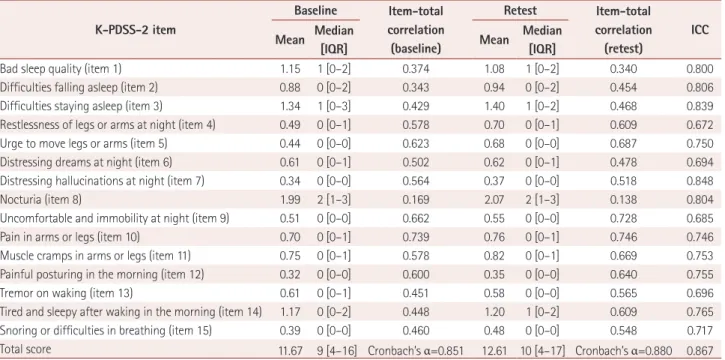
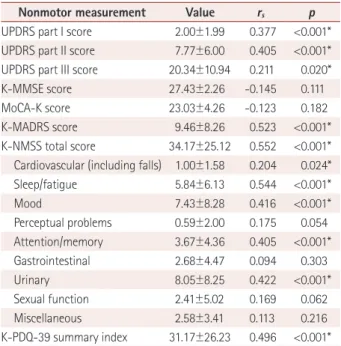
K-PDSS-2 score was 11.67±9.87 (mean±SD), with a median of 9 and an interquartile range (IQR) of 4–16. Most (97.5%, n=119) of the 122 study patients who completed the baseline evaluation also participated in the retest K-PDSS-2 evalua-tion, in which the score was 12.61±11.67, with a median of 10 and an IQR of 4–17. In terms of internal consistency, the item-total correlation coefficient ranged from 0.169 to 0.739 at baseline and from 0.138 to 0.746 at the retest. All items ex-cept for item 8 (nocturia) satisfied the criterion of the item-total correlation coefficient (>0.30; Table 2). Cronbach’s α coefficients for the K-PDSS-2 total scores at baseline and the retest were 0.851 and 0.880, respectively, thereby meeting the standard established for internal consistency (Cronbach’s α >0.70; Table 3). With regards to the test–retest reliability over the interval from 10 to 14 days, the ICCs ranged from 0.672 (item 4) to 0.848 (item 7), with ICC >0.60 for all items (Table 2). The ICC of the K-PDSS-2 total score was 0.867, and hence exceeded the threshold of 0.60. The scale precision as determined by the SEM was 3.60, therefore also meeting the criterion (<½SD=4.94).Table 3 lists the coefficients for the correlations between K-PDSS-2 and the range of clinical rating scales of PD used to assess convergent validity. The total K-PDSS-2 score showed significant correlations with the K-PDQ-39 summary index (rs=0.496) and K-MADRS score (rs=0.523), and was strongly
correlated with the total K-NMSS score (rs=0.552) and the
scores in some of the corresponding K-NMSS domains. As expected, the strongest correlation among K-NMSS domains was observed for the K-NMSS sleep/fatigue domain (rs=
Table 1. Demographics and clinical characteristics of the study pa-tients with Parkinson’s disease
Characteristic Value (n=122)
Age, years 66.55±8.64 [60–73]
Sex
Male 62 (50.8)
Female 60 (49.2)
Disease duration, months 45.82±46.51 [30–72]
Motor subtype
Tremor-dominant 32 (26.2)
Intermediate 13 (10.7)
PIGD 77 (63.1)
Present medication use
LEDD, mg/day 371.92±401.95 [0–600] Levodopa 99 (81.2) Dopamine agonists 61 (50.0) COMT inhibitors 3 (2.5) MAO inhibitors 23 (18.9) Amantadine 31 (25.4) Anticholinergics 14 (11.5) Acetylcholinesterase inhibitors 5 (4.1) Antidepressants 16 (13.1)
Hoehn and Yahr stage 2.16±0.67 [2–2.5]
Stage 1 16 (13.1)
Stage 2 57 (46.7)
Stage 3 47 (38.5)
Stage 4 or 5 2 (1.6)
Data are mean±standard deviation [interquartile range] or n (%) values. COMT: catechol-O-methyltransferase, LEDD: levodopa equivalent daily dosage, MAO: monoamine oxidase, PIGD: postural instability and gait difficulty.
Table 2. Clinimetric validation-related statistics
K-PDSS-2 item Baseline Item-total correlation (baseline) Retest Item-total correlation (retest) ICC Mean Median [IQR] Mean Median [IQR]
Bad sleep quality (item 1) 1.15 1 [0–2] 0.374 1.08 1 [0–2] 0.340 0.800
Difficulties falling asleep (item 2) 0.88 0 [0–2] 0.343 0.94 0 [0–2] 0.454 0.806
Difficulties staying asleep (item 3) 1.34 1 [0–3] 0.429 1.40 1 [0–2] 0.468 0.839
Restlessness of legs or arms at night (item 4) 0.49 0 [0–1] 0.578 0.70 0 [0–1] 0.609 0.672
Urge to move legs or arms (item 5) 0.44 0 [0–0] 0.623 0.68 0 [0–0] 0.687 0.750
Distressing dreams at night (item 6) 0.61 0 [0–1] 0.502 0.62 0 [0–1] 0.478 0.694
Distressing hallucinations at night (item 7) 0.34 0 [0–0] 0.564 0.37 0 [0–0] 0.518 0.848
Nocturia (item 8) 1.99 2 [1–3] 0.169 2.07 2 [1–3] 0.138 0.804
Uncomfortable and immobility at night (item 9) 0.51 0 [0–0] 0.662 0.55 0 [0–0] 0.728 0.685
Pain in arms or legs (item 10) 0.70 0 [0–1] 0.739 0.76 0 [0–1] 0.746 0.746
Muscle cramps in arms or legs (item 11) 0.75 0 [0–1] 0.578 0.82 0 [0–1] 0.669 0.753
Painful posturing in the morning (item 12) 0.32 0 [0–0] 0.600 0.35 0 [0–0] 0.640 0.755
Tremor on waking (item 13) 0.61 0 [0–1] 0.451 0.58 0 [0–0] 0.565 0.696
Tired and sleepy after waking in the morning (item 14) 1.17 0 [0–2] 0.448 1.20 1 [0–2] 0.609 0.765
Snoring or difficulties in breathing (item 15) 0.39 0 [0–0] 0.460 0.48 0 [0–0] 0.548 0.717
Total score 11.67 9 [4–16] Cronbach’s α=0.851 12.61 10 [4–17] Cronbach’s α=0.880 0.867
Validation of K-PDSS-2
JCN
0.544; Table 3). There was also a significant relationship be-tween the total K-PDSS-2 score and H-Y stage (standardized Jonckheere-Terpstra statistic=2.091, p=0.037).
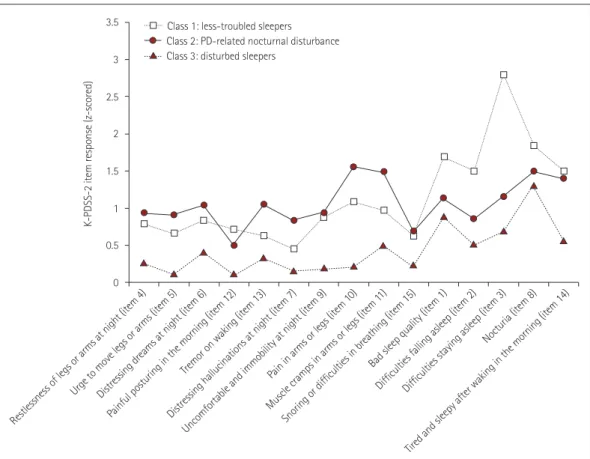
LCAs were conducted with K-PDSS-2 items to identify subtypes of sleep problems, trialing solutions involving from one to seven latent classes. A three-class solution was found to be the most-parsimonious model based on interpretability and fit indices (Table 4). Symptom profiles of the 3 subtypes of sleep disturbance are presented graphically in Fig. 1 as the
predicted responses of the study patients in each class on a range of 15 items of K-PDSS-2. Across all study participants (n=122), 78 patients (63.9%) were assigned to class 1, the larg-est latent class. The symptom profiles of class 1 were charac-terized by overall low predicted responses on K-PDSS-2 items (Fig. 1), and so individuals in class 1 were labeled as “less-troubled sleepers.” Twenty-two patients (18.0%) were classi-fied into class 2, with high predicted responses for the rest-lessness of legs or arms at night (item 4), urge to move legs or arms (item 5), distressing dreams at night (item 6), distressing hallucinations at night (item 7), pain in arms or legs (item 10), muscle cramps in arms or legs (item 11), and tremor on wak-ing (item 13). Since most of these items have been described as PD symptoms at night and motor symptoms at night in previous factor analyses,7,9 class 2 was labeled “PD-related nocturnal difficulties.” Finally, 22 patients (18.0%) were as-signed to class 3, which was profiled by marked predicted re-sponses in bad sleep quality (item 1), difficulties falling asleep (item 2), difficulties staying asleep (item 3), and nocturia (item 8). Since most of these items have indicated disturbed sleep or fragmented sleep in previous factor-analysis stud-ies,7,9,11 individuals in class 3 were labeled as “disturbed sleep-ers” (Fig. 1).
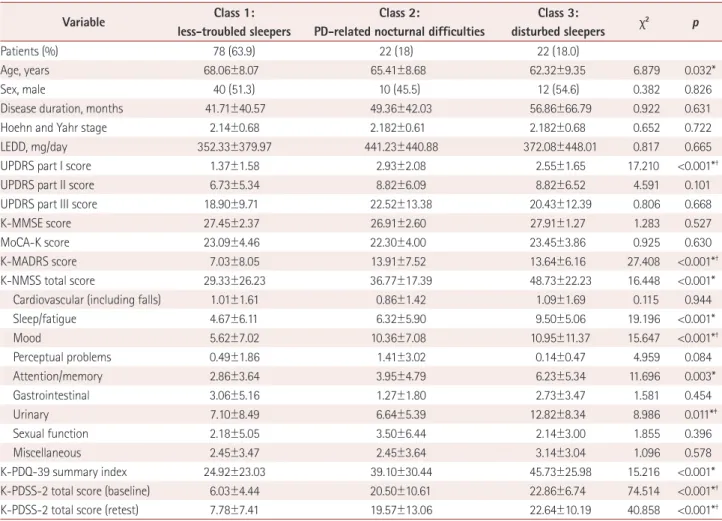
Table 5 compares demographics and clinical variables among the three classes. Group differences based on the Kruskal-Wallis test were found across age, total K-PDSS-2 score (both at baseline and the retest), K-PDQ-39 summary index, UP-DRS part I score, K-MAUP-DRS score, total K-NMSS score, and scores in four K-NMSS domains (sleep/fatigue, mood, atten-tion/memory, and urinary domains). Post-hoc analysis of be-tween-group differences indicated that the patients in class 3 tended to be younger and have a higher total K-NMSS score, K-NMSS sleep/fatigue domain score, K-NMSS attention/ memory domain score, and K-PDQ-39 summary index than those in class 1. Class 3 patients also showed a higher NMSS urinary domain score compared with those in class 1 or 2. Compared to class 1 patients, those in classes 2 and 3 showed a markedly higher UPDRS part I score, K-MADRS score, and K-NMSS mood domain score. There were no significant dif-ferences in sex, disease duration, motor phenotype, levodopa equivalent daily dosage, use of antiparkinsonian medication, or UPDRS part II or III scores between the three classes.
DISCUSSION
The purpose of the current study was twofold: to determine 1) the clinimetric properties of the K-PDSS-2 and 2) whether distinct subtypes of sleep disturbance can be distinguished among patients with PD on the basis of the validated K-PDSS- 2 instrument.
Table 4. Model-fit indices in latent class analysis with one to seven derived classes
Number
of classes AIC BIC Log-likelihood
Smallest class size (%) 1 3873.52 4041.77 -1876.76 122 (100.00) 2 3706.43 4045.71 -1732.21 34 (24.59) 3 3659.52 4169.86 -1647.76 22 (17.19) 4 3727.88 4409.25 -1620.94 12 (8.2) 5 3792.90 4645.33 -1592.45 11 (6.6) 6 3892.84 4916.31 -1581.42 8 (3.3) 7 3943.22 5137.73 -1545.61 9 (4.9)
AIC: Akaike information criterion, BIC: Bayesian information criterion. Table 3. Convergent validity of K-PDSS-2 with other motor and non-motor measurements and patient-perceived quality of life
Nonmotor measurement Value rs p
UPDRS part I score 2.00±1.99 0.377 <0.001*
UPDRS part II score 7.77±6.00 0.405 <0.001*
UPDRS part III score 20.34±10.94 0.211 0.020*
K-MMSE score 27.43±2.26 -0.145 0.111
MoCA-K score 23.03±4.26 -0.123 0.182
K-MADRS score 9.46±8.26 0.523 <0.001*
K-NMSS total score 34.17±25.12 0.552 <0.001*
Cardiovascular (including falls) 1.00±1.58 0.204 0.024*
Sleep/fatigue 5.84±6.13 0.544 <0.001* Mood 7.43±8.28 0.416 <0.001* Perceptual problems 0.59±2.00 0.175 0.054 Attention/memory 3.67±4.36 0.405 <0.001* Gastrointestinal 2.68±4.47 0.094 0.303 Urinary 8.05±8.25 0.422 <0.001* Sexual function 2.41±5.02 0.169 0.062 Miscellaneous 2.58±3.41 0.113 0.216 K-PDQ-39 summary index 31.17±26.23 0.496 <0.001*
Data are mean±standard deviation values.
*p<0.05. p values are from the Spearman correlation test.
K-MADRS: Korean version of the Montgomery-Åsberg Depression Rat-ing Scale, K-MMSE: Korean version of the Mini-Mental State Examination, K-NMSS: Korean version of the Non-Motor Symptoms Scale, K-PDQ-39: Korean version of the 39-item Parkinson’s Disease Questionnaire, K-PDSS-2: Korean version of Parkinson’s Disease Sleep Scale-2, MoCA-K:
Korean version of the Montreal Cognitive Assessment, rs: Spearman
rank-order correlation coefficient, UPDRS: Unified Parkinson’s Disease Rating Scale.
Yang HJ et al.
JCN
Overall, the cross-cultural adaptation of the K-PDSS-2 in-strument developed using a structured translation and re-view processes exhibited satisfactory clinimetric attributes. Similar to the original PDSS-2 validation study, we found that the new instrument had good internal consistency and good test–retest reliability.7,23 The scale precision of the K-PDSS-2 on measurement error was acceptable in terms of the SEM value, which was less than half the SD.7,9 The SEM of K-PDSS-2 of our study (3.60 <½SD=4.94) was comparable to that found in the original PDSS-2 validation study (3.98< ½SD=4.45)7 and the study by the Hungarian group (2.459< ½SD=5.404).9
The convergent validity of K-PDSS-2 was well supported by its statistical correlations with other clinical measures. Consis-tent with the findings of previously published analyses, the sleep-related problems and nocturnal disabilities as measured herein with K-PDSS-2 increased with advancing disease se-verity according to H-Y stages.9,24 Higher K-PDSS-2 scores were significantly correlated with worse K-PDQ-39 scores, indicating a relationship between HRQoL and sleep distur-bance in PD patients. This finding corroborates previous re-ports of significant correlations between PDSS-2 scores and the HRQoL as measured via PDQ-39 or its subdomains.7-9,11,25 It is important to note that we found no significant
correla-tion between K-PDSS-2 and neurocognitive performance as assessed by both MoCA-K and K-MMSE, whereas depres-sion as assessed by K-MADRS was closely related to the total K-PDSS-2 score. Our results are consistent with two other groups finding no significant correlation between the PDSS-2 total score and cognitive outcomes assessed using the origi-nal MoCA9 and MMSE11 instruments.
Using LCA, we were able to classify sleep disturbances in patients with PD into three latent groups: one baseline sub-type (class 1), which covered approximately two-thirds of the study patients, and two subtypes (classes 2 and 3) associated with increased sleep disturbances. One remarkable LCA find-ing was that the three latent classes did not directly parallel all 15 K-PDSS-2 items in terms of severity (i.e., mild, moderate, and severe). Instead, the predicted item responses (Fig. 1) showed that patients in class 2 were more likely to experience more PD-related nocturnal symptoms, whereas patients in class 3 were more likely to report general sleep difficulties than patients in the other subtypes. Our LCA outcomes indi-cated that sleep disorders in patients with PD are more com-plicated than simply the degree of severity of sleep disturbances; instead, there are different subgroups of patients with sleep dis-turbances, including those with PD-specific or general sleep difficulties. 3.5 3 2.5 2 1.5 1 0.5 0
K-PDSS-2 item response (z-scored)
Restlessness of legs or arms at night (item 4)
Urge to move legs or arms (item 5)Distressing dreams at night (item 6) Painful posturing in the morning (item 12)
Tremor on waking (item 13)
Distressing hallucinations at night (item 7) Uncomfortable and immobility at night (item 9)
Pain in arms or legs (item 1 0)
Muscle cramps in arms or legs (item 1 1)
Snoring or difficulties in breathing (item 15) Bad sleep quality (item 1)
Difficulties falling asleep (item 2)Difficulties staying asleep (item 3) Nocturia (item 8)
Tired and sleepy after waking in the morning (item 14)
Class 1: less-troubled sleepers Class 2: PD-related nocturnal disturbance Class 3: disturbed sleepers
Fig. 1. Predicted symptom profiles of K-PDSS-2 item responses for the sleep-disturbance subtypes based on latent class analysis. K-PDSS-2: Ko-rean version of Parkinson’s Disease Sleep Scale-2, PD: Parkinson’s disease.
Validation of K-PDSS-2
JCN
In a recent review, Diederich and McIntyre3 proposed cat-egorizing sleep problems in PD into 1) primary causes relat-ing to degeneration of the brainstem regulatory center and impaired thalamocortical arousal, 2) secondary causes in-cluding motor symptoms, nocturnal dyskinesia, and dysauto-nomia, 3) tertiary causes mainly due to medication, and 4) oth-er causes including depression, cardiac, and pulmonary comorbidity. Louter et al.1 also suggested three main sub-groups of sleep disorders in patients with PD: 1) primary sleep symptoms caused by neurodegeneration in sleep-regu-lating regions, 2) nocturnal disturbances due to PD symp-toms, and 3) medication-related sleep disorders. Our study empirically characterized the underlying structure of sleep dis-turbances in PD that have been and continue to be observed routinely by movement disorder experts and clinical neurolo-gists in practice. The present LCA results suggested that
pa-tients in class 3 can suffer from neurodegeneration in sleep-regulating regions, whereas patients in class 2 manifest with PD-related nocturnal disturbances.1,3,4 Since the K-PDSS-2 in-strument did not directly address the medications taken by pa-tients, medication-related sleep problems might not have been sufficiently captured.
It is particularly interesting that the differences between groups of motor symptoms as assessed by UPDRS parts II and III remained small. In contrast, patients identified as be-ing in either class 2 or 3 had more-severe nonmotor symp-toms. Our findings of a discrepancy between motor and non-motor symptoms in relation to sleep-disturbance subtypes are consistent with those of several data-driven subtyping studies in PD that have found patients experiencing PD motor symp-toms of similar severities exhibiting considerable differences in the severities of their nonmotor symptoms.26-29
Table 5. Demographics and clinical characteristics of study patients in three sleep-disturbance-related latent classes
Variable Class 1:
less-troubled sleepers
Class 2:
PD-related nocturnal difficulties
Class 3:
disturbed sleepers χ2 p
Patients (%) 78 (63.9) 22 (18)�� 22 (18.0)
Age, years 68.06±8.07 65.41±8.68 62.32±9.35 6.879 0.032*
Sex, male 40 (51.3) 10 (45.5) 12 (54.6) 0.382 0.826
Disease duration, months 41.71±40.57 49.36±42.03 56.86±66.79 0.922 0.631
Hoehn and Yahr stage 2.14±0.68 2.182±0.61 2.182±0.68 0.652 0.722
LEDD, mg/day 352.33±379.97 441.23±440.88 372.08±448.01 0.817 0.665
UPDRS part I score 1.37±1.58 2.93±2.08 2.55±1.65 17.210 <0.001*†
UPDRS part II score 6.73±5.34 8.82±6.09 8.82±6.52 4.591 0.101
UPDRS part III score 18.90±9.71 22.52±13.38 20.43±12.39 0.806 0.668
K-MMSE score 27.45±2.37 26.91±2.60 27.91±1.27 1.283 0.527
MoCA-K score 23.09±4.46 22.30±4.00 23.45±3.86 0.925 0.630
K-MADRS score 7.03±8.05 13.91±7.52 13.64±6.16 27.408 <0.001*†
K-NMSS total score 29.33±26.23 36.77±17.39 48.73±22.23 16.448 <0.001*
Cardiovascular (including falls) 1.01±1.61 0.86±1.42 1.09±1.69 0.115 0.944
Sleep/fatigue 4.67±6.11 6.32±5.90 9.50±5.06 19.196 <0.001* Mood 5.62±7.02 10.36±7.08 10.95±11.37 15.647 <0.001*† Perceptual problems 0.49±1.86 1.41±3.02 0.14±0.47 4.959 0.084 Attention/memory 2.86±3.64 3.95±4.79 6.23±5.34 11.696 0.003* Gastrointestinal 3.06±5.16 1.27±1.80 2.73±3.47 1.581 0.454 Urinary 7.10±8.49 6.64±5.39 12.82±8.34 8.986 0.011*‡ Sexual function 2.18±5.05 3.50±6.44 2.14±3.00 1.855 0.396 Miscellaneous 2.45±3.47 2.45±3.64 3.14±3.04 1.096 0.578 K-PDQ-39 summary index 24.92±23.03 39.10±30.44 45.73±25.98 15.216 <0.001*
K-PDSS-2 total score (baseline) 6.03±4.44 20.50±10.61 22.86±6.74 74.514 <0.001*†
K-PDSS-2 total score (retest) 7.78±7.41 19.57±13.06 22.64±10.19 40.858 <0.001*†
Data are n (%) or mean±standard deviation values. p values are from the chi-square test or the Kruskal-Wallis test followed by post-hoc comparisons
with Bonferroni-corrected Mann-Whitney tests.
*Significant difference between classes 1 and 3, †Significant difference between classes 1 and 2, ‡Significant difference between classes 2 and 3.
MADRS: Korean version of the Montgomery-Åsberg Depression Rating Scale, MMSE: Korean version of the Mini-Mental State Examination, K-NMSS: Korean version of the Non-Motor Symptoms Scale, K-PDQ-39: Korean version of the 39-item Parkinson’s Disease Questionnaire, K-PDSS-2: Korean version of Parkinson’s Disease Sleep Scale-2, LEDD: levodopa equivalent daily dosage, MoCA-K: Korean version of the Montreal Cognitive As-sessment, PD: Parkinson’s disease, UPDRS: Unified Parkinson’s Disease Rating Scale.
Yang HJ et al.
JCN
It is important to note the potential limitations of this study.First, our classification of sleep disturbances was based on the K-PDSS-2 instrument, which does not include items related to RBD-related nocturnal motor features.8,30 The validity of this subtyping has not been tested using polysomnography, sleep latency testing, or actigraphy.31,32 RBD, obstructive sleep apnea, or other sleep-related respiratory disturbances can ac-count for some instances of sleep disturbance observed in class 3, warranting further evaluation by objective testing methods such as polysomnography. The second limitation is that our study included only patients with K-MMSE scores ≥20 at the time of registration, and the mild cognitive im-pairments in PD could go unrecognized if screening is per-formed using MMSE scores.33 Third, convergent validity was only tested against the corresponding K-NMSS domain (do-main 2 of K-NMSS), and not against other generic sleep scales such as the Pittsburgh Sleep Quality Index or the Wis-consin Sleep Questionnaire.6,34 Fourth, our study did not de-termine the optimal cutoff score for K-PDSS-2. No such in-formation is provided for Korean patients with PD, and thus further studies are needed to address the cutoff value for the K-PDSS-2 instrument.10,24 Another drawback of our study is that measure of daytime sleep disturbances (e.g., excessive daytime sleepiness) and related assessment instruments were not utilized.
In conclusion, the K-PDSS-2 instrument demonstrated clinimetric reliability and validity, indicating that it is a suit-able tool for measuring nocturnal disturbances and sleep disorders in Korean patients with PD. Moreover, using a data-driven approach, we were able to identify subtypes of sleep disturbance in patients with PD. The validity of our LCA-de-rived subtypes was supported by distinct differences in demo-graphics and clinical features between the groups. We expect our findings to be useful in both research and clinical eval-uations of sleep disturbances in PD.
Author Contributions
Conceptualization: Seong-Beom Koh, Joong-Seok Kim, Sang Jin Kim, Sang-Myung Cheon, Tae-Beom Ahn, Han-Joon Kim, Hui-Jun Yang. Data curation: Sang Jin Kim, Han-Joon Kim, Hui-Jun Yang. Formal analysis: Han-Joon Kim, Hui-Jun Yang. Investigation: Seong-Beom Koh, Joong-Seok Kim, Sang Jin Kim, Tae-Beom Ahn, Sang-Myung Cheon, Han-Joon Kim, Jin Whan Cho, Yoon-Joong Kim, Hyeo-Il Ma, Mee Young Park, Jong Sam Baik, Phil Hyu Lee, Sun Ju Chung, Jong-Min Kim, In-Uk Song, Ji-Young Kim, Young-Hee Sung, Do Young Kwon, Jae-Hyeok Lee, Jee-Young Lee, Ji Seon Kim, Ji Young Yun, Hee Jin Kim, Jin Youg Hong, Mi-Jung Kim, Jinyoung Youn, Ji Sun Kim, Eung Seok Oh, Won Tae Yoon, Sooyeoun You, Kyum-Yil Kwon, Hyung-Eun Park, Su-Yun Lee, Younsoo Kim, Hui-Jun Yang, Hee-Tae Kim. Methodology: Seong-Beom Koh, Joong-Seok Kim, Sang Jin Kim, Sang-Myung Cheon, Tae-Beom Ahn. Project administration: Seong-Beom Koh, Joong-Seok Kim, Sang Jin Kim, Sang-Myung Cheon, Tae-Beom Ahn. Software: Joon Kim, Hui-Jun Yang. Writing—original draft: Han-Joon Kim, Hui-Jun Yang. Writing—review & editing: Sang Jin Kim.
ORCID iDs
Hui-Jun Yang https://orcid.org/0000-0002-3593-1134 Han-Joon Kim https://orcid.org/0000-0001-8219-9663 Seong-Beom Koh https://orcid.org/0000-0002-9411-4863 Joong-Seok Kim https://orcid.org/0000-0001-8087-7977 Tae-Beom Ahn https://orcid.org/0000-0002-7315-6298 Sang-Myung Cheon https://orcid.org/0000-0001-5905-2188 Jin Whan Cho https://orcid.org/0000-0002-9145-6729 Yoon-Joong Kim https://orcid.org/0000-0002-2956-1552 Hyeo-Il Ma https://orcid.org/0000-0001-6733-9779 Mee Young Park https://orcid.org/0000-0002-5683-1634 Jong Sam Baik https://orcid.org/0000-0002-5300-203X Phil Hyu Lee https://orcid.org/0000-0001-9931-8462 Sun Ju Chung https://orcid.org/0000-0003-4118-8233 Jong-Min Kim https://orcid.org/0000-0001-5723-3997 In-Uk Song https://orcid.org/0000-0002-0181-0844 Ji-Young Kim https://orcid.org/0000-0002-0666-927X Young-Hee Sung https://orcid.org/0000-0002-2840-1338 Do Young Kwon https://orcid.org/0000-0002-5414-0397 Jae-Hyeok Lee https://orcid.org/0000-0002-4274-7415 Jee-Young Lee https://orcid.org/0000-0002-9120-2075 Ji Seon Kim https://orcid.org/0000-0002-8117-5114 Ji Young Yun https://orcid.org/0000-0001-9648-9450 Hee Jin Kim https://orcid.org/0000-0003-1554-2657 Jin Yong Hong https://orcid.org/0000-0002-2476-3737 Mi-Jung Kim https://orcid.org/0000-0001-9097-2759 Jinyoung Youn https://orcid.org/0000-0003-3350-5032 Ji Sun Kim https://orcid.org/0000-0003-3669-9151 Eung Seok Oh https://orcid.org/0000-0003-2068-3235 Won Tae Yoon https://orcid.org/0000-0002-7026-3899 Sooyeoun You https://orcid.org/0000-0003-4753-4491 Kyum-Yil Kwon https://orcid.org/0000-0001-5443-0952 Hyung-Eun Park https://orcid.org/0000-0003-4000-1051 Su-Yun Lee https://orcid.org/0000-0003-1072-8452 Younsoo Kim https://orcid.org/0000-0002-0292-1538 Hee-Tae Kim https://orcid.org/0000-0002-7722-4841 Sang Jin Kim https://orcid.org/0000-0001-7240-2154 Conflicts of Interest
The authors have no potential conflicts of interest to disclose. Acknowledgements
This work was supported by a grant from Samil Pharmacy Company. The funder had no role in study design, data collection, data analysis, data interpretation or writing of the manuscript.
REFERENCES
1. Louter M, Aarden WC, Lion J, Bloem BR, Overeem S. Recognition and diagnosis of sleep disorders in Parkinson’s disease. J Neurol 2012; 259:2031-2040.
2. Kwon DY, Koh SB, Lee JH, Park HK, Kim HJ, Shin HW, et al. The KMDS-NATION Study: Korean Movement Disorders Society multi-center assessment of non-motor symptoms and quality of life in Par-kinson’s disease NATION Study Group. J Clin Neurol 2016;12:393-402. 3. Diederich NJ, McIntyre DJ. Sleep disorders in Parkinson’s disease:
many causes, few therapeutic options. J Neurol Sci 2012;314:12-19. 4. Sixel-Döring F, Trautmann E, Mollenhauer B, Trenkwalder C. Age,
drugs, or disease: what alters the macrostructure of sleep in Parkin-son’s disease? Sleep Med 2012;13:1178-1183.
5. Pellecchia MT, Antonini A, Bonuccelli U, Fabbrini G, Ferini Strambi L, Stocchi F, et al. Observational study of sleep-related disorders in Italian patients with Parkinson’s disease: usefulness of the Italian ver-sion of Parkinson’s disease sleep scale. Neurol Sci 2012;33:689-694.
Validation of K-PDSS-2
JCN
6. Högl B, Arnulf I, Comella C, Ferreira J, Iranzo A, Tilley B, et al. Scales to assess sleep impairment in Parkinson’s disease: critique and recom-mendations. Mov Disord 2010;25:2704-2716.
7. Trenkwalder C, Kohnen R, Högl B, Metta V, Sixel-Döring F, Frauscher B, et al. Parkinson’s disease sleep scale--validation of the revised ver-sion PDSS-2. Mov Disord 2011;26:644-652.
8. Suzuki K, Miyamoto M, Miyamoto T, Tatsumoto M, Watanabe Y, Su-zuki S, et al. Nocturnal disturbances and restlessness in Parkinson’s disease: using the Japanese version of the Parkinson’s disease sleep scale-2. J Neurol Sci 2012;318:76-81.
9. Kovács N, Horváth K, Aschermann Z, Ács P, Bosnyák E, Deli G, et al. Independent validation of Parkinson’s disease sleep scale 2nd ver-sion (PDSS-2). Sleep Biol Rhythms 2016;14:63-73.
10. Muntean ML, Benes H, Sixel-Döring F, Chaudhuri KR, Suzuki K, Hira-ta K, et al. Clinically relevant cut-off values for the Parkinson’s disease sleep scale-2 (PDSS-2): a validation study. Sleep Med 2016;24:87-92. 11. Arnaldi D, Cordano C, De Carli F, Accardo J, Ferrara M, Picco A, et
al. Parkinson’s disease sleep scale 2: application in an Italian popula-tion. Neurol Sci 2016;37:283-288.
12. Brown RG, Landau S, Hindle JV, Playfer J, Samuel M, Wilson KC, et al. Depression and anxiety related subtypes in Parkinson’s disease. J Neurol Neurosurg Psychiatry 2011;82:803-809.
13. Starkstein S, Dragovic M, Jorge R, Brockman S, Merello M, Robinson RG, et al. Diagnostic criteria for depression in Parkinson’s disease: a study of symptom patterns using latent class analysis. Mov Disord 2011; 26:2239-2245.
14. Brennan L, Devlin KM, Xie SX, Mechanic-Hamilton D, Tran B, Hur-tig HH, et al. Neuropsychological subgroups in non-demented Par-kinson’s disease: a latent class analysis. J Parkinsons Dis 2017;7:385-395.
15. Ownby RL, Peruyera G, Acevedo A, Loewenstein D, Sevush S. Sub-types of sleep problems in patients with Alzheimer disease. Am J Geri-atr PsychiGeri-atry 2014;22:148-156.
16. Kim JY, Song IU, Koh SB, Ahn TB, Kim SJ, Cheon SM, et al. Valida-tion of the Korean version of the scale for outcomes in Parkinson’s disease-autonomic. J Mov Disord 2017;10:29-34.
17. Jankovic J, McDermott M, Carter J, Gauthier S, Goetz C, Golbe L, et al. Variable expression of Parkinson’s disease: a base-line analysis of the DATATOP cohort. Neurology 1990;40:1529-1534.
18. Koh SB, Kim JW, Ma HI, Ahn TB, Cho JW, Lee PH, et al. Validation of the Korean-version of the nonmotor symptoms scale for Parkinson’s disease. J Clin Neurol 2012;8:276-283.
19. Kwon DY, Kim JW, Ma HI, Ahn TB, Cho J, Lee PH, et al. Translation and validation of the Korean version of the 39-item Parkinson’s dis-ease questionnaire. J Clin Neurol 2013;9:26-31.
20. Kang YW, Na DL, Hahn SH. A validity study on the Korean
Mini-Mental State Examination (K-MMSE) in dementia patients. J Korean Neurol Assoc 1997;15:300-308.
21. Lee JY, Lee DW, Cho SJ, Na DL, Jeon HJ, Kim SK, et al. Brief screen-ing for mild cognitive impairment in elderly outpatient clinic: valida-tion of the Korean version of the Montreal Cognitive Assessment. J Geriatr Psychiatry Neurol 2008;21:104-110.
22. Horváth K, Aschermann Z, Acs P, Deli G, Janszky J, Karádi K, et al. Test-retest validity of Parkinson’s disease sleep scale 2nd version (PDSS-2). J Parkinsons Dis 2014;4:687-691.
23. Visser I, Speekenbrink M. DepmixS4: an R package for hidden mar-kov models. J Stat Softw 2010;36:1-21.
24. Suzuki K, Miyamoto T, Miyamoto M, Suzuki S, Numao A, Watanabe Y, et al. Evaluation of cutoff scores for the Parkinson’s disease sleep scale-2. Acta Neurol Scand 2015;131:426-430.
25. Duncan GW, Khoo TK, Yarnall AJ, O’Brien JT, Coleman SY, Brooks DJ, et al. Health-related quality of life in early Parkinson’s disease: the impact of nonmotor symptoms. Mov Disord 2014;29:195-202. 26. Van Rooden SM, Heiser WJ, Kok JN, Verbaan D, Van Hilten JJ,
Ma-rinus J. The identification of Parkinson’s disease subtypes using clus-ter analysis: a systematic review. Mov Disord 2010;25:969-978. 27. Erro R, Vitale C, Amboni M, Picillo M, Moccia M, Longo K, et al.
The heterogeneity of early Parkinson’s disease: a cluster analysis on newly diagnosed untreated patients. PLoS One 2013;8:e70244. 28. Landau S, Harris V, Burn DJ, Hindle JV, Hurt CS, Samuel M, et al.
Anxiety and anxious-depression in Parkinson’s disease over a 4-year period: a latent transition analysis. Psychol Med 2016;46:657-667. 29. Van Rooden SM, Colas F, Martínez-Martín P, Visser M, Verbaan D,
Marinus J, et al. Clinical subtypes of Parkinson’s disease. Mov Disord 2011;26:51-58.
30. Pushpanathan ME, Loftus AM, Gasson N, Thomas MG, Timms CF, Olaithe M, et al. Beyond factor analysis: multidimensionality and the Parkinson’s disease sleep scale-revised. PLoS One 2018;13:e0192394. 31. Uemura Y, Nomura T, Inoue Y, Yamawaki M, Yasui K, Nakashima K.
Validation of the Parkinson’s disease sleep scale in Japanese patients: a comparison study using the Pittsburgh Sleep Quality Index, the Ep-worth Sleepiness Scale and Polysomnography. J Neurol Sci 2009;287: 36-40.
32. Stavitsky K, Cronin-Golomb A. Sleep quality in Parkinson disease: an examination of clinical variables. Cogn Behav Neurol 2011;24:43-49. 33. Mamikonyan E, Moberg PJ, Siderowf A, Duda JE, Have TT, Hurtig
HI, et al. Mild cognitive impairment is common in Parkinson’s dis-ease patients with normal Mini-Mental State Examination (MMSE) scores. Parkinsonism Relat Disord 2009;15:226-231.
34. Kurtis MM, Balestrino R, Rodriguez-Blazquez C, Forjaz MJ, Marti-nez-Martin P. A review of scales to evaluate sleep disturbances in movement disorders. Front Neurol 2018;9:369.