KSTLE International Journal, Vol. 10, No. 1/2, December 2009, pp. 23-26
Comparison of Tribological Characteristics of ZnO Coatings Prepared
by Sputtering and Sol-gel Methods
Li-Yu Lin and Dae-Eun Kim†
Department of Mechanical Engineering, Yonsei University, Shinchong-dong 134, Seoul 120-749, Korea
(Received 20 October 2009; Revised 21 November 2009)
Abstract: In this work the tribological characteristics were compared between ZnO coatings on glass substrate prepared by sputtering and sol-gel methods. In order to assess the effects of processing method on the tribological characteristics, the friction and wear properties of the coatings were measured by using a reciprocating type of micro-tribotester. The sputtered ZnO coatings were prepared on a glass substrate at room temperature, 150° C, and 300° C. The ZnO coatings prepared by sol-gel method were heat-treated in air atmosphere at 550° C for one hour. The crystal structure and surface morphology of the coatings were measured by X-ray diffraction (XRD) and Atomic Force Microscope (AFM), respectively. The experimental results showed that overall the sputtered coatings exhibited better friction and wear properties than coatings prepared by sol-gel method. The sputtered coating grown at room temperature had a relatively low friction coefficient of 0.14 and superior wear resistance compared with the other coatings. Nevertheless, sol-gel method of coating ZnO on glass is beneficial for economical coating of a large surface area.
Keywords: Coating, friction, sol-gel, sputtering, wear, ZnO
1. Introduction
Zinc oxide (ZnO) has been getting much attention because of its desirable electric, optical, and piezoelectric properties. ZnO is a promising material for applications in transparent conductive coatings that are widely used in liquid crystal display (LCD), solar cells, gas sensors, and probe of tunneling-electron luminescence microscope. Also, ZnO has been used in piezoelectric sensors and UV photodetectors. Since ZnO is commonly utilized as a coating its surface properties are important to achieve high performance and reliability. Particularly, the tribological characteristics of ZnO coatings are critical in applications where the surface experiences some amount of mechanical stress. For example, in the probe of a tunneling-electron luminescence microscope, the wear resistance of the probe must be maximized in order to attain high reliability. In2O3, ITO and Sb-TO, which are transparent
conductive materials, have been used as probe materials [1-3]. It has been reported that Scanning Electron Microsopy (SEM) analysis of the Sb-TO probe showed that it can readily wear due to contact and scanning during the operation of the microscope [4]. Also, the lubricating properties of ZnO coatings have been achieved by controlling the fabrication
conditions of pulsed-laser deposition (PLD) method. The result of this study suggested that ZnO coatings with low friction and good wear resistance have a great potential to be used for wide temperature range applications [5].
The past investigations on the tribological characteristics of ZnO coatings and Al-doped ZnO coatings showed that the frictional behavior and wear resistance could be controlled by the processing conditions and method. ZnO coatings grown by PLD exhibited low friction (µ = 0.15-0.2) when the coatings were deposited in a partially oxygen environment at room temperature. In contrast, the hot pressed coatings of ZnO showed a friction coefficient of 0.6-0.7, and the ZnO coating grown by PLD without oxygen at room temperature showed a friction coefficient of 0.3 [6]. When ZnO coatings were prepared by sol-gel method, it was found that the annealing temperature played an important role in friction coefficient and wear resistance properties. This study showed that the wear resistance, as well as the mechanical properties of ZnO coatings prepared by sol-gel method, improved with annealing temperature [7]. When sputtering was used to grow Al-doped ZnO coatings, it was demonstrated that the coatings grown at room temperature had a lower friction coefficient and wear loss, compared with the coatings grown at higher temperature [8].
From previous researches on the tribological characteristics of ZnO coatings, it may be deduced that the tribological performance of the coatings could be optimized by using
†Corresponding author; [email protected] Tel: +82-2-2123-2822, Fax : +82-2-312-2159
24 Li-Yu Lin and Dae-Eun Kim
different processing conditions and methods. The motivation of this work was to compare the tribological characteristics of ZnO coatings on a glass substrate prepared by sputtering and sol-gel methods. The effects of processing conditions and methods on the crystal structure, surface morphology, and tribological characteristics were investigated. The crystal structure and surface morphology were characterized by X-ray diffraction (XRD) and Atomic Force Microscopy (AFM). The friction and wear of the coatings were evaluated by a reciprocating type of micro-tribotester.
2. Experimental details
Pure ZnO coatings were deposited on glass substrates by an RF magnetron sputtering system. The pressure of the sputtering chamber was first lowered to 7.5×10⁻⁴ Pa, and then argon gas was introduced into the chamber to maintain a pressure of 0.67 Pa. The temperature of the glass substrate was set at room temperature (R.T.), 150oC and 300oC to grow ZnO coatings at three different temperatures. The thickness of all the sputtered coatings was about 400 nm. This was achieved by controlling the deposition time. The ZnO target power was fixed at 165 W.
For the sol-gel coating method, the ZnO coating was grown on a glass substrate and then annealed in air atmosphere at 550oC for 1 hour. The details of the sol-gel processing are described in the work by Lin and Kim [7]. This work also showed that the ZnO coating annealed at 550oC had better tribological performance than the coatings annealed at lower annealing temperatures. Hence the pure ZnO coatings prepared by sputtering were compared with sol-gel ZnO coatings annealed at 550oC.
The XRD system used for the measurement of crystal structure was Rigaku D/MAX 2500H equipped with Cu-Ka X-ray and it was operated at 40 kV and 100 mA. The surface morphology of the ZnO coatings was measured in contact mode by an AFM (SPA 400, Seiko Instrument Inc.). The friction and wear of the coatings were evaluated by using a reciprocating type of a micro-tribotester in ambient condition with a relative humidity of about 20% and a temperature of 22oC. A silicon nitride ball with 1 mm diameter was used to slide against the coated specimens under a normal load of 50 mN at the frequency of 1 Hz. The wear loss of the coatings was evaluated from the cross-sectional area of the wear track measured by the AFM.
3. Results and discussion
3.1. Crystal structure and surface morphology of ZnO coatings
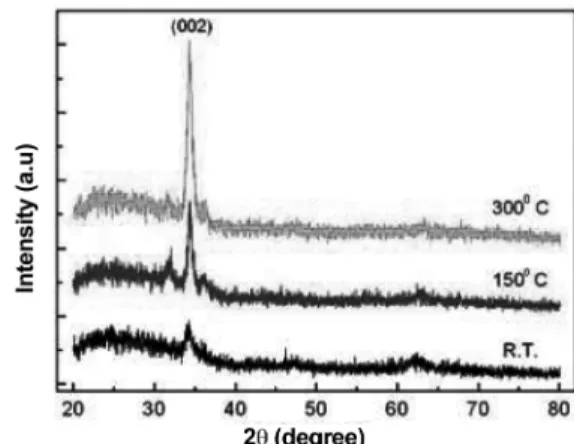
The crystal structure of the coatings was measured by XRD. Fig. 1 shows the XRD patterns of the sputtered ZnO coatings at different temperatures. To some degree, these patterns are similar to the XRD measurements of Al-doped ZnO coatings prepared by sputtering [8]. However, compared with the XRD pattern of ZnO coated by sol-gel method presented by Lin and Kim [7], the patterns are quite different. When the coatings
were deposited by sputtering, the XRD patterns of the coatings grown at three different temperatures had a distinct peak at 34.4o, which corresponds to the (002) diffraction of ZnO. Also, it showed that the intensity of (002) peak increased with increasing growth temperature. The increase in the intensity of (002) peaks was attributed to the increase in crystallinity. Compared with the sputtered ZnO coatings, the ZnO coating prepared by sol-gel method and annealed at 550oC showed three diffraction peaks in the XRD pattern. The three peaks appeared at 31.8o, 34.4o and 36.3o, which belongs to (100), (002) and (101) diffractions, respectively [7]. From the XRD patterns, it can be found that the sputtered ZnO coatings had a better crystal quality than the ZnO coating prepared by sol-gel method.
The surface morphology of the coatings was measured by an
Fig. 1. XRD patterns of sputtered ZnO coatings grown at room temperature (R.T.), 150oC and 300oC.
Fig. 2. AFM images of sputtered ZnO coatings grown at (a) room temperature, (b) 150oC, (c) 300oC, and (d) sol-gel ZnO coating annealed at 550oC.
Comparison of Tribological Characteristics of ZnO Coatings Prepared by Sputtering and Sol-gel Methods 25
AFM. Fig. 2 shows the AFM images of the coatings, which was acquired in the contact mode. The results of AFM measurement indicated that the grain size of the sputtered ZnO coatings increased with growth temperature. It was thought that the increase in grain size was due to the improvement of crystallinity. Also, the surface roughness of the coatings was obtained from AFM images. The root-mean-square (RMS) roughness was 2.4 nm, 4.2 nm, and 7.7 nm, for the sputtered ZnO coatings grown at room temperature, 150oC and 300oC, respectively. The RMS roughness of the ZnO coating prepared by sol-gel method was 4.5 nm. It could be found that the surface roughness of the sputtered coatings increased with growth temperature. Also, the surface roughness of the ZnO coating prepared by sol-gel method was within the range of the surface roughness values of the sputtered ZnO coatings. The alteration of the crystal structure and surface morphology resulted from the different processing conditions and methods. Although the electric and optical properties of the coatings have been widely studied for the coatings prepared by sputtering and sol-gel methods, the effects of the change in microstructure due to different processing conditions and methods on the tribological characteristics has not been reported in the past.
3.2. Friction and wear characteristics of the ZnO coatings The tribological characteristics of the ZnO coatings were evaluated by using a reciprocating type of micro-tribotester. A normal load of 50 mN was applied on the silicon nitride ball sliding against the ZnO coatings. Fig. 3 shows the friction coefficient of the ZnO sputtered coatings with respect to sliding cycles. The results show that the sputtered ZnO coatings grown at room temperature had the lowest friction coefficient (µ = 0.14). Also, it can be seen that the friction coefficient of the sputtered coatings increased with growth temperature. It was suggested that the increase in friction coefficient was attributed to the change in crystallinity and surface roughness. In comparison to the sputtered coatings, the friction coefficient of the ZnO coating prepared by sol-gel method and annealed at 550oC had a friction coefficient of
~0.45 [7]. Thus, the sputtered ZnO coating is superior in terms of friction coefficient compared with the ZnO coating prepared by sol-gel method. The variation of the frictional behaviors is attributed to the difference in the crystal structure and surface morphology of the coatings.
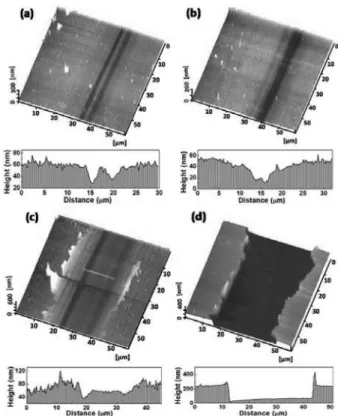
The wear characteristics of the ZnO coatings were characterized by an AFM. Fig. 4 shows the AFM images of the wear tracks that were formed after 10,000 sliding cycles under a 50 mN normal load. Also, the cross-sectional areas of the wear tracks shown in the figure were analyzed to quantify the wear loss. The calculated results showed that the wear rate of the sputtered ZnO coatings grown at room temperature, 150oC, and 300oC was 0.27, 0.35, and 0.4×10⁻¹⁰mm3/cycle, respectively. It was found that the sputtered ZnO coating grown at room temperature had a relatively higher wear resistance. However, the ZnO coating was completely worn out after 10,000 sliding cycles when the same wear test conditions were applied to the ZnO coating prepared by sol-gel method. The results suggested that sputtered ZnO coatings had superior wear resistance, compared with the ZnO coating prepared by sol-gel method.
Through the experimental investigation on the tribological characteristics of ZnO coatings prepared by sputtering and sol-gel methods, it was found that the sputtered ZnO coating exhibited superior tribological properties. From the view point of crystal structure and surface morphology, it is suggested that the transformation of coating microstructure may be controlled by different processing conditions and methods to improve the
Fig. 3. Friction coefficient of sputtered ZnO coatings grown at room temperature, 150oC, 300oC.
Fig. 4. AFM images of the wear tracks after 10,000 sliding cycles for the sputtered ZnO coatings grown at (a) room temperature, (b) 150oC, (c) 300oC and (d) sol-gel ZnO coatings annealed at 550oC.
26 Li-Yu Lin and Dae-Eun Kim
tribological properties. It has been reported that Al-doped ZnO coating grown by sputtering had a hardness of 7 GPa and the coatings grown at room temperature had a higher hardness than the coatings grown at higher temperatures. In contrast, the hardness of ZnO coatings prepared by sol-gel method that were grown on a Si substrate was reported to be only about 2.4 GPa [7]. Thus, it is postulated that the mechanical properties of the sputtered ZnO coatings are superior to that of the ZnO coatings prepared by sol-gel method, and the improvement in the mechanical properties has a significant contribution in increasing the wear resistance of the ZnO coating. Despite its relatively inferior tribological properties compared with the sputtered coatings, ZnO coatings prepared by sol-gel method offer the advantage of being cost effective and more accommodating to large surface area applications.
4. Conclusions
The tribological characteristics of ZnO coatings on a glass substrate prepared by sputtering and sol-gel methods were investigated. The growth temperature of the sputtered coatings was set to room temperature, 150oC, and 300oC. The ZnO coating prepared by sol-gel method was annealed at 550oC. The tribological experiments were conducted using a reciprocating type of micro-tribotester. It was found that the tribological properties of sputtered ZnO coatings were superior to that of ZnO coatings prepared by sol-gel method, and the sputtered ZnO coating grown at room temperature had a relatively low friction coefficient of 0.14 and higher wear resistance than the coatings grown at higher temperatures. Also, the crystal structure and surface morphology of ZnO coatings varied significantly for different processing conditions and methods.
Acknowledgement
This work was financially supported by the Ministry of Knowledge Economy of Korea (2008-N-PV08-P-06-0-000).
References
1. Murashita, T., Novel conductive transparent tip for low-temperature tunneling-electron luminescence microscopy using tip collection, J. Vac. Sci. Tech. B:, Vol. 15, No. 1, pp. 32-37, 1997.
2. Tatte, T., Avarmaa, T., Lohmus, R., Maeorg, U., Pistol, M. E., Raid, R., Sildos, I., Lohmus, A., Transparent and conductive Sb-doped tin oxide SPM tips prepared by sol-gel method, Mater. Sci. Eng. C:, Vol. 19, pp. 101-104, 2002.
3. Murashita, T., Conductive transparent fiber probes for shear-force atomic shear-force microscope, Ultramicroscopy, Vol. 106, pp. 146-151, 2006.
4. Jacobsen, V., Tatte, T., Bransheid, R, Maeorg, U., Saal, K., Kink, I., Lohmus, A., Kreiter, M., Electrically conductive and optically transparent Sb-doped SnO2 STM-probe for local
excitation of electroluminescence, Ultramicroscopy, Vol. 104, pp. 39-45, 2005.
5. Zabinski, J. S., Corneille, J., Prasad, S. V., Mcdevitt, N. T., Bultman, J. B., Lubricious zinc oxide film: synthesis, characterization and tribological behavior, J. Mater. Sci., Vol. 32, pp. 5313-5319, 1997.
6. Prasad, S. V., Walck, S. D., Zabinski, J. S., Microstructural evolution in lubricious ZnO films grown by pulsed laser deposition, Thin Solid Films, Vol. 360, pp. 107-117, 2000. 7. Lin, L. Y., Kim, D. E., Effect of annealing temperature on the
tribological behavior of ZnO films prepared by sol-gel method, Thin Solid Films, Vol. 517, pp. 1690-1700, 2009. 8. Lin, L. Y., Jeong, M. C., Kim, D. E., Myoung, J. M., Micro/
nanomechanical properties of aluminum-doped zinc oxide films prepared by radio frequency magnetron sputtering, Surf. Coat. Techn. Vol. 201, pp. 2547-2552, 2006.