J Korean Acad Community Health Nurs (지역사회간호학회지)
Vol. 29 No. 3, 300-309, September 2018 https://doi.org/10.12799/jkachn.2018.29.3.300
Effects of Intervention Using PARO on the Cognition, Emotion, Problem
Behavior, and Social Interaction of Elderly People with Dementia
Koh, In Soon
1· Kang, Hee Sun
21Assistant Professor, Department of Nursing, Andong Science of College, Andong 2Professor, Red Cross College of Nursing, Chung-Ang University, Seoul, Korea
Purpose: This study aims to investigate the effects of intervention using the therapeutic robot, PARO, on the cognition, emotion, problem behavior, and social interaction of elderly people with dementia. Methods: A nonequivalent control group pretest-posttest design was used. A total of 33 elderly people with dementia living in a nursing home facility participated in the study, with 17 in the experimental group and 16 in the control group. The intervention program with PARO was administered twice a week for 6 weeks, for a total of 12 sessions. Data were collected before and after intervention, using a questionnaire, direct observation, and video recording. Results: There were statistically significant differences in positive emotions and problem behaviors between the groups. The experimental group demonstrated a significant improvement in social interaction. Conclusion: PARO intervention can be utilized as an effective nursing intervention to increase positive emotions and social interaction, as well as decrease problem be-haviors, in elderly people with dementia living in nursing home facilities.
Key Words: Robotics; Dementia; Emotions; Problem behavior; Social behavior
Corresponding author: Koh, In Soon
Department of Nursing, Andong Science of College, 189 Seoseon-gil, Seohu-myeon, Andong 36616, Korea. Tel: +82-54-851-3762, Fax: +82-54-852-9907, E-mail: [email protected]
- This article is article is based on a part of the first author's doctoral thesis from University.
Received: Apr 4, 2018 / Revised: Jul 31, 2018 / Accepted: Jul 31, 2018
This is an open access article distributed under the terms of the Creative Commons Attribution Non-Commercial License (http://creativecommons.org/licenses/ by-nc/3.0), which permits unrestricted non-commercial use, distribution, and reproduction in any medium, provided the original work is properly cited.
INTRODUCTION
1. Background
As Korea has developed into an aging society, the num-ber of elderly people with dementia is increasing rapidly along with the increase of the elderly population. The prevalence of dementia in Korea was 10.2% in 2017, and the number of dementia patients is estimated to be ap-proximately 720,000[1]. The increase in the number of eld-erly people with dementia has led to social problems, such as a rise in the number of accidents involving people with dementia and an increase in their treatment costs. Demen-tia is characterized by progressive deterioration of cogni-tive functions such as memory, orientation, andjudgment. Elderly people with dementia have difficulty in forming relationships with others and experience serious emo-tional problems such as anxiety or depression [2]. Nega-tive emotions and a lack of social interaction in elderly
people with dementia cause problems behaviors [3], and their problem behaviors are a major factor in reducing the quality of life of caregivers, as well as the elderly people with dementia themselves [4]. According to the need-driv-en demneed-driv-entia-compromised behavior model (NDB model) proposed by Algase et al. [5], the problem behaviors of eld-erly people with dementia occur when their needs are not satisfied, and their cognitive function, emotions, and so-cial interactions influence the problem behaviors.
In order to improve the problem behaviors of elderly people with dementia, various intervention methods have been proposed and tried, and among them, animal-as-sisted therapy is effective in improving the cognitive func-tion, emotional stability, and sociality of elderly people with dementia through interactions with animals [6]. However, animal-assisted interventions using living ani-mals involve some problems, including allergic reactions to animal hair or fur, risk of infection, and animal-related accidents [7]. As an alternative to this method, pet-like
ro-bots based on the models of pets have been developed and utilized. A pet robot gives feelings of closeness to elderly people with dementia and is capable of verbal and non-verbal empathy and communication; the PARO robot de-veloped for psychotherapy is a representative example of therapeutic pet-like robots [8]. PARO responds by nod-ding its head, moving its arms, blinking its eyes, or pro-ducing the sounds of ‘ee-ying’ when a person is speaking to or touching it. It has been reported that a PARO robot with these functions has been effective in improving emo-tional stability, communication, and motivation in elderly people with dementia [9].
In a study of interventions using PARO for elderly peo-ple with dementia, interaction with PARO stimulated the cerebral cortical neurons of elderly people with dementia and helped to improve their brain activity [8]. Previous studies have also reported that activities involving phy-sical contact, such as stroking, touching, and hugging PARO, increased laughter, smiling, and speaking in eld-erly people with dementia [10,11]. Studies were mostly conducted with elderly people with severe dementia, and researchers reported that a 6-week PARO intervention conducted with groups of 3~6 people resulted in impro-vements in the mood and communication of elderly peo-ple with dementia [12], and that a 12-week PARO inter-vention decreased the levels of depression and problem behaviors in elderly people with dementia [13]. However, in studies conducted in Korea, PARO interventions were performed for elderly people with mild dementia for 6 weeks. As a result, speaking in elderly people with de-mentia increased, but the effects on mood state and prob-lem behaviors were not consistent [14,15]. In order to in-crease the effects of PARO interventions applied to elderly people with dementia, the use of small groups of three or fewer is recommended [12], suggesting that elderly people with dementia may be affected differently depending on their opportunity to interact with PARO. Despite the prev-alence of advanced dementia and a high prevprev-alence of emotional problems, such as depression, anxiety, and pro-blem behaviors, in elderly people living in long-term care facilities, there have been few studies on small-group ro-bot interventions for elderly people with severe dementia.
2. Purpose
The purpose of this study was to investigate the effects of the PARO intervention on cognitive function, emotion, problem behaviors and social interaction in elderly people with dementia. In this study, it was hypothesized that the PARO intervention would improve cognitive function,
emotion, and social interaction and reduce problem be-haviors in elderly people with dementia.
METHODS
1. Study Design
This is a nonequivalent control group pretest-posttested study to investigate the effects of the PARO intervention on cognitive function, emotion, problem behaviors and so-cial interactions in elderly people with dementia.
2. Participants
The participants of this study were people who were diagnosed with dementia among elderly people aged≥65 who were living in a long-term care facility located inJ city, Korea. Most of the elderly people in the institution were female. The inclusion criteria for the participants were as follows: people with no mental illness other than dementia, a Korean mini-mental state examination (MMSE-K) score of 10~19 points, and no marked physical limitations on performing the program activities, who voluntarily agreed to participate in the study and signed the informed consent form. After evaluating whether they met the inclusion cri-teria, a total of 38 participants were selected. As for the sample size, the minimum sample size was calculated based on the independent two-sample t-test using the G* Power 3.1 program. The sample size was calculated by us-ing a statistical power of .80, significance level of .05, and effect size of 1.0 (large effect size) based on a previous study of the PARO intervention program for elderly peo-ple with dementia [13]. As a result, the sampeo-ple size was de-termined to be at least 17 people per group and a total of 34 people. Finally, 38 people were initially selected in consid-eration of the drop-out rate and coding was carried out. Participants were randomly assigned to the experimental group (n=19) or control group (n=19) based on a coin toss performed by a research assistant. During the intervention process, one person refused to participate in the program and another withdrew due to disease exacerbation in the experimental group, and two people were transferred to other facilities and one person was admitted to the hospi-tal in the control group. Thus, a tohospi-tal of five people with-drew their participation in the study. Consequently, a total of 33 people divided into the experimental group (n=17) and control group (n=16) were included in the final analy-sis. The intervention in this study was conducted from August 29 to October 29, 2016.
3. Outcome Measures
The tools used in this study were used after obtaining approval from the developers of the original tools and the researchers who standardized the Korean translated ver-sions by e-mail.
1) Cognitive function
Cognitive function refers to intellectual abilities such as orientation, memory, attention, calculation, linguistic un-derstanding, andjudgment [16]. In this study, cognitive function was assessed using the MMSE-K developed by Kwon and Park [16], who translated, modified, and com-plemented the original tool to generate a tool that is suit-able for Korean elderly people and reflects education ex-perience. The inter-rater reliability of the MMSE-K was .99 [16]. The adjusted scores were obtained by adding a total of 4 points in people with no formal education, that is, by adding 1 point for time orientation, 2 points for attention and calculation, and 1 point for language function in case of no formal schooling. The total score is 30 points, and it is assumed that a score of 24 points or more indicates a nor-mal level of cognitive function, a score of 20~23 -points in-dicates “suspected cognitive impairment,” and a score of 19 points or less indicates “confirmed cognitive impair-ment.”
2) Emotion
Emotion is a response to stimulation including cogni-tion, behaviors, and feelings and refers to fear, anger, sad-ness, joy, acceptance, disgust, and surprise [17]. In this study, emotion was assessed using the Apparent Emotion Rating Instrument (AER) developed by Snyder et al.[18]. This tool consists of a total of six items, including three items concerned with positive emotions (pleasure, inter-est, and stability) and three items concerned with negative emotions (anger, anxiety, and depression). For each item, the response is marked as “1” if there is an item corre-sponding to the qualities of the respondent and “0” if not. In the case of each positive emotion item, 15 points are giv-en if the response is marked as “1,” but for each negative emotion, 15 points are given if the response is marked as “0;” thus, scores range from 0 to 90 points, with higher scores indicating higher levels of positive emotions. The inter-observer reliability of the original tool ranged from 82% to 100%, and the inter-observer reliability was 88.7% in this study.
3) Problem behaviors
Problem behaviors refer to inappropriate verbal, speech,
or behavioral acts not explained by the subject’s needs or confusion [21]. The level of problem behaviors was as-sessed using the Korean version of the Cohen-Mansfield Agitation Inventory (K-CMAI). This tool consists of a total of 21 items rated on a 7-point scale and includes items con-cerning physical aggressive, physical non-aggressive, ver-bal aggressive, and verver-bal non-aggressive behaviors (e.g. beating, cursing, or violent language). The scores ranged from 21 to 147 points, with higher scores indicating a high-er frequency of problem behaviors. Regarding the reli-ability of the tool, the Cronbach’s ⍺of the original tool ranged from .89 to .90, and Cronbach’s ⍺was .83 in this study.
4) Social interaction
Social interaction refers to the interaction between in-dividuals or groups of people who constitute a society and refers to verbal and nonverbal communication such as words, actions, facial expressions, and gestures [19]. In this study, we used the observation table developed by Wada et al.[20] to examine the reactions between elderly people with dementia and PARO. The table was composed of four domains, including facial expression (laughter and smil-ing), looking at PARO, talking to PARO, and interacting with PARO (i.e., physical contact). In this study, we re-corded videos of central activities among the program ac-tivities for 10 minutes, and split the video recordings into 20 second clips. Facial expression was then assessed by measuring the frequency of laughing or smiling, the gaze was assessed by the frequency of meeting the eyes of PARO or looking at it, speaking was assessed by the fre-quency of talking to PARO, and the interaction with PARO was measured by the frequency of stroking or touching PARO. The score for each domain ranged from 0 to 30 points, so the total scores obtained by summing the scores of the four domains ranged from 0 to 120 points, with higher scores indicating higher levels of social interaction. The interobserver reliability of the original tool was 69~ 100%, and the interobserver reliability of the tool used in this study was 93.6%.
4. Intervention
The PARO intervention is focused on strengthening the cognitive function of elderly people with dementia, en-hancing their emotional stability and social interaction, and reducing their problem behaviors by promoting inter-actions based on the formation of emotional closeness to PARO. The contents of the program are composed on the basis of the review of studies which measured the effects
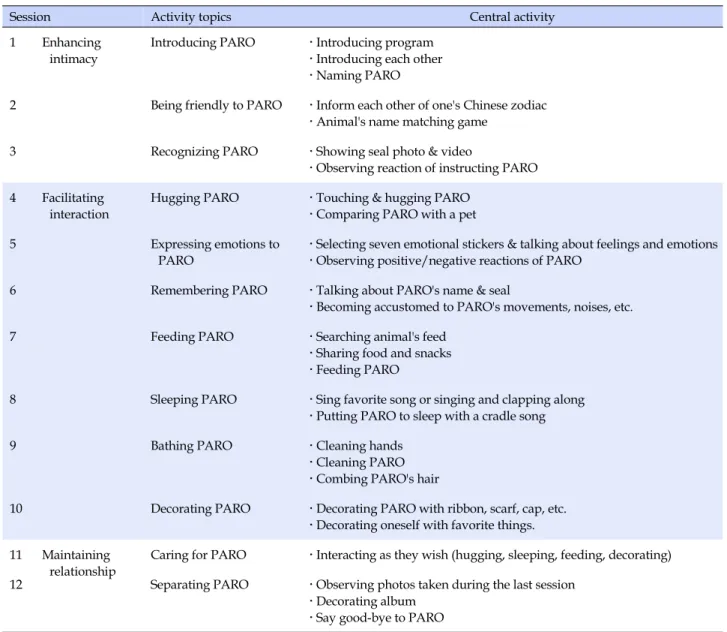
Table 1. PARO Robot Intervention
Session Activity topics Central activity
1 Enhancing intimacy
Introducing PARO Introducing program Introducing each other Naming PARO
2 Being friendly to PARO Inform each other of one's Chinese zodiac Animal's name matching game
3 Recognizing PARO Showing seal photo & video
Observing reaction of instructing PARO 4 Facilitating
interaction
Hugging PARO Touching & hugging PARO Comparing PARO with a pet
5 Expressing emotions to
PARO
Selecting seven emotional stickers & talking about feelings and emotions Observing positive/negative reactions of PARO
6 Remembering PARO Talking about PARO's name & seal
Becoming accustomed to PARO's movements, noises, etc.
7 Feeding PARO Searching animal's feed
Sharing food and snacks Feeding PARO
8 Sleeping PARO Sing favorite song or singing and clapping along Putting PARO to sleep with a cradle song
9 Bathing PARO Cleaning hands
Cleaning PARO Combing PARO's hair
10 Decorating PARO Decorating PARO with ribbon, scarf, cap, etc. Decorating oneself with favorite things. 11 Maintaining
relationship
Caring for PARO Interacting as they wish (hugging, sleeping, feeding, decorating) 12 Separating PARO Observing photos taken during the last session
Decorating album Say good-bye to PARO
of group-based PARO interventions on cognitive function, emotions, and problem behaviors in elderly people with dementia residing in facilities [11,13] and with reference to the PARO manual developed to increase interactions with PARO [23]. They were reviewed through consultation with a clinical expert, nursing professor, and physician special-izing in dementia in a long-term care facility. The PARO manual [23] provides effective examples of the first-time contact, interaction, and retrieval of the robot for the effec-tive application of PARO in an institution.
The contents of the program consisted of the intimacy formation stage (Sessions 1~3), interaction promotion stage (Sessions 4~10), and relationship maintenance stage (Ses-sions 11~12). The relationship formation stage is the step where there is the formation of the relationship with PARO,
the interaction promotion stage is the phase for active phy-sical contact with PARO, and the relationship maintenan-ce stage is the step for finishing the program. The specific contents of each stage are shown in Table 1.
In this study, the PARO intervention program con-sisted of a total of 12 sessions, and was conducted for 30 minutes per session in the afternoon on Monday and Fri-day every week for 6 weeks in a long-term care facility. The 6-week intervention period is sufficient time for social interactions to occur [11]. Each session lasted for 30 mi-nutes, selected based on the duration for which elderly people with dementia could participate in the program while maintaining concentration. The intervention period of this study was based on a previous study [13] in which the problem behaviors of older people with dementia
were reduced when a 6-week intervention consisting of 12 sessions was performed. In order to promote social inter-action, group activities are recommended rather than in-dividual activities. If the number of people in a group is large, participation time and degree of concentration are reduced, so activities conducted with small groups of 3 people or less are recommended [11,24]. Thus, in this stu-dy, each group consisted of three people, and a PARO ro-bot was used for each group. The program was conducted in a space that did not involve any disturbances from other people and was separated from the living facilities in or-der to prevent the dispersion of the experimental effect. With respect to the method by which the program was conducted, each session was composed of the introduc-tion, central activities, and closing stage. The facilitator en-couraged the participants to greet each other during the introductory session and repeatedly informed the partic-ipants of the date, day of the week, and season of the day during which the session was performed in order to im-prove the orientation of the elderly people with dementia. Through healthy hand-clapping activity, we tried to en-sure that the participants were relaxed and increase their concentration during the program activities. The central activity part of each session was the time during which the participants interacted directly with PARO. This activity was focused on leading the participants to have a con-tinuous interest in PARO, increasing their participation, and improving emotional stability and social interaction. The facilitator turned on PARO and placed it on the table for the participants to reach out and touch it. When PARO was handed to a participant, the facilitator asked the par-ticipant to gaze directly into the eyes of the robot, and pro-vided each participant with an opportunity to contact it individually in order to increase the interactions. When PARO was retrieved from the participants, the partici-pants were led to exchange goodbyes with PARO and then it was turned off and placed under the table. During the closing stage, the central activities of the day were sum-marized, opinions about them were exchanged briefly, goodbyes were said, and the session was finished.
5. Data Collection
Data collection was carried out after confirming the re-liability between the researcher and research assistant through a preliminary study. In order to increase the ob-jectivity of measurements, social interaction was meas-ured using video analysis. The data collection consisted of a questionnaire survey and video recording, and was con-ducted simultaneously from both the experimental and
control groups. The general characteristics, such as age, gender, educational level, religion, and period of resi-dence in the facility, were obtained by referring to the medical records. The data concerning cognitive functions were collected by the researcher before the start of the pro-gram and after its completion. The emotions were eval-uated independently by the researcher and trained re-search assistants by observing the participants before the start of the program and after its completion. Social inter-action was measured only in the experimental group. Using the videos of the participants recorded during the first and the last sessions of the program, the researcher and trained research assistants independently evaluated the interactions of the participants with the observation tables. Problem behaviors were measured before and after the program by the nurse in charge, who directly recorded the behaviors of the participants on the problem behavior checklist.
6. Ethical Considerations
To ensure the ethical protection of the participants, the study was conducted after obtaining approval from the IRB of C university in Seoul where the researcher belongs (IRB approval No.: 1041078-201607-HR-139-01). After ex-plaining the purpose and procedure of the research to the director of the institution where the intervention of this study was performed, we received their cooperation for conducting the study and approval for video recording. Considering that the participants are elderly people with dementia, we provided the participants and their guard-ians with explanations of the purpose, procedure, and pe-riod of study, and obtained informed consents.
7. Data Analysis
The data were statistically analyzed using the SPSS 21.0 program for Windows. The normality of the general char-acteristics and outcome variables was examined using the Kolmogorov-Smirnov test, and cognitive function, emo-tion, and problem behavior variables of the experimental group and the control group were normally distributed. Chi-square, Fisher’s exact, and independent t-tests were used to test for group differences in demographics and outcome variables before the intervention. To test the im-pact of the PARO intervention, between-group differences were analyzed using independent t-tests. The change in social interaction between pre- and post-intervention in the intervention group was analyzed using a paired t-test. A p-value of less than 0.05 was considered significant.
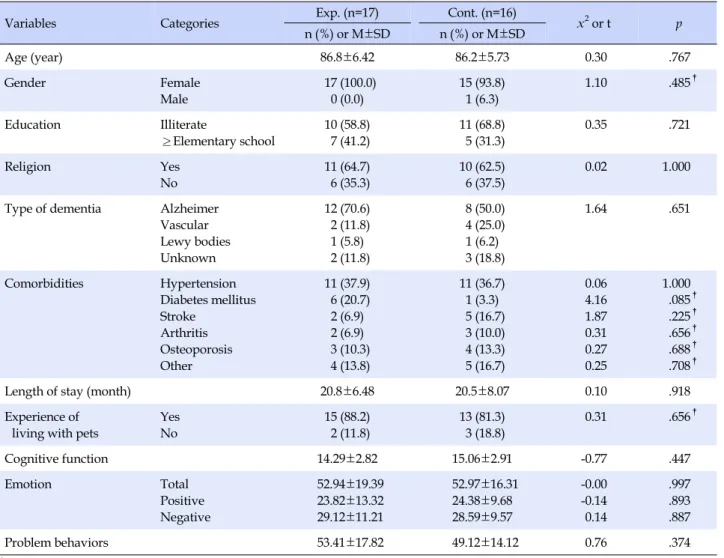
Table 2. Test of Homogeneity of General Characteristics and Outcome Variables (N=33)
Variables Categories Exp. (n=17) Cont. (n=16) x2 or t p
n (%) or M±SD n (%) or M±SD Age (year) 86.8±6.42 86.2±5.73 0.30 .767 Gender Female Male 17 (100.0) 0 (0.0) 15 (93.8) 1 (6.3) 1.10 .485† Education Illiterate ≥Elementary school 10 (58.8) 7 (41.2) 11 (68.8) 5 (31.3) 0.35 .721 Religion Yes No 11 (64.7) 6 (35.3) 10 (62.5) 6 (37.5) 0.02 1.000
Type of dementia Alzheimer Vascular Lewy bodies Unknown 12 (70.6) 2 (11.8) 1 (5.8) 2 (11.8) 8 (50.0) 4 (25.0) 1 (6.2) 3 (18.8) 1.64 .651 Comorbidities Hypertension Diabetes mellitus Stroke Arthritis Osteoporosis Other 11 (37.9) 6 (20.7) 2 (6.9) 2 (6.9) 3 (10.3) 4 (13.8) 11 (36.7) 1 (3.3) 5 (16.7) 3 (10.0) 4 (13.3) 5 (16.7) 0.06 4.16 1.87 0.31 0.27 0.25 1.000 .085† .225† .656† .688† .708†
Length of stay (month) 20.8±6.48 20.5±8.07 0.10 .918
Experience of living with pets
Yes No 15 (88.2) 2 (11.8) 13 (81.3) 3 (18.8) 0.31 .656† Cognitive function 14.29±2.82 15.06±2.91 -0.77 .447 Emotion Total Positive Negative 52.94±19.39 23.82±13.32 29.12±11.21 52.97±16.31 24.38±9.68 28.59±9.57 -0.00 -0.14 0.14 .997 .893 .887 Problem behaviors 53.41±17.82 49.12±14.12 0.76 .374 †
Fisher's exact test; Exp.=Experimental group; Cont.=Control group.
RESULTS
1. General Characteristics
The participants of this study consisted 33 elderly peo-ple with dementia, divided into the experimental group (n=17) and control group (n=16). The mean age was 86.8 ±6.42 years in the experimental group and 86.2±5.73 years in the control group; most of the participants were female. The most common type of dementia was Alzheimer-type dementia (70.6% in the experimental group and 50% in the control group). As a result of testing the homogeneity of general characteristics, there was no significant difference between the two groups in terms of sex, age, educational level, religion, dementia type, disease associated with de-mentia, period of residence in the facility, or experience of raising an animal. In addition, testing the homogeneity of the dependent variables between the two groups was
per-formed prior to the intervention, and there was no sig-nificant difference between the two groups in terms of cognitive function (t=-0.77, p=.447), emotion (t=-0.00, p= .997), or problem behaviors (t=0.76, p=.374) (Table 2).
2. Cognitive Function
The difference between pre- and post-intervention scores of cognitive function was 0.24±1.44 points in the experi-mental group and -0.50±1.15 points in the control group. The difference between the two groups was not significant (t=1.61, p=.117) (Table 3).
3. Emotion
The change in the total score for emotions before and af-ter the inaf-tervention was larger in the experimental group (7.50±11.56 points) than in the control group (1.41±7.85
Table 3. Effects of PARO Robot Intervention (N=33)
Variables
Exp. (n=17) Cont. (n=16)
t†(p)
Pre Post Difference
t†(p) Pre Post Difference t†(p)
M±SD M±SD M±SD M±SD M±SD M±SD Cognitive function 14.29±2.82 14.52±3.31 0.24±1.44 -0.68 (.509) 15.06±2.91 14.56±3.27 -0.50±1.15 1.73 (.104) 1.61 (.117) Emotion Total 52.94±19.39 60.44±19.39 7.50±11.56 -2.68 (.017) 52.97±16.31 54.38±14.36 1.41±7.85 -0.72 (.485) 1.76 (.088) Positive 23.82±13.32 31.32±13.58 7.50±11.25 -2.75 (.014) 24.38±9.68 25.78±10.94 1.40±3.02 -1.86 (.083) 2.10 (.044) Negative 29.12±11.21 29.12±7.90 0.00±5.92 0.00 (1.000) 28.59±9.57 28.59±7.36 0.00±7.75 0.00 (1.000) 0.00 (1.000) Problem behavior 53.41±17.82 50.59±17.15 -2.82±5.08 2.29 (.036) 49.13±14.12 52.38±13.30 3.25±5.16 -2.52 (.024) -3.40 (<.001) †
Paired t-test within group; ‡
t-test between groups; Exp.=Experimental group; Cont.=Control group.
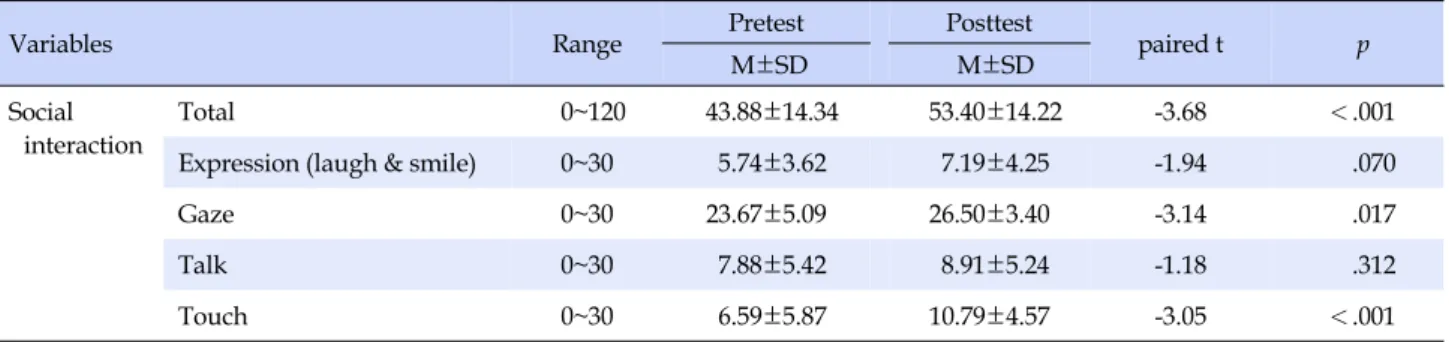
Table 4. Change in Social Interaction in Intervention Group (N=17)
Variables Range Pretest Posttest paired t p
M±SD M±SD
Social interaction
Total 0~120 43.88±14.34 53.40±14.22 -3.68 <.001
Expression (laugh & smile) 0~30 5.74±3.62 7.19±4.25 -1.94 .070
Gaze 0~30 23.67±5.09 26.50±3.40 -3.14 .017
Talk 0~30 7.88±5.42 8.91±5.24 -1.18 .312
Touch 0~30 6.59±5.87 10.79±4.57 -3.05 <.001
points), but the difference between the two groups was not significant (t=1.76, p=.088). The increase in the score for positive emotions was larger in the experimental group (7.50±11.25 points) than the control group (1.40±3.02 points), and the difference between the two groups was statistically significant (t=2.10, p=.044). In contrast, there was no change in the score for negative emotions in both the experimental group (0.00±5.92 points) and the control group (0.00±7.75 points), and there was no statistically significant difference between groups (t=0.00, p=1.000) (Table 3).
4. Problem Behaviors
The difference in the score for problem behaviors be-tween experimental group (-2.82±5.08 points) and the control group (3.25±5.16 points) was statistically signifi-cant (t=-3.40, p<.001) (Table 3).
5. Social Interaction
The total score for social interaction significantly in-creased from 43.88±14.34 points before intervention to 53.40±14.22 points after intervention (t=-3.68, p<.001). Regarding the subdomains of social interaction, there was no statistically significant difference between the pre- and
post-intervention measures of facial expression (t=-1.18,
p=.312) and talkng to PARO (t=-1.94, p=.070). In contrast,
the levels of looking at PARO (t=-3.14, p=.017) and inter-action with PARO (t=-3.05, p<.001) were statistically sig-nificantly increased (Table 4).
DISCUSSION
As a result of performing the PARO intervention in eld-erly people with dementia, there was no significant differ-ence between pre-intervention and post-intervention sco-res in cognitive function; however, the cognitive function of the elderly people with dementia who participated in the program did not decrease but was maintained at the same level as that before the intervention. Based on the re-sults of previous studies of elderly people with dementia interacting with PARO, EEG examination showed that cerebral cortical neuronal activity increased [8], and that elderly people with dementia could focus on participating in the program for longer [25]. It is believed that the PARO intervention can help maintain the cognitive function of elderly people with dementia. Therefore, if the cognitively stimulating activity is repeatedly performed by continu-ously providing the PARO robot intervention to elderly people with dementia, it is expected to help delay the
de-cline of cognitive function or maintain cognitive function. There was no significant difference in the level of emo-tions between the experimental group and control group, but the scores for positive emotions were higher after the intervention than before the intervention, and there were significant differences in this increase between groups. These results are in agreement with those of previous studies which reported that after the 6-week PARO inter-vention was conducted for elderly people with mild and severe dementia living in long-term care facilities, assess-ment of their mood state using the Face Scale showed an improvement in the mood of the elderly people with de-mentia, including more positive facial expressions [11,13]. In addition, the findings of this study are similar to the re-sults of another prior study which reported that 5-week PARO intervention conducted three times per week led to an increase of pleasure in elderly people with severe de-mentia [24]. In this regard, it has been previously observed that as elderly people with dementia interact with the PARO robot, they are reminded of their past pleasant ex-periences, express positive emotions, and as a result, feel better and more comfortable [10]. In light of these results, in this study, when elderly people with dementia living in long-term care facilities expressed positive emotions and shared pleasant emotions with other participants while they were participating in the PARO intervention pro-gram, the activities are thought to have helped increase positive emotions. In contrast, negative emotions were not significantly different between the two groups. This result is not consistent with the findings of a previous study [8] in which the scores for depression were reduced after 8 weeks when the PARO intervention was performed for elderly people with dementia living in long-term care facilities. However, the effect on depression was not ob-served in a study in which a silver care robot was utilized in elderly people with dementia residing in long-term care facilities for 5 weeks [26]. Compared with these studies, it seems that the 6-week intervention consisting of a total of 12 sessions performed in this study was not sufficient in its length and/or frequency to improve negative emotions such as depression and anxiety. As a result, it was found that the PARO intervention is more effective for increasing positive emotions than for decreasing negative emotions in elderly people with dementia living in long-term care facilities, so it can be considered as a useful method for im-proving the positive emotions of elderly people with de-mentia. However, because there was no significant differ-ence in the total score of emotions between the experi-mental group and control group, it is necessary to confirm the effects of the PARO intervention by strengthening the
activities of expressing and sharing good feelings in the fu-ture in the PARO robot intervention program and apply-ing a long-term PARO intervention.
The level of problem behaviors was lower after the in-tervention than before the inin-tervention, and the difference between groups was significant. This result is consistent with some previous studies that reported that the PARO intervention for elderly people with mild dementia duced problem behaviors such as aggressive behavior, re-petitive questions or requests, and complaints [13,27]. In order to reduce the problem behaviors of elderly people with dementia, sensory interventions, which provide psy-chological stability by stimulating various senses such as visual, tactile, and auditory senses, are effective [28]. In this regard, it is thought that PARO stimulates the audi-tory sense by producing crying sounds similar to those of a therapy dog, and the touch of the robot which feels pleas-ant because the soft hair and warm body temperatures help to stimulate the sensory function of elderly people with dementia, thereby decreasing their problem beha-viors. In addition, a prior study suggested that when eld-erly people with dementia interact with PARO, such inter-actions stimulate the frontal lobe, which is responsible for language and emotions, and thus lead to the improvement of mood and change in behavior in elderly people with dementia [29]. The findings of this study are believed to show that as elderly people with dementia talk to PARO while looking into its eyes and stroke and hug it, such be-haviors stimulate brain activity and induce emotional sta-bility, thereby leading to a decrease in problem behaviors. The scores for social interaction were significantly high-er in the last session than in the first session. This result is consistent with that in a previous study of a PARO inter-vention in elderly people with dementia in long-term care facilities that reported that as elderly people with de-mentia regarded PARO increasingly as a pet and inter-acted with it, their number of conversations with other elderly people in the facility or their caregivers increased [29]. In addition, there were changes in the behaviors of the participants where the participants who interacted with PARO served as role models for the other participants who were not interested in the robot; those who had been passive showed interest in PARO and talked with their colleagues [30]. In this study, the intervention program was performed by dividing the participants into small groups, and elderly people with dementia were allowed to perform physical contact activities such as holding, touch-ing, and stroking PARO, and were then provided with op-portunities to express their feelings in words. These activ-ities are thought to have been helpful in increasing their
social interaction.
With respect to the effects on each domain of social in-teraction, looking at and interacting with PARO signifi-cantly increased. When elderly people look at PARO, it is regarded as an act of expressing interest that PARO stim-ulates in elderly people with dementia and leads them to participate in the program [29]. Furthermore, physical contact activities such as touching and hugging PARO are effective in increasing social interaction. On the other hand, in this study, there was no significant difference in facial expressions or speaking to PARO. These results of this study are not consistent with some previous studies which reported that when PARO and a lion doll were used with elderly people with moderate or severe dementia for six months and the differences between the two groups were compared, speaking, as well as laughter and smiling, were significantly increased in the PARO intervention group [10], and that the application of the 12-week intervention led to an increase in laughter and smiling [9]. These incon-sistencies in study results may be interpreted in several ways. First, considering that long-term PARO interven-tion may be more effective than short-term interveninterven-tion for the improvement of changes in facial expression or speaking, the effects of long-term interventions need to be examined in future studies. In addition, elderly people with dementia characteristically often display a blank, ex-pressionless look, and rarely show clear changes in facial expressions, so it is difficult to observe their facial expres-sions or assess changes of them accurately. Therefore, it is thought that if emotional expressions expressing pleasure, activities of mimicking facial expressions, and game activ-ities for exchanging words are strengthened in the PARO interventions, it will help increase the changes in facial ex-pressions and/or speaking in elderly people with dementia.
CONCLUSION
The results of this study show that the PARO inter-vention is effective in increasing positive emotions and so-cial interaction and reducing problem behaviors in elderly people with dementia living in long-term care facilities. In other words, the PARO intervention can be used as an ad-junct method for nursing interventions for elderly people with dementia. Although the high cost of the product is a disadvantage, it is being used in many countries around the world, such asJapan, the USA, Sweden, Australia, and the Netherlands. This study is expected to contribute to the accumulation of nursing-related knowledge about the effects of the PARO intervention conducted in Korea. It was confirmed that the nursing intervention using PARO
is applicable in practice to elderly people with dementia. In order for these nursing interventions to be actively uti-lized, it is necessary to provide financial support to care fa-cilities for elderly people with dementia based on the gov-ernment’s policy.
Since this study was conducted with elderly people with dementia in a single long-term care facility, the study results should be generalized with caution. In addition, another limitation of this study is that the intervention program leading to the effect of social interaction was per-formed only in the experimental group. To improve the validity of the study results, further research needs to be conducted.
REFERENCES
1. National Institute of Dementia. 2017 National institute of Dementia Annual Report [Internet]. Gyeonggi: National Institute of Dementia. 2018 [cited 2018 March 5]. Available from: http://www.nid.or.kr/info/today_list.aspx
2. Moon SH, Hong GR. Predictors of depression among older adults in long-term care facilities. Journal Korean Gerontol-ogical Nursing Society. 2015;7(2):65-75.
https://doi.org/10.17079/jkgn.2015.17.2.65
3. Kang MG, Park HO, Park HJ. Factors affecting agitation in nursing home patients with dementia. Journal Korean Geron-tological Nursing Society. 2016;18(1):41-52.
https://doi.org/10.17079/jkgn.2016.18.1.41
4. Song JA, Park JW, Kim HJ. Impact of behavioral and psycho-logical symptoms of dementia on caregiver burden in nursing homes. Journal Korean Gerontological Nursing Society. 2013; 15(1):62-74.
5. Algase DL, Beck C, Kolanowski A, Whall A, Berent S, Richards K, et al. Need-driven dementia-compromised behavior: An al-ternative view of disruptive behavior. American Journal of Al-zheimer's Disease and Other Dementias. 1996;11(6):10-19. https://doi.org/10.1177%2F153331759601100603
6. Bernabei V, De Ronchi D, La Ferla T, Moretti F, Tonelli L, Ferrari B, et al. Animal-assisted interventions for elderly pa-tients affected by dementia or psychiatric disorders: A review. Journal of Psychiatric Research. 2013;47(6):762-773.
https://doi.org/10.1016/j.jpsychires.2012.12.014
7. Bert F, Gualano MR, Camussi E, Pieve G, Voglino G, Siliquini R. Animal assisted intervention: A systematic review of bene-fits and risks. European Journal of Integrative Medicine. 2016; 8(5):695-706. https://doi.org/10.1016/j.eujim.2016.05.005 8. Shibata T, Wada K. Robot therapy: A new approach for mental
healthcare of the elderly - a mini-review. Gerontology. 2010;57 (4):378-386. https://doi.org/10.1159/000319015
de-vice: Qualitative and quantitative evaluations of robot ther-apy in dementia care. Proceedings of the IEEE. 2012;100(8): 2527-2538. https://doi.org/10.1109/JPROC.2012.2200559 10. Jøranson N, Pedersen I, Rokstad AM, Aamodt G, Olsen C,
Ihlebæk C. Group activity with Paro in nursing homes: Sys-tematic investigation of behaviors in participants. International Psychogeriatrics. 2016;28(8):1345-1354.
https://doi.org/10.1017/S1041610216000120
11. Takayanagi K, Kirita T, Shibata T. Comparison of verbal and emotional responses of elderly people with mild/moderate dementia and those with severe dementia in responses to seal robot, PARO. Frontiers in Ageing Neuroscience. 2014;26(6): 257-262. https://doi.org/10.3389/fnagi.2014.00257
12. Yu R, Hui E, Lee J, Poon D, Ng A, Sit K, et al. Use of a ther-apeutic, socially assistive pet robot (PARO) in improving mood and stimulating social interaction and communication for peo-ple with dementia: Study protocol for a randomized controlled trial. Journal of Medical Internet Research Protocols. 2015;4(2): e45-e57. https://doi.org/10.2196/resprot.4189
13. Jøranson N, Pedersen I, Rokstad AMM, Ihlebæk C. Effects on symptoms of agitation and depression in persons with demen-tia participating in robot-assisted activity: A cluster-random-ized controlled trial. Journal of the American Medical Directors Association. 2015;16(10):867-873.
https://doi.org/10.1016/j.jamda.2015.05.002
14. Song JH. Effects of a robot pet-assisted program for elderly people with dementia. Journal of Korean Academy of Nursing. 2009;39(4):562-573.
https://doi.org/10.4040/jkan.2009.39.4.562
15. Lim NY, Kang HS, Park YS, An DH, Oh JH, Song JH. Cognitive function, mood, problematic behavior and response to inter-action with robot pet by elders with dementia. Journal of Ko-rean Academy of Fundamentals of Nursing. 2009;16(2):223-231. 16. Kwon YC, Park JH. Development of the test for the elderly-Korean version of Mini-Mental State Examination (MMSE-K). Journal of the Korean Neuropsychiatric Association. 1989;28(1): 125-135.
17. Plutchik R. A psychoevolutionary theory of emotions. Social Science Information. 1982;21(4):529-553.
https://doi.org/10.1177%2F053901882021004003
18. Snyder M, Ryden MB, Shaver P, Wang JJ, Savik K, Gross CR, et al. The apparent emotion rating instrument. Clinical Geron-tologist. 1998;18(4):17-29.
https://doi.org/10.1300/J018v18n04_03
19. Giddens A. The constitution of society: Outline of the theory of structuration. 1st ed. Los Angeles, USA: University of Califor-nia; 1984. 402 p.
20. Wada K, Ikeda Y, Inoue K, Uehara R. Development and
pre-liminary evaluation of a caregiver's manual for robot therapy using the therapeutic seal robot paro. 19th International Sym-posium in Robot and Human Interactive Communication. 2010. Sept 13-15; Viareggio, Italy. IEEE Xplore. 2010; 533-538. https://doi.org/10.1109/ROMAN.2010.5598615
21. Cohen-Mansfield J, Billig N. Agitated behaviors in the elderly: A conceptual review. Journal of the American Geriatrics Soci-ety. 1986;34(10):711-721.
22. Kim JL, Wang SG, Kim MG, Kim SY, Kim UJ. A standardiza-tional study for the Korean version of cohen-mansfield agi-tation inventory (K-CMAI). Journal of the Korean Society of Biological Therapies in Psychiatry. 2008;14(1):31-42.
23. Wada K, Inoue K. Caregiver’s Manual for robot Therapy: Prac-tical use of therapeutic seal robot Paro in elderly facilities. To-kyo: Japan. Tokyo Metropolitan University; 2010. 30 p. 24. Moyle W, Cooke M, Beattie E, Jones C, Klein B, Cook G, et al.
Exploring the effect of companion robots on emotional ex-pression in older adults with dementia: A pilot randomized controlled trial. Journal of Gerontological Nursing. 2013;39(5): 46-53. https://doi.org/10.3928/00989134-20130313-03 25. Chang W, Šabanovic S, Huber L. Use of seal-like robot PARO
in sensory group therapy for older adults with dementia. 8th ACM/IEEE International Conference on Human-Robot In-teraction. 2013 March 3-6; Tokyo, Japan. IEEE Xplore. 2013; 101-102. https://doi.org/10.1109/HRI.2013.6483521
26. Oh JH, Yi YJ, Shin CJ, Park CS, Kang SS, Kim JH, et al. Effects of silver-care-robot program on cognitive function, depression, and activities of daily living for institutionalized elderly peo-ple. Journal of Korean Academy of Nursing. 2015;45(3):388- 396. https://doi.org/10.4040/jkan.2015.45.3.388
27. Soler MV, Agüera-Ortiz L, Rodríguez JO, Rebolledo CM, Mu-ñoz AP, Pérez IR, et al. Social robots in advanced dementia. Frontiers in Aging Neuroscience. 2015;7:133.
https://doi.org/10.3389/fnagi.2015.00133
28. Livingston G, Kelly L, Lewis-Holmes E, Baio G, Morris S, Patel N, et al. Non-pharmacological interventions for agitation in dementia: Systematic review of randomised controlled trials. The British Journal of Psychiatry. 2014;205(6):436-442. https://doi.org/10.1192/bjp.bp.113.141119
29. Bemelmans R, Gelderblom GJ, Jonker P, de Witte L. How to use robot interventions in intramural psycho-geriatric care; A feasibility study. Applied Nursing Research. 2016;30:154-157. https://doi.org/10.1016/j.apnr.2015.07.003
30. Šabanović S, Chang W. Socializing robots: Constructing ro-botic sociality in the design and use of the assistive robot PARO. Journal of Knowledge, Culture and Communication. 2016;31(4):537-551.