11-2 / M. Schoeppler
IMID 2009 DIGEST • Abstract
After setting the gold standard for both industrial drop-on-demand inkjet printheads and R&D printers for functional materials printing, FUJIFILM Dimatix has developed a printhead with the highest jetting frequency ever obtained. Operating at 100 kHz, the MEMS fabricated SAMBA printhead expands the capabilities of fabrication methods for display applications.
1. Introduction
As an additive process, inkjets are enabling manufacturing processes that are cost effective and less wasteful than many standard subtractive processes. Digital materials deposition with inkjets has transformed the way displays are being built in Gen 8 manufacturing facilities [1]. FUJIFILM Dimatix piezoelectric drop-on-demand (DOD) inkjets have been integrated into equipment to increase manufacturing capabilities with concomitant reduction in manufacturing costs by increasing precision, reliability and volume control. These tools have demonstrated reliability and productivity in the manufacturing of color filters, PLED displays, organic TFTs, RFID components, touch screen displays and other emerging technologies [2, 3].
A successful printing system integrates fluids, maintenance, printheads, substrate handling, and processing with existing manufacturing equipment. However, technological breakthroughs for printheads are continuously required to accelerate the development of functional materials printing. Developed by FUJIFILM Dimatix and FUJIFILM Corporation, SAMBA™ printheads increase the speed of single pass printing without having to trade off print width, throughput or quality. In addition, FUJIFILM Dimatix has developed two new R&D printers to aid industrial and university laboratories in making breakthroughs in materials science for digital fabrication techniques using DOD printing. The
DMP-3000 is an inkjet deposition system that is capable of printing a wide range of functional fluids from both experimental cartridge-based printheads with small volumes and high performance printheads appropriate for industrial and high throughput applications. The Dimatix Experimental Printer (DXP) uses the high performance SAMBA printhead technology and has the accuracy, precision and resolution required for droplet deposition in the one picoliter range.
2. Results
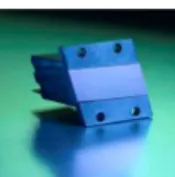
Developed cooperatively by FUJIFILM Dimatix and FUJIFILM Corporation, the new SAMBA inkjet technology utilizes Dimatix’s proprietary silicon MEMS fabrication method. SAMBA printhead modules are constructed from silicon and other robust materials and print a wide variety of inks in grayscale using VersaDrop™ multipulse jetting capability. The unique attributes of Shaped Piezo Silicon™ fabrication allow the printhead module’s drop volume to be the first ever sub one picoliter printhead. The first implementation of SAMBA inkjet technology is in a parallelogram shaped “printhead on a chip” that measures 45 mm deep and groups 2,048 inkjets per module at 1,200 dots per inch spacing. It pulses fluids at 100,000 cycles per second (100 kHz), the highest jetting frequency ever obtained. It is the first extensible piezoelectric DOD inkjet design that delivers wide-width, high resolution, and single pass printing without having to trade off print width, throughput or quality. A SAMBA printhead module is shown in Figure 1.
Figure 1. SAMBA printhead module. Single Pass Printing of Picoliter Droplets for Flexible
Display Applications
Martin Schoeppler
FUJIFILM Dimatix, Inc., Santa Clara, California 95050-2704 U.S.A. Tel.:1-408-565-9150, E-mail: [email protected] Keywords: inkjet, printer, printheads, display, manufacturing
11-2 / M. Schoeppler
• IMID 2009 DIGEST
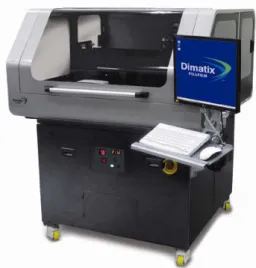
Distributed worldwide, the Dimatix Materials Printer (DMP) has been used by chemists, material scientists, fluid formulators and many other scientific sectors to evaluate whether they can transfer piezoelectric DOD inkjet printing of functional materials from the laboratory to a high throughput manufacturing process. However, while it has been beneficial to jump-start new projects at the academic setting, the DMP’s limited substrate size and limited fluid volumes have required us to develop a new Dimatix Materials Printer, the DMP-3000, which is shown in Figure 2.
Figure 2. Dimatix Materials Printer DMP-3000.
Successfully meeting major design specifications, the DMP-3000 is an inkjet deposition system that is capable of printing a wide range of functional fluids from both experimental cartridge-based printheads with small volumes and high performance printheads appropriate for industrial and high throughput applications. The printable area has been increased, and the positional accuracy and repeatability have been specified to ± 5 µm and ± 1 µm, respectively. The heated vacuum platen enables device printing on sheets of flexible materials such as PET and polyimide. There is an integrated drop visualization system that captures droplet formation images dynamically as droplet ejection parameters are established to produce a tuned printhead. Another camera system allows substrate measurements and alignment, dynamic observations of droplet drying behavior, and droplet measurement and placement calculations. Because we integrated both disposable cartridge printheads and high performance printheads in the same tool, translation from R&D to production can occur. Processing conditions and sample testing
are determined and devices are generated. These data can then be the basis for specifying a prototype printing system with production printing speeds. Because the SAMBA printhead technology is the first ever high frequency one picoliter capable printhead, it required us to develop the Dimatix Experimental Printer (DXP). This system is shown in Figure 3.
Figure 3. Dimatix Experimental Printer (DXP).
In vast contrast to the DMP, this inkjet printing engineering tool has the accuracy, precision and resolution requirements for droplet deposition in both the picoliter and sub-picoliter range. Desired feature sizes of 10 μm have driven the need for droplets in the sub one picoliter range; therefore, stage accuracy has become a critical component of droplet deposition. Each printhead has micro-adjusters for alignment within a micron to an adjacent printhead. The stage system is even more precise with mechanical and optical accuracy and includes dynamic feedback for positional verification. This entirely new architecture with granite structural components, air bearings, linear motors, Invar mounted encoders, and vibration isolation systems is the first printer that can meet this challenge. Evaluation of printhead performance including droplet formation and droplet trajectories is performed by high performance microscope grade optics and an image capturing system. A built-in microscope with multiple light sources obtains images of many different fluid and substrate combinations as well as droplet formation and image placement. Proprietary pattern recognition software measures a large number of images from both microscope systems and obtains data relevant to Six Sigma analyses. Coupled together, the SAMBA printhead technology and the highly accurate DXP allow the next generation tool for developing the most precise printing method of functional fluids for future deposition applications.
11-2 / M. Schoeppler
IMID 2009 DIGEST • 3. Conclusion
As a tool maker that develops both innovative inkjet technology and world-class fabrication tools for manufacturing processes, we have to develop tools that will then be adopted by display and printed electronics manufacturers. We do not know where scientists and engineers will push the envelope first. Driving droplet size down for inkjet printing allows DOD inkjet printing of interconnects, thin film phosphors, printable conductors, printable semiconductors and other organic and inorganic materials. Once these tools are implemented into research and manufacturing, the full impact will be realized.
4. References
1. C. Annis, “Exposure equipment trends in TFT-LCD manufacturing", Solid State Technology (2008). 2. B. R. T., D., Chalamala, "Big and bendable [flexible
plastic-based circuits]." Spectrum, IEEE, 42(9): 6 (2005).
3. J. C. Jinwoo Kim, Seungjun Chung, Jeonghun Kwak, Changhee Lee and Yongtaek Hong, "Inkjet-Printed Silver Gate Electrode and Organic Dielectric Materials for Bottom-Gate Pentacene Thin-Film Transistors." Journal of the Korean Physical Society,54(1): 4 (2009).