Anaplastic Thyroid Carcinoma Arising From a
Calcified Thyroid Mass
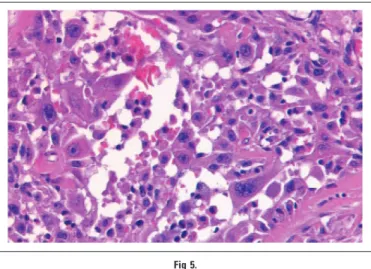
A 68-year-old female presented for follow-up of a dense cal-cified mass in the right thyroid with a 3-year history. An ultrasound (US) of the affected thyroid demonstrated a newly-developed hy-poechoic area (Fig 1, arrows) at the low portion of the calcified thyroid mass with multiple cervical lymphadenopathies (Fig 2) on the right side. Three years prior, a neck US incidentally detected a dense calcified mass in the right thyroid (Fig 3, arrows) without evidence of pathologic lymphadenopathy. At that time, the cyto-logic result of the calcified mass obtained using US-guided fine-needle aspiration biopsy was nondiagnostic. At the most recent follow-up, however, fine-needle aspiration biopsy of the newly-developed hypoechoic area revealed papillary carcinoma. Subse-quent total thyroidectomy with bilateral neck dissection was performed. The specimen was an ill-defined lesion showing thick irregular fibrosis (blue arrows) and calcifications (yellow arrows) with a conventional papillary carcinoma area (black arrows) and solid infiltrative area (Fig 4; ⫻12.5). The solid infiltrative area revealed highly atypical cells with polygonal or spindle and poly-morphic cytoplasm and bizarre nuclei with prominent eosino-philic nucleoli (Fig 5;⫻200), suggesting anaplastic transformation. After 3 months, the patient complained of palpable neck nodes. The patient underwent fluorodeoxyglucose positron emission to-mography/computed tomography to evaluate the metastasis. Mul-tiple hypermetabolic lesions were detected on the lungs, heart, neck, liver, and in the skeletal systems (Fig 6, arrows) on positron emission tomography/computed tomography. She died of an up-per respiratory infection 6 months after the oup-peration.
Though anaplastic thyroid carcinomas account for only 1.6% of primary malignant thyroid neoplasms,1they are the most aggressive
malignancies known and have a poor prognosis and clinical outcome.2-5An anaplastic thyroid carcinoma is usually fatal with a median survival of 3 to 9 months, and only 10% to 15% of patients survive 2 years. It is characterized by a rapid rate of local growth and a high propensity for metastasis at initial presentation and during its accelerated course.6The rapidly fatal disease course that is commonly observed in individuals diagnosed with anaplastic thyroid cancer is in dramatic contrast to the excellent prognosis of individuals diagnosed with differentiated thyroid cancer. An ana-plastic thyroid carcinoma may arise in some cases from pre-existing differentiated thyroid cancer.7Anaplastic transformation or the intratumoral evolution of anaplastic carcinoma from pre-existing differentiated thyroid cancer has become a well-accepted process, despite a limited understanding of its underlying mecha-nisms.4,6It can be considered a part of the natural history of an untreated differentiated thyroid carcinoma. Fine-needle aspiration
Fig 1.
Fig 2.
Fig 3.
J
OURNAL OF
C
LINICAL
O
NCOLOGY
D I A G N O S I S I N O N C O L O G YV O L U M E 2 6 䡠 N U M B E R 2 2 䡠 A U G U S T 1 2 0 0 8
3800 © 2008 by American Society of Clinical Oncology Journal of Clinical Oncology, Vol 26, No 22 (August 1), 2008: pp 3800-3807
2014 from 128.134.207.85
Information downloaded from jco.ascopubs.org and provided by at SWETS SUBSCRIPTION SERVICE on November 10, Copyright © 2008 American Society of Clinical Oncology. All rights reserved.
biopsy is the gold standard for diagnosis of a thyroid nodule. It has a sensitivity of 71% to 93% and a specificity of 96%.7,8However, FNAC has a false negative rate of 11% to 25%, and 5% to 30% of results were unsatisfactory or nondiagnostic.9,10In our case, the initial US-guided fine-needle aspiration biopsy revealed a nondi-agnostic result. The clinician opted for a strategy of only observing the mass until any change occurred. After 3 years of follow-up investigation, the radiologist found a new soft tissue portion at the inferior margin of the calcified mass. Finally, papillary carcinoma was confirmed when US-guided needle aspiration biopsy was per-formed by targeting the soft tissue component. Cytology of the newly-developed soft tissue area arising from the long-standing calcified mass was the key to diagnosis of this case. In our case, the dense calcified mass did not change for 3 years. Although the calcified thyroid mass was not confirmed as malignancy at the initial exam-ination, the mass might have been a well-differentiated papillary thyroid carcinoma. Anaplastic transformation, as a stage of thyroid tumorigenesis, may develop from this long-standing well-differentiated papillary carcinoma. In summary, an anaplastic thy-roid carcinoma is a rare but very aggressive malignancy, and it can evolve from a pre-existing well-differentiated papillary thyroid carcinoma as a coarse calcified mass. Therefore, when new soft tissue mass from a long-stable calcified thyroid mass is detected, a prompt cytologic examination should be performed.
Soo Jin Kim and Jin Young Kwak
Department of Radiology, Research Institute of Radiological Science, Yonsei University College of Medicine, Seoul, Korea
Soon Won Hong
Department of Pathology, Yonsei University College of Medicine, Seoul, Korea Eun-Kyung Kim, Min Jung Kim, Sung Hee Park, and Eun Ju Son
Department of Radiology, Research Institute of Radiological Science, Yonsei University College of Medicine, Seoul, Korea
Cheong Soo Park and Woong Youn Chung
Department of Surgery, Yonsei University College of Medicine, Seoul, Korea
AUTHORS’ DISCLOSURES OF POTENTIAL CONFLICTS OF INTEREST
The author(s) indicated no potential conflicts of interest.
REFERENCES
1. Gilliland FD, Hunt WD, Morris DM, et al: Prognostic factors for thyroid carcinoma: A population-based study of 15,698 cases from the Surveillance, Epidemiology and End Results (SEER) program, 1973-1991. Cancer 79:564-573, 1997
Fig 4.
Fig 5.
Fig 6. Diagnosis in Oncology
www.jco.org © 2008 by American Society of Clinical Oncology 3801
2014 from 128.134.207.85
Information downloaded from jco.ascopubs.org and provided by at SWETS SUBSCRIPTION SERVICE on November 10, Copyright © 2008 American Society of Clinical Oncology. All rights reserved.
2. McIver B, Haye ID, Giuffrida DF, et al: Anaplastic thyroid carcinoma: A 50-year experience at a single institution. Surgery 130:1028-1034, 2001
3. Ain KB: Anaplastic thyroid carcinoma: A therapeutic challenge. Semin Surg Oncol 16:64-69, 1999
4. Wiseman SM, Loree TR, Rigual NR, et al: Anaplastic transformation of thyroid cancer: Review of clinical, pathologic, and molecular evidence provides new insights into disease biology and future therapy. Head Neck 25:662-670, 2003
5. Ain KB: Anaplastic thyroid carcinoma: Behavior, biology, and therapeutic approaches. Thyroid 8:715-726, 1998
6. Segev DL, Umbricht C, Zeiger MA: Molecular pathogenesis of thyroid cancer. Surg Oncol 12:69-90, 2003
7. Seiberling KA, Dutra JC, Grant T, et al: Role of intrathyroidal calcifications detected on ultrasound as a marker of malignancy. Laryngoscope 114:1753-1757, 2004
8. Amrikachi M, Ramzy I, Rubenfeld S, et al: Accuracy of fine-needle aspiration of thyroid. Arch Pathol Lab Med 125:484-488, 2001
9. Khoo ML, Assa SL, Witterick IJ, et al: Thyroid calcification and its association with thyroid carcinoma. Head Neck 2002:651-655, 2002
10. Gharib H: Changing concepts in the diagnosis and management of thyroid nodules. Endocrinol Metab Clin North Am 8:377-383, 1997
DOI: 10.1200/JCO.2008.17.2122
■ ■ ■
Capecitabine-Induced Coronary Vasospasm
A 38-year-old woman with a history of hyperlipidemia and breast cancer was hospitalized after undergoing an exercise stress echocardiogram, which was markedly positive for ischemia. The patient reported a strong family history of premature coronary artery disease (CAD). She denied smoking and admitted to social use of alcohol. Five years before the current events, ductal carci-noma in situ was treated with lumpectomy, radiation therapy, and chemotherapy with cyclophosphamide, paclitaxel, and doxorubi-cin (a total dose of 240 mg/m2), which she tolerated without any apparent cardiac toxicity. Two months prior to the stress test, a recurrence of cancer in the lumpectomy bed was detected. She
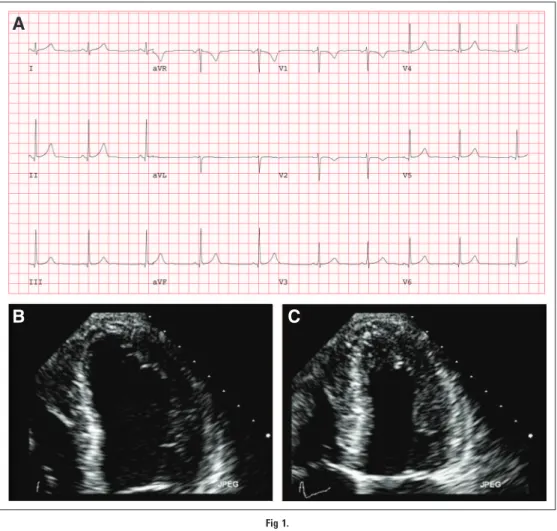
underwent bilateral mastectomy with reconstruction, and adju-vant oral capecitabine therapy was initiated at 3500 mg daily. A few days after beginning capecitabine, she noted dyspnea, lightheaded-ness, and palpitations with mild exertion, and was no longer able to tolerate her usual high-intensity workouts. She was referred for an echocardiographic stress test. Her resting electrocardiogram (ECG) was normal (Fig 1A). The resting ECG (Fig 1: Apical four-chamber view of the left ventricle; 1B, diastole; and 1C, systole) demonstrated normal cardiac function with left ventricular ejec-tion fracejec-tion of 64%. The patient exercised on a treadmill using the Bruce Protocol for 5 minutes and 18 seconds attaining a peak workload of seven metabolic equivalent units (METs). The heart rate quickly rose from 62 to 171 (93% predicted heart rate). She
A
B
C
Fig 1. Goldsmith et al
3802 © 2008 by American Society of Clinical Oncology JOURNAL OFCLINICALONCOLOGY
2014 from 128.134.207.85
Information downloaded from jco.ascopubs.org and provided by at SWETS SUBSCRIPTION SERVICE on November 10, Copyright © 2008 American Society of Clinical Oncology. All rights reserved.