P1-39 / F. Xu
IMID 2009 DIGEST •
Abstract
Novel compounds with rod and disc mesogens were synthesized and characterized. The molecular structures were confirmed by FT-IR, 1H-NMR spectroscopy and elemental analysis. The optical properties of these molecules were investigated by UV-vis absorption spectroscopy and photo-luminescence spectroscopy. We found that they are a novel series of blue light-emitting molecules. The absorption spectra peaks of these compounds varied from 336 nm-341 nm, while the maximum emissions centered form 410 nm-450 nm in chloroform solution. However, unexpectedly we could not found their biaxiality and mesomorphic properties by POM, conoscopy and DSC method.
1. Introduction
The liquid crystal state of matter has attracted a great deal of attention because of their structures and dynamic properties. Now liquid crystals have been a central part of our lives. For example, we are very familiar with varied products of liquid crystal displays. In 1970, the biaxial nematic (Nb) liquid crystal was predicted theoretically by M.J. Freiser. Many works have been done in order to synthesis Nb liquid crystals. Because scientist indicated that the rotation of the minor director (m) in the biaxial liquid crystals might be relatively faster than the major director (n) base on the IPS liquid crystal display mode. In 1991, Praefcke et al. proposed that motifs combining the features of rods and disks can form biaxial nematic liquid crystals. In our study, we also try to design and synthesis compounds combined with rod and disc mesogens.
2. Experimental
2.1. Measurements
IR and NMR spectra were obtained by using Jasco 300E FT/IR and Bruker DPX 200 MHz NMR spectrometers. The chemical shifts were reported in ppm units with tetramethylsilane (TMS) as internal standard. Elemental analysis was performed with a Thermofinnigan EA1108. The transition behaviors were characterized by differential scanning calorimetry (NETZSCH 200 F3) and polarizing microscopy (Zeiss, Jenapol). Optical texture observation was carried out using a polarizing microscope with a hot stage (Mettler FP82HT). UV-vis absorption spectra were reported on an OPTIZEN 3220UV spectrometer. Photoluminescence was measured by RF-5301PC spectrometer.
2.2. Synthesis
Three kinds of oxadizole derivatives named as OXDn (n=1, 2 and 3, the number of phenol groups in the central part) were synthesized. The synthetic route is shown in the scheme 1. Their chemical structures were confirmed by FT-IR, 1H-NMR spectroscopy and elemental analysis.
2.2.1. Ethyl 3,4,5-tris (dodecyloxy) benzoate (1) Anhydrous Na2CO3 (2.544 g, 24 mmol) and ethyl 3,4,5-trihydroxy benzoate (1.189 g, 6 mmol) were added to the mixture of DMF (40 mL) and 1- bromododecane (4.31 mL, 18 mmol) under nitrogen. The mixture was stirred at 80 ℃ for 6 h. The reaction mixture was cooled to room temperature. The resulting solution was poured into water. The precipitate was collected and dried under vacuum. The crude product was chromatographed on a silica gel column with chloroform as the eluent to afford
Synthesis and Properties of Biaxial LC from
Dumbbell-shaped Molecules
Fei Xu and E-Joon Choi
*Dept. of Polymer Science and Engineering, Kumoh National Institute of Technology, Gumi, Gyeongbuk, 730-701, Korea
Tel.:82-54-478-7684, E-mail: [email protected]
P1-39 / F. Xu
• IMID 2009 DIGEST
product 1. IR (KBr Pellet, cm-1): 3060 (sp2 C-H stretch), 2915, 2854 (sp3 C-H stretch), 1718 (Conj. C=O stretch), 1581, 1471 (Aromatic C=C stretch), 1330, 1108 (C-O stretch); 1H NMR (CDCl 3, δ in ppm): 7.22 (s, 2H, Ar-H), 4.31 (m, 2H, Ar-COOCH2CH3), 3.98 (t, 6H, Ar-OCH2CH2), 1.71 (m, 6H, Ar-OCH2CH2CH2), 1.33 (m, 6H, Ar-OCH2CH2(CH2)8 CH2CH3), 1.30 (t, 3H, Ar-COOCH2CH3), 1.29 (m, 48H, Ar-OCH2CH2(CH2)8CH2CH3), 0.85 (t, 9H, Ar-OCH2CH2(CH2)8CH2CH3). 2.2.2. 3,4,5-tris(dodecyloxy) benzohydrazide (2) Ethyl 3,4,5-tris(dodecyloxy)benzoate (1 g, 1.42 mmol) and excess hydrazine monohydrate in ethanol was refluxed for 40 h. The resulting solution was poured into water. The precipitate was collected and dried under vacuum. The crude product was recrystallized from ethanol/water to give pure product 2. IR (KBr Pellet, cm-1): 3319 (NH
2 stretch), 3297, 3243 (NH stretch), 3018 (sp2 C-H stretch), 2921, 2848 (sp3 C-H stretch), 1617 (Conj. C=O stretch), 1346, 1124 (C-O stretch); 1H NMR (CDCl 3, δ in ppm): 6.89 (s, 2H, Ar-H), 3.98 (t, 6H, Ar-OCH2CH2), 1.80 (m, 6H, Ar-OCH2CH2CH2), 1.33 (m, 6H, Ar-OCH2CH2(CH2)8CH2 CH3), 1.29 (m, 48H, Ar-OCH2CH2(CH2)8CH2CH3), 0.85 (t, 9H, Ar-OCH2CH2(CH2)8CH2CH3). 2.2.3. N'1,N'4-bis(3,4,5-tris(dodecyloxy)benzoyl)tere- phthalohydrazide (3-1)
At the atmosphere of nitrogen, terephthalic acid (1 g,
5.8 mmol) was added into SOCl2 and then added
pyridine into three neck flask. The reaction mixture was refluxed at 80 ℃ for 6 h. The reaction mixture
was cooled to 40 ℃ and SOCl2 was removed at the
vacuum state. DCM (30 mL) was added to dissolve the residue absolutely and then add 3,4,5-tris(dodecyloxy)-benzohydrazide (8.0 g, 11.6 mmol) and a little pyridine. The mixture was refluxed at
40 ℃ for 12 h. After cooling at room temperature, the resulting solution was poured into distilled water (500ml). The precipitate was collected and dried under vacuum. The crude product was recrystallized from ethanol to give pure product 3-1. IR (KBr Pellet, cm-1): 3172 (NH stretch), 3018 (sp2 C-H stretch), 2917, 2852 (sp3 C-H stretch), 1579 (Conj. C=O stretch), 1330, 1120 (C-Ostretch); 1H NMR (CDCl
3, δ in ppm): 8.00 (d, 4H, H), 7.01 (s, 4H, H), 3.95 (t, 12H, Ar-OCH2CH2), 1.71 (m, 12H, Ar-OCH2CH2CH2), 1.33 (m, 12H, Ar-OCH2CH2(CH2)8CH2CH3), 1.22 (m, 96H, Ar-OCH2CH2(CH2)8CH2CH3), 0.85 (t, 18H, Ar-OCH2 CH2(CH2)8CH2CH3). 2.2.4. 1,4-bis(5-(3,4,5-tris(dodecyloxy) phenyl)-1,3,4-oxadiazol-2-yl)benzene (OXD1)
The purified N'1,N'4-bis(3,4,5-tris(dodecyloxy) benzoyl)terephthalohydrazide was dissolved in
phosphorous oxychloride (POCl3) and refluxed for
about 40 h. Excess POCl3 was removed through
distillation and the residue was slowly added into ice water. After the removal of solvent under reduced pressure, the crude product was further purified through a column of silica gel using 2% ethyl acetate in chloroform as eluent to afford product OXD1. IR (KBr Pellet, cm-1): 3070 (sp2 C-H stretch), 2925, 2846 (sp3 C-H stretch), 1695 (C=N stretch), 1380, 1120 (C-O stretch); 1H NMR (CDCl
3, δ in ppm): 8.29 (d, 4H, Ar-H), 7.31 (s, 4H, Ar-H), 4.05 (t, 12H, Ar-OCH2CH2), 1.71 (m, 12H, Ar-OCH2CH2CH2), 1.33 (m, 12H, Ar-OCH2CH2(CH2)8CH2CH3), 1.22 (m, 96H, Ar-OCH2 CH2(CH2)8CH2CH3), 0.85 (t, 18H, Ar-OCH2CH2 (CH2)8CH2CH3).
Other compound 3-n and OXDn molecules were
synthesized with method same as compound 3-1 and OXD1. HO HO COC2H5 HO O C12H25O C12H25O COC2H5 C12H25O O K2CO3/ DMF NH2NH2 HOCO OCOH CHNHNC CNHNHC O O C12H25O OC12H25 OC12H25 OC12H25 C12H25O C12H25O C12H25O C12H25O CNHNH2 C12H25O O C12H25Br SOCl2 O O POCl3 N N O N N O OC12H25 OC12H25 C12H25O C12H25O C12H25O OC12H25 EtOH n n n 1 2 3-n OXDnn(n(n==11,, 2 2 anandd 33))
P1-39 / F. Xu
IMID 2009 DIGEST •
2.2.5. N'4,N'4'-bis(3,4,5-tris(dodecyloxy)benzoyl) biphenyl-4,4'-dicarbohydrazide (3-2)
Compound 3-2 was obtained as gray solid in 83% yield. IR (KBr Pellet, cm-1): 3180 (NH stretch), 3016 (sp2 C-H stretch), 2917, 2852 (sp3 C-H stretch), 1585 (Conj. C=O stretch), 1336, 1120 (C-O stretch); 1H NMR (CDCl3, δ in ppm): 8.26 (d, 4H, Ar-H), 7.80 (d, 4H, H), 7.32 (s, 4H, H), 4.05 (t, 12H, Ar-OCH2CH2), 1.73 (m, 12H, 12H, Ar-OCH2CH2CH2), 1.33 (m, 12H, Ar-OCH2CH2(CH2)8CH2CH3), 1.22 (m, 96H, Ar-OCH2CH2(CH2)8CH2CH3), 0.85 (t, 18H, Ar-OCH2CH2 (CH2)8CH2CH3). 2.2.6. 4,4'-bis(5-(3,4,5-tris(dodecyloxy)phenyl)-1,3,4-oxadiazol-2-yl)biphenyl (OXD2)
Compound OXD2 was obtained as yellow solid in
33% yield. IR (KBr Pellet, cm-1): 3093 (sp2 C-H stretch), 2917, 2852 (sp3 C-H stretch), 1589 (C=N stretch), 1324, 1118 (C-O stretch); 1H NMR (CDCl
3, δ in ppm): 8.25 (d, 4H, Ar-H), 7.80 (d, 4H, Ar-H), 7.32 (s, 4H, Ar-H), 4.05 (t, 12H, Ar-OCH2CH2), 1.71 (m, 12H, Ar-OCH2CH2CH2), 1.33 (m, 12H, Ar-OCH2CH2 (CH2)8CH2CH3), 1.22 (m, 96H, Ar-OCH2CH2(CH2)8 CH2CH3), 0.85 (t, 18H, Ar-OCH2CH2(CH2)8CH2CH3). Anal. Calcd. C: 77.57% H: 10.55% and N: 3.62%, and found C: 76.67% H: 10.88% and N: 3.57%.
2.2.7.N'4,N'4'' -bis(3,4,5-tris(dodecyloxy)benzoyl)p-terphenyl-4,4''-dicarbohydrazide (3-3)
Compound 3-3 was obtained as gray solid in 80% yield. IR (KBr Pellet, cm-1): 3178 (NH stretch), 3033 (sp2 C-H stretch), 2917, 2848 (sp3 C-H stretch), 1581 (Conj. C=O stretch), 1336, 1122 (C-O stretch); 1H NMR (CDCl3, δ in ppm): 7.93 (d, 4H, Ar-H), 7.70 (d, 4H, Ar-H), 7.65 (s, 4H, Ar-H), 7.07 (s, 4H, Ar-H), 3.95 (t, 12H, Ar-OCH2CH2), 1.71 (m, 12H, Ar-OCH2CH2 CH2), 1.33 (m, 12H, Ar-OCH2CH2(CH2)8CH2CH3), 1.22 (m, 96H, Ar-OCH2CH2(CH2)8CH2CH3), 0.85 (t, 18H, Ar-OCH2CH2 (CH2)8CH2CH3). 2.2.8. 4,4''-bis(5-(3,4,5-tris(dodecyloxy) phenyl)-1,3,4 -oxadiazol-2-yl)p-terphenyl (OXD3)
Compound OXD3 was obtained as yellow solid in
29.6% yield. IR (KBr Pellet, cm-1): 3033 (sp2 C-H stretch), 2917, 2848 (sp3 C-H stretch), 1606 (C=N stretch), 1324, 1120 (C-O stretch); 1H NMR (CDCl
3, δ in ppm): 8.20 (d, 4H, Ar-H), 7.83 (d, 4H, Ar-H), 7.77 (s, 4H, H), 7.32 (s, 4H, H), 4.00 (t, 12H, Ar-OCH2CH2), 1.71 (m, 12H, Ar-OCH2CH2CH2), 1.33 (m, 12H, Ar-OCH2CH2(CH2)8CH2CH3), 1.22 (m, 96H, Ar-OCH2CH2(CH2)8CH2CH3), 0.85 (t, 18H, Ar-OCH2CH2 (CH2)8CH2CH3). Anal. Calcd. C: 78.37% H: 10.30%
and N: 3.45%, and found C: 78.38% H: 10.55% and N: 3.46%.
3. Results and discussion
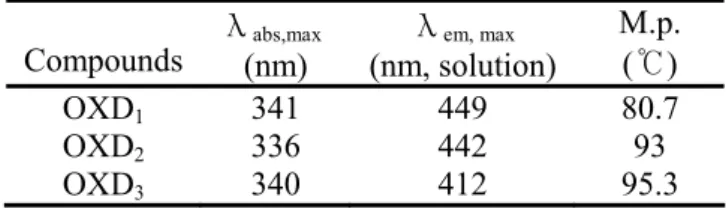
3.1. Thermal and optical propertiesWe have synthesized a novel series of dumbbell-shaped molecules. The UV-vis absorption maximum peaks and PL emission peaks are shown in the Fig.1 and Fig.2. From table 1 we can see that the PL emission peaks have a little blue shift and the melting temperature increased, as the length of the central part
increased. Compound OXD1 and OXD2 radiate blue
emission and OXD3 radiate purple emission in
chloroform solution as shown in Fig.2. At present, their electroluminescence properties are under investigated. Wavelength (nm) 260 280 300 320 340 360 380 400 Absor ban ce 0.0 .5 1.0 1.5 2.0 2.5 OXD1 OXD2 OXD3
Fig.1. UV-vis spectra of OXDn in CHCl3 solution.
Wavelength (nm) 350 400 450 500 550 600 In ten si ty -200 0 200 400 600 800 1000 1200 OXD1 OXD2 OXD3
P1-39 / F. Xu
• IMID 2009 DIGEST
TABLE 1. Optical absorption, emission in CHCl3
solution and melting point.
Compounds λ(nm)abs,max (nm, solution) λem, max
M.p. (℃) OXD1 341 449 80.7 OXD2 336 442 93 OXD3 340 412 95.3
4. Summary
A novel series of 1,3,4-oxadiazole derivatives were synthesized and their optical properties were investigated. Unexpectedly, these three compounds could not show liquid crystal phase in spite of the central units of these compounds are linear enough to form rigid mesogens. That is because of the existence of trialkoxy terminal groups. Instead, the UV-vis absorption maximum peaks (336 nm-341 nm) and PL emission peaks (410 nm-450 nm) have a little blue shift along with increasing the length of central
mesogen.
Acknowledgement
This work was supported by the Korea Science and Engineering Foundation (KOSEF) grant funded by the Korea government (MEST) (No. R01-2008-000-115 21-0).
5. References
1. M. J. Freiser, Phys. Rev. Lett., 24, p.1041(1970). 2. G. R. Luckhurst, Thin Solid Films, 40, p.393(2001). 3. T, Hatano and T. Kato, Tetrahedron, 64, p.8368
(2008).
4. S. Qu and M. Li, Tetrahedron, 63, p.12429 (2007). 5. D. W. Bruce, The Chemical Record, 4, p.10(2004). 6. N. A. Zafiropoulos, E. Choi, T. Dingemans, W. Lin,
and E. T. Samulski. Chem, Mater., 20[12], p.3821 (2008).