P2-3 / H. J. Lee
• IMID 2009 DIGEST
Abstract
A novel blue emitting Ca1-xMg2Si3O9:Eux phosphor was synthesized by the solid state reaction and its photoluminescence properties were optimized by controlling concentration of the activator contents and substituting concentration of Ca ion by Sr ion. The photoluminescence (PL) showed that this phosphor is efficiently excited by ultraviolet (UV)-visible light in the wavelength range from 200 to 410 nm. Also this phosphor emits intensely blue light with a broad peak at around 450 nm.
1. Introduction
White LED is highly expected as one of the most promising eco-friendly light sources, with much less CO2 gas exhaustion to save energy consumption than conventional light sources such as incandescent lamp. Phosphor is a main key material for LED to generate the next coming light source.
Europium activated silicates have been widely studied due to high chemical stability and various structures. Among them, calcium magnesium silicate (CMS) has been intensively studied because of long lasting phosphor and efficient phosphor that emits blue light by ultraviolet or vacuum ultraviolet (VUV) 1
. In this work, we prepared new stoichiometric of CMS system such as CaMg2Si3O8:Eu phosphor particles by solid state reaction. In order to enhance the excitation, emission property and color index to suitable for UV LED, europium concentrations were varied to optimize. Also substituting strontium by calcium element, it helps the particle to promote and lead to enhance the luminous property.
2. Experimental
The photo-luminescent phosphors were synthesized by using solid-state reaction method. Raw materials CaCO3 (99.9%, Aldrich), MgO (99.9%, Kojundo), SrCO3 (99.9%, Aldrich), SiO2 (99.9%, Aldrich), Eu2O3
(99.99%, Aldrich) were used. The synthesis processes are as follows. The mixture were weighed in the stoichiometric ratio and ground in mortar with acetone. After optimizing heat treatment temperature, the mixture was calcined at 1250℃ or 1300℃ for 4h in a reducing atmosphere. The final samples were washed in warm water to remove the residue from the reactants. The reaction time and temperature were optimized for maximum PL intensity.
3. Results and discussion
A novel blue emitting phosphor, (Ca,Sr)Mg2Si3O9:Eu
2+
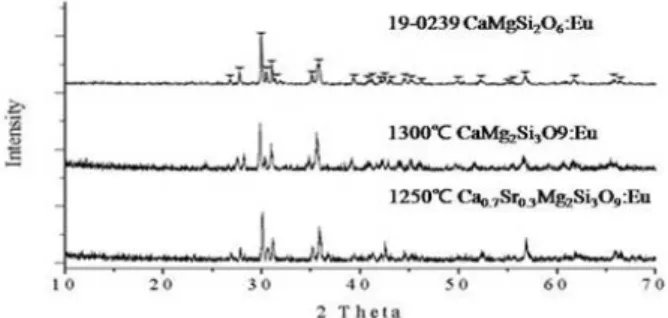
was prepared by the conventional solid state reaction at 1300℃, 1250℃ in reductive atmosphere. According to XRD analysis, CaMg2Si3O9:Eu
2+
or whether substituting Sr with Ca, both of them have similar XRD data of monoclinic structure CaMgSi2O6:Eu
2+
as shown in figure 1. In spite of the stoichiometic of Ca, Sr, Mg, Si and O are different, it shows that the crystal structure same.
Figure 1. X-ray diffraction patterns of the phosphors prepared with and without Sr element
The composition of (Ca,Sr)Mg2Si3O9 was confirmed by energy-dispersive X-ray spectroscopy (EDX). The Ca:Sr:Mg:Si ratios for products are approximately 0.7:0.3:2:3 that are correspond with the chemical
Optical Properties of blue emitting (Ca, Sr)Mg2Si3O9:Eu
2+phosphor
Hyun Ju Lee, Kyung Pil
and Jae Soo Yoo
School of Chemical Engineering and Materials Science, Chung-Ang University, Huksuk-Dong 221, Dongjak-gu, Seoul 156-756, Korea
Tel.:82-2-820-5274, E-mail: [email protected]
P2-3 / H. J. Lee
IMID 2009 DIGEST • formulae of Ca0.7Sr0.3Mg2Si3O9.
Figure 2. EDX analysis of (Ca,Sr)Mg2Si3O9:Eu2+
As exhibited on Fig.3, the photoluminescence spectra show that this phosphor is efficiently excited by UV-visible light and emits intensely blue light with broad peak at around 450 nm. No shift in the peak of each spectrum was observed with changing europium concentration. All the excitation spectra of CaMg2Si3O9:Eu have strong excitation bands of the Eu2+ 4f-5d transitions were observed from 250 to 410nm. We ascribe the excitation 200-450 nm to crystal field splitting of Eu2+ 4f7(8S7/2)-4f65d(7FJ) transition according to the assignment in other Eu2+ doping system2,3.
Figure 3. Relative Excitation (λem=450 nm) (a) and emission (λex=405 nm) (b) spectra of the CaMg2Si3O9:Eu phosphor prepared at 1300℃ for 4 h.
It was found that the luminous intensity and color of CaMg2Si3O9:Eu blue-emitting phosphors were improved when the appropriate amount of calcium ions was replaced by strontium ions. The luminescent properties of (Ca,Sr)Mg2Si3O9:Eu
2+
phosphor were optimized by changing europium content and the concentration of substituting strontium element with calcium element. The quenching concentration for CaMg2Si3O9:Eu
2+
was 0.03mol%. Figure 4 shows when substituting 0.3 mole Sr element with Ca element. Adding strontium enhanced the luminous intensity and excitation property. Also the particle size increased as substituting more strontium element.
Figure 4. Dependency of relative excitation (a) and emission (b) spectra on the amount of Sr elements substituted by Ca prepared at 1250℃ for 4hours
P2-3 / H. J. Lee
• IMID 2009 DIGEST
The highest luminescent intensity, which was obtained when the Eu2+ content (x) and the Sr substituting concentration (y) were 0.01 and 0.3, showed about 70% improvement compared with that of commercial Nichia BAM sample. As a result, the increase of the quenching concentration and substituting Sr element played key role in enhancing the luminescent intensity.
4. Summary
A novel new blue emitting phosphor, (Ca,Sr)Mg2Si3O9:Eu
2+
was synthesized. In order to enhance the luminous property of CMS phosphor, changing europium concentration and substituting Sr by Ca. The highest luminescent intensity of this blue phosphor had 170% compared to commercial BAM(BaMgAl10O17:Eu) with better excitation spectrum suitable for UV LED.
Acknowledgement
This work was partially supported by the IT R7D program of MKE
5. References
1. Z. Zhang and Y. Wang, J. Lumin., 128, p.383-386 (2008).
2. H. J. Kim and J. S. Im, SID’05 Technical Digest, Vol. 1, p.401 (2005).
3. K. Y. Jung, K. H. Han, Y. C. Kang and H. K. Jung, Mater. Chem. Phys., 98, pp330 (2006)