J. Korean Soc. Appl. Biol. Chem. 51(4), 334-337 (2008)
Short Communication
334
Bioactive Flavonoids from
Trapa
pseudoincisa
Myoung-Chong Song
1, Hye-Joung Yang
1,
Dae-Keun Kim
2, Tae-Sook Jeong
3,
Byoung-Mog Kwon
4, Jong-Pyung Kim
5,
Sang-Kyu Park
6, and Nam-In Baek
1,*
1Graduate School of Biotechnology and PlantMetabolism Research Center, Kyung Hee University, Suwon 446-701, Republic of Korea
2Department of Pharmacy, Woosuk University, Jeonju
565-701, Republic of Korea
3National Research Laboratory of Lipid Metabolism
and Atherosclerosis, 4Molecular Cancer Research
Center, and 5Laboratory of Antioxidant, Korea
Research Institute of Bioscience and Biotechnology, Daejon 305-333, Republic of Korea
6Department of Life Science, Ajou University, Suwon
443-749, Republic of Korea
Received April 7, 2008; Accepted September 2, 2008 Key words: ABTS, DPPH, FPTase, cell proliferation,
isoquercitrin, LDL-oxidation, naringenin, PRL-3, quercetin, quercitrin, superoxide, Trapa pseudoincisa
Trapa pseudoincisa Nakai (Hydrocaryaceae) is an
aquatic annual herb found in Korea, Japan, and China. T. pseudoincisa has been used for the remedy of several diseases including quadriplegia, diarrhea, and gastric ulcers [Jung and Shin, 1990]. Prior phytochemical and pharmacological studies reported some sterols as cytotoxic substances against ascites sarcoma [Irikura et al., 1972].
In addition, cis-hinokiresinol was reported as a scavenger of ABTS cation and superoxide anion radicals, and an inhibitor of LDL-oxidation, FPTase, PRL-3, and NO-production [Song et al., 2008]. The triterpenoids including cycloeucalenol, ursolic acid, and 2β,3α ,23-trihydroxyurs-12-en-28-oic acid in T. pseudoincisa have also been repoted [Song et al., 2007].
Herein, the isolation and identification of four flavonoids, naringenin (1), quercetin (2), quercitrin (3), and isoquercitrin (4), from T. pseudoincisa and their biological activities including scavenging activities for ABTS [Roberta et al., 1999], DPPH [Han et al., 2004], and superoxide radical [Yoo et al., 2006], and their inhibitory activities against FPTase [Kwon et al., 1997], LDL-oxidation [Ahn et al., 2001], and proliferation of HUVECs [Lee et al., 2006], are described.
The dried whole plant of T. pseudoincisa (1.1 kg) was extracted with 80% aqueous MeOH (2L×3), and evaporated
in vacuo. The extracts were successively partitioned with water (1 L), EtOAc (1 L×2), and n-BuOH (1 L×2). The TIE (30 g) was subjected to the SiO2 (500 g, 70-230
mesh, Merck, Darmstadt, Germany) cc (Φ 6×12cm) eluted with n-hexane-EtOAc [10:1→5:1→3:1→1:1, v/v, 300 mL each] and CHCl3-MeOH (10:1→7:1→5:1→3:1→
1:1, v/v, 300 mL each) to give twenty-four fractions (TIE1~TIE24). TIE13 [2.1 g, Ve/Vt 0.56-0.62] was chromatographed by ODS (50 g, 70-230 mesh, Merck) cc (Φ 3.5×10 cm, MeOH-water=1:1→3:1, v/v, 2,000 mL each) to give compound 1 (22 mg, Ve/Vt 0.13-0.15; SiO2
TLC Rf 0.3, CHCl3-MeOH=15:1). TIE15 (3.5 g, Ve/Vt
0.65-0.69) was applied to the SiO2 (75 g) cc (Φ 4.0×10
cm) eluted with CHCl3-MeOH (15:1, v/v, 3,200 mL) to
afford twelve fraction (TIE15-1~TIE15-12). TIE15-9 (0.3 g, Ve/Vt 0.61-0.73) was subjected by the SiO2 (25 g)
cc (Φ 3×7 cm) eluted with n-hexane-EtOAc (1:1, v/v, 2,000 mL) to give compound 2 (10 mg, Ve/Vt 0.15-0.19; ODS TLC Rf 0.7, MeOH-water=3:1). TIE21 (2.3 g, Ve/
Vt 0.91-0.94) was applied to the SiO2 (150 g) cc (Φ 4×12
cm) eluted with EtOAc-n-BuOH-water (15:1:0.5, v/v, 3,200 mL) to give compound 3 (1.2 g, Ve/Vt 0.24-0.45; SiO2 TLC Rf 0.4, CHCl3-MeOH-water=7:3:1). The TIB
(5.1 g) was subjected to the SiO2 (50 g, 70-230 mesh,
Meck) cc (Φ 3.5×10 cm) and eluted with EtOAc-n -BuOH-water (5:4:1, v/v, 4,000 mL) to give four fractions (TIB1~TIB4). TIB2 (2.6 g, Ve/Vt 0.22-0.54) was applied to the SiO2 (50 g) cc (Φ 3.5×10 cm) eluted with
EtOAc-n-BuOH-water (60:2:1, v/v, 3,150 mL) to give seven fraction (TIB2-1~TIB2-7). TIB2-2 (1.4 g, Ve/Vt 0.12-0.31) was applied to the SiO2 (50 g) cc (Φ 3.5×10 cm)
eluted with EtOAc-n-BuOH-water (60:2:1, v/v, 1900
*Corresponding author
Phone: +82-31-201-2661; Fax: +82-31-201-2157 E-mail: [email protected]
Abbreviations: ABTS,
2,2'-azinobis(3-ethylbenzthiazoline-6-sulfonic acid); BHA, butylated hydroxyanisole; bFGF, basic fibroblast growth factor; cc, column chromatography; DPPH, diphenylpicrylhydrazyl; FPTase, farnesyl protein transferase; HUVECs, hunan umbilical vein endothelial cells; LDL, low-den-sity lipoprotein; ODS, octadecyl silica gel; PRL-3, phosphatase of regenerating liver-3; TIB, n-butanol fraction; TIE, ethyl
ace-tate fraction; Ve/Vt, elution volume/total volume doi:10.3839/jksabc.2008.057
Bioactive Flavonoids from Trapa pseudoincisa 335
mL) to give six fraction (TIB2-1~TIB2-6). TIB2-2-3 (160 mg, Ve/Vt 0.22-0.45) was applied to the SiO2 (50 g)
cc (Φ 3.5×10 cm) eluted with CHCl3-MeOH-water
(10:3:1, lower layer of 1,400 mL) to produce compound 4 (49 mg, Ve/Vt 0.63-0.72; SiO2 TLC Rf 0.5, CHCl3
-MeOH-water=65:35:10) (Fig. 1).
Naringenin (1) Yellow powder (MeOH-H2O); [α]D
+15.8 (c 0.3, EtOH); EIMS m/z 272[M]+, 179, 166, 153, 124, 119, 107, 107, 91, 69; IR (KBr, ν) 3,250, 1,630, 1,605, 1,520, 1,500 cm−1; 1H-NMR (400 MHz, CD 3OD, δ) 7.30 (1H, d, J=8.0 Hz, H-2', 6'), 6.81 (1H, d, J=8.0 Hz, H-3', 5'), 5.89 (1H, s, H-6), 5.88 (1H, s, H-8), 5.32 (1H, dd, J=10.0, 2.8 Hz, H-2), 3.09 (1H, dd, J=16.8, 10.0 Hz, H-3a), 2.68 (1H, dd, J=16.8, 10.0 Hz, H-3b); 13C-NMR
(100 MHz, CD3OD, δ) Refer to Table 1.
Quercetin (2) Yellow powder (MeOH-H2O); EIMS m/
z 302[M]+, 301, 274, 273, 245, 153, 137, 109; IR (KBr, ν)
3380, 1669, 1614, 1512 cm−1; 1H-NMR (400 MHz,
CD3OD, δ) 7.73 (1H, d, J=2.0 Hz, H-2'), 7.63 (1H, dd,
J=8.6, 2.0 Hz, H-6'), 6.79 (1H, d, J=8.6 Hz, H-5'), 6.38 (1H, d, J=1.8 Hz, H-8), 6.18 (1H, d, J=1.8 Hz, H-6); 13
C-NMR (100 MHz, CD3OD, δ) Refer to Table 1.
Quercitrin (3) Yellow powder (MeOH-H2O); [α]D -178
(c 0.1, MeOH); FABMS m/z 449.2[M+H]+, 303.1[M-Rhm+1]+; IR (KBr, ν) 3228, 1655, 1614, 1549, 1449, 1176, 1086 cm−1; 1H-NMR (400 MHz, CD 3OD, δ) 7.25 (1H, d, J=2.0 Hz, H-2'), 7.21 (1H, dd, J=8.4, 2.0 Hz, H-6'), 6.86 (1H, d, J=8.4 Hz, H-5'), 6.28 (1H, d, J=2.0 Hz, H-8), 6.22 (1H, d, J=2.0 Hz, H-6), 5.26 (1H, d, J=2.0Hz, H-1''), 0.80 (3H, d, J=6.0 Hz, H-6''); 13C-NMR (100
MHz, CD3OD, δ) Refer to Table 1.
Isoquercitrin (4) Yellow powder (MeOH-H2O); [α]D
-12.5 (c 0.9, MeOH); FABMS m/z 465[M+H] +; IR (KBr, ν) 3300, 1650 cm−1; 1H-NMR (400 MHz, CD 3OD, δ) 7.56 (1H, dd, J=2.4, 8.4 Hz, H-6'), 7.70 (1H, d, J=1.6 Hz, H-2'), 6.89 (1H, d, J=8.4 Hz, H-5'), 6.33 (1H, d, J=1.6 Hz, H-8), 6.14 (1H, d, J=1.6 Hz, H-6), 5.24 (1H, d, J=7.2 Hz, H-1''); 13C-NMR (100 MHz, CD
3OD, δ) Refer to Table 1.
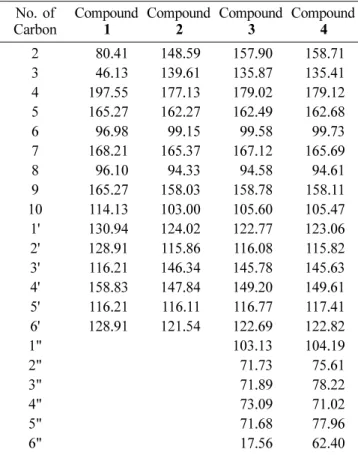
Structural identifications of these compounds were carried out by interpretation of several spectroscopic data and comparison with the data described in the literature. Compounds 1-4 were readily identified as naringenin (1) [Exarchou et al., 2003], quercetin, (2) [Jung et al., 2007],
quercetin 3-O-α-L-rhamnopyranoside (quercitrin, 3) [Jung
et al., 2007], and quercetin 3-O-β-D-glucopyranoside
(isoquercitrin, 4) [Han et al., 2004].
The inhibitory activities of compounds 2 and 3 on LDL-oxidation (IC50: 2, 30.1 mM; 3, 111.6 mM) was
almost ten times higher than that of probucol (IC50: 5.4
mM), a well known inhibitor that is much more potent than the other active components obtained from natural sources [Kim et al., 2005]. LDL-oxidation has been proposed as an important step in the formation of atherosclerotic lesions. Evidence to support this hypothesis is based in part on the observational studies that show associations between oxidized LDL cholesterol, as well as the presence of atherosclerotic lesions and the progression of carotid artery atherosclerosis.
Compounds 1-4 exhibited scavenging activity against
Fig. 1. Chemical structures of flavonoids from T. pseudoincisa.
Table 1. 13C-NMR data (100 MHz, δ
C) of compounds
1-4 from T. pseudoincisa in CD3OD
No. of
Carbon Compound 1 Compound 2 Compound 3 Compound 4
2 80.41 148.59 157.90 158.71 3 46.13 139.61 135.87 135.41 4 197.55 177.13 179.02 179.12 5 165.27 162.27 162.49 162.68 6 96.98 99.15 99.58 99.73 7 168.21 165.37 167.12 165.69 8 96.10 94.33 94.58 94.61 9 165.27 158.03 158.78 158.11 10 114.13 103.00 105.60 105.47 1' 130.94 124.02 122.77 123.06 2' 128.91 115.86 116.08 115.82 3' 116.21 146.34 145.78 145.63 4' 158.83 147.84 149.20 149.61 5' 116.21 116.11 116.77 117.41 6' 128.91 121.54 122.69 122.82 1" 103.13 104.19 2" 71.73 75.61 3" 71.89 78.22 4" 73.09 71.02 5" 71.68 77.96 6" 17.56 62.40
336 Myoung-Chong Song et al.
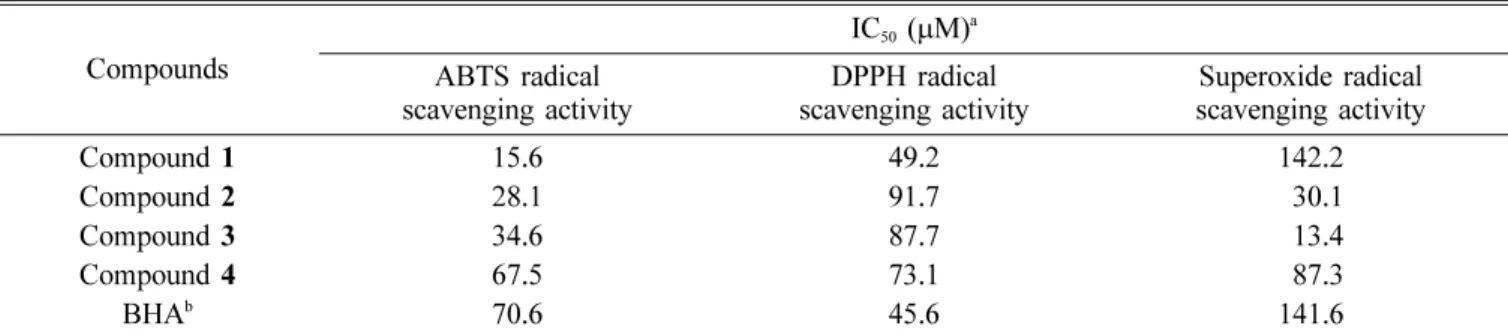
ABTS cation (IC50 values: 1, 15.6µM; 2, 28.1µM; 3,
34.6µM; 4, 67.5µM), DPPH (IC50 values: 1, 49.2µM; 2,
91.7µM; 3, 87.7µM; 4, 73.1µM), and superoxide anion radicals (IC50 values: 1, 142.2µM; 2, 30.1µM; 3, 13.4
µM; 4, 87.3µM). BHA, a well known antioxidant, was also evaluated as the positive control; IC50 values on the
ABTS cation, DPPH, and superoxide anion radicals were 70.6, 45.6, and 141.6µM, respectively. Compounds 1-3 showed higher scavenging activity on ABTS than BHA. In DPPH radical-scavenging activity, compound 1 was revealed to have almost the same level of activity as the positive control, and the compounds 2 and 3 exhibited significantly higher superoxide radical-scavenging activity than BHA. T. pseudoincisa has also been reported to show high scavenging activity against the DPPH free radical-generating system [Kim et al., 1997]. Thus, the four flavonoids could be principal contributors to the radical-scavenging activity of T. pseudoincisa.
The methanol extract of T. pseudoincisa strongly inhibited the activity of FPTase by 90% at 100µg/mL. Compounds 1 and 3 had IC50 of 70.2 and 117.2µM,
respectively. On the other hand, 2-hydoxycinnamaldehyde, a well known FPTase inhibitor, showed IC50 value of
172.3µM [Kwon et al., 1997], lower than those of compounds 1 and 3. Compounds 1 and 3 also exhibited PRL-3 inhibitory activity with IC50 values of 133.1 and
130.6µM, respectively, whereas some biflavonoids such as ginkgetin and sciadopitysin were reported to show inhibitory activity on PRL-3 with IC50 values of 25.8 and
46.2µM [Choi et al., 2006] (Table 2). In addition, compounds 1 and 3 showed more effective inhibitory activity against PRL-3 than ginkgetin and sciadopitysin. Therefore, compounds 1 and 3 may be useful lead compounds for the development of antitumor drugs through the control of FPTase and PRL-3-mediated signal pathways.
Though compound 3 did not show any significant cytotoxic effect on the non-stimulated HUVECs at 100
µg/mL, it inhibited the bFGF-induced endothelial proliferation by 80% at 25µg/mL. Compound 3 showing inhibitory activity on the proliferation of HUVECs without cytotoxicity could be a useful source in the development of drugs for the prevention and remedy of cancer.
In conclusion, four flavonoids, naringenin, quercetin, quecitrin, and isoquercitrin, were isolated from T. pseudoincisa, and their inhibitory activities, including scavenging activities on ABTS, DPPH, and superoxide anion radicals inhibitory activities against LDL-oxidation, FPTase, PRL-3, and proliferation of HUVECs, were evaluated for use as antioxidant, antiatherogenic, and anticancer materials.
Acknowledgments. This work was supported by the SRC program of MOST/KOSEF (R11-2000-081-03001-0) through the Plant Metabolism Research Center, Kyung Hee University and by the Basic Science Program of MOST/KOSEF (R11-2006-000-11096-0).
References
Ahn BT, Lee SK, Lee SB, Lee ES, Kim JG, Bok SH, and Jeong TS (2001) Low-density lipoprotein-antioxidant constituents of Saururus chinensis. J Nat Prod64, 1562-1564.
Choi SK, Oh HM, Lee SK, Jeong DG, Ryu SE, Son KH, Han DC, Sung ND, Baek NI, and Kwon BM (2006) Biflavonoids inhibited phosphatase of regenerating liver-3 (PRL-liver-3). Nat Prod Res 20, 341-346.
Exarchou V, Godejohann M, Beek TA, Gerothanassis IP, and Vercoort J (2003) LC-UV-solid-phase extraction-NMR-MS combined with a cryogenic flow probe and its application to the identification of compounds present in Greek oregano. Anal Chem75, 6288-6294.
Han JT, Bang MH, Chun OK, Kim DO, Lee CY, and Baek NI (2004) Flavonol glycosides from the aerial parts of Aceriphyllum rossii and their antioxidant activities. Arch
Table 2. Scavenging activities of compounds 1-4 from T. pseudoincisa and BHA
Compounds IC50 (µM)
a
ABTS radical
scavenging activity scavenging activityDPPH radical scavenging activitySuperoxide radical
Compound 1 15.6 49.2 142.2 Compound 2 28.1 91.7 030.1 Compound 3 34.6 87.7 013.4 Compound 4 67.5 73.1 087.3 BHAb 70.6 45.6 141.6 aIC
50 values indicate 50% inhibition concentration (mM), and were determined based on the regression lines at five different
concentrations.
Bioactive Flavonoids from Trapa pseudoincisa 337
Pharm Res 4, 390-395.
Irikura T, Masuzawa K, Tanaka N, Hasegawa Y, Kawasaki H (1972) Antitumor steroids from Trapa fruits. Jpn
Tokyo Koho JP 47041522 19721020 Showa, p 3.
Jung BS and Shin MK (1990) In ‘Hyang Yak Dae Sa Jun’, Young Lim Sa (3rd ed.), Seoul, Korea.
Jung SJ, Kim DH, Hong YH, Lee JH, Song HN, Rho YD, and Baek NI (2007) Flavonoids from the flower of Rhododendron yedoense var. poukhanense and their anti-oxidant activities. Arch Pharm Res30, 146-150.
Kim BJ, Kim JH, Kim HP, and Heo MY (1997) Biological screening of 100 plant extracts for cosmetic use (II): anti-oxidative activity and free radical scavenging activ-ity. Int J Cosmet Sci19, 299-307.
Kim DH, Lee HJ, Oh YJ, Kim MJ, Kim SH, Jeong TS, and Baek NI (2005) Iridoid glycosides isolated from Oldeni-andia diffusa inhibit LDL-oxidation. Arch Pharm Res
28, 1156-1160.
Kwon BM, Lee SH, Kim KS, Lee IR, Lee UC, Hong SH, and Bok SH (1997) Rhombenone: farnesyl transferase inhibitor from the leaves of Hedera rhombea Bean.
Bioorg Med Chem Letters7, 971-974.
Lee EO, Lee HJ, Hwang HS, Ahn KS, Chae C, Kang KS, Lu J, and Kim SH (2006) Potent inhibition of Lewis lung cancer growth by heyneanol A from the roots of Vitis amurensis through apoptotic and anti-angiogenic activities. Carcinogenesis27, 2059-2069.
Roberta RE, Pellegrini N, Proteggente A, Pannala A, Yang M, and Catherine RE (1999) Antioxidant activity apply-ing an improved ABTS radical cation decolorization Assay. Free Radic Biol Med 26,1231-1237.
Song MC, Yang HJ, Lee DY, Ahn EM, Kim DK, Kim JY, Chung DK, and Baek NI (2007) Triterpenoids from Trapa pseudoincisa. J Appl Biol Chem50, 259-263.
Song MC, Yang HJ, Han MW, Kim DK, Kwon BM, Lee KT, and Baek NI (2008) Inhibitory activities of cis -hinokiresinol from Trapa pseudoincisa on FPTase, PRL-3, and NO-production. J Appl Biol Chem51, in press.
Yoo NH, Kim JP, Yun BS, Ryoo IJ, Lee IK, Yoon ES, Koshino H, and Yoo ID (2006) Hirsutenols D, E and F, new sesquiterpenes from the culture broth of Stereum hirsutum. J Antibiot59, 110-113.