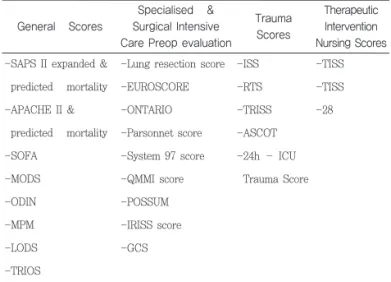
측정체계는 중환자실에 있는 환자들의 중증도를 평가하기 위 하여 개발되었다. 좋은 측정체계는 간단하고 신뢰할 수 있으며 사용자와 무관하게 구현이 쉽고 광범위한 환자에서 적용 가능하 여야 한다. 또한 치료에 비의존적이며 결과(outcome)를 향상시키 는 데에 기여할 수 있어야 한다. 이러한 측정체계의 개발은 전세 계적으로 환자에 따른 임상 결정을 내리는 가이드 라인을 발전시 키고 사망률을 예측해 볼 수 있다. 따라서 중환자 관련 분야 뿐 만 아니라 여러 분야에서 다양한 측정체계가 개발되어져 왔다 (Table 1).
1981년 APACHE (Acute Physiology and Chronic Health Evaluation) 측정체계가 개발된 이후1), 1984년에는 SAPS (Simplified Acute Physiology Score)2), 1985년 사망 확률 모델 (Mortality Probability Model)과 같은 다양한 측정체계가 도입되 었다3). 시간이 지남에 따라 이러한 모델들은 보정 (calibration)과 경신(update)을 반복하고 있다. 그 결과 가장 최근에 발표된 모 델은 2005년 출판 된 SAPS 3와 2006년 출판 된 APACHE IV 모델이다4-6).
윤소희, 박종국
제주대학교 의학전문대학원(Received December 10, 2014; Revised December 17, 2014; Accepted December 24, 2014)
ICU scoring system, SAPS 3
So Hui Yun, Jong Cook Park
Department of Anesthesiology and Pain Medicine, Jeju National University Hospital
The scoring systems used widely in the field of intensive care are prognostic models that estimate the in hospital mortality rate. Many clinicians utilize these systems to measure the severity of illness, predict patient prognosis, and gather information for clinical research. We introduce the SAPS (Simplified Acute Physiology Score) 3 system that one of these scoring system.(J Med Life Sci 2014;11(2):192-196)
Key Words
: scoring system, SAPS 3, predictive mortalityScoring Systems
Correspondence to : Jong Cook Park
Department of Anesthesiology and Pain Medicine, Jeju National University School of Medicine, Aran 13gil 15, Jeju-si, Jeju Special Self-governing Province, Republic of Korea, 690-767
E-mail : [email protected]
Abstract
Table 1. Classifying scoring systems.
General Scores
Specialised & Surgical Intensive Care Preop evaluation
Trauma Scores
Therapeutic Intervention Nursing Scores -SAPS II expanded &
predicted mortality -APACHE II & predicted mortality -SOFA -MODS -ODIN -MPM -LODS -TRIOS
SAPS : Simplified Acute Physiology Score
APACHE : Acute Physiology and Chronic Health Evaluation SOFA : Sequential Organ Failure Assessment
MODS : Multiple Organ Dysfunction Score ODIN : Organ Dysfunction and/or Infection MPM : Mortality Probability Model LODS : Logistic Organ Dysfunction System TRIOS : Three days recalibrated ICU Outcome Score
POSSUM : Physiologic & Operative Severity Score for the enumeration of Mortality & morbidity
ISS : Injury Severity Score RTS : Revised Trauma Score
-Lung resection score -EUROSCORE -ONTARIO -Parsonnet score -System 97 score -QMMI score -POSSUM -IRISS score -GCS -ISS -RTS -TRISS -ASCOT -24h – ICU Trauma Score -TISS -TISS -28
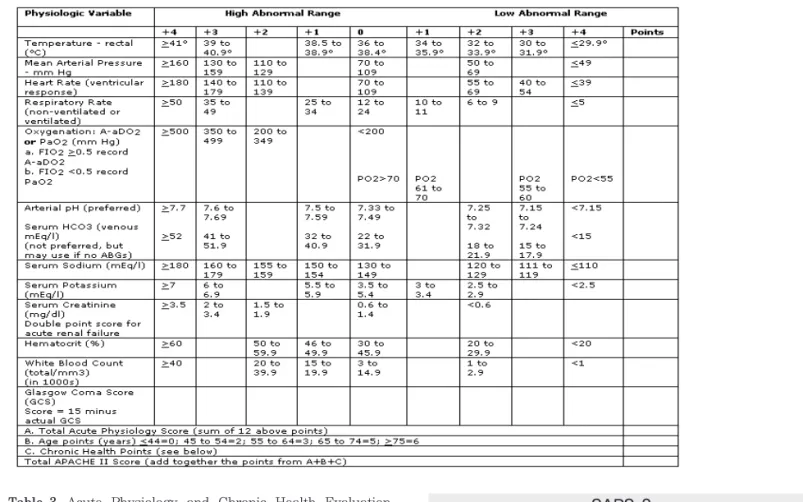
얼마 전까지만 하더라도 집중치료실에서는 이들 측정체계 중 APACHE II를 사용하여 환자의 사망률을 예측하고 질환의 중증 도를 측정하는 지표로 널리 사용하여 왔다. 이 모델은 약 20년 전 발표된 모델이지만 간단하고 사용하기에 접근성이 좋기 때문 에 여전히 많이 사용되고 있다7). 본 제주대학교병원에서도 2014 년 8월까지는 이러한 APACHE II 모델로 집중치료실 환자들의 예후를 측정해 왔다. APACHE II 점수는 세가지 요소로 구성되는데 첫째가 급성 생 리 점수 (Acute physiology score, APS)이다. 이 항목의 APACHE II 점수의 가장 많은 부분을 차지하는 구성 요소로 집 중치료실에 내원 후 24시간 이내에 측정한 12가지 임상 측정치 들로 이루어져 있다. 점수를 산정할 때는 시간 내의 가장 비정상
치를 수집한다. 구성 요소 중 둘째는 나이를 보정(age adjustment)하는 것으로 44세 이상의 환자에게 1-6점을 더한다. 마지막으로 만성 건강 평가(chronic health evaluation)로 심장, 폐, 신장, 간 및 면역체계에 만성 중증 기능 장애가 있는 환자의 경우에는 추가적인 보정을 한다(Table 2, 3). APACHE II에서 점 수 평가를 위하여 사용하는 로짓(logit)은 다음과 같다. 그러나 이러한 점수체계는 몇 가지 제한점이 있다. 급성 생리 점수는 심혈관계 약물, 기계호흡 및 해열 치료 사용 여부에 관계 없이 측정된 값이며 또한 고령에 대해서는 과도한 가중치를 부과 하였다. 만성적 건강 상태 평가에서 영양불량이나 악액질 (cachexia)에 대해 고려된 바도 없다8). 2014년 9월부터 12월까지 집중치료실 운영에 대한 평가 기간 에 속하게 된다. 이번 평가 항목 중 예측 사망률을 측정하는 기
APACHE II
Table 2. Acute Physiology and Chronic Health Evaluation (APACHE) II scoring system.
SAPS 3
Table 3. Acute Physiology and Chronic Health Evaluation
(APACHE) II score estimation.
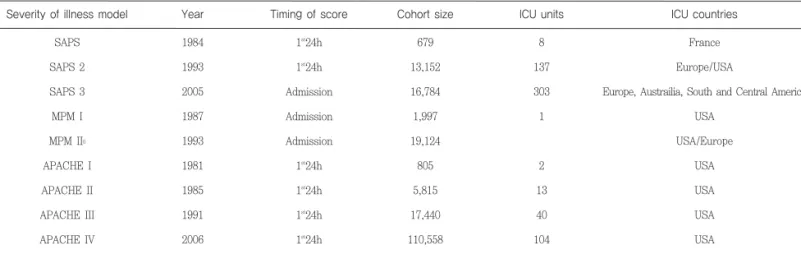
별에 유용한 것으로 알려진 바 있다. 전세계적으로 중환자실에서 이 모델을 사용한 결과 연구된 바로는 판별력(discrimination)은 좋으나 보정력(calibration)이 떨어지는 것으로 발표되고 있다9-13). SAPS 3에서는 전체 309개의 집중치료실 환자 22,791명을 대 상으로 하여 중복 입원환자 1,455명을 제외하고 16세 미만의 환 자 628명, 집중치료실 입·퇴원 데이터가 명확하지 않은 환자 1,074명과 결과가 기록되지 않은 환자 57명을 제외하여 기본 집중치료실 환자 총 16,784명을 포함시켰다. 참여 지역도 유럽 내로만 국한 시키지 않고 온라인을 통한 데이터 수집 체계를 구 축하여 호주, 중남미, 북미, 지중해 국가 등이 코호트 환자군에 포함되었다(Table 4).
개념적으로 SAPS 3 입원 점수(admission score)는 다음과 같 은 부분을 포함하여 세 영역의 점수를 산술 합으로 표현한다 (Table 5).
Table 4. Most common internationally recognized risk adjusted models for mortality prediction in intensive care unit.
Severity of illness model SAPS SAPS 2 SAPS 3 MPM I MPM II0 APACHE I APACHE II APACHE III APACHE IV Year 1984 1993 2005 1987 1993 1981 1985 1991 2006 Timing of score 1st24h 1st24h Admission Admission Admission 1st24h 1st24h 1st24h 1st24h Cohort size 679 13,152 16,784 1,997 19,124 805 5,815 17,440 110,558 ICU units 8 137 303 1 2 13 40 104 ICU countries France Europe/USA
Europe, Austrailia, South and Central America USA USA/Europe USA USA USA USA
Table 5. Simplified Acute Physiology Score (SAPS) 3 admission score.
Patient characteristics before admission Age
Length of stay before ICU admission Intra-hospital location before admission
Comorbidities
Use of therapeutic options before ICU adm.
Circumstances surrounding admission Planned or unplanned Reason for admission (diagnostic group)
Surgical status at ICU admission Anatomical site of surgery Acute infection at ICU admission
Acute physiological changes within 1 hours before or after admission
GCS Total bilirubin Body temperature Creatinine Heart rate Leukocytes pH Platelets Systolic blood pressure
1. 집중치료실 입원 전 알고 있었던 환자의 특성 : 나이, 이전 건강상태, 동반질환, 집중치료실 입원 전의 환 자 위치(응급실, 수술실, 병동, 다른 집중치료실 등), 병원 체류 기간 및 주로 사용한 치료 내용 2. 집중치료실 입원 당시의 상황 : 사유, 수술 부위의 해부학적 위치(해당하는 경우), 입원의 계획성 여부 및 감염과 수술 상태 3. 집중치료실 입원 당시(입원 1시간 전·후) 생리적 장애의 존재 및 그 정도 이후 통계 및 분석을 할 때에는 교차검증을 위하여 이전에 제 안된 것과 같이 무작위로 데이터베이스로부터 환자의 수에 따라 비슷한 사이즈의 다섯 가지 분야를 추출하고14) 모델의 복잡성을 감소시키기 위하여 로지스틱 회귀 분석을 사용하였다15). 원내 사 망률을 예측할 때에는 수축 파워 변환을 위하여 로그로 전환하여 사용하였다. SAPS 3 점수 평가를 위해 사용한 로짓과 예측사망 률은 다음과 같은 공식을 사용하였다. SAPS 3는 집중치료실의 평가에서 개별 환자를 평가해낼 수 있다. 그리하여 개별 환자 평가 시스템은 (1) 만성 건강 상태 및 이전 치료 (2) 중환자실 입원 관련 상황 (3) 생리적 기능 저하의 존재와 정도 등과 같이 예후의 상대적 기여도를 분리하여 구축한 다. 흥미로운 점은 입원 점수 첫째 항목인 집중치료실 입원 전에 알고 있던 환자의 정보로 전체 모델의 예측력 절반 이상이 달성 된다는 점이다. 예후 모델의 생리적 기능은 또한 22.5%는 중환 자실 입원 당시의 상황과 관련된 데이터인 둘째 항목을 사용하 여, 나머지 27.5%는 생리적 데이터의 복합인 셋째 항목으로 예 후 모델을 더욱 향상시킬 수 있다. 이러한 모델의 성능을 평가하기 위해서는 몇 가지 기준을 적 용하는데 전체 집중치료실 인구에서 퇴원 시 관찰/예측 사망률뿐 만 아니라 다른 환자 유형에 맞는 위험 조정 사망률을 이용한다. SAPS 3의 연구 결과는 세계의 지역에 따라 다른 관찰/예측 사망 률을 보였고 이는 다른 생활양식(예를 들어 비만, 술, 담배 등과 같은)이나 인구 구성에 따른 유전적 차이와 같은 지역별 변화사 항 또한 급성 의료 구조 및 조직과 관련하여 지속적으로 탐색되 어야 한다. SAPS 3는 데이터 수집을 집중치료실 입원 전·후 1시간으로 제한하여 대부분 입실 첫 24시간을 기준으로 데이터를 수집하는 다른 모델들과 차이가 있다16-18). ROC 곡선의 감소로 영향을 주 는 요인을 최소화 하고 집중치료실에서 발생하는 정확한 시간의 시켜 이에 대응하여 예측 사망률도 증가된 것처럼 보일 수 있음) 에 의해 영향을 받을 수 있는 이전 SAPS II나 APACHE II, III 같은 이전의 모든 체계와 비교하여 SAPS 3가 갖는 우월성이라 할 수 있다. 현재 본원에서 운영 중인 집중치료실은 크게 다섯 가지로 분 류해 볼 수 있다. 외과계 집중치료실, 내과계 집중치료실, 신생아 집중치료실, 심혈관계 집중치료실 및 뇌졸중 집중치료실이 운영 되고 있다. 각 집중치료실은 입실하는 환자군의 기준뿐만 아니라 질병의 심각도 및 침상 수도 서로 다르며 기대하는 역할도 다양 하다. 따라서 전체를 하나로 묶어서 타 병원이나 다른 나라의 평 균치와 비교하기에는 한계가 있다. 실제로 SAPS 3 모델 개발 당 시 시행한 자료 수집 및 분석 결과에서도 유럽 내에서도 각 세부 지역별로 질병의 심각도는 27~35점까지, 사망률은 거의 2배에 가까울 정도인 10.8~20.6%까지 다양할 정도로 비교가 어려웠다 고 발표하였다5). 앞으로 우리는 본원의 집중치료실 전체뿐만 아니라 각 세부 집중치료실에 따른 평가의 차이 및 다른 연구기관 들에서 발표한 내용과 비교하여 제주도 내의 환자군이 갖는 특성을 연구할 계획 이다. 이와 더불어 입원 당시의 점수체계에서 한발 더 나아가 SAPS 3에서 언급하고 있는 위험 조정 사망률에 영향을 줄 수 있는 집중치료실 입실 후 발생 요인에 대한 연구도 수행할 계획 이다.
1) Knaus WA, Zimmerman JE, Wagner DP, Draper EA, Lawrence DE. APACHE-acute physiology and chronic health evaluation: a physiologically based classification system. Crit Care Med. 1981;9(8):591-597.
2) Le Gall JR, Loirat P, Alperovitch A, et al. A simplified acute physiology score for ICU patients. Crit Care Med. 1984;12(11):975-977.
3) Lemeshow S, Teres D, Pastides H, Avrunin JS, Steingrub JS. A method for predicting survival and mortality of ICU patients using objectively derived weights. Crit Care Med. 1985;13(7):519-525.
4) Moreno RP, Metnitz PG, Almeida E, et al. SAPS 3--From evaluation of the patient to evaluation of the intensive care unit. Part 2: Development of a prognostic model for hospital mortality at ICU admission. Intensive
향후 계획
(APACHE) IV: hospital mortality assessment for today's critically ill patients. Crit Care Med. 2006;34(5):1297-1310.
7) Knaus WA, Draper EA, Wagner DP, Zimmerman JE. APACHE II: a severity of disease classification system. Crit Care Med. 1985;13(10):818-829.
8) Marino PL, ed The ICU Book. 3rd ed. Lippincott Williams & Wilkins2007.
9) Costa e Silva VT, de Castro I, Liaño F, Muriel A, Rodríguez-Palomares JR, Yu L. Performance of the third-generation models of severity scoring systems (APACHE IV, SAPS 3 and MPM-III) in acute kidney injury critically ill patients. Nephrol Dial Transplant. 2011;26(12):3894-3901.
10) Soares M, Silva UV, Teles JM, et al. Validation of four prognostic scores in patients with cancer admitted to Brazilian intensive care units: results from a prospective multicenter study. Intensive Care Med. 2010;36(7):1188-1195.
11) Khwannimit B, Bhurayanontachai R. The performance and customization of SAPS 3 admission score in a Thai medical intensive care unit. Intensive Care Med. 2010;36(2):342-346.
care unit. Br J Anaesth. 2008;101(6):798-803.
13) Lee H, Shon YJ, Kim H, Paik H, Park HP. Validation of the APACHE IV model and its comparison with the APACHE II, SAPS 3, and Korean SAPS 3 models for the prediction of hospital mortality in a Korean surgical intensive care unit. Korean journal of anesthesiology. 2014;67(2):115-122.
14) Hastie T TR, Friedman J, ed The elements of statistical learning: data mining, inference, and predition: Springer, Berlin Heidelberg New York; 2001.
15) Bauder P PB, Hackl P. Model selection by multiple test procedures. Statistics. 1988:19:39-44.
16) Bosman RJ, Oudemane van Straaten HM, Zandstra DF. The use of intensive care information systems alters outcome prediction. Intensive Care Med. Sep 1998;24(9):953-958.
17) Suistomaa M, Kari A, Ruokonen E, Takala J. Sampling rate causes bias in APACHE II and SAPS II scores. Intensive Care Med. Dec 2000;26(12):1773-1778.
18) Boyd O, Grounds M. Can standardized mortality ratio be used to compare quality of intensive care unit performance? Crit Care Med. Oct 1994;22(10):1706-1709.