2012 년도 한국멀티미디어학회 춘계학술발표대회 논문집 제 15 권 1 호
- 89 -
Survey on the Authentication and Key Management of 802.11s
Jun Huy Lam*, Sang-Gon Lee* � , Whye Kit Tan**Division of Computer & Information Engineering, Dongseo Univerisity � Corresponding Author
e-mail : [email protected], [email protected], [email protected] Abstract
Wireless Mesh Network expanded the capability of the conventional wireless networking by allowing the nodes to operate in proactive mode, reactive mode or the combination of both, the hybrid mode in the multi-hopping nature. By doing so, the links between the nodes become much more robust and reliable because of the number of paths to reach a destination node from a source node can be more than 1 and do not need to rely on the access point (AP) alone to relay the messages. As there may be many possible ways to form an end-to-end link between 2 nodes, the routing security becomes another main concern of the 802.11s protocol. Besides its reliance on the 802.11i for the security measures, 802.11s also includes some new features such as the Mesh Temporal Key (MTK) and the Simultaneous Authentication of Equals (SAE). The authentication and key management (AKM) process of 802.11s were observed in this paper.
1. Introduction
Wireless Mesh Network expanded the capability of the conventional wireless networking by allowing the nodes to operate in proactive mode, reactive mode or the combination of both, the hybrid mode in the multi-hopping nature. By doing so, the links between the nodes become much more robust and reliable because of the number of paths to reach a destination node from a source node can be more than 1 and do not need to rely on the access point (AP) alone to relay the messages. As there may be many possible ways to form an end-to-end link between 2 nodes, the routing security becomes another main concern of the 802.11s protocol.
Hence, a study was done on the security features of the 802.11s, such as the procedures and method used to authenticate the nodes as well as the generation and distribution of the keys. The security features of 802.11i which were used in Wi-Fi were inherited in 802.11s.
Besides its reliance on the 802.11i for the security measures [1], 802.11s also includes some new features in order to protect the end-to-end communication between the 2 nodes with the help of the Mesh Temporal Key (MTK) which is derived from the Authenticated Mesh Peering Exchange (AMPE) [2]. The Simultaneous Authentication of Equals (SAE) [2] is added to 802.11s to allow the mutual authentication in the case of the reactive mode link establishment in which the authentication server does not present.
The remainder of the paper is organized as follow. Section 2 explains the overview of the authentication and key management process of 802.11s. Section 3 describes the authentication methods of 802.11s. Section 4 emphasizes on the key management of 802.11s and the paper ends with the conclusion in Section 5.
2. Overview of the Authentication and Key Management (AKM) process of 802.11s
The authentication and key management (AKM) process starts when the nodes are able to detect each other’s presence. Once the nodes detected each other, they will decide on the authentication method used in order to establish the authentication process. Open authentication method can be used but the security level of this authentication method is very weak as the Pre-Shared Key (PSK) is vulnerable to a
number of attacks if it does not go through a complex processing before using it directly.
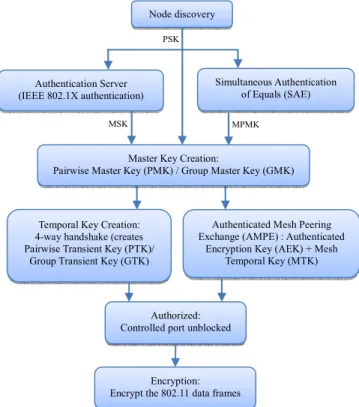
In the case of wireless mesh network, there are 2 authentication methods that can be choose from to process the PSK into a secure key, they are the Authentication Server (IEEE 802.1X) authentication or the Simultaneous Authentication of Equals (SAE) [2]. However, SAE is preferred in order to build a robust wireless mesh network because it does not require an external authentication server and hence the flexibility of SAE protocol allows any node to initiate or respond to any link formation request as long as they possess the password. This allows the authentication to be done even when the nodes operate in the reactive mode. The overview of the AKM process is shown in Figure 1.
Figure 1 : Overview of Authentication and Key Management (AKM) 3. Authentication Methods of 802.11s Node discovery Authentication Server (IEEE 802.1X authentication) Simultaneous Authentication of Equals (SAE)
Master Key Creation:
Pairwise Master Key (PMK) / Group Master Key (GMK)
MSK
PSK
MPMK
Temporal Key Creation: 4-way handshake (creates Pairwise Transient Key (PTK)/
Group Transient Key (GTK)
Authorized: Controlled port unblocked
Encryption: Encrypt the 802.11 data frames
Authenticated Mesh Peering Exchange (AMPE) : Authenticated
Encryption Key (AEK) + Mesh Temporal Key (MTK)
2012 년도 한국멀티미디어학회 춘계학술발표대회 논문집 제 15 권 1 호
- 90 -
3.1 Authentication Server (IEEE 802.1X Authentication)
IEEE 802.1X is a framework to authenticate and authorize devices that are trying to connect to a network [3]. It contains 3 main components which are the supplicant, authenticator and authentication server [4]. The authenticator doesn’t authenticate the supplicant, it merely passes the messages between the supplicant and authentication server. Supplicant will be authenticated by the authentication server through the authenticator [5]. The relationships between these 3 components are shown in Figure 2.
Figure 2 : The relationship between 3 components of 802.1X The traffic between the supplicant and authenticator uses the IEEE 802.1X protocol but the traffic between the authenticator and the authentication server is not defined in IEEE 802.1X nor 802.11i [6]. Remote Authentication Dial-In User Service (RADIUS) protocol is typically used for the communication between the authenticator and authentication server. IEEE 802.1X does not have its own algorithm for the authentication process. Extensible Authentication Protocol (EAP) or Extensible Authentication Protocol over LAN (EAPoL) is typically used as the authentication algorithm. EAP algorithms include the EAP-MD5, EAP-TLS, EAP-SIM, EAP-TTLS, EAP-AKA and others [4].
Two ports are available in IEEE 802.1X for the network access which is the Uncontrolled port and Controlled port [4]. Uncontrolled port is only used prior the supplicant is authenticated and EAP message are the only message allowed in this port. Controlled port is used after the supplicant is authenticated and allows the supplicant to access to the Local Area Network (LAN).
3.2 Simultaneous Authentication of Equals (SAE)
In order to build a robust mesh network, the protocol must support simultaneous initiation and peer-to-peer without lock-step [7]. The no lock-step protocol such as SAE indicates that there is no initiator or responder in this protocol, either party can initiate or both parties can initiate simultaneously [7]. It also allows the network to reform the topology easily if any unexpected partition occurs.
The discrete logarithm problem is known to be
computationally intractable in the SAE protocol. The finite cyclic group used in SAE protocol can be based on the prime modulus groups or the elliptic curve groups. Both the prime modulus groups and elliptic curve groups consists of a scalar operation (scal) and an element operation (elem) as listed below,
· Prime modulus groups :
o Scalar operation : exponentiation of a generator to some scalar power
o Element operation : modular multiplication of 2 elements
· Elliptic curve groups :
o Scalar operation : multiplication of a point on the curve by a scalar
o Element operation : addition of 2 points on the curve
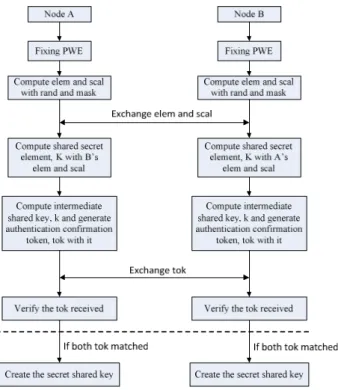
SAE begins when a peer node was discovered. Prior any message was sent, the parties involved will select an element in the finite cyclic group based on the password and their identities and then fix the password element (PWE). The input password is a pre-shared key (PSK) and the detailed pseudo codes for the PWE as well as the equations and rules used in SAE can be found at the SAE proposal [7]. The overview of the SAE protocol is shown in Figure 4, refer to [7] for the details of SAE protocol.
Figure 4 : Overview of the SAE protocol 4. Key Management process of 802.11s
4.1 Master Key Creation
The output from the authentication stage, the Master Pairwise Master Key (MPMK from SAE protocol), Pre-Shared Key (PSK from Open Authentication) or Master Secret key (MSK from IEEE 802.1X) will be used to derive the first level of the Pairwise Master Key (PMK), the
2012 년도 한국멀티미디어학회 춘계학술발표대회 논문집 제 15 권 1 호
- 91 - Pairwise Master Key – Mesh Key Distributor (PMK-MKD) and then the second level of the PMK, Pairwise Master Key – Mesh Authenticator (PMK-MA) [2]. In the master key creation process, only the PMK and Group Master Key (GMK) were involved. The 2 master keys will then be used to generate the temporal key, PTK, GTK or MTK for each session before they can be used to encrypt any messages.
Since GMK is only used to protect the messages but does not provide authentication, the identity of the node is not required. Hence, GMK is just a 256-bit cryptographic quality random number generated only at the authenticator side and this GMK will then be used to generate GTK which will be used for the multicast and broadcast messages [8].
For PMK, the equations used to derive the first level of PMK, MKD, and then the second level of PMK, PMK-MA can be found at [9].
4.2 Temporal Key Creation
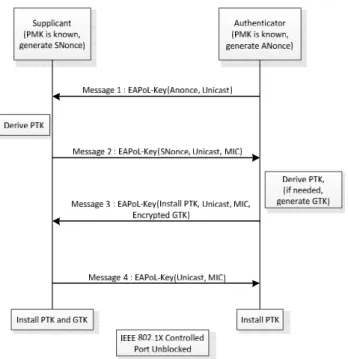
There are 3 temporal keys in 802.11s protocol which is one additional temporal key compared to the conventional key hierarchy in 802.11i. Similar with the 802.11i, 802.11s uses the same generation of PTK and GTK from the PMK and GMK through the 4-way handshake and the group key handshake as shown in Figure 5 and Figure 6 respectively [1,10]. However, the extra temporal key, Mesh Temporal Key (MTK) will be generated through the Authenticated Mesh Peering Exchange (AMPE) simultaneously with the PTK and GTK [2]. Similar with 802.11i, PTK is used to secure the unicast messages and GTK is used to secure the multicast or broadcast messages. MTK however is used to secure the end-to-end communication between 2 MPs [12].
Figure 5 : 4-way Handshake
Figure 6 : Group Key Handshake
The detailed equations used to generate the PTK for each session can be found at [9]. PTK composes of 3 main sections; they are explained as below and the PTK hierarchy is shown in Figure 7 [1,11].
1. Key Confirmation Key (KCK) : used to provide data integrity during the 4-way handshake and group key handshake (to prove the possession of PMK) 2. Key Encryption Key (KEK) : used to provide data
privacy during the 4-way handshake and group key handshake, encrypt the GTK for distribution 3. Temporal Key (TK) : used to encrypt/decrypt the
MSDU payload of 802.11 data frames between the supplicant and the authenticator and will be used for TKIP (Temporal Key Integrity Protocol) and CCMP (Counter-mode/CBC-MAC Protocol)
Figure 7 : PTK Hierarchy
The detailed equations used to generate the GTK can be found at [1]. GTK composes of 2 main sections as explained below and GTK hierarchy is shown in Figure 8 [11].
1. Group Encryption Key (GEK) : Key for data encryption (used by CCMP and TKIP) 2. Group Integrity Key (GIK) : Key for data
2012 년도 한국멀티미디어학회 춘계학술발표대회 논문집 제 15 권 1 호
- 92 - Fi gure 8 : GTK Hierarchy
4.3 Authenticated Mesh Peering Exchange (AMPE)
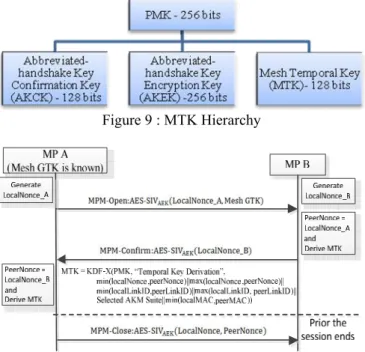
At the end of the AMPE handshake, MTK will be generated. This key will be used to protect the end-to-end communication between 2 mesh points [12]. The derivation of MTK and AKEK (also known as AEK) can be found at [2]. Mesh Peering Management (MPM) protocol is used for the AMPE handshake and MPM messages are encrypted with Advanced Encryption Standard-Synthetic Initialization Vector (AES-SIV) protocol by using AEK as the encryption key. Figure 9 shows the MTK hierarchy and the overview of AMPE handshake is shown in Figure 10.
Figure 9 : MTK Hierarchy
Figure 10 : Overview of AMPE handshake
The resultant temporal keys, PTK, GTK or MTK will be used to encrypt the messages of the information exchanges process for their respective purposes. The encryption process however depends on the encryption algorithm that was chosen by the particular network. The common encryption such as the Advanced Encryption Standard (AES) can be used to perform the encryption with the help of the resultant temporal key as the input key.
5. Conclusion
This paper shows the brief introduction to the security features of the 802.11s in term of the authentication method and the key management process. These security features are
mainly inherited from the 802.11i with some improvements to accommodate the requirement of the 802.11s such as the authentication method proposed by Dan Harkins, the SAE protocol [7] makes the authentication in reactive mode much easier without the need of the authentication server.
For the future work, we hope to improve the security architecture of the 802.11s with the help of our research in this paper. The improvement proposed can also be evaluated with the embedded systems test bed that we had built.
Acknowledgement
This work was supported by 2011 National Research Foundation of Korea (2011-0004713).
Reference
[1] 802.11 Working Group of the IEEE 802 Committee, “IEEE Std 802.11i”, the Institute of Electrical and Electronics Engineers (IEEE), Inc, New York, NY, USA, 24 June 2004.
[2] 802.11 Working Group of the IEEE 802 Committee, “IEEE Std 802.11s”, the Institute of Electrical and Electronics Engineers (IEEE), Inc, New York, NY, USA, 10 September 2011.
[3] Jyh-Cheng Chen and Yu-Ping Wang, “Extensible Authentication Protocol (EAP) and IEEE 802.1X : Tutorial and Empirical Experience”, IEEE Radio Communication, pp26-32, December 2005.
[4] Qian Qiongfen, Li Chunli and Zhang Xiaoqing, “On Authentication System based on 802.1X Protocol in LAN”, International Conference on Internet Technology and Applications, Wuhan, China, 20-22 August 2010. [5] Peter J. Welcher, “Examining 802.1X and EAP”,
Chesapeake Netcraftsmen, 8 July 2006, http://www.netcraftsmen.net/welcher/papers/dot1x.html [6] David Halasz, “IEEE 802.11i and Wireless Security”,
EE Times, 25 August 2004,
http://www.eetimes.com/discussion/other/4025006/IEEE -802-11i-and-wireless-security
[7] Dan Harkins, “Simultaneous Authentication of Equals : A Secure, Password-Based Key Exchange for Mesh Networks”, The Second International Conference on Sensor Technologies and Applications, 2008.
[8] Jon Edney and William A.Arbaugh, “Real 802.11 Security : Wi-Fi Protected Access and 802.11i”, Pearson Education Inc., pp 203-228 March 2004.
[9] 802.11 Working Group of the IEEE 802 Committee, “IEEE Std 802.11s/D2.06”, the Institute of Electrical and Electronics Engineers (IEEE), Inc, New York, NY, USA, January 2009.
[10] David D. Coleman, David A. Westcott, Bryan E. Harkins and Shawn M. Jackman, “CWSP : Certified Wireless Security Professional Official Study Guide”, Wiley Publishing Inc, pp 190-204 , 2010.
[11] Guillaume Lehembre, “Wi-Fi security – WEP, WPA and WPA2”, hakin9, June 2005.
[12] Andre Egners and Ulriker Meyer, “Wireless Mesh Network Security : State of Affairs”, IEEE 35th Conference on Local Computer Networks (LCN), 10-14 October 2010.