Downloaded from www.sjweh.fi on October 25, 2016
Original article
Scand J Work Environ Health 2013;39(5):515-520
doi:10.5271/sjweh.3356
Working hours and depressive symptomatology among full-time employees: Results from the fourth Korean National Health and Nutrition Examination Survey (2007–2009)
by Kim I, Kim H, Lim S, Lee M, Bahk J, June KJ, Kim S, Chang WJ
We found an association between long working hours and depressive symptomatology. The full-time employees who worked long hours showed higher prevalence of depressive symptomatology after the data were adjusted for individual characteristics, socioeconomic factors, health behaviors, and work schedules.
Affiliation: Department of Preventive Medicine, Ewha Woman’s University School of Medicine. 911-1, Mok-6-dong, Yandchun-gu, Seoul, Korea. [email protected]
Refers to the following texts of the Journal: 2003;29(3):0 2009;35(5):321-400 2011;37(5):359-449 2012;38(5):391-484 The following article refers to this text: 2016;42(2):99-176
Key terms: depression; depressive symptomatology; full-time employee; Korea; Korean National Health and Nutrition Examination Survey; mental disorder; mental health; mental illness; workhour; working hour; worktime
O
riginal article
Scand J Work Environ Health. 2013;39(5):515–520. doi:10.5271/sjweh.3356
Working hours and depressive symptomatology among full-time employees:
Results from the fourth Korean National Health and Nutrition Examination
Survey (2007–2009)
by Inah Kim, MD, PhD,1 Hyunjoo Kim, MD, PhD,2 Sinye Lim, MD, PhD,3 Mira Lee, MD,4 Jinwook Bahk,
MPH,5 Kyung Ja June, PhD,6 Soyeon Kim, MPH,7 Won Joon Chang, MD 8
Kim I, Kim H, Lim S, Lee M, Bahk J, June KJ, Kim S, Chang WJ. Working hours and depressive symptomatology among full-time employees: Results from the fourth Korean National Health and Nutrition Examination Survey (2007–2009). Scand J Work Environ Health. 2013;39(5):515–520. doi:10.5271/sjweh.3356
Objective This study aimed to examine the distribution of working hours and the association between work-ing hours and depressive symptomatology uswork-ing representative data from a national, population-based survey. Method Data came from the fourth Korean National Health and Nutrition Examination Survey (2007–2009), which employed a systematic, stratified cluster-sampling method. We used logistic regression procedures to estimate the importance of weekly working hours as a predictor of depressive symptomatology.
Results The prevalence of depressive symptomatology was 10.2%. The work week, which averaged 48.3 hours for the sample as a whole, was longer for men (49.8 hours) than women (45.3 hours), and 12.1% of respondents were engaged in shift work. In logistic regression analyses, compared to those working <52 hours per week, the odds ratios (OR) of working hours as a predictor of depressive symptomatology were 1.19 [95% confidence interval (95% CI) 0.77–1.85] for those working 52–59 hours per week and 1.62 (95% CI 1.20–2.18) for those working ≥60 hours per week, after adjustment for demographic characteristics, health behaviors, socioeconomic status, employment status, and work schedules. It showed a positive dose–response relationship between working hours and depressive symptomatology (P=0.0059).
Conclusions Working hours in Korea are long. There is an association between working hours and depressive symptomatology, and there seems be a trend in working hours and depressive symptomatology.
Key terms depression; Korea; mental disorder; mental health; mental illness; workhour; worktime.
1 Department of Occupational Health, Graduate School of Public Health, Yonsei University, Seoul, Korea. 2 Department of Preventive Medicine, Ewha Woman’s University School of Medicine, Seoul, Korea 3 Department of Occupational and Environmental Medicine, Kyung hee University Hospital, Seoul, Korea. 4 Physicians For Humanism, Loves Park, IL, USA.
5 Department of Occupational & Environmental Health, Graduate School of Public Health, Seoul National University, Seoul, Korea. 6 Department of Nursing, Soonchunhyang University, Cheonan, Korea.
7 Department of Health Science and Services, Graduate School of Public Health, Seoul National University, Seoul, Korea. 8 Department of Occupational and Environmental Medicine, Dankook University Hospital, Cheonan, Korea.
Correspondence to: Hyun Joo Kim, Department of Preventive Medicine, Ewha Woman’s University School of Medicine. 911-1, Mok-6-dong, Yandchun-gu, Seoul, Korea. [E-mail: [email protected]]
Long working hours increase the risk of various health problems, such as coronary heart diseases, work-related
injuries, sleep disorders, and mental disorders (1–3).
Work schedules can affect the length and quality of sleep, leading to low productivity and workplace hazards. Like-wise, long working hours can cause other medical prob-lems, including fatigue, excessive stress, negative mood, generalized discomfort and pain as well as neurological, cognitive, and physiological dysfunction (4).
The World Health Organization has predicted that depression will account for the second largest propor-tion of global disease burden by 2020 (5). Depression could deteriorate industrial productivity and reduce cost effectiveness (6, 7). Mood disorders have emerged as the second most common psychiatric disorder compensated by the Industrial Accident Compensation Insurance (IACI) in Korea, followed by neurotic, stress-related, and somatoform disorders (8).
Long working hours and depressive symptomatology
Several studies have shown inconsistent relation-ships between long working hours and depression (9–12). Inconsistencies between studies might originate from small sample sizes, study subjects that are limited to specific organizations or occupations, cross-sectional study designs, or various methods for evaluating work-ing hours or depression (13–15).
Koreans work long hours. In 2010, annual working hours in Korea averaged 2193 hours per person, the highest among the Organization for Economic Co-operation and Development (OECD) countries (16). In 2004–2005, 49.5% of the workers spent >48 hours in the workplace, the second-highest figure in the world after Peru (17).
Despite these observations, research on the rela-tionship between working hours and mental health has remained very limited in Korea and other countries. This study aimed to (i) examine the distribution of working hours among Korean workers, using representative data from a large national survey, and (ii) investigate the relationship between working hours and depressive symptomatology.
Methods
Study subjects
This study was based on representative data obtained from the fourth Korean National Health and Nutrition Examination Survey (K-NHANES IV), conducted by the Ministry of Health and Welfare since 1998. K-NHANES IV uses a systematic, stratified, cluster-sampling proce-dure based on the 2005 National Census Registry, and a rolling sampling survey method was introduced in the same year. This approach made each sample con-ducted over a 3-year time period an independent and homogeneous probability sample. The response rate for K-NHANES IV was 78.4%. Of the 24 871 people who participated in the health interview survey (4594 in 2007, 9744 in 2008, and 10 533 in 2009), 4662 fulltime employees (FTE) working >35 hours per week were included in our study.
Study variables
Demographic and behavioral characteristics
Information regarding gender, age, marital status, alco-hol consumption, smoking status, and exercise was obtained through interviews. “Problem drinking” was defined as consuming ≥6 and 4 glasses of alcohol ≥2
times per week among men and women, respectively. Exercise was defined as physical exercise for ≥20 min-utes ≥3 times per week that led to rapid respiration or physical strain.
Working hours and work schedules
Working hours were identified using the following ques-tion: “How many hours do you work in a week on aver-age in your job, including overtime but excluding meal time?” We classified working hours into three catego-ries: (i) <52 hours, (ii) 52–59 hours, and (iii) >60 hours per week. This classification is based on the fact that 52 hours per week is the working hour limit suggested in the Labor Standard Act in Korea (18), and 60 hours per week is the practical standard of the Korean government for compensation of death caused by overwork.
Those who answered “yes” to the question, “Do you usually work during the day time (6:00–18:00 hours)?” were classified as day workers, while those who answered “no” were classified as shift workers. Depressive symptomatology
FTE were defined to have depressive symptomatol-ogy if they answered positively to the question, “Have you experienced serious sadness or hopelessness that restricts your daily life, continuously for ≥2 weeks in the last year?”
Statistical analysis
We used SAS software package version 9.2 (SAS Insti-tute, Cary, NC, USA) to estimate means, proportions, and adjusted odds ratios (OR) for multi-stage and strati-fied survey design. We adapted the integrated survey weights according to the official analysis guidelines of the Korea Ministry of Health and Welfare and the Korea Center for Disease Control and Prevention. We additionally used the Cochran-Armitage trend test to examine a dose–response association between working hours and the OR.
Results
Demographic and work characteristics
More male (65.9%) than female (34.1%) FTE par-ticipated in this study to reflect the gender distribution among Korean workers in the general population. The majority of respondents (52.9%) belonged to age group 20–39 years old, followed by 40–54-year olds (35%), ≥55-year olds (10.5%), and <20-year olds (0.9%).
The total number of weighted study population was approximately 11.9 million. Of the FTE, 36.0% were current smokers, 22.7% were problem drinkers, and 78.4% were regular workers whose work contracts lasted for ≥12 months. With respect to working hours per week, 61.0% worked <52 hours, 9.0% worked 52–59 hours, and 20.6% worked ≥60 hours. Of the FTE, 12.1% were engaged in non-daytime shifts, including evening or night shifts. The prevalence of depressive symptom-atology among FTE was 10.2% (table 1).
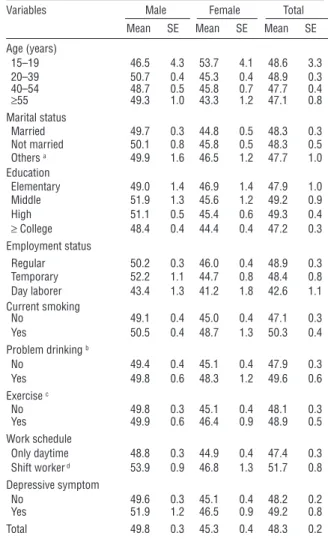
Weekly working hours and depressive symptomatology The work week was longer among men [49.8, standard error (SE) 0.3, hours] than women (45.3, SE 0.4, hours). The work week was the longest among participants aged 20–39 years (48.9, SE 0.3, hours). For women, work-ing hours were the longest among divorced, separated, or widowed participants (46.5, SE 1.2, hours). Current smokers and problem drinkers showed longer working hours (50.3 hours and 49.6 hours, respectively), and the differences between smokers versus non-smokers and problem drinkers versus non-problem-drinkers were larger among women than men. According to employ-ment status, day laborers who work for daily wages worked shorter hours (42.6, SE 1.1, hours) than regular (48.9, SE 0.3, hours) or temporary workers (48.4, SE 0.8, hours). The working hours of FTE in 24-hour rotat-ing shifts were the longest (68.9, SE 3.0, hours) com-pared to other categories of shifts. FTE who experienced depressive symptomatology worked longer hours (49.2, SE 0.8, hours) than non-depressed respondents (table 2). Multivariate analysis of working hours and depressive symptomatology
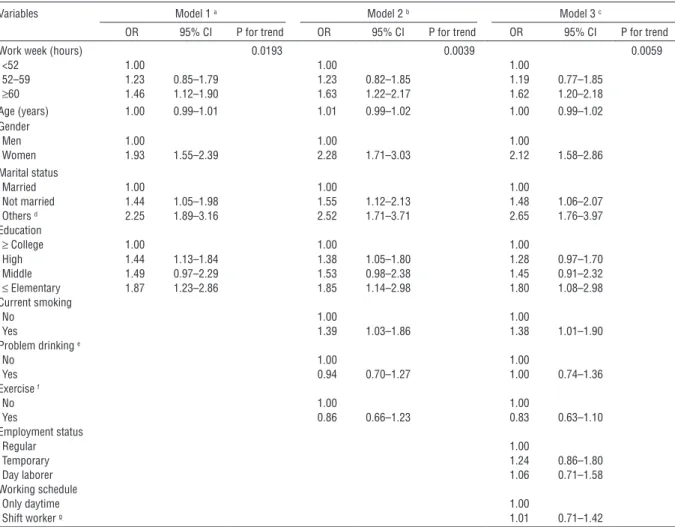
Model 1 was adjusted for age, gender, marital status, and education status. The reference group comprised FTE who worked <52 hours per week. As a predictor of depressive symptomatology, the OR for working ≥60 and 52–59 hours per week was 1.46 (95% CI 1.12–1.90) and 1.23 (95% CI 0.85–1.79), respectively. After further adjustment for health behaviors such as smoking, drink-ing, and exercise in model 2, the OR for working ≥60 and 52–59 hours per week was 1.63 (95% CI 1.22–2.17) and 1.23 (95% CI 0.82–1.85), respectively. In model 3, additionally adjusted for employment status and working schedules, the OR for working ≥60 and 52–59 hours per week was 1.62 (95% CI 1.20–2.18) and 1.19 (95% CI 0.77–1.85), respectively. We also found that the relationship between working hours and depressive symptomatology showed a dose–response relationship (P-value for trend test=0.0193, 0.0039, and 0.0059, respectively). However, we could not find a relationship between shift work and depressive symptomatology (OR
1.01, 95% CI 0.71–1.42) (table 3).
Discussion
In this study using representative national data, we con-firmed that the working hours in Korea are substantially longer than most OECD countries. Approximately 20% of the FTE worked ≥60 hours per week as compared to 9.5% in Australia in 2000 (20). The average work week of FTE in Korea (48.3 hours) was longer than the aver-age work week of the 27 European Union (EU27) mem-ber states in 2006 (41.3 hours) (21). In the European Working Condition Survey, some 15% of employees in the EU27 worked ≥48 hours per week. In the Nordic countries, <10% of the workforce worked >48 hours per week. The Korea Workers Compensation & Welfare Ser-vice considers that a work week of ≥60 hours warrants compensation as it contributes to “death by overwork.” We also found a substantial relationship between working hours and depressive symptomatology, which is consistent with previous studies. Virtanen et al (12) found that working >55 hours per week is associated with depressive symptoms; a cohort study using White-hall II data revealed that every 10-hour increase in working hours is related to a 17% increase in depressive symptoms (12).
Our study is the first to identify the association between working hours and depressive symptomatol-ogy using representative national data in Korea. As revealed by the significant trend showing higher level of depressive symptomatology among respondents working ≥60 hours per week as compared to those working <60 hours, we can also suggest the possibil-ity of dose–response relationship between long work weeks and depressive symptomatology.
Although we used survey analysis with suitable weighting procedures to estimate the association between working hours and depressive symptomatol-ogy among Korean workers, the actual number of FTE respondents remained relatively small. Cross-sectional design is another limitation of the study. Due to lack of longitudinal follow-up data, definite conclusions about causality between working hours and depressive symptomatology could not be drawn. That is to say, reverse causality between work hours and depressive symptomatology could not be ruled out. In addition, the K-NHANES IV uses a single question to assess depres-sive symptomatology; a stronger procedure should involve a multi-item, validated instrument to identify depression.
In this study, the relationship of work schedule and depressive symptomatology proved no signifi-cance, unlike previous studies showing an association
Long working hours and depressive symptomatology
between work schedules and depressed mood (22). However, this association was not significant after adjusting for demographic factors such as age and gender in recent study result using the same cohort (13). In previous studies without significant association between shift work and depression, authors pointed out the possibility of underestimation due to healthy worker effect, overcorrection for effect modifiers such as work characteristics, job stress, or gender, and misclassification due to the large study sample size including various occupational groups (13, 23). The result of this study could also be underestimated due to
possible misclassification due to large sample size with various work characteristics, regardless of adjustment for employment status. Economical reward of shift work is another possible explanation for this negative result (24). It might be one of the specific reasons why Korean FTE worked longer hours, including night shifts. As a result, the difference in economic reward between shift and day workers could be very large.
This study has led to important implications for a policy change. The association between working hours and depressive symptomatology supports a recent policy decision of the Korean government to shorten working hours and increase public awareness of the relationship between long working hours and depres-sion. We anticipate further research using
representa-Table 1. Characteristic of study subject (N=4662). [SE=standard
error]
Variables Frequency Weighted
frequency % SE Gender Women 1939 4 059 857 34.1 0.73 Age (years) <20 42 101 397 0.9 0.14 20–39 2204 6 301 784 52.9 1.06 40–54 1685 4 261 798 35.8 0.98 ≥55 731 1 255 678 10.5 0.47 Marital status Married 3288 8 035 237 67.9 1.04 Not married 922 2 903 034 24.5 0.97 Others a 422 891 658 7.5 0.46 Education Elementary 600 1 147 585 9.6 0.51 Middle 423 981 897 8.2 0.47 High 1692 4 666 075 39.1 1.00 ≥ College 1947 5 125 100 43.0 1.12 Employment status Regular 3575 9 345 040 78.4 0.82 Temporary 614 1 442 231 12.1 0.58 Day laborer 472 1 125 542 9.4 0.52 Current smoking Yes 1461 4 269 323 36.0 0.81 Problem drinking b Yes 798 2 314 906 22.7 0.80 Exercise c Yes 849 2 205 604 18.6 0.71 Workweek (hours) <40 58 192 010 1.7 0.33 40–51 2703 6 993 477 59.3 0.88 52–59 409 1 057 648 9.0 0.49 60–65 426 1 123 449 9.5 0.50 >65 497 1 305 874 11.1 0.56 Work schedule Only daytime 3872 9 853 008 87.9 0.75 Shift worker d 523 1 359 260 12.1 0.75 Depressive symptom Yes 526 1 214 363 10.2 0.51 Total 4662 11 920 657 100.0
a Widowed, separated, or divorced.
b Average amount in each kind of drinking was ≥6 units for men and ≥4
units for women and average frequency was ≥ 2 days/week.
c ≥20 minutes/once and ≥3 times/week with rapid respiration or physical
strain.
d Usual working schedule include evening or night work.
Table 2. The distribution of average working hours according to
individual characteristics by gender. [SE=standard error]
Variables Male Female Total
Mean SE Mean SE Mean SE
Age (years) 15–19 46.5 4.3 53.7 4.1 48.6 3.3 20–39 50.7 0.4 45.3 0.4 48.9 0.3 40–54 48.7 0.5 45.8 0.7 47.7 0.4 ≥55 49.3 1.0 43.3 1.2 47.1 0.8 Marital status Married 49.7 0.3 44.8 0.5 48.3 0.3 Not married 50.1 0.8 45.8 0.5 48.3 0.5 Others a 49.9 1.6 46.5 1.2 47.7 1.0 Education Elementary 49.0 1.4 46.9 1.4 47.9 1.0 Middle 51.9 1.3 45.6 1.2 49.2 0.9 High 51.1 0.5 45.4 0.6 49.3 0.4 ≥ College 48.4 0.4 44.4 0.4 47.2 0.3 Employment status Regular 50.2 0.3 46.0 0.4 48.9 0.3 Temporary 52.2 1.1 44.7 0.8 48.4 0.8 Day laborer 43.4 1.3 41.2 1.8 42.6 1.1 Current smoking No 49.1 0.4 45.0 0.4 47.1 0.3 Yes 50.5 0.4 48.7 1.3 50.3 0.4 Problem drinking b No 49.4 0.4 45.1 0.4 47.9 0.3 Yes 49.8 0.6 48.3 1.2 49.6 0.6 Exercise c No 49.8 0.3 45.1 0.4 48.1 0.3 Yes 49.9 0.6 46.4 0.9 48.9 0.5 Work schedule Only daytime 48.8 0.3 44.9 0.4 47.4 0.3 Shift worker d 53.9 0.9 46.8 1.3 51.7 0.8 Depressive symptom No 49.6 0.3 45.1 0.4 48.2 0.2 Yes 51.9 1.2 46.5 0.9 49.2 0.8 Total 49.8 0.3 45.3 0.4 48.3 0.2
a Widowed, separated, or divorced.
b Average amount in each kind of drinking was ≥6 units for men and ≥4
units for women and average frequency was ≥2 days/week.
c ≥20 minutes/once and ≥3 times/week with rapid respiration or
physi-cal strain
tive data about the relationships between working hours and other health problems.
References
1. Van der Hulst M. Long workhours and health. Scand J Work Environ Health. 2003;29(3):171–88. http://dx.doi. org/10.5271/sjweh.720.
2. Caruso CC, Hitchcock EM, Dick RB, Russo JM, Schmit JM. Overtime and extended work shifts: recent findings on illnesses, injuries, and health behaviors. Cincinnati: National Institute for Occupational Safety and Health (NIOSH); 2004.
3. Artazcoz L, Cortès I, Escribà-Agüir V, Cascant L, Villegas R.. Understanding the relationship of long working hours with health status and health-related behaviors. J Epidemiol Community Health. 2009 Jul;63(7):521–7. http://dx.doi. org/10.1136/jech.2008.082123.
4. Caruso CC, Bushnell T, Eggerth D, Heitmann A, Kojola B, Newman K, et al. Long working hours, safety, and health: toward a National Research Agenda. Am J Ind Med. 2006 Nov;49(11):930–42. http://dx.doi.org/10.1002/ajim.20373. 5. Murray CJ, Lopez AD. Alternative projections of mortality
and disability by cause 1990-2020: Global Burden of Disease Study. Lancet. 1997; 349:1498–504. http://dx.doi. org/10.1016/S0140-6736(96)07492-2.
6. Kessler RC, Greenberg PE, Mickelson KD, Meneades LM,
Table 3. The odds ratios and 95% confidence intervals of working hours on depressive symptom. [OR=odds ratio; 95% CI=95%
confi-dence interval]
Variables Model 1 a Model 2 b Model 3 c
OR 95% CI P for trend OR 95% CI P for trend OR 95% CI P for trend
Work week (hours) 0.0193 0.0039 0.0059
<52 1.00 1.00 1.00 52–59 1.23 0.85–1.79 1.23 0.82–1.85 1.19 0.77–1.85 ≥60 1.46 1.12–1.90 1.63 1.22–2.17 1.62 1.20–2.18 Age (years) 1.00 0.99–1.01 1.01 0.99–1.02 1.00 0.99–1.02 Gender Men 1.00 1.00 1.00 Women 1.93 1.55–2.39 2.28 1.71–3.03 2.12 1.58–2.86 Marital status Married 1.00 1.00 1.00 Not married 1.44 1.05–1.98 1.55 1.12–2.13 1.48 1.06–2.07 Others d 2.25 1.89–3.16 2.52 1.71–3.71 2.65 1.76–3.97 Education ≥ College 1.00 1.00 1.00 High 1.44 1.13–1.84 1.38 1.05–1.80 1.28 0.97–1.70 Middle 1.49 0.97–2.29 1.53 0.98–2.38 1.45 0.91–2.32 ≤ Elementary 1.87 1.23–2.86 1.85 1.14–2.98 1.80 1.08–2.98 Current smoking No 1.00 1.00 Yes 1.39 1.03–1.86 1.38 1.01–1.90 Problem drinking e No 1.00 1.00 Yes 0.94 0.70–1.27 1.00 0.74–1.36 Exercise f No 1.00 1.00 Yes 0.86 0.66–1.23 0.83 0.63–1.10 Employment status Regular 1.00 Temporary 1.24 0.86–1.80 Day laborer 1.06 0.71–1.58 Working schedule Only daytime 1.00 Shift worker g 1.01 0.71–1.42
a Adjusted for demographic factors such as age, gender, marital status, and education.
b Adjusted for demographic factors and health behaviors such as current smoking, problem drinking, and exercise.
c Adjusted for demographic factors, health behaviors, and work characteristics such as employment status and working schedule. d Widowed, separated, or divorced.
e Average amount in each kind of drinking was ≥6 units for men and ≥4 units for women and average frequency was ≥2 days/week. f ≥20 minutes/once and ≥3 times/week with rapid respiration of breath or physical strain.
g Usually working from 14:00–24:00 hours, usually working from 21:00–08:00 hours the following day, regular rotating shift, 24-hour
Long working hours and depressive symptomatology
Wang PS. The effects of chronic medical conditions on work loss and work cutback. J Occup Environ Med. 2001;43:218– 25. http://dx.doi.org/10.1097/00043764-200103000-00009. 7. Kessler RC, Akiskal HS, Ames M, Birnbaum H, Greenberg P, Hirschfeld RM, Jin R, Merikangas KR, Simon GE, Wang PS. Prevalence and effects of mood disorders on work performance in a nationally representative sample of U.S. workers. Am J Psychiatry. 2006;163:1561–8. http://dx.doi.org/10.1176/appi. ajp.163.9.1561.
8. Choi KS, Kang SK. Occupational psychiatric disorders in Korea. J Korean Med Sci. 2010 Dec;25(Suppl):S87–93. http:// dx.doi.org/10.3346/jkms.2010.25.S.S87.
9. Shields M. Long working hours and health. Health Rep. 1999 Autumn;11(2):33–48.
10. Nagashima S, Suwazono Y, Okubo Y, Uetani M, Kobayashi E, Kido T, et al. Working hours and mental and physical fatigue in Japanese workers. Occup Med (Lond). 2007 Sep;57(6):449– 52. http://dx.doi.org/10.1093/occmed/kqm047.
11. Kleppa E, Sanne B, Tell GS. Working overtime is associated with anxiety and depression: the Hordaland Health Study. J Occup Environ Med. 2008 Jun;50(6):658–66. http://dx.doi. org/10.1097/JOM.0b013e3181734330.
12. Virtanen M, Ferrie JE, Singh-Manoux A, Shipley MJ, Stansfeld SA, Marmot MG, et al. Long working hours and symptoms of anxiety and depression: a 5-year follow-up of the Whitehall II study. Psychol Med. 2011;18:1–10.
13. Driesen K, Jansen NW, van Amelsvoort LG, Kant I. The mutual relationship between shift work and depressive complaints - a prospective cohort study. Scand J Work Environ Health. 2011;37(5):402–10. http://dx.doi.org/10.5271/ sjweh.3158.
14. Nakata A. Work hours, sleep sufficiency, and prevalence of depression among full-time employees: a community-based cross-sectional study. J Clin Psychiatry. 2011 May;72(5):605– 14. http://dx.doi.org/10.4088/JCP.10m06397gry.
15. Varma A, Marott JL, Stoltenberg CD, Wieclaw J, Kolstad HA, Bonde JP. With long hours of work, might depression then lurk? A nationwide prospective follow-up study among Danish senior medical consultants. Scand J Work Environ Health. 2012 Sep;38(5):418–26. http://dx.doi.org/10.5271/
sjweh.3268
16. OECD (2012). Hours worked, In: OECD Factbook 2011-12: Economic, Environmental and Social Statistics [Internet]. Paris: OECD Publishing; 2011 [cited 2011 Dec 7]. Available from: http://www.oecd-ilibrary.org/economics/oecd-factbook_18147364.
17. Lee S, McCann D, Messenger JC. Working time around the world; trends in working hours, law and policies in a global comparative perspective. Geneva: ILO; 2007. p. 45–53. 18. Ministry of Employment and Labor [Internet]. Chapter IV.
Working Hours and Recess, In: Labor Standard Act. 2011. [cited 2011 October 31] Available from: http://www.moel.go.kr/ english/topic/laborlaw_view.jsp?idx=254&tab=Standards. 19. Korea Center for Disease Control & Prevention. Data analysis,
In; Korea Health Statistics 2009 :Korea National Health and Nutrition Examination Survey (KNHANESIV-3). Seoul: Ministry of Health & Welfare; 2010. p. 7–12.
20. Hartley L, Creed H, Gilroy P, Todd D [Internet]. Extended Working Hours Review. 2004. [cited 2001 Feb 4] Available from: http://www.commerce.wa.gov.au/labourrelations/ PDF/Publications/EWH_Final_27Feb04.pdf.
21. European Foundation for the Improvement of Living and Working Conditions [Internet]. Comparative analysis of working time in the European Union. 2010. [cited 2009 Nov 16] Dublin. http://www.eurofound.europa.eu/docs/ewco/ tn0803046s/tn0803046s.pdf.
22. Driesen K, Jansen NW, Kant I, Mohren DC, van Amelsvoort LG. Depressed mood in the working population: associations with work schedules and working hours. Chronobiol Int. 2010;27(5):1062–79. http://dx.doi.org/10.3109/07420528.2 010.489877.
23. Bara AC, Arber S. Working shifts and mental health--findings from the British Household Panel Survey (1995-2005). Scand J Work Environ Health. 2009 Oct;35(5):361–7. http://dx.doi. org/10.5271/sjweh.1344.
24. Kim YH, Kim YM, Kim SH, Chang KO, Koo MJ, Lee NY. Workers’ experiences in shift work. J Korean Acad Community Health Nurs. 2007;18(2):284–92. (Korean). Received for publication: 4 June 2012