ⓒ 2021 The Korean Society of Neurogastroenterology and Motility
JNM
Journal of Neurogastroenterology and Motility
Received: July 16, 2020 Revised: December 8, 2020 Accepted: December 28, 2020
This is an Open Access article distributed under the terms of the Creative Commons Attribution Non-Commercial License (http://creativecommons. org/licenses/by-nc/4.0) which permits unrestricted non-commercial use, distribution, and reproduction in any medium, provided the original work is properly cited.
*Correspondence: Sang Kil Lee, MD, PhD
Department of Internal Medicine, Yonsei University College of Medicine, 50-1 Yonsei-ro, Seodaemun-gu, Seoul 03722, Korea Tel: +82-2-2228-1996, Fax: +82-2-393-6884, E-mail: [email protected]
Da Hyun Jung and Cheal Wung Huh equally contributed to this work.
A Systematic Review and Meta-analysis of
Randomized Control Trials: Combination
Treatment With Proton Pump Inhibitor Plus
Prokinetic for Gastroesophageal Reflux Disease
Da Hyun Jung,1 Cheal Wung Huh,2 Sang Kil Lee,1* Jun Chul Park,1 Sung Kwan Shin,1 and Yong Chan Lee11Department of Internal Medicine, Severance Hospital, Yonsei University College of Medicine, Seoul, Korea; and 2Department of Internal
Medicine, Yongin Severance Hospital, Yonsei University College of Medicine, Seoul, Korea
Background/Aims
Prokinetics can be used for treating patients with gastroesophageal reflux disease (GERD), who exhibit suboptimal response to proton pump inhibitor (PPI) treatment. We conducted a systematic review to assess the potential benefits of combination treatment with PPI plus prokinetics in GERD.
Methods
We searched PubMed, the Cochrane Library, and EMBASE for publications regarding randomized controlled trials comparing combination treatment of PPI plus prokinetics to PPI monotherapy with respect to global symptom improvement in GERD (until February 2020). The primary outcome was an absence or global symptom improvement in GERD. Adverse events and quality of life (QoL) scores were evaluated as secondary outcomes using a random effects model. Quality of evidence was rated using Grading of Recommendations, Assessment, Development, and Evaluation (GRADE).
Results
This meta-analysis included 16 studies involving 1446 participants (719 in the PPI plus prokinetics group and 727 in the PPI monotherapy group). The PPI plus prokinetics treatment resulted in a significant reduction in global symptoms of GERD regardless of the prokinetic type, refractoriness, and ethnicity. Additionally, treatment with PPI plus prokinetics for at least 4 weeks was found to be more beneficial than PPI monotherapy with respect to global symptom improvement. However, the QoL scores were not improved with PPI plus prokinetics treatment. Adverse events observed in response to PPI plus prokinetics treatment did not differ from those observed with PPI monotherapy.
Conclusions
Combination of prokinetics with PPI treatment is more effective than PPI alone in GERD patients. Further high-quality trials with large sample sizes are needed to verify the effects based on prokinetic type.
(J Neurogastroenterol Motil 2021;27:165-175)
Key Words
Introduction
Gastroesophageal reflux disease (GERD) is a common gas-trointestinal disorder with an estimated worldwide prevalence of between 8% and 33%.1
Following the introduction of proton pump inhibitors (PPIs) into the drug market, PPIs were used as the treatment of choice for GERD. However, approximately 30% of the GERD patients treated with the standard doses of PPIs continue to manifest symptoms.2
Consequently, the use of other ad-junctive treatments, including histamine H2 receptor antagonists, prokinetics, alginate, and surgery have been suggested in several guidelines.3-8
However, the evidences supporting the efficacy of such treatments are currently weak. Prokinetics have traditionally been found to improve gastrointestinal motility, and therefore have been recommended as a first-line treatment in functional dyspepsia patients with a postprandial distress subtype.9
Furthermore, several studies have reported that when used in combination with PPIs, prokinetics show additional benefits with respect to global symptom improvement in patients with GERD.10-12
In the Asia-Pacific re-gion, the consensus regarding the management of GERD has indi-cated that the uses of prokinetics as an adjunctive therapy with PPIs may have a beneficial effect on the treatment of PPI-refractory GERD symptoms, although the effect appears to be modest.13,14
In Asia, the most commonly used prokinetics are mosapride, itopride, and domperidone. However, another prokinetic agent, cisapride, has been withdrawn from the market owing to its association with fatal heart arrhythmia. Furthermore, although previous studies have shown that mosapride, a selective 5-hydroxytryptamine 4 receptor agonist, can reduce the episodes of acid reflux and enhance esopha-geal clearance,15,16
another clinical trial has reported no additional ef-fect of mosapride when used in combination with PPIs for treating GERD.12
Accordingly, for clarifying the efficacy of prokinetics for the treatment of patients with GERD, we conducted a systematic review of studies that have used prokinetics as an adjunctive therapy for the treatment of GERD.
Methods
Literature Search Strategy
In this study, we performed a systematic review and meta-analysis of the effects of the combination treatment with PPI plus prokinetics and PPI monotherapy on GERD symptoms based on the Preferred Reporting Items for Systematic reviews and
Meta-Analyses (PRISMA) principles.17
PubMed, Cochrane Library, and EMBASE databases (from inception to February 2020) were searched independently by 2 authors of the present review (D.H.J. and C.W.H.), using the following search string (Supplementary Data). Cited references in published studies were manually and re-petitively searched to identify other relevant studies. The latest date for updating our search was February 14, 2020.
Study Selection
In the first stage of study selection, the title and abstract of ar-ticles returned by our keyword search were scrutinized to rule out articles deemed irrelevant with respect to the purpose of the present analysis. Thereafter, we screened the full texts of all selected studies in accordance with our stated inclusion and exclusion criteria. The inclusion criteria were as follows: (1) a diagnosis of GERD, (2) randomized controlled trials with parallel design, (3) comparison of PPI plus prokinetics therapy with PPI monotherapy for the treat-ment of GERD, (4) investigations of adults aged ≥ 18 years; and (5) no evidence of disorder (organic, metabolic, or drug-induced) to explain the symptoms. The exclusion criteria were as follows: (1) studies without a detailed description of the diagnosis of GERD, (2) studies in which the objective was to evaluate herbal prokinetic agents; (3) studies in which the treatment duration was less than 7 days, (4) publication in a language other than English, or (5) abstract-only publications.
Data Extraction
Two authors (D.H.J. and C.W.H.) of the present review in-dependently extracted data from the included studies using a pre-data extraction form. The titles and abstracts of all included studies were reviewed to exclude irrelevant publications. Discrepancies in data interpretation were resolved by discussion, re-review of studies, or when necessary, consultation with the third author (S.K.L.) of this review. The data collected included the following: (1) partici-pant characteristics, including demographics, recruitment source, diagnostic criteria used by the study authors, and GERD subtype; (2) interventions details, including the name of the PPI or proki-netic, dose, and treatment duration; (3) and improvement in reflux symptoms before and after the intervention, including the number of patients with reflux symptoms, quality of life (QoL), and adverse events (AEs). We defined refractory GERD as patients who com-plained of GERD symptoms despite with once daily dose of PPI for at least 8 weeks.
Primary and Secondary Outcomes
The primary outcome was a global symptom improvement of GERD. If more than 1 definition of global symptom improve-ment was identified, we assessed the most stringent definition of global symptom improvement. Although we primarily evaluated patient reported outcomes after treatment, if this information was not available, we used overall symptom assessment by the physician or researcher. If the global symptoms of GERD were not reported, we used heartburn or reflux improvement as the outcome measure. Secondary outcomes were QoL and AEs.
Methodological Quality
All trials were assessed using Cochrane’s “Risk of Bias (RoB)” tool, which includes the following domains: random sequence generation (selection bias), allocation concealment (selection bias), blinding of participants and personnel (performance bias), blinding of outcome assessment (detection bias), incomplete outcome data addressed over the short and long terms (attrition bias); selective re-porting (rere-porting bias); and other biases. Two authors (D.H.J. and C.W.H.) independently assessed the methodological quality of the included studies. Any disagreement between the 2 evaluators was resolved by discussion.
Statistical Methods
For data analysis, we used Review Manager version 5.3 (Rev-Man for Windows 7; the Nordic Cochrane Centre, Copenhagen, Denmark). The Mantel–Haenszel random-effect model was used for binary end points, and the inverse variance method was used for continuous outcomes. In addition, we evaluated subgroup analyses
according to the following criteria: GERD based on endoscopic findings (erosive reflux disease (ERD) vs non-erosive reflux dis-ease (NERD), refractory GERD vs non-refractory GERD, study population (Eastern vs Western), length of treatment (≤ 4 weeks vs > 4 weeks), and studies assessed as low RoB vs unclear RoB. To determine heterogeneity, we used the I2
test developed by Hig-gins.18 A P-value of < 0.05 was considered statistically significant. The levels of evidence in each outcome were evaluated based on the Grading of Recommendations, Assessment, Development, and Evaluation (GRADE) approach with the consensus of 2 authors (D.H.J. and C.W.H.).
Results
Study Selection
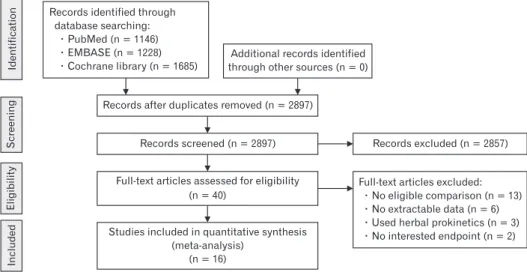
Our primary literature search retrieved a total of 2897 studies, of which 2857 were rejected based on the scrutiny of the title and ab-stract. The remaining 40 articles were subjected to full reviews, and after assessing the eligibility, we excluded a further 24 articles (Fig. 1), leaving 16 articles10,19-33
for meta-analysis (Table 1). These 16 studies presented details on 1446 participants, among whom 719 were in-cluded in the PPI plus prokinetics group (mosapride,10,21,22,24,25,29-32,34 domperidone,23,27,28
revexepride,19,20
and acotiamide26
) and 727 were included in the PPI monotherapy group. Among these 16 stud-ies, half (8 studies) were rated as having an unclear RoB, whereas among the remaining eight studies, 6 and 2 trials were assessed as having a low and high RoB, respectively. The authors’ assessments regarding each RoB domain in the respective trials are shown in Supplementary Figure 1.
Identification
Screening
Eligibility
Included
Additional records identified through other sources (n = 0)
Records after duplicates removed (n = 2897)
Records screened (n = 2897)
Full-text articles assessed for eligibility (n = 40)
Studies included in quantitative synthesis (meta-analysis)
(n = 16)
Full-text articles excluded: No eligible comparison (n = 13) No extractable data (n = 6) Used herbal prokinetics (n = 3) No interested endpoint (n = 2) Records excluded (n = 2857) Records identified through
database searching: PubMed (n = 1146) EMBASE (n = 1228) Cochrane library (n = 1685)
Figure 1. Flow diagram of the studies included in the meta-analysis.
Table 1.
Characteristics of Included Studies
A
uthors
n
Male (n)
Age (mean, yr)
R egion of study Outcome measures Type of out -come GERD sub -type I (n) GERD subtype II PPI Prokinetic Treat -ment duration Yamashita et al, 26 2019 70 33 PPI: 70.0 PPI + P rokinetic: 63.0 Eastern (Japan) Overall treatment ef -fect Binar y NERD: 55 ERD: 15 R efractor y GERD NA A cotimide 100 mg tid 2 wk
Xiao and Mao,
32 2019 90 53 PPI: 39.9 PPI + P rokinetic: 40.6 Eastern (China) RDQ Continuous NA Non-refractor y GERD Omeprazole 20 mg bid Mosapride 5 mg tid 12 wk
Sirinawasatien and Kanta
-thavorn, 33 2019 44 13 PPI: 53.1 PPI + P rokinetic: 49.2 Eastern (Thailand) FSSG Continuous NA R efractor y GERD Omeprazole 20 mg qd Mosapride 5 mg tid 4 wk Puranik et al, 27 2018 80 55 NA Eastern (India) FSSG Continuous NA Non-refractor y GERD Pantoprazole 40 mg qd Domperidone 30 mg qd 2 wk Marakhouski et al, 28 2017 100 27 PPI: 47.1 PPI + P rokinetic: 45.7 W estern (Belar us) GERD -Q Binar y NA Non-refractor y GERD Omeprazole 20 mg bid Domperidone 30 mg bid 8 wk L ee et al, 29 2017 116 78 PPI: 55.8 PPI + P rokinetic: 54.9 Eastern (K orea)
Total GERD symptom score
Binar y ERD: 116 Non-refractor y GERD Esomeprazole 40 mg qd Mosapride 5 mg tid 8 wk Shaheen et al, 19 2015 240 94 PPI: 46.2 PPI + P rokinetic: 49.2 W estern (USA) GERD -Q Binar y NA R efractor y GERD NA R eve xepride 0.5 mg tid 8 wk Tack et al, 20 2015 60 25 PPI: 45.8 PPI + P rokinetic: 43.8 W
estern (European countries)
PA GI-SYM Continuous NA R efractor y GERD NA R eve xepride 0.5 mg tid 4 wk Yamaji et al, 21 2014 50 13 PPI: 61.7 PPI + P rokinetic: 65.0 Eastern (Japan) FSSG Continuous NA Non-refractor y GERD Omeprazole 10 mg qd Mosapride 5 mg tid 4 wk W ang, 30 2014 116 NA NA Eastern (China) GERD -Q Binar y NA Non-refractor y GERD Esomeprazole 20 mg bid Mosapride 10 mg tid 8 wk Cho, 22 2013 43 24 PPI: 43.0 PPI + P rokinetic: 49.0 Eastern (K orea) R eflux-symptoms questionnaire Binar y NA Non-refractor y GERD Esomeprazole 40 mg qd Mosapride 5 mg tid 4 wk Lim, 31 2013 30 16 PPI: 53.3 PPI + P rokinetic: 48.5 Eastern (K orea)
Questionnaires about gastroesophageal reflux symptoms
Continuous NA Non-refractor y GERD Pantoprazole 40 mg qd Mosapride 5 mg tid 8 wk Ndraha, 23 2011 60 20 PPI: 40.4 PPI + P rokinetic: 44.3 Eastern (Indonesia) FSSG Continuous NA Non-refractor y GERD Omeprazole 20 mg bid Domperidone 10 mg bid 2 wk Miwa, 10 2011 192 72 PPI: 52.2 PPI + P rokinetic: 52.1 Eastern (Japan) Patient’s reflux symptoms
Binar y NERD:192 Non-refractor y GERD Omeprazole 10 mg qd Mosapride 5 mg tid 4 wk Hsu et al, 24 2010 94 48 PPI: 47.0 PPI + P rokinetic: 47.0 Eastern (Taiwan) FSSG Binar y ERD:94 Non-refractor y GERD Lansoprazole 30 mg qd Mosapride 5 mg tid 8 wk Madan et al, 25 2004 61 40 PPI: 34.7 PPI + P rokinetic: 36.5 Eastern (India) Patient’s reflux symptoms
Binar y ERD:32 NERD: 29 Non-refractor y GERD Pantoprazole 40 mg bid Mosapride 5 mg tid 8 wk
GERD, gastroesophageal reflux disease; PPI, proton pump inhibitor; NERD, non-erosive reflux disease; ERD, erosive reflux diseas
e; RDQ, reflux disease questionnaire; FSSG, frequency scale for the symp
-tom of GERD; GERD
-Q, gastroesophageal reflux disease questionnaire; P
A
GI-SYM, patient assessment of upper gastrointestinal symptom severity inde
x; NA, not available; qd, once a day; bid, twice a day;
tid, 3 times a day
Primary and Secondary Outcomes
Nine studies indicated global symptom improvement of GERD in terms of a binary outcome (yes or no),10,19,22,24-26,28-30 whereas the other 7 studies20,21,23,27,31-33
reported continuous mea-sures (ie, a change in symptom improvement). Among the 9 studies that rated global symptom improvement of GERD in terms of a binary outcome, the average percentage symptom improvement was 63.8% in the PPI plus prokinetics group, compared with 50.6% in the PPI monotherapy group. The PPI plus prokinetics treatment was found to significantly reduce the global symptoms of GERD (risk ratio [RR] of reflux symptoms resolution, 1.22; 95% CI, 1.11 to 1.35; P < 0.0001; number needed to treat [NNT], 7; 95% CI, 5 to 13 with low heterogeneity [I2
15%]). With respect to indi-vidual prokinetics, the data were as follows: mosapride (RR, 1.16; 95% CI, 1.05 to 1.28; NNT, 11; 95% CI, 5 to 51), and prokinetics other than mosapride (RR, 1.54; 95% CI, 1.23 to 1.93; NNT, 5; 95% CI, 4 to 11) (Fig. 2). In the seven trials in which the primary outcome was reported as a continuous measure (change in symp-tom improvement), subgroup analyses also showed a significant im-provement in the PPI plus prokinetics group (pooled standardized mean difference [SMD], 1.38; 95% CI, 0.42 to 2.34) with high
heterogeneity (Supplementary Fig. 2).
Pooled data from 2 studies (n = 300) which reported the QoL scores revealed no significant differences in the QoL scores between patients receiving PPI plus prokinetics treatment and PPI mono-therapy (SMD, 1.22; 95% CI, -1.76 to 4.20; I2
, 99%; P = 0.420). Pooled data from 8 separate studies (n = 725) which reported AEs including 3 different prokinetics (mosapride, domperidone, and acotiamide) revealed that AEs were detected in 7.9% of patients in the PPI plus prokinetics group compared with 9.2% of patients in the PPI monotherapy group. There was no association between a specific prokinetic and any particular AE (RR, 0.91; 95% CI, 0.57 to 1.45; I2, 0%; P = 0.680).
Subgroup Analyses
Erosive reflux disease versus non-erosive reflux disease Evaluation of the outcomes based on GERD subtype deter-mined by endoscopic findings was performed in 9 studies. Analysis of 4 studies involving 257 participants with the ERD subtype showed no significant improvement in patients in the PPI plus prokinetics group with moderate heterogeneity. Three studies that evaluated patients with the NERD subtype (n = 276) revealed
PPI + mosapride vs PPI Cho 2013 Hsu 2010 Lee 2017 Madan 2004 Miwa 2011 Wang 2014 Subtotal (95% CI) Total events
Heterogeneity: Tau = 0.00; Chi = 2.27, df = 5 ( = 0.81); I = 0% Test for overall effect: Z = 3.02 ( = 0.002)
PPI + other prokinetics vs PPI Marakhouski 2017
Shaheen 2015 Yamashita 2019 Subtotal (95 % CI) Total events
Heterogeneity: Tau = 0.00; Chi = 1.23, df = 2 ( = 0.54); I = 0% Test for overall effect: Z = 3.76 ( = 0.0002)
Total (95 % CI) Total events
Heterogeneity: Tau = 0.00; Chi = 9.46, df = 8 ( = 0.31); I = 15% Test for overall effect: Z = 3.94 ( < 0.0001)
Test for subgroup differences: Chi = 5.08, df = 1 ( = 0.02); I = 80.3%
2 2 2 2 2 2 2 2 2 2 2 P P P P P P P Study or subgroup Risk ratio M-H, random, 95% CI Weight M-H, random, 95% CI
PPI plus prokinetics Risk ratio
0.01 0.1 1 10 100 19 39 46 25 45 48 222 25 71 10 106 328 24 44 60 28 97 58 311 50 118 35 203 514 13 41 36 23 42 38 193 13 51 5 69 262 19 50 56 33 95 58 311 50 122 35 207 518 6.8% 24.1% 14.2% 12.5% 9.1% 16.2% 82.9% 3.3% 12.8% 1.1% 17.1% 100.0% 1.16 [0.80, 1.67] 1.08 [0.91, 1.28] 1.19 [0.94, 1.52] 1.28 [0.99, 1.66] 1.05 [0.77, 1.43] 1.26 [1.01, 1.57] 1.16 [1.05, 1.28] 1.92 [1.12, 3.31] 1.44 [1.11, 1.86] 2.00 [0.76, 5.25] 1.54 [1.23, 1.93] 1.22 [1.11, 1.35] PPI
Events Total Events Total
Favours [PPI]
Favours
[PPI + Prokinetics]
Figure 2. Forest plot comparing proton pump inhibitor (PPI) plus prokinetics and PPI monotherapy in patients with gastroesophageal reflux dis-ease in term of symptom improvement, subgrouped by individual prokinetic.
no significant difference between the combination treatment with PPI plus prokinetics and PPI monotherapy groups with respect to relieving the symptoms of reflux, and showed that there was signifi-cant heterogeneity among these trials. Four trials involving 499 par-ticipants did not differentiate between GERD subtypes. Subgroup analyses in these trials indicated the efficacy of PPI plus prokinetics therapy at reducing global GERD symptoms (RR, 1.34; 95% CI, 1.15 to 1.57; NNT, 5; 95% CI, 3 to 9) with low heterogeneity (Supplementary Fig. 3).
Refractory gastroesophageal reflux disease versus non-refractory gastroesophageal reflux disease
Analysis of 2 studies involving 310 participants with refractory GERD revealed a significant global symptom improvement in the PPI plus prokinetics group (NNT, 5; 95% CI, 3 to 15) with low heterogeneity. Seven studies evaluated patients with non-refractory GERD (n = 722) and identified a greater likelihood of global symptom improvement in patients receiving PPI plus prokinetics treatment compared with those receiving PPI monotherapy (NNT, 8; 95% CI, 5 to 22) with no significant heterogeneity (Fig. 3). Region of study (Western versus Eastern)
Two trials with 340 participants were conducted in Western
countries (the Czech Republic, France, Germany, Hungary, Latvia, Poland, Romania, the USA, and Belarus), whereas 7 studies involv-ing 692 participants were conducted in Asia (Korea, Japan, Taiwan, India, and China). Studies from both regions indicated the efficacy of PPI plus prokinetics at reducing global GERD symptoms with low heterogeneity (Fig. 4). However, the NNT was found to be 2-fold higher in the Eastern population (10; 95% CI, 5 to 37) than that in patients from Western countries (5; 95% CI, 3 to 10). Length of treatment
Three trials that assessed the efficacy of treatment (PPI plus prokinetics treatment or PPI monotherapy) for 4 weeks or less, and the included follow-up in 305 individuals revealed no significant difference between the PPI plus prokinetics and PPI monotherapy groups with respect to relieving the symptoms of GERD, and there was a low heterogeneity among these trials. In contrast, among pa-tients receiving treatment for at least 4 weeks, there was a significant reduction in GERD symptoms in patients treated with PPI plus prokinetics compared to those treated with PPI monotherapy, (n = 727) (NNT 6, 95% CI, 4 to 10) (Fig. 5).
Risk of bias (low versus unclear)
Five trials with a low RoB (n = 533) revealed the significant
Studies only included patients with refractory GERD Shaheen 2015
Yamashita 2019 Subtotal (95% CI) Total events
Heterogeneity: Tau = 0.00; Chi = 0.43, df = 1 ( = 0.51); I = 0% Test for overall effect: Z = 3.06 ( = 0.002)
Studies only included patients with non-refractory GERD Cho 2013 Hsu 2010 Lee 2017 Madan 2004 Marakhouski 2017 Miwa 2011 Wang 2014 Subtotal (95 % CI) Total events
Heterogeneity: Tau = 0.00; Chi = 5.71, df = 6 ( = 0.46); I = 0% Test for overall effect: Z = 3.39 ( = 0.0007)
Total (95 % CI) Total events
Heterogeneity: Tau = 0.00; Chi = 9.46, df = 8 ( = 0.31); I = 15% Test for overall effect: Z = 3.94 ( < 0.0001)
Test for subgroup differences: Chi = 2.66, df = 1 ( = 0.10); I = 62.4%
2 2 2 2 2 2 2 2 2 2 2 P P P P P P P Study or subgroup Risk ratio M-H, random, 95% CI Weight M-H, random, 95% CI
PPI + Prokinetics PPI Risk ratio
0.01 0.1 1 10 100 71 10 81 19 39 46 25 25 45 48 247 328
Events Total Events Total 118 35 153 24 44 60 28 50 97 58 361 514 51 5 56 13 41 36 23 13 42 38 206 262 122 35 157 19 50 56 33 50 95 58 361 518 12.8% 1.1% 13.8% 6.8% 24.1% 14.2% 12.5% 3.3% 9.1% 16.2% 86.2% 100.0% 1.44 [1.11, 1.86] 2.00 [0.76, 5.25] 1.47 [1.15, 1.88] 1.16 [0.80, 1.67] 1.08 [0.91, 1.28] 1.19 [0.94, 1.52] 1.28 [0.99, 1.66] 1.92 [1.12, 3.31] 1.05 [0.77, 1.43] 1.26 [1.01, 1.57] 1.18 [1.07, 1.30] 1.22 [1.11, 1.35] Favours [PPI] Favours [PPI + Prokinetics]
Figure 3. Forest plot comparing proton pump inhibitor (PPI) plus prokinetics and PPI monotherapy in patients with gastroesophageal reflux dis-ease in term of symptom improvement, subgrouped by refractoriness of gastroesophageal reflux disdis-ease.
Western Marakhouski 2017 Shaheen 2015 Subtotal (95% CI) Total events Heterogeneity: Tau = 0.00; Ch = 0.91, df = 1 ( = 0.34); I = 0% Test for overall effect: Z = 3.53 ( = 0.0004)
Eastern Cho 2013 Hsu 2010 Lee 2017 Madan 2004 Miwa 2011 Wang 2014 Yamashita 2019 Subtotal (95 % CI) Total events Heterogeneity: Tau = 0.00; Ch = 3.52, df = 6 ( = 0.74); I = 0% Test for overall effect: Z = 3.15 ( = 0.002)
Total (95 % CI) Total events
Heterogeneity: Tau = 0.00; Ch = 9.46, df = 8 ( = 0.31); I = 15% Test for overall effect: Z = 3.94 ( < 0.0001)
Test for subgroup differences: Chi = 4.18, df = 1 ( = 0.04); I = 76.1%
2 2 2 2 2 2 2 2 2 2 2 P P P P P P P i i i Study or subgroup Risk ratio M-H, random, 95% CI Weight M-H, random, 95% CI
PPI + Prokinetics PPI Risk ratio
0.01 0.1 1 10 100 Favours [PPI + Prokinetics] 25 71 96 19 39 46 25 45 48 10 232 328
Events Total Events Total 50 118 168 24 44 60 28 97 58 35 346 514 13 51 64 13 41 36 23 42 38 5 198 262 50 122 172 19 50 56 33 95 58 35 346 518 3.3% 12.8% 16.0% 6.8% 24.1% 14.2% 12.5% 9.1% 16.2% 1.1% 84.0% 100.0% 1.92 [1.12, 3.31] 1.44 [1.11, 1.86] 1.52 [1.20, 1.91] 1.16 [0.80, 1.67] 1.08 [0.91, 1.28] 1.19 [0.94, 1.52] 1.28 [0.99, 1.66] 1.05 [0.77, 1.43] 1.26 [1.01, 1.57] 2.00 [0.76, 5.25] 1.17 [1.06, 1.29] 1.22 [1.11, 1.35] Favours [PPI]
Figure 4. Forest plot comparing proton pump inhibitor (PPI) plus prokinetics and PPI monotherapy in patients with gastroesophageal reflux dis-ease in term of symptom improvement, subgrouped by region of study.
< 4 weeks Cho 2013 Miwa 2011 Yamashita 2019 Subtotal (95% CI) Total events
Heterogeneity: Tau = 0.00; Chi = 1.60, df = 2 ( = 0.45); I = 0% Test for overall effect: Z = 1.05 ( = 0.29)
> 4 weeks Hsu 2010 Lee 2017 Madan 2004 Msrakhouski 2017 Shaheen 2015 Wang 2014 Subtotal (95 % CI) Total events
Heterogeneity: Tau = 0.01; Chi = 8.00, df = 5 ( = 0.16); I = 38% Test for overall effect: Z = 3.48 ( = 0.0005)
Total (95 % CI) Total events
Heterogeneity: Tau = 0.00; Chi = 9.46, df = 8 ( = 0.31); I = 15% Test for overall effect: Z = 3.94 ( < 0.0001)
Test for subgroup differences: Chi = 0.60, df = 1 ( = 0.44); I = 0%
2 2 2 2 2 2 2 2 2 2 2 P P P P P P P Study or subgroup Risk ratio M-H, random, 95% CI Weight M-H, random, 95% CI
PPI + Prokinetics PPI Risk ratio
Favours [PPI] 0.01 0.1 1 10 100 Favours [PPI + Prokinetics] 19 45 10 74 39 46 25 25 71 48 254 328
Events Total Events Total 24 97 35 156 44 60 28 50 118 58 358 514 13 42 5 60 41 36 23 13 51 38 202 262 19 95 35 149 50 56 33 50 122 58 369 518 6.8% 9.1% 1.1% 17.0% 24.1% 14.2% 12.5% 3.3% 12.8% 16.2% 83.0% 100.0% 1.16 [0.80, 1.67] 1.05 [0.77, 1.43] 2.00 [0.76, 5.25] 1.13 [0.90, 1.42] 1.08 [0.91, 1.28] 1.19 [0.94, 1.52] 1.28 [0.99, 1.66] 1.92 [1.12, 3.31] 1.44 [1.11, 1.86] 1.26 [1.01, 1.57] 1.26 [1.10, 1.43] 1.22 [1.11, 1.35]
Figure 5. Forest plot comparing proton pump inhibitor (PPI) plus prokinetics and PPI monotherapy in patients with gastroesophageal reflux dis-ease in term of symptom improvement, subgrouped by length of treatment.
Table 2.
Grading of R
ecommendations, Assessment, Development, and Evaluation Assessment for P
roton P
ump Inhibitor Plus P
rokinetic V
ersus P
roton P
ump Inhibitor Monotherapy
Studies PPI plus prokinetic compare to PPI for GERD Patient: GERD Setting: out patients Inter
vention: PPI plus prokinetic
Comparison: PPI monotherapy
Outcome
Anticipated absolute effects (95% CI)
R
elative effect (95% CI)
No of participants
(studies)
Certainty of the evidence (GRADE)
Comments
Risk with PPI
Risk with PPI plus
prokinetic Symptom improvement 51 per 100 (46 to 56) 64 per 100 (59 to 69) RR 1.22 (1.11-1.35) 1032 (9 RCT s) Moderate a
Change of QoL scores
-300 (2 RCT s) Ver y low a,b,c
Higher scores mean better quality of life
A dverse events 11 per 100 (6 to 16) 10 per 100 (5 to 15) RR 0.91 (0.57-1.45) 725 (8 RCT s) L ow a,b
a Downgraded one level due to study limitations: most information were obtained from studies with unclear risk of bias. b Downgraded one levels due to imprecision (small number of included trials). c Downgraded one level due to serious inconsistency: significant heterogeneity
.
Grading of R
ecommendations, Assessment, Development, and Evaluation (GRADE)––working group grades of evidence:
High certainty: we are ver
y confident that the tr
ue effect lies close to that of the estimate of the effect.
Moderate certainty: we are moderately confident in the effect estimate: the tr
ue effect is lik
ely to be close to the estimate of the effect, but there is a possibility that it is substantially different.
L
ow certainty: our confidence in the effect estimate is limited: the tr
ue effect may be substantially different from the estimate of the effect.
V
er
y low certainty: we have ver
y little confidence in the effect estimate: the tr
ue effect is lik
ely to be substantially different from the estimate of effect.
PPI, proton pump inhibitor; GERD, gastroesophageal reflux disease; RR, risk ratio; RCT
efficacy of combination treatment with PPI plus prokinetics at improving global GERD symptoms. Similarly, 4 studies with 499 individuals having an unclear RoB revealed significant differences between the PPI plus prokinetics and PPI monotherapy arms, with a low heterogeneity between the studies (Supplementary Fig. 4).
Quality of Evidence
On comparing the efficacy of the PPI plus prokinetics treat-ment with that of the PPI monotherapy, GRADE assesstreat-ment of the quality of evidence indicated a moderate effect on reducing the global GERD symptoms. This can be attributed to concerns regarding the RoB in primary outcome assessments relating to trial design (eg, unexplained random sequence generation, allocation concealment, and blinding method for participants, medical person-nel, and outcome assessors). However, the quality of evidence for QoL was found to be very low, while for AEs it was low (Table 2).
Discussion
GERD is a complex disease characterized by a multifactorial pathogenesis. Previously, 60-70%, 20-30%, and 6-10% improve-ment in the symptoms of GERD in response to PPI treatimprove-ment has been reported in patients with NERD, ERD, and Barrett’s esophagus, respectively.2
Given this variable efficacy, agents other than PPIs, including histamine H2 receptor antagonists, alginate, baclofen, and prokinetics, are often used for treating patients with GERD.34
Although the use of prokinetics in North America is generally limited, these agents are widely used in patients with func-tional dyspepsia in Asia. However, evidence regarding the efficacy of prokinetics for treating patients with GERD is controversial.
The present systematic review indicate that compared with PPI monotherapy, combination treatment with PPI plus prokinetics can improve GERD symptoms with a moderate NNT of 7 and low heterogeneity. In addition, although only 2 trials were assessed, our analysis indicated that in patients with PPI-refractory GERD, PPI plus prokinetics treatment showed beneficial effects with low het-erogeneity with respect to global symptom improvement of GERD compared with that observed in response to PPI monotherapy. Our analysis identified mosapride, domperidone, acotiamide, and revex-epride as effective prokinetics in GERD patients when combined with PPI therapy. In contrast to the results of a previous meta-analysis,12
our findings on PPI plus mosapride treatment indicated the beneficial effects of prokinetics with respect to reducing GERD symptoms. This disparity in assessments can probably be explained by our inclusion of 2 studies, involving 232 participants that were
published subsequent to the publication of the aforementioned meta-analysis,29,30
in which combination treatment with PPI plus mosapride was found to result in a significant global symptom improvement of GERD. Mosapride has the effect of reducing the acid reflux by modulating esophageal motility,16
and accordingly, mosapride combined with PPI therapy was found to be beneficial for enabling relief from GERD symptoms. However, given that the assessment of the efficacies of domperidone, acotiamide, and revex-epride were represented by 1 study each, we were unable to verify whether any of these prokinetics are more effective than mosapride owing to insufficient evidence.
With respect to the region of study, trials conducted in both Western and Eastern countries have demonstrated the efficacy of combination treatment with PPI plus prokinetics at reduc-ing GERD symptoms. Although only 2 relevant trials have been conducted in Western countries, these indicated that the patients in these countries (NNT, 5) appear to show a more pronounced re-sponse to treatment with PPI plus prokinetics treatment compared with patients in Eastern countries (NNT, 10). Although we assume that these differences in response may be associated with patient-related factors such as ethnicity, genetics, environment, and culture, additional studies in Western countries would be necessary to pro-vide more supportive epro-vidence in this respect.
With respect to the length of treatment, patients receiving treat-ment for ≤ 4 weeks appear to show no significant difference in their response to combination treatment with PPI plus prokinetics and PPI monotherapy with respect to relief from GERD symptoms. However, in patients treated for at least 4 weeks, those receiving PPI plus prokinetics therapy were found to show a greater reduc-tion in GERD symptoms than patients receiving PPI monotherapy. Therefore, when physicians prescribe a combination of prokinetics and PPI to patients with GERD, a treatment regimen of at least 4 weeks should be recommended.
With respect to the GERD subtype determined by endoscopic findings, studies with the ERD and NERD subtype showed no significant difference between the combination treatment with PPI plus prokinetics and PPI monotherapy groups with respect to glob-al symptom improvement. We thought that it was due to the smglob-all number of studies and more than moderate heterogeneity.
Although the present study represents the most comprehensive review to date on comparison between PPI plus prokinetics therapy and PPI monotherapy with respect to the treatment of patients with GERD, it does have certain limitations. First, half (8/16) of the studies we assessed were rated as having an unclear RoB, and thus, at best, the quality of evidence should be considered
moder-ate. Second, given the limited availability of prokinetics in Western countries, we included only 2 relevant studies in the present meta-analysis. Third, the type of prokinetics was heterogenous. Lastly, various methods were used to evaluate primary outcome (global symptom improvement of GERD).
Despite the aforementioned limitations, this study can, never-theless, be considered to have certain strengths. This, to the best of our knowledge, is the first meta-analysis to show the superior ef-ficacy of PPI plus prokinetics treatment with respect to PPI mono-therapy in patients with GERD. In this respect, current guidelines simply recommend the use of prokinetics in combination with PPIs in GERD patients who exhibit an insufficient response to PPI alone. However, with the exception of studies that have examined the effect of individual prokinetics, there is a lack of strong evidence regarding the efficacy of these agents in the treatment of patients with GERD when used in combination with PPI therapy. The findings of this study do, nevertheless, indicate that combination treatment with prokinetics and PPI would be beneficial in patients with GERD, particularly when this treatment lasts for at least 4 weeks.
In conclusion, the findings of this study indicate (with a mod-erate level of evidence) the benefits of combining prokinetics with PPI therapy for treating GERD. Although the data we assessed were insufficient to identify the type(s) of prokinetics that would be the most effective, we found that the combination of prokinetics and PPI appears to reduce the symptoms of GERD in patients who are unresponsive to PPI monotherapy.
Supplementary Materials
Note: To access the Supplementary Data and Figures men-tioned in this article, visit the online version of Journal of Neurogas-troenterology and Motility at http://www.jnmjournal.org/, and at https://doi.org/10.5056/jnm20161.
Financial support: This work was supported by the National
Research Foundation of Korea (NRF) grant funded by the Korea government (MSIT) (No. 2020R1C1C1013775).
Conflicts of interest: None.
Author contributions: In planning and/or conducting the
study: Da Hyun Jung, Cheal Wung Huh, and Sang Kil Lee; collecting and/or interpreting data: Da Hyun Jung, Cheal Wung Huh, Jun Chul Park, Sung Kwan Shin, and Yong Chan Lee; drafting the manuscript: Da Hyun Jung, Cheal Wung Huh, and
Sang Kil Lee; and guarantor of the article: Sang Kil Lee.
References
1. El-Serag HB, Sweet S, Winchester CC, Dent J. Update on the epidemi-ology of gastro-oesophageal reflux disease: a systematic review. Gut 2014; 63:871-880.
2. Fass R, Shapiro M, Dekel R, Sewell J. Systematic review: proton-pump inhibitor failure in gastro-oesophageal reflux disease--where next? Ali-ment Pharmacol Ther 2005;22:79-94.
3. Iwakiri K, Kinoshita Y, Habu Y, et al. Evidence-based clinical practice guidelines for gastroesophageal reflux disease 2015. J Gastroenterol 2016; 51:751-767.
4. Seo HS, Choi M, Son SY, Kim MG, Han DS, Lee HH. Evidence-based practice guideline for surgical treatment of gastroesophageal reflux disease 2018. J Gastric Cancer 2018;18:313-327.
5. Sigterman KE, van Pinxteren B, Bonis PA, Lau J, Numans ME. Short-term treatment with proton pump inhibitors, H2-receptor antagonists and prokinetics for gastro-oesophageal reflux disease-like symptoms and endoscopy negative reflux disease. Cochrane Database Syst Rev 2013; 2013:CD002095.
6. Katz PO, Gerson LB, Vela MF. Guidelines for the diagnosis and management of gastroesophageal reflux disease. Am J Gastroenterol 2013;108:308-328.
7. van Pinxteren B, Numans ME, Bonis PA, Lau J. Short-term treatment with proton pump inhibitors, H2-receptor antagonists and prokinetics for gastro-oesophageal reflux disease-like symptoms and endoscopy negative reflux disease. Cochrane Database Syst Rev 2006:CD002095.
8. van Pinxteren B, Sigterman KE, Bonis P, Lau J, Numans ME. Short-term treatment with proton pump inhibitors, H2-receptor antagonists and prokinetics for gastro-oesophageal reflux disease-like symptoms and endoscopy negative reflux disease. Cochrane Database Syst Rev 2010: CD002095.
9. Stanghellini V, Chan FK, Hasler WL, et al. Gastroduodenal disorders. Gastroenterology 2016;150:1380-1392.
10. Miwa H, Inoue K, Ashida K, et al. Randomised clinical trial: efficacy of the addition of a prokinetic, mosapride citrate, to omeprazole in the treat-ment of patients with non-erosive reflux disease - a double-blind, placebo-controlled study. Aliment Pharmacol Ther 2011;33:323-332.
11. Miyamoto M, Manabe N, Haruma K. Efficacy of the addition of pro-kinetics for proton pump inhibitor (PPI) resistant non-erosive reflux dis-ease (NERD) patients: significance of frequency scale for the symptom of GERD (FSSG) on decision of treatment strategy. Intern Med 2010;49: 1469-1476.
12. Liu Q, Feng CC, Wang EM, Yan XJ, Chen SL. Efficacy of mosapride plus proton pump inhibitors for treatment of gastroesophageal reflux dis-ease: a systematic review. World J Gastroenterol 2013;19:9111-9118. 13. Fock KM, Talley N, Goh KL, et al. Asia-Pacific consensus on the
man-agement of gastro-oesophageal reflux disease: an update focusing on refractory reflux disease and barrett’s oesophagus. Gut 2016;65:1402-1415.
man-agement of gastroesophageal reflux disease: update. J Gastroenterol Hepatol 2008;23:8-22.
15. Ruth M, Finizia C, Cange L, Lundell L. The effect of mosapride on oesophageal motor function and acid reflux in patients with gastro-oesophageal reflux disease. Eur J Gastroenterol Hepatol 2003;15:1115-1121.
16. Ruth M, Hamelin B, Röhss K, Lundell L. The effect of mosapride, a novel prokinetic, on acid reflux variables in patients with gastro-oesopha-geal reflux disease. Aliment Pharmacol Ther 1998;12:35-40.
17. Liberati A, Altman DG, Tetzlaff J, et al. The PRISMA statement for reporting systematic reviews and meta-analyses of studies that evaluate health care interventions: explanation and elaboration. J Clin Epidemiol 2009;62:e1-e34.
18. Higgins JP, Thompson SG, Deeks JJ, Altman DG. Measuring inconsis-tency in meta-analyses. BMJ 2003;327:557-560.
19. Shaheen NJ, Adler J, Dedrie S, et al. Randomised clinical trial: the 5-HT4 agonist revexepride in patients with gastro-oesophageal reflux disease who have persistent symptoms despite PPI therapy. Aliment Pharmacol Ther 2015;41:649-661.
20. Tack J, Zerbib F, Blondeau K, et al. Randomized clinical trial: effect of the 5-HT4 receptor agonist revexepride on reflux parameters in patients with persistent reflux symptoms despite PPI treatment. Neurogastroen-terol Motil 2015;27:258-268.
21. Yamaji Y, Isomura Y, Yoshida S, Yamada A, Hirata Y, Koike K. Random-ized controlled trial comparing the efficacy of mosapride plus omeprazole combination therapy to omeprazole monotherapy in gastroesophageal reflux disease. J Dig Dis 2014;15:469-476.
22. Cho YK, Choi MG, Park EY, et al. Effect of mosapride combined with esomeprazole improves esophageal peristaltic function in patients with gastroesophageal reflux disease: a study using high resolution manometry. Dig Dis Sci 2013;58:1035-1041.
23. Ndraha S. Combination of PPI with a prokinetic drug in gastroesopha-geal reflux disease. Acta Med Indones 2011;43:233-236.
24. Hsu YC, Yang TH, Hsu WL, et al. Mosapride as an adjunct to lanso-prazole for symptom relief of reflux oesophagitis. Br J Clin Pharmacol 2010;70:171-179.
25. Madan K, Ahuja V, Kashyap PC, Sharma MP. Comparison of efficacy of
pantoprazole alone versus pantoprazole plus mosapride in therapy of gas-troesophageal reflux disease: a randomized trial. Dis Esophagus 2004;17: 274-278.
26. Yamashita H, Okada A, Naora K, Hongoh M, Kinoshita Y. Adding acotiamide to gastric acid inhibitors is effective for treating refractory symptoms in patients with non-erosive reflux disease. Dig Dis Sci 2019; 64:823-831.
27. Puranik RU, Karandikar YS, Bhat SM, Patil VA. Pharmacoeconomic evaluation of pantoprazole and pantoprazole plus domperidone in treat-ment of patients with GERD. J Clin Diagn Res 2018;12:Ic01-Ic05. 28. Marakhouski KY, Karaseva GA, Ulasivich DN, Marakhouski YK.
Omeprazole-domperidone fixed dose combination vs omeprazole monotherapy: a phase 4, open-label, comparative, parallel randomized controlled study in mild to moderate gastroesophageal reflux disease. Clin Med Insights Gastroenterol 2017;10:1179552217709456.
29. Lee JY, Kim SK, Cho KB, et al. A double-blind, randomized, multi-center clinical trial investigating the efficacy and safety of esomeprazole single therapy versus mosapride and esomeprazole combined therapy in patients with esophageal reflux disease. J Neurogastroenterol Motil 2017; 23:218-228.
30. Wang YP, Ji LS, Ni M, Fan HW, Sha JP. Clinical effects of esomepra-zole combined with mosapride for treatment of gastroesophageal reflux disease. World Chin J Digestol 2014;22:5671-5674.
31. Lim HC, Kim JH, Youn YH, Lee EH, Lee BK, Park H. Effects of the addition of mosapride to gastroesophageal reflux disease patients on proton pump inhibitor: a Prospective randomized, double-blind study. J Neurogastroenterol Motil 2013;19:495-502.
32. Xiao F, Mao J. Treatment of gastroesophageal reflux-related cough with proton pump inhibitors and prokinetic agents. Acta Medica Mediterra-nea 2019;35:3131-3137.
33. Sirinawasatien A, Kantathavorn N. Efficacy of the four weeks treatment of omeprazole plus mosapride combination therapy compared with that of omeprazole monotherapy in patients with proton pump inhibitor-refractory gastroesophageal reflux disease: a randomized controlled trial. Clin Exp Gastroenterol 2019;12:337-347.
34. Gyawali CP, Fass R. Management of gastroesophageal reflux disease. Gastroenterology 2018;154:302-318.