A Comparative Study of City Brand Management
–
focused on developing City Brand Identity
↲
김서영, Seoyoung Kim*, 권만우, Mahnoo Kwon**
↲
↲
AbstractThe aim of this study is to analyze the unique framework of Hong Kong brand and compare it to Seoul through examining the process of developing city brand visual identity, which is top-down. As Asian cities, the processes of developing their city identity system to be strong city brands have taken outstandingly different steps between two cities. Hong Kong has the strongest tourism attributes modernity, stability, attractiveness of tourism attributes. Hong Kong has the most competitive power. Korea is the least one. Hong Kong has made it as a good example of a city brand and proved it through tourism statistics which are one of visible branding results. Apparently, it gives us constructive suggestions to consider its steps for developing city brand identity.
↲
Keyword: Place Branding, City Branding, City Brand Identity, Brand Management, Brand Touchpoints
*주저자 : 경성대학교 디지털콘텐츠학부 초빙외래교수 e-mail: [email protected]
**교신저자 : 경성대학교 디지털콘텐츠학부 부교수 e-mail: [email protected]
1. Introduction
Brand value based management is not a thing which only a company must have nowadays. As the paradigm of globalization has been shifting to glocalization, cities are required to build themselves up as brands. Furthermore, it is expected that cities as brands have powerful magnetizing effects on business, tourism and symbols of a country.
Some cities such as London, Paris, Tokyo and New York are more well-known than their own countries. Organized branding management to form specific identities has been implemented. As the result, they are iconized as independent city brands and shaped their own identities regardless of their own countries. To enhance a city’s value and differentiate a city from a bunch of others, city brand management is the critical strategy.
The aim of this study is to analyze the unique framework of Hong Kong brand and compare it to Seoul through examining the process of developing city brand visual identity.
As Asian cities, the processes of developing their city identity system to be strong city brands have taken outstandingly different steps between two cities. Hong Kong has the strongest tourism attributes among four Asian countries which are Hong Kong, Korea, Taiwan and Singapore. [1] Those cities were evaluated with the tourism attributes of modernity, stability, attractiveness and the natural factors. Hong Kong is in the first rank of modernity, stability, attractiveness. Conclusively, Hong Kong has the most competitive power. Korea is the least one.
City Branding is not just about tourism. According to above, however, it is obvious that Hong Kong has made it as a good example of a city brand and proved it through tourism statistics which are one of visible branding results. Apparently, it gives us constructive suggestions to consider its steps for developing city brand identity.
2. City Branding
2.1 The meaning of city branding to a city
The concept of branding, in fact, which is the idea that one product it more valuable, has more equity than an alternative because it is attached to a recognizable name and promise authenticity [2], can be extended to a city brand management. Customers purchase products of a brand because they believe the brand they choose is more valuable and makes them
differential. A brand is built up based on the image in customers’ mind. To be more valuable and recognizable than alternatives, the object of a city branding is not the city itself, but its image [3] and experience. City branding provides the basis for developing policy to pursue the economic development and, at the same time, it serves as a conduit for city residents to identify with their city. [3] The strategy of a city branding is related with formation of a city’s image and inspiration of pride of residents to link them to revitalization of economy and tourism. [4]
2.2 Brand touchpoint
The concept of touchpoints comes from industry. The definition of brand touchpoint is that it is all of the different ways that a brand interacts with and makes an impression on customers, employees and stakeholders. Every action, tactic and strategy a brand has with customers or stakeholders is a brand touchpoint. [5]
The key point of touchpoints is they are factors to interact and communicate with people and form a series of experience on a brand. The ways of building up a strong industrial brand provide a benchmark for a city brand. Analyzing what strong and weak touchpoints a city has can come up with the direction a city brand takes.
2.3 The function of City Brands as touchpoints
City Brands functions as touchpoints to impact and make impressions on visitors, inhabitants and stakeholders. In effect, a city brand can be sum of their experiences and perception with its value based on strong brand management. Brand image and identity of a city or a nation are formed through tangible and intangible elements of it. Especially, visual identity is designed to link and deliver historical and cultural icons of a city.
2.4 International ranking of Seoul
In 2006, OECD assessed thirty cities of 26 member countries and assessment included factors like GNP and GNI. Cities are categorized in three groups. First group is the upper class. It is also called World star group. London, Paris, Tokyo and Milan belong to this group and they are strong icon cities to represent their own countries. In the middle class that is called National star group, there are Chicago, Madrid and
Budapest. The lower group, which Seoul, Busan, Berlin and Montreal are included, is Conversion group which means cities do not have powerful drive for growth so that it could be in recession unless innovative strategy is implemented. [6]
This outcome displays that Korean cities are at the crossroads to renovate themselves for raising the international competitive power and cannot be optimistic about the positions of the future. The paradigm of a city has been changing world-wide. Korean cities need to upgrade them. They must reinforce their power and city image and be required specific plans to practice.
3. Asia’s World City, Hong Kong
3.1 The foundation of the department of Brand
HK
In 2000, three years later after Hong Kong was returned to China, some issues on its identity and future were arising. As China was broadening its economic network towards Western corporations, the brand value of Hong Kong was decreasing. The world started regarding Hong Kong as a part of China. Hong Kong was not the hub of Chinese continent any more.
The city of Hong Kong established a special department named Brand HK having responsibility for developing and maintaining strong Hong Kong Brand. The city government selected professional agencies such as Burson-marsteller for PR, Landor Associates for BI and Wirthlin Wordlwide for researches to conduct the long-term project of Brand HK.
3.2 The process of rebranding Hong Kong
Their process to develop Brand HK included eight steps. 1) Quantitative and qualitative researches before and during Brand Identity work. 2) Comprehending of the present position of Brand HK through worldwide brand database 3) Benchmarking of other city or nation brands: UK, Canada, New Zealand etc. 4) Evaluating BI of reputable brands in Hong Kong 5) Developing and testing HK BI line 6) Developing Brand Communications 7) Developing Brand Manual 8) Developing international brand communication program. [6]
International design studios designed thousands of tentative identities and the representative of HK government reviewed them and selected five. These five designed were assessed strictly by focus groups in
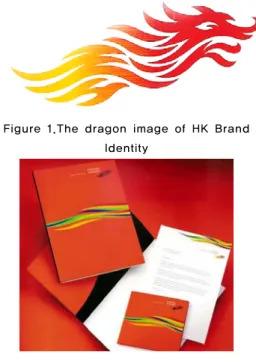
Hong Kong, North America, Australia and Europe. HK BI that a dragon is place with Hong Kong in Chinese characters was adopted and it was considered as the one that international groups accepted and understood. The mild and flexible dragon stands for dynamics and speed and reflects Hong Kong which is constantly changing. The flowing line of the dragon also symbolizes calligraphy of China and convergence of Western and Eastern cultures.
3.3 The successful management of Hong Kong
Brand
There was a broad common understanding in the present position of Brand HK and city brand positioning. According to the research, Hong Kong was thought of as a city which was more positive and stronger than other Asian cities. Brand HK had comparatively higher awareness and familiarity than loyalty and significant consideration. Future of Hong Kong was thought pessimistically. [7]
However, it was found that there were a few city brands which had built holistic city brand systems in the city brand positioning. Most motivations of branding were tourism and the authorities were under the leadership. [7] In this point, Hong Kong took a groundbreaking step on the way of building a city brand. Hong Kong government carried the least leadership and gave agencies the green light to manage professionalism.
Figure 1.The dragon image of HK Brand Identity
Figure 2.HK Brand Identity applications
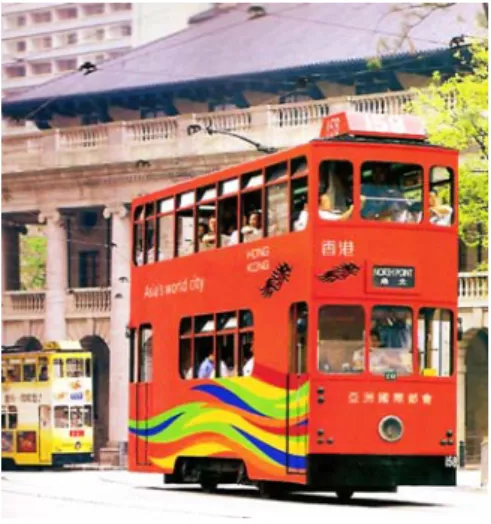
Hong Kong is a successful example of establishment and management of a city brand. The visual identity with a dragon has consistency in displaying itself and delivering the meaning of BI on the websites or media related to the government. The support of the government is also solid.
3.4 The limitation of branding Hong Kong
One thing the government did not consider was, however, the voices of residents in Hong Kong had not been reflected during the process. The process was significantly meaningful. It was not still motivated only by tourism but it has finally been focused on tourism in a great measure. As a result, it has been isolated from real people in Hong Kong. [7]
This is a common mistake to take place when a government carries out a public design project. A focus group in Hong Kong assessed five design samples before the present visual identity was adopted. In actuality, however, the voices of real people were limitedly reflected. Hong Kong is a brand to be seen internationally as innovative, up-to-date, dynamic, intelligent, glamorous, energetic, unique and distinctive, it is not seen as a friendly brand. [2]
The case of Hong Kong provides another suggestion to examine how a city brand meets demands of a government and voices of habitants. At this point, Hong Kong system has things to improve.
Figure 3.HK Brand Identity applications on city train
4. Hi, Seoul
4.1 The foundation of the city marketing
department
The World cup in 2002, which unified the citizens of Seoul and formed very positive image on Seoul, brought the necessity of branding Seoul to strengthen the competitive power and to maintain the favorable city image. Seoul government ended up setting up the city marketing department.
Since then, the department has executed international marketing towards abroad press, public relations of Seoul related to Korean Wave and CRM through marketing support for foreign residence and through convention marketing. They are lack of strategic analysis and plans for raising image of Seoul and brand value. [8]
The implementation of the marketing department is just extended public relations and not the marketing or branding for a city management and not satisfactory enough to upgrade Seoul as an international city fulfilling the requirements of the global era.
4.2 The process of developing Hi, Seoul
Seoul has developed its identity through the top-down system. The top-top-down system of Seoul is based on open competition from its citizens and made a decision by majority. Professionalism and systemicity are followed after the decision is made. Hi, Seoul represents the meaning of harmony of Seoul citizens to be free from regional disagreement, openness and friendship for foreigners. Of course, Hi has the same sound of High, so that it implies the vision of upgrading Seoul as a world-class city whose well-organized systems of transportation, economy, environment and administration.
For the fist time, Seoul planned to execute the basic strategy of city branding spreading this brand identity. The succeeding details have not practiced. The familiarity and reliance are low and does not stand for the identity and vision of Seoul. [8]
Figure 4. Seoul’s BI of Hi Seoul
Figure 5.Seoul’s BI of Hi Seoul applications
4.3 The requirements of branding Seoul
Seoul is demanded a holistic brand management in order to be a creative, dynamic city with consistency and storytelling on design identity providing visitors with memorable experience, priding inhabitants on living in, and convincing stakeholders of potential investment.
Compared to Brand HK’s system and the process of developing identity system, Seoul has not taken professional steps and has been lack of long-term strategy. It was adopted through open competition by citizens of Seoul and it looks like representing the real voices of citizens.
Even though identity of Hong Kong has limited opinions of residents and must be improved, the structured cooperation of Hong Kong government and professional agencies and the organized developing steps conclusively have rebuilt Hong Kong as a successful brand. Seoul must deal with this kind of a city as a benchmark.
5. Conclusion
The city of Hong Kong established a special department named Brand HK having responsibility for developing and maintaining Hong Kong Brand. New York has searched to recreate New York as a sustainable city brand with a marketing strategy agency CMG after 9.11.
Seoul needs to have a master plan for branding itself and the system also needs to change. Seoul was selected as ‘World Design Capital in 2010’. To be a strong city brand, however, Seoul has to understand what touchpoints it has and which ones must stand for it. Each touchpoint offers the opportunity to establish and build our city into positive experience and memory.
References
[1] Han, P.G., et Lee E. J., “Nations’ positioning using tourism image” focused on Korea, Hong Kong, Taiwan and Singapore”, Tourism research, Vol.23, NO.2, pp. 449~467, 2008
[2] J. Winfie-Pfefferkornld., "The Branding of Cities" Syracus University, 2005
[3] Kavaratzis, M. “from city marketing to city branding: Towards a theoretical framework for developing city brand”, Place branding, Vol.1, pp.58~73, 2004
[4] Yim, S.T., "City Branding for developing tourism contents”, Korean Contents Journal, Vol. 8 No. 3, pp. 127~137, 2008
[5] Davis, S. and Longoria, M., “Harmonizing your touchpoints”, Brand packaging, 2003
[6] DESIGN, “Asia’s world city: A manual for city branding Hong Kong”, DESIGN, Vol.296, pp.92~95, 2003
[7] Park, J.H., "Branding a nation, focused on Germany and Hong Kong", Branding Forum, pp. 6~14, 2003
[8] Kim, C.D., “The future work of Public marketing administration: focused on Seoul marketing department” Korean Administration Journal, ,pp. 441~455, 2006