P1-71 / Y. K. Kim
• IMID 2009 DIGEST
Abstract
The electroluminescent devices with the phenylnaphthyldiamine HTMs as the hole-transporting layer were more efficient than that with the biphenyldiamine HTM 1. Particularly, the life-time of the device IV using HTM 2 is about two times longer than that of the reference device III with HTM 1 within the measured current density, indicating more effective recombination at the emitting layer of device IV.
1. Introduction
Since the first report of multi-layered organic light-emitting diodes (OLEDs) [1], many studies have focused on improving device efficiency and enhancing the durability of OLEDs. For the fabrication of highly stable OLEDs, specific optical and electronic properties, such as fluorescence, energy levels, charge mobility etc, and high morphologic stability are required [2-5]. The electrochemical stability of materials used in OLED is very important to improve the device properties. Also, the thermal stability of hole-transporting material is one of the significant factors of the device durability. Under thermal stress, most organic glass transition materials tend to turn into the thermodynamically stable crystalline state, which leads to device failure [6-7]. It is known that an amorphous thin film with a high glass transition temperature (Tg) is more stable to heat
damage [8-12]. In general, high thermal stability,
especially high Tg above 100 °C, good hole
transporting ability, and excellent film formability are essentially needed for the hole-transporting materials. Various triarylamine derivatives have been utilized as hole-transporting materials (HTMs) because of their good film forming capabilities as well as good hole-transporting abilities [4, 12-13]. Recently,
considerable efforts have been devoted to the development of new amorphous triarylamines possessing high morphologic stability [14-19]. We have already reported that the device employing thermally stable hole-transporting materials showed high efficiencies [20-21]. However, we think that these hole-tansporting materials cannot meet high efficiency and long lifetime simultaneously.
In this paper, three advanced HTMs were designed and synthesized to increase the stability of aminyl radical cation which can result in minimizing the cleavage of σ bond in molecules [22-23]. Furthermore resonance effect and steric factor have to be considered to minimize the dimerization reaction in solid state. We focus on these hole-transporting materials with enhanced EL properties.
2. Experimental
The Pd-catalyzed amination reaction of resulting 2-bromo-9,9-dimethyl-9H-fluorene 3 (30 mmol, 8.19 g) with aniline (36 mmol, 3.35 g) was performed by using catalytic amount of Pd2(dba)3 (0.02 mol%, 550
mg) and P(tBu)3 (0.02 mol %, 121 mg) in the presence
of NaOt-Bu (45 mmol, 4.32 g) in dry toluene. The reaction mixture was heated for 3 hours at 85 °C. After cooling, the reaction mixture was pored into water and extracted with diethyl ether. The organic
phase was dried over anhydrous MgSO4 and then the
volatile was removed. The purification of residue by column chromatography on silica gave (9,9-dimethyl-9H-fluoren-2-yl)-phenyl-amine 4a (7.88 g, 92 %). 4b and 4c were synthesized by using corresponding amines, 1-naphthylamine and 4-aminobiphenyl, respectively (Scheme 1).
The phenylnaphthyldiamine derivatives HTM 2-4
Improved Performance of Organic Light-Emitting Diodes
Using Novel Hole-transporting Materials
Young Kook Kim*, Seok-Hwan Hwang, Yoonhyun Kwak, Chang-Ho Lee,
Jeoung-In Yi, Jonghyuk Lee, Sungchul Kim
OLED Development Team, SAMSUNG MOBILEDISPLAY CO., LTD. Giheung-Gu, Youngin-City, Gyeonggi-Do, 446-711, Korea
Tel.: +82-31-209-3853, E-mail: [email protected]
Keywords: Organic light-emitting diodes (OLEDs), hole-transporting material, phenylnaphthyldiamine, radical cation, life-time
P1-71 / Y. K. Kim
IMID 2009 DIGEST •
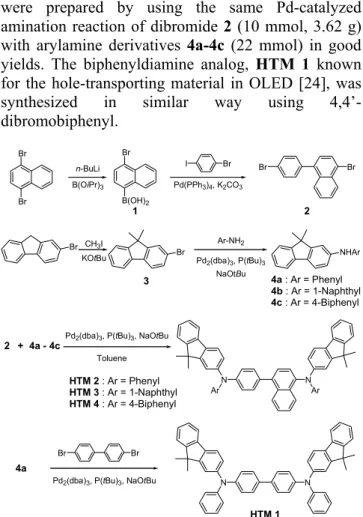
were prepared by using the same Pd-catalyzed amination reaction of dibromide 2 (10 mmol, 3.62 g) with arylamine derivatives 4a-4c (22 mmol) in good yields. The biphenyldiamine analog, HTM 1 known for the hole-transporting material in OLED [24], was synthesized in similar way using 4,4’-dibromobiphenyl. Br B(OH)2 Br Br Br Br CH3I KOtBu NHAr Ar-NH2 Pd2(dba)3, P(tBu)3 Br Br n-BuLi B(OiPr)3 I Br Pd(PPh3)4, K2CO3 1 2 3 HTM 2 : Ar = Phenyl HTM 3 : Ar = 1-Naphthyl HTM 4 : Ar = 4-Biphenyl 2 4a - 4cPd2(dba)3, P(tBu)3, NaOtBu
Toluene N N Ar Ar NaOtBu 4a : Ar = Phenyl 4b : Ar = 1-Naphthyl 4c : Ar = 4-Biphenyl N N 4a
Pd2(dba)3, P(tBu)3, NaOtBu
Br Br
HTM 1 +
Scheme 1. Synthesis of the phenylnaphthyldiamine
derivatives and HTM 1
The radical cations of HTM 2-4 were more stable than that of HTM 1 by two factors. The naphthyl amine radical cation is preferred because it has two more resonance forms than the phenyl analog. It is well known that molecules having more resonace form are more stable. In addition, the naphthyl amine radical cation can be stabilized further by steric effect. A bulky naphthyl moiety that is bigger than phenyl moiety can retard dimerization of radical cations.
The thermal stability data of these three phenylnaphthyldiamine derivatives, HTM 2-4, were investigated by differential scanning calorimetry and thermogravimetric analysis; the results are summarized in Table 1 with the well-known hole-transporting material HTM 1 for comparison.
As shown in Table 1, all three phenylnaphthyldiamine-cored HTMs (HTM 2-4) have
higher value of Tg relative to their biphenyldiamine
analog HTM 1, proofing the high morphologic stability of the amorphous phase in a deposited film, which is a prerequisite for the application in organic electroluminescent devices. The HOMO and LUMO
levels of these phenylnaphthyldiamine derivatives are also listed in Table 1. The HOMO was determined using a photoelectron spectrometer, while LUMO was calculated based on the HOMO energy level and the lowest energy absorption edge of the UV absorption spectrum. The HOMO and LUMO levels of these compounds were measured at ca. 5.40 - 5.45 eV and 2.43 - 2.53eV, respectively.
3. Results and discussion
To evaluate hole-transporting ability of newly synthesized phenylnaphthyldiamine derivative HTM
2, we fabricated the hole-dominant device using HTM 2 as a hole-transporting material with structures as
follows: ITO/2-TNATA/HTM 2/EML/Al (device II).
Figure 1. Structure of EL devices used in this study
On ITO substrate, 4´,4´´-tris(N-(naphth-2-yl)-N-phenyl-amino)triphenylamine (2-TNATA) was previously deposited as a hole-injecting material. IDE 215 doped with 3 % of IDE 118 (host and dopant materials by Idemitsu Co., LTD) was used as blue emitting layer. A reference device I composed of
HTM 1 as a hole-transporting material with the same
thickness was also constructed for comparison (Figure 1).
The current-voltage (I-V) characteristics of the devices are shown in Figure 2. The current density of the device II prepared with HTL 2 is almost twice higher than that of the reference device I (103.4
mA/cm2 vs 58.5 mA/cm2 at 6 V). These outcomes
showed that the hole-transporting ability of a phenylnaphthyldamine-cored HTM 2 was highly improved than that of biphenyldamine-cored HTL 1 due to its more resonance form in the radical cation as well as the steric effect of a naphthyl moiety resulting in efficient carrier transportation characteristics of device I and II.
We also expected the stability of the phenylnaphthyl core is better than that of the biphenyl core since it has more resonance structure and higher
P1-71 / Y. K. Kim
• IMID 2009 DIGEST
Table 1. Physical properties of the phenylnaphthyldiamine derivatives and biphenyldiamine derivative HTM 1
a Obtained from TGA measurement. b Obtained from DSC measurement. c Measured in CH
2Cl2 solution. d Determined by
ultraviolet photoelectron spectroscopy (UPS). e Calculated based on the HOMO level and the lowest energy absorption edge of the UV spectrum. 4 6 8 0 50 100 150 200 250 300 350 400 C urrent de nsity (mA/cm 2) Voltage (V) Device I Device II
Figure 2. Current density-applied voltage
characteristics of device I and II
radical stability. Three EL devices as shown in Figure
1, ITO/2-TNATA/HTM 2/EML/Alq3/LiF/Al (device
IV), ITO/2-TNATA/HTM 3/EML/Alq3/LiF/Al
(device V), and ITO/2-TNATA/HTM
4/EML/Alq3/LiF/Al (device VI), were fabricated in
order to estimate their suitabilities as a hole transporting material in comparison with the reference
device; ITO/2-TNATA/HTM 1/EML/Alq3/LiF/Al
(device III). Figure 3 shows the luminance and the applied voltage characteristics in the four devices. The
luminance of the device IV reached 4,561 cd/m2 at
6.5V.
Surprisingly, the devices IV-VI with HTM 2-4 as a hole-transporting material showed a significant enhancement of the luminous efficiency compared to reference device III.
The luminous efficiency of the device IV is about 40% higher than that of the device III. The luminous efficiencies of other two devices were also higher than that of the device III. The luminous efficiencies of the device IV-VI with HTM 2-4 were 8.52, 7.98 and 7.50 cd/A, respectively. Table 2 shows the EL performances of all devices at 6.5V.
As shown in Table 2, the devices IV-VI using HTM
2-4 as a hole-transporting material showed remarkable
4 5 6 7 8 2000 4000 6000 8000 10000 12000 14000 16000 Lu m inan ce ( cd/ m 2) Applied Voltage (V) HTM 1 HTM 2 HTM 3 HTM 4
Figure 3. Luminance-applied voltage characteristics
of devices III-VI
Table 2. EL performance of four devices III-VI at 6.5V
Device Current density
(mA/cm2) Luminance (cd/m2) Current efficiency (cd/A)
Device III 39.01 2383.2 6.11 Device IV 53.54 4561.6 8.52 Device V 46.48 3708.9 7.98 Device VI 53.87 4041 7.50 0 50 100 150 200 250 300 350 400 450 500 50 60 70 80 90 100 110 Lumina nce (% ) Time (h) HTM 1 HTM 2
Figure 4. The life-time characteristics of the two
devices at 100mA/cm2; device III (■), device IV (●)
current density and current efficiency performance compared to the reference device III.
Compounds Tda (°C) Tgb (°C) Tmb (°C) Tcb (°C) λmaxc (nm) HOMOd (eV) LUMOe(eV)
HTM 1 HTM 2 HTM 3 HTM 4 380 395 430 423 121 159 167 174 264 296 225 255 NA NA NA NA 360 342 355 353 5.40 5.40 5.45 5.45 2.38 2.43 2.53 2.48
P1-71 / Y. K. Kim
IMID 2009 DIGEST •
In other words, it is thought that phenylnaphthydiamine derivatives HTM 2-4 have superior hole-transporting abilities than biphenyldiamine derivative HTM 1.
Figure 4 shows the life-time characteristics of the device IV and the reference device III. The life-time of the device IV is about two times longer than that of the standard device III within the measured current density, indicating more effective recombination at the emitting layer of device IV. These results indicated that phenylnaphthyldiamine derivatives have higher hole-transporting abilities and stabilities toward electric current than that of biphenyldiamine derivative.
4. Summary
We designed and prepared phenylnaphthyldiamine derivatives as a hole-transporting material. These materials having naphthalene moiety are more stable in radical cation state because of more resonance form and sterically more favored than that of phenyl moiety because of retardation of dimerization reaction. These two factors can contribute to the enhancement of the hole-transporting ability resulting in better OLED performance. The device of fluorescent blue OLED using phenylnaphthyldiamines as the hole-transporting layer have much better overall EL performance than the reference device with biphenyldiamine layer. Phenylnaphthyldiamines were found to be good hole-transporting materials for highly efficient OLEDs resulting in lower operating voltage, higher efficiencies and longer life-time.
5. References
1. C. W. Tang, S. A. Van Slake, Appl. Phys. Lett., 51, 913 (1987).
2. Y. Shirota, J. Mater. Chem., 10, 1 (2000).
3. T. Fuhrmann, J. Salbeck, Advances in Photochemistry (eds., D. C. Neckers, D. H. Volman, G. von Bünau), Vol. 27, Wiley, New York (2002).
4. U. Mitschke, P. Bauerle, J. Mater. Chem., 10, 1471 (2000).
5. J. Kido, Bull. Electrochem. 10, 1 (1994).
6. S. Tokito, Y. Taga, Appl. Phys. Lett., 66, 673 (1995)
7. P. F. Smith, P. Gerroir, S. Xie, A. AM. Hor, Z.
Popovic, M. L. Hair, Langmuir, 14, 5946 (1998) 8. K. Naito, A. Miura, J. Phys. Chem., 97, 6240
(1993).
9. S. Tokito, H. Tanaka, K. Noda, A. Okada, Y. Taga, Appl. Phys. Lett., 70, 1929 (1997).
10. B.E. Konne, D.E. Loy, M.E. Thompson, Chem. Mater., 10, 2235 (1998).
11. F. Steuber, J. Staudigel, M. St¨ossel, J. Simmerer, A. Winnacker, H. Spreitzer, F. Weiss¨ortel, J. Salbe´ck, Adv. Mater., 12, 130 (2000).
12. P. Strohriegl, J.V. Grazulevicius, Adv. Mater., 14 (2002) 1439.
13. L. S. Hung and C. H. Chen, Mater. Sci. Eng.,
R39, 143 (2002).
14. M. Thelakkat and H. Schmidt, Adv. Mater., 10, 219 (1998).
15. K. Katsuma and Y. Shirota, Adv. Mater., 10, 223 (1998).
16. I. Y. Wu, J. T. Lin, Y. T. Tao, E. Balasubramaniam, Y. Z. Su and C. W. Ko, Chem. Mater., 13, 2626 (2001).
17. C. W. Ko and T. Tao, Synth. Met., 126, 37 (2002). 18. K. T. Wong, Z. J. Wang, Y. Y. Chien and C. L.
Wang, Org. Lett., 3, 2285 (2001).
19. D. E. Loy, B. E. Konne and M. E. Thompson, Adv. Funct. Mater., 12, 245 (2002).
20. Y. K. Kim and S. H. Hwang, Chem. Lett., 35, 120 (2006).
21. Y. K. Kim and S. H. Hwang, Synth. Met., 156, 1028 (2006).
22. A. C. Albrecht and W. T. Simpson, J. Am. Chem. Soc., 77, 4453 (1955).
23. a) J. Fossey, D, Lefort, and S. Janine, Free Radicals in Organic Chemistry, chapter 4, Willy, New York, (1995). b) H. G. Viehe, Z. Janousek, R. Merenyi and L. Stella, Acc. Chem. Res., 18, 148 (1985).
24. a) A. Sellinger, R. Tamaki, R. Laine, M. Richard M. K. Ueno, H. Tanabe, E. Williams and G. G. E. Jabbour, Chem. Comm., 29, 3700 (2005). b) K. Okinaka, A. Saitoh, T. Kawai, A. Senoo and K. Ueno, Digest of Technical Papers - Society for Information Display International Symposium, 35, 686 (2004).