© Korean Powder Metallurgy Institute 1080 -1. Introduction
B4C based ceramics exhibits many attractive properties
for structural materials such as high melting point, low density, good chemical stability, high wear resistance, and high hardness, which enables them to be used for wear resistant parts, light weight armor, and cutting tool [1-4]. However, B4C-based ceramics have some major problems
such as low strength and fracture toughness compared with other competitive engineering ceramics such as Si3N4 and
SiC. Furthermore, B4C-based ceramics have very poor
sinterability due to its low self diffusion coefficient. Many researches have been performed to improve the mechanical properties as well as sinterability of B4C-based ceramics
[3-12]. The studies reveal that it would be a challenge to achieve both improvements in sinterability and mechanical properties. Therefore, in this study, reactive sintering process was performed to prepare fully dense B4C-based
ceramic composites by adding SiC and TiC into B4C matrix
at a relatively low temperature. The effect of adding SiC and TiC on sinterability and mechanical properties of B4C-based ceramic composites was investigated.
2. Experimental and Results
In this study, B4C, TiC, and SiC powder were used as
starting materials. B4C, SiC, and TiC powder were mixed
with a composition of B4C : SiC : TiC = 50~75 : 20 :
5~30 in wt. % using SPEX™ mill for 10 min in Ar atmosphere. B4C-based ceramic composites were fabricated
by hot pressing at the temperature range of 1950 oC under
40 MPa for 0.5 h in Ar atmosphere. After the fabrication process, phase identifications of fabricated B4C-based
ceramic composites were done by X-ray diffraction (XRD) method with Cu-k radiation. The polished surface of fabricated B4C-based ceramic composites was electrochemically
etched in 20% HNO3 solution, and then examined by
scanning electron microscope (SEM). The three-point bending tests were performed to measure the toughness by single edge notched beam method of B4C-based ceramic
composites specimen with dimensions of about 3 x 4 x 25 mm.
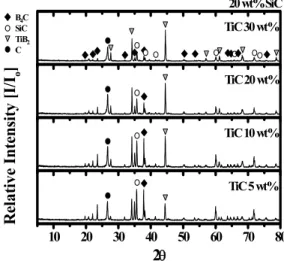
Fig.1 shows XRD patterns of fabricated B4C-based
ceramic composites by hot pressing. The crystalline phases in B4C-based ceramic composites comprise B4C, TiB2, SiC,
and graphite. With increasing TiC content in starting
10 20 30 40 50 60 70 80 20 wt% SiC TiC 5 wt% R elat ive In te ns it y [I /Io ] 2θ TiC 10 wt% TiC 20 wt% TiC 30 wt% B4C SiC TiB2 C
Fig. 1. XRD patterns of B4C composites fabricated by
hot pressing at 1950 oC.
2006 POWDER METALLURGY World Congress
PC03-W-16
Reaction Synthesis and Mechanical Properties of
B
4C-based Ceramic Composites
Jae-Ho Han 1,a, Sang-Whan Park 2,b and Young-Do Kim 1,c 1
Division of Materials Science & Engineering, Hanyang Univ., Seoul 133-791, Korea
2
Multifunctional Ceramics Research Center, KIST, Seoul, Korea
a
[email protected], [email protected], [email protected]
Abstract
In this investigation, B4C based ceramic composites were fabricated by in-situ reaction hot pressing using B4C, TiC and
SiC powder as starting materials. The reaction synthesized composites by hot pressing at 1950 oC was found to posses
very high relative density. The reaction synthesized B4C composites comprise B4C, TiB2, SiC and graphite by the reaction
between TiC and B4C. The newly formed TiB2 and graphite was embedded both inside grain and at grain boundary of
B4C. The mechanical properties of reaction synthesized B4C-TiB2-SiC-graphite composites were more enhanced compared
to those of monolithic B4C.
© Korean Powder Metallurgy Institute 1081
-materials, intensities of XRD peaks for TiB2 and graphite
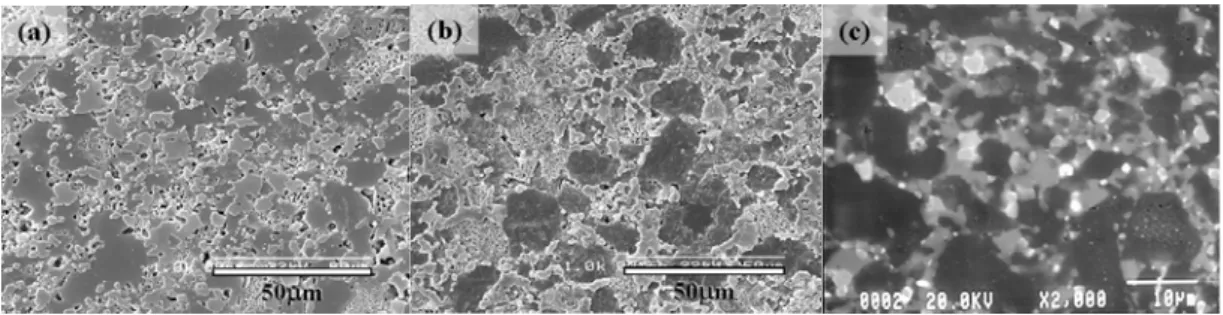
increases as shown in Fig. 1. Fig. 2 shows the SEM microstructures of fabricated B4C-based ceramic
composites. SiC and newly formed phases were relatively well distributed inside B4C grain as well as along the B4C
grain boundaries. With increase TiC content, newly formed phases and SiC dispersions formed another interconnected matrix along with B4C matrix. From the EDS analysis,
dispersions as shown in Fig. 3(c), the gray colored and white colored phase were identified as SiC and newly formed TiB2 phase, respectively. Fig. 3 shows the flexural
strength and fracture toughness of B4C-based ceramic
composites fabricated in this study.
5 10 15 20 25 30 0 350 400 450 500 550 600 0 7 8 9 10 11 12 Fr ac tu re t oug hness [ MP a m 1/ 2 ] F lexural str e ngt h [ M P a ] TiC contents [wt.%] Flexural strength Fracture toughness
Fig. 3. Flexural strength and fracture toughness of B4C
composites fabricated by hot pressing.
Both flexural strength and fracture toughness of B4C-based ceramic composites almost linearly increase
with the content of TiC in the starting material. For the B4C-based ceramic composites with TiC content of 30 wt.%,
flexural strength and fracture toughness were about 570 MPa and 9.5 MPam1/2, respectively.
3. Summary
In this study, B4C-TiB2-SiC-graphite composites were
synthesized by reactive hot pressing using B4C, TiC and
SiC powder as starting materials. The mechanical properties of reaction synthesized B4C-TiB2-SiC –graphite composites
fabricated in this study showed significant improvements compared to those of monolithic B4C and other B4C-based
ceramic composites reported in the previous studies. The flexural strength and fracture toughness of these in-situ B4C
synthesized composites were 400-570 MPa and 6-9.5 MPam1/2, respectively. The enhanced fracture toughness of
B4C based ceramic composites are considered to be due to
the severe crack deflection at the phase boundary between B4C matrix and dispersions consisting of SiC and TiB2,
which occur by residual stress from the difference in thermal expansion coefficients of B4C, SiC, and TiB2 upon
cooling from the fabrication temperature. 4. References 1. H. Nishikawa: Ceramics Vol. 22 (1987), p. 40
2. W. C. Johnson.: Am. Ceram. Soc, Bull. Vol. 80 (2001), p. 64 3. F. Thevenot: J. Eur. Ceram. Soc. Bull. Vol. 6 (1990), p. 205 4. F. Thevenot: Key Eng. Mat. Vol. 56-57 (1991), p. 59 5. K. Schwetz, et al.: J. Solid State Chem. Vol. 133 (1997), p. 68 6. L. S. Sigl: J. Eur. Ceram. Soc. Vol. 18 (1998), p. 1521 7. D. K. Kim and C. H. Kim: Adv. Ceram. Mater. Vol. 3 (1988), p. 52 8. G. J. Zhang, et al.: Mater. Lett. Vol.25 (1995) p. 97
9. S. Yamada, et al.: J. Eur. Ceram. Soc. Vol. 23 (2003) p. 561 10. Z. Yuhua, et al.: Mater. Res. Bull. Vol 39 (2004), p. 1615 11. S. Li, et al.: Mater. Lett. Vol. 57 (2003), p. 1445-1452(2003) 12. S. Li: Mater. Sci. & Eng. A Vol. 332 (2002), p. 37