29
Exploring White Preservice Mathematics Teachers’
Racial Identity and Culturally Relevant Teaching
Practices
Eunhye Cho(Graduate Student)
1, Lillie R. Albert(Professor)
2,
Sunghwan Hwang(Teacher)
3*1 Boston College, [email protected] 2 Boston College, [email protected]
3 Seoul Gaju Elementary School, [email protected]
(Received March 8, 2021; Revised March 26, 2021; Accepted March 30, 2021)
The purpose of this study was to examine what factors affect the construction of preservice white mathematics teachers’ racial identities and the relationship between their racial identities and Culturally Relevant Teaching (CRT) practices. We examined five white female preservice teachers who enrolled in an elementary mathematics methods course at a private university in the US. We collected data consisting of lesson plans, semi-structured interviews, and reflection of a taught lesson in the 2018 fall term and examined them using qualitative research methods. We found that preservice teachers’ racial identities were affected by their backgrounds, K-12 school experiences, and practicum school environment. We also found a relationship between teachers’ sensitivity to racial issues and their endorsement of CRT strategies. The findings also revealed that the relationships were mediated by practicum school contexts. Based on the findings, we provided practical implications for the teacher education programs.
Keywords: racial identity, culturally relevant teaching, preservice mathematics teacher,
practicum
MESC Classification: B50, D40 MSC2010 Classification: 97D80, 97B50
I. INTRODUCTION
The United States (US), as one of the most heterogeneous countries globally, is known for its racial diversity. As students with various racial backgrounds learn mathematics in the same classrooms, teachers are expected to modify their teaching strategies considering
the students’ backgrounds (Ladson-Billings, 1995). However, not all teachers were able to successfully modify teaching strategies to involve all students in mathematics learning.
Teachers have various racial identities based on their family backgrounds, K-12 learning experiences, teacher education programs, and practicum (Bollin & Finkel, 1995; Liggett, 2009; McIntyre, 1997). These experiences have them to construct a particular type of racial identity, which has them embrace or eschew to talk about racial and cultural issues in classrooms (Haviland, 2008; Milner, 2017). Teachers’ racial identities affect their instructional practices (Delpit, 2006; Matias & Mackey, 2016; Picower, 2009; Sleeter, 2001; Vaught & Castagno, 2008). They decide how to teach mathematics based on their perception of race and culture in mathematics learning. For example, some mathematics teachers encourage their students to use their respective home languages, as well as “standard white English (Smitherman, 1973),’’ so they can comfortably express themselves at school, which can ultimately help them develop their academic skills while remaining grounded in their home culture (Ladson-Billings, 1995). Other teachers might ask students only to use English in classroom, regardless of their English proficiency. They might also use mathematical contexts, such as American football games, which students from other countries are not familiar with the term. Consequently, students who are familiar with English and a certain mathematical context tend to have higher achievement than students who are not. Therefore, mathematics teachers should have adequate racial identity and teaching practices to support students’ mathematical learning.
Studies have shown that most US teachers do not shape racial identities that fully support learning of marginalized students (Picower, 2009). As most of them grew-up in white-dominant environments with less exposure to those of other races, they have difficulties noticing racial and cultural issues and understanding challenges of marginalized students’ learning. As a result, only a few teachers could modify tasks and teaching practices considering students’ backgrounds (Ladson-Billings, 1995). Therefore, researchers have claimed that teacher education programs should help preservice teachers construct adequate racial identity and culturally relevant teaching (CRT) practices to meet the needs of diverse learners. As preservice teachers are in the middle of racial identity construction stage, they start to construct a more concrete racial identity by learning from teacher education programs and practicum experiences. Moreover, compared to in-service teachers who are unlikely to change their teaching practices, preservice teachers are more malleable and likely to accept new teaching practices (e.g., CRT) according to various learnings.
Despite increasing research on teachers’ racial identities and CRT, preservice mathematics teachers’ identities and CRT practices have gained little attention (Banks & Banks, 2019; Milner, 2017). While researchers have reported that teachers’ perception toward race, culture, and identity issues affect their instructional practices and student outcomes (Martin, 2009; Nasir, 2002), limited research has been conducted to examine
white preservice mathematics teachers’ racial identities and teaching practices and relationship between them. Therefore, the purpose of this study was to examine what factors affect the construction of white preservice mathematics teachers’ racial identities and the relationship between their racial identities and CRT practices. The present study aims to address the following research questions:
1. What are the factors affecting the construction of white preservice mathematics teachers’ racial identities?
2. What culturally relevant teaching strategies do white preservice mathematics teachers integrate into their practicum classrooms?
3. How are white preservice mathematics teachers’ racial identities associated with their implementation of culturally relevant teaching strategies in practicum classrooms?
In the following section, we examined the relevant literature associated with whiteness, racial identity, and CRT. Next, we discuss findings of white preservice teachers’ racial identities and CRT practices. The final sections comprise discussions and implications indicating how this study affects teacher education programs in international contexts to be more culturally appropriate and teacher education programs in international contexts with emerging diversity in their classrooms.
II. LITERATURE REVIEW
1. WHITENESS AND RACIAL IDENTITY
The term of whiteness has commonly used to describe the privilege of white negatively. Applebaum (2016) reported that whiteness is represented as “culturally, socially, politically, and institutionally produced and reproduced systems of institutional processes and individual practices that benefit white people while simultaneously marginalizing other” (p. 3). Thus, whiteness is an assumption that being born a white person entails this individual inherits and reproduces the meaning of whiteness constructed through the symbolic systems of the world. As white people are naturally exposed to these circumstances, some white people consciously and unconsciously (re)interpret and (re)produce Whiteness (Dixon-Román, 2017). In the educational field, previous studies on whiteness primarily focused on teachers’ whiteness and its repercussions on institutional context (Barnes, 2017; Jupp & Slattery, 2010). For example, McIntyre (1997) examined a group of white preservice middle school teachers and reported that they are out of being responsible for racism, which is considered a phenomenon in society. Moreover, the
teachers eschewed talking about racial issues in the classroom.
However, more studies have found that white teachers possess a different level of whiteness based on their personal experiences. Therefore, more studies have focused on the construction of white teachers’ racial identities, shaping their whiteness by considering the role of context (Flintoff, Dowling, & Fitzgerald, 2015; Gomez, Allen, & Clinton, 2004; Haviland, 2008). Gee (2001) described four factors affecting the construction of persons’ identities: nature, institution, discourse, and affinity. Therefore, white preservice teachers attending the same teacher college program could have different racial identities based on their physical environment that a person has been given (nature), school experiences (institution), conversation with others (discourse), and experiences with close socializers (affinity). Downey and Cobbs (2007) examined how field experience affects racial identities of preservice teachers and found that the field experience made them reflect previous mathematics instruction and realize students’ diverse needs related to their cultural backgrounds. Consequently, the teachers developed a new racial identity that was more sensitive to racial issues.
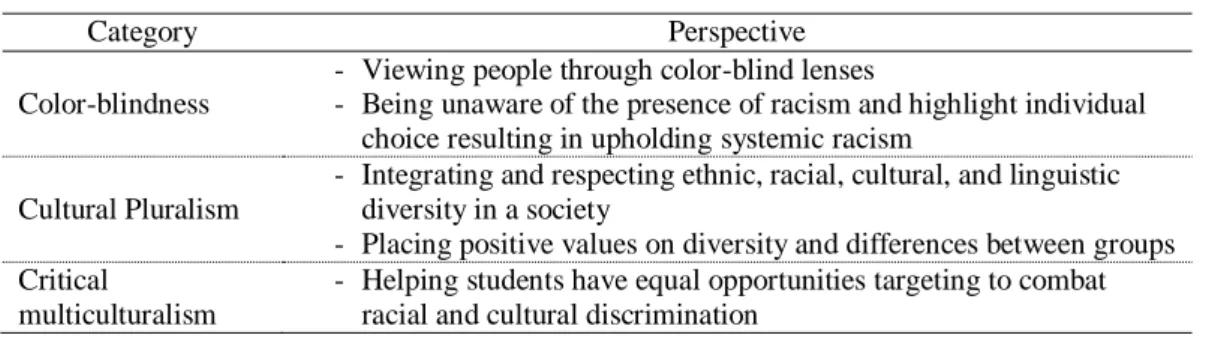
Researchers have suggested several categories to classify teachers’ racial identities (McLaren, 1994; Solomona, Portelli, Daniel, & Campbell, 2005). However, they could generally be classified into color blindness, cultural pluralism, and critical social justice perspective (See Table 1.). As a hierarchical structure, teachers with social justice perspectives are the most sensitive to inter-racial issues. Color-blindness is an ideology that skin color is insignificant and does not take race into account (Neville, Awad, Brooks, Flores, & Bluemel, 2013). This perspective involves understanding that race should not matter in understanding individuals’ experiences (Tran & Paterson, 2015), and race privilege no longer prevails as it used to be. This perspective views differences between people as stemming from individual choice or personal characteristics and ignores systemic racism and racial stratification. Cultural pluralism is referred to by various names, such as ethnic pluralism and biculturalism. Cultural pluralism relies on the concept that ethnic, racial, cultural, and linguistic diversity of the groups has been recognized and respected in a society (Banks & Banks, 2019). Each group is considered to have unique identities, and society needs to integrate those diverse cultures. In this pluralistic society, the value that a citizen should develop is tolerance to “other” cultures. The commonality of these terms claim that various groups should fully participate in their sub-societies but have allegiances to the larger society such as nation and accept its idealized values (James, 1977). The final stance, critical multiculturalism, is characterized by individual’s attitudes to reflect on racial issues that emerged at various levels and act on racism at a societal level (Bensimon, 1994; McLaren, 1994).
This version of multiculturalism does not see cultural diversity as a goal but rather a commitment to the emancipatory action for self-empowerment and social transformation.
white teachers who endorse this perspective appraise racism and “internalize a multicultural identity with nonracist white identity as its core (Utt & Tochluk, 2020, p. 128).”
Table 1. Perspective of each stage of racial identity
Category Perspective
Color-blindness
- Viewing people through color-blind lenses
- Being unaware of the presence of racism and highlight individual choice resulting in upholding systemic racism
Cultural Pluralism
- Integrating and respecting ethnic, racial, cultural, and linguistic diversity in a society
- Placing positive values on diversity and differences between groups Critical
multiculturalism
- Helping students have equal opportunities targeting to combat racial and cultural discrimination
2. CULTURALLY RELEVANT TEACHING
The increasing incongruence between a predominantly white teacher population and racially diverse student population calls for teachers to reflect on their teaching methods to determine the most appropriate method in serving diverse students’ needs and interests (Dornoo, 2014). Ladson-Billings (1995) conceptualized CRT pedagogy in a mathematics classroom and reported that culturally relevant teachers “utilize students’ culture as a vehicle for learning” (p. 161). In CRT practices, teachers allow students to incorporate their cultural assets and help them critique the status quo. Moreover, teachers ensure to apply interactively and create an approach to their classroom in reaching students with diverse needs taking into account their ethnic identities and cultural backgrounds, which can improve student outcomes (Gay, 2010; Irvine & Armento, 2001). A vision of CRT advocating the inclusion of diverse students in the major mathematics curriculum standards has been observed (Common Core State Standards Initiative [CCSSI], 2010; National Council of Teachers of Mathematics [NCTM], 2000). NCTM clarified equity principle that underlies ideals for high-quality mathematics education that mathematics teachers should consider in the development of curriculum and instruction across all grade levels. The equity principle refers to “Excellence in mathematics education requires high-quality expectations and strong support for all students” (p. 12). CCSSI (2010) also conveys an overview of guiding principles that students should be equally served in the mathematics classroom. Therefore, CRT is not an option in mathematics curriculum and instruction, but a mandatory principle should be integrated into the mathematics classroom.
Studies showed that teachers’ CRT practices are related to their racial identities (Ladson-Billings, 1995; Milner, 2017). Teacher’s lack of racial awareness protects them from implementing culturally relevant instruction (Young, 2010). For example, a white female
teacher, Ms. Rossi, in Ladson-Billings’ (1995) study, encouraged her African American students to take on academic leadership, believing that they can exert social power. She engaged her students in higher levels of mathematical activities. Because Ms. Rossi is an Italian American woman (nature) and taught and interacted with students in various school contexts (institution and discourse), including students from low socioeconomic status, she could adjust her lessons to keep entire students be engaged in several mathematical activities. Other white teachers, however, might unconsciously favor white students with similar backgrounds with them and discriminate non-white students with different racial and cultural backgrounds (Ladson-Billings, 1995).
Relating to CRT, Haviland (2008) proposed power-confronting and power-maintaining strategies in class. Teachers using power-confronting strategies might acknowledge differences between students and critic stereotype-teaching practices. They modify mathematical tasks in textbooks and devise a teaching strategy to support learning of non-white marginalized students and willing to discuss equity issues. Moreover, these teachers encourage students to bring their cultural artifacts to classroom and use them as tools in teaching mathematics. Teachers adopting power-maintaining strategies, however, might accept stereotypes without questioning and avoid discussing inequality issues. They also ignore students’ differences and ask students to solve problems using one strategy only. Moreover, Dornoo (2014) identified the following five CRT strategies in the mathematics classroom: (a) preservice teachers tended to believe students demographics need to be observed as they have different learning styles; (b) differentiated teaching is needed to accommodate the level of students’ potential, background, and experiences using various teaching methods; (c) math should be inclusive for all students regardless of their race, gender, home language, and socioeconomic status by connecting their real-world community situations to school knowledge; (d) students’ prior knowledge should be clarified and valorized in planning lessons; and (e) resources and supplies should be sufficient for all students, particularly for relatively disadvantaged students due to their socioeconomic status.
As a site for developing teacher’s racial identities and their pedagogical approaches, experience in teacher education programs plays a critical role in building their teaching philosophy, which may continue in their long teaching careers. Talking about race helps preservice white teachers modify their inadequate racial identities and gain knowledge and skills for CRT (Howard & del Rosario, 2000; Sleeter, 2016). However, only a few empirical studies have been conducted to examine CRT practices of preservice mathematics teachers focusing on a deep analysis of racial issues (Dornoo, 2014; Downey & Cobbs, 2007). In this regard, this study examines racial identities and CRT practices of preservice mathematics teachers and relationship between them.
III. METHODS
1. STUDY PARTICIPANTS
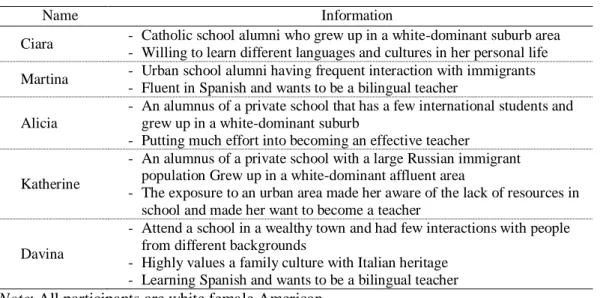
The participants of this exploratory study are selected among the students who enrolled in an elementary mathematics methods course at a private university in the US during the 2018–2019 academic year. The course emphasized equity and justice practices in education and introduced CRT practices in mathematics classrooms. As a requirement of a course, students were asked to teach mathematics lessons incorporating CRT strategies at pre-practicum schools. Of the ten preservice teachers who volunteered to participate in this research, the following five white female preservice teachers showing contradictory racial identity were selected: Ciara, Martina, Alicia, Katherine, and Davina (all names are pseudonym). Basic information of the participants is summarized in Table 2. They all completed their practicums in racially and ethnically diverse classrooms in urban school districts.
Table 2. Information on participants
Name Information
- Ciara - Catholic school alumni who grew up in a white-dominant suburb area - Willing to learn different languages and cultures in her personal life - Martina - Urban school alumni having frequent interaction with immigrants
- Fluent in Spanish and wants to be a bilingual teacher - Alicia
- An alumnus of a private school that has a few international students and grew up in a white-dominant suburb
- Putting much effort into becoming an effective teacher - Katherine
- An alumnus of a private school with a large Russian immigrant population Grew up in a white-dominant affluent area
- The exposure to an urban area made her aware of the lack of resources in school and made her want to become a teacher
- Davina
- Attend a school in a wealthy town and had few interactions with people from different backgrounds
- Highly values a family culture with Italian heritage - Learning Spanish and wants to be a bilingual teacher Note: All participants are white female American
2. DATA COLLECTION
We explained the research’s goal and procedures and collected consent forms from interested participants. Then, we collected data consisting of lesson plans, semi-structured interviews, and reflection of a taught lesson in the 2018 fall term. Interview data were used as the main source of the study data, and other data were secondarily used when we need to check the accuracy of our interpretation of the interview data sets. For individual
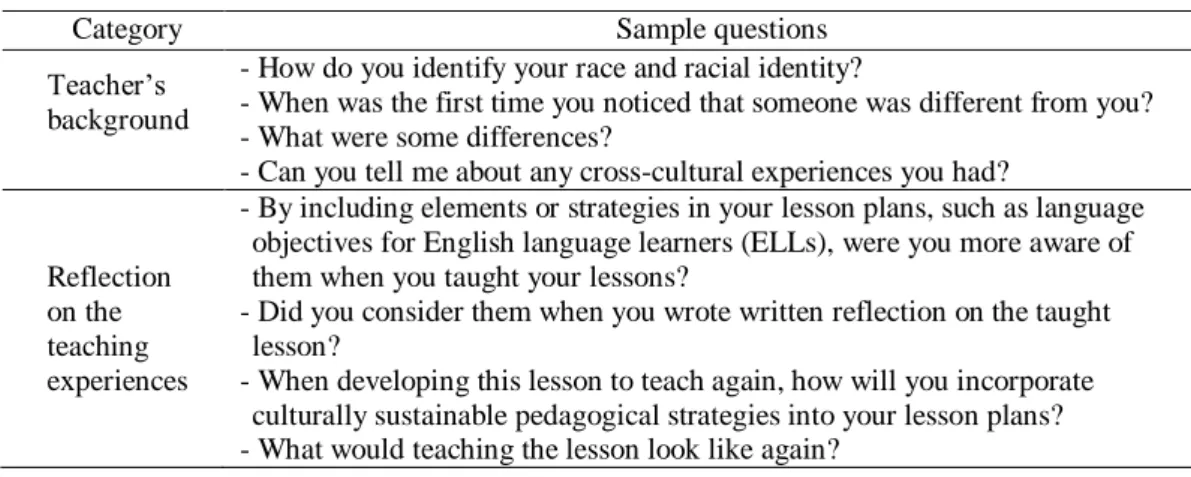
participants, semi-structured interviews were conducted in a private location on campus, audio recorded and transcribed. The interview protocols consist of questions about (1) preservice teacher’s background and (2) reflection on the lesson plan designing and teaching experiences in the mathematics classroom. The former and latter questions were designed to examine racial identity and the CRT practices of preservice teachers during practicum. Sample interview questions are presented in Table 3.
Table 3. Sample interview questions
Category Sample questions
- Teacher’s background -
- How do you identify your race and racial identity?
- When was the first time you noticed that someone was different from you? - What were some differences?
- Can you tell me about any cross-cultural experiences you had?
- Reflection on the teaching experiences
- By including elements or strategies in your lesson plans, such as language objectives for English language learners (ELLs), were you more aware of them when you taught your lessons?
- Did you consider them when you wrote written reflection on the taught lesson?
- When developing this lesson to teach again, how will you incorporate culturally sustainable pedagogical strategies into your lesson plans? - What would teaching the lesson look like again?
3. DATA ANALYSIS
The exploratory study focused on how white preservice teachers construct their identities and how their racial identities are related to their CRT practices. To achieve these goals, the interview data were transcribed first and analyzed through racial identity and CRT practices. Regarding racial identity, we dissected and compared what and how each participant talked about their racial identity backgrounds based on Gee’s discourse framework, including nature, institution, discourse, and affinity.
Then, we classified each teacher’s racial identity into one of the following three types of racial identity based on literature reviews (McLaren, 1994; Neville et al., 2013; Tran & Paterson, 2015): color blindness, cultural pluralism, and critical social justice perspective. Haviland’s (2008) and Dornoo’s (2014) studies were used to examine white preservice mathematics teachers’ CRT strategies and CRT practices. We focused on what culturally relevant teaching strategies preservice teachers used in the mathematics classroom. Then, the relationship between racial identity and CRT practices was examined.
IV. RESULTS
This section elaborated on white preservice teachers’ adoption of CRT practices in mathematics classrooms, which were associated with their racial identities. Based on the analysis of their discursive strategies that revealed their motivation, practice, and reflection of the CRT, along with their racial identity, we can identify the following three types of racial identity and CRT approach: (a) color-blindness and avoidance of CRT; (b) cultural pluralism and acknowledgment of CRT; (c) critical multiculturalism and engagement of CRT (See Table 4). Table 5 shows the relationship between racial identity and teaching strategies.
Table 4. Each teacher’s racial identity and CRT practices
- Name Ciara Alicia Katherine Davina Martina - Racial identity
Color-blindness Cultural pluralism Critical multiculturalism - CRT practices Avoidance of CRT Acknowledgment of CRT Engagement of CRT Table 5. Relationship Between Racial Identity and Teaching Strategies
- Category - Perspective - Classroom strategy
- Color-blindness
- Viewing people through color-blind lenses
- Being unaware of the presence of racism and highlighting individual choice, resulting in upholding systemic racism
- Teachers do not validate their students’ racial identities.
- Cultural pluralism
- Integrating and respecting ethnic, racial, cultural, and linguistic diversity in a society
- Placing positive values on diversity and differences between groups
- Teachers include the contents and themes of race, culture, and ethnicities without changing the curriculum structure.
- Critical
multiculturalism
- Helping students have equal opportunities targeting to combat against racial and cultural discrimination
- Teachers change the structure of the curriculum and educate students for social change
1. COLOR- BLINDNESS AND AVOIDANCE OF CULTURALLY RELEVANT TEACHING
The color-blind approach is the positionality of white people who are unlikely to notice disadvantage due to race held by being unaware of, neglecting, ignoring, or denying
negative experiences of people of color (Fryberg, 2010). Ciara grew up in a “primarily white” environment that “lack diversity.” She situated herself as being isolated from other races and experiences accompanied by those races. During her private school time, she was taught what she defined as “Catholic value,” emphasizing the nature of universality, such as “We are all part of a community,” rather than focusing on cultural differences in each subgroup. As a community member, paying attention to “individuals” is emphasized more than illuminating the different experiences that emerged from cultural and racial groups. She assumed that her private school experience had shaped her value, stating that “(we need to) respect and care for everyone, regardless of their religion or race.” However, she was not aware of “how to talk about race” and did not feel comfortable, because she felt herself “stuck in a bubble of white culture.” Even after attending college, she still felt she struggled with encountering racial ideology-related experiences and issues. She stated, “I cannot even define my (white) culture.” She normalized white culture by saying, “White has no culture,” which is aligned with the belief that white is normal and unauthentic (Hughey, 2010).
Ciara attended an urban elementary school in which the majority of students were bilinguals and who immigrated from different countries. During a mathematics lesson, she taught how to compare numbers of objects in a group, applying the concept of ‘‘greater than, less than, and equal’’ using unifix cubes. Her lesson focused on teaching mathematical knowledge of number comparisons. She did not take the individual students’ differences into account and strictly checked their mathematical performance according to learning objectives. She stated that she was unable to talk about racial and cultural issues in mathematics classrooms and design a lesson from a CRT perspective for the following three reasons: The first reason was the influence of a supervisor teacher at the practicum school. The teacher did not see the value of CRT and prohibited Ciara from having a racialized talk. Ciara’s supervisor explicitly expressed that she did not want Ciara to incorporate cultural components in her mathematics lesson plan, “She did not want me to include it because it’s like you choose only one culture from multiple cultures.”
Second, Ciara found that the time for a mathematics lesson was restricted as it had to cover the mathematics topics suggested in the Common Core Standards in Mathematics. She said, “I couldn’t include a book about cultures due to the time constraint, too.” Third, Ciara had no idea how to incorporate CRT strategies into mathematics lessons owing to lack of race-related experiences and knowledge. She said, “I don’t know how to teach mathematics using CRT strategies.” In sum, Ciara shaped her racial identity by perceiving that we are all individuals who prevent us from talking about race. Furthermore, because of her practicum school environment and her inexperience with CRT, she did not implement the CRT strategies she learned in her teacher preparation program.
2. CULTURAL PLURALISM AND ACKNOWLEDGMENT OF CULTURALLY RELEVANT TEACHING
Alicia, Katherine, and Davina are aware of the cultural and racial identities in which various minoritized groups of society share and believe that values and practices of these groups should be valued by a larger society. They noticed some challenges and benefits that white people disproportionally have. Katherine, for example, said, “It (my practicum class) was very diverse, racial, and languages … The thing that bothered me most (in that class) was the lack of resources in that urban school.” As shown in Katherine’s quote, the teachers in this category (cultural pluralism) perceived and interpreted what they observed in practicum through a lens of racial disparities. The upbringing environments of three teachers affected the construction of their racial identities. Davina stated, “We (our family) are such an Italian family. Our family has a very big family dinner on Sundays. This is the defining aspect of what I call my (own) family culture.” Katherine stated, “[I observed that] there are people of a specific nationality and origin but don’t participate in certain cultural traditions of that nationality. So, I think it (culture) is very family to family.” These students situate themselves in a larger unit of a group, such as a European American family and community beyond an individual level. Katherine explicitly presented her identity as a group member of community, stating, “it’s important to be like a better citizen and a community member in the local and global community.” The three preservice teachers’ image of a society (e.g., America, global community) was view as “isolated” groups (White, Black, Asian, Indigenous, etc.) and expressed their beliefs about the importance of harmony among these groups.
Furthermore, the practicum school environment affected their racial identity. The three teachers continuously received support from their coworkers and colleagues during their practicum period. When Davina developed a lesson plan including the vocabulary she would use in her classroom, one of her colleagues who came to that school as a preservice teacher like Davina, who is “fluent” in Spanish, reviewed Davina’s lesson plan and provided feedback. Endorsing a racial identity that acknowledges and respects diversity, and they taught a mathematics lesson in their practicum school. Alicia (lesson topic: polygon classification focusing on concave, convex, or regular taught for fifth graders), Katherine (lesson topic: teaching the concepts of adding doubles and doubles plus one within 10 for first graders), and Davina’s (lesson topic: composing a composite shape from pattern blocks and incorporating different configurations using more or less blocks taught for first graders) lesson consisted of four strategies: (a) creating a welcoming mathematics classroom for all students, (b) using cultural content to accept and celebrate cultural differences, (c) acknowledging different levels of students’ mathematics performance, and (d) using group-oriented tasks and active communication skills.
The first strategy was about creating a welcoming mathematics classroom for all students, including marginalized students and ELLs, by incorporating differentiated tools and ways of communication. They used words that all students could understand. For example, Alicia used a set of different worksheets developed based on students’ English proficiency. She also provided an additional “pre-made” note containing definitions of the mathematical concepts in different languages. The second strategy was integrating students’ cultural content into mathematics lessons. For example, Davina used an example of Dia de Los Muertos (Mexican holiday for Day of the Dead) instead of Halloween, so her Latino students would feel that their cultural celebration was acknowledged in the classroom. She further emphasized careful attention in the selection of examples used during mathematics instruction. “You can’t just use pictures you find online, such as different animals, modes of transportation in your classroom. As it is an urban school, I was not sure how familiar my kids are with them. Sometimes kids can’t have cards. They can’t like going to the zoo.” Davina makes assumptions about her students that is misleading, suggesting that children in urban schools do not visit zoos and do not have knowledge or experiences about various modes of transportation.
The third strategy was acknowledging different levels of students’ mathematics performance, holding high expectations for their mathematics proficiency. Katherine said, “I realize that not every student will get the same amount of mathematical task done at the same time, but I still have high expectations for everyone.” Instead of framing some students as inferior regarding their mathematical performance, she used several mathematical materials (e.g., Unifix cubes) to improve students’ understanding of addition. She also provided additional time for struggling students. As a result, most students were able to solve addition problems. In her reflective journal, she remarked, “The manipulative facilitated an understanding of adding doubles because the students were able to physically snap together the cubes to form two of the same number regardless of their English proficiency. They were then able to hold [representations] of each of their numbers in a different hand and show that they had two of the same number.”
The fourth strategy was using open-ended and group-oriented tasks. Using these tasks, all students were able to engage in mathematical discussion and their ideas were respected. Alicia brought multiple group works into her class so that students could help bilingual students understand new mathematical concepts. She said this group work leads all students, including newly arrived emergent bilinguals, “not just to sit, but making them think more.” In her reflective journal, Katherine shared her strategy of making students work in “turn and talk partners,” to discuss ideas and solutions before sharing them with the whole class. She considered that this activity led to positive results and stating, “By asking if a student had an idea, I made all students feel comfortable to answer it.’’
3. CRITICAL MULTICULTURALISM AND ENGAGEMENT OF CULTURALLY RELEVANT TEACHING
Martina identified as white, and she described her K-12 school context as “minoritized.” The student population at her school was Guatemalan, speaking Spanish was considered a norm for interacting with other students. She expressed, “I was in the minority for not being a Guatemalan. Sounds weird, but it gave me a unique experience with Spanish speaking kids, and it provided me a chance to learn about different Guatemalan traditions.” She called it “unique” as whites tend to be considered majority in a society, as opposed to what she felt during her K-12 school experience. She considered this a valuable experience, which helped her learned Spanish. When she had to choose which school to complete her practicum, she selected a bilingual urban school that shared similar qualities as her elementary school. She saw herself as committing to equitable issues. She explained, “I think it’s really equitable, especially if you try to incorporate the cultural ideas manifested in math.” She positioned herself as a white teacher willing to learn about other cultures and taking responsibility to fight against inequity issues. She stated, “I am interested in seeing the diversity” in her student population. Furthermore, she held high expectations of students and encouraged groupwork to facilitate scaffolding among students. She also evaluated students as “able to work really well with each other.” Her supervising teacher also emphasized the importance of “collaborative” work and groupwork, allowing Martina to integrate this approach into her classroom practices.
During one of her lessons, Martina taught fifth graders how to find the volume of multiple rectangular prisms using additive techniques and the volume formula. Many of the students in the classroom were from culturally diverse backgrounds who spoke Spanish as their first language. The supervising teacher allowed her to use various CRT strategies, “not just focusing on Common Core (mathematics curriculum) and testing.” With this intention toward CRT pedagogy, she employed various approaches by incorporating students’ cultural backgrounds into her mathematics lessons. In developing and practicing mathematics lessons, she also devised a way to engage students’ parents and families. She wanted to display what their students did at the school’s main office because “several [students’] parents walk into the main office or go there to drop stuff off.” She described Latino parents are very “serious, and they push themselves to do better.” Her observations about Latino parents empowered her to incorporate CRT into her teaching practices.
Martina spoke both Spanish and English when teaching mathematics lessons for her students. She started each lesson by stating the objectives in both languages. In comparison with teachers in the second category (teachers with cultural pluralism and acknowledgment of culturally relevant teaching) who provided additional care to ELLs as an “option,” Martina assured each of her students with a different level of knowledge and English
proficiency could start from the same point to reach an equal outcome (e.g., learning objective). Moreover, Martina encouraged her students to bring their cultural artifacts to school and use them as tools to teach mathematics. She explained, “They use their manipulatives that they brought from their home, instead of necessarily using something on (classroom) counters.” She believed that this activity was a way to “give students a voice, not push culture out of the classroom.” She also believed that what students brought from home to school as an asset, and it is important for teachers to allow students to “bring their culture into the classroom and use it as a benefit.” Valuing students’ home culture as a benefit and empowering students to stand as an active co-creator in a classroom, is a more active view of students’ cultures and roles, which is a pluralistic cultural viewpoint. She also saw this activity as an instrument that connects mathematics to real life. “It (this approach) applies to your (student’s) life,” she concluded.
V. DISCUSION AND CONCLUSIONS
This study examined how white preservice teachers construct their racial identities and implement CRT strategies in racially diverse classrooms and the association between them. The study examined their lesson plans, interview data, and reflection of a taught lesson to achieve research goals, revealing the following two findings. First, preservice teachers’ racial identities were affected by their backgrounds, K-12 school experiences, and practicum school environment. For example, the first group (i.e., Ciara) and second (Alicia, Davina, Katherine) shared the commonality of growing up in wealthy white-dominant suburban areas. These groups, however, showed a slight difference regarding the level of emphasis of family heritage value in that the second group valorized their culture heritage (e.g., Italian American) regularly through their family events. The third group (i.e., Martina) had a different home backgrounds from the first two groups in terms of the local contexts that consisted of diverse races, languages, and immigrant backgrounds. Moreover, the K-12 practicum schools show different levels of integrating diversity. For example, Ciara’s school emphasized the value of coexistence with others, but not teasing out different cultures and corresponding groups’ values.
When we situated the preservice teachers on a spectrum of exposing to diversity in their K-12 school experiences, least exposed on the left and most exposed on the right, the first group (i.e., Ciara) holding a color-blind view, stands on the far left, and the second group (Alicia, Davina, Katherine) and the third group (Martina) gradually stand on the right. These findings were consistent with Gee’s four factors (2000) (nature, institution, discourse, and affinity) influencing peoples’ identity construction. In this regard, we suggest that teacher education programs designed a mathematics education course that weaves these
four factors into teaching CRT pedagogy and instruction. Mathematics education courses should have several modules devoted to helping preservice teachers explore racial identity-building process, while connecting it to how they might implement CRT strategies. The need for mathematics education course development with a focus on culturally relevant pedagogy is not solely a recommendation for U.S. contexts. As immigration and refugee is on the rise across the globe, countries including some continental Europe countries and Asian countries face the necessities to raise awareness of racially and culturally sensitive teaching. Furthermore, we suggest teacher education programs of some countries that hold relatively homogeneous racial demographics, such as Korea and Japan should also consider engaging in discussions about race and diversity. Because it is a way to understand deep and entrenched equity in society and mathematics teacher education programs need to be foregrounded in equity practices (Strutchens et al., 2012)
Second, a relationship between teachers’ sensitivity to racial issues and their endorsement of CRT strategies was observed, and this finding is consistent with the findings of Ladson Billings’ (1995) study. The findings also revealed that the relationships were mediated by practicum school contexts. Urban practicum school environments can be described as a ‘‘double-edged sword’’ area based on the study data that generate favorable and unfavorable consequences for preservice teachers simultaneously. The positive side of the findings was that preservice teachers were able to encounter their racial identities and reflect on their willingness to apply CRT instruction. The downside of the findings was that not all urban practicum schools welcomed and fostered the implementation of CRT due to their restricted schedule and pressure from standardized testing and curriculum. The first group of teachers, Ciara, had a color blindness perspective and neglected the incorporation of CRT by supervisor teachers who overvalue keeping up with the mathematics curriculum standard (Bonilla-Silva, 2010). She was explicitly and implicitly asked not to have racial-related talks in the classroom due to her supervisor’s perception based on the idea that such talks cannot deal with everyone’s cultures and interest. Constrained school environments reinforced the color blindness perspective for teachers to avoid talks about racial-related issues (Lawrence, 1997) and were less likely to appropriately respond to students’ needs and struggles in the mathematics classroom.
The second group of teachers, Alicia, Katherine, and Davina, having a cultural pluralism perspective, emphasized integrating presumably static cultural values into a dominant society and asking people to tolerate differences among subgroups. Unlike Ciara’s school environment, the practicum school climate they worked on did not suppress them from teaching standardized testing. For example, Davina’s school emphasized Spanish-native speaking students to engage in the mathematics classroom fully. Thus, she could write and explain every mathematical term in both English and Spanish. However, as they had limited experience with racially diverse students before coming to urban schools, they had a deficit
perspective that focuses on what students lack instead of what “cultural wealth (Yosso, 2005)” students brought to the classroom. Although they acknowledge the value of CRT strategies in mathematics classrooms, their approaches did not accompany an asset-based view on students. Moreover, they added contents and concepts of diverse cultures, race, and ethnicity, while maintaining the curriculum structure (Banks & Banks, 2019).
The third group of teachers, Martina, had a critical multiculturalism perspective and actively implement CRT strategies. She reaffirmed and explored aspects of her racial identity based on her K-12 experience. She leaned into learning a new language (i.e., Spanish) and volunteered to work for a bilingual school based on her built-in language strength. At school, she viewed diverse students on an equal basis and found a way to involve parents in a math classroom activity by building a bridge from home to school. In summary, teachers with a critical multiculturalism perspective effectively challenge racially stratified schooling and society to create a safe school atmosphere for all students. Teachers design a class where students can make reflective decisions about prejudice and discrimination in their school and communities (Banks & Banks, 2019).
Based on these findings, it would be logical to say that mathematics courses can help preservice teachers develop adequate racial identity. Because college periods were critical times for building their teaching philosophy, teacher educators continuously support preservice teachers to help them acquire knowledge for teaching mathematics and develop a sensitive mind to racial issues. For example, by articulating their racial-related and teaching experiences, white preservice teachers could develop a sense of racial identity and endorsement of CRT practices. As a strategy, we believe that teacher education should provide a space that encourages the collective efforts of preservice teachers where they can discuss their personal experiences about race and racist ideology and learn about others’ racial experiences inside and outside the college classroom (Michael & Conger, 2009). Also, given that not all practicum schools endorse CRT instruction, mathematics teacher educators might provide experiences regarding how to change and challenge these narratives in the system to replace new and more culturally adequate ones into place (Gutiérrez, 2013). Moreover, supervisor teachers in practicum schools should provide preservice teachers with opportunities to develop and implement CRT strategies in diverse classrooms. These experiences can be a starting point for preservice white teachers to craft their identities while simultaneously including culturally relevant practices.
Due to the small number of participants, this study has limitations in generalizing the findings to other contexts. Nevertheless, the findings of this study revealed that teachers’ home backgrounds, K-12 experiences, and practicum school environment shape teachers’ racial identities. This study shows that despite the difficulty of implementing CRT strategies, if white preservice teachers have support from their surrounding individuals and environments, such as their supervising teachers, institutions, and even larger contexts, they
will be provided with more learning opportunities to grow as culturally relevant teachers. Moreover, the teachers are more likely to implement CRT strategies in mathematics classrooms.
REFERENCES
Applebaum, B. (2016, June 09). Critical whiteness studies. Oxford Research Encyclopedia of Education. Retrieved 1 Feb. 2021, from https://oxfordre.com/education/view/10.1093/acrefore/ 9780190264093.001.0001/acrefore-9780190264093-e-5.
Banks, J. A., & Banks, C. A. M. (2019). Multicultural education: Issues and perspectives. John Wiley & Sons. Hoboken, NJ.
Barnes, M. E. (2017). Practicing what we preach in teacher education: A critical whiteness studies analysis of experiential education. Studying Teacher Education, 13(3), 294-311.
Bensimon, E. M. (1994). Multicultural teaching and learning. University Park, PA: National Center on Postsecondary Teaching, Learning & Assessment.
Bollin, G. G., & Finkel, J. (1995). White racial identity as a barrier to understanding diversity: A study of preservice teachers. Equity and Excellence in Education, 28(1), 25-30.
Bonilla-Silva, E. (2010). The 2008 elections and the future of anti-racism in 21st century America or how we got drunk with Obama's hope liquor and failed to see reality. Humanity & Society, 34(3), 222-232.
Common Core State Standards Initiative. (2010). Common core state standards for mathematics. Washington, DC: Author.
Delpit, L. (2006). Other people’s children: Cultural conflict in the classroom. New York, NY: The New Press.
Dixon-Román, E. J. (2017). Inheriting possibility: Social reproduction and quantification in education. Minneapolis, MN: University of Minnesota Press.
Dornoo, M. (2014). Pre-service teachers’ attitudes and beliefs in relation to teaching mathematics equitably to all students. International Journal of Education and Social Science, 1(5), 48-58. Downey, J. A., & Cobbs, G. A. (2007). “I actually learned a lot from this”: A field assignment to
prepare future preservice math teachers for culturally diverse classrooms. School Science and Mathematics, 107(1), 391-403.
Flintoff, A., Dowling, F., & Fitzgerald, H. (2015). Working through whiteness, race and (anti) racism in physical education teacher education. Physical Education and Sport Pedagogy, 20(5), 559-570.
Fryberg, S. A. (2010). Constructing junior faculty of color as strugglers: The implications for tenure and promotion. In D. Little & S. P. Mohanty (Eds.), The future of diversity (pp. 181-217). New York, NY: Palgrave Macmillan.
Gee, J. P. (2001). Identity as an analytic lens for research in education. Review of Research in Education, 25, 99–125.
Gomez, M. L., Allen, A. R., & Clinton, K. (2004). Cultural models of care in teaching: A case study of one pre-service secondary teacher. Teaching and Teacher Education, 20(5), 473-488. Gutiérrez, R. (2013). Why (urban) mathematics teachers need political knowledge. Journal of
Urban Mathematics Education, 6(2), 7-19.
Haviland, V. S. (2008). “Things get glossed over”: Rearticulating the silencing power of whiteness in education. Journal of Teacher Education, 59(1), 40-54.
Howard, T. C., & del Rosario, C. D. (2000). Talking race in teacher education: The need for racial dialogue in teacher education programs. Action in Teacher Education, 21(4), 127-137.
Irvine, J. J., & Armento, B. J. (2001). Culturally responsive teaching: Lesson planning for
elementary and middle grades. Education Review, 34(1), 39-81.
James, W. (1977). A pluralistic universe. Cambridge, MA: Harvard University Press.
Jupp, J. C., & Slattery, P. (2010). White male teachers on difference: Narratives of contact and tensions. International Journal of Qualitative Studies in Education, 23(2), 199-215.
Ladson‐ Billings, G. (1995). But that's just good teaching: The case for culturally relevant pedagogy. Theory into Practice, 34(3), 159-165.
Lawrence, S. M. (1997). Beyond race awareness: White racial identity and multicultural teaching. Journal of Teacher Education, 48(2), 108-117.
Liggett, T. (2009). Unpacking white racial identity in English language teacher education. In R. Kubota & A. Lin (Eds.), Race, culture, and identities in second language education: Exploring critically engaged practice (pp. 27–43). Mahwah, NJ: Lawrence Erlbaum Associates.
Martin, D. B. (2009). Researching race in mathematics education. Teachers College Record, 111(2), 295–338.
Matias, C. E., & Mackey, J. (2016). Breaking down whiteness in antiracist teaching: Introducing critical whiteness pedagogy. The Urban Review, 48(1), 32-50.
McIntyre, A. (1997). Making meaning of whiteness: Exploring racial identity with white teachers.
New York, NY: State University of New York Press
McLaren, P. (1994). White terror and oppositional agency: Towards a critical multiculturalism. In D. T. Goldberg (Ed.), Multiculturalism: A critical reader (pp. 45-74). Oxford: Blackwell.
Michael, A., & Conger, M. C. (2009). Becoming an anti-racist white ally: How a white affinity group can help. Perspectives on Urban Education, 6(1), 56-60.
Milner, H. R. (2017). Opening commentary: The permanence of racism, critical race theory, and expanding analytic sites. Peabody Journal of Education, 92(3), 294-301.
Nasir, N. I. S. (2002). Identity, goals, and learning: Mathematics in cultural practice. Mathematical thinking and learning, 4(2-3), 213-247.
National Council of Teachers of Mathematics. (2000). Principles and standards for school mathematics. Reston, VA: Author.
Neville, H. A., Awad, G. H., Brooks, J. E., Flores, M. P., & Bluemel, J. (2013). Color-blind racial ideology: Theory, training, and measurement implications in psychology. American Psychologist, 68(6), 455.
Picower, B. (2009). The unexamined whiteness of teaching: How white teachers maintain and enact
dominant racial ideologies. Race Ethnicity and Education, 12(2), 197-215.
Sleeter, C. (2016). Wrestling with problematics of whiteness in teacher education. International Journal of Qualitative Studies in Education, 29(8), 1065-1068.
Sleeter, C. E. (2001). Preparing teachers for culturally diverse schools: Research and the overwhelming presence of whiteness. Journal of Teacher Education, 52(2), 94-106.
Smitherman, G. (1973). White English in blackface or, Who do I be?. The Black Scholar, 4(8), 32-39.
Solomona, R. P., Portelli, J. P., Daniel, B. J., & Campbell, A. (2005). The discourse of denial: How white teacher candidates construct race, racism and ‘white privilege’. Race Ethnicity and Education, 8(2), 147-169.
Strutchens, M., Bay-Williams, J., Civil, M., Chval, K., Malloy, C. E., White, D. Y., ... & Berry, R. Q. (2012). Foregrounding equity in mathematics teacher education. Journal of Mathematics Teacher Education, 15(1), 1-7.
Tran, N., & Paterson, S. E. (2015). “American” as a proxy for “whiteness”: Racial color-blindness in everyday life. Women & Therapy, 38(3), 341-355.
Utt, J., & Tochluk, S. (2020). White teacher, know thyself: Improving anti-racist praxis through
racial identity development. Urban Education, 55(1), 125-152.
Vaught, S. E., & Castagno, A. E. (2008). “I don't think I'm a racist”: Critical race theory, teacher
attitudes, and structural racism. Race Ethnicity and education, 11(2), 95-113.
Yin, R. K. (2017). Case study research and applications: Design and methods. Thousand Oaks, CA: Sage Publications.
Yosso, T. J. (2005). Whose culture has capital? A critical race theory discussion of community cultural wealth. Race ethnicity and education, 8(1), 69-91.
Young, E. (2010). Challenges to conceptualizing and actualizing culturally relevant pedagogy: How viable is the theory in classroom practice?. Journal of Teacher Education, 61(3), 248-260.