CHEMICAL COMPATIBILITY OF SOIL-BENTONITE CUT-OFF WALL FOR IN-SITU
GEOENVIRONMENTAL CONTAINMENT
TORU INUIi),ATSUSHI TAKAIii),TAKESHI KATSUMIiii),MASASHI KAMONiv),and SUSUMU ARAKIv)
ABSTRACT
A construction technique to install the soil-bentonite (SB) cut-off wall for in-situ geoenvironmental containment by employing the trench cutting and re-mixing deep wall method is first presented in this paper. The laboratory test results on the hydraulic barrier performance of SB in relation to the chemical compatibility are then discussed. Hydraulic conductivity tests using flexible-wall permeameters as well as swell tests were conducted for SB specimens exposed to various types and concentrations of chemicals (calcium chloride, heavy fuel oil, ethanol, and/or seawater) in the permeant and/or in the pore water of original soil. For the SB specimens in which the pore water of original soil did not contain such chemicals and thus the sufficient bentonite hydration occurred, k values were not significantly increased even when permeated with the relatively aggressive chemical solutions such as 1.0 mol/L CaCl2 or 50%-concentration ethanol solution. In contrast, the SB specimens containing CaCl2 in the pore
water had the higher k values. The excellent linear correlation between log k and swelling pressure implies that the swelling pressure can be a good indicator for the hydraulic barrier performance of the SB.
Key Words: Cut-off wall, Bentonite, Hydraulic conductivity, Swelling, Chemical compatibility
1 INTRODUCTION
Management of contaminated sites has been an important issue in the area of geotechnical and geoenvironmental engineering. Vertical cut-off walls are constructed at contaminated sites to contain the wastes and contaminants and prevent their transport in the aquifer. A hydraulic barrier material in the cut-off wall system needs to have a low hydraulic conductivity, and includes several types of materials such as geomembrane, steel (pipe) sheet pile, soil-cement, cement-bentonite, soil-bentonite, etc. Among them, soil-bentonite (SB) mixture is one of the most widely used materials since it is capable of providing low hydraulic conductivity values as well as sufficient deformability (e.g. Grube 1992). However, there are still several issues to be solved in order to promote the application of SB, such as achieving the higher construction quality and understanding the chemical compatibility. In this paper, a construction technique to install the SB cut-off wall which has been proposed by the authors (e.g., Kamon et al. 2006, Katsumi et al. 2008a) is presented. The experimental results on the hydraulic barrier performance of SB mixture focusing on its chemical compatibility are addressed.
2 CONSTRUCTION METHOD
It is expected that containment technologies would be more widely applied, since the soil excavation and removal has been a major technology for subsurface contamination. One of the great concerns on cut-off wall systems may include the quality assurance because they are constructed in-ground. Homogeneity is an important factor since the larger variability in the hydraulic conductivity leads to the higher flux of contaminant out of the barrier system even though the average hydraulic conductivity values are equal (Britton and Filz 2007).
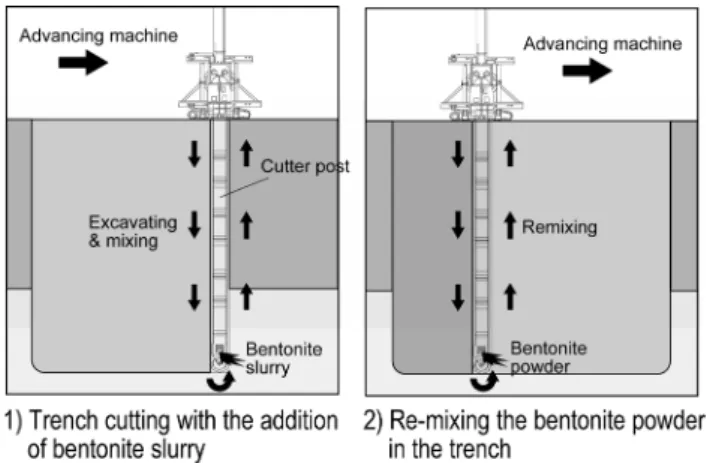
A new method for constructing the SBM vertical cut-off wall has been developed by employing the trench cutting and re-mixing deep wall (TRD) method, in order to achieve the high homogeneity of the in-ground wall (Kamon et al. 2006, Katsumi et al. 2008a). Figure 1 shows the construction sequence of the SBM vertical cut-off wall employing the TRD method. First, the trench cutting is conducted supplying bentonite slurry to maintain the workability of the soil inside the trench. Then, re-mixing with bentonite powder is conducted in the trench. The advantage of employing the TRD method is to construct the cut-off
i) Associate Professor, Graduate School of Global Environmental Studies, Kyoto University, Sakyo, Kyoto 606-8501, Japan.
ii) Takenaka Corporation, Shinsuna, Koto, Tokyo 136-0075, Japan; Formerly Graduate Student, Kyoto University, Sakyo, Kyoto 606-8501, Japan. iii) Professor, Graduate School of Global Environmental Studies, Kyoto University, Sakyo, Kyoto 606-8501, Japan.
iv) President, Kagawa National College of Technology, 355 Chokushi-cho, Takamatsu, Kagawa 761-8058, Japan. v) Director, Raito Kogyo Co., Ltd., 4-2-35 Kudan-Kita, Chiyoda-ku, Tokyo 102-0073, Japan.
wall of high homogeneity even in the layered ground, since the cutter post which advances horizontally through the layers excavates, injects slurry or powder from its head, and mixes the soil, forming a continuous wall (e.g. Kamon et al. 1998, Katsumi et al. 2003).
Figure 1. In situ construction of SB vertical cut-off wall by TRD method (Kamon et al. 2006)
3 EXPERIMENTAL METHODS
3.1 Materials
Three different soils were used for this series of the research, however experimental results on only one type of soil is presented in this paper. Results of other two types of soils are presented in Katsumi et al. (2008a and 2009). The soil used is a mixture of volcanic cohesive soil and sandy gravel collected at a pilot scale test site (referred to composite soil in the following), presented in Kamon et al. (2006). The soil was sieved through a 4.75 mm-opening screen prior to the preparation of SB mixture specimen. The composite soil was prepared by mixing sandy gravel and volcanic cohesive soil at their natural water contents. The mixing ratio of 25:4 by dry weight (sandy gravel: volcanic cohesive soil) was determined based on the thickness of each layer obtained from the boring log on the pilot test site. It consisted of 5.6% gravel (> 2 mm), 70.8% sand (2 mm - 0.075 mm), 15.8% silt (0.005 mm – 0.075 mm), and 7.8% clay (< 0.005 mm) fractions and exhibited 1.5 x 10⁻⁷ m/s of hydraulic conductivity. Types and
concentrations of chemical in the pore water was adjusted to the target value, as mentioned in 3.2.
Simulating the process of the wall construction by the TRD method, 10%-concentration hydrated bentonite slurry was firstly blended with the soil. The additive content of the bentonite slurry was determined based on the flowability of the soil-slurry mixture, approximately 150-mm flow value according to JIS R 5201. Once a mixture of suitable flowability was established, 100 kg/m3 powder bentonite was added and mixed using the soil mixer.
3.2 Hydraulic conductivity test
After consolidation at 40 kPa in the oedometer, SB mixture specimens having a 30 mm in height and 60 mm in diameter were subjected to the hydraulic conductivity tests. A flexible-wall permeameter with a fallen-head system according to ASTM D5084 was employed. A confining pressure of 30 kPa and a hydraulic gradient of approximately 30-40 were applied during the permeation. Permeation continued until the following four requirements were confirmed: 1) the volumes of the effluent and the influent were balanced, 2) the change in k values with time was negligible, 3) pore volumes of flow were greater than 3, and 4) the electrical conductivity of the effluent was equal to that of the influent. Testing conditions were listed in Table 1. P-series was designed to assess the chemical compatibility of the SB attacked by the solution containing the chemicals. In this series, bentonite in SB has been firstly wetted with the pore water of original soil. In the N-series, the expected detrimental effect of the chemicals contained in the pore water of soil was verified, since swelling of the bentonite in the SB is impeded due to the chemicals in the soil in these cases. Table 1. Experimental conditions of the hydraulic
conductivity test Test No. Chemical concentration in original soilb Chemical concentration of permeant Hydraulic conductivity, k (m/s) P-00 0 0 5.0 x 10⁻¹¹ P-10 0 0.1 mol/L-CaCl2 1.9 x 10⁻¹⁰ P-20 0 0.25 mol/L-CaCl2 2.2 x 10⁻¹⁰ P-30 0 1.0 mol/L-CaCl2 1.4 x 10⁻¹⁰ P-40 0 Seawater 1.2 x 10⁻¹⁰ P-50 0 50%-ethanol 4.9 x 10⁻¹¹ N-00 0 0.1 mol/L-CaCl2 1.2 x 10⁻¹⁰ N-10 0.01 mol/L-CaCl2 0.1 mol/L-CaCl2 2.2 x 10⁻¹⁰ N-20 0.025 mol/L-CaCl2 0.1 mol/L-CaCl2 5.6 x 10⁻¹⁰ N-30 0.05 mol/L-CaCl2 0.1 mol/L-CaCl2 1.0 x 10⁻⁹ N-40 0.1 mol/L-CaCl2 0.1 mol/L-CaCl2 1.3 x 10⁻⁹ N-50 Seawater Seawater 9.3 x 10⁻¹⁰ N-60 5,000 mg/kg-heavy
fuel oil A 0.1 mol/L-CaCl2 1.0 x 10
−10
N-70 10,000 mg/kg-heavy
fuel oil A 0.1 mol/L-CaCl2 8.3 x 10
−11
S-01 0.01 mol/L-CaCl2 0.01 mol/L-CaCl2 1.0 x 10⁻¹⁰
3.3 Swelling test
Swelling pressure of the SB specimen, which had a 20 mm height and was 60 mm in diameter after the consolidation at 40 kPa, under the constant volume condition was measured by using the testing apparatus shown in Figure 2. During the test, the specimen was submerged in the solution whose composition corresponded to that of the permeant used in the hydraulic conductivity test. The swelling pressure was determined when it reached the maximum value. Cases P-00, S-01, N-40, N-50, N-60, and N-70 shown in Table 1 were tested.
Figure 2. Testing apparatus for measuring the swelling pressure (Katsumi et al. 2009)
4 RESULTS AND DISCUSSIONS 4.1 Effects of chemicals in the permeant
The k values in P-series were affected by the types and concentrations of chemicals in the permeant (Figure 3). SB permeated with the distilled water had four orders of magnitude lower k (5.0 x 10⁻¹¹ m/s) than the original composite soil (1.5 x 10⁻⁷ m/s). The k for 0.1 M CaCl2 solution was 3.5 times higher than that for
distilled water, but still low enough to function as the cut-off wall even against more than 6 pore volumes of flow (Kamon et al. 2006). Effect of the CaCl2
concentration on the k was negligible when it was higher than 0.1 M. The k value for 1.0 M CaCl2
solution was slightly lower than those for 0.1 and 0.25 M, probably due to the higher viscosity of the permeant. Permeated with the seawater which contains several species of multivalent cations, the k became 1 to 2 x 10⁻¹⁰ m/s, which was similar to that for CaCl2 solutions.
These observations confirm that the k of SB is not significantly increased even against the permeant containing the 1.0 M multivalent cation if the bentonite in the SB is hydrated with the soil pore water.
Figure 3. Effect of the chemicals in the permeant on the k (Katsumi et al. 2009).
For 50% ethanol, k was not affected apparently. To take the effect of the high viscosity of ethanol solution into consideration, the intrinsic permeability of the SB should be discussed. The intrinsic permeability was 1.5 x 10⁻¹⁷ m2 for 50% ethanol, which was only 3 times larger than that for the distilled water, 5.1 x 10⁻¹⁸ m2.
This result indicates that the SB was able to maintain its hydraulic barrier performance even when permeated with the high concentration of organic solvents.
4.2 Effects of chemicals in the soil pore water Figure 4 shows the k values obtained in N-series, where the SB contains various types and concentrations of chemicals in the soil pore water. 0.1 M CaCl2
solution was used as the permeant in N-Series, except the case N-50 using seawater. The k values were increased exponentially for the CaCl2 concentrations
and the k for 0.1 M CaCl2 solution reached higher than
1 x 10⁻⁹ m/s. For the seawater, approximately one order of magnitude higher value was observed by comparing with the SB to which no chemical was added. This increase is equivalent to that caused by 0.05 and 0.1 M CaCl2 solution. Five or 10 g/kg heavy oil in the pore
water had no influence on the k value.
Figure 4. Effect of the chemicals in the soil pore water on the k (Katsumi et al. 2009)
By comparing the effects of divalent cations on the
k when they exist in the permeant (P-series) and in the
pore water of the original soil (N-series), the divalent cations in the pore water cause more significant increase in the k. The k for 0.1 M CaCl2 in the permeant
was 3.5 times as high as that for 0 M CaCl2. In contrast,
the increase of the CaCl2 concentration in the pore
water from 0 to 0.1 M resulted in the increase in the k by more than one order of magnitude. These observations indicate that the degree of prehydration of bentonite, which is dependent on the chemical composition of the first wetting liquid (e.g., Shackelford et al. 2000, Katsumi et al. 2008b), is an important factor for the chemical compatibility of the
SB. Thus, the concentration of the divalent cation and its variation in groundwater at the site of concern should be considered in evaluating the hydraulic barrier performance of SB.
4.3 Swelling pressure versus hydraulic conductivity It can be hypothesized that the hydration of bentonite is an index of the chemical compatibility of SB. To evaluate the effect of bentonite hydration on the hydraulic barrier performance of SB quantitatively, the swelling pressure, which is representative of the degree of bentonite hydration, was measured for the SB containing various types and concentrations of chemicals as indicated in 3.3. Figure 5 shows the relationship between the swelling pressure (ps) and log
k. A good liner correlation between ps and log k is
observed based on the fact that the relatively lower ps
values were observed for the SBs exposed to the high concentrations of divalent cation, which had the higher
k values. While it takes a long time to measure the k of
low-permeable materials such as SB, swelling pressure can be tested mostly within a week. Considering this fact, the swelling pressure is expected to be employed as a good indicator for the hydraulic barrier performance of the SB in the QC/QA. To verify the applicability of the swelling test to a simple quality control method, test results on the SB processed from different types of soil and with various bentonite contents, however, should be collected and analyzed.
Figure 5. Swelling pressure versus k of the SB (Katsumi et al. 2009)
5 CONCLUSIONS
A series of laboratory tests were conducted to verify the applicability of the SB to the in situ containment cut-off wall from the viewpoint of the hydraulic barrier performance. Particularly, chemical effects on the quality and performance of the SB were assessed in detail.
For the SB specimens in which the pore water of original soil did not contain any chemicals and
accordingly the sufficient bentonite hydration was expected to occur, hydraulic conductivity (k) values were low enough and not significantly increased even when permeated continuously with relatively aggressive chemical solutions such as 1.0 mol/L CaCl2
or 50%-concentration ethanol solutions. This fact leads the practical implication that the SB cut-off wall can maintain its hydraulic barrier performance in the long term, if constructed at the site where there are no significant concentrations of chemicals in the soil.
In contrast, SB specimens containing a certain concentration of divalent cation in the pore water had the relatively higher hydraulic conductivity values due to the restricted bentonite hydration and swelling. The first exposure effects were clearly shown. For higher than 0.05 M of CaCl2 solutions or the seawater,
approximately one order of magnitude higher k values were obtained. When the pore of the original soil is filled with the seawater, the SB had more than one order of magnitude higher k value. If constructed by the seaside, the quality of the SB cut-off wall should be carefully considered. In contrast, 10,000 mg/kg-soil or less concentrations of oil in the soil had no adverse effect on the k of the SB.
The degree of the bentonite hydration, as well as the volume of immobile water, is an important factor affecting the hydraulic barrier performance of the SB. Linear correlation between log k and the swelling pressure of the SB was observed regardless of types of chemicals to which the SB is exposed. Considering the fact that the hydraulic conductivity test on SB requires a long testing duration, the swelling pressure test can be employed as a simple quality control method for the hydraulic barrier performance of the SB.
ACKNOLOGEMENTS
The laboratory experiments were conducted with the cooperation of Mr. D. Matsuhashi and Mr. F. Kurihara, former graduate students at Kyoto University. Valuable support from Mr. K. Sugiyama, Raito Kogyo Co., Ltd., is greatly acknowledged.
REFERENCES
1) Britton, J.P. and Filz, G.M. (2007): High uniformity versus low hydraulic conductivity for vertical barriers in contaminant containment applications, Geoenvironmental
Engineering, GSP No.163, S.E. Burns, P.J. Culligan, J.C.
Evans, P.J. Fox, K.R. Reddy, N. Yesiller (eds.), ASCE (on CD).
2) Grube, W.E. (1992): Slurry trench cut-off walls for environmental pollution control, Slurry Walls: Design,
Construction, and Quality Control, ASTM STP 1129, D.B.
Paul et al. (eds.), ASTM, Philadelphia, pp.69-77.
3) Kamon, M., Ohta, H., Aoi, M. and Asada, S. (1998): Development of new river protection method by continuous inclined diaphragm wall, Environmental Geotechnics, P.S. Sêco e Pinto (ed.), Balkema, Rotterdam, pp.35-38.
(2006): Hydraulic performance of soil-bentonite mixture barrier, 5ICEG Environmental Geotechnics, H.R. Thomas (ed.), Thomas Telford Publishing, London, pp.733-740. 5) Katsumi, T., Kamon, M., Watanabe, M., Suminaga, I., and
Fukagawa, R. (2003): Basic properties of soil-cement cutoff wall applied to waste containment barriers, Soil and Rock
America 2003, P.J. Culligan, H.H. Einstein, and A.J. Whittle
(eds.), VGE, Essen, Germany, pp.1389-1395.
6) Katsumi, T., Kamon, M., Inui, T., and Araki, S. (2008a): Hydraulic barrier performance of SBM cut-off wall constructed by the trench cutting and re-mixing deep wall method, GeoCongress 2008: Geotechnics of Waste
Management and Remediation, Geotechnical Special Publication No.177, M.V. Khire, A.N. Alshawabkeh, and
K.R. Reddy (eds.), ASCE, pp.628-635.
7) Katsumi, T., Ishimori, H., Ogawa, A., Maruyama, S., and Fukagawa, R. (2008b): Effects of water content distribution on hydraulic conductivity of prehydrated GCLs against calcium chloride solutions, Soils and Foundations, JGS, Vol.48, No.3, pp.407-417.
8) Katsumi, T., Inui, T., and Kamon, M. (2009): Chemical effects on the performance of soil-bentonite cut-off walls for in-situ containment, Proceedings of the 17th International
Conference on Soil Mechanics and Geotechnical Engineering, M. Hamza, M. Shahien, and Y. ElMossallamy
(Eds.), IOS Press, pp.2552-2555.
9) Shackelford, C.D., Benson, C.H., Katsumi, T., Edil, T.B., and Lin, L. (2000): Evaluating the hydraulic conductivity of GCLs permeated with non-standard liquids, Geotextiles and