A Thesis
For The Degree of Master of Veterinary Medicine
Antigenic Diversity of Theileria Major Piroplasm
Surface Protein Gene on Korean Native Black
Cattle in Jeju
Graduate School, Cheju National University Department of Veterinary Medicine
Myung-Soon Ko
Antigenic Diversity of Theileria Major Piroplasm
Surface Protein Gene on Korean Native Black
Cattle in Jeju
Myung-Soon Ko
(Supervised by Professor Kyoung-Kap Lee)
A thesis submitted in partial fulfillment of the requirement for the degree of Master of Veterinary Medicine
2003. 12.
This thesis has been examined and approved.
Thesis director, Ho-Choon Woo, Prof. of Veterinary Medicine
Young-Min Yun, Prof. of Veterinary Medicine
Kyoung-Kap Lee, Prof. of Veterinary Medicine
Antigenic Diversity of Theileria Major Piroplasm
Surface Protein Gene on Korean Native Black
Cattle in Jeju
Myung-Soon Ko
(Supervised by Professor Kyoung-Kap Lee)
Department of Veterinary Medicine
Graduate School, Cheju National University, Jeju 690-756, Korea
Abstract
The piroplasms, Theileria sp. and Babesia sp. are both tick-transmitted intracelluar haemoprotozoan parasites and cause anorexia, fever, anemia and icterus. Bovine piropasmosis caused by
T. sergenti and Babesia ovata are a cause of major economic loss
in grazing cattle in Japan and Korea.
I have investigated co-infection of Theileria and Babesia sp. by PCR and PCR-RFLP and examined the antigenic diversity of MPSP gene on 35 herds of clinically healthy Korean Native Black Cattle that were born and raised in National Jeju Agricultural Experiment Station in May, 2003.
In the microscopic examination of Giemsa - stained blood smears (×1,000), intracellular parasites were rare. The hematological data were in normal range.
Twenty (57.1%) out of 35 samples were co-infection of
Theileria and Babesia sp.. All the blood samples were amplified
universal MPSP gene and infected with mixed C, I, B1 and B2 of
Theileria sp.. They were mainly C and B type. There were allelic
variants in Korean Native Black Cattle in Jeju.
---Key word : Theileria, Babesia, Major Piroplasm Surface Protein
1. Introduction --- 1
2. Materials and Methods --- 4
3. Results --- 10
4. Discussion --- 23
5. References --- 26
Summary ( in Korean) --- 35
I. Introduction
Theileria and Babesia sp. are both tick-transmitted intracellular
haemoprotozoan parasites and cause anorexia, fever, anemia and icterus. There are several species of Theileria in cattle. Theileria
sergenti of them is less pathogenic species and widely distributed in
East Asia. But the bovine theileriosis caused by T. sergenti is a cause of major economic loss in grazing cattle in Japan and Korea.
In the Korea, bovine piroplasmosis is caused by Babesia ovata (Cho et al., 2002) and Theileria sergenti (Lee & Kim, 1987; Baek et
al., 1990, 1992, 1994; Chae et al., 1996a,b, 1998a,b; Kang et al., 1997;
Kang et al., 1999). Infected cattle suffer from chronic anemia due to intraerythrocytic piroplasms and occasionally die in severe cases. After recovery from the acute phase, the infection may assume a subclinical, chronic course and these animals could become carriers of the piroplasms. The carriers may act as a reservoirs, parasites are present in very low numbers in the blood and generally may not detected in Giemsa-stained blood smear.
On the molecular level, Major piroplasm surface protein (MPSP), 16S and 18S rRNA genes have been extensively studied on distinction from species related to Theileria sp..
The MPSP is a major target antigen recognized by the host immune system and show antigenic polymorphism as an immune evasion mechanism (Zhuang et al ., 1994, Kim S. J et al., 1998). Non-pathogenic Theileria species are divided into at least five type, I (Ikeda), C (Chitose), B (Buffeli) 1, 2 and Thai type based on the allelic form of MPSP genes (Kubota et al., 1996, Kakuda et al., 1998b, Inoue
et al., 2001, Sarataphan et al., 2003).
The field isolates from Japan, Korea, Australian, other Asian and European countries are reported to contain mixed populations of parasite bearing various combinations of MPSP allelic types (Kakuda
et al, 1998b. Kubota et al., 1996a, Wang et al., 1998, Inoue et al.,
2001, Sarataphan et al., 2003).
In Japan, Theileria species consist of I, C and B2 type parasites (Kubota et al., 1995, 1996). In Korea, I type is common and I and C type are co-infection. Some of the Korean isolates contain the parasites with allelic form of B1 type that is seen only in the T.
orientalis/buffeli. This suggests that T. orientalis/buffeli. may
co-exist with T. sergenti in Korea (Kakuda et al., 1998b)
Kubota et al. (1996b) suggested that developmental stages in tick gut and salivary gland is essential for maintenance or expansion of antigenic and genetic diversities of parasites.
The hypothesis for the presence of antigenically diversified parasites is that the parasite may increase their antigenic diversity in order to evade the immunity of an individual animal and of an animal herd (Onuma et al., 1998).
In this study, I have surveyed co-infection of Theileria and
Babesia sp. on the Korean Native Black Cattle in Jeju and also
II. Materials and Methods
Experimental animals
Blood samples were collected in EDTA tubes on 35 herds Korean Native Black Cattle from National Jeju Agricultural Experiment Station in May, 2003 and maintained at -70℃ until DNA extraction. Thin blood film smears were made from fresh blood and stained with Giemsa by standard microscopic methods for the evaluation of intracellular parasites.
DNA Extraction
DNA was extracted from frozen blood samples by the following method (modified Miller's method). For each sample 500㎕ of blood was treated with two volumes of STE buffer (10mM Tris-HCl, pH 8.0, 1mM EDTA, 0.1M NaCl) and then centrifuged at 12,000×g for 5 min. The pellets were washed two or three times in STE buffer to remove the cell debris with every wash. The pellets resuspended in SDS-Proteinase K buffer (0.1mg/㎕) and then incubated at 37℃ on overnight. The DNA was extracted with phenol and precipitated with cold ethanol. The DNA was then collected by centrifugation and resuspended in 20㎕ of DW.
Amplification of DNA
Five sets of primer were used in this study. The first set (430bp) comprising of RLB-F2 and RLB-R2 was to amplify the gene encoding for Theileria & Babesia sp.. The second set (875bp) was Ts-U and Ts-R for Theileria Universal MPSP gene. The different sense primers, Ts-C (831bp), Ts-I (826bp), Ts-B (826bp) together with the same anti-sense primer Ts-R were to amplify the MPSP genes of two T. sergenti (C and I type) and T. buffeli (B type), respectively.
Table 1. The Oligonucleotide Primers used in PCRs and the expected Tm(℃) and Size(bp) of PCR Products.
Primer Sequence (5'→3') Tm(℃) Size(bp)
RLB-F2 GACACAGGGAGGTAGTGACAAG
52 430
RLB-R2 CTAAGAATTTCACCTCTGACAGT Ts-U CACGCTATGTTG TCCAAGAG
57 875
Ts-R TGTGAGACTCAATGCGCCTA
Ts-C GCGGATCCTCATCGTCTCTGCAACT 831 Ts-I AAGGATCCGTCTCTGCTACCGCCGC 826
Ts-B GCGGATCCGCTCTGCAACCGCAGAG 826 RLB-F2 & R2 : primer set for the Theileria & Babesia sp.
Ts-U & R : primer set for the Theileria Universal MPSP gene Ts-C, I, B & Ts-R : primer set for the C, I, B type, respectively
The amplification mixture contained 10× PCR buffer, 20pmol each primer, one unit Taq polymerase (Takara, Japan), 200mM each of the dNTP, 50∼100ng template DNA in final volume of 20㎕.
Amplification was carried out using an automatic DNA thermal cycler (Takara, Japan). Thermal cycling profile was followed; initial enzyme activation and hot start, 10min at 94℃; 35∼40 cycles of 1min at 95℃, 30s at Tm(℃) of each primer, extension 1min at 72℃ and final extension of 7min at 72℃.
PCR products were detected and their sizes estimated by co-electrophoresis of 5㎕ of the reaction mix and standard size markers 100bp ladder, on 1.2% agarose gel (SEA KEM, FMC, USA), and visualized by UV illumination of ethidium bromide stained DNA.
PCR-RFLP
To examine the co-infection of Theileria and Babesia sp. amplified products by RLB primer set were isolated from gel and subsequently digested with KpnⅠ (Takara, Japan). Amplified products by Ts-B and Ts-R primer were analyzed based on RFLP as described previously (Kubota et al, 1996b; Kakuda et al., 1998b) for subdivided for B1 and B2 type. PCR products were purified with GenecleanⓇ Ⅱ Kit (Q-Bio Gene, USA), followed by restriction enzyme digestion with BglⅠ(Bioneer, USA), DraⅠ (Takara, Japan),
EcoT14Ⅰ(Bioneer, USA), EcoRV (Bioneer, USA), and HindⅢ
(Takara, Japan). Reaction mixture was 1㎕ PCR product, 1㎕ buffer (×10), 10∼15 unit restriction enzyme, add the dH2O to final volume
10㎕. Reaction mixture incubated at 37℃ for 2 hours. Digested PCR products were detected and their sizes estimated by co-electrophoresis of 5ul of the reaction mix and standard size marker (∅X174-HaeⅢ digest), on a 2% agarose gel (SEA KEM, FMC, USA) and visualized by UV illumination of ethidium bromide stained DNA.
Cloning and Sequencing of PCR products
PCR products were loaded on a 1.2% agarose gel and the band of the correct size was excised. Amplicons of the B type were extracted from the excised band with GenecleanⓇ Ⅱ Kit (Q-Bio Gene, USA) and were ligated into the pGEMⓇ-T easy vector systems(Promega, USA) and transformed into DH5α One Shot
Escherichia coli, according to the Manufacturer's instructions. A kit
(Accu PrepⓇ Plasmid Extraction Kit, Bioneer, Korea) was used to isolate cloned DNA. Presence of an insert was verified using an T7 primer and Ts-R primer. Three clones were chosen for sequencing.
Sequence alignment and Homology analysis
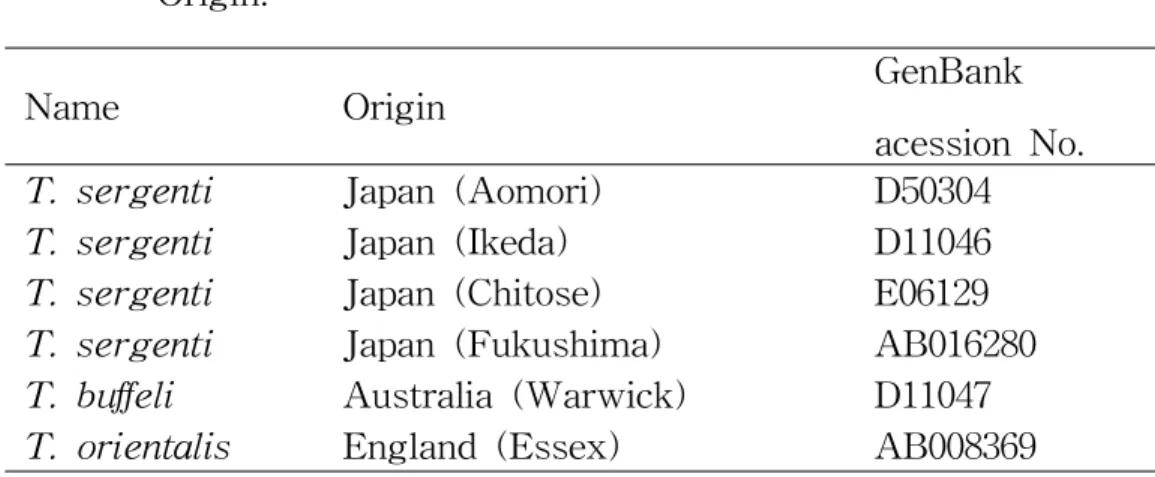
GenBank accession numbers of MPSP sequences are T. sergenti (D50304, D11046, E06129, AB016280) T. buffeli (D11047), T.
orientalis (AB008369). Sequences listed in Table 2. Sequences
alignment and homology analysis were performed by programs of CLUSTAL W (http://www.ebi.ac.uk/clustalw/).
Table 2. MPSP Sequences of T. buffeli-like Parasites with their Origin.
Name Origin GenBank
acession No.
T. sergenti Japan (Aomori) D50304
T. sergenti Japan (Ikeda) D11046
T. sergenti Japan (Chitose) E06129
T. sergenti Japan (Fukushima) AB016280
T. buffeli Australia (Warwick) D11047
Ⅲ. Results
Hematology and Microscopy examination
The hematological values of all the samples were in the normal ranges (Table 3). The mean packed cell volume (PCV) was 40± 5.9 % in 9 parasitemic cows and was 37±5.2% in 26 non-parasitemic cows on microscopic examination.
Table 3. Hematological Values of Korean Native Black Cattle.
(mean ± SD) A B RBC (104/㎕) 883 ± 87 846 ± 128 WBC (㎕) 11858 ± 4775 12148 ± 3757 PCV (%) 40 ± 5.9 37 ± 5.2 Fibrinogen (mg/100㎖) 556 ± 194 592 ± 208 Total protein (g/100㎖) 7.3 ± 0.5 7.3 ± 0.6 A : Parasitemic group on microscopic examination.
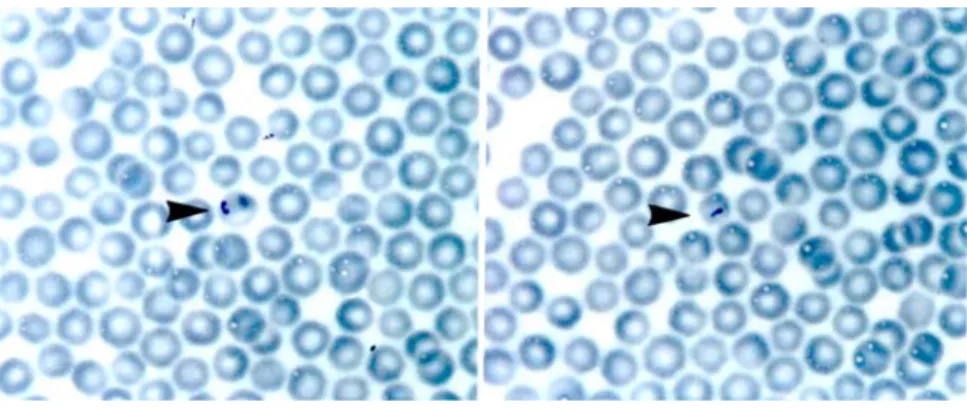
In the microscopic examination of Giemsa-stained blood smears, 9 of 35 cattle had intraerythrocytic piroplasms but infected erythrocytes were rare (Figure 1).
Figure 1. Intraerythrocytic forms of piroplasms. Piroplasms are indicated with arrow. Giemsa-stained blood smear, ×1000
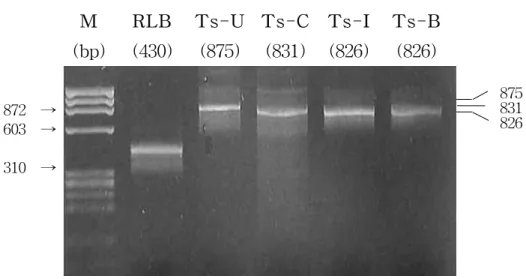
M RLB Ts-U Ts-C Ts-I Ts-B (bp) (430) (875) (831) (826) (826) 875 831 826 872 → 603 → 310 → Amplification of DNA
All the blood samples were amplified RLB primer set(430bp) and Theileria universal MPSP gene(875bp). The allele type of MPSP gene amplified the different sense primers, Ts-C for C type (831bp), Ts-I for I type (826bp) and Ts-B for B type (826bp) with anti-sense primer, Ts-R (Figure 2).
Figure 2. PCR amplification of primer sets. Primers were Ts-C, Ts-I, Ts-B used by the combination with Ts-R primer. Lane M; marker (∅X174-HaeⅢ digest).
Co-infection Ts-infection
M (bp) U K U K
500 → 300 →
PCR-RFLP for the Detection of Theileria & Babesia sp.
In PCR-RFLP, the PCR amplification of RLB-F2/R2 with Kpn Ⅰ showed as figure 3. When co-infection of Theileria and Babesia sp. showed two band (digested and non-digested band) on agarose gel electrophoresis (Figure 3). The Theileria infection showed one band (digested). Twenty (57.1%) of 35 samples were co-infection of
Theileria and Babesia sp..
427 371
Analysis of Allele type of Theileria MPSP gene
The result of allele-specific PCR were mixed infection with C, I, B type. The twenty of 35 blood samples were C type and B type were 17. The eleven samples were unknown type (Table 4).
Table 4. Analysis of Theileria parasite isolates by allele-specific PCR.
No. of isolates MPSP allele type
C type B type I type Unknown type
5/35 + - - -9/35 + + - -4/35 + + + -2/35 + - + -4/35 - + - -11/35 - - - + 20/35 17/35 6/35 11/35
PCR-RFLP of B type of MPSP gene
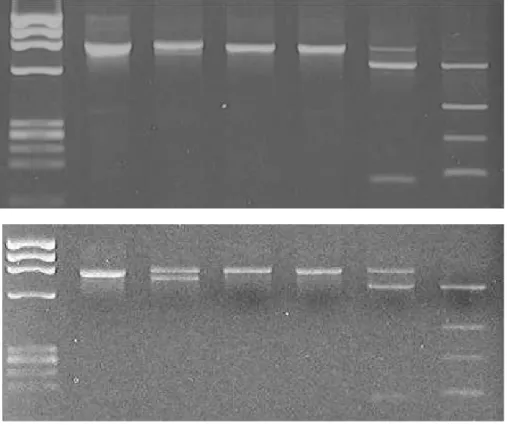
When amplified products by Ts-B and Ts-R primer were analyzed based on RFLP, the eleven of 17 amplification of B type showed as Figure 4A. Three restriction enzyme, BglⅠ, DraⅠand
EcoT14Ⅰ, had not enzyme site in amplificons. But EcoRV and Hind
Ⅲ digested the PCR products and produced three band with EcoRV and four band with HindⅢ. The five of 17 were similar to pattern of Figure 4A with DraⅠ, EcoT14Ⅰ, EcoRV and HindⅢ. But digested with BglⅠand produced two band as Figure 4B.
Figure 4. Restriction pattern of the PCR product that amplified by Ts-B and Ts-R primer set. The PCR product was digested with the restriction enzyme, BglⅠ (Bg), DraⅠ (D), EcoT14Ⅰ (E14), EcoRV (EV) and HindⅢ (H), eletrophoresed on a 2.0% agarose gel and stained with
M (bp) U Bg D E14 EV H 872 → ← 603 → 310 → ←
Comparison of nucleotide sequences
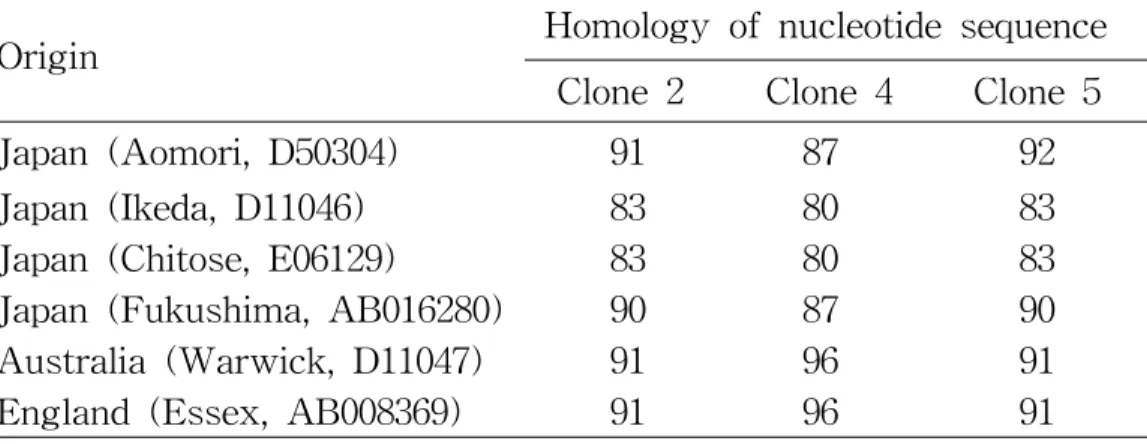
Comparative sequence analysis was carried out with the 3 sequences obtained in the present study, together with 6 sequences reported previously of MPSP gene of Theileria sp. The results shown Figure 6 and the homology value were Table 5. The homology of these three sequence of Theileria sp. isolates from Korean Native Black Cattle showed 91% (Clone 2), 87% (Clone 4) and 93% (Clone 5) with B2 type (D50304) and they were 91% (Clone 2), 96% (Clone 4) and 91% (Clone 5) with B1 type (D11047) respectively.
D11047 1: GCTCTGCAACCGCAGAGGAGAAAAAAGAACCAGCAAAGGCTGAAGAGAAGAAAGATTTAG : 60 AB008369 1: G******AA*CGCA*AGGAGA*****G**CCA*****G*****A********A**T***G : 60 D50304 1: G******AA*CGCA*AG---A*****G**GCA*****A*****T********G**T***G : 57 AB016280 1: T******AA*TGCA*AAGAGA*****G**GCT*****G*****T********G**T***G : 60 D11046 1: T******TA*CGCC*CAGAGG*****A**GAT*****G*****A********G**C***A : 60 E06129 1: T******TA*CGCC*CAGAGG*****A**GAT*****G*****A********G**C***A : 60 Clone 2 1: G******AA*C-CA*AGGAGA*****G**CCA*****G*****A********A**T***G : 59 Clone 4 1: G******AC*---A*AGGAGA*****G**CCA*****G*****A********A**T***G : 57 Clone 5 1: G******AA*CGCA*AGGAGA*****G**CCA*****G*****A********A**T***G : 60 D11047 61: CTCTGGAAGTTAACGCCACCCAGGGTGAAAATTTTACAGTCAATGCAACCAATGCCAACG : 120 AB008369 61: ****G*****T*********CAG*GT***A*****AC****A*T**AA*CA*T******* : 120 D50304 58: ****T*****T*********CAG*CT***A*****AC****A*T**AA*CA*C******* : 117 AB016280 61: ****T*****A*********CAG*CT***A*****AC****A*T**AA*CA*T******* : 120 D11046 61: ****C*****T*********GCA*CC***C*****AA****G*C**CT*AA*C******* : 120 E06129 61: ****C*****T*********GCA*CC***C*****AA****G*C**CT*AA*C******* : 120 Clone 2 60: ****T*****A*********CAG*CT***A*****AC****A*T**AA*CG*C******* : 119 Clone 4 58: ****G*****T*********CAG*GT***A*****GC****A*T**AA*CA*T******* : 117 Clone 5 60: ****T*****A*********CAG*CT***A*****AC****A*T**AA*CG*C******* : 120 D11047 121: ACGTCGTTTTTACTGCCTCGGATGGATATCGTTTCAAGACTCTTAAGGTTGGAGATAAAA : 180 AB008369 121: *****************TCG**T****AT**TT*******TC*T*****T********A* : 180 D50304 118: *****************AAT**G****TT**CA*******AG*T*****T********A* : 177 AB016280 121: *****************AAT**G****AC**TA*******AC*T*****T********A* : 180 D11046 121: *****************GAA**G****AC**CA*******AC*C*****C********G* : 180 E06129 121: *****************GAA**G****AC**CA*******AC*C*****C********G* : 180 Clone 2 120: *****************AAT**G****TT**CG*******AC*T*****T********A* : 179 Clone 4 118: *****************TCG**G****AT**TT*******TC*T*****T********A* : 177 Clone 5 121: *****************AAT**G****TT**CG*******AC*T*****T********A* : 180 to be continued
D11047 181: CTTTGTATACCGTTGATACATCCAAATTCACTCCAACCGTTGCCCACAGAATTAAGCATG : 240 AB008369 181: CTT*******C**T*****AT****A*****T*****C**T**C******A*T******* : 240 D50304 178: CAT*******C**T*****AG****A*****T*****A**C**C******C*C******* : 237 AB016280 181: CTT*******T**A*****AT****A*****T*****A**C**C******C*G******* : 240 D11046 181: ACC*******C**A*****TT****G*****C*****T**C**C******C*G******* : 240 E06129 181: ACC*******C**A*****TT****G*****C*****T**C**C******C*G******* : 240 Clone 2 180: CAT*******C**T*****AT****A*****T*****A**C**T******C*T******* : 239 Clone 4 178: CAT*******C**T*****AT****A*****T*****A**C**C******A*T******* : 237 Clone 5 181: CAT*******C**T*****AT****A*****T*****A**C**T******C*T******* : 240 D11047 241: GTGATGCCTTGTTCTTCAAGCTTGACCTTTCCCATGCCAAGCCAC*CTTGTTCAAGAAGA : 300 AB008369 241: GT**TGC*T*******C*****TGA***T*****T**C**G***C*CT*G********** : 300 D50304 238: GA**TAA*T*******C*****TGA***T*****T**T**G***C*TT*A********** : 297 AB016280 241: CT**AGA*C*******A*****CGA***T*****T**A**A***C*TT*G********** : 300 D11046 241: CT**CGA*C*******C*****CAA***G*****C**A**G***T*GC*G********** : 300 E06129 241: CT**CGA*C*******C*****CAA***G*****C**A**G***T*GC*G********** : 300 Clone 2 240: GT**TGC*T*******C*****CGA***T*****T**C**G***C*CC*G********** : 299 Clone 4 238: GT**ATG*C*******C*****TGG***T*****T**C**G***C*CT*G********** : 297 Clone 5 241: GT**TGC*T*******C*****CGA***T*****T**C**G***C*CC*G********** : 300 D11047 301: AGACTGACAAGGATTGGGTTCAGTTTAACTTTGGCCAGTACCTTGACGAATTTGTATGGA : 360 AB008369 301: ***CT********T*****T**G**T*A***T*G*********T**C***T*TG*A**** : 360 D50304 298: ***CC********T*****T**G**T*G***C*C*********C**T***G*AG*C**** : 357 AB016280 301: ***GC********A*****A**G**C*G***C*C*********C**T***G*TC*C**** : 360 D11046 301: ***CT********T*****T**A**C*G***C*C*********C**T***G*TG*A**** : 360 E06129 301: ***CT********T*****T**A**C*G***C*C*********C**T***G*TG*A**** : 360 Clone 2 300: ***CC********T*****T**G**T*G***C*C*********T**G***G*AG*C**** : 359
D11047 361: AGGAAAAGAAGGAACTCAAGGATATAGATGCATCCAAGTTTGCAGAGGCAGGTCTTTTTG : 420 AB008369 361: *G**A********ACTC**G**TC*A**T**AT*******TG****GA*A********T* : 420 D50304 358: *G**G********TGTG**A**CC*C**T**CT*******TG****CG*T********C* : 417 AB016280 361: *A**A********ATCC**A**CC*C**T**CT*******TG****AG*T********T* : 420 D11046 361: *G**G********AGTA**A**CC*C**C**AT*******CG****CG*A********C* : 420 E06129 361: *G**G********AGTA**A**CC*C**C**AT*******CG****CG*A********C* : 420 Clone 2 360: *A**A********ACTC**G**CC*C**T**AG*******TG****GG*A********T* : 419 Clone 4 358: *A**A********ACTC**G**TC*C**T**AT*******TA****GG*A********T* : 417 Clone 5 361: *A**A********ACTC**G**CC*C**T**AG*******TG****GG*A********T* : 420 D11047 421: CAGCTGATACATTCGGTACTGGTAAGGTTTATGACTTT : 458 AB008369 421: *AG*T**TA*A********T**T***G*T**TG****T : 458 D50304 418: *CG*T**TG*A********T**T***G*C**CG****C : 455 AB016280 421: *CC*T**TG*A********C**A***G*T**CG****C : 458 D11046 421: *CG*T**GG*T********C**A***C*G**CA****C : 458 E06129 421: *CG*T**GG*T********C**A***C*G**CA****C : 458 Clone 2 420: *CG*T**TG*A********C**A***G*T**CG****C : 457 Clone 4 418: *AG*A**TA*A********C**T***G*A**TG****C : 455 Clone 5 421: *CG*T**TG*A********C**A***G*T**CG****C : 458
Figure 6. Comparison of partial nucleotide sequence from PCR product (Clone 2, 4, 5) and MPSP genes of other
Theileria sp. from the GenBank database. Gaps (-)
represent space introduced into the aligned sequences by the Multiple Alignment program in the CLUSTAL W program. An asterisk marks represent the nucleotide identity.
Table 5. Nucleotide sequence comparison of MPSP gene of other
Theileria sp.
Origin Homology of nucleotide sequence
Clone 2 Clone 4 Clone 5
Japan (Aomori, D50304) 91 87 92
Japan (Ikeda, D11046) 83 80 83
Japan (Chitose, E06129) 83 80 83
Japan (Fukushima, AB016280) 90 87 90
Australia (Warwick, D11047) 91 96 91
Ⅳ. Discussion
The major clinical sign of bovine piroplasmosis is a hemolytic anemia, but this is not clearly established in subclinical stage of herd investigation (Stockham et al., 2000). A combination of predisposing factors influences the course of clinical illness. In this study, although I found piroplasms in 9 cows in microscopic examination, all the samples were positive for Theileria sp. by PCR and all the cows were in subclinical stage.
Both Theileria segenti and Babesia ovata are often collectively referred as bovine piroplasmosis in Korea. The co-infection rate of
Theileria sergenti and Babesia ovata was 40% by serological test
(Jeon et al., 1978) and 33% in Japan by microscopic examination (Arai et al., 1998). In the present study, the result showed 57.1% co-infection rate higher than that previously studied. The prevalence of Theileria sergenti infection in Jeju (Kim G.H et al., 1999) was higher than that in other province (Song et al., 2003) and the biological vector was identical as Haemaphysalis longicornis which of Theileria sergenti (Kawazu et al., 1995), Babesia ovata (Cho et
al., 2002) and B. caballi (Bautista et al., 2003). Kubota et al. (1996b)
and Onuma et al. (1998) suggested that the presence of multiple parasite clone in a vector is essential to cross-fertilization which will
Majority of T. sergenti-infected cattle in Japan presented mixed parasite population bearing I and C type parasites. T. buffeli is distributed mainly in Australian and in adjacent areas in Asia (Kubota et al., 1996b, Kakuda et al., 1998b, Wang et al., 1998). In Taiwan and other East Asia, I type parasite could not be identified (Wang et al., 1998, Inoue et al., 2001, Sarataphan et al., 2003), while I type is major parasite distributed in Japan and Korea (Kakuda et
al., 1998b; Kubota et al., 1996b; Kim G.H et al., 1999). There is no
report concerning the relation between the allelic form and virulence
of T. sergenti/buffeli. However, there are several suggestive
evidence that I type is more pathogenic than C and B type. Ikeda (I type) stock is more pathogenic than fukushima (C type) stock and all Theileria isolates contained I type parasite and showed severe symptoms in Korea (Kakuda et al., 1998b). In this study, they were mainly C type (20 of 35) and B type (17 of 35). I type were rare (6 of 35) and all cattle were normal in clinical signs and hematological examination.
In this study, I tried PCR-RFLP for subdivided of B type as described previously (Kubota et al., 1996b; Kakuda et al., 1998b).
product of Theileria isolates from Korean Native Black Cattle may be closely related to T. sergenti (B2 type) and T. buffeli (B1 type).
Kubota et al. (1996b) demonstrated that parasite population ratio changes between I and C type parasites occurred during persistent infection in cattle and Iwasaki et al (1998) provided further evidence that population shift from parasite expressing one allelic type of MPSP to those expressing another type result in apparent antigenic change of the parasites.
Many studies reported that susceptibilities to piroplasmosis are different according to breed. Kim et al (1999) reported that Korean native cattle show solider resistance to T. sergenti infection than the Holstein in Jeju. Results in this study suggested that the different of resistance according to breed and host immuno response. So, it is necessary more investigation about the resistance and adaptation of Korean Native Black Cattle in Jeju conditions compare with another breed.
In this study demonstrates that the co-infection of Theileria and Babesia sp. is high and infects with mixed allele types of MPSP gene of Theileria sp.. Also, there are allelic variants in Jeju. Therefore, further studies on the tick, analysis of antigenic difference between variant of each type and the seasonal variation of allele type are essential for the developing optimal treatment and control methods.
Ⅴ. References
Arai, S., Tsuji, M., Kim, S.J., Nakada, K., Kirisawa, R., Ohta, M., Ishihara, C., 1998. Antigentic and Genetic Diversities of Babesia
ovata in Persistently Infected Cattle. J. Vet. Med. Sci. 60:
1321-1327.
Baek, B.K., Kim, B.S., Lee H.I., 1990. Fine structure of Theileria
sergenti merozoite in Korean native cattle. Korean J. Vet. Sci.
30: 465-471.
Baek, B.K., Choi, B.S., Hansen, R., Kakoma, I., 1992. Immunogenicity and Protective Efficacy of Solubilzed Merozoite- enriched
Theileria sergenti Immunogens: Ⅰ. protection against
Homologous Challenge. Korean J. Parasitol. 30: 133-140.
Baek, B.K., Kim, B.S., Whim, B.M., Lee, H.I., Park, Y.H., Kakoma, I., 1994. Immunogenicity and protective effecacy solubilized merozoite-enriched Theileria sergenti Immunogens: Ⅲ.
caballi (Nuttall and Strickland, 1910) parasite transmission from
experimentally-infected SCID mice to the ixodid tick,
Haemaphysalis longicornis (Neuman, 1901). Vet. Parasitol. 102:
185-191.
Chae, J.S., Lee, J.M., Kwon, O.D., Lee, S.O., Chae, K.S., Onuma, M., 1996a. Comparative analyses of Theileria sergenti isolated from Korea and Japan by Southern hybridization and polymerases chain reaction. Korean J. Vet. Res. 36: 187-193.
Chae, J.S., Lee, J.M., Kwon, O.D., Park, J.H., Chae, K.S., 1996b. Rapid detection of Theileria sergenti by the polymerase chain reaction in Korea cattle. Korean J. Vet. Res. 36: 195-207.
Chae, J.S., Kwon, O.D., Holman, P.J., Waghela, S.D., Waner, G.G., Lee, J.M., 1998a. Identical small subunit ribosomal nucleotide sequence of bovine Theileria isolates (Korea and Japan) and
Theileria buffeli(marula, Kenya). Kor. J. Parasitol. 36: 47-53.
Chae, J. S., Lee, J.M., Kwon, O.D., Holman, P.J., Waghela, S.D., Wagner, G.G., 1998b. nucleotide sequence heterogeneity in the small subunit ribosomal RNA gene variable(V4) region among and within geographic isolates of Theileria from cattle, elk and white-tailed deer. Vet. Parasitol. 75: 41-52.
Cho, S.H., Kim, T.S., Lee, H.W., Tsuji, M., Ishihara, C., Kim, J.T., Wee, S.H., Lee, C.G., 2002. Identification of newly isolated
Babesia parasites from cattle in Korea by using the
Bo-RBC-SCID mice. Kor. J. Parasitol. 40: 33-40.
Criado-Fornelio, A., Martinez-Marcos, A., Buling-Sarana, A., Barba-Carretero, J.C., 2003a. Presence of Mycoplasma haemofelis, Mycoplasma haemominutum and Piroplasmids in
cats from southern Europe: a molecular study. Vet. Microbiol. 93: 307-317.
Criado-Fornelio, A., Martinez-Marcos, A., Buling-Sarana, A., Barba-Carretero, J.C., 2003b. Molecular studies on Babesia,
Theileria and Hepatozoon in southern Europe: Part Ⅰ.
Epizootiological aspect. Vet. Parasitol. 113: 189-201.
Gubbles, M.J., Hong, Y., Weide, M., Qi, B., Nijman, I.J., Guangyuan, L., Jongejan, F., 2000. Molecular characterization of the
Protein Gene-Specific Polymerase Chain Reaction. J. Vet. Med.
Sci. 63(10): 1155-1157.
Iwasaki, T., Kakuda, T., Sako, Y., Sugimoto, C., Onuma, M., 1998. Differentiation and quantification of Theileria sergenti piroplasm type using type-specific monoclonal antibodies. J. Vet. Med.
Sci. 60: 665-669.
Jeon, Y., 1978. A survey on Babesiosis and Theileriasis in Korean cattle. Korean J. Vet. Res. 18: 23-26( in Korean)
Jeong W., Kwen CH., Kang SW., Paik SG., 2003. Diagnosis and quantification on Theileria sergenti using TaqMan PCR. Vet.
Parasitol. 111: 287-295.
Kakuda, T., Shiki, M., Kubota, S., Sugimoto, C., Brown, W.B., Kosum, C., Nopprn, S., Onuma, M., 1998a. Phylogeny of benign
Theileria species from cattle in Thailand, Chaina, the U.S.A
based on the major piroplasm surface protein and small subunit ribosomal RNA genes. Int. J. Parasitol. 28: 1261-1267.
Kakuda, T., Kubota, S., Sugimoto, C., Baek, B. K., Yin, H., 1998b. Analysis of Immunodominant Piroplasm Surface Genes of Benign Theileria Parasites Distributed in China and Korea by
Allele-Specific Polymerase Chain Reaction. J. Vet. Med. Sci. 60(2): 237-239.
Kang, S.W., Choi, E.J., Kweon, C.H., 1997. Cloning and sequencing of p33 in a Korean isolate of Theileria sergenti. Korean J.
Parasitol. 35: 105-110.
Kang, S.W., Kweon, C.H., Choi, E.J., Yoon, Y. D., 1999. Expression of major piroplasm protein (p33) of Theileria sergenti (Korean isolate) and its immunogenicity in guinea pigs. Korean J.
Parasitol. 37: 277-283.
Katzer F., Mckellar S., Kirvar E., Shiels B., 1998. Phylogenetic analysis of Theileria and Babesia equi in relation to the establishment of parasite populations within novel host species and the devlopment of diagnostic tests. Mol. Biochemi. Parasitol. 95: 33-44.
Kawazu, S.I., Okumura, T., Hirogari, Y., Miyhara, T., Terasaka, Y., Hida, M., Terada, Y., Kamio, T., Fujisaki, K., 1997. A polymorphism Observed in the Experimentally Successful Peptide Vaccine Sequence Derived from Theileria sergenti Piroplasm Major Surface Antigen (p33). J. Vet. Med. Sci. 59: 829-831.
Kawazu, S.I., Kamio, T., Kakuda, T., Terada, Y., Sugimoto, C., Fujisaki, K., 1999. Phylogenetic relationship of the benign
Theileria species in cattle and Asian buffalo based in the major
piroplasm surface protein (p33/34) gene sequences. Int. J.
Parasitol. 29: 613-618.
Kim, G.H., Lee, K.K., Onuma, M., 1999. Susceptibility of Theileria
sergenti Infection in Holstein Cattle Compared to Korea Native
Cattle on Cheju Island. J. Protozool. Res. 9: 103-112.
Kim, S.J., Tsuji, M., Kubota, S., Wei, Q., Lee, J.M., Ishihara, C., Onuma, M., 1998. Sequence analysis of the major piroplasm surface protein gene of benign bovine Theileria parasites in East Asia. Int. J. Parasitol. 28: 1219-1227.
Knowles D.P., Kappmeyer L.S., Perryman L.E., 1997. Genetic and biochemical analysis of erythrocyte-stage surface antigens
belonging to a family of highly conserved proteins of Babesia
equi and Theileria species. Mol. Biochemic. Parasitol. 90: 69-79.
Kubota, S., Sugimoto, C., Kakuda, T., Onuma, M., 1996a. Analysis of Immunodominant Piroplasm Surface Antigen Allele in Mixed Populations of Theileria sergenti and T. buffeli. Int. J. Parasitol. 26: 741-747.
Kubota, S., Sugimoto, C., Onuma, M., 1996b. Population dynamics of
Theileria sergenti in persistently infected cattle and vector ticks
analysed by a polymerase chain reaction. Parasitology 112: 437-442.
Lee, J.M., Kim, M.C., 1987. Studies for the Effective Diagnosis and Treatment of Bovine Piroplasmosis. Korean J. Vet. Res. 27: 321-330.
Onuma, M., Kakuda, T., Sugimoto, C., 1998. Theileria parasites infection in East Asia and control of the disease. Comp. Immun.
Theileria Parasites in thai Cattle. J. Vet. Med. Sci. 61: 991-994.
Sarataphan, N., Kakuda, T., Chansiri, K., Onuma, M., 2003. Survey of Benign Theileria Parasites of Cattle and Buffaloes in Thailand using Allele-Specific Polymerase Chain Reaction of Major Piroplasm Surface Protein Gene. J. Vet. Med. Sci. 65(1): 133-135.
Song, K.H., Sang B.C., 2003. Prevalence of Theileria sergenti infection in Korean native cattle by polymerase chain reaction.
Korean J. Parasitol. 41(3): 141-145.
Stockham, S.L., Kjemtrup, A.M., Conrad, P.A., Schmidt, D.A., Scott, M. A., Robinson, T.W., Tyler, J.W., Johnson, G.C., Carson, C.a., Cuddihee, P., 2000. Theileriosis in a Missouri Beef Herd Caused
by Theileria buffeli: Case Report, Herd Investigation,
Ultrastructure, Phylogenetic Analysis, and Experimental Transmission. Vet. Pathol. 37: 11-21.
Tsuji, M., Arai, S., Nakamura, Y., Kim, S.J., Cho, S.H., He, F.Q., Ishihara, C., 1999. Preparation of Antibodies Directed to the
Babesia ovata- or Theileria sergenti- prasitized Erythrocytes. J. Vet. Med. Sci. 61: 73-76.
Wang, C.T., Kubota, S., Kakuda, T., Kuo, C.C., Hsu, T.L., Onuma, M., 1997. Survey of Theileria Parasite Infection in Cattle in Taiwan. J. Vet. Med. Sci. 60: 253-255.
Zhuang WZ, Sugimoto C, Matsuba T, Niinuma S, Murata M, Onuma M. 1994. Analyses of antigenic and genetic diversities of
Theileria sergenti piroplasm surface proteins. J. Vet. Med. Sci.
56: 469-473.
초 록
제주 흑한우의 Theileria Major Piroplasm Surface
Protein Gene 항원형의 다양성
(지도교수 : 이 경 갑) 고 명 순 제주대학교 일반대학원 수의학과 Piroplasm은 진드기가 매개하는 주혈원충으로, 허약, 발열, 빈혈 및 황달을 일으킨다. 한국과 일본에 분포하는 것은 Theileria sergenti와 Babesia ovata로, 방목중인 소의 증체률 저하로 인한 경제적 손실이 큰 것으로 알려져 있다. 본 연구는 제주농업시험장에서 생산, 방목 사육중인 제주 흑한우 35마리를 대상으로, RLB-F2/R2 pirmer set를 이용한 PCR과 KpnⅠ를 이용한 PCR-RFLP을 실시하여 Theileria 와 Babesia sp의 혼합감염와 Allele-specific PCR를 하여 Theileria의 MPSP gene 항원형의 다양성 에 대한 조사하였다.색한 혈액도말표본에서는 35마리 중 9마리에서 충체를 발견하였으나, 그 빈도는 매우 낮았다.
PCR결과 35마리 모두 Theileria에 감염되어있었으며, 그 중 20마 리 (57.1%)가 Theileria 와 Babesia sp.의 혼합감염이었다.
Theileria의 MPSP gene 항원형에 대한 조사시, C (Chitose) type,
I (Ikeda) type 과 B (Buffeli) type이 혼합감염되어 있었으며, 주된 type은 C와 B type이었다. B type에 대한 RFLP을 실시하여 변이형을 확인하였다.
---주요어 : Theileria, Babesia, Major Piroplasm Surface Protein gene,