J Korean Acad Community Health Nurs (지역사회간호학회지) https://doi.org/10.12799/jkachn.2019.30.4.391
Methodological Issues in Nursing Research using IT Technology:
A Discussion Paper
Im, Eun-Ok
1· Chee, Wonshik
21Mary T. Champagne Professor, School of Nursing, Duke University, North Carolina 2Associate Professor, School of Nursing, Duke University, North Carolina, USA
Purpose: Recent advances in computer and mobile technologies have brought increasing usages of IT technology in nursing research across nursing fields. Despite the increasing usages, there has been little discussion on methodological issues involved in nursing research using IT technology. This is a discussion paper to identify methodological issues in IT technology-based nursing research. Methods: An analysis was done using content analysis on research team meeting minutes and research team members’ research diaries in a clinical trial that tested the efficacy of a technology-based intervention. First, several major categories of IT technology-based nursing research are concisely summarized. Then, the method that was used for this analysis is presented. Results: The findings are presented as themes reflecting methodological issues in IT technology-based research: (a) difficulties in recruitment due to necessary technology literacy; (b) facilitating recruitment through allowing the use of multiple languages; (c) participants’ preferences for specific IT technology; (d) efforts needed to ensure technological security; (e) participants’ preferences for design; and (f) necessary considerations on timing. Conclusion: Finally, future directions for nursing research using IT technology are proposed based on the identified issues.
Key Words: Information technology; Nursing methodology research; Methods; Nursing
Corresponding author: Im, Eun-Ok
School of Nursing, Duke University, 307 Trent Dr. Durham, NC 27710, USA. Tel: +1-919-668-3838, E-mail: [email protected]
Received: 26 Sep, 2019 / Accepted: 19 Nov, 2019
This is an open access article distributed under the terms of the Creative Commons Attribution Non-Commercial License (http://creativecommons.org/licenses/ by-nc/3.0), which permits unrestricted non-commercial use, distribution, and reproduction in any medium, provided the original work is properly cited.
INTRODUCTION
Recent advances in computer and mobile technologies have brought increasing usages of IT technology in nurs-ing research across nursnurs-ing fields [1-6]. Mainly due to easy access (e.g., 24 hour, 7 day access), IT technology has been widely used in health care fields including nursing [1-6]. Furthermore, IT technology using computers and mobile devices (mobile phones and tablets) provides a more effective medium for nursing research compared with traditional media of research (e.g., pen-and-pencil questionnaire, printed pamphlets, face-to-face meetings, phone calls, etc.) [7-10]. For instance, an Internet education program provided an efficient way to deliver knowledge and information to metabolic syndrome patients in promot-ing their physical activity [11]. An Internet-based smokpromot-ing cessation program was also effective in reducing smoking among adolescents through providing information and coaching through the Internet [12].
Despite the increasing usages, there has been little
dis-cussion on methodological issues involved in nursing re-search using IT technology [2]. When multiple databases were searched during the past decade to identify articles on methodological issues involved in nursing research us-ing IT technology, only few articles were identified [13-15]. Except the papers by the authors of this paper, most issues that have been discussed are related to descriptive studies that used the Internet as a plain data collection method or a data source [4,5]. Subsequently, these papers rarely pro-vide directions on what need to be considered in the use of IT technology in nursing research in general because they tended to focus on issues in simple usages of the Internet as a quantitative or qualitative data collection medium or method [4,5].
In this paper, to identify methodological issues in using IT technology in nursing research in general, research team meeting minutes and research team members’ re-search diaries from a clinical trial that tested the efficacy of a technology-based intervention were analyzed using a content analysis. In this paper, IT technology refers to
technology using computers and mobile devices to save, search, transmit, and manage data or information. Here, IT technology-based research in nursing mean nursing studies using computers and mobile devices as data col-lection and/or intervention medium. First, several major categories of IT technology-based research are concisely summarized. Then, the method that was used for this dis-cussion paper is presented. The findings are presented next as the themes reflecting methodological issues in nursing research using IT technology. Finally, future di-rections for nursing research using IT technology are proposed.
1. IT Technology-based Research in Nursing
Based on the previous categories of Web-based inter-ventions by Im and Chang [2] and new evolving IT tech-nology using mobile devices (e.g., smartphone, tablets), IT technology-based research in nursing could be roughly categorized into: (a) IT technology-based descriptive stud-ies; (b) IT technology-based education/information pro-grams; (c) IT technology-based coaching/consultation programs; (d) IT technology-based decision support sys-tems; (e) IT technology-based support groups; (f) IT tech-nology-based games; and (g) combinations of multiple cat-egories (e.g., IT technology-based education/information programs + IT technology-based support groups).
IT technology-based descriptive studies often use sim-ple online questionnaires/surveys, online forum discus-sions, or social media for data collection and/or data sources. The purpose of these studies is usually to gather the descriptive data through an online medium to explore a specific nursing phenomenon with various specific aims (e.g., to describe characteristics of a specific study pop-ulation, to examine the associations among different varia-bles, etc.). For instance, Im and her colleagues [16] con-ducted a national scope Internet survey on menopausal symptoms among four racial/ethnic groups of midlife women using IT technology (through computers and mo-bile devices). They used the Internet survey to overcome geographical constraints; it was difficult to recruit an ad-equate number of racial/ethnic minority women in a local area where racial/ethnic diversities did not exist.
IT technology-based education/information programs usually include educational/informational content from conventional education programs through IT technology- based media. The goal of these programs is to provide their users with access to educational/informational materials through multiple media. For example, Reynolds et al. [17] tested the acceptance of a technology-based
education/in-formational program for sexual health risk-reduction in Ecuadorean adolescents. Thobias and Kiwanuka [18] de-veloped a mHealth data model (educational/informa-tional) to improve the knowledge on reproductive and child health services in rural areas (low resource areas) among mothers.
IT technology-based coaching/counselling programs aim to provide coaching and/or counselling in health-re-lated topics (e.g., self management of diabetes, counselling for depressive symptoms). For instance, Wootton et al.[19] tested a telehealth counselling program for youth and young adults living with HIV. Hecht et al. [20] examined the efficacy of a motivational counseling intervention us-ing automated interactive voice response (IVR) telephone and text messaging for those with serious mental illness.
IT technology-based decision support systems provide their users with assistance in making decisions associated with health-related choices. For instance, Saver et al. [21] developed an online decision support system to assist midlife women to make right decisions on management of menopausal symptoms, hormone replacement therapy, and preventive health behaviors. Also, in the study by Im and Chee [22], a decision support system was developed and tested to assist nurses to make culturally appropriate decisions on cancer pain management for racial/ethnic minority patients with cancer.
IT technology-based support groups provide peer or professional support as in traditional support groups, but through different channels such as Web-based media (e.g., chat room, smart phone app, etc.). The users could usually share their opinions and experience with their peers or health care providers in order to provide support and advice. For instance, Herman and colleagues [10] utilized an online discussion platform to give peer support for African American women who were low-income, first- time pregnant. Also, in the study by Cantrell and Conte [9], they utilized a chat room using audio, video, and text chats for increasing hope among young women cancer survivors. IT technology-based games aim to be educational aids in enhancing cognitive and/or social skills among young-er populations (e.g., adolescents). For example, Horvath et al. [23] tested a technology-based intervention using gami-fication components to increase antiretroviral therapy ad-herence of men who had sex with men. Also, in the study of Sward et al. [13], they utilized an online game in order to test the knowledge on pediatrics among medical students. Finally, because these categories are not mutually ex-clusive, many researchers have combined these different types of IT technology-based research methods in their studies. Indeed, in a number of studies, different types of
IT technology-based interventions are combined. For ex-ample, Penn and Kuperberg [24] adopted multiple com-ponents of technology-based interventions including peer support interventions, personalized psychoeducational counseling, and skill-enhancing interventions in order to assist adolescents and young adults with cancer. In the study of Weinert et al. [25], they combined an online edu-cation program and a virtual support group to provide coaching/support for self-management among midlife women with chronic diseases in rural areas.
2. The Original Study
The original study that was the basis for this discussion paper aimed to test a culturally tailored technology-based intervention in its efficacy to improve Asian American breast cancer survivors’ survivorship experience. The study was approved by the Institutional Review Board of the institute where the authors worked. The participants came from only three sub-ethnic groups including Chi-nese, Koreans, andJapanese. These sub-ethnic groups were chosen because Chinese are the largest group within Asian Americans [15,16], Koreans are the most rapidly increas-ing group within Asian Americans [15,16], andJapanese have the highest risk of getting breast cancer among Asian Americans [17-20].
The original study adopted a randomized control group design (repeated measures pretest/posttest). The study aimed to recruit 330 Asian American breast cancer survi-vors through online and offline support groups and com-munities/groups that targeted Asian Americans. The in-tervention group used the inin-tervention and an online site by the American Cancer Society (ACS) during the period of 3 months. The control group used only the online site during the period of 3 months.
The intervention itself was consisted of three culturally tailored components including sub-ethnic specific social networking sites, sub-ethnic specific education sessions, and sub-ethnic specific online resources. The intervention was provided in four languages (Mandarin Chinese, Kore-an, Japanese, and English), and the participants were al-lowed to choose their preferred languages to use the inter-vention. The social networking sites were managed and moderated by culturally matched bilingual intervention-ists, and culture-specific examples from former studies of the research team were used to guide the discussions in the sites. The education sessions included general and sub-ethnic specific information on breast cancer survivor-ship. The online resources also included links to general and sub-ethnic specific resources in the U.S. and in the
par-ticipants’ countries of origin.
The questionnaires included 14 items on background characteristics (e.g., gender, education, religion, family in-come), 8 items on health/disease characteristics (e.g., per-ceived health, breast cancer diagnosis, length of time after diagnosis, and cancer stage), the Functional Assessment of Cancer Therapy Scale-Breast Cancer [26], the Memorial Symptom Assessment Scale-Short Form [24], and the Sup-port Care Needs Survey-34 Short Form [23]. All the meas-urement scales were reliable and valid in Asian Americans (Cronbach’s ⍺=.76~.96). An intent-to-treat linear mixed- model growth curve analysis [27] was done to analyze the data. More details on the study could be found elsewhere [14].
METHODS
Themes reflecting methodological issues in nursing re-search using IT technology were extracted using a content analysis. The minutes from regular team meetings and weekly diaries on issues/concerns by team members were the data sources. Team members were asked to write and keep research diaries throughout the research process, and research team meetings were recorded as minutes. The minutes of research team meetings were about 1-2 pa-ges (single-spaced) per meeting (3 to 4 meeting per month); over 80 pages (single-spaced) were included in the analy-sis. About 300 pages of memos (26 to 80 pages per team member) were written as narratives or bullet points. Then, all the data were analyzed using the content analysis by Weber [28]. First, the data were reviewed at multiple times, and line-by-line codes were developed. Then, the codes were reviewed and finalized through team meetings. The unit of analysis was individual words. Then, the codes were re-reviewed for categorization, and the extracted cat-egories were combined to reflect methodological issues in nursing research using IT technology. Through the proc-ess, six themes were extracted from the categories. This thematic analysis aimed to provide the bases for this dis-cussion paper rather than aiming at a full qualitative re-search study.
RESULTS
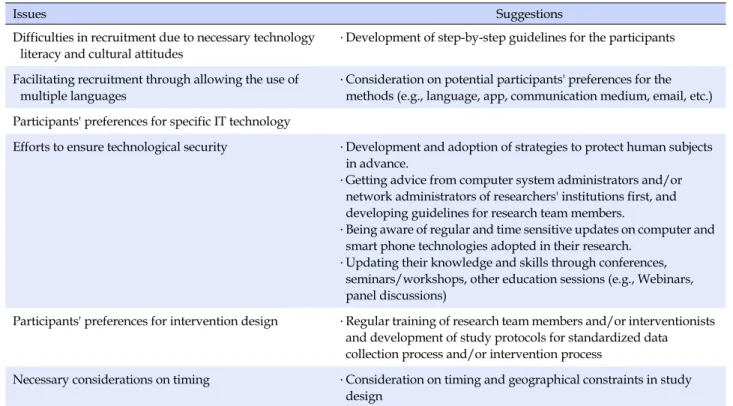
1. The Methodological Issues (See Table 1)
1) Difficulties in Recruitment Due to Necessary Technol-ogy Literacy and Cultural Attitudes
From 1990s when researchers began to use IT technol-ogy, technology illiteracy of research staff members and/
Table 1. Methodological Issues and Suggestions for Future IT Technology-based Research
Issues Suggestions
Difficulties in recruitment due to necessary technology literacy and cultural attitudes
․Development of step-by-step guidelines for the participants Facilitating recruitment through allowing the use of
multiple languages
․Consideration on potential participants' preferences for the methods (e.g., language, app, communication medium, email, etc.) Participants' preferences for specific IT technology
Efforts to ensure technological security ․Development and adoption of strategies to protect human subjects in advance.
․Getting advice from computer system administrators and/or network administrators of researchers' institutions first, and developing guidelines for research team members.
․Being aware of regular and time sensitive updates on computer and smart phone technologies adopted in their research.
․Updating their knowledge and skills through conferences, seminars/workshops, other education sessions (e.g., Webinars, panel discussions)
Participants' preferences for intervention design ․Regular training of research team members and/or interventionists and development of study protocols for standardized data collection process and/or intervention process
Necessary considerations on timing ․Consideration on timing and geographical constraints in study design
or research participants has been reported as a major meth-odological issue in IT technology-based research [26]. Although there have been drastic advances in computer and mobile technologies and the use of computers and mobile devices became ubiquitous, technology illiteracy is still a methodological issue in IT technology-based re-search, especially IT technology-based intervention stu-dies. Indeed, in the original study, some groups of poten-tial participants would not be able to participate in the study due to their technology illiteracy and/or lack of ac-cess to the technology, which limited the potential pool of participants. In the original study, a total of 222 partic-ipants were recruited for 3.5 years (63 to 64 particpartic-ipants per year) despite various recruitment strategies that we adopted for the study. Throughout the research process, those who were not able to use computers and/or mobile devices were automatically excluded because of the na-ture of the technology-based intervention (e.g., the partic-ipants needed to use their computers or mobile devices to use the intervention). All the participants had access to the project website through their computers and/or mobile devices (mostly smartphones).
With this requirement of technology literacy, Asian Americans’ general attitudes toward research also neg-atively influenced the recruitment process of the partic-ipants for this technology-based study. It is well known
that it would be difficult to recruit Asian Americans into research studies in general [29]. A possible reason for their hesitance in participating in research would be their mis-trust toward government and medical research due to their previous experience with the U.S. authorities. Historically, they experienced the Gentleman’s Agreement between the U.S. andJapanese Governments that prohibited the immi-gration ofJapanese men [30], the Naturalization laws that prohibited Asians from U.S. citizenship until 1952 [30], and the internment ofJapanese Americans in the World War II [30]. Especially with a stigmatized condition such as breast cancer among Asian Americans [31,32], it would be much more difficult to recruit this specific group of participants into any types of research. This signifies that, even in nurs-ing research usnurs-ing IT technology, this kind of potential participants’ attitudes toward research participation could affect the research methodology in general and the recruit-ment and retention process in particular.
2) Facilitating Recruitment through Allowing the Use of Multiple Languages
IT technology enabled the use of multiple languages in the original study, which strongly supports the strengths of IT technology-based research in approaching marginal-ized populations who tend to be difficult to approach in real health care systems due to multiple reasons such as
language proficiency, power differentials, transportation difficulties, etc. Indeed, for the study, the use of multiple languages was essential because the participants included many non-native English speakers. The adoption of IT technology easily allowed the use of multiple language versions of the project website, informed consent, educa-tional modules, and online resources. Then, the use of multiple language versions allowed the participants to choose their preferred languages in their participation in the study. It was obvious that the use of multiple lan-guages facilitated the recruitment and retention of many participants who might have not joined the study only with the use of English. It is reported in the literature that those with limited language proficiency are less likely to ask questions [33]. In other words, with language diffi-culties, they would not participate in research studies that they would need to ask questions and get answers. Indeed, in this specific study, the research team members fre-quently recognized that the participants wanted to partic-ipate in the study because they could use their native lan-guages to get help for their survivorship issues/concerns. Also, the research team members frequently found that the participants preferred the use of their native languages in answering the questions in the questionnaires even when they were able to read and write in English. 3) Participants' Preferences for Specific IT Technology
Participants’ preferences for specific IT technology are an important factor to consider in IT technology-based search, which could affect the process of recruitment, re-tention, intervention, and data collection. In the original study, the intervention was provided through a project Website that the participants could access through both computers and mobile devices. Because Asians have been reported as the racial/ethnic group whose usages of com-puters and mobile devices are more prevalent than any other racial/ethnic groups’ [27, 29-31], no issue/concern was expected at the beginning. However, the reality was a little bit different; the participants preferred utilizing their own apps such as Line, WeChat, and Kakaotalk in order to get coaching/support and communicate with the inter-ventionists. They preferred the use of multiple functions included in their apps that they were usually using in their daily life (e.g., voice calls using the app, voice dictation functions, instant messaging). Furthermore, the original plan for using emails for communication (e.g., study up-dates, reminders, etc.) needed to be changed as well. In many cases, the participants did not know how to access their emails even when they had email accounts. In many cases, the participants needed the research team members’
assistance to go through the intervention and surveys; they wanted to get step-by-step instructions through their social media apps and/or phone calls. The use of the com-munication apps was helpful and essential in participant recruitment as well. For instance, when WeChat was used to announce the study just for New York areas, we had over 7K clicks duringjust one day.
The use of communication apps by the participants add-ed another layer of human subject protection issue though because the apps usually involve risks related to privacy and confidentiality. Thus, in the original study, the partic-ipants were allowed to use their apps only to contact the interventionists, and the research team members were al-lowed to use the apps only to send reminders to the par-ticipants. Also, the participants were required to use only nick-names, and identity information was always blocked (not allowed to use) during communication.
4) Efforts to Ensure Technological Security
Human subject protection issues have been one of the major methodological concerns related to IT technology- based research [26,27,29,30]. The concerns include those related to protection of privacy, copyright, and confiden-tiality, lack of ethical guidelines and/or policies related to IT technology-based research, and unanticipated conse-quences due to the use of IT technology [26,27,29,30]. Des-pite continuous efforts to establish national and/or inter-national standardized guidelines for IT technology-based research, virtually none is clearly established [24]. Con-ventionally, the SANS/FBI recommendations, the Health Insurance Portability and Accountability Act (HIPAA), and the Ubuntu Linux security updates are frequently used to guide IT technology-based research in recent years. How-ever, the lack of standardized guidelines/policies could be a major issue in IT technology-based research.
In the original study, the project website was developed and maintained in the central servers of the institute where the study was conducted. Subsequently, it was assumed that the servers and website were regularly updated/up-graded and carefully monitored by the IT office However, the research team was contacted by the participants at multiple times because they had a warning security mes-sage from the project website when they tried to log in, which actually made some of them to decline to partic-ipate in the study. The participants were seriously con-cerned that their privacy might not be ensured, and they declined to participate or withdrew their participation during the research process. Subsequently, this greatly af-fected the process of recruitment, retention, intervention, and data collection.
The use of emails also brought up some human subject protection issues at multiple times in the original study. One of the cases was: an interventionist sent out an email from her gmail account because her institutional email ac-count was not working in a specific time period and she did not want her participant to wait until her institutional email account was back to normal. Due to strict regu-lations related to email communication at the institute where the original study was conducted, it raised a red flag, and the interventionist needed to go through multi-ple layers of training related to email communication, which significantly delayed the research process.
5) Participants' Preferences for Intervention Design Participants’ preferences for intervention design were another important factor to consider in IT technology- based research. In the original study, there were several intervention design issues, which were mainly related to the project website design. One of them was the font size used in the project website. The participants of the original study tended to be older, and many of them had vision problems in reading the content in small fonts. Also, the project website needed to be developed in multiple lan-guages as in the components of the intervention itself. When the first home page of the project website was de-signed only in English, some participants could not create their accounts in the website to participate in the study. Step-by-step instructions in their original languages were essential to make them to register for the website.
Another intervention design issue was how to design the intervention to retain the participants. In the original study, having a symptom log through which the partic-ipants could monitor their progress (to meet the goals that they set with the interventionists) was helpful in retaining the participants in the intervention. Weekly reminders through texting was also helpful in retaining the partic-ipants in the intervention for three months. Also, provid-ing educational sessions that were directly related to re-cent concerns/issues of the participants was also helpful in retaining the participants in the intervention. Finally, regular updates of the resources provided in the vention were also essential to keep the participants’ inter-ests and retain the participants in the intervention. 6) Necessary Considerations on Timing
Timing is another important factor to consider in the de-sign of any IT technology-based research studies, espe-cially in the data collection and/or intervention process. In the original study, a national sampling/recruitment was done because the number of Asian Americans living in
one local area would not be enough to test the efficacy of the intervention. With the national recruitment process, methodological issues related to time and geographical constraints were raised. For instance, some participants did not trust the study because the original study was con-ducted in a different state from theirs. Furthermore, as other researchers have raised [3,32,34-36], timing issues were one of the methodological concerns in the original study as well. Indeed, the differences in time zones be-tween the participants and interventionists decreased the efficiency of the intervention implementation. Many par-ticipants wanted to schedule individual coaching sessions at their convenience, which was usually not during the in-terventionists’ working hours. Furthermore, it was diffi-cult to maintain the participants’ adherence during holi-days such as Christmas and summer vacations.
DISCUSSION
1. Suggestions for Future IT Technology-based Research
These methodological issues provide some directions for future IT technology-based research. First of all, for future IT technology-based research, step-by-step guide-lines for the participants need to be developed and pro-vided for the participants. As discussed, although the par-ticipants were required to use computers and/or mobile devices for their participation in the study, many partic-ipants were not technology savvy (although they had ac-cess to computers and/or mobile devices). Thus, step-by- step instructions by the research team members were es-sential to make them even to sign up for the study and go through the research process successfully.
Second, researchers need to be aware of potential par-ticipants’ preferences for the methods that will be used in their IT technology-based research (e.g., language, app, communication medium, emails, etc.). As discussed, the use of communication apps was not originally planned in the original study. However, due to the preferences on the use of apps by the participants, the apps were adopted for the study implementation. Without incorporating the par-ticipants’ preferences into the study design and imple-mentation plans, it would have been difficult to recruit the participants and conduct the intervention as planned in the research design.
Third, as in traditional research, researchers need to carefully develop and adopt strategies to protect human subjects in advance. Checking with IRB policies related to the use of IT technology would be essential to meet the requirements. Also, regular training on human subject
protection among research team members would be also essential to ensure adequate protection of human subjects. Furthermore, research records need to be regularly moni-tored to double-check any potential breaches in security and confidentiality of the study. In this way, studies could be successfully and ethically conducted as planned in the study design.
Fourth, it would be essential to get advice from com-puter system administrators and/or network administra-tors of researchers’ institutions first, and develop guide-lines for research team members as well. Especially, the re-search team members need to be on the same page about technical aspects of the study (e.g., the use of email ac-counts, etc.), which would ensure the rigor in data collec-tion and/or the fidelity of the intervencollec-tion. Furthermore, researchers need to be aware of regular and time sensi-tive updates on computer and smart phone technologies adopted in their research to ensure the security and con-fidentiality of their studies. They could easily update their knowledge and skills through conferences, seminars/ work-shops, and other education sessions (e.g., Webinars, panel discussions).
Fifth, as in traditional research, the research team mem-bers of IT technology-based research need to be regularly trained. Surely, development of study protocols for stand-ardized data collection process and/or intervention proc-ess would be proc-essential to ensure the quality, rigor, and/or fidelity of the studies and/or interventions. Regular sup-port group meetings for research team members and/or interventionists could also help ensure the quality, rigor, and/of fidelity of the studies and/or interventions.
Finally, researchers need to consider potential study and/or intervention implementation issues in IT technol-ogy-based research (e.g., timing, geographical constraints). As in traditional research, issues related to time and geographical limitations could also complicate the im-plementation of the study and/or intervention using IT tech-nologies, which subsequently threatens the rigor of the studies.
CONCLUSION
In this paper, methodological issues in IT technology- based research were discussed based on the issues raised in an IT technology-based interventions study among Asian American breast cancer survivors. Based on the dis-cussions, implications for future IT technology-based re-search were suggested. Despite high potential of IT tech-nology-based research in many aspects of research proc-ess, researchers need to consider several methodological
issues in conducting IT technology-based studies. Maybe, with further advances in computer and mobile tech-nologies, these issues could disappear in the near future. Or, further investigations on these issues could help devel-op more detailed and rigorous IT technology-based re-search methodologies for future nursing rere-search.
REFERENCES
1. Jander A, Crutzen R, Mercken L, De Vries H. Web-based inter-ventions to decrease alcohol use in adolescents: A Delphi study about increasing effectiveness and reducing drop-out. BMC Public Health. 2015;15:340.
https://doi.org/10.1186/s12889-015-1639-z
2. Im E-O, Chang S. Web-based interventions in nursing. Com-puters, Informatics, Nursing. 2013;31(2):94-102.
https://doi.org/10.1097/NXN.0b013e3182771868
3. Im E-O, Lee Y, Chee E, Chee W. Web-based interventions for menopause: A systematic integrated literature review. Matu-ritas. 2017;95:24-30.
https://doi.org/10.1016/j.maturitas.2016.10.009
4. Christensen H, Griffiths KM, Korten A. Web-based cognitive behavior therapy: Analysis of site usage and changes in de-pression and anxiety scores.Journal of Medical Internet Re-search. 2002;4(1):e3. https://doi.org/10.2196/jmir.4.1.e3 5. Kim C-J, Kang D-H. Utility of a web-based intervention for
in-dividuals with type 2 diabetes: The impact on physical activity levels and glycemic control. Computers, Informatics, Nursing. 2006;24(6):337-345.
https://doi.org/10.1097/00024665-200611000-00008
6. Sward KA, Richardson S, KendrickJ, Maloney C. Use of a web-based game to teach pediatric content to medical stu-dents. Ambulatory Pediatrics. 2008;8(6):354-359.
https://doi.org/10.1016/j.ambp.2008.07.007
7. YeJ. Acculturative stress and use of the internet among East Asian international students in the United States. Cyberpsy-chology & Behavior. 2005;8(2):154-161.
https://doi.org/10.1089/cpb.2005.8.154
8. Im E-O, Chee W. A descriptive Internet survey on menopausal symptoms: Five ethnic groups of Asian American university faculty and staff.Journal of Transcultural Nursing. 2005;16(2): 126-135. https://doi.org/10.1177/1043659604273550
9. Paxton RJ, Nayak P, Taylor WC, Chang S, Courneya KS, Schover L, et al. African-American breast cancer survivors' preferences for various types of physical activity interven-tions: A Sisters Network Inc. web-based survey.Journal of Cancer Survivorship. 2014;8(1):31-38.
https://doi.org/10.1007/s11764-013-0307-5
10. Hobbs BB, Farr LA. Assessing internet survey data collection methods with ethnic nurse shift workers. Chronobiology
Inter-national. 2004;21(6):1003-1013. https://doi.org/10.1081/cbi-200038529
11. Bosak KA, Yates B, Pozehl B. Effects of an Internet physical ac-tivity intervention in adults with metabolic syndrome. Western Journal of Nursing Research. 2010;32(1):5-22.
https://doi.org/10.1177/0193945909333889
12. Chen H-H, Yeh M-L. Developing and evaluating a smoking cessation program combined with an Internet-assisted instru-ction program for adolescents with smoking. Patient Educa-tion and Counseling. 2006;61(3):411-418.
https://doi.org/10.1016/j.pec.2005.05.007
13. Im E-O, Kim S, Xu S, Lee C, Hamajima Y, Inohara A, et al. Issues in recruiting and retaining Asian American breast can-cer survivors in a technology-based intervention study. Can-cer Nursing. 2018.
https://doi.org/10.1097/NCC.0000000000000657
14. Im E-O, Lee SJ, Hu Y, Cheng C-Y, Iikura A, Inohara A, et al. The use of multiple languages in a technology-based intervention study: A discussion paper. Applied Nursing Research. 2017; 38:147-152. https://doi.org/10.1016/j.apnr.2017.10.011 15. Im E-O, Chee W, Hu Y, Kim S, Choi H, Hamajima Y, et al. What
to consider in a culturally tailored technology-based interven-tion? Computers, Informatics, Nursing. 2018;36(9):424-429. https://doi.org/10.1097/CIN.0000000000000450
16. Im E-O, Lee B, Chee W, Brown A, Dormire S. Menopausal symptoms among four major ethnic groups in the U.S. West-ernJournal of Nursing Research. 2010;32(4):540-565. https://doi.org/10.1177/0193945909354343
17. Reynolds C, Sutherland MA, Palacios I. Exploring the use of technology for sexual health risk-reduction among ecuador-ean adolescents. Annals of Global Health. 2019;85(1):57. https://doi.org/10.5334/aogh.35
18. Thobias J, Kiwanuka A. Design and implementation of an m-health data model for improving health information access for reproductive and child health services in low resource settings using a participatory action research approach. BMC Medical Informatics and Decision Making. 2018;18(1):45. https://doi.org/10.1186/s12911-018-0622-x
19. Wootton AR, Legnitto DA, Gruber VA, Dawson-Rose C, Neilands TB,Johnson MO, et al. Telehealth and texting inter-vention to improve HIV care engagement, mental health and substance use outcomes in youth living with HIV: A pilot fea-sibility and acceptability study protocol. BMJ Open. 2019;9(7): e028522. https://doi.org/10.1136/bmjopen-2018-028522 20. Hecht J, Rigotti NA, Minami H, Kjome KL, Bloom EL, Kahler
CW, et al. Adaptation of a sustained care cessation interven-tion for smokers hospitalized for psychiatric disorders: Study protocol for a randomized controlled trial. Contemporary Clin-ical Trials. 2019;83:18-26.
https://doi.org/10.1016/j.cct.2019.06.001
21. Saver BG, Gustafson D, Taylor TR, Hawkins RP, Woods NF, Dinauer S, et al. A tale of two studies: The importance of set-ting, subjects and context in two randomized, controlled trials of a web-based decision support for perimenopausal and post-menopausal health decisions. Patient Education and Counsel-ing 66. 2007;66(2):211-222.
https://doi.org/10.1016/j.pec.2006.12.004
22. Im E-O, Chee W. The DSCP-CA: A decision support computer rogram--cancer pain management. Computers, Informatics, Nursing. 2011;29(5):289-296.
https://doi.org/10.1097/NCN.0b013e3181f9dd23
23. Horvath KJ, Amico KR, Erickson D, Ecklund AM, Martinka A, DeWittJ, et al. Thrive with me: Protocol for a randomized con-trolled trial to test a peer support intervention to improve anti-retroviral therapy adherence among men who have sex with men.JMIR Research Protocols. 2018;7(5):e10182.
https://doi.org/10.2196/10182
24. Penn A, Kuperberg A. Psychosocial support in adolescents and young adults with cancer. The CancerJournal. 2018;24(6): 321-327. https://doi.org/10.1097/PPO.0000000000000339 25. Weinert C. "Measuring Social Support: PRQ2000." In
Measure-ment of Nursing Outcomes: Vol. 3. Self Care and Coping, 161-172. New York: Springer, 2003.
26. Bush NE, WooldridgeJ, Foster V, Shaw K, Brown P. Web site design and development issues: The Washington State Breast and Cervical Health Program Web Site Demonstration Project. Oncology nursing forum. 1999;26(5):857-865.
27. Pew Internet and American Life Project. Demographics, degrees of Internet access, and health. February 2010.
http://www.pewinternet.org/~/media/Files/Presentations /2006/Fox_UNC_June_2006[1].pdf. Accessed December 31, 2013.
28. Weber RP. Basic content analysis. Thousands Oaks, CA: Sage; 1990.
29. Pew Internet and American Life Project. 17% of cell phone owners do most of their online browsing on their phone, rather than a computer or other device. 2012.
http://pewinternet.org/Reports/2012/Cell-Internet-Use-201 2.aspx. Accessed May 20, 2014.
30. López G, Ruiz NG, Patten E. Key facts about Asian Americans, a diverse and growing population. Pew Res Cent. September 2017.
http://www.pewresearch.org/fact-tank/2017/09/08/key-fa cts-about-asian-americans/. Accessed February 19, 2018. 31. Fallows D. Pew Internet & American life report. How women
and men use the Internet. 2005.
http://www.pewinternet.org/. Accessed May 20, 2014. 32. Shaw BR, Hawkins R, Arora N, McTavish F, Pingree S,
Gustaf-son DH. An exploratory study of predictors of participation in a computer support group for women with breast cancer.
Computers, Informatics, Nursing. 2006;24(1):18-27. https://doi.org/10.1097/00024665-200601000-00007
33. Green AR, Ngo-Metzger Q, Legedza ATR, Massagli MP, Phil-lips RS, Iezzoni LI. Interpreter services, language concordance, and health care quality. Experiences of Asian Americans with limited English proficiency.Journal of General Internal Medi-cine. 2005;20(11):1050-1056.
https://doi.org/10.1111/j.1525-1497.2005.0223.x
34. Massoudi BL, Olmsted MG, Zhang Y, Carpenter RA, Barlow CE, Huber R. A web-based intervention to support increased
physical activity among at-risk adults.Journal of Biomedical Informatics. 2010;43(5):S41-S45.
https://doi.org/10.1016/j.jbi.2010.07.012
35. Neve MJ, Collins CE, Morgan PJ. Dropout, nonusage attrition, and pretreatment predictors of nonusage attrition in a com-mercial Web-based weight loss program.Journal of Medical Internet Research. 2010;12(4):e69.
https://doi.org/10.2196/jmir.1640
36. Hine C. Virtual Methods: Issues in Social Research on the Internet. Oxford, UK: Berg; 2005.