P2-18 / W. Han
• IMID 2009 DIGEST
Abstract
Nonideality of LED lens and diffuser as well as cross-talk between backlights should be compensated because they have large effects on image qualities. The computation complexities of conventional compensations are greatly increased as resolutionbecomes higher. The block based compensation is proposed to alleviate the computation complexity considering backlight profiles and image pixel characteristics.
1. Introduction
The backlights of LCD used in various display devices such as mobile phones, PC monitors and HDTVs have great impacts on image qualities. Current HDTV requires higher image quality and resolution and the edge and direct type LED backlights have been reported.
For LCD with backlights, the brightness should be constant throughout entire backlight block area divided by backlight LED array. Currently, the number of LED is increased and spacing between LEDs becomes smaller for higher image qualities, making the compensation computation more complex. In real backlight, the brightness changes due to the nonideality of LED lens and diffuser. In addition, although neighboring backlight blocks should not interfere with each other, there is cross-talk between the adjacent backlight blocks, which becomes more severe with local dimming. Since the nonideality of lens and diffuser as well as cross-talk have considerable effects on image qualities, intensive compensations are required to cancel out the effects.
The conventional compensation methodologies adjust the value of pixels to compensate the variation of backlight profile and to make the superposed
backlight profile flat[1]. Since the amounts of
compensation should be computed for every pixel, large amount of computation is required.
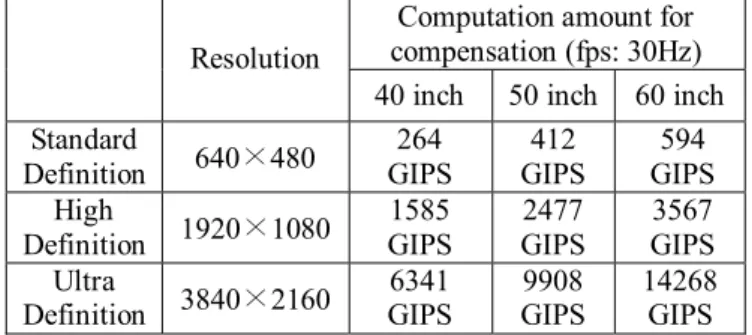
Table 1. Computation amounts of pixel based compensation according to resolutions (15mm LED pitch)
Computation amount for compensation (fps: 30Hz) Resolution
40 inch 50 inch 60 inch Standard
Definition 640×480 GIPS 264 GIPS 412 GIPS 594 High Definition 1920×1080 1585 GIPS 2477 GIPS 3567 GIPS Ultra
Definition 3840×2160 GIPS 6341 GIPS 9908 14268 GIPS
GIPS (Giga Instructions per Second) Table 1 shows that the computation amounts of conventional compensations for the cross-talk and the nonideality of LED lens and diffuser are greatly increased as resolution and display panel size increase. Therefore, the compensation with less computation complexity is desirable without degradation of image qualities.
2. Pixel block based LCD backlight nonideality
& cross-talk compensation
In conventional approach[2], the amounts of compensation to adjust pixel values are determined by the backlight brightness and image pixel value. Therefore, backlight brightness computation of every pixel is required.
As shown in (1), the backlight brightness (BB) at pixel(i, j) (0 ≤ i, j ≤ Horizontal, vertical pixel
Low Computation Complexity Block Based Nonideality
and Cross-talk Compensations for LCD Backlight
WonJin Han, JaeHee You
School of Electrical Engineering, Hong Ik University 72 - 1, Sangsudong, Mapogu, Seoul 121-791, Korea Tel.: +82-2-320-1657, E-mail: [email protected]
P2-18 / W. Han
IMID 2009 DIGEST •
resolution – 1, respectively) can be computed according to backlight profile (BP), the brightness of backlight LED (LB) and the distance between pixel and backlight LED (D).
(1)
Because the backlight brightness for a pixel area is superposition of lights from neighboring backlight LEDs near the pixel, the backlight brightness computations of every pixel (for every i, j) require large amount of computations as shown in Table 1.
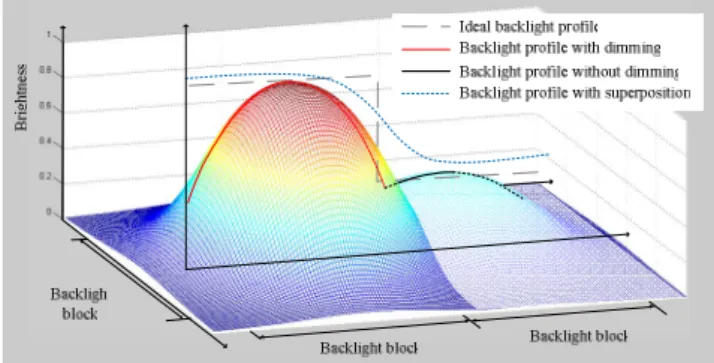
Figure 1. Superposition of backlight profiles with local dimming
Figure 1 shows the total backlight profile considering nonideality of LED lens and diffuser and cross-talk between backlights with local dimming. Since the superimposed backlight profile even with local dimming doesn’t change abruptly with respect to each pixel, the compensations don’t have to be computed with pixel basis.
Figure 2. Difference of neighboring pixels
As shown in Figure 2, pixel value difference within 3 pixel distance is less than 20% for various image samples. Therefore image pixel value shows homogeneity across the several consecutive pixels.
Since both of backlight profile and pixel value do not change abruptly, the compensation based on pixel blocks with appropriate size doesn’t degrade image qualities a lot for not only the cross-talk between backlights but also the nonideality of LED lens and diffuser. Also the amount of change of backlight profile and image pixel value for nonideality as well as cross-talk are very similar, the same size of compensation block can be used for both of them, which makes the compensation a lot simpler.
The block based compensation is computed based on the center of the compensation block since it can best represent the all pixels in the compensation block. The amount of computation is reduced by inverse of compensation block size.
3. Simulation results
Figure 3 shows the image qualities and the amount of compensations according to various compensation block sizes. Image qualities are maintained with up to 6×6 pixel block, decreasing amount of compensation computation by 60%.
Figure 3. Image qualities and amounts of compensation according to compensation block sizes
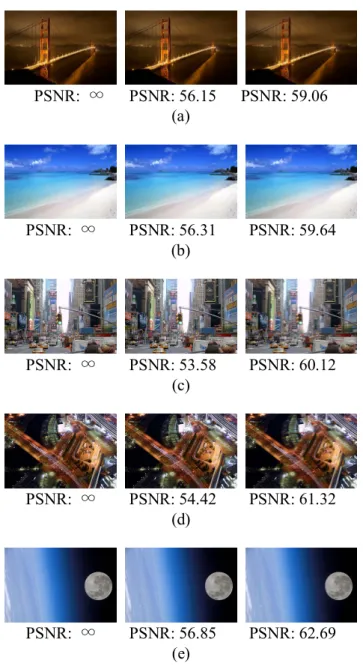
Figure 4 shows original images and the results of conventional pixel based vs. proposed block based compensation. Only PSNR is decreased by 4dB, with 60% less computation amounts.
P2-18 / W. Han • IMID 2009 DIGEST PSNR: ∞ PSNR: 56.15 PSNR: 59.06 (a) PSNR: ∞ PSNR: 56.31 PSNR: 59.64 (b) PSNR: ∞ PSNR: 53.58 PSNR: 60.12 (c) PSNR: ∞ PSNR: 54.42 PSNR: 61.32 (d) PSNR: ∞ PSNR: 56.85 PSNR: 62.69 (e)
Figure 4. Conventional vs. proposed compensations (a) Dark Image, (b) Bright Image, (c) Image with abrupt color change, (d) Image with abrupt brightness
change, (e) Image with small brightness change Table 2. Amounts of computation and image qualities according to block size
Block Based Image Quality Index 4×4 6×6 8×8 Pixel Based Computation Amount(GIPS) 63.40 28.18 15.85 1014.63 PSNR(dB) 56 53 51 59 Distortion 0.97 0.97 0.96 0.99 SSIM 0.98 0.98 0.97 0.99 Hue 34 32 30 49 Saturation 0.93 0.90 0.89 0.97
4. Conclusion
Identical size pixel block based compensation methodologies for lens and diffuser nonideality as well as cross-talk compensation utilizing homogeneity of image pixels are proposed. It greatly reduces amount of compensation computation for large display systems with less cost and power consumption. Image qualities such as PSNR, hue, saturation and computation amounts for various block sizes are evaluated. Identical 6×6 block size can be used for both cross-talk and nonideality compensation with 60% less computation amount and PSNR above 50dB.
Acknowledgement
This research was supported in part by a grant (F0004110-2009-32) from the Information Display R&D Center, one of the Knowledge Economy Frontier R&D Program funded by the Ministry of Commerce, Industry and Energy of the Korean Government and in part by Seoul Research and Business Development Program (10555).
5. References
1. Huajun J. Peng, Wei Zhang, Chun-Kit Hung, Chen-Jung Tsai, Kwan-Wah Ng and Shou-lung Chen, “High Contrast LCD TV Using Active Dynamic LED Backlight”, SID 07
2. Hanfeng Chen, Junho Sung, Taehyeun Ha and Yungjun Park, “Locally Pixel-Compensated Backlight Dimming for Improving Static Contrast on LED Backlit LCDs”, SID 07