ISSN 2234-3806 • eISSN 2234-3814 Ann Lab Med 2018;38:324-330
https://doi.org/10.3343/alm.2018.38.4.324
Recent Increase in the Incidence of TEM-135
β-Lactamase-harboring Neisseria gonorrhoeae in Korea
John Hoon Rim, M.D.1,2,3, Hyunsoo Kim, M.D.4, Hyukmin Lee, M.D.1, Dongeun Yong, M.D.1, Seok Hoon Jeong, M.D.1, and Kyungwon Lee, M.D.1
Department of Laboratory Medicine and Research Institute of Bacterial Resistance1, and Department of Pharmacology2, Yonsei University College of
Medicine, Seoul; Department of Medicine3, Physician-Scientist Program, Yonsei University Graduate School of Medicine, Seoul; Department of Laboratory
Medicine4, The National Police Hospital, Seoul, Korea
Background: We investigated the molecular epidemiological characteristics and
antimi-crobial susceptibility pattern of penicillinase-producing Neisseria gonorrhoeae (PPNG) isolates to monitor the change in distribution of blaTEM in Korea.
Methods: We collected 804 PPNG isolates from diverse hospitals and clinics mainly
lo-cated in Seoul, Korea, over a period of 11 years (2005–2015). Isolate susceptibility to seven antimicrobials was determined using the agar dilution test. The molecular epidemiological characteristics of the isolates were determined by Sanger sequencing of blaTEM, N. gonor-rhoeae multiantigen sequence typing (NG-MAST) and plasmid typing.
Results: Among 72 fully sequenced PPNG isolates, sixteen (22.2%) possessed TEM-135.
All TEM-135 isolates had a common silent mutation (c.18C>T), which was previously un-reported. We observed a pattern of continuous increase in the number of TEM-135 iso-lates since 2012. The median and 90% minimum inhibitory concentration of azithromycin were substantially lower in the TEM-135 group than in the non-PPNG and TEM-1 groups. All TEM-135 isolates showed different NG-MAST types and predominantly harbored To-ronto/Rio (75%) plasmids. A comprehensive comparative analysis of PPNG with TEM-135 according to NG-MAST, plasmid type, and year of isolation revealed a wide distribution.
Conclusions: The proportion of TEM-135 PPNG has continuously increased since 2012,
in association with clonal spread. The difference at position 18 of the TEM-135 sequence can be interpreted as the existence of multiple clonal complexes. The possibility that TEM-135 was acquired via foreign plasmids requires careful follow-up and continuous monitor-ing of TEM-135 to ascertain whether it constitutes a step towards evolutionary change.
Key Words: Penicillinase-producing Neisseria gonorrhoeae, blaTEM, TEM-135 β-lactamase, NG-MAST, Plasmid typing, Antibiotic resistance, Korea
Received: July 25, 2017
Revision received: September 30, 2017 Accepted: February 27, 2018
Corresponding author: Hyukmin Lee
Department of Laboratory Medicine, Yonsei University College of Medicine, 211 Eonju-ro, Gangnam-gu, Seoul 06273, Korea Tel: +82-2-2019-3777
Fax: +82-2-2057-8926
E-mail: [email protected]
© Korean Society for Laboratory Medicine
This is an Open Access article distributed under the terms of the Creative Commons Attribution Non-Commercial License (http://creativecom-mons.org/licenses/by-nc/4.0) which permits unrestricted non-commercial use, distribution, and reproduction in any medium, provided the original work is properly cited.
INTRODUCTION
Penicillin treatment failure was first reported soon after the intro-duction of penicillin administration in the 1940s; dissemination of penicillin resistance has made this antibiotic useless since the 1950s [1]. The mechanism of penicillin resistance prevalent
during the 1960s and mid-1970s is associated with mutations in chromosomal genes (mainly penA gene) encoding for penicil-lin binding proteins (chromosomally-mediated penicilpenicil-lin resis-tant N. gonorrhoeae, CMRNG) [1, 2]. Although CMRNG resulted in clinical treatment failure, administration of high-dose penicil-lin remained effective against CMRNG until a new resistance
2017-03-16 https://crossmark-cdn.crossref.org/widget/v2.0/logos/CROSSMARK_Color_square.svg
mechanism emerged in 1976 [3]. This novel mechanism re-sulted from the acquisition of a plasmid-located β-lactamase gene (blaTEM-1) exhibiting high-level resistance to penicillin (peni-cillinase-producing N. gonorrhoeae, PPNG). Wide dissemina-tion of PPNG ultimately provoked the usage of extended-spec-trum cephalosporin antibiotics, including ceftriaxone and cefix-ime, which were effective against the TEM-1 β-lactamase with a narrow hydrolytic spectrum [4, 5]. However, there have been frequent recent reports of new β-lactamase variants sharing com-mon single nucleotide polymorphisms (compared with TEM-1).
TEM-135, which has a single amino acid change (M182T) compared with the TEM-1 sequence, was first reported in 2005 [6], and its frequency and genetic diversity have been consis-tently evaluated in many countries. The clinical significance of TEM-135 remains unclear, as there are no major differences in the minimal inhibitory concentrations (MICs) of penicillin and extended-spectrum cephalosporins; however, the emergence of TEM-135 could signify the introduction of other TEM β-lactamases with an extended β-lactam hydrolytic spectrum through muta-tion or plasmid acquisimuta-tion under the high selective pressure of cephalosporin usage. We aimed to determine the prevalence of 135 and compare the characteristics of 1- and TEM-135-producing N. gonorrhoeae isolated in Korea from 2005 to 2015.
METHODS
1. N. gonorrhoeae isolates
A total of 804 isolates were collected over 11 years (2005–2015) from 40 diverse hospitals and primary-care clinics in Korea to test for the presence of the TEM-135 gene. This study was ap-proved by the Institutional Review Board of the Human Research Protection Center in the Yonsei University Health System (4-2016-0359). Transgrow medium was used as the transport medium to minimize the loss of viable N. gonorrhea isolates, and modi-fied Thayer-Martin medium (Becton-Dickinson, Cockeysville, MD, USA) was used for colony growth and incubation. Bacterial identification was confirmed by Gram-stain and the Vitek system (bioMerieux, Marcy l’Etoile, France) or by matrix-assisted laser desorption/ionization-time of flight (MALDI-TOF) mass spec-trometry (Bruker Daltonics, Bremen, Germany). All isolates were collected for the national surveillance program for gonococci supported by the Korean Centers for Disease Control and Pre-vention. They were stored at –70°C until the number of isolates collected was sufficient for analysis. Molecular analysis was per-formed.
2. Antimicrobial susceptibility testing and examination of
β-lactamase production
The antimicrobial susceptibility of all isolates to the antibiotics (penicillin G, tetracycline, ceftriaxone, spectinomycin, ciproflox-acin, nalidixic acid, and azithromycin) was determined using the CLSI disk diffusion method [7]. MIC was calculated using the agar dilution test according to the CLSI guidelines [8] for all antibiotics except azithromycin, for which the European Com-mittee on Antimicrobial Susceptibility Testing (EUCAST) cut-off values were used [9]. The median and 90% MIC values (MIC50 and MIC90) and range were evaluated for the three groups of isolates: non-PPNG, PPNG with 1, and PPNG with TEM-135.
3. DNA extraction and mismatch amplification mutation
assay polymerase chain reaction
DNA was extracted from PPNG bacterial suspensions, using the QIAquick gel extraction kit (Qiagen, Hilden, Germany). Mismatch amplification mutation assay (MAMA) PCR was performed to detect the blaTEM-135 allele, and TEM PCR was performed to iden-tify both blaTEM-1 and blaTEM-135 [10]. The complete blaTEM sequen-ces of PPNG isolates were confirmed by Sanger sequencing based on a comparison between the TEM-135 reference se-quence (GenBank accession number: GQ896333) and the PCR products.
4. Molecular epidemiology of TEM-135 isolates using N.
gonorrhoeae multiantigen sequence typing (NG-MAST)
and plasmid typing
To evaluate the molecular epidemiology of the TEM-135
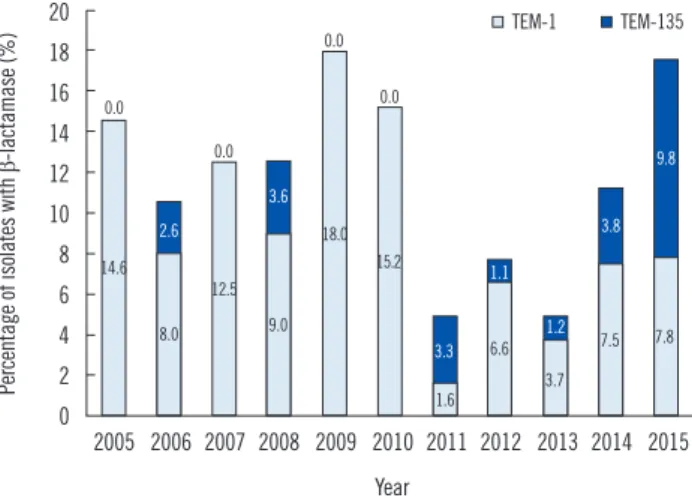
iso-Fig. 1. Chronological changes in the percentage of isolates with TEM-1 or TEM-135 β-lactamase among all the N. gonorrhoeae iso-lates collected between 2005 and 2015.
20 18 16 14 12 10 8 6 4 2 0 2005 2006 2007 2008 2009 2010 2011 2012 2013 2014 2015 Year
Percentage of isolates with
β-lactamase (%) 0.0 0.0 0.0 0.0 TEM-1 TEM-135 2.6 14.6 8.0 12.5 9.0 18.0 15.2 3.3 1.6 6.6 3.7 7.5 7.8 1.1 1.2 3.8 9.8 3.6
Table 1. Alterations in the nucleic acid and amino acid sequences of TEM-1 and TEM-135 β-lactamase
Species (GenBank accession number) subtypesTEM
Position of nucleic acid alteration (amino acid alteration) 18 (Silent) Wild type: T, Mutant: C 539 (Met182Thr) Wild type: T, Mutant: C 547 (Ala185Thr) Wild type: G, Mutant: A
N. gonorrhoeae (AG) TEM-1 T T G
Salmonella enerica subsp. enterica serovar Typhimurium (AJ634602) TEM-135 T C G
N. gonorrhoeae (GQ896333, Thailand) TEM-135 C C G
N. gonorrhoeae (AB551787, Japan) TEM-135 T C G
N. gonorrhoeae (KM998962) TEM-220 T C A
N. gonorrhoeae isolates with TEM-135 in this study TEM-135 T C G
Nucleotides written in boldface are mutated nucleotides.
Table 2. Comparison of resistance proportion and antibiotic geometric mean MIC values according to the presence of TEM-1 or TEM-135
Antibiotics MIC (µg/mL) Antimicrobial susceptibility (%)
Range MIC50 MIC90 Susceptible Intermediate Resistant
TEM-1 PPNG (N=38)* Penicillin 2–256 64 128 0 0 100 Ceftriaxone ≤0.008–0.12 0.03 0.12 100 0 Cefixime ≤0.008–0.25 0.03 0.12 100 0 Spectinomycin 16–32 32 32 100 0 0 Tetracycline 0.25–128 4 32 9.4 12.5 78.1 Ciprofloxacin 0.06–32 2 16 3.1 6.3 90.6 Azithromycin† ≤0.06–8 0.25 1 60.0 24.0 16.0 TEM-135 PPNG (N=14)‡ Penicillin 32–256 128 128 0 0 100 Ceftriaxone ≤0.008–0.06 ≤0.008 ≤0.008 100 0 Cefixime ≤0.008–0.06 ≤0.008 ≤0.008 100 0 Spectinomycin 8–32 32 32 100 0 0 Tetracycline 0.25–32 0.5 32 15.4 53.8 30.8 Ciprofloxacin ≤0.008–8 2 4 15.4 0 84.6 Azithromycin† ≤0.06–0.25 0.06 0.25 100 0 0 Non-PPNG (N=529) Penicillin ≤0.06–32 1 4 0 61.5 38.5 Ceftriaxone ≤0.008–0.25 0.03 0.12 100 0 Cefixime ≤0.008–0.5 0.03 0.25 96.6 3.4 Spectinomycin ≤4–32 32 32 100 0 0 Tetracycline ≤0.12–128 2 32 3.0 31.0 66.0 Ciprofloxacin ≤0.008–64 8 16 12.3 3.7 84.0 Azithromycin† ≤0.06–4 0.25 0.5 57.2 35.2 7.6
*Of the 56 TEM-1 PPNG isolates, 38 isolates were available for antimicrobial susceptibility testing with all seven antibiotics; †EUCAST cut-off values were
uti-lized because there are no recommended cut-off values in CLSI M100-S25; ‡Of the 16 TEM-135 PPNG isolates, 14 isolates were available for antimicrobial
susceptibility testing with all seven antibiotics.
lates, NG-MAST was performed by sequencing the porB and tbpB genes; allele numbers and sequence types (STs) were as-signed using the NG-MAST website (http://www.ng-mast.net), as previously described [11]. For plasmid typing, multiplex PCR was performed on all isolates, as previously described, using primers BL1, BL2, BL3, and BL4 [12].
RESULTS
1. Detection and trends of PPNG isolates with TEM-135
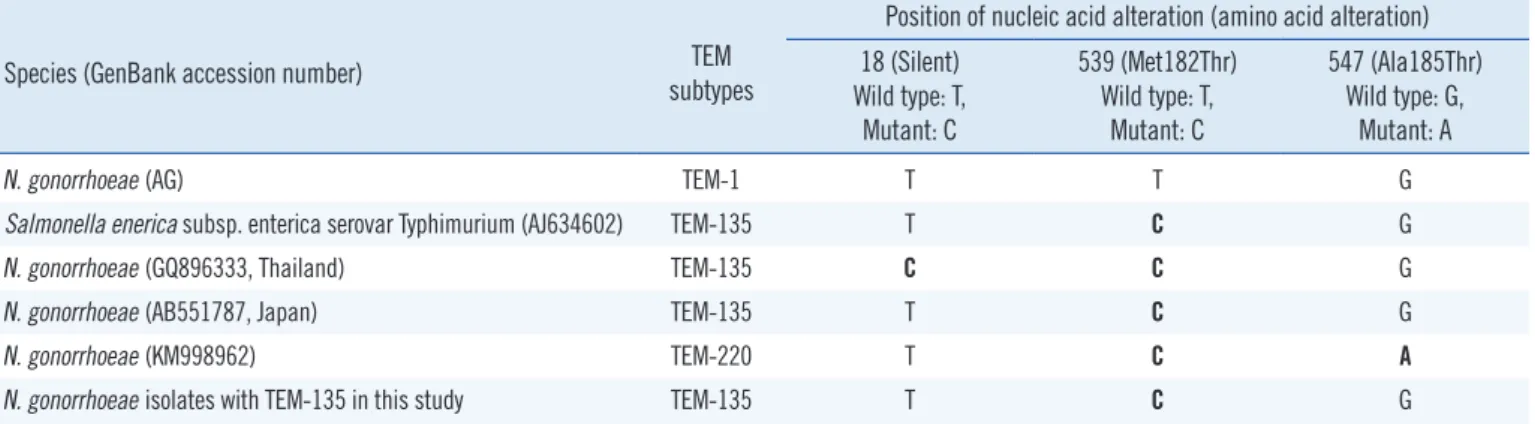
PPNG isolates accounted for 11.6% (N=93) of the 804 isolates, with patterns fluctuating by collection year (Fig. 1). Only 72 PPNG isolates (77.4%) were available for further molecular investiga-tion because of loss or deteriorainvestiga-tion of the isolates during thestorage period. These 72 isolates were subjected to full sequence analysis to determine the presence of TEM-1 or TEM-135; 22.2% (N=16) were shown to harbor TEM-135. The first TEM-135 iso-late was identified in 2006, and the number of TEM-135 isoiso-lates has continuously increased since 2012. Although no variant types other than TEM-1 and TEM-135 were found, all isolates possessed a silent mutation, c.18C>T, which does not change the original amino acid (Proline) compared with the previously reported blaTEM-135 reference sequence (GQ896333; Table 1).
2. Antimicrobial susceptibility of PPNG isolates with or
without TEM-135
Of the 72 PPNG isolates, 52 (38 TEM-1 and 14 TEM-135 iso-lates) were randomly selected (mainly because of strain
avail-Fig. 2. Genetic distance tree and plasmid types of penicillinase-producing Neisseria gonorrhoeae with TEM-1 or TEM-135 grouped accord-ing to porB genotype. Alleles marked with a black circle or numbers shown in red are associated with isolates harboraccord-ing TEM-135; num-bers in parenthesis indicate the number of isolates with the same sequence type. Although sequence types are diverse among isolates with TEM-135, two small clusters (cluster A and B) accounting for 56.3% (9/16) of all TEM-135 isolates appear to be independently segregated.
Abbreviation: NG-MAST, Neisseria gonorrhoeae multiantigen sequence typing; ST, sequence type; AF, African; AS, Asian; TR, Tronto/Rio. 15
305
A
ability) for antimicrobial susceptibility testing with seven antibiot-ics. The proportions of susceptible isolates for the seven antibi-otics were similar between the TEM-1 group and TEM-135 group, whereas the non-PPNG group showed a different pattern (Table 2). Comparison of the MIC50 and MIC90 (determined using the agar dilution test) of the three groups (non-PPNG, PPNG with TEM-1, and PPNG with TEM-135) showed that the MIC50 and MIC90 of ceftriaxone and cefixime were significantly lower in the TEM-135 than in the other groups (all values ≤0.008 μg/mL). Additionally, the MIC50 and MIC90 of azithromycin in the TEM-135 group were also lower than those in the TEM-1 group (MIC50= 0.06 µg/mL and MIC90=0.25 µg/mL for the TEM-135 group). No significant changes in antimicrobial resistance trends were observed in the TEM-1, TEM-135, and non-PPNG groups (Sup-plemental Data Table S1).
3. Determination of molecular epidemiological
characteristics by NG-MAST and plasmid typing
The STs of 72 PPNG isolates were determined by NG-MAST in order to elucidate the molecular epidemiology of plasmids pos-sessing certain types of penicillinases; 59 different STs were iden-tified, indicating heterogeneous epidemiological distribution (Fig. 2). The STs bearing TEM-135 were dispersed throughout the genetic tree (generated based on por gene sequences using the unweighted pair group method with arithmetic mean [UPGMA] approach), except for two small clusters (cluster A and B; Fig. 2). Plasmid typing of all PPNG isolates demonstrated that the African plasmid type was the most common type, present in 51/72 isolates (70.8%), followed by the Toronto/Rio (N =13, 18.1%) and the Asian (N=8, 11.1%) plasmid types. However, among the TEM-135 isolates, the Toronto/Rio plasmid type was predo-minant (N=13, 81.3%), followed by the Asian (N=2, 12.5%) and the African (N=1, 6.2%) plasmid types. ST3965 isolates all possessed TEM-1 on an African type plasmid, except for one isolate with TEM-135 on a Toronto/Rio type plasmid. In cluster A, five TEM-135 isolates (designated with black dots and bold red numbers; blue box, Fig. 2) appeared to be closely related based on close genetic distances (determined by NG-MAST), the predominance of the Toronto/Rio type (established by plas-mid typing), and recent isolation (within the last three years). Four isolates in cluster B (Fig. 2) harbored three Toronto/Rio plasmids and one Asian plasmid. Interestingly, the Asian and African plasmids bearing TEM-135 have appeared recently (in 2012, 2014, and 2015).
DISCUSSION
The emergence of PPNG was one reason for the use of extended-spectrum cephalosporins, including ceftriaxone and cefixime; the appearance of TEM-135 could constitute another turning point in gonococcal treatment through the evolution or introduc-tion of novel β-lactamases to N. gonorrhoeae. Following the first report of 135 in Japan, the reported prevalence of TEM-135 ranged from 9.4% to 57.8% according to country [10, 13-17]. The average prevalence of TEM-135 in our study was 22.2% over a period of 11 years (2005–2015). Although the prevalence trends showed fluctuations, a pattern of continuous increase in the proportion of TEM-135 is observed in the last four years (2012– 2015).
The antimicrobial susceptibility patterns of ceftriaxone, cefix-ime, azithromycin, and tetracycline in PPNG with TEM-135 dif-fered from those in PPNG with TEM-1. Although all PPNG iso-lates were susceptible to ceftriaxone and cefixime, the MIC50 and MIC90 of both antibiotics were much lower in PPNG with TEM-135 (both values ≤0.008 μg/mL) than in PPNG with TEM-1 (0.03 μg/mL and 0.12 μg/mL, respectively). The rate of azithro-mycin-susceptible isolates was 100% in TEM-135 strains, but 60% in TEM-1 strains. The MIC50 of tetracycline in TEM-135 and TEM-1 PPNG was 0.5 μg/mL and 4 μg/mL, respectively, and the rates of resistance were 30.8% and 78.1%, respec-tively. Although a previous study conducted in England utilizing a similar approach discovered statistically higher ciprofloxacin and tetracycline MIC values in TEM-135 strains [14], our results do not support such trends. However, they may suggest clonal relatedness consisting of isolates highly susceptible to ceftriax-one and cefixime that can be discriminated from TEM-1 PPNG, despite the high selective pressure of ceftriaxone usage in Korea.
This hypothesis can be partially supported by our phylogenetic and plasmid analyses. The phylogenetic tree based on partial porB sequences revealed that some of the TEM-135 isolates appear to be closely related in terms of genetic distances and recent isolation within the last three years (Cluster A and B; Fig. 2). However, the other genetically dispersed TEM-135 PPNG isolates were also highly susceptible to ceftriaxone and cefixime, which may suggest that TEM-135 PPNG isolates originated in a low ceftriaxone selective pressure environment (similar to tetra-cycline-resistant N. gonorrhoeae [TRNG] that has increased re-cently in Korea [18]), compared with TEM-1 PPNG, which is less susceptible to ceftriaxone and cefixime.
The predominance of the Toronto/Rio plasmid type in TEM-135 PPNG revealed in our study is in line with previous
epide-miological studies conducted in other countries [10, 15, 16, 19], although only one study from England reported the predomi-nance of the Asian plasmid type [14]. Therefore, we assume that a specific plasmid (Toronto/Rio) has been distributed world-wide. The ceftriaxone and cefixime MIC values of isolates with an Asian plasmid type (0.06 μg/mL, respectively) were higher than the values of isolates with other plasmid types; however, the number of isolates was too small to draw any definitive con-clusions.
A recent report identified four novel TEM alleles from globally collected strains [19]; we did not identify any new TEM alleles other than TEM-1 and TEM-135. Interestingly, all isolates in this study had a thymidine instead of cytosine at nucleic acid posi-tion 18 compared with the previously reported blaTEM-135 refer-ence sequrefer-ence from Thailand (GenBank accession number: GQ896333). However, a comparison of our sequences with N. gonorrhoeae TEM-1 and TEM-220 sequences revealed that thy-midine at position 18 is common (Table 1). Moreover, the bla-TEM-135 sequence in Salmonella enterica subsp. enterica serovar Typhimurium, in which TEM-135 was first identified, was identi-cal to that of all our TEM-135-harboring isolates. This sequence is also identical to the sequences of the first TEM-135 isolates reported in Japan [17]. Thus, the TEM-135 PPNG isolates from our study might be more closely related to the original Japanese TEM-135 isolates than to the previously reported reference strain. Furthermore, the clonal relatedness of TEM-135 strains only became prominent in the last three years, suggesting the possi-bility of foreign acquisition.
In conclusion, the proportion of TEM-135 PPNG has continu-ously increased during the past four years and most of the iso-lates are highly susceptible to ceftriaxone and cefixime despite the high selective pressure of ceftriaxone usage in Korea. The recent increase in TEM-135 PPNG proportion is associated with clonal spread; however, we hypothesize that most of the isolates have originated from relatively low ceftriaxone selective pressure environments. Moreover, the difference at position 18 of the TEM-135 sequence can be interpreted as the presence of at least two clonal complexes, one of which is thought to be asso-ciated with the Japanese sequence, even though direct connec-tion cannot be proved. The possibility of foreign import requires rigorous follow-up to control the foreign acquisition of novel re-sistance and continuous monitoring of TEM-135 to elucidate whether TEM-135 constitutes a step towards evolutionary change of resistance to prevent the dissemination.
Authors’ Disclosures of Potential Conflicts of
Interest
There are no conflicts of interest to declare.
Acknowledgment
We are very grateful to Minhee Sohn and Hayeon Kim for col-lecting the isolates.
REFERENCES
1. Unemo M and Shafer WM. Antimicrobial resistance in Neisseria gonor-rhoeae in the 21st century: past, evolution, and future. Clin Microbiol Rev 2014;27:587-613.
2. Ng LK, Martin I, Lau A. Trends of chromosomally mediated antimicrobial resistance in Neisseria gonorrhoeae in Canada: 1994-1999. Sex Transm Dis 2003;30:896-900.
3. Ashford WA, Golash RG, Hemming VG. Penicillinase-producing Neisse-ria gonorrhoeae. Lancet 1976;2:657-8.
4. Unemo M, Del Rio C, Shafer WM. Antimicrobial resistance expressed by Neisseria gonorrhoeae: a major global public health problem in the 21st century. Microbiol Spectr 2016;4:EI10-0009-2015.
5. Bergstrom S, Norlander L, Norqvist A, Normark S. Contribution of a TEM-1-like beta-lactamase to penicillin resistance in Neisseria gonorrhoeae. Antimicrob Agents Chemother 1978;13:618-23.
6. Pasquali F, Kehrenberg C, Manfreda G, Schwarz S. Physical linkage of Tn3 and part of Tn1721 in a tetracycline and ampicillin resistance plas-mid from Salmonella typhimurium. J Antimicrob Chemother 2005;55: 562-5.
7. Clinical and Laboratory Standards Institute. Performance standards for antimicrobial disk susceptibility tests. 12th ed. CLSI supplement M02-A12. Wayne, PA: Clinical and Laboratory Standards Institute; 2015. 8. Clinical and Laboratory Standards Institute. Performance standards for
antimicrobial susceptibility testing. 25th ed. CLSI supplement M100-S25. Wayne, PA: Clinical and Laboratory Standards Institute; 2015. 9. The European Committee on Antimicrobial Susceptibility Testing.
Break-point tables for interpretation of MICs and zone diameters. Version 5.0, 2015.
10. Nakayama S, Tribuddharat C, Prombhul S, Shimuta K, Srifuengfung S, Unemo M, et al. Molecular analyses of TEM genes and their correspond-ing penicillinase-produccorrespond-ing Neisseria gonorrhoeae isolates in Bangkok, Thailand. Antimicrob Agents Chemother 2012;56:916-20.
11. Unemo M and Dillon JA. Review and international recommendation of methods for typing Neisseria gonorrhoeae isolates and their implications for improved knowledge of gonococcal epidemiology, treatment, and bi-ology. Clin Microbiol Rev 2011;24:447-58.
12. Palmer HM, Leeming JP, Turner A. A multiplex polymerase chain reac-tion to differentiate beta-lactamase plasmids of Neisseria gonorrhoeae. J Antimicrob Chemother 2000;45:777-82.
13. Chen SC, Yin YP, Dai XQ, Yu RX, Han Y, Sun HH, et al. Prevalence and molecular epidemiological typing of penicillinase-producing Neisseria gonorrhoeae and their bla(TEM-135) gene variants in Nanjing, China. Sex Transm Dis 2013;40:872-6.
14. Cole MJ, Unemo M, Grigorjev V, Quaye N, Woodford N. Genetic diversi-ty of blaTEM alleles, antimicrobial susceptibility and molecular
epidemio-logical characteristics of penicillinase-producing Neisseria gonorrhoeae from England and Wales. J Antimicrob Chemother 2015;70:3238-43. 15. Gianecini R, Oviedo C, Littvik A, Mendez E, Piccoli L, Montibello S, et al.
Identification of TEM-135 β-lactamase in Neisseria gonorrhoeae strains carrying African and Toronto plasmids in Argentina. Antimicrob Agents Chemother 2015;59:717-20.
16. Whiley D, Trembizki E, Buckley C, Freeman K, Lawrence A, Limnios A, et al. Penicillinase-producing plasmid types in Neisseria gonorrhoeae clinical isolates from Australia. Antimicrob Agents Chemother 2014;58: 7576-8.
17. Ohnishi M, Ono E, Shimuta K, Watanabe H, Okamura N. Identification
of TEM-135 β-lactamase in penicillinase-producing Neisseria gonorrhoe-ae strains in Japan. Antimicrob Agents Chemother 2010;54:3021-3. 18. Lee H, Kim H, Kim HJ, Suh YH, Yong D, Jeong SH, et al. Increasing
in-cidence of high-level tetracycline-resistant Neisseria gonorrhoeae due to clonal spread and foreign import. Yonsei Med J 2016;57:350-7. 19. Muhammad I, Golparian D, Dillon JA, Johansson A, Ohnishi M, Sethi S,
et al. Characterisation of blaTEM genes and types of β-lactamase
plas-mids in Neisseria gonorrhoeae - the prevalent and conserved blaTEM-135
has not recently evolved and existed in the Toronto plasmid from the or-igin. BMC Infect Dis 2014;14:454.
Supplemental Data Table S1. Comparison of resistance proportion and antibiotic geometric mean MIC values according to the presence of TEM-1 or TEM-135 during the years 2006–2010 and 2011–2015
Antibiotics
2005–2010 2011–2015
MIC (µg/mL) MIC (µg/mL)
Range MIC50 MIC90 Range MIC50 MIC90
TEM-1 PPNG (N=38)* N=19 N=19 Penicillin 4–256 64 128 2–256 128 256 Ceftriaxone ≤0.008–0.12 0.03 0.12 ≤0.008–0.06 0.03 0.06 Cefixime ≤0.008–0.12 0.03 0.12 ≤0.008–0.25 0.03 0.06 Spectinomycin 16–32 32 32 16–32 32 32 Tetracycline 0.25–32 2 16 0.25–128 32 64 Ciprofloxacin 0.06–4 2 4 1–32 4 8 Azithromycin ≤0.06–1 0.5 1 ≤0.06–8 0.5 1 TEM-135 PPNG (N=14)† N=4 N=10 Penicillin 128 128 128 32–256 128 128 Ceftriaxone ≤0.008 ≤0.008 ≤0.008 ≤0.008–0.06 ≤0.008 0.06 Cefixime ≤0.008–0.015 ≤0.008 0.015 ≤0.008–0.06 ≤0.008 0.06 Spectinomycin 16–32 16 32 8–32 32 32 Tetracycline 0.5–16 0.5 16 0.25–32 0.5 32 Ciprofloxacin ≤0.008–2 2 2 ≤0.008–8 2 4 Azithromycin‡ ≤0.06–0.25 0.06 0.25 ≤0.06–0.25 0.06 0.25 Non-PPNG (N=529) N=238 N=291 Penicillin ≤0.06–8 1 2 ≤0.06–128 1 4 Ceftriaxone ≤0.008–0.25 0.03 0.12 ≤0.008–1 0.03 0.12 Cefixime ≤0.008–0.5 0.03 0.12 ≤0.008–4 0.03 0.25 Spectinomycin ≤4–32 32 32 8–64 32 32 Tetracycline ≤0.12–64 2 16 ≤0.12–128 2 32 Ciprofloxacin ≤0.008–64 8 16 ≤0.008–64 8 32 Azithromycin‡ ≤0.06–1 0.5 1 ≤0.06–4 0.25 0.5
*Of the 56 TEM-1 PPNG isolates, 38 isolates were available for antimicrobial susceptibility testing with all seven antibiotics; †Of the 16 TEM-135 PPNG
iso-lates, 14 isolates were available for antimicrobial susceptibility testing with all seven antibiotics; ‡EUCAST cut-off values were utilized because there are no
recommended cut-off values in CLSI M100-S25.