Endocrinol Metab 2016;31:292-299
http://dx.doi.org/10.3803/EnM.2016.31.2.292 pISSN 2093-596X · eISSN 2093-5978
Original
Article
Trends in Diabetes Incidence in the Last Decade Based on
Korean National Health Insurance Claims Data
Sun Ok Song1,*, Yong-ho Lee2,*, Dong Wook Kim3, Young Duk Song1, Joo Young Nam1, Kyoung Hye Park1,
Dae Jung Kim4, Seok Won Park5, Hyun Chul Lee2, Byung-Wan Lee2
1Division of Endocrinology and Metabolism, Department of Internal Medicine, National Health Insurance Service Ilsan Hospital, Goyang; 2Division of Endocrinology and Metabolism, Department of Internal Medicine, Severance Hospital, Yonsei University College of Medicine, Seoul; 3Department of Policy Research Affairs, National Health Insurance Service Ilsan Hospital, Goyang; 4Department of Endocrinology and Metabolism and Institute on Aging, Ajou University School of Medicine, Suwon; 5Department of Internal Medicine, CHA Bundang Medical Center, CHA University, Seongnam, Korea
Background: Epidemiological data is useful to estimate the necessary manpower and resources used for disease control and pre-vention of prevalent chronic diseases. We aimed to evaluate the incidence of diabetes and identify its trends based on the claims data from the National Health Insurance Service database over the last decade.
Methods: We extracted claims data on diabetes as the principal and first additional diagnoses of National Health Insurance from January 2003 to December 2012. We investigated the number of newly claimed subjects with diabetes codes, the number of claims and the demographic characteristics of this population.
Results: Total numbers of claimed cases and populations with diabetes continuously increased from 1,377,319 in 2003 to 2,571,067 by 2012. However, the annual number of newly claimed diabetic subjects decreased in the last decade. The total num-ber of new claim patients with diabetes codes decreased as 30.9% over 2005 to 2009. Since 2009, the incidence of new diabetes claim patients has not experienced significant change. The 9-year average incidence rate was 0.98% and 1.01% in men and wom-en, respectively. The data showed an increasing proportion of new diabetic subjects of younger age (<60 years) combined with a sharply decreasing proportion of subjects of older age (≥60 years).
Conclusion: There were increasing numbers of newly claimed subjects with diabetes codes of younger age over the last 10 years. This increasing number of diabetic patients will require management throughout their life courses because Korea is rapidly be-coming an aging society.
Keywords: Diabetes; Incidence; Claims data; Korea
Received: 22 January 2016, Revised: 26 March 2016, Accepted: 25 April 2016
Corresponding author: Young Duk Song
Division of Endocrinology and Metabolism, Department of Internal Medicine, National Health Insurance Service Ilsan Hospital, 100 Ilsan-ro, Ilsandong-gu, Goyang 10444, Korea
Tel: +82-31-900-3470, Fax: +82-31-900-0519, E-mail: [email protected] *These authors contributed equally to this work.
Copyright © 2016 Korean Endocrine Society
This is an Open Access article distributed under the terms of the Creative Com-mons Attribution Non-Commercial License (http://creativecomCom-mons.org/ licenses/by-nc/4.0/) which permits unrestricted non-commercial use, distribu-tion, and reproduction in any medium, provided the original work is properly cited.
INTRODUCTION
Diabetes mellitus (DM) is one of the most common and rapidly increasing chronic metabolic disorders in the world. In 2013, more than 382 million people had diabetes worldwide [1], cor-responding to 8.3% of all adults. This number is expected to in-crease to 592 million about 10% individuals by 2035 [1]. Dia-betes can cause serious complications and mortality, resulting in a large burden to the public health care system as well as to pa-tients.
The management of patients with diabetes is a major chal-lenge for health care systems. From the public health perspec-tive, epidemiological data is useful to estimate the necessary manpower and resources needed for disease control and pre-vention of common chronic diseases. In the absence of reliable population-based data on diabetes, nationwide claims data can provide credible evidence for investigating the actual epidemi-ologic status and the medical cost of diabetes [2]. Claims data include a large population-based longitudinal registry and are widely used in epidemiology and health services research [3]. In Korea, a universal coverage was achieved by the govern-ment in 1989 and provides coverage for nearly 100% of the to-tal population [2]. In 2013, the National Health Insurance sys-tem covered 97.2% (n=49,989,620) of the whole population in Korea, and the medical aid system covered the remaining 2.8% (n=1,458,871).
Because of the significant impact of diabetes on public health, the incidence of diabetes and associated annual medical claim cases in the general population of Korea has been investigated. Studies in initial stage have been carried out to examine the epi-demiology of diabetes in Korea based on urban or rural commu-nity cohorts [4-8]. Recently, the Task Force Team for Basic Sta-tistical Study of Korean Diabetes Mellitus from the Korean Dia-betes Association has reported a 12.4% prevalence of diaDia-betes in adults aged older than 30 years based on the nationwide Korea National Health and Nutrition Examination Survey (KNHANES) [9]. Although the KNHANES is a well-designed survey that re-flects representative citizens in Korea, it does not assess trends in diabetes incidence or the status of medical care utilization in diabetic patients in Korea. Korean diabetes fact sheets 2015 showed that the prevalence of diabetes steadily increased from 5.6% in 2006 to 8.0% in 2013 from the health insurance claim forms made by National Health Insurance Service (NHIS) [10]. However, we could not find the incidence of diabetes. The latest study showed that the incidence decreased from 9.8/1,000 per-son-year in 2009 to 9.5/1,000 perper-son-year in 2011 and
preva-lence of type 2 diabetes mellitus (T2DM) increased from 6.1% in 2008 to 6.9% in 2010 using the Health Insurance Review and Assessment database [11].
Therefore, we aimed to evaluate trends in the annual medical claims in diabetic patients and the incidence of diabetes in the general population of Korea using nationwide claims data from the NHIS database over the last decade.
METHODS
Data sourceA universal compulsory NHIS program was launched by inte-gration of Medical Insurance Societies under the Korean gov-ernment in February 1999. The NHIS program is mandatory and covered the entire population in Korea (51 million) as of 2013. This study was based on the compulsory health insur-ance claims from the NHIS claims database. The NHIS claims database provided data after de-identification; claims case data contained date of birth, region of residence, gender, and date of hospital visit. The protocol was reviewed and approved by the Institutional Review Board of National Health Insurance Ser-vice Ilsan Hospital (SUYON 2014-036).
Study population
Using the NHIS claims database from January 1, 2003 to De-cember 31, 2012, DM patients were defined as those who claimed DM as a principal or first additional diagnosis. Princi-pal and first additional diagnosis statements were determined by the International Classification of Diseases, 10th Revision, Clinical Modification (ICD-10-CM) code for diabetes (E1000– E1090, type 1 diabetes mellitus; E1100–E1190, T2DM; E1200– E1290, malnutrition-related diabetes, type 3 diabetes mellitus; E1300–E1390, diabetes associated with other disease, other di-abetes; E1400–E1490, diabetes type unknown, unknown dia-betes). The data was extracted on August 30, 2014.
To obtain nationwide data on the incidence of diabetes, we extracted the new claims with DM codes in each studied year. For detailed analysis of the diabetic population in Korea, strati-fication by gender and age group (0 to 9, 10 to 19, 20 to 29, 30 to 39, 40 to 49, 50 to 59, 60 to 69, 70 to 79, and 80 years or old-er) was performed.
Statistical analysis
All data were analyzed using SAS software version 9.3 (SAS Institute Inc., Cary, NC, USA). Age- and gender-specific annu-al incidence of DM from 2004 to 2012 were cannu-alculated by
di-viding the number of DM patients by the Korean population from the Korea Census Statistics (http://kostat.go.kr/portal/ english/index.action). The age- and gender-specific annual in-cidence rates (number of newly claimed subjects in each year/ number of individuals in the chosen age range) were calculat-ed. The annual trends in number of claimed cases and inci-dence were explored using chi-square test for trends within age-gender strata. We applied time series analysis to forecast the annual number of claims cases and newly claimed DM pa-tients. A P<0.05 was considered statistically significant.
RESULTS
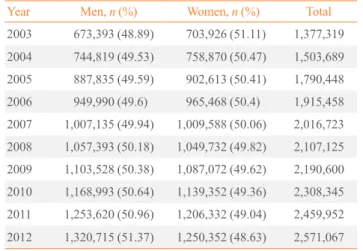
Trends in number of claim patients with diabetes by year Table 1 describes the 10-year trend in number of annual claim patients with diabetes from 2003 to 2012. During this time pe-riod, the total number of claim patients with diabetes increased by an average of 186.7%. In 2003, the total number of claim patients with diabetes was 1,377,319, with a greater proportion of females (women, 703,926 [51.1%]). However, this number increased to 2,571,067 by 2012, with a greater proportion of males (men, 1,320,715 [51.4%]). Males have accounted for more than 50% of diabetic claim patients since 2008, which may be attributed to the relatively rapid increase of male pa-tients with diabetes (196.1% [177.6%] increase from 2003 to 2012 in men [women]).
Trends in number of total claim cases for diabetes by year and average annual claim cases per patient-year
The total number of claim cases for diabetes dramatically
in-creased from 8,351,674 in 2003 to 22,777,110 in 2012 (Table 2), representing a 272.7% increase over 10 years. In terms of gen-der analysis, there was a greater increase in total number of claim cases in men compared to women (286.1% in men vs. 260.6% in women), which is consistent with the findings above. In 2003, the total number of claim cases for diabetes in females was much higher than that in males (52.5% female vs. 47.5% male). Over the next 10 years, this gender gap was gradually re-duced, resulting in relatively similar proportions of male and fe-male patients in 2012 (50.1% fefe-male vs. 49.9% fe-male).
The average annual claim cases per patient were calculated by dividing the number of total diabetes claim cases by the number of diabetes claim patients (Supplemental Table S1). The average was 6.1±5.6 claim cases per patient-year in 2003, which rapidly increased up to 9.0±10.3 claim cases per pa-tient-year in 2008 and then held steady to 2012. This implies that the average interval of clinic visits decreased from approx-imately 60 days in 2003 to 40 days in 2012.
Trends in incidence of new claim patients with diabetes by year
Table 3 shows the incidence of new diabetes claim patients from 2004 to 2012 according to gender. The total number of new claim patients with diabetes codes abruptly increased in 2005 (from 562,440 in 2004 to 643,395 in 2005) and then gradually decreased until 2009 (444,452 in 2009), showing a 30.9% decrease in diabetes incidence over these 5 years (2005 to 2009, P for trend <0.0001). Since 2009, the incidence of new diabetes claim patients has not experienced significant change. The maximal (peak) incidence rate was 1.28% and
Table 1. Trends in the Number of Diabetes Claim Patients by Year
Year Men, n (%) Women, n (%) Total
2003 673,393 (48.89) 703,926 (51.11) 1,377,319 2004 744,819 (49.53) 758,870 (50.47) 1,503,689 2005 887,835 (49.59) 902,613 (50.41) 1,790,448 2006 949,990 (49.6) 965,468 (50.4) 1,915,458 2007 1,007,135 (49.94) 1,009,588 (50.06) 2,016,723 2008 1,057,393 (50.18) 1,049,732 (49.82) 2,107,125 2009 1,103,528 (50.38) 1,087,072 (49.62) 2,190,600 2010 1,168,993 (50.64) 1,139,352 (49.36) 2,308,345 2011 1,253,620 (50.96) 1,206,332 (49.04) 2,459,952 2012 1,320,715 (51.37) 1,250,352 (48.63) 2,571,067
Table 2. Trends in the Number of Total Diabetes Claim Cases by Year
Year Men, n (%) Women, n (%) Total
2003 3,968,411 (47.52) 4,383,263 (52.48) 8,351,674 2004 4,510,704 (48.28) 4,832,272 (51.72) 9,342,976 2005 5,379,721 (49.14) 5,567,347 (50.86) 10,947,068 2006 6,105,981 (48.74) 6,422,251 (51.26) 12,528,232 2007 7,704,612 (47.90) 8,381,517 (52.10) 16,086,129 2008 9,006,979 (47.73) 9,862,716 (52.27) 18,869,695 2009 9,449,227 (48.07) 10,207,780 (51.93) 19,657,007 2010 9,875,313 (48.44) 10,510,536 (51.56) 20,385,849 2011 10,506,851 (49.03) 10,923,602 (50.97) 21,430,453 2012 11,355,282 (49.85) 11,421,828 (50.15) 22,777,110 Total 77,863,081 (48.55) 82,513,112 (51.45) 160,376,193
1.36% in men and women, respectively, occurring in 2005. The 9-year average incidence rate was 0.98% and 1.01% in men and women, respectively. The gender-specific incidence rate of diabetes decreased more rapidly in women, resulting in a rate of 0.82% in 2012 compared to 0.85% for men.
Age distribution in new claims cases with diabetes codes by year
Next, we assessed the average age of new diabetes claim pa-tients by year and gender (Table 3). Overall, in a total of 5,828,450 individuals, the average age of new claim patients with diabetes (from 2003 to 2012) was 64±15 years. After gender-specific analysis, men tended to be younger than wom-en at the time of the first claim for diabetes. The median age of new diabetes claim patients was 64±19 years in men and 68± 21 years in women in 2004. During 9 years of follow-up, the median age of new diabetes claim patients steadily decreased by an average of 6 years regardless of gender (P for trend <0.001). In 2012, the median age was 57±19 years in men and 61±20 years in women, a statistically significant difference between gender (P<0.001).
From 2003 to 2007, the majority of new diabetes claim pa-tients were between 70 and 79 years of age (Fig. 1). However, the average age of the majority of new claim patients began to decrease from 2006 such that, since 2008, individuals aged 50 to 59 years have accounted for the largest proportion of new diabetes claim patients. This is due to the rapid decrease in the number of new claim patients older than 60 years (from 137,545+144,557+90,060 in 2004 to 98,399+75,061+29,736 in 2012), whereas there was no decrease in subjects in their 50s
during the past 9 years (from 113,804 in 2004 to 117,934 in 2012). In particular, changes in the number of new claim pa-tients showed contrasting patterns in the younger and older age groups. Numbers of new claim patients with diabetes dramati-cally increased among those aged 10 to 49 years (106% in 10s, 34% in 20s, 53% in 30s, and 25% in 40s, when comparing 2004 and 2012). Meanwhile, the number of new claim patients older than 60 years decreased (–28% in 60s, –48% in 70s, and –67% in over 80, when comparing 2004 and 2012).
Prediction of annual number of claim patients with diabetes
Fig. 2 demonstrates the observed and predicted number of
an-Table 3. Incidence of New Diabetes Claim Patients by Year and Gender
Year
Total population Men Women
Number Newly claimed patients, n (%) Number Newly claimed patients, n (%) mean±SDAge, yr, Number Newly claimed patients, n (%) mean±SDAge, yr,
2004 48,583,805 562,440 (1.16) 24,363,083 280,629 (1.15) 64±19 24,220,722 281,811 (1.16) 68±21 2005 48,782,274 643,395 (1.32) 24,456,234 313,527 (1.28) 63±19 24,326,040 329,868 (1.36) 68±20 2006 48,991,779 549,090 (1.12) 24,557,004 266,983 (1.09) 62±19 24,434,775 282,107 (1.16) 68±21 2007 49,268,928 495,668 (1.01) 24,691,249 243,714 (0.99) 61±20 24,577,679 251,954 (1.03) 66±21 2008 49,540,367 495,668 (1.00) 24,822,897 227,069 (0.92) 60±20 24,717,470 234,465 (0.95) 66±21 2009 49,773,145 444,452 (0.89) 24,929,939 219,945 (0.88) 59±19 24,843,206 224,507 (0.90) 64±21 2010 50,515,666 429,256 (0.85) 25,310,385 214,112 (0.85) 59±19 25,205,281 215,144 (0.85) 63±21 2011 50,734,284 441,361 (0.87) 25,406,934 222,630 (0.88) 58±19 25,327,350 218,731 (0.86) 62±20 2012 50,948,272 423,935 (0.83) 25,504,060 215,791 (0.85) 57±19 25,444,212 208,144 (0.82) 61±20 Total 447,138,520 4,451,131 (1.00) 224,041,785 2,204,400 (0.98) - 223,096,735 2,246,731 (1.01) -30 25 20 15 10 5 0 Proportion (%) 2004 2005 2006 2007 2008 2009 2010 2011 2012
Age group (yr) <29 30−39 40−49 50−59 60−69 70−79 ≥80
Fig. 1. Changes in the age of new claim patients from 2004 to 2012. Age distribution of new claim patients from 2004 to 2012.
nual diabetes claim patients or cases in Korea. There has been a steady increase in the annual number of total diabetes claim pa-tients and cases in the period from 2003 to 2012. If this rate of increase continues, the estimated annual number of total
diabe-tes claim patients will increase from 2,571,067 in 2012 to 2,968,983 in 2015 and to 3,632,176 in 2020 (141% estimated increment from 2012 to 2020) (Fig. 2A). Moreover, the estimat-ed annual number of total diabetes claim cases is expectestimat-ed to
in-Estimated no. Estimated no. Estimated no. Year Year Year 2003 2005 2007 2009 2011 2013 2015 2017 2019 2021 2003 2005 2007 2009 2011 2013 2015 2017 2019 2021 2004 2006 2008 2010 2012 2014 2016 2018 2020 2022
Fig. 2. Observed and predicted annual numbers of diabetes claim patients and cases. (A) Observed and predicted annual numbers of total diabetes claim patients. (B) Observed and predicted annual numbers of total diabetes claim cases. (C) Observed and predicted annual in-cidence of new diabetes claim patients. CI, confidence interval.
A B C 4,000,000 3,500,000 3,000,000 2,500,000 2,000,000 1,500,000 4,000,000 3,000,000 2,000,000 1,000,000 600,000 500,000 400,000 300,000 200,000 100,000 0 Year Estimates 80% CI 95% CI 2015 2,968,983 2,832,871−3,105,095 2,760,818−3,177,148 2020 3,632,176 3,409,906−3,854,446 3,292,244−3,972,109 Year Estimates 80% CI 95% CI 2015 27,585,589 25,451,166−29,720,011 24,321,272−30,849,906 2020 35,599,720 32,114,223−39,085,217 30,269,112−40,930,327 Year Estimates 80% CI 95% CI 2015 354,682 220,421−488,943 149,347−560,017 2020 268,116 66,725−469,508 −39,885−576,118
crease from 22,777,110 in 2012 to 27,585,589 in 2015 and to 35,599,720 in 2020 (156% increment from 2012 to 2020) (Fig. 2B). Contrarily, the estimated annual number of new diabetes claim patients will decrease from 423,935 in 2012 to 354,682 in 2015 and to 268,116 in 2020 if the current decline continues (66% estimated decrement from 2012 to 2020) (Fig. 2C).
DISCUSSION
In this nationwide study using claims data, we investigated the trends in the annual incidence of diabetes and the number of medical claims and patients with diabetes in the general popu-lation of Korea. During the 10 years from 2003 to 2012, the annual number of diabetes claim patients continuously in-creased by 186.7%, resulting in 2,571,067 individuals in 2012. Furthermore, the annual number of total claim cases for diabe-tes dramatically increased by 272.7% over this period, which can be attributed to the increase in the average number of claim cases per patient. However, the incidence of new diabetes claim patients gradually decreased from 2005 to 2009 and has remained steady since 2009, resulting in an overall 30.9% de-crease from 2005. The average age of new claims subjects with diabetes codes decreased from 64 and 68 years in men and women, respectively, in 2004 to 57 and 61 years in 2012.
Although the prevalence of diabetes is influenced by diag-nostic method and criteria, it has dramatically increased by 6.6-fold from 1.5% to 9.9% in the past 40 years in Korea [4]. A re-cent paper based on data from the KNHANES 2011 reported that the prevalence of diabetes was 12.4% (estimated number of subjects with diabetes in 2011 [4,006,686]) in Korean adults older than 30 years [12]. In agreement with these statistics, we observed a steady increase in the annual number of total claim patients with diabetes, though this increase is lagging behind the estimated number of subjects with diabetes in Korea. In 2011, a total of 2,459,952 people visited a hospital for diabetes, accounting for only 61% (2,459,952/4,006,686) of subjects with diabetes. This low proportion may have several causes: (1) subjects with undiagnosed diabetes [13]; (2) subjects with known diabetes who do not receive treatment [14]; (3) inaccu-rate coding for diabetes by medical professionals; and (4) dif-ferences in research design and methods.
Our report found that the increase in annual number of total claim cases for diabetes outnumbered that of total diabetes claim patients. This can be explained by the increase in the av-erage number of claim cases per patient-year from 6.1 to 8.9 over the 10 studied years. Economic development, increased
public interest in health-care, and changes in health policies that expanded health insurance coverage may have all influenced the increase in total number of diabetes claim cases [15]. More-over, subjects with a longer duration of diabetes are likely to have more comorbidities that may require frequent hospital vis-its for medical care [14]. Further detailed investigation should be implemented to examine the overall characteristics of pa-tients with diabetes in Korea. In terms of gender differences, a relatively rapid increase in the annual number of diabetes claim patients from 2003 to 2012 was seen in men (196.1%) com-pared to women (177.6%). Similarly, the annual number of total diabetes claim cases also increased more in men (286.1%) than in women (260.6%) during the 10-year interval.
Although the prevalence of diabetes and annual number of claim patients with diabetes in Korea steadily increased during the last 10 years, the incidence of new claim patients has re-mained steady since 2009. The maximal incidence rate was 1.28% and 1.36% in men and women, respectively, in 2005 compared to 0.85% and 0.82% in 2012. Similar findings were observed in a nationwide population-based pharmacoepidemi-ological study in Sweden [16]. A previous study reported that the estimated incidence of diabetes among Korean adults aged 20 to 79 years was 0.76% in 2003 [14]. A community cohort study by Cho [6] showed that the annual incidence range of T2DM was 1.33% to 2.35% in those in their 40s, 1.48% to 3.18% in those in their 50s, 1.85% to 4.55% in those in their 60s, and 3.08% to 5% in those in their 70s. Consistent with our findings, Koo et al. [11] reported a decrease in the incidence of T2DM from 0.98% in 2009 to 0.95% in 2011. However, the prevalence of obesity has gradually increased in Korean adults aged ≥19 years from 26.9% in 1998 to 32.0% in 2011 [17]. This discrepancy may be due to earlier detection of diabetes with improved accessibility to primary medical care and the establishment of the National Health Screening Exam (NHSE). Since 2000, the health insurance systems in Korea have been incorporated into a unified system operated by the NHIS [2]. As part of the NHIS health-care system, all insurance subscrib-ers are allowed a free biannual NHSE [18]. According to the report of Ministry of Health and Welfare, the rate of undergo-ing NHSE was 35% in 1999, 48% in 2003, 55% in 2006, and 65% in 2008, there has been increased up to 71% in 2011 and 2012. However, increasing health check-up rate can be hardly expected to increase in number of new diabetes patients, the assumed reasons as follows: First, the increment of screening rate was rapidly increasing 20% from 1999 to 2008, and then it showed only 5% after 2008. This screening rate almost reached
a plateau [19]. Second, the increasing proportion of examina-tion subjects is occupied by previous examiners and the people who already have the disease including diabetes and hyperten-sion [19]. Therefore, additional diagnosis of new diabetes may be reduced. In addition, the health checkup rate of younger ages increased because of increasing interests of health through various media; however, the proportion of young diabetes pa-tients in young population is significantly lower than in the old age. As well as, the changing demographic structure of our country seems to be associated. As progressing aging country, the elderly populations are increasing; in contrast, young popu-lations are actually shrinking.
While the number of new diabetes claim patients did not sig-nificantly change over the last 4 years, the average age of new diabetes claim patients has decreased by 6 years from 2003 to 2012, regardless of gender. Furthermore, the age range of the majority of new diabetes claim patients has decreased from the 70s in 2003 to 2007 to the 50s in 2008 to 2012. These findings imply two possibilities: (1) the age at initial diagnosis of diabe-tes decreased due to diabediabe-tes awareness campaigns, positive attitudes for individual health-care, and enhanced accessibility of primary medical care and NHSE [15] or (2) diabetes devel-oped at an earlier age due to increased obesity in younger adults [17].
The present study demonstrates a steady increase in the an-nual number of total diabetes claim patients and cases during the last 10 years. Although the fit of the models was not ideal, this data suggests that a further 1.4- to 1.6-fold increase in the number of total diabetes claim patients and cases can be ex-pected in 2020. This translates into a future increase in medical expenses for the management of patients with diabetes in Ko-rea, which should be considered a crucial issue for health-care providers.
The current study has several limitations that should be ad-dressed by further investigation. We defined subjects as having diabetes based on the diagnosis information from the claims data without considering medication prescription data. There-fore, we were unable to calculate the prevalence of diabetes from the latter dataset. Furthermore, the typical limitations of research based on a medical claims database also apply to our study. Only subjects who actively utilized health care and were able to access medical personnel were represented in the NHIS data and analyzed in this study. Thus, the actual incidence rate of diabetes may be underreported due to individuals with undi-agnosed diabetes. Lastly, the accuracy of diagnosis coding for diabetes in the claims data has not been intensively validated
by independent research such as confirmation with laboratory data or medical records. Despite these limitations, the present study demonstrates for the first time trends in the annual num-ber of total diabetes claim patients and cases in Korea from 2003 to 2012. The use of the claims database illustrates actual changes in claims patterns in clinical practice in Korea. Fur-thermore, we analyzed trends by gender and age groups and predicted the future number of claim patients and cases with diabetes.
In summary, there have been increasing numbers of diabetes claim subjects and cases in Korea in the last 10 years, although the annual number of new diabetes claim patients did not in-crease during the last 4 years. Considering the fact that new claim subjects with diabetes are getting younger, the number of patients with a longer duration of diabetes who are at higher risk for related comorbidities will gradually increase. Thus, it is necessary for health-care policy makers to establish a long-term health-care management plan for preventing chronic dia-betic complications.
CONFLICTS OF INTEREST
No potential conflict of interest relevant to this article was re-ported.
ACKNOWLEDGMENTS
This study was supported by a grant from the National Health Insurance Service Policy Research (2014-20-009).
ORCID
Sun Ok Song http://orcid.org/0000-0003-4829-3407 Yong-ho Lee http://orcid.org/0000-0002-6219-4942 Young Duk Song http://orcid.org/0000-0001-5397-1458
REFERENCES
1. International Diabetes Federation. IDF diabetes atlas. 6th ed. Brussels: International Diabetes Federation; 2013. 2. Song SO, Jung CH, Song YD, Park CY, Kwon HS, Cha
BS, et al. Background and data configuration process of a nationwide population-based study using the Korean Na-tional Health Insurance System. Diabetes Metab J 2014;38: 395-403.
in-gredient cost of chronic comorbidity in the Irish elderly population with medication treated type 2 diabetes: a retro-spective cross-sectional study using a national pharmacy claims database. BMC Health Serv Res 2013;13:23. 4. Kim DJ. The epidemiology of diabetes in Korea. Diabetes
Metab J 2011;35:303-8.
5. Shin CS, Lee HK, Koh CS, Kim YI, Shin YS, Yoo KY, et al. Risk factors for the development of NIDDM in Yonchon County, Korea. Diabetes Care 1997;20:1842-6.
6. Cho NH. The epidemiology of diabetes in Korea: from the economics to genetics. Korean Diabetes J 2010;34:10-5. 7. Oh JY, Lee HJ, Hong ES, Hong YS, Sung YA, Lee SH. The
prevalence and incidence of diabetes in Mokdong, Seoul. J Korean Diabetes Assoc 2003;27:73-83.
8. Song KH, Nam-Goomg IS, Han SM, Kim MS, Lee EJ, Lee YS, et al. Change in prevalence and 6-year incidence of di-abetes and impaired fasting glucose in Korean subjects liv-ing in a rural area. Diabetes Res Clin Pract 2007;78:378-84. 9. Task Force Team for Basic Statistical Study of Korean
betes Mellitus from the Korean Diabetes Association. Dia-betes fact sheet in Korea 2013 [Internet]. Seoul: Korean Di-abetes Association; 2013 [cited 2016 May 11]. Available from: http://www.diabetes.or.kr/.
10. Task Force Team for Basic Statistical Study of Korean betes Mellitus from the Korean Diabetes Association. Dia-betes fact sheet in Korea 2015 [Internet]. Seoul: Korean Di-abetes Association; 2015 [cited 2016 May 11]. Available from: http://www.diabetes.or.kr/.
11. Koo BK, Lee CH, Yang BR, Hwang SS, Choi NK. The in-cidence and prevalence of diabetes mellitus and related ath-erosclerotic complications in Korea: a National Health In-surance Database Study. PLoS One 2014;9:e110650. 12. Jeon JY, Ko SH, Kwon HS, Kim NH, Kim JH, Kim CS, et
al. Prevalence of diabetes and prediabetes according to
fast-ing plasma glucose and HbA1c. Diabetes Metab J 2013;37: 349-57.
13. Lee YH, Bang H, Kim HC, Kim HM, Park SW, Kim DJ. A simple screening score for diabetes for the Korean popula-tion: development, validation, and comparison with other scores. Diabetes Care 2012;35:1723-30.
14. Task Force Team for Basic Statistical Study of Korean Dia-betes Mellitus of Korean DiaDia-betes Association, Park IB, Kim J, Kim DJ, Chung CH, Oh JY, et al. Diabetes epidem-ics in Korea: reappraise nationwide survey of diabetes “dia-betes in Korea 2007”. Dia“dia-betes Metab J 2013;37:233-9. 15. Cho NH. Diabetes burden and prevention in Korea and the
Western Pacific Region. Diabetes Res Clin Pract 2014;106 Suppl 2:S282-7.
16. Jansson SP, Fall K, Brus O, Magnuson A, Wandell P, Ost-gren CJ, et al. Prevalence and incidence of diabetes melli-tus: a nationwide population-based pharmaco-epidemiolog-ical study in Sweden. Diabet Med 2015;32:1319-28. 17. Kim CS, Ko SH, Kwon HS, Kim NH, Kim JH, Lim S, et
al. Prevalence, awareness, and management of obesity in Korea: data from the Korea National Health and Nutrition Examination Survey (1998-2011). Diabetes Metab J 2014; 38:35-43.
18. Lee CH, Sung NY, Lee J, Bae SC. Factors associated with gout in South Koreans: analysis using the National Health Insurance Corporation and the National Health Screening Exam databases. Clin Rheumatol 2013;32:829-37.
19. Lee HY, Park JH, Kim Y. A study of strategy for improving efficiency of National Health Screening program [Internet]. Sejong: Ministry of Health and Welfare; 2012 [cited 2016 May 11]. Available from: http://www.snu-dhpm.ac.kr/pds/ article.html?code=report1&number=2397&keyfield=&k ey=.