P2-2 / K. Ohara
• IMID 2009 DIGEST
Abstract
We report on preparation of CaBaSiS4:Eu2+ material by an advanced chemical solution method and fluorescent properties of the new material. The emission spectrum of CaBaSiS4:Eu2+ has the main peak centered at 598 nm, with the corresponding excitation maximum at around 420 nm. The strongest emission intensity of this material approached 96% compared to one of the best commercially available YAG:Ce3+ phosphor.
1. Introduction
Although it is difficult to synthesize complex sulfides as compared to oxides, the authors’ group has succeeded in preparation of a complex sulfide phosphor having a high emission intensity through an advanced chemical solution method. This study focused on CaBaSiS4:Eu2+ phosphor. While it is
known that the corresponding thiosilicates of Ca or Ba exhibit orange-red [1,2] or turquoise blue [3,4] emission, respectively, the existence of CaBaSiS4:Eu2+
phosphor which includes both Ca and Ba and its emission characteristics are not known. This paper reports on the synthesis method and structural analysis of the new CaBaSiS4:Eu2+ phosphor, and its emission
characteristics.
2. Experimental
The material synthesis was carried out by an original three-step process as follows: the first step includes preparation of CaCO3:Eu
3+
and BaCO3:Eu 3+
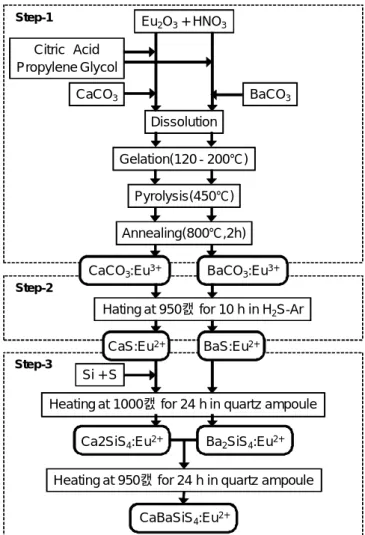
by a solution method, the second step includes conversion of these carbonates into the corresponding sulfides, CaS:Eu2+ and BaS:Eu2+, and the third step is based upon reactions between Si and various sulfides. The schematic flowchart of the synthesis is shown in Fig. 1. Step-1 (Polymerizable complex (PC) method): The required amounts of Ca, Ba and Eu salts were dissolved into a mixed solution of citric acid and
Step-1 Step-2 Step-3 Eu2O3+ HNO3 Citric Acid Propylene Glycol CaCO3 BaCO3 Gelation(120 - 200℃) Dissolution Pyrolysis(450℃) Annealing(800℃,2h) CaCO3:Eu3+
Hating at 950캜 for 10 h in H2S-Ar CaS:Eu2+
Si + S
Heating at 1000캜 for 24 h in quartz ampoule BaCO3:Eu3+
BaS:Eu2+
Ca2SiS4:Eu2+
CaBaSiS4:Eu2+
Ba2SiS4:Eu2+ Heating at 950캜 for 24 h in quartz ampoule
Fig. 1. Flowchart of CaBaSiS4:Eu 2+
synthesis.
propylene glycol followed by polyesterification during a prolonged heating at 120˚C. The resulting resin-like matter was calcined at 800˚C in air to obtain carbonate precursor powders, in which Eu can be expected to be dispersed uniformly. Step-2 (Gaseous reduction sulfurization (GRS) method): CaS:Eu2+ and BaS:Eu2+ were obtained by filling the carbonate precursor powders into alumina boats followed by heat-treatment at 950˚C for 10 h under the flow of Ar-(10%)H2S using a tube furnace. Step-3 (Ampoule
sealing method): Ca2SiS4:Eu 2+
and Ba2SiS4:Eu 2+
were
Luminescent properties of a new yellow phosphor CaBaSiS
4:Eu
2+synthesized by an advanced chemical solution method
Keishiro Ohara, Valery Petrykin, Satoko Tezuka and Masato Kakihana
Institute of Multidisciplinary Research for Advanced Materials, Tohoku University, 2-1-1 Katahira, Aoba-ku, Sendai 980-8577, Japan
TEL:+81-(0)22-217-5649, e-mail: [email protected]
Keywords : new phosphor, yellow emission, an advanced chemical solution synthesis, CaBaSiS4:Eu 2+
P2-2 / K. Ohara
IMID 2009 DIGEST • obtained by reactions of Si with CaS:Eu2+ and
BaS:Eu2+, respectively, at 1000˚C for 24 h together with a required amount of S in sealed quartz ampoules. Afterwards, the obtained single-phase powders were mixed in the molar ratio of one to one, and sealed again in ampoules followed by heat-treatment at 950˚C for 24 h to obtain CaBaSiS4:Eu
2+
.
3. Results and discussion
The result of SEM-EDX analysis showed that the composition of the final sample was nearly Ca:Ba:Si:S=1:1:1:4 and it proved that the synthesis of CaBaSiS4 was successful, although the XRD
measurement showed that the sample included CaS and Ba2SiS4 as trace impurities. Further detailed
analysis revealed that the crystal structure of CaBaSiS4 differed from those of Ca2SiS4 and Ba2SiS4
described by orthorhombic system [5], instead of which the XRD pattern of CaBaSiS4 was indexed as
belonging to a monoclinic unit cell with the lattice parameters of a = 8.37Å, b = 6.67 Å, c = 6.51Å, β = 108.2˚, and that it is isostructural to Eu2SiS4. The
emission spectrum of this nearly single-phase phosphor prepared at 950˚C has the main peak centered at 598 nm with the corresponding excitation maximum at 422 nm, and the emission intensity was 63% compared to that of one of the best commercially available YAG:Ce3+. Moreover, it turned out that the emission intensity increased up to 96% of YAG:Ce3+ (Fig. 2) and 155% of Ca2SiS4:Eu
2+
with increasing the synthesis temperature from 950˚C to 1000˚C, although the fraction of the impurity phases increased significantly. The observed increase of the emission intensity is partially attributed to the fact that the material had higher crystallinity corresponding to smaller amount of defects resulting from the reaction at the higher synthesis temperature. One of the characteristic attributes of CaBaSiS4:Eu
2+
is that its excitation spectrum corresponding to the yellow emission band at 598 nm ranges from 250 nm to 550 nm, which is much wider than that of YAG:Ce3+ (Fig. 2). It is of particular importance that CaBaSiS4:Eu2+
can be excited by use of both near-UV and blue LEDs yielding the yellow emission with almost comparable intensities, which is advantageous for white LED applications.
Fig. 2. Excitation (Ex.) and emission (Em.) spectra of CaBaSiS4:Eu
2+
(2mol% relative to Ca and Ba) synthesized at 1000˚C in comparison to a commercially available YAG:Ce3+.
4. Summary
The significance of this work contributing to the field of science and technology of information display includes on one hand the discovery of a new yellow phosphor CaBaSiS4:Eu
2+
emitting a strong yellow light at 598nm with the corresponding excitation spectrum covering a wide range of wavelength between 300 and 500nm, and on the other hand this result demonstrates that the advanced chemical solution method is applicable to preparation of a wide range of complex sulfide based phosphors, and such synthesis techniques are considered to be useful for researchers working with sulfides for white LED and other applications.
5. References
[1] S. M. Hong N. Dner, B. Loos, P. F. Smet, J. E. Van Haecke, E. Michelena, and D. Poelman,
EL2006 Proceedings, pp.127-129 (2006).
[2] P. F. Smet, N. Avci, B. Loos, J. E. Van Haecke, and D. Poelman, J. Phys.: Cond, Matter, 19, 246223(12pp)(2006).
[3] F. J. Avella, J. Electrochem. Soc.: Solid State
Science, 118, pp.1862-1863 (1971).
[4] Y. Miyazaki, K. Ohmi, and H. Kobayashi, EL2006
Proceedings, pp.440-443 (2006).
[5] J. T. Lemley, Acta Cryst., B30, pp.549-550 (1974).