Copyright © 2021 Korean Cleft Palate-Craniofacial Association
This is an Open Access article distributed under the terms of the Creative Commons Attribution Non-Commercial License (https://creativecommons.org/ licenses/by-nc/4.0/) which permits unrestricted non-commercial use, distribution, and reproduction in any medium, provided the original work is properly cited.
www.e-acfs.org
pISSN 2287-1152 eISSN 2287-5603
Original Article
INTRODUCTION
Since the first case of an epidemic viral pneumonia in Wuhan, China in December 2019, the infection rapidly spread. The causative virus was a novel coronavirus and was named
corona-virus disease 2019 (COVID-19) [1,2]. With a high infectivity, COVID-19 spread worldwide, and as a response, the World Health Organization after all declared the infection a global pandemic on March 11, 2020 [3]. In South Korea, the number of confirmed cases of COVID-19 has risen progressively since the first confirmed case in January 2020, with 3,526 cases re-ported by March 1, 2020; 23,889 cases by October 1, 2020; 34,652 cases by December 1, 2020; and 96,017 cases reported by March 15, 2021. The Korean government raised the infec-tious disease risk to “serious” on February 23 [4]. Reopening of schools that had been scheduled on March 2, 2020, was delayed to May 20, 2020, since then, students have only partially
re-Effects of COVID-2019 on plastic surgery
emergencies in Korea
Young Soo Yoon, Chang Ho Chung, Kyung Hee Min Department of Plastic and
Reconstructive Surgery, Nowon Eulji Medical Center, Eulji University School of Medicine, Seoul, Korea
Background: To fight the coronavirus disease 2019 (COVID-19) pandemic, many countries have implemented social distancing and lockdowns. We investigated the changes in the trauma pat-terns of emergency plastic surgeries in the midst of a pandemic.
Methods: A retrospective review of the medical records of all patients treated for emergency plastic surgeries was performed at our hospital in Seoul. We conducted the analysis between March 1 and June 30, 2020, and compared the data obtained with that of the same period in 2019. We also investigated changes in trauma patterns according to the social distancing level from July 2020 to February 2021.
Results: There was a total of 800 emergency plastic surgery patients from March to June 2020, which was less than the 981 in the corresponding period in 2019. The proportion of patients aged 7–17 years and ≥ 80 in 2020 showed a significant decrease. In 2020, patients presenting with fa-cial trauma decreased and hand trauma, markedly laceration, increased significantly. In 2020, more injuries happened at home, whereas significantly fewer injuries happened on the streets. In 2020, slipping and sports injury decreased, whereas penetrating injury increased significantly. In the changes observed according to the social distancing level, there were significant differences in age classification, facial open wound, and the mechanism of injury.
Conclusion: Social distancing has caused a change in emergency plastic surgeries. To ensure safe and appropriate treatment, strict epidemiologic workup and protective equipment are re-quired.
Keywords: Coronavirus / Plastic surgery / Trauma
Correspondence: Kyung Hee Min
Department of Plastic and Reconstructive Surgery, Nowon Eulji Medical Center, Eulji University School of Medicine, 68 Hangeulbiseong-ro, Nowon-gu, Seoul 01830, Korea
E-mail: [email protected]
This work was supported by the National research Foundation of Korea (NRF) grant funded by the Korea government (MIST; Ministry of Science and ICT) (2018R1C1B504478613).
turned to in-school classes [5]. Since June 28, 2020, predefined levels of social distancing have been implemented depending on the severity of the local COVID-19 epidemic and the inten-sity of quarantine measures. Level 1 is classified as standard daily life precautions; Level 1.5 to 2 is the local epidemic level; and Level 2.5 to 3 is seen as the national epidemic level. As the level of social distancing increases, participation in gatherings and use of multi-use facilities becomes progressively more re-stricted [4].
As shown here, the COVID-19 has led to heavy restrictions in schools, workplaces, public facilities, and shops, and the imple-mentation of social distancing has brought upon grave changes in people’s lifestyles. Health care facilities engage in stringent disinfection measures and implement visitor restrictions in an effort to respond to the COVID-19. The present study aims to compare the data on patients admitted to the emergency de-partment, who were treated by the plastic surgery department since the outbreak of COVID-19 with the data in the same pe-riod last year, in order to examine the changes caused by COV-ID-19. In addition, as social distancing was implemented, we attempted to determine whether there was any change in the profile of plastic surgery trauma patients according to the social distancing level.
METHODS
We retrospectively analyzed the data from the medical records of all patients treated for emergency plastic surgeries at the emergency medicine department of our hospital, between March 1 and June 30, 2020. Additionally, this data was com-pared to that obtained from the same period in 2019. Plastic surgery patients who visited the emergency room from July 2020 when social distancing began to be implemented by level, to February 2021, were analyzed to determine whether there was a difference in the pattern of plastic surgery according to the level of social distancing. The social distancing level was di-vided into 3 stages: Stage 1, daily life precautions (Level 1); Stage 2, local epidemic level (Level 1.5 to 2); and Stage 3, national epi-demic level (Level 2.5 to 3). In the statistical analysis, the periods were matched and compared at each stage. The medical records were analyzed for factors such as age, sex, region of injury, type of injury, mechanism of injury, presence of domestic violence, location where injury had occurred, and admission status.
Statistical analysis was performed using SPSS 26.0 (IBM Corp., Armonk, NY, USA). Pearson chi-square test and Fisher exact test were utilized to investigate the differences between the vari-ables. Student t-test was used to investigate quantitative parame-ters. A p-value <0.05 was considered statistically significant.
The study was approved by the Institutional Review Board of our hospital (IRB No. 2020-08-007).
RESULTS
A total of 981 patients were treated for emergency plastic sur-gery between March 1 and June 30, 2019. On the other hand, during the same period in 2020, the total number of patients had decreased to 800. There was no significant difference in the mean age and sex of the patients between both periods. When age was analyzed by section, the proportion of patients aged 7–17 years and ≥80 years showed a significant decrease in 2020, compared to those in 2019 (p<0.000).
In 2020, facial trauma decreased and hand trauma increased significantly compared to that in 2019 (p<0.000). Among facial trauma, open wounds and contusions were significantly re-duced whereas in regard to hand trauma, laceration increased significantly. However, there was no significant difference ob-served in burns and animal bites between the two periods. In 2020, when compared to 2019, a significant difference was ob-served whereby more injuries took place at home and fewer in-juries were seen on the streets (p<0.000). Regarding the mech-anism of injury in 2020, as compared to 2019, slip down and sports injury decreased, whereas penetrating injury increased significantly (p<0.000). Assault injury and domestic violence were not significantly different between the two periods. The patient on admission was not significantly different between the two periods (Table 1).
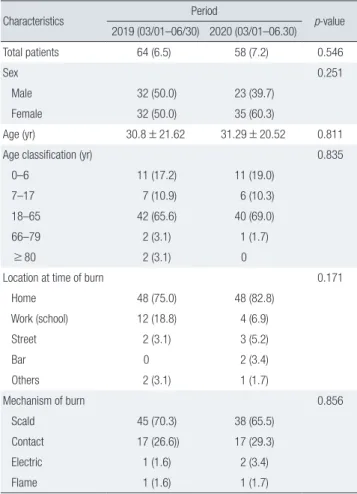
While analyzing burn patients, no significant difference was observed between the two periods, in factors such as, the total number of patients, sex, age, location where burn occurred, and mechanism of burn. However, in 2020, burns-related injuries were observed more in women than in men, and burns at home increased whereas burns at work or school decreased, when compared to that in 2019. However, there was no significant difference observed (Table 2).
The level of social distancing in Seoul started at Level 1 on June 28, 2020 and subsequently increased by several levels. During the period investigated in this study, social distancing was at Stage 1 for 84 days, at Stage 2 for 75 days, and at Stage 3 for 84 days (Fig. 1) [4]. In the comparison between stages, there were significantly fewer patients aged 7 to 17 years during Stage 3 and significantly fewer patients aged 18 to 65 years during Stage 2. During Stage 1, the incidence of facial open wounds was significantly lower than during the other stages. The inci-dence of sports-induced trauma was significantly higher during Stage 1, while the incidence of bump-induced trauma (trauma caused by collision with an object) was significantly higher
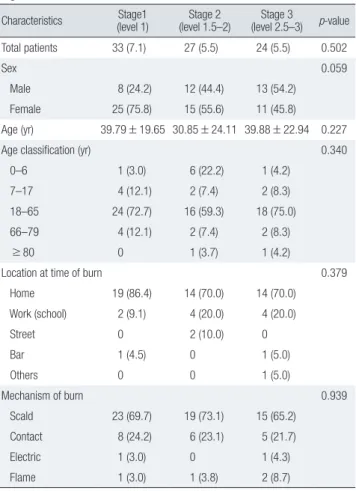
dur-ing Stage 3. There were no other statistically significant differ-ences in the results between stages (Tables 3, 4).
DISCUSSION
Owing to the rapid spread of COVID-19, social distancing and region-wide lockdowns have been implemented globally, with
people’s living patterns being forced to change.
In Anhui Province in eastern, China, the number of traffic-re-lated injuries along with outdoor injuries showed a significant decrease during the peak of the pandemic [6]. In Salisbury Dis-trict Hospital in southwest England, during the lockdown peri-od, there was a drop in the number of trauma patients [7]. Ad-ditionally, in Mexico City, during the COVID-19 lockdown, plastic surgery-related emergency procedures were reduced by 65% [8]. Hassan et al. [9] reported that during stay-at-home or-ders, in Chicago, emergency plastic surgeries were significantly decreased with a marked decrease in hand traumas. In addi-tion, our results showed that the number of patients treated with emergency plastic surgeries decreased between March 1 and June 30, 2020, compared to the same period in 2019 (800 vs. 981). The number of patients with facial trauma decreased significantly. In addition, the pattern of facial trauma changed: whereas lacerations and contusions significantly decreased, there was no significant difference in the number of fractures. This is likely to be because individuals with relatively minor trauma did not visit the emergency department because of dif-ficulty with accessing the hospital and individuals’ reluctance to visit the hospital due to COVID-19. Similar to other studies, in Table 1. Characteristics of patients
Characteristics Period p-value
2019 (03/01–06/30) 2020 (03/01–06/30) Total patients 981 800 Sex 0.861 Male 576 (58.7) 473 (59.1) Female 405 (41.3) 327 (40.9) Age (yr) 36.05 ± 25.22 35.77 ± 23.63 0.812 Age classification (yr) 0.000 0–6 169 (17.2) 154 (19.3) 7–17 136 (13.9) 64 (8.0) 18–65 535 (54.5) 497 (62.1) 66–79 87 (8.9) 71 (8.9) ≥ 80 54 (5.5) 14 (1.8) Face 578 (58.8) 391 (48.9) 0.000 Open wound 433 (44.1) 295 (36.9) 0.002 Contusion 106 (10.8) 56 (7.0) 0.005 Fracture 39 (4.0) 40 (5.0) 0.296 Hand 274 (28.0) 305 (38.0) 0.000 Laceration 250 (25.5) 288 (36.0) 0.000 Tendon injury 4 (0.4) 1 (0.1) 0.262 Fracture 20 (2.0) 16 (2.0) 0.954 Burn 64 (6.5) 58 (7.2) 0.546 Animal bite 62 (6.3) 38 (4.8) 0.152 Location at time of injury 0.000 Home 422 (43.0) 441 (55.1) Work (school) 92 (9.4) 85 (10.6) Street 401 (40.9) 233 (29.1) Bar 58 (5.9) 38 (4.8) Others 8 (0.8) 3 (0.4) Mechanism of injury 0.000 Assault 45 (5.3) 37 (5.3) Domestic violence 4 (0.4) 6 (0.8) 0.359 Slip down 279 (32.6) 170 (24.1) Sports 57 (6.7) 24 (3.4) Motor vehicle collisions 28 (3.3) 32 (4.5) Penetrating 209 (24.4) 261 (37.1) Bump 219 (25.6) 161 (22.9) Fall 18 (2.1) 19 (2.7)
Admission 12 (1.2) 12 (1.5) 0.614 Values are presented as number (%) or mean ± SD.
Table 2. Characteristics of burn patients
Characteristics Period p-value
2019 (03/01–06/30) 2020 (03/01–06.30) Total patients 64 (6.5) 58 (7.2) 0.546 Sex 0.251 Male 32 (50.0) 23 (39.7) Female 32 (50.0) 35 (60.3) Age (yr) 30.8 ± 21.62 31.29 ± 20.52 0.811 Age classification (yr) 0.835 0–6 11 (17.2) 11 (19.0)
7–17 7 (10.9) 6 (10.3) 18–65 42 (65.6) 40 (69.0) 66–79 2 (3.1) 1 (1.7) ≥ 80 2 (3.1) 0
Location at time of burn 0.171 Home 48 (75.0) 48 (82.8) Work (school) 12 (18.8) 4 (6.9) Street 2 (3.1) 3 (5.2) Bar 0 2 (3.4) Others 2 (3.1) 1 (1.7) Mechanism of burn 0.856 Scald 45 (70.3) 38 (65.5) Contact 17 (26.6)) 17 (29.3) Electric 1 (1.6) 2 (3.4) Flame 1 (1.6) 1 (1.7) Values are presented as number (%) or mean ± SD.
our study, the number of injuries at home increased and those on the streets decreased. However, there was no decrease in the number of traffic injuries observed in our results. Unlike the findings of Hassan et al. [9], our results revealed that hand-re-lated trauma, especially laceration, increased significantly, while facial trauma had significantly decreased. This can be attributed to an increase in activities at home, such as cooking, as the time spent at home had increased.
In Chicago, Illinois, domestic violence-related calls had in-creased by 12% during stay-at-home [10]. Hassan et al. [9] also reported that the percentage of assault injuries, including do-mestic violence, had increased. However, there was no such in-crease observed in assault injury and domestic violence in our results. In our results, the number of school-going patients, aged 7–17 years, decreased significantly in 2020. We assume that this may reflect the decrease in chance of trauma due to the decrease in outdoor activities as students spend more time at home as school attendance is delayed. In addition, the number of patients aged ≥80 years decreased in 2020. This could possi-bly be because the elderly are aware of their vulnerability to-wards contracting COVID-19, resulting in them maintaining social distancing more thoroughly, and performing fewer out-door activities. In addition to this, in our study, the characteris-tics of burns were not significantly different between the two periods. Kruchevsky et al. [11] reported that in northern Israel, during the lockdown period, the number of adult burn patients had decreased by 66%. However, there was no decrease ob-served in the number of pediatric burn patients. In addition to this, children aged 2–5 years and female patients from all pedi-atric age groups were seen to have a higher susceptibility to burns. They suggested that a decrease in the number of adult burn patients was associated with a decrease in occupation-re-lated burn. They also suggested an increase in kitchen and din-ing activities durdin-ing a period of lockdown, which tend to be
more likely performed by women. In our results, although not significant, in 2020, there was an increase in female patients and burn injuries at home, with a decrease in occupation- or school-related burn injuries.
In the changes observed according to the social distancing level, the incidence of sports-induced trauma was significantly higher during Stage 1 (Level 1), and the incidence of bump-in-duced trauma was significantly higher during Stage 3 (Level 2.5 to 3). This reflects the increased restriction of outdoor activities as the level of social distancing increased. However, the lack of a significant difference in many of the results suggests that people are adapting to changes in their daily life as the during of social distancing becomes increasingly prolonged.
Even in the midst of a serious crisis such as a pandemic, emer-gency plastic surgeries and traumas are inevitable. In addition, plastic surgeons, especially when managing craniofacial trau-ma, are at a greater risk of exposure to the virus as they examine and treat patients while being in close contact with their nose and mouth [12]. Therefore, strict epidemiologic investigation and monitoring of COVID-19-related symptoms in patients are very crucial.
Currently, in Korea, patients with fever or respiratory toms are treated in a separate clinic, and patients with symp-toms suggestive of COVID-19 are required to undergoing coronavirus testing and treatment in a negative pressure isola-tion room, even when visiting the emergency department. Ad-ditionally, when managing suspected infections, it is necessary to install appropriate protective equipment.
To prevent trauma at home during the pandemic, it is also important to educate people about safety education and first-aid tips at home.
The limitation of our study is that our data were based on a single emergency medicine department in Seoul. It is likely that the COVID-19 epidemic has had a similar effect on emergency
3 2.5 2 1.5 1 0.5 0
Social distance level (Seoul)
Fig. 1. Changes in the social distancing level in Seoul from June 28, 2020 to February 28, 2021 [4].
6/28 7/5 7/12 7/19 7/26 8/2 8/9 8/16 8/23 8/30 9/6 9/13 9/20 9/27 10/4 10/11 10/18 10/25 11/1 11/8 11/15 11/22 11/29 12/6 12/13 12/20 12/27 1/3 1/10 1/17 1/24 1/31 2/7 2/14 2/21 2/28
plastic surgery consultations in other regions of Korea, but the situation may differ in hospitals around the city center and provinces, especially in hospitals around highways.
The findings of our study confirm that a change in lifestyle owing to the COVID-19 pandemic causes a change in the pat-terns of trauma-related emergency plastic surgeries. The
COV-ID-19 epidemic situation is likely to change a lot in the future due to the impact of vaccination and mutant strains of the vi-rus. Changes in the incidence and pattern of trauma are antici-pated, not only because of COVID-19, but also because of other rapidly evolving social changes, such as the development of motor vehicles and machines with advanced safety features, and an increase in the use of electric scooters. To adapt to this change and to manage patients safely and appropriately, it is important that the government, hospitals, physicians, and pa-tients cooperate with each other.
NOTES
Conflict of interestNo potential conflict of interest relevant to this article was re-ported.
Ethical approval
The study was approved by the Institutional Review Board of Nowon Eulji Medical Center (IRB No; 2020-08-007) and per-formed in accordance with the principles of the Declaration of Table 3. Characteristics of patients by stage of social distancing level
Characteristics (level 1)Stage1 (level 1.5–2)Stage 2 (level 2.5–3)Stage 3 p-value
Total patients 468 494 438
Sex 0.127
Male 260 (55.6) 298 (60.3) 271 (61.9) Female 208 (44.4) 196 (39.7) 167 (38.1) Age (yr) 37.57 ± 24.50 38.10 ± 25.97 37.99 ± 24.88 0.944 Age classification (yr) 0.021 0–6 79 (16.9) 86 (17.4) 83 (18.9) 7–17 46 (9.8) 59 (11.9) 24 (5.5) 18–65 283 (60.5) 263 (53.2) 267 (61.0) 66–79 43 (9.2) 60 (12.1) 46 (10.5) ≥ 80 17 (3.6) 26 (5.3) 18 (4.1) Face 256 (54.7) 291 (58.9) 258 (58.9) 0.324 Open wound 168 (35.9) 208 (42.1) 199 (45.4) 0.011 Contusion 75 (16.0) 67 (13.6) 52 (11.9) 0.190 Fracture 13 (2.8) 16 (3.2) 7 (1.6) 0.271 Hand 156 (33.3) 148 (30.0) 120 (27.4) 0.148 Laceration 135 (28.8) 132 (26.7) 106 (24.2) 0.286 Tendon injury 15 (3.2) 11 (2.2) 11 (2.5) 0.626 Fracture 6 (1.3) 5 (1.0) 3 (0.7) 0.665 Burn 33 (7.1) 27 (5.5) 24 (5.5) 0.502 Animal bite 21 (4.5) 27 (5.5) 36 (8.2) 0.050 Location at time of injury 0.263 Home 229 (50.1) 240 (49.3) 247 (56.9) Work (school) 41 (9.0) 49 (10.1) 39 (9.0) Street 172 (37.6) 183 (37.6) 135 (31.1) Bar 12 (2.6) 14 (2.9) 11 (2.5) Others 3 (0.7) 0 2 (0.5) Mechanism of injury 0.004 Assault 16 (3.9) 23 (5.2) 19 (5.0) Domestic violence 5 (1.1) 7 (1.4) 5 (1.1) 0.873 Slip down 125 (30.2) 149 (33.8) 117 (30.9) Sports 37 (8.9) 17 (3.9) 14 (3.7) M otor vehicle collisions 18 (4.3) 25 (5.7) 13 (3.4) Penetrating 129 (31.2) 122 (27.7) 113 (29.8) Bump 70 (16.9) 83 (18.8) 95 (25.1) Fall 8 (1.9) 13 (2.9) 4 (1.1) Admission 28 (6.0) 27 (5.5) 24 (5.5) 0.926 Values are presented as number (%) or mean ± SD.
Table 4. Characteristics of burn patients by stage of social distanc-ing level
Characteristics (level 1)Stage1 (level 1.5–2)Stage 2 (level 2.5–3)Stage 3 p-value
Total patients 33 (7.1) 27 (5.5) 24 (5.5) 0.502
Sex 0.059
Male 8 (24.2) 12 (44.4) 13 (54.2) Female 25 (75.8) 15 (55.6) 11 (45.8)
Age (yr) 39.79 ± 19.65 30.85 ± 24.11 39.88 ± 22.94 0.227 Age classification (yr) 0.340 0–6 1 (3.0) 6 (22.2) 1 (4.2)
7–17 4 (12.1) 2 (7.4) 2 (8.3) 18–65 24 (72.7) 16 (59.3) 18 (75.0) 66–79 4 (12.1) 2 (7.4) 2 (8.3) ≥ 80 0 1 (3.7) 1 (4.2)
Location at time of burn 0.379 Home 19 (86.4) 14 (70.0) 14 (70.0) Work (school) 2 (9.1) 4 (20.0) 4 (20.0) Street 0 2 (10.0) 0 Bar 1 (4.5) 0 1 (5.0) Others 0 0 1 (5.0) Mechanism of burn 0.939 Scald 23 (69.7) 19 (73.1) 15 (65.2) Contact 8 (24.2) 6 (23.1) 5 (21.7) Electric 1 (3.0) 0 1 (4.3) Flame 1 (3.0) 1 (3.8) 2 (8.7) Values are presented as number (%) or mean ± SD.
Helsinki. The requirement of informed consent was waived owing to the retrospective nature of the study.
ORCID
Young Soo Yoon https://orcid.org/0000-0003-4651-240X Chang Ho Chung https://orcid.org/0000-0002-9431-737X Kyung Hee Min https://orcid.org/0000-0002-3456-0191 Author contribution
Conceptualization: KHM. Data curation: YSY, CHC. Formal analysis: YSY, CHC. Methodology: KHM. Supervision: KHM. Writing - original draft: YSY, CHC, KHM. Writing - review & editing: KHM.
REFERENCES
1. Li Q, Guan X, Wu P, Wang X, Zhou L, Tong Y, et al. Early transmission dynamics in Wuhan, China, of novel coronavi-rus-infected pneumonia. N Engl J Med 2020;382:1199-207. 2. Wang C, Horby PW, Hayden FG, Gao GF. A novel coronavirus
outbreak of global health concern. Lancet 2020;395:470-3. 3. World Health Organization (WHO). WHO novel coronavirus
(COVID-19) dashboard [Internet]. Geneva: WHO; c2020 [cit-ed 2021 Apr 1]. Available from: http://www.who.int/.
4. Korea Disease Control and Prevention Agency. Coronavi-rus-19, Republic of Korea [Internet]. Osong: Korea Disease Control and Prevention Agency; c2021 [cited 2021 Apr 1]. Available from: http://ncov.mohw.go.kr/en/.
5. Ministry of Education. Press release [Internet]. Ministry of
Ed-ucation: Sejong; c2020 [cited 2021 Apr 1]. Available from: http://english.moe.go.kr/main.do?s=english.
6. Zhu W, Li X, Wu Y, Xu C, Li L, Yang J, et al. Community quar-antine strategy against coronavirus disease 2019 in Anhui: an evaluation based on trauma center patients. Int J Infect Dis 2020;96:417-21.
7. Valand P, Lloyd N, Robson M, Steele J. Trauma transformed: a positive review of change during the COVID-19 pandemic. J Plast Reconstr Aesthet Surg 2020;73:1357-404.
8. Telich-Tarriba JE, Navarro-Barquin DF. Plastic surgery emer-gency surgical care during the COVID-19 lockdown at a Mex-ico City academic center. J Plast Reconstr Aesthet Surg 2021; 74:644-710.
9. Hassan K, Prescher H, Wang F, Chang DW, Reid RR. Evaluat-ing the effects of COVID-19 on plastic surgery emergencies: protocols and analysis from a level I trauma center. Ann Plast Surg 2020;85(2S Suppl 2):S161-S165.
10. Assad S, Hickey M. Chicago sees an uptick in domestic violence calls during coronavirus outbreak [Internet]. WBBM-TV CBS 2. Chicago, IL: c2020 [cited 2021 Apr 1]. Available from: https:// chicago.cbslocal.com/video/4510850-chicago-sees-an-uptick-in-domestic-violence-calls-during-coronavirus-outbreak/. 11. Kruchevsky D, Arraf M, Levanon S, Capucha T, Ramon Y,
Ull-mann Y. Trends in burn injuries in Northern Israel during the COVID-19 lockdown. J Burn Care Res 2021;42:135-40. 12. Holmes S, Bhatti N, Bhandari R, Chatzopoulou D. Toward a
consensus view in the management of acute facial injuries dur-ing the Covid-19 pandemic. Br J Oral Maxillofac Surg 2020;58: 571-6.
![Fig. 1. Changes in the social distancing level in Seoul from June 28, 2020 to February 28, 2021 [4]](https://thumb-ap.123doks.com/thumbv2/123dokinfo/4870068.32603/4.892.70.815.108.322/fig-changes-social-distancing-level-seoul-june-february.webp)