2-GHz carbon nanotube mode-locked Yb:YAG
channel waveguide laser
S
UNY
OUNGC
HOI,
1,2,5T
HOMASC
ALMANO,
1,3,5F
ABIANR
OTERMUND,
2,6AND
C
HRISTIANK
RÄNKEL1,3,71Institute für Laser-Physik, Universität Hamburg, Luruper Chaussee 149, 22761 Hamburg, Germany 2Department of Physics, Korea Advanced Institute of Science and Technology (KAIST), Daehak-ro 291,
34141 Daejeon, South Korea
3Hamburg Centre of Ultrafast Imaging, Universität Hamburg, Luruper Chaussee 149, 22761 Hamburg,
Germany
4Zentrum für Lasermaterialien, Leibniz-Institut für Kristallzüchtung, Max-Born-Straße 2, 12489 Berlin,
Germany
5These authors contributed equally 6[email protected]
Abstract: We demonstrate GHz-repetition rate mode-locked operation of a
femtosecond-laser-inscribed Yb:YAG channel waveguide laser using single-walled carbon nanotube saturable absorber mirror (SWCNT-SAM). A 6.3-mm-long, type II Yb:YAG waveguide laser with an extended cavity configuration delivers mode-locked picosecond (ps) pulses at GHz repetition rates. The dispersion of the laser cavity is compensated by the combination of a multi-functional output coupler and the Gires-Tournois interferometer (GTI) effect arising from an air-gap between the facet of the waveguide and the output coupler. The incident beam fluence on the SWNCNT-SAM is controlled by adjusting two intracavity lenses to avoid optical damage on the polymer nanocomposite matrix containing the SWCNTs. The average output power of our mode-locked waveguide laser is 322 mW at a pump power of 3.2 W. Nearly Fourier-limited, stable 2-ps-short pulses are generated at a repetition rate of 2.08 GHz.
© 2018 Optical Society of America under the terms of the OSA Open Access Publishing Agreement
OCIS codes: (140.4050) Mode-locked lasers; (140.3615) Lasers, ytterbium; (230.7380) Waveguides, channeled;
(160.4236) Nanomaterials. References and links
1. T. Calmano and S. Müller, “Crystalline waveguide lasers in the visible and near-infrared spectral range,” IEEE J. Sel. Top. Quantum Electron. 21(1), 1602213 (2015).
2. R. R. Gattass and E. Mazur, “Femtosecond laser micromachining in transparent materials,” Nat. Photonics 2(4), 219–225 (2008).
3. F. Chen and J. R. V. de Aldana, “Optical waveguides in crystalline dielectric materials produced by femtosecond-laser machining,” Laser Photonics Rev. 8(2), 251–275 (2014).
4. T. Calmano, J. Siebenmorgen, A.-G. Paschke, C. Friebig, K. Paschke, G. Erbert, K. Petermann, and G. Huber, “Diode pumped high power operation of a femtosecond laser inscribed Yb:YAG waveguide laser [Invited],” Opt. Mater. Express 1(3), 428–433 (2011).
5. J. Siebenmorgen, T. Calmano, K. Petermann, and G. Huber, “Highly efficient Yb:YAG channel waveguide laser written with a femtosecond-laser,” Opt. Express 18(15), 16035–16041 (2010).
6. N. Jornod, V. J. Wittwer, C. Kränkel, D. Waldburger, U. Keller, T. Südmeyer, and T. Calmano, “High-power amplification of a femtosecond vertical external-cavity surface-emitting laser in an Yb:YAG waveguide,” Opt. Express 25(14), 16527–16533 (2017).
7. A. Choudhary, A. A. Lagatsky, P. Kannan, W. Sibbett, C. T. A. Brown, and D. P. Shepherd, “Diode-pumped femtosecond solid-state waveguide laser with a 4.9 GHz pulse repetition rate,” Opt. Lett. 37(21), 4416–4418 (2012).
8. A. Choudhary, A. A. Lagatsky, Z. Y. Zhang, K. J. Zhou, Q. Wang, R. A. Hogg, K. Pradeesh, E. U. Rafailov, W. Sibbett, C. T. A. Brown, and D. P. Shepherd, “A diode-pumped 1.5 μm waveguide laser mode-locked at 6.8 GHz by a quantum dot SESAM,” Laser Phys. Lett. 10(10), 105803 (2013).
#315863 https://doi.org/10.1364/OE.26.005140
9. A. A. Lagatsky, A. Choudhary, P. Kannan, D. P. Shepherd, W. Sibbett, and C. T. A. Brown, “Fundamentally mode-locked oscillators with multi-gigahertz repetition frequencies up to 15 GHz,” Opt. Express 21(17), 19608– 19614 (2013).
10. C. Khurmi, N. B. Hébert, W. Q. Zhang, S. Afshar V, G. Chen, J. Genest, T. M. Monro, and D. G. Lancaster, “Ultrafast pulse generation in a mode-locked erbium chip waveguide laser,” Opt. Express 24(24), 27177–27183 (2016).
11. D. P. Shepherd, A. Choudhary, A. A. Lagatsky, P. Kannan, S. J. Beecher, R. W. Eason, J. I. Mackenzie, X. Feng, W. Sibbett, and C. T. A. Brown, “Ultrafast high-repetition-rate waveguide lasers,” IEEE J. Sel. Top. Quantum Electron. 22(2), 1100109 (2016).
12. S. Yamashita, “A Tutorial on nonlinear photonic applications of carbon nanotube and graphene,” J. Lightwave Technol. 30(4), 427–447 (2012).
13. Z. Sun, T. Hassan, and A. C. Ferrari, “Ultrafast lasers mode-locked by nanotubes and graphene,” Physica E
44(6), 1082–1091 (2012).
14. R. Mary, G. Brown, S. J. Beecher, F. Torrisi, S. Milana, D. Popa, T. Hasan, Z. Sun, E. Lidorikis, S. Ohara, A. C. Ferrari, and A. K. Kar, “1.5 GHz picosecond pulse generation from a monolithic waveguide laser with a graphene-film saturable output coupler,” Opt. Express 21(7), 7943–7950 (2013).
15. A. G. Okhrimchuk and P. A. Obraztsov, “11-GHz waveguide Nd:YAG laser CW mode-locked with single-layer graphene,” Sci. Rep. 5(6), 11172 (2015).
16. Y. Ren, G. Brown, R. Mary, G. Demetriou, D. Popa, F. Torrisi, A. C. Ferrari, F. Chen, and A. K. Kar, “7.8 GHz graphene-based 2-μm monolithic waveguide laser,” IEEE J. Sel. Top. Quantum Electron. 21(1), 1602106 (2015). 17. J. W. Kim, S. Y. Choi, D.-I. Yeom, S. Aravazhi, M. Pollnau, U. Griebner, V. Petrov, and F. Rotermund,
“Yb:KYW planar waveguide laser Q-switched by evanescent-field interaction with carbon nanotubes,” Opt. Lett.
38(23), 5090–5093 (2013).
18. A. Choudhary, S. Dhingra, B. D’Urso, T. L. Parsonage, K. A. Sloyan, R. W. Eason, and D. P. Shepherd, “Q-switched operation of a pulsed-laser-deposited Yb:Y2O3 waveguide using graphene as a saturable absorber,” Opt.
Lett. 39(15), 4325–4328 (2014).
19. Y. Tan, S. Akhmadaliev, S. Zhou, S. Sun, and F. Chen, “Guided continuous-wave and graphene-based Q-switched lasers in carbon ion irradiated Nd:YAG ceramic channel waveguide,” Opt. Express 22(3), 3572–3577 (2014).
20. Y. Tan, C. Cheng, S. Akhmadaliev, S. Zhou, and F. Chen, “Nd:YAG waveguide laser Q-switched by evanescent-field interaction with graphene,” Opt. Express 22(8), 9101–9106 (2014).
21. S. Y. Choi, T. Calmano, M. H. Kim, D.-I. Yeom, C. Kränkel, G. Huber, and F. Rotermund, “Q-switched operation of a femtosecond-laser-inscribed Yb:YAG channel waveguide laser using carbon nanotubes,” Opt. Express 23(6), 7999–8005 (2015).
22. M. H. Kim, T. Calmano, S. Y. Choi, B. J. Lee, I. H. Baek, K. H. Ahn, D.-I. Yeom, C. Kränkel, and F. Rotermund, “Monolayer graphene coated Yb:YAG channel waveguides for Q-switched laser operation,” Opt. Mater. Express 6(8), 2468–2474 (2016).
23. E. Kifle, X. Mateos, J. R. de Aldana, A. Ródenas, P. Loiko, S. Y. Choi, F. Rotermund, U. Griebner, V. Petrov, M. Aguiló, F. Díaz, and F. Díaz, “Femtosecond-laser-written Tm:KLu(WO4)2 waveguide lasers,” Opt. Lett.
42(6), 1169–1172 (2017).
24. E. Kifle, X. Mateos, P. Loiko, K. Yumashev, A. Yasukevich, V. Petrov, U. Griebner, M. Aguiló, and F. Díaz, “Graphene Q-switched Tm:KY(WO4)2 waveguide laser,” Laser Phys. 27(4), 045801 (2017).
25. C. Cheng, Z. Li, N. Dong, J. Wang, and F. Chen, “Tin diselenide as a new saturable absorber for generation of laser pulses at 1μm,” Opt. Express 25(6), 6132–6140 (2017).
26. S. Yamashita, Y. Inoue, K. Hsu, T. Kotake, H. Yaguchi, D. Tanaka, M. Jablonski, and S. Y. Set, “5-GHz pulse Fabry-Pérot laser mode-locked using carbon nanotubes,” IEEE Photonics Technol. Lett. 17(4), 750–752 (2005). 27. A. Martinez and S. Yamashita, “Multi-gigahertz repetition rate passively modelocked fiber lasers using carbon
nanotubes,” Opt. Express 19(7), 6155–6163 (2011).
28. A. Martinez and S. Yamashita, “10 GHz fundamental mode fiber laser using a graphene saturable absorber,” Appl. Phys. Lett. 101(4), 041118 (2012).
29. H.-W. Yang, C. Kim, S. Y. Choi, G.-H. Kim, Y. Kobayashi, F. Rotermund, and J. Kim, “1.2-GHz repetition rate, diode-pumped femtosecond Yb:KYW laser mode-locked by a carbon nanotube saturable absorber mirror,” Opt. Express 20(28), 29518–29523 (2012).
30. S. Y. Choi, J. W. Kim, M. H. Kim, D.-I. Yeom, B. H. Hong, X. Mateos, M. Aguiló, F. Díaz, V. Petrov, U. Griebner, and F. Rotermund, “Carbon nanostructure-based saturable absorber mirror for a diode-pumped 500-MHz femtosecond Yb:KLu(WO4)2 laser,” Opt. Express 22(13), 15626–15631 (2014).
1. Introduction
Compact pulsed waveguide lasers are interesting for diverse application areas. Particularly, waveguides in Yb3+-doped crystals possess advantages over those in other materials. Besides
the well-known properties of Yb3+-doped materials emitting in the 1 μm spectral region such
as broad gain bandwidth, high Stokes efficiency and low thermal load, they also provide higher absorption and emission cross sections as well as superior thermal properties and
damage thresholds compared to glass waveguides [1]. Among the various methods for manufacturing crystalline waveguides as laser gain media, the fs-laser inscription is one of the most successful techniques [2,3]. Waveguides written by a fs-laser are classified in different types. In this work, we fabricated type II waveguides, where two parallel tracks are inscribed into the gain media using fs laser pulses [1]. Between these tracks, waveguiding is enabled by stress surrounding the inscribed tracks inducing an increased refractive index in their surroundings. This mechanism allows for a strong confinement of the waveguide mode in the center between the two tracks with a separation of few tens of micrometers. Based on this fs-laser inscription scheme, highly efficient continuous wave fundamental mode fs-laser operation [4,5] and high-power amplification of femtosecond laser [6] have been successfully demonstrated in few mm-long monolithic Yb3+-doped channel waveguides.
In recent years, mode-locked operation of waveguides has been demonstrated by employing saturable absorbers (SAs) including semiconductor saturable absorber mirrors (SESAMs) [7–11] and low-dimensional carbon nanostructures [12,13]. Although the SESAM is a widely applied saturable absorber, the low-dimensional materials including single-walled carbon nanotubes (SWCNTs), graphene and 2D materials are also frequently used for initiating mode-locked and Q-switched pulses in various laser systems including waveguide lasers [12–25]. Inherent fast response times in the few-picosecond range or even below, nonlinear absorption in a broad spectral range and relatively simple fabrication processes make these materials a cost-effective alternative for SAs applicable for waveguide lasers. Furthermore, they have the potential to facilitate mode-locking of compact laser systems at multiple GHz repetition rates up to 19.5 GHz [25–29]. However, mode-locked waveguide lasers using graphene SAs are rarely reported [14,15], and mode-locking of waveguide lasers by carbon nanotubes has not been demonstrated, yet.
In this work, we demonstrate the first Yb:YAG channel waveguide laser mode-locked by using a SWCNT-SAM. The cavity dispersion is carefully managed by a multifunctional GTI-coated output coupling mirror with a thin air-gap between the piezo-driven multifunctional mirror and the end facet of waveguide. The SWCNT-SA is spin-coated onto a dielectric mirror and the laser consists of an extended cavity with two lenses to control the fluence on the SAM. The few millimeter-long channel waveguide laser generates stable and nearly Fourier-limited 2-ps pulses at a repetition rate of >2 GHz with an average output power exceeding 300 mW in an extended cavity configuration.
2. Fabrication of channel waveguide and saturable absorber
The channel waveguide is fabricated inside a 7% Yb3+-doped YAG crystal by the fs-laser
inscription technique. The pulsed laser source used for the inscription is a 1-kHz Ti:sapphire chirped pulse amplifier (CPA) system with a center wavelength of 775 nm. The details of the waveguide inscription are described in [4,5]. Using an aspheric lens the 150-fs pulses from the CPA system are focused into the crystal about 350 μm below the polished surface of the crystal. Each waveguide consists of two parallel tracks (type II) with separations between 20 and 28 μm [1]. The linear translation with a velocity of 25 µm/s of the crystal through the focus is superimposed by a perpendicular sine oscillation with an amplitude between 2 and 4 μm at a frequency of 70 Hz. This approach increases the refractive index change due to the inscribed tracks and yields a better light confinement in the waveguide. The end facets of the waveguide are polished parallel to each other to form a Fabry-Pérot resonator. The continuous wave (cw) waveguide laser operates very efficient without the use of dielectric mirrors [4,5]. In this study, one of the waveguide end-facets is slightly wedged by 22° to suppress feedback from the end-facets, which would lead to laser operation from the waveguide itself. This wedge also contributes to preventing mode-locking instabilities in the extended cavity configuration due to residual reflections at the intracavity facets.
The SA used for the channel waveguide laser mode-locking experiments is fabricated from the arc-discharged SWCNT powder (Meijo Nano Carbon Co., Ltd), which exhibits a
broadband absorption extending over the 1 and 2 μm spectral region. The SWCNT powder is dispersed in an organic solvent with a surfactant and mixed with poly(methyl methacrylate) (PMMA). The SWCNT/PMMA dispersion is dripped onto a dielectric mirror and a few hundreds of nanometers thin film is deposited on the dielectric mirror using spin-coating. Since linear and nonlinear optical properties of SWCNT-SA are strongly influenced by the SWCNT concentration and the film thickness, we coated the dielectric mirror several times with a dispersion with a comparably low CNT concentration to optimize the saturable absorption properties for efficient and stable waveguide laser mode-locking around 1 μm. The final SA exhibits about 2.5% of linear absorption near the laser operation wavelength. The nonlinear absorption behavior is similar to previous results described in [30], and comparable to that of the SESAM applied for few-GHz-repetition waveguide laser mode-locking [7].
3. Experimental results
Fig. 1. Schematic of the SWCNT-SA mode-locked Yb:YAG channel waveguide laser. λ/2: half-wave plates; DM: dichroic mirror; L: convex lens with f = 30 mm; OC: multifunctional GTI-coated 5% output coupler mirror, piezo-controlled; L1 and L2: aspheric lenses with f = 3.1 mm and 11 mm, respectively.
Fig. 2. (a) Average output power of the cw waveguide laser with a HR mirror instead of the SWCNT-SAM, (b) optical spectrum and (c) Q-switched pulse train evolution of the waveguide laser with increasing pump power.
The SWCNT mode-locked channel waveguide laser setup is depicted in Fig. 1. A high brightness (M2 < 2) optically-pumped semiconductor laser (OPSL), tuned to a wavelength of
969 nm is used as a pump source. A pair of half-wave plates are installed in front and behind an optical isolator to ensure the polarization state of the pump beam being parallel to the y-axis. The linearly p-polarized pump beam is focused onto the end-facet of a 6.3-mm-long Yb:YAG channel waveguide with a f = 30 mm lens (L) through a multifunctional mirror. This mirror is highly transparent for the pump wavelength and at the same time acted as a 5% output coupler (OC) for the laser wavelength. Moreover, the mirror has a GTI coating with a total group delay dispersion (GDD) of −1300 fs2 to compensate the dispersion of the pulse in
the cavity. This multifunctional mirror is mounted on a piezo-controlled translation stage. In this way, we are additionally able to control the dispersion in the laser cavity by utilizing the GTI effect of the thin air-gap between the OC and the facet of the waveguide. The extended cavity of the waveguide laser contains two aspheric lenses with focal lengths of 3.1 mm and 11 mm, respectively. The laser mode diameter on the SWCNT-SAM is controlled by changing the position of these lenses to reach a sufficient fluence for allowing stable mode-locking while keeping the necessary fluence for saturable absorption low to prevent optical
damage. The total cavity length of the laser with an extended cavity configuration amounts to 64 mm.
When the SWCNT-SAM is replaced by a HR mirror, the laser operates in the cw regime with a laser threshold pump power of 43 mW. In this case, the maximum average output power is measured to be 410 mW at a pump power of 2.85 W. Although the cw waveguide laser can operate at significantly higher pump powers [4,5], in the subsequent mode-locking experiments, we used the pump power only up to ~3 W to prevent possible damage of the SA. The slope efficiency in cw operation operating near 1030 nm is 15.2%, as shown in Fig. 2(a) and Fig. 2(b). This efficiency is significantly lower than the typical efficiency of monolithic cw fs-laser inscribed Yb:YAG waveguide lasers. This is mainly attributed to the high losses at the wedged waveguide facets about 1 dB/cm and the additional losses through the intracavity lenses and incoupling losses at the wedged interface of the waveguide. Hence, the low output coupling transmission leads to a low resonator extraction efficiency.
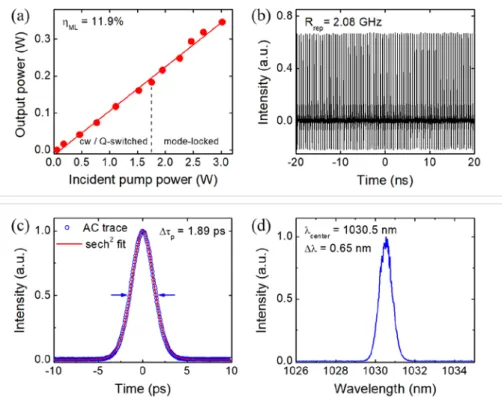
Fig. 3. Characteristics of the mode-locked Yb:YAG channel waveguide laser using SWCNT-SAM. (a) Average output power vs. incident pump power at 5% OC, (b) pulse train, (c) autocorrelation trace and sech2 fit (red curve), and (d) optical spectrum of the mode-locked
pulses.
For the mode-locking experiment we used the SWCNT-SAM. At pump powers below 1.8 W, the waveguide laser operates in the cw regime when the air-gap between waveguide laser and the output coupler is kept constant. By aligning the air-gap distance, the laser operation regime can be switched from cw to Q-switching or Q-switched mode-locking. In this way, stable Q-switched pulses are obtained at pump power levels between the lasing threshold of 59 mW and 1.8 W. It should be noted that the laser operates preferably in the Q-switched mode-locking regime rather than Q-switching at the pump powers between 1 W and 1.8 W when the air-gap distance is carefully adjusted [Fig. 2(c)].
Mode-locking of the waveguide laser starts at pump powers above 1.8 W when the air-gap distance between the piezo-controlled OC mirror and the Yb:YAG crystal was precisely
realigned. The average output power in mode-locked operation amounts to 322 mW at a slope efficiency of 11.3% at the highest incident pump power of 3.1 W, which is slightly lower than that in the cw regime [Fig. 3(a)]. In all cases the mode profile remained circular indicating fundamental mode operation. Up to this pump power level, no damage of the SA layer is observed. Thanks to the low saturation fluence of the SWCNT-SAM of only few tens of μJ/cm2, the mode-locking of the laser is stable even at an intracavity beam diameter on the
saturable absorber of more than 100 μm. However, above 3.1 W of the pump power, the surface of the SWCNT/PMMA layer is slightly deformed due to heat accumulation inside the polymer matrix, which hinders stable mode-locked pulse generation. To avoid this phenomena, we plan to actively cool the polymer-based SA in future experiments and to control the intracavity beam waist more precisely. The repetition rate of the mode-locked laser is measured to be 2.08 GHz [Fig. 3(b)] which corresponds to a total cavity length of 64 mm taking into account the refractive indices of the 6.3-mm-long Yb:YAG waveguide, the lenses and the SA. Figure 3(b) shows the stable pulse train in a 40-ns time span. In wider time spans of the oscilloscope we could not observe any Q-switching instabilities. The mode-locked pulse characteristics are shown in Fig. 3(c) and Fig. 3(d). The autocorrelation trace in Fig. 3(c) indicates a pulse width of 1.89 ps assuming sech2-pulses. Figure 3(d) shows the
corresponding optical spectrum centered at 1030.5 nm with a spectral bandwidth of 0.65 nm leading to a time-bandwidth product of 0.349, close to the Fourier limit. This value is only slightly above the theoretical limit of 0.315, indicating that the combination of the dispersive coating of the OC and the precise alignment of the air-gap allows for a fairly good dispersion control.
4. Conclusion
In conclusion, we demonstrate a fs-laser-written crystalline Yb:YAG channel waveguide laser, mode-locked by employing SWCNTs as saturable absorber. To the best of our knowledge, these results represent the first mode-locked Yb3+-doped waveguide laser based
on SWCNTs and the highest repetition rate in any extended waveguide laser configuration. Precise alignment of a piezo-controlled thin air-gap between the GTI-coated output coupling mirror and the end-facet of the waveguide allows for a fine tuning of the laser cavity dispersion. The resulting pulse duration of 1.89 ps is only slightly longer than that of the Fourier-limited pulse. Further optimization of waveguide length and configuration, absorber parameters and dispersion management makes us possible to generate much shorter pulses in fs regime, which can be applied for frequency combs at GHz repetition rates. The results show that low-dimensional carbon nanostructures such as SWCNTs are promising materials for pulsing monolithic waveguide lasers, delivering ultrashort pulses at multiple GHz repetition rate. Direct coating of the SA on the facet of the waveguides, which we have demonstrated previously [22], should be an even better approach to achieve a true monolithic laser mode-locking with precise cavity dispersion management.
Funding
National Research Foundation of Korea (NRF) (2016R1A6A3A03009053, 2016R1A2A1A05005381, 2017R1A4A1015426); Deutsche Forschungsgemeinschaft (DFG) (CA 1380/1-1, EXC 1074).