Notes Bull. Korean Chem. Soc. 2012, Vol. 33, No. 6 2059 http://dx.doi.org/10.5012/bkcs.2012.33.6.2059
Synthesis and Structural Characterization of Strontium Complex of
Symmetrically Functionalized
β-Diketimine Ligand
Sheby M. George, Gyu Hwan Yon,‡ Bo Keun Park, Kang Mun Lee,† Youngkyu Do,† Chang Gyoun Kim,* and Taek-Mo Chung*
Thin Film Materials Research Group, Korea Research Institute of Chemical Technology, Yuseong P.O. Box 107, Daejeon 305-600, Korea. *E-mail: [email protected] (C.G. Kim), [email protected] (T.-M. Chung)
†Department of Chemistry, KAIST, Daejeon 305-701, Korea
‡Bio-Organic Science Division, Korea Research Institute of Chemical Technology, Yuseong P.O. Box 107, Daejeon 305-600, Korea
Received January 10, 2012, Accepted March 6, 2012
Key Words : Strontium complex, β-Diketiminate ligand, Tetradentate ligand, Thermal properties, Precursor
The attraction in organometallic chemistry of the heavier alkaline earth elements such as, barium, strontium, and cal-cium have driven by their potential application in a variety of fields such as organic synthesis,1 lactide polymerization,2 and as precursors for the growth of thin films.3 The synthesis of new compounds of strontium and other alkaline earth metals is often met with challenges such as poor compound stability and solubility. This is mainly because of the tendency of these metals, to form oligomeric compounds with low solubility and poor volatility owing to their large ionic radius combined with a small charge. Typically, three different approaches are used to prevent oligomerization: addition of neutral multidentate Lewis base molecules to the coordination sphere of the metal, use of large and sterically demanding ligands, or use of donor functionalized ligands. Sterically demanding ligands4 such as β-diketiminates,5 indenyls,6 cyclopentadienyls,7 and guanidinates,4c which provide greater encapsulation of the metal, result in stable and soluble monomeric compounds. Among these, β-di-ketiminate ligands commonly act as bidentate four-electron donors through the formation of two metal-nitrogen σ-bonds. Aside from the interesting structural features, β-di-ketiminate ligands have been employed as important spectator ligands in catalytic processes, often as cyclopentadienyl or β-diketonato ligand replacements. The versatility of β-di-ketimine ligands is due to the fact that they can be modified
at both the nitrogen atoms and the carbon atoms of the ligand core to suit different steric and electronic demands of organometallic complexes. In pursuit of novel, structurally interesting alkaline earth metal complexes, we exploited the structural tunability of the β-diketiminate ligands to design a new diketiminate derivative and its strontium complex. Herein, we present the synthesis and structural characteri-zation of a new strontium complex using newly synthesized symmetrically functionalized β-diketimine ligands.
The strontium complex SrL2 was synthesized by treating Sr[N(SiMe3)2]2·2DME with 2 equivalents of β-diketimine (LH) in toluene at room temperature (Scheme 1). The crystals of 1 were grown from a saturated hexane solution at −30 °C. Compound 1 was well characterized by single crystal X-ray diffraction, nuclear magnetic resonance (NMR) spectro-scopy (1H, 13C), Fourier-transform infrared (FT-IR) spectro-scopy, elemental analysis, and thermogravimetric analysis (TGA).
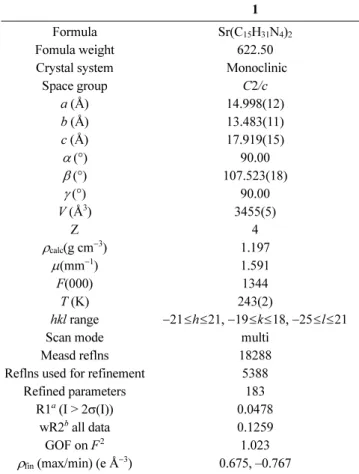
The single-crystal X-ray study revealed that 1 crystallizes in the monoclinic space group C2/c (Details of experimental crystallographic data for 1 are summarized in Table 1). The crystal structure of 1 is shown in Figure 1, where it can be seen that the geometry around the strontium ion is a distorted octahedron. In all the previously reported strontium β-diketiminate complexes,5b,8,9 the valences of the strontium ion were satisfied either by the π-electron cloud of the
2060 Bull. Korean Chem. Soc. 2012, Vol. 33, No. 6 Notes
diketiminate ligand (by η2,η3,η5 bonds), solvent molecules, or halogens. In complex 1, the bulkiness of the ligands limited the coordination of the strontium to six. The coordination positions of strontium were satisfied by six nitrogen atoms from the two diketiminate (LH) ligands, leaving one amine site free from both ligands. The deviation from the ideal octahedral angle in the crystal structure of 1 might have been due to the steric interaction between the propylamine side chains of the ligands. The nitrogen-strontium-nitrogen bite angles for the β-diketiminate ligand backbone, N(1)–Sr–N(2) and N(1i)–Sr–N(2i), were 71.95(8)°, while the interligand nitrogen-strontium-nitrogen angles were between 123.20(10)° for N(1)–Sr–N(1i) and 100.23(11)° for N(2)–Sr–N(2i), which is a significant deviation from the ideal octahedral angle. The distortion of the geometry was also evidenced from the deviation in the dihedral angle of the N(1)–Sr–N(2) and N(1i)–Sr–N(2i) planes, which was 34.08(9)°. Four among the six Sr–N bonds in 1, where the nitrogen atoms are from the diketiminate backbone were in the range 2.514(2)–2.573(2) Å, which is slightly longer than normal Sr–N bonds (2.49 Å),8 while the other two axial Sr–N bonds from the amine side chains showed a longer bond length of 2.744(3) Å for Sr–N(4) and Sr–N(4i), which is shorter than typical Sr–N (amine) (2.8 Å) bonds.9,10 The distance (N(3)···N(3i)) between nonbonded amine side chains was 5.744(7) Å, and the propyl amine side chain was flexible enough for an extended coordination. These two
free coordination sites can be used for the synthesis of bimetallic complexes containing strontium ion.
The absence of an –NH peak in the 1H NMR of 1 com-pared to the free diketimine ligand was a clear indication of metal-ligand bond formation. The methyl groups of β-diketiminate ligand backbone appeared as a singlet at δ 2.00 in 1, which were downfield compared to the free ligands (δ 1.74). The twelve methyl group protons attached to the side chain amine also moved downfield to a value of δ 2.14 for complex 1 compared to δ 2.12 in the free ligand. The hydrogen atoms on the β-CH fragments of the β-diketimine ligands in 1 resonated at δ 4.52, which were upfield compared to the free ligand (β-CH) (LH) δ 4.59. In the
13C{1H} NMR spectra, the β-CH fragment in 1 resonated at
δ 93.9 and was upfield compared to the free ligand (β-CH) (LH) δ 94.8.
The FT-IR spectra of complex 1 showed a strong peak at 1560 cm−1, which is consistent with the partial C=N double bond character shown by the previously reported β-di-ketiminate complexes.11 Thermogravimetric analysis of the complex 1 was carried out from room temperature to 900 °C (Figure 2) under a constant flow of nitrogen gas. Complex 1 decomposed in one step, losing about 76% of its mass in the 140-320 °C region, and this might have been due to the evaporation of the compound and possible decomposition of the product, finally leaving about 20% nonvolatile residue at 500 °C. The reason for the significant amount of residues was the decomposition of the complex during the TG analysis into nonvolatile compounds.
In summary, a new strontium β-diketiminate complex was synthesized and characterized. The crystal structure of the
Table 1. Crystallographic data and data collection parameters for 1 1
Formula Sr(C15H31N4)2
Fomula weight 622.50
Crystal system Monoclinic
Space group C2/c a (Å) 14.998(12) b (Å) 13.483(11) c (Å) 17.919(15) α (°) 90.00 β (°) 107.523(18) γ (°) 90.00 V (Å3) 3455(5) Z 4 ρcalc(g cm−3) 1.197 μ(mm−1) 1.591 F(000) 1344 T (K) 243(2) hkl range −21≤h≤21, −19≤k≤18, −25≤l≤21
Scan mode multi
Measd reflns 18288
Reflns used for refinement 5388
Refined parameters 183 R1a (I > 2σ(I)) 0.0478 wR2b all data 0.1259 GOF on F2 1.023 ρfin (max/min) (e Å−3) 0.675, –0.767 aR1 = Σ||F o| − |Fc||/Σ|Fo|. bwR2 = {[Σw(Fo2−Fc2)2]/[Σw(Fo2)2]}1/2.
Figure 1. Molecular structure of 1. Hydrogen atoms are omitted for clarity. Selected bond distances (Å) and angles (°) Sr–N(1) 2.573(2), Sr–N(2) 2.514(2), Sr–N(4) 2.744(3), N(1)–Sr–N(2) 71.95(8), N(1)–Sr–N(1i) 123.20(10), N(2)–Sr–N(2i) 100.23(11), N(2i)–Sr–N(1) 156.89(7), N(2)–Sr–N(4) 73.16(9), N(1)–Sr–N(4) 102.35(9), N(2)–Sr–N(4i) 95.74(8), N(2)–Sr–N(4) 73.16(9), N(1)– Sr–N(4i) 85.80(9), N(4)–Sr–N(4i) 162.99(9).
Notes Bull. Korean Chem. Soc. 2012, Vol. 33, No. 6 2061
complex showed two free amine groups from the ligand side chains which might be useful in the synthesis of bimetallic complex containing strontium ion. The thermo-gravimetric analysis of complex 1 displayed single step decomposition, leaving 20% of nonvolatile residue. The studies to explore this compund as a possible strontium precursor for the growth of thin films of SrTiO3 (STO), and Ba0.5Sr0.5TiO3
(BSTO) using MOCVD techniques are in progress.
Experimental Section
Sr[N(SiMe2)2]2·2DME was prepared by the literature
method.12 All reactions were carried out in inert dry condi-tion using standard Schlenk techniques or in argon filled glove box. Hexane and toluene were purified by Innovative Technology PS-MD-4 solvent purification system. All other chemicals were purchased from Aldrich and used as received. NMR spectra were recorded on Bruker 300 MHz spectrometer with C6D6 as solvent and standard. IR spectra
were obtained from Nicolet Nexus FT-IR spectrophotometer. Elemental analyses were carried out on Thermo Scientific OEA Flash 2000 Analyzer. Thermogravimetric analyses were carried out on SETARAM 92-18 TG-DTA instrument.
Synthesis of N1-(( Z)-4-(3-(Dimethylamino)propylamino)-pent-3-en-2-ylidene)-N3,N3-dimethyl propane-1,3-diamine (LH). A mixture of N,N-diisopropyl-2,4-pentanediketimine (78 g, 0.43 mol) and N,N-dimethyl-1,3-propanediamine (44 g, 0.43 mol) was heated at 130 °C for 14 h. The isopropyl amine formed during this reaction was removed by vacuum, and the resultant was further purified by vacuum distillation affording LH. (bp: 150 °C/0.02 mmHg, 23 g, 0.085 mol, 20%). 1H NMR (C6D6, 300 MHz) δ 1.74 (s, 6H), 1.76 (quintet, 4H), 2.12 (s, 12H), 2.33 (t, 4H, J = 7.0 Hz), 3.22 (t, 4H, J = 6.74 Hz), 4.59 (s, 1H), 11.46 (s, 1H). 13C NMR (C6D6, 75 MHz) δ 19.4, 30.2, 44.7, 45.7, 57.8, 94.8, 160.2. FT-IR (KBr, cm−1): 2940 (m), 2860 (m), 2820 (m), 2771 (m), 1630 (vs), 1560 (s), 1500 (w), 1460 (m), 1440 (m), 1378 (w), 1338 (w), 1080 (w), 1042 (w), 834 (w), 723 (m). EI-MS, m/z (%): 268 (58) [M+]. Synthesis of SrL2 (1). LH (0.537 g, 2 mmol) in 5 mL of
toluene was added drop wise to a stirring solution of Sr[N(SiMe2)2]2·2DME (0.59 g, 1 mmol) in toluene (10 mL).
After stirring for 15 h at room temperature, the reaction mixture was evaporated to dryness to obtain a yellow solid. The residue was then re-dissolved in hexane and filtered through 0.2 μm filter. The hexane was then evaporated to obtain the product as yellow crystalline solid. X-ray quality crystals were grown from a concentrated hexane solution upon cooling. Yield: 0.56 g (90%). 1H NMR (C6D6, 300
MHz) δ 1.61 (quintet, 4H, J = 6.7 Hz), 2.00 (s, 6H), 2.14 (s, 12H), 2.30 (t, 4H, J = 6.4 Hz), 3.45 (t, 4H, J = 6.9 Hz), 4.52 (s, 1H). 13C NMR (C6D6, 75 MHz) δ 21.5, 30.3, 45.5, 47.5, 58.2, 93.9, 163.9. FT-IR (KBr, cm−1): 2940 (m), 2860 (m), 2820 (m), 2771 (m), 1630 (s), 1560 (s), 1490 (s), 1459 (s), 1420 (s), 1340 (s), 1269 (w), 1155 (w), 1062 (w), 1042 (w), 1009 (w), 830 (w), 726 (w), 710 (m). EI-MS, m/z (%): 268 (58) [L+]. Anal. Calcd for C30H62N6Sr (622.5): C, 57.88; H,
10.04; N, 18.00. Found: C, 57.63; H, 10.39; N, 18.59. X-ray Crystallography. Single crystals of 1 were grown from a saturated hexane at –30 oC. A specimen of suitable size and quality was coated with Paratone oil and mounted onto a glass capillary. Reflection data were collected on a Bruker Apex II-CCD area detector diffractometer, with graphite-monochromated MoKα radiation (λ = 0.71073 Å). The hemisphere of reflection data were collected as ω scan frames with 0.3o/frame and an exposure time of 10 s/frame. Cell parameters were determined and refined by SMART program.13 Data reduction was performed using SAINT soft-ware.14 The data were corrected for Lorentz and polarization effects. An empirical absorption correction was applied using the SADABS program.15 The structure was solved by direct methods and all non-hydrogen atoms were subjected to anisotropic refinement by full-matrixleast-squares on F2 by using the SHELXTL/PC package.16 Hydrogen atoms were placed at their geometrically calculated positions and refine driding on the corresponding carbon atoms with isotropic thermal parameters.
Acknowledgments. This research was supported by the Converging Research Center Program through the Ministry of Education, Science and Technology (2011K000604).
Supporting Information. Crystallographic data have been deposited with Cambridge Crystallographic Data Centre: Deposition number CCDC-853154 for compound 1. Copies of the data canbe obtained free of charge via http:// www.ccdc.cam.ac.uk/conts/retrieving.html (or from the Cambridge Crystallographic DataCentre, 12, Union Road, Cambridge, CB2 1EZ, U.K.; Fax: +441223336033; e-mail: [email protected]).
References
1. (a) Buch, F.; Harder, S. Z. Naturforsch. 2008, 63b, 169. (b) Spielmann, J.; Harder, S. Eur. J. Inorg. Chem. 2008, 1480. (c) Crimmin, M. R.; Barrett, A. G. M.; Hill, M. S.; Hitchcock, P. B.; Procopiou, P. A. Organometallics 2007, 26, 2953. (d) Spielmann, J.; Harder, S. Chem.-Eur. J. 2007, 13, 8928. (e) Ruspic, C.; Figure 2. Thermogravimetric curve of 1.
2062 Bull. Korean Chem. Soc. 2012, Vol. 33, No. 6 Notes
Harder, S. Inorg. Chem. 2007, 46, 10426. (f) Barrett, A. G. M.; Crimmin, M. R.; Hill, M. S.; Hitchcock, P. B.; Procopiou, P. A. Angew. Chem., Int. Ed. 2007, 46, 6339. (g) Crimmin, M. R.; Barrett, A. G. M.; Hill, M. S.; Procopiou, P. A. Org. Lett. 2007, 9, 331. (h) Crimmin, M. R.; Casely, I. J.; Hill, M. S. J. Am. Chem. Soc. 2005, 127, 2042.
2. (a) Chisholm, M. H.; Zhou, Z. J. Mater. Chem. 2004, 14, 3081. (b) Chisholm, M. H.; Gallucci, J. C.; Phomphrai, K. Inorg. Chem. 2004, 43, 6717. (c) Chisholm, M. H.; Gallucci, J. C.; Phomphrai, K. Chem. Commun. 2003, 48.
3. (a) Matthews, J. S., Jr.; Rees, W. S. Adv. Inorg. Chem. 2000, 50, 173. (b) Wojtczak, W. A.; Fleig, P. F.; Hampden-Smith, M. J. Adv. Organomet. Chem. 1996, 40, 215. (c) Marks, T. J. Pure Appl. Chem. 1995, 67, 313.
4. (a) Weeber, A.; Harder, S.; Brintzinger, H. H. Organometallics 2000, 19, 1325. (b) Feil, F.; Harder, S. Eur. J. Inorg. Chem. 2003, 3401. (c) Feil, F.; Harder, S. Eur. J. Inorg. Chem. 2005, 4438. (d) Harder, S.; Feil, F.; Weeber, A. Organometallics 2001, 20, 1044. (e) Harder, S.; Feil, F.; Knoll, K. Angew. Chem., Int. Ed. 2001, 40, 4261. (f) Harder, S.; Feil, F. Organometallics 2002, 21, 2268. (g) Feil, F.; Müller, C.; Harder, S. J. Organomet. Chem. 2003, 683, 56. (h) Cloke, F. G. N.; Hitchcock, P. B.; Lappert, M. F.; Lawless, G. A.; Royo, B. Chem. Commun. 1991, 724. (i) Green, D. C.; Englich, U.; Ruhlandt-Senge, K. Angew. Chem., Int. Ed. 1999, 38, 354.
5. (a) Clegg, W.; Coles, S. J.; Cope, E. K.; Mair, F. S. Angew. Chem., Int. Ed. 1998, 37, 796. (b) El-Kaderi, H. M.; Heeg, M. J.; Winter, C. H. Organometallics 2004, 23, 4995. (c) Harder, S. Organo-metallics 2002, 21, 3782.
6. Overby, J. S.; Hanusa, T. P. Organometallics 1996, 15, 2205. 7. (a) Hanusa, T. P. Chem. Rev. 1993, 93, 1023. (b) Hanusa, T. P.
Organometallics 2002, 21, 2559. (c) Burns, C. J.; Andersen, R. A. J. Organomet. Chem. 1987, 325, 31. (d) Williams, R. A.; Hanusa,
T. P.; Huffmann, J. C. Organometallics 1990, 9, 1128. (e) Burkey, D. J.; Williams, R. A.; Hanusa, T. P. Organometallics 1993, 12, 1331. (f) Williams, R. A.; Tesh, K. F.; Hanusa, T. P. J. Am. Chem. Soc. 1991, 113, 4843. (g) Sitzmann, H.; Dezember, T.; Ruck, M. Angew. Chem., Int. Ed. 1998, 37, 3113. (h) Harvey, M. J.; Quisenberry, K. T.; Hanusa, T. P.; Young, V. G. Eur. J. Inorg. Chem. 2003, 3383. (i) Weber, F.; Sitzmann, H.; Schultz, M.; Sofield, C. D.; Andersen, R. A. Organometallics 2002, 21, 3139. 8. Sarish, S. P.; Jana, A.; Roesky, H. W.; Schulz, T.; John, M.; Stalke,
D. Inorg. Chem. 2010, 49, 3816.
9. (a) Sedai, B.; Heeg, M. J.; Winter, C. H. Organometallics 2009, 28, 1032. (b) El-Kaderi, H. M.; Heeg, M. J.; Winter, C. H. Organometallics 2004, 23, 4995. (c) Luo, B.; Yu, D.; Kucera, B. E.; Campbell, S. A.; Gladfelter, W. L. Chem. Vap. Deposition 2007, 13, 381.
10. Park, J. W.; Kim, J. T.; Koo, S. M.; Kim, C. G.; Kim, Y. S. Polyhedron 2000, 19, 2547.
11. (a) Richeson, D. S.; Mitchell, J. F.; Theopold, K. H. J. Am. Chem. Soc. 1987, 109, 5868. (b) Yao, Y.; Xue, M.; Luo, Y.; Zhang, Z.; Jiao, R.; Zhang, Y.; Shen, Q.; Wong, W.; Yu, K.; Sun, J. J. Organomet. Chem. 2003, 678, 108. (c) Zhang, Z.; Yao, Y.; Zhang, Y.; Shen, Q.; Wong, W. Inorg. Chim. Acta 2004, 357, 3173. 12. Westerhausen, M. Inorg. Chem. 1991, 30, 96.
13. SMART, version 5.0, Data collection software, Bruker AXS, Inc., Madison, WI, 1998.
14. SAINT, version 5.0, Data integration software, Bruker AXS Inc., Madison, WI, 1998.
15. Sheldrick, G. M. SADABS, Program for absorption correction with the Bruker SMART system, Universitat Gottingen, Germany, 1996.
16. Sheldrick, G. M. SHELXL-93: Program for the refinement of crystal structures; Universitat Gottingen: Germany, 1993.