Division of Rheumatology, Department of Internal Medicine, Yonsei University College of Medicine, Seoul, Republic of Korea.
Eun Seong Park, MD Sung Soo Ahn, MD Seung Min Jung, MD, PhD Jason Jungsik Song, MD, PhD Yong-Beom Park, MD, PhD Sang-Won Lee, MD, PhD
Please address correspondence to: Dr Sang-Won Lee,
Division of Rheumatology, Department of Internal Medicine, Yonsei University College of Medicine, 50-1 Yonsei-ro, Seodaemun-gu, Seoul 03722, Republic of Korea. E-mail: [email protected]
Received on August 9, 2017; accepted in revised form on October 10, 2017.
Clin Exp Rheumatol 2018; 36 (Suppl. 111): S115-S120.
© Copyright CliniCaland
ExpErimEntal rhEumatology 2018. Key words: ANCA-associated vasculitis, microscopic polyangiitis, eosinophilic granulomatosis with polyangiitis, kidney-transplantation, relapse, graft-rejection
Competing interests: none declared.
ABSTRACT
Objectives. We investigated renal outcome of kidney-transplantation in Korean recipients with biopsy-proven renal involvement of antineutrophil cy-toplasmic antibody (ANCA)-associated vasculitis (AAV) in a single centre. Methods. We reviewed the medical records of 144 Korean patients and included 3 female patients with mi-croscopic polyangiitis (MPA) and one male patient with eosinophilic granu-lomatosis with polyangiitis (EGPA) in this study. We obtained clinical and laboratory data related to kidney-transplantation, analysed renal out-come of kidney-transplantation in 4 re-cipients with AAV and compared it with those of previous studies.
Results. The mean age at diagnosis was 37.8 years and that at kidney-transplantation was 40.8 years. Time-gap from AAV to ESRD ranged from 1 to 48 months and that from AAV to kid-ney-transplantation ranged from 2 to 95 months. All kidney-recipients with had been followed-up for two years or greater. At diagnosis, MPO-ANCA was detected in only MPA patients, while, at transplantation, MPA-ANCA was de-tected in 2 MPA patients and an EGPA patient. All patients have received tac-rolimus and mycophenolate mofetil based on glucocorticoid after kidney-transplantation. Among 4 kidney-recip-ients with AAV, one MPA patient under-went renal re-biopsies three times due to renal function deterioration during the follow-up. Renal histology revealed T cell-mediated and antibody-mediated rejection rather than relapse of MPA. Neither relapse nor graft failure was observed in our study.
Conclusion. Renal outcome of kidney- transplantation in recipients with AAV was good and kidney-transplantation is deserved to be recommend as a safe and effective therapeutic modality to AAV patients with ESRD.
Introduction
Antineutrophil cytoplasmic antibody (ANCA)-associated vasculitis (AAV) is a group of systemic necrotising vas-culitides, which mainly encroach small vessels from capillaries to arterioles (1). AAV generally consists of 3 vari-ants based on clinical and histological features including microscopic poly-angiitis (MPA), granulomatosis with polyangiitis (GPA, identical to Wegen-er’s granulomatosis) and eosinophilic GPA (EGPA, identical to Churg-Strauss syndrome) (1-5). The frequency of re-nal involvement of AAV depends on variants: 90–100% in MPA, 50–80% in GPA, 31–51% in ANCA positive EGPA and 4–16% ANCA negative EGPA (6). Most common histological feature of renal involvement of AAV is pauci-im-mune crescentic and/or necrotising glo-merulonephritis, leading to rapid pro-gressive glomerulonephritis (7). Renal involvement of AAV may result in end stage renal disease (ESRD) in 20-40% of AAV patients (8-10), and kidney transplantation has been considered a suitable therapeutic modality and more valuable benefits than maintenance of dialysis (11, 12). So far, histological features, age, glomerular filtration rate and PR3-ANCA at kidney transplanta-tion were reported to be poor prognos-tic factors (13, 14). Despite a relatively low rate (0.02/patient year) of relapse of AAV after kidney-transplantation, because no guideline for kidney-trans-plantation in AAV patients with ESRD is recommended optimal timing and indication of kidney-transplantation and risk factors for relapse of AAV after kidney-transplantation, we still have concerns over the adverse effects of relapse on both graft- and patient-survival (8). Moreover, there was no report regarding renal outcome of kid-ney-transplantation in recipients with AAV in Korea. Hence, in this study, we investigated renal outcome of
kidney-recipients with ANCA-associated vasculitis
transplantation in Korean recipients with biopsy-proven renal involvement of AAV in a single centre.
Materials and methods Patients
We retrospectively reviewed the details of the electrical medical records of 144 Korean patients according to the inclu-sion criteria as the follows: i) patients who were first classified as MPA, GPA or EGPA from October 2000 to July 2017 at Division of Rheumatology, De-partment of Internal Medicine, Yonsei University College of Medicine, Sever-ance hospital; ii) those who were clas-sified according to the 1990 American College of Rheumatology (ACR) clas-sification criteria for GPA and EGPA, the 2007 European Medicines Agency (EMA) algorithm and the 2012 revised Chapel Hill Consensus Conference Nomenclature of Vasculitides (1-4); iii) those who had results of myeloper-oxidase (MPO)-ANCA and proteinase 3 (PR3)-ANCA at diagnosis and kid-ney-transplantation; vi) those who had biopsy-proven pauci-immune based crescentic and/or necrotising glomeru-lonephritis (7); v) those who had ESRD due to AAV, but not due to other mean-ingful medical conditions to accelerate progression to ESRD, such as diabetes mellitus, refractory hypertension, viral hepatitis, autoimmune diseases other than AAV; vi) those who underwent kidney-transplantation at Severance hospital after January 2005 and who had been followed-up for two years or greater; vii) those who had received prednisolone, mycophenolate mofetil and tacrolimus based on the same proto-col suggested by Department of Trans-plantation Surgery after January 2005; viii) those who had well-written medi-cal records at diagnosis, around kidney-transplantation and during the follow-up to identify clinical progress. Medical conditions were searched by the 10th revised International Classification of Diseases (ICD-10) and medications administered were monitored under the Korean Drug Utilization Review (DUR) system. Five patients fulfilled the inclu-sion criteria, but one patient had been followed-up for only two months. Fi-nally, we included four patients in this
study and investigated renal outcome of kidney-transplantation in 4 Korean recipients with biopsy-proven AAV in a single centre. This study was approved by the institutional Review Board of Severance Hospital (4-2016-0901). Clinical and laboratory data and AAV classification
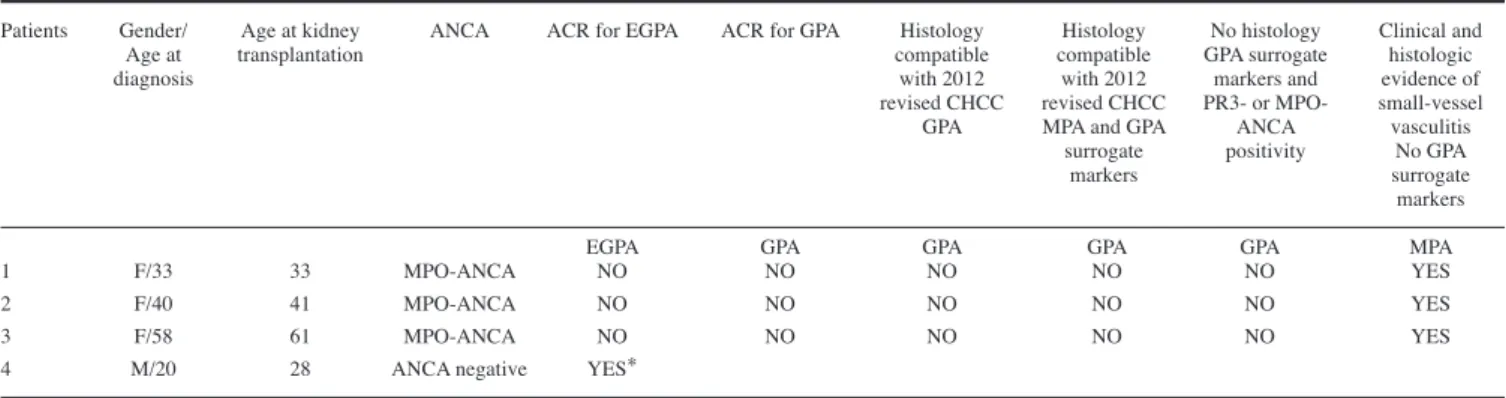
We collected age at diagnosis and age at kidney-transplantation and gender as demographic data. We also collected time-gap from diagnosis of AAV to ESRD and time-gap from diagnosis of AAV to kidney-transplantation. We ob-tained the results of MPO-ANCA and PR3-ANCA not only at diagnosis, but also at kidney-transplantation. We also obtained renal histological features at diagnosis. We applied sequentially the 1990 ACR criteria for EGPA and GPA and the 2007 EMA algorithm modified by the 2012 CHCC definitions to study subjects as described in Table I (1-4). Data related to kidney-transplantation We reviewed the medical records re-lated to kidney-transplantation regard-ing kidney donor, therapeutic regimens based glucocorticoid after kidney-trans-plantation, rejection, relapse of AAV, graft failure and CKD stage at present. Graft failure was defined as a status which needs to restart dialysis therapy or re-transplantation and death due to renal and non-renal cause (9, 15). Pa-tients with unexplained elevated serum creatinine (greater than 30% increase over baseline), increased proteinuria (greater than 0.5g/day), and persistent haematuria (>5 RBC/HPF) were sub-jected to renal biopsy (7, 9, 16). Acute rejection was defined when histological features exhibited one of three charac-ters: acute T cell-mediated rejection, acute antibody-mediated rejection and acute vascular rejection (17). Relapse was defined as recurrence or new onset of disease attributable to active vascu-litis (18).
Literature review
We selected 4 studies with a consid-erable number of kidney-recipients with AAV from Western countries and case-reports from North-Eastern Asian countries with similar ethnicity to
Ko-rea, Japan and China. We also com-pared renal outcome between our study and previous studies.
Results
Baseline characteristics of 4 kidney-recipients with AAV classified by the 1990 ACR classification criteria and the 2007 EMA algorithm modified by the 2012 CHCC definitions
Our study included three female kid-ney-recipients with MPA and the mean age at diagnosis and that at kidney-transplantation were 43.7 year and 45.0 years. All MPA patients did not fulfil the 1990 ACR criteria for EGPA or GPA. All MPA patients exhibited pauci-immune crescentic and/or ne-crotising glomerulonephritis and had MPO-ANCA. Because they showed no granulomatosis on histology, or no GPA surrogate markers, they could be classified as MPA. Our study included only one male kidney-recipient with EGPA, who had been classified by the 1990 ACR classification criteria with items of asthma, eosinophilia, periph-eral neuropathy, paranasal sinusitis and extravasation of eosinophils on histol-ogy. He had been diagnosed at 20 years of age and he underwent kidney-trans-plantation at 28 years of age. He had neither MPO-ANCA nor PR3-ANCA. Renal outcome of kidney
transplantation in 4 recipients with AAV
Renal outcome of 4 kidney-recipients with AAV is shown in Table II.
Time-gap from diagnosis of AAV to ESRD ranged from 1 to 48 months and that from diagnosis of AAV to kidney-transplantation ranged from 2 to 95 months. All kidney-recipients with AAV had been followed-up for two years or greater. On histology, two MPA patients exhibited pauci-immune crescentic and necrotising glomeru-lonephritis and one MPA patients ex-hibited pauci-immune crescentic glo-merulonephritis. One EGPA patient exhibited extravasation of eosinophils along with pauci-immune crescentic glomerulonephritis. All patients re-ceived kidney from living related donor (LRD). MPO-ANCA was detected in all MPA patients at diagnosis, but it was
detected in only two of three MPA pa-tients at kidney-transplantation. Mean-while, MPO-ANCA was not detected in an EGPA patient at diagnosis, but it was detected at kidney-transplantation. All patients have received tacrolimus and mycophenolate mofetil based on glu-cocorticoid after kidney-transplantation according to the same protocol suggest-ed by Department of Transplantation Surgery after January 2005. Among 4 kidney-recipients with AAV, one MPA patient exhibited the increased amount of proteinuria and the deterioration in renal function. Finally she underwent re-biopsy of kidney three times
dur-ing the follow-up. Renal histology by three re-biopsies revealed T cell-medi-ated and antibody-medicell-medi-ated rejection. Therefore, on the basis of histological features, we attributed the aetiology of aggravation of renal function to rejec-tion rather than MPA. Plasmapheresis and glucocorticoid pulse therapy were performed for rapid kidney allograft dysfunction as induction therapy, and then tacrolimus and mycophenolate mofetil along with glucocorticoid were administered. Although three-time re-jections provoked no graft failure, renal function deteriorated up to CKD stage IV though three-time rejections.
Literature reviews and comparison of renal outcome between this study and previous studies
We reviewed previous studies investi-gating renal outcome of kidney-trans-plantation in a large number of AAV patients described in Table III. A study with 113 kidney-recipients with AAV in the Netherlands reported the median time-gap from kidney-transplantation to relapse of AAV of 22 months, 5 graft-survival rate of 83% and 5 year-patient-survival of 95% (19). A study with 93 kidney-recipients with AAV in Australia and New Zealand reported that MPA showed the worse renal
out-Table I. Baseline characteristics of 4 kidney-recipients with AAV classified by the 1990 ACR classification criteria and the 2007 EMA
algorithm modified by the 2012 CHCC definitions.
Patients Gender/ Age at kidney ANCA ACR for EGPA ACR for GPA Histology Histology No histology Clinical and Age at transplantation compatible compatible GPA surrogate histologic
diagnosis with 2012 with 2012 markers and evidence of
revised CHCC revised CHCC PR3- or MPO- small-vessel GPA MPA and GPA ANCA vasculitis
surrogate positivity No GPA
markers surrogate
markers
EGPA GPA GPA GPA GPA MPA
1 F/33 33 MPO-ANCA NO NO NO NO NO YES
2 F/40 41 MPO-ANCA NO NO NO NO NO YES
3 F/58 61 MPO-ANCA NO NO NO NO NO YES
4 M/20 28 ANCA negative YES*
*YES: asthma, sinusitis, eosinophilia and peripheral neuropathy; pauci-immune crescentric glomerulonephritis.
AAV: ANCA-associated vasculitis; ANCA: antineutrophil cytoplasmic antibody; ACR: American College of Rheumatology; EMA: European Medicine Agency; CHCC: Chapel Hill Consensus Conference; EGPA: eosinophilic granulomatosis with polyangiitis; GPA: granulomatosis with polyangiitis; MPA: microscopic polyangiitis; PR3: proteinase 3; MPO: myeloperoxidase.
Table II. Renal outcome of kidney-transplantation in 4 recipients with AAV.
Patients Time-gap Time-gap from Follow-up Histological Kidney ANCA Therapeutic Rejection Relapse Graft Renal (AAV from AAV AAV to kidney- duration features donor at kidney- regimens failure Function variants) to ESRD transplantation after kidney- transplantation based on (CKD
(months) (months) transplantation glucocorticoid stage)
(months) after kidney-
transplantation
1 (MPA) 29 32 33 pauci-immune LRD MPO-ANCA tacrolimus and NO NO NO CKD I crescentic and positive mycophenolate
necrotising mofetil glomerulonephritis
2 (MPA) 1 2 28 pauci-immune LRD MPO-ANCA tacrolimus and NO NO NO CKD III crescentic positive mycophenolate
glomerulonephritis mofetil with interstitial
nephritis
3 (MPA) 23 37 60 pauci-immune LRD ANCA tacrolimus and YES NO NO CKD IV crescentic and negative mycophenolate
necrotising mofetil glomerulonephritis
4 (EGPA) 48 95 126 pauci-immune LRD MPO-ANCA tacrolimus and NO NO NO CKD I crescentic positive mycophenolate
glomerulonephritis mofetil
extravasation
of eosinophils
AAV: ANCA-associated vasculitis; ANCA: antineutrophil cytoplasmic antibody; ESRD: end stage renal disease; CKD: chronic kidney disease; MPA: microscopic polyangiitis; EGPA: eosinophilic granulomatosis with polyangiitis; LRD: living related donor; MPO: myeloperoxidase.
come than GPA in both graft-survival and patient-survival (50% at 10 years for MPA vs. 62% at 10 years for GPA, and 68% at 10 years for MPA vs. 85% at 10 years for GPA, respectively) (20). A study with 85 kidney-recipients with AAV in United States of America (USA) provided more concrete information on relapse of AAV represented as vasculi-tis relapse per patient year of 0.02 for the follow-up of 64 months and time-gap from kidney-transplantation to re-lapse of 29.6 months. Furthermore, it reported the better overall 10 year-graft survival than a study in Australia and New Zealand (79% vs. 50% for MPA and 62% for GPA), but similar 10 year-patient survival (21). Another study with 107 kidney-recipients with AAV in the United Kingdom (UK) provided the similar renal outcome to the results of a study conducted in USA including vasculitis relapse per patient year of 0.01 for the follow-up of 66 months, 10 graft survival of 70% and 10 year-patient survival of 65% (22).
There must be ethnic differences in both graft-survival and patient-survival between kidney-recipients with AAV in Western and North-Eastern Asian coun-tries (23). However, as far as I know, there were only several case reports. Renal outcomes of kidney-transplanta-tion in two Japanese kidney-recipients with AAV were reported. A 21 year-old
recipient exhibited neither relapse of AAV nor graft failure during the fol-low-up of 48 months, while a 57 year-old recipient showed relapse of AAV at 12 months after kidney-transplantation, leading to graft failure (24, 25). Renal outcome of kidney-transplantation in one Chinese recipient with AAV was also reported. This recipient immedi-ately experienced relapse of AAV at 4 days after kidney-transplantation and underwent plasma exchange. Fortu-nately, despite relapse of AAV, no graft failure was observed during the follow-up of 5 months (26).
Our study included the more number of kidney-recipients and followed them up for the longer period than previous reports in Japan and China. Further-more, renal outcome of kidney-trans-plantation was better that that of Japa-nese cases: neither relapse of AAV nor graft failure were observed during the follow-up of 61.8 months.
Discussion
In this study, we first reported renal outcome of kidney-transplantation in Korean recipients with biopsy-proven renal involvement of AAV in a single centre. Of 144 patients with AAV, 5 patients underwent kidney-transplanta-tion due to ESRD related to AAV, but we included only 4 kidney-recipients with AAV, who had been followed-up
for two years or greater (3 MPA and 1 EGPA patients). Four patients exhib-ited a relatively long time-gap between diagnosis of AAV to ESRD of 25.3 months and that between diagnosis of AAV to kidney-transplantation of 41.5 months. During a considerable period of follow-up, one kidney-recipient un-derwent renal re-biopsy due to allograft rejection, but not relapses of MPA, on the basis of histopathological features of kidney tissues. We suggest that phy-sicians should not hesitate to consider kidney-transplantation as one of renal replacement modalities in AAV pa-tients, whose renal function deteriorates to ESRD, with concerns over relapse of AAV or graft failure.
A recent review described the dis-crepancies in clinical phenotypes and outcomes of AAV patients in Japan compared to those in the UK such as older at disease onset, less PR3-ANCA positivity, milder renal dysfunction and more frequent respiratory involvement (27).
Due to lack of data regarding renal out-come of kidney-transplantation in AAV recipients from North-Eastern Asian countries, we inevitably analysed renal outcome in those from Western coun-tries and we learned several issues: first, relapse of AAV can occur regard-less of the presence of graft failure (19, 21, 22). Thus, kidney-transplantation
Table III. Literature reviews and comparison of renal outcome between this study and previous studies.
Authors Nation Number of Transplant Follow-up Vasculitis Time-gap Graft survival Patient survival (reference number) kidney- years or duration relapse from KT
recipients age after KT per patient to relapse (months) year (months)
Göçeroğlu A, et al. (17) Netherlands 113 1984-2011 NA NA Median 22 95% at 1 year and 83% at 5 years 95% at 5 years Tang et al. (18) Australia and 93 1996-2010 NA NA 82% at 5 years and 50% 82% at 5years and 68%
New Zealand at 10 years (MPA) at 10 years (MPA)
96% at 5 years and 62% 96% at 5 years and 85% at 10 years (GPA) at 10 years (GPA) Geetha D, et al. (19) USA 85 1996-2010 64 0.02 29.6 (2-55) 100% at 1 year, 97.9% at 5 years 100% at 1 year, 93.4% at 5 years
and 79% at 10 years and 67.4% at 10 years Little MA, et al. (20) UK 107 1965-2005 66 0.01 NA 90% at 5 years and 70% 90% at 5 years and 65% at 10 years
at 10 years
Kaseda K, et al. (22) Japan 1 21 years 48 0 100% 100%
Tabata H, et al. (23) Japan 1 57 years NA 1 12 0% 100%
Sun Q, et al. (24) China 1 2006 5 1 4 days 100% 100%
after KT
Park ES, et al. Republic 4 33, 41, 61 61.8 NA NA 100% 100% of Korea and 28 years
is recommended to be performed after a sufficient period from the achieve-ment of remission without a contrain-dication by ANCA positivity at kidney-transplantation (11). Relapse was more frequent in the first 2 years with differ-ences in its frequency according vari-ants: GPA (up to 60%), EGPA (35%) and MPA (8%) (10). Also cyclophos-phamide or rituximab can be still neces-sary for treating post-transplant relapse of AAV despite immunosuppressive agents such as tacrolimus or mycophe-nolate mofetil based on glucocorticoids (11). Although, there was no relapse in our study, we realise the need for se-rial assessment of vasculitis activity and titres of ANCAs with a short-term follow-up schedule. Second, given that AAV recurrence was observed in small number of renal allografts (2%) (20), both reduced graft-survival and patient-survival rates mainly result from acute or chronic rejection, but not relapse of AAV. Third, MPA exhibits the rapider progression to graft failure (Hazard ratio 1.87) and the higher mortality (Hazard ratio of 1.94) than GPA at 10 years after kidney-transplantation (20). Returning to data from North-Eastern Asian coun-tries, Japanese kidney-recipients with AAV exhibited graft-survival of 50%, while Chinese kidney-recipient with AAV exhibited graft-survival of 100%. However, because these reports includ-ed only one recipient per each case-re-port and two of three case-recase-re-ports ob-served relapse of AAV and graft failure within 12 months. On the other hands, our study included 4 kidney-recipients among 144 AAV patients and observed renal outcome for at least more than 2 years. By contrast with studies from Western countries, our study showed no relapse, no graft failure and further-more, no difference in graft-survival and patient-survival rates between MPA and EGPA. However, there were three cases of rejection in one patient with MPA. Thus, we conclude that kidney-transplantation is a safe and effective therapeutic method for AAV patients with ESRD under the administration of tacrolimus or mycophenolate mofetil based on glucocorticoids, which can provide therapeutic benefit for prevent-ing relapse of MPA.
Cyclophosphamide or rituximab along with glucocorticoid are currently rec-ommended as the induction therapeutic regimens (28-30). Once remission is achieved, azathioprine, methotrexate and mycophenolate mofetil and/or glu-cocorticoid are suggested as the mainte-nance therapeutic regimens (6, 31). On the other hands, the combination thera-py of calcineurin inhibitors such as tac-rolimus and sitac-rolimus, and mycopheno-late mofetil based on glucocorticoids, which has a selective mechanism for T and B cell post-transplantation immune modulation, has been recommended as post-transplantation maintenance therapeutic regimens until now (32). This combination therapy has increased both graft-survival and patient-survival rates, and reduced the opportunity of infection by (33). Furthermore a com-bination therapy of tacrolimus and mycophenolate mofetil and/or gluco-corticoid, modulating both T and B cells, might be sufficient to maintain remission or low vasculitis activity af-ter kidney-transplantation. Thus, we conclude that a combination therapy of tacrolimus and mycophenolate mofetil and/or glucocorticoid may reduce the rate of relapse of AAV, resulting in the low frequency of graft failure.
We wonder how we could affirm that the deterioration in renal function and three time-renal re-biopsies were due to allograft rejection rather than relapse of AAV in patient 3. We have two reasons beyond histological features: first, high titre of circulating ANCA at kidney-transplantation is associated with re-lapse of AAV during the follow-up after kidney-transplantation (22). Patient 3 exhibited ANCA positivity at diagnosis of AAV, however, ANCA negativity at kidney-transplantation. Thus, the pos-sibility of relapse of AAV is relatively low. Second, patient 3 did not exhibit other extra-renal manifestations, which she had exhibited at diagnosis of AAV. Therefore, we affirm that patient 3 ex-perience acute and chronic allograft re-jection rather than relapse of AAV. Our study has a strong merit that we first reported renal outcome of kidney-transplantation in recipients with AAV with a considerable follow-up dura-tion after kidney-transplantadura-tion.
Par-ticularly, because all kidney-recipients received immunosuppressive drugs according to a controlled protocol in a single centre, we could minimise the confounding factors depending on ther-apeutic regimens. However, our study also has several issues. First, due to the limited number of kidney-recipients with AAV, the different follow-up dura-tion as well as timing of kidney trans-plantation, our study could provide neither the general conclusion with sta-tistical significance nor the right time to perform kidney transplantation after diagnosis. However, considering geo-graphical and ethnic variations between Western and North-Eastern Asian coun-tries, our study might have the clini-cal implication that it could provide a therapeutic potential of kidney trans-plantation in Korean AAV patients with ESRD including North-Eastern Asian countries. Second, due to the retrospec-tive study-design, we could not provide the serial and protocol-based assess-ment of vasculitis activity and titres of ANCAs during the follow-up for the right timing of kidney transplantation to improve the graft survival. Last, be-cause the kidney-recipients with AAV in our study were too heterogeneous to hypothesise the AAV variant-specific mechanism and furthermore no patients with GPA underwent kidney-transplan-tation, we could not elucidate renal outcome of kidney-recipients based on each variant of AAV. If future studies can prospectively and serially assess protocol-based vasculitis activity and titres of ANCAs, they could provide valuable and dynamic information of renal outcome of kidney-transplanta-tion in recipients with AAV during the long-term follow-up. In conclusion, renal outcome of kidney- transplanta-tion in recipients with AAV was good and kidney-transplantation is deserved to be recommend as a safe and effective therapeutic modality to AAV patients with ESRD.
References
1. JENNETTE JC, FALK RJ, BACON PA et al.: 2012 revised International Chapel Hill Con-sensus Conference Nomenclature of Vascu-litides. Arthritis Rheum 2013; 65: 1-11. 2. LEAVITT RY, FAUCI AS, BLOCH DA et al.:
1990 criteria for the classification of Wegen-er’s granulomatosis. Arthritis Rheum 1990; 33: 1101-7.
3. MASI AT, HUNDER GG, LIE JT et al.: The American College of Rheumatology 1990 criteria for the classification of Churg-Strauss syndrome (allergic granulomatosis and angii-tis). Arthritis Rheum 1990; 33: 1094-100. 4. WATTS R, LANE S, HANSLIK T et al.:
Devel-opment and validation of a consensus meth-odology for the classification of the ANCA-associated vasculitides and polyarteritis no-dosa for epidemiological studies. Ann Rheum Dis 2007; 66: 222-7.
5. CORNEC D, CORNEC-LE GALL E, FERVENZA
FC, SPECKS U: ANCA-associated vasculitis - clinical utility of using ANCA specificity to classify patients. Nat Rev Rheumatol 2016; 12: 570-9.
6. MILLET A, PEDERZOLI-RIBEIL M, GUILLEVIN L, WITKO-SARSAT V, MOUTHON L: Antineu-trophil cytoplasmic antibody-associated vas-culitides: is it time to split up the group? Ann Rheum Dis 2013; 72: 1273-9.
7. BERDEN AE, FERRARIO F, HAGEN EC et al.: Histopathologic classification of ANCA-as-sociated glomerulonephritis. J Am Soc Neph-rol 2010; 21: 1628-36.
8. ALLEN A, PUSEY C, GASKIN G: Outcome of renal replacement therapy in antineutrophil cytoplasmic antibody-associated systemic vas-culitis. J Am Soc Nephrol 1998; 9: 1258-63. 9. GEETHA D, SEO P: Renal transplantation in
the ANCA-associated vasculitides. Am J Transplant 2007; 7: 2657-62.
10. MUKHTYAR C, FLOSSMANN O, HELLMICH B et al.: Outcomes from studies of antineu-trophil cytoplasm antibody associated vas-culitis: a systematic review by the European League Against Rheumatism systemic vas-culitis task force. Ann Rheum Dis 2008; 67: 1004-10.
11. HRUSKOVA Z, GEETHA D, TESAR V: Renal transplantation in anti-neutrophil
cytoplasmic antibody-associated vasculitis. Nephrol Dial Transplant 2015; 30 (Suppl. 1): i159-63.
12. SCHMITT WH, VAN DER WOUDE FJ: Organ
transplantation in the vasculitides. Curr Opin Rheumatol 2003; 15: 22-8.
13. KRISTENSEN T, GREGERSEN JW, KRAG SR, IVARSEN P: The relation between histopatho-logical classification and renal outcome, ANCA subtype and treatment regimens in ANCA-associated vasculitis. Clin Exp Rheu-matol 2016; 34 (Suppl. 97): S105-10. 14. CHAIGNE B, GUILLEVIN L: Unsolved
ques-tions and concerns about treatment of anti-neutrophil cytoplasm antibody-associated vasculitides. Clin Exp Rheumatol 2016; 34 (Suppl. 97): S121-8.
15. CAIROLI E, SANCHEZ-MARCOS C, ESPINOSA G et al.: Renal transplantation in systemic lu-pus erythematosus: outcome and prognostic factors in 50 cases from a single centre. Bi-omed Res Int 2014; 2014: 746192.
16. YU TM, WEN MC, LI CY et al.: Impact of recurrent lupus nephritis on lupus kidney transplantation: a 20-year single center expe-rience. Clin Rheumatol 2012; 31: 705-10. 17. LEFAUCHEUR C, LOUPY A, VERNEREY D et
al.: Antibody-mediated vascular rejection of kidney allografts: a population-based study. Lancet 2013; 381: 313-9.
18. MUKHTYAR C, HELLMICH B, JAYNE D, FLOSSMANN O, LUQMANI R: Remission in antineutrophil cytoplasmic antibody-associ-ated systemic vasculitis. Clin Exp Rheumatol 2006; 24 (Suppl. 43): S-93-8.
19. GÖÇEROĞLU A, RAHMATTULLA C, BERDEN AE et al.: The Dutch Transplantation in Vas-culitis (DUTRAVAS) Study: Outcome of Re-nal Transplantation in Antineutrophil Cyto-plasmic Antibody-associated Glomerulone-phritis. Transplantation 2016; 100: 916-24. 20. TANG W, BOSE B, McDONALD SP et al.:
The outcomes of patients with ESRD and ANCA-associated vasculitis in Australia and New Zealand. Clin J Am Soc Nephrol 2013; 8: 773-80.
21. GEETHA D, EIRIN A, TRUE K et al.: Renal transplantation in antineutrophil cytoplasmic antibody-associated vasculitis: a multicenter experience. Transplantation 2011; 91: 1370-5. 22. LITTLE MA, HASSAN B, JACQUES S et al.:
Renal transplantation in systemic
vasculi-tis: when is it safe? Nephrol Dial Transplant 2009; 24: 3219-25.
23. FURUTA S, CHAUDHRY AN, HAMANO Y et al.: Comparison of phenotype and outcome in microscopic polyangiitis between Europe and Japan. J Rheumatol 2014; 41: 325-33. 24. KASEDA K, MARUI Y, SUWABE T et al.:
Kidney transplantation for a patient with re-fractory childhood-onset ANCA-associated vasculitis. Mod Rheumatol 2016; 26: 307-9. 25. TABATA H, HONDA K, MORIYAMA T et al.:
Two cases of ANCA-associated vasculitis in post-transplant kidney: relapse and de novo. Clin Transplant 2009; 23 (Suppl. 20): 49-53. 26. SUN Q, CHENG D, WEN J et al.: Successful
renal transplantation in a patient with anti-neutrophil cytoplasmic autoantibody-associ-ated microscopic polyangiitis: effect of early plasma exchange and mycophenolate mofetil. Transplant Proc 2008; 40: 3764-6. 27. ELEFANTE E, MONTI S, BOND M et al.: One
year in review 2017: systemic vasculitis. Clin Exp Rheumatol 2017; 35 (Suppl. 103): S5-26.
28. STONE JH, MERKEL PA, SPIERA R et al.: Rituximab versus cyclophosphamide for ANCA-associated vasculitis. N Engl J Med 2010; 363: 221-32.
29. JONES RB, TERVAERT JW, HAUSER T et al. Rituximab versus cyclophosphamide in AN-CA-associated renal vasculitis. N Engl J Med 2010; 363: 211-20.
30. de GROOT K, HARPER L, JAYNE DR et al.: Pulse versus daily oral cyclophosphamide for induction of remission in antineutrophil cytoplasmic antibody-associated vasculitis: a randomized trial. Ann Intern Med 2009; 150: 670-80.
31. GUILLEVIN L, PAGNOUX C, KARRAS A et al.: Rituximab versus azathioprine for main-tenance in ANCA-associated vasculitis. N Engl J Med 2014; 371: 1771-80. 32. MENON MC, MURPHY B: Maintenance
im-munosuppression in renal transplantation. Curr Opin Pharmacol 2013; 13: 662-71. 33. PONTICELLI C: Present and future of
immu-nosuppressive therapy in kidney transplanta-tion. Transplant Proc 2011; 43: 2439-40.