Health Status of The Elderly and Their Labor Force Participation
in the Developing Countries along the Asia-Pacific Rim
E.
H.
Choe* .N.
Ogawa**'N.
O. Tsuya**.M.
Won뿔ith***The discussions and analyses presented in this paper indiCàte the predominant role played by families in. providing both . financia1 and emotiona1 support to the elderly in Asia. As represented by their high labor force participation rates by intemational stan-dards, however, a substantial proportion of old Asians support themselves through em-ployment, mostly in a맑iculture or other industries with low productivity. On the other hand, the availability of resources through the public' support systerrì is still severely limited in most Asian countries. There are a number of indications
,
however; that as a consequence of fertility and morta1ity dec1ines;' coupled with rapid industria1ization and urbanization, family size and structure have already been shifting in mahy Asian countries, so that the pattem of support systems, both personal and public, has been chilnging' pronouncedly in recent years.In the years to come
,
the role of public support for the elderly compared with family support ,,,; likely to become increasin생y important, thus approaching the pàttem prevai-ling in the West, but many polkymakers in Asian countries take a negative view of the experiences of the Westem industrializedmtionsCMartin, 1988).One of the reasons is that these policymakers are aware of the dilemmas currently facing the Westem in-dustria1ized nations in maintaining their social security programs. The other reason is that Westem-style values and institutions erode traditional support systems for the aged. There are numerous psychological and emotiona1 elements involved in institutio-na1izing support for the .elderly, and the marked differences in social and cultûra1 fac-tors between the Asian countries and the Westem industrialized nations make it diffi-cult for the former to use to old-age support systems prevailing in the latter as a mo-del.
It is important for Asian policymakers to t빼e into consideration the fact that Asia’s aging process is e째ected to be extremely fast, and that it is likely to accelerate at a lower level of economic development, compared to the high level in the West. Besi-, des, Asia’s sociocultural setting is markedly different from that for the Westem indust-ria1ized countries. For these reasons, Asian countries in the process of rapid population
* Vice President, KIHASA
** Professor, Nihon University, Tokyo, Japan
*** Professor, Chulalongkom University, Bangkok, Thailand
1 . Introduction
Until the early 1980s, many of the govemments of developing countries in Asia perceived that po-pulation a.밍ng was an issue only among developed nations. As a consequence of their rapid fertility dec1ines over the past few decades, however, these Asian govemments have become increasingly aware of various aging problems in their own countries which require more focused attention in the process of formulating their long-term development plans. It should bestressed that because the fertility tran-sition in these developing countries in Asia has been substantia1ly shorter than in the developed nations
,
the speed of population a밍ng in the former has been and will be considerably faster than that obseπed in the latter(Leete, 1987). Moreover, 머 though at present the mortality effect on populationa밍ng is limited in most of these Asian developing countries, if the recent trends in remarkable
morta-liη improvement continue, mortality at advanced ages will fall pronouncedly in the relatively near future, thus further contributing to population aging
(Myers, 1988).
Both fertility dec1ines and mortality improveme-nts affect not only the proportion of the elderly in the total population at the macro level but also the elderly people' s way of life at the micro level. As a consequence of lowered fertility, each old person
-152-has fewer children to depend u때n for the sake of old-age security(Martin and Culter, 1983). Due to the extention of longevity, old persons may need to modify their retirement plans(Livi - Bacci, 1982).
Besides the fertility and mortality changes, the tirbanization process is likely to affect the welfare of the aged. Urbanization, which is both an antece-dent and consequence of economic development (Hauser, 1982; Ogawa, 1985a), tends to lead to an increase in the unmber of nuc1ear families and to a decrease in the number of traditional joint fami-lies. It a1so brings about numerous life-style cha-nges not only among the young but also among the aged. In parallel with such changes in family struc-ture and life-styles, ecocomic development induces a rise in rural- urban mobility of the young, which in tum poses geographical obstac1es to reciprocal family aid. Economic development also facilitates vertical mobility, which places parents and offspring in different social c1asses, consequently weakening the filial relationship(Davis and van den Oever, 19 81).
As a consequence of these demographic changes coupled with economic development, the pattem of support for the elderly has been gradually shifting from informa1 family support to formal public SUp" port in a number of developing countries, particula-rly along the Asia - Pacific rim (Martin, 1988). Ho-wever, most of these countries are still at an early stage of this transition, and a considerably higher
proportion of the elderly in the Asian and Pacific rim area, compared with the aged in the developed region, are still in the work force to support them-selves as well as their families.
Although there are a host of factors affecting la-bor force participation among the elderly, a number of past studies CBoskn, 1977; Zabalza, Pissarides and Barton, 1980) show that the health status of the aged plays an important role in determining whether or not they participate in the work force. In virtually all populations, older age groups e때e rience more illness and need more health services than younger age groups. Due to limited access to health care in both public and private sectors, ho-wever, the health condition of the elderly in the developing countries along the rim is generally less favorable than those in developed nations C 0.맹.wa, 1990a). It should be stressed that health is not only an 띠tal determinant of achieving and of maintaining and societal well- being, but also a primary lever for initiating the development process CMaddox, 1982).
This paper examines the relationships between two key factors in human resource development
,
i.e., the work pattem of the elderly and its relation-ship with their health status. To achieve this objec-tive, we heavily draw upon micro-level data rece-ntly gathered in Thailand and South Korea. To fa-cilitate the statistical analysis which follows, we first review the demographic profile of the aged popula-tion and their socioeconomic status in developing countries along the rim in the next section. In sec-tion III, we attempt to ana1yze the effect of a cha-nge in the health status of elderly persons upon their labor force participation in the two Asian cou-ntries at different stages of ecocomic development.
II. The Elderly in
단leAsia - Pacific
Rim Ar
ea:
‘A Demographic
Pro화le
and Socioeconomic
Status
Dennograpbúc
Stanus
The population aged 65 and over in the three subregions of AsiaCEast, Southeast and South Asia) was estimated at 128.3 million in 1985CUnited Na-tions, 1989). These elderly persons correspond to Table 1. Intemational Comparison of the Proportion of Those Aged 65 and over in 1985.
Asian Countries Industrialized Countries
Country Percentage of Country Percentage of aged population 앵;ed pop띠l떠tion
Japan 10.3 Australia 10.1
Philippines 3.4 New Zealand 10.5
Indonesia 3.6
u.
S. A 11.9Thailand 3.6 France 13.0
Malaysia 3.8 S떼tzerland 14.6
South Korea 4.3 West Germany 14.7
Sin탱.pore 5.2 United Kingdom 15.1
China 5.3 Norway 15.5
Hong Kong 7.6 Sweden 17.9
Source : United Nations. 1989. World Popμlation Prosþects 1988, New York
153-4.7 percent of the total population li띠ng in the th-ree subregions, which is considerably lower than that for the developed region (11.5 percent), and slightly below that for the wor1d total (6.0 percent). Table 1 compares the proportion of the popula-tion at ages 65 and over for selected countries along the rim and Western countries in 1985. In the Asia- Pacific region, Japan' s population is by far the most aged; 10. 3 percent of her population are those aged 65 and over. Japan is followed by Hong Kong (7.6 Percent), Chica (5.3 Percent), and Singapore (5.2 percent). Although Japan' s popula-tion is pronouncedly aged among the countries in the Asian and Pacific region , it is still young rela-tive to the populations of most Western industriali-zed countries.
All the populations along the Asia - Pacific rim are projected to age substantially over the next few decades (United Nations, 1989). As discussed else-where (Ogawa, 1988a) , most of these populations are expected to show a marked increase in the proportion of old-old persons(75 years of age and over). Moreover, due to the difference in life e때e ctancy at higher ages between males and females, each of these popu1ations is projected to undergo a pronounced predominance of women among the elder1y.
It should a1so be emphasized that the nexus bet-ween the development of an urban -industrial eco-nomy and population aging observed in the present-day developed countries will not be as close in these Asian - Pacific cbuntries(Jones, 1988). Some Asian countries such as South Korea and Ma1aysia are likely to be as urbanized and industrialized as Western industrialized countries were when they became aged. In contrast, other Asian countries along the rim, such as China and Thailand, will
be-come aged societies at considerably lower levels of urbanization and agro-industrialization. Owing to this difference in population aging in the context of development between Asia and the West, the appli-cability of the aging policies formulated in the Wes-tern industrialized nations to these Asian countries seems to be rather limited.
More importantly, the speed of population aging is likely to accelerate in some of the countries along the rim in the early part of the next century. For instance, between the years 2000 and 2025, the aged population is expected to increase from 7.0 to 13.0 percent in China, from 10.8 to 21.0 percent in Hong Kong, from 6.3 to 13.9 percent in South Ko-rea, from 7.1 to 19.1 percent in Singapore, and from 5.0 to 10.2 percent in Thailand. These pr여ected re-sults indicate that the tempo of population aging in these Asian countries along the rim is substantia11y faster, compared with that for the Western indust-rialized populations. For this reason, these Asian countries wil1 go through an extremely compressed process of population - development interactions,
and thus is likely to lead to a host of difficult a며u
stment problems at various familial and societal le-vels.
Socioeconomic Status of
삼leElderly
and Fantily Support
Let us now turn our attention to more proximate demographic factors which may influence the deg-“
ree of support across generations. In the recent past, demographers have been increasingly referring to what has been termed “familial support ratios", to assess the availability of intergenerational family support for the elder1y(Myers, 1988). These ratios, which re1ate the population at ages 45-49 to those
Table 2. Familial Support Ratios for Selected Asian Coun며es, 1985 and 2025.* Country Hong Kong Ja뼈n China Singapore Philippines Malaysia
뾰
-m
때
때
m
m
mμ
m-때
쩌뼈
쩌뼈
때뼈
m
뼈
뼈
찌때
mω
Thailand 128 Indonesia 1.35 South Korea 1.38*Famili외 support ratio= (those aged 45-49)/(those aged 65-79).Source : Same as Table 1.
aged 65-79, enable us to evaluate number of adu1t children in terms of a single generation of parents who would have borne them at ages 15 through 34. Table 2 presents the familia1 sUI꾸ort ratios for the nine countries along the rim in 1985 and 2025.
Over the next four decades, all the countries are expected to face a fast reduction in the demogra-phic potential of familial support by adult children for the elder1y. Such dec1ining trends are particula-rly pronounced in Japan, China, South Korea, Hong Kong and Singapore. In these countries, manpower resources for the provision of home care will be in-creasingly scarce in the years ahead.
A more relevant measure for assessing the avai-lability of family support is the Living arrangements for the elderly which are often taken as a first in-dicator of family relations. One of the nationa1 sam-ple surveys undertaken in South Korea in 1985 shows that 79 percent of 1,856 respondents aged 60 and over were living with their children (Choi, 19 85). A sample survey conducted in one of the pro-vinces in northern China in 1983 found that 79 pe-rcent of the rura1 elder1y were living with their children(Qu, 1984). According to recent World Hea1th Organisation(WHO) surveys on the elderly,
72 percent of Malaysians aged 60 and over were living with their children, and the corresponding fi-gure for the Philippine counterparts was 79 percent
(Andrews et al., 1986). Data gathered from the ASEAN aging survey gave yielded a highly compa-rable resu1t; over 70 percent of the elder1y were living with their children in the four ASEAN coun-tries(Singapore, Malaysia, the Philippines and Indo-nesia) (Chen and Jones, 1989). Furthermore, an international comparative study carried out in 1986 covering five countries (Japan Management and Coordination Agency, 1987), indicated that in Thai-land, 48.5 percent of the elderly aged 60 and over were residing in a three- generation arrangement.
In sharp contrast, only 0.2 percent of the elder1y aged 60 and over in Denmark, 0.5 percent in the United States, and 14.1 percent in Ita1y were living in a three-generation household.
The multigenerationa1 living arrangements tend to facilitate intergenerationa1 familial support, both economic and non - economic, from adult children to their elderly parents. this pattern of support for the elder1y is documented by some of the micro-level survey findings. According to recent WHO su-rveys on the elderly cited earlier, in the case of
South Korea, the sources of their income were from family(67 percent), work(19 percent), pen-sions (6 percent), and others(8 percent). As for the Malaysian respondents, the percentage distribution of these responses was 62, 19, 14, and 5 percent, respectively, while it was 54, 22, 13, and 11 percent for the Philippine elder1y. A similar pattem of main ihcome sources for the elderly can be observed among other Asian countries(Singapore, Thailand and Indonesia), as demonstrated by data gathered from ASEAN' s recent surveys on aging( Chen and Jones, 1989). Taking Thailand for example, 53 per-cent of the respondents stated that their main in-come source was their families, while 28 percent
Percent 100 90 -ïO 30 0
chose the category of “work", and 2 percent, “ pen-sions". It is also important to note that data from both WHO and ASEAN surveys show that these percentage distributions vary substantially with age and sex. For instance, older respondents and wo-men particularly like1y to report dependence on the family as the main source of income. In the male population, decreasing involvement in the paid work force is also associated with increased dependence on the family for financial support. In addition to this, pensions become an important source of in-come, particularly for men over 65 years.
It should be bome in mind, however, that al-though support for the elderly remains a family
re-83.9
CHINA INDONE5IA . JAPAN 50πH KOREA M따..A Y5IA PHJLIPPINE5 TH.-\IL~lJ)
(982) (1985) (1985) (1985) (980) (980) (1980) Source : United Nations. 1989. Demographic Year벼ok 1987, New York.
Figure 1.Percentage of Those Aged 65 and over Residing in Rural Areas in Selected Asian Countries in Recent Years
156-Table 3. Labor Force Participation Rates for Ma1es and Fema1es Aged 60 and over in Selected Countries Circa 1980. Country (Year) China (1982) Hong Kong (1986) Indonesia (1980) ]apan (1985) South Korea (1980) Malaysia (1980) Philippines (1975) Singapore (1980) Thailand (1980) France Sweden United Kingdom United States
Source : Intemational Labour Office. 1988.
Yearbook 01 Labour Statistics, Geneva. (1982) (1985) (1981) (1980)
sponsibility in most Asian societies, the extent to which family support is provided to old persons di-ffers in urban and rural areas; the traditional fa-mily support system is more widely practiced in rural areas than in urban areas(Gibson, 1988). Fi-gure 1 illustrates the intercountry differences in the proportion of the elderly residing in rural areas in the early 1980s. From this figure, we can observe that the m머ority of aged persons in the developing countries along the Asia - Pacefic rim are still living in rural areas.
Moreover, largely because the predominant por-tion of the elderly in these developing countries inhabit rural areas where poverty is prevalent, their labor force participation rates are considerably high. Table 3 displays the age-sex-specific labor force participation rates among the elderly for selected countries in both Asia and the West. The data
re-(unit : percent) Females Males 60-64 65 and over Asi때 countries 63.7 30.1 592 29.7 76.7 53.4 78.3 41.6 68.8 40.6 69.0 49.4 84.1 62.4 52.5 28.6 69.6 39.0 Westem countries 39.1 5.0 632 11.3 74.5 10.8 60.4 19.3 60-64 65 and over 16.9 4.7 25.9 12.1 32.9 19.0 37.9 15.2 31.3 13.0 26.7 18.9 19.5 13.6 11.3 6.4 38.1 17.6 22.4 22 45.6 3.1 22.3 3.7 34.0 8.2
ported in this table show that there are substantial differences in the labor force participation rates be-tween the two groups, particularly among those aged 65 and over, regardless of sex. Among the nine Asian countries included in this table, the male labor force participation rate of those aged 65 and over is the highest in the Philippines (62. 4 percent), while the corresponding figure for women is 19.0 percent for Indonesia. In contrast, among the four selected Westem nations, the United States has the highest labor force participation rates of those aged 65 and oveζ i.e., 19.3 percent for men and 82 percent for women.
In a society where public income support is ra-rely provided to the elderly, the deterioration of their health conditions is often onset of their retire-ment lifeCPetri, 1982). In theWHO surveys on aging, each respondent was asked to evaluate their
hea1th. In South Korea, 54 percent of the male res-pondents felt healthy, compared with 45 percent of their fema1e counterp따ts. In Malaysia, most people (72 percent) reported that they felt healthy, and no sex difference was noted. In the Philippines, 84 pe-rcent of the elderly responded positively to this question, but there was a small sex difference. The WHO data also show that contrary to the stereoty-ped view that the elderly are incapacitated and the-refore unable to control their lives, most responde-nts in these Asian countries a10ng the rim were able without help to cope with almost all activities of daily living(ADL). Despite such high overall po-sitive self- asssessment of health, the data reveal that there was a general deterioration in reported hea1th status with advancing age.
Comparable results emerged from data from the ASEAN aging survey which collected a range of in-formation about the health and disability status of the aged. In Malaysia, the Philippines, and Thai-land, from one third to almost one half of respon-dents reported a significant health impairment over the previous year prior to the survey, the figures being higher for women than for men and increa-sing with age. Moreover, data gathered in Thailand indicate that because of the high incidence of mul-tigenerationa1 living arrangements, spouse and chil-dren are the caregivers in the great majority of ca-ses of i11ness among the elderly. Although the info-rmation is available only for Thailand, it is likely that the situation does not differ very much in the other ASEAN countries (Chen and Jones, 1989).
The foregoing .discussions point to the demogra-phic and socioeconomic profile of the elderly in the developing region along the rim as follows: the
m며ority of the elderly are living with their children
and in rural areas; families continue to provide most income, health, and supportive services requi-red by older people; and more importantly, a sub-stantial proportion of the elderly are healthy and
en뿔ged in economic activities.
Availability of Public Support
In the process of economic development, howe-ver, this general profile of the elderly in Asia has been gradually changing in recent years, partly in response to improved public support programs. As suggested by the modernization hypothesis (Cowgill and Holmes, 1972), in par떠lel with socioeconomic development, the responsibility for the provision of economic security for the dependent elderly tends to be shifted from the family to the state. A simple intercountry data analysis su잃ests the possibility that as the level of economic development is heigh-tened, the pattern of allocation of support resources changes from informa1 support (Ogawa, 1990b).
In the Asia - Pacific rim countries, however, the relative share of the social security expenditure in GDP is considerably lower than that of Wetern de-veloped nations. In the early 1980s, for instance, it was 1.7percent for Malaysia, 0.6 percent for the Philippines, 5.2 percen:t for Singapore, and 0.2 per-cent for Thailand CInternational Labour Office, 19 88). In Asia, Japan is an exception; 10.9 percent of her GDP was allotted to the social security prog-ram in 1982-3. In corresponding figures for Wes-tern industrialized nations are much higher; it was 28.0 percent for France, 32.6 percent for Swe-den, 뻐d 19.5 percent for the United Kingdom.
In most countries along the rim, public pensions, which are one of the coie components of the public
-158-support system, are available to only a small propo-rtion of the e1derly-usually those living in urban areas. Singapore' s Central Provident Fund, which was established in 1953, covered 36 percent of 54 -year-olds in 1983 (Jones, 1985). This system has been under operation with the principle of equity ; each individual has his/her own account. Similarly, a number of developing Asian countries have insti-tuted such provident fund schemes. In Malaysia,
the provident fund, instituted in 1952
,
covered app-roximately 73 percent of the work force in 1981. In other countries a1ong the rim, provident funds are also in operation,
but on a more limited scale. In-donesia serves a case in point. In the Philippines, social insurance schemes are available, though they are at a premature stage(Jones, 1988). In Thailand, the existing old -age pension plans cover govem-ment employees, state enterprise employees, and private enterprise employees (Kiranandana, Wong-boonsin, and Kiranandana, 1988). In 1985, it was estimated that only 7 percent of the elderly aged 60 and over received benefits from these highly ur-ban - based pension plans. In China, in 1981, 45 pe-rcent of urban retirees are pension recipients, as opposed to 1.5 percent for rural retirees(Ogawa,1988b). Because of such limited coverage in rural areas, the rural aged continue to work as long as their physical coditions permit.
In addition to public pensions, the govemment medical service program is a m해or component of the social security system. As compared with pen-sions, health care is more wide1y available to the elderly of Asia. However, the adequacy and
accessi-biliη of health care differs from country to country as well as within each country. In China, for exam-ple, urban elderly retired from state-owned
enter-
~159-prises receive free medical care services, whereas the medical care costs of all other urban elderly are paid by municipal govemments. In rural areas, most brigades have 0∞perative health plans(Yang, 1988). In Singapore, a part of each person’ s aocount in the Central Provident Fund has been used for the Medisave program since 1984. In Malaysia, compre-hensive health and medical services have been available to the general population, but not specifi-cally for the elderly.
Moreover, data collected from the WHO surveys on aging indicate that 9 percent of Malaysians and 16 percent. of Filipinos felt tþ.at they needed more medical care than they were already obtaining. The desire for more medical services was distributed evenly across both sexes, all age groups, and ru-ra1/ urban boundaries. In South Korea, almost half be1ieved that their medical care was inadequate. It
is important to. note that the WHO survey results show that the main reason for not having received medical services was that they could not afford it.
The above cursory overview of pension and me-dical programs currently available for the e1derly in the Asian developing countries along the rim attests to the fact that both the scope am;l depth of socia1 security provision is limited by their overa11 leve1 of socioeconomic resources and competing demands upon these resources by different socia1 groups. Put differently, in the developing countries along the Asia - Pacific rim, family members provide econo-mic support to older relatives, as well as serving as front -line health caregivers, while the public sector plays a marginal role. In view of the recent demog-raphic and socioeconomic developments, however, many of the govemments have. been increasingly aware of the necessity of improving public support
to needy older persons. In fact, the crucial question facing these governments is the extent to which they should assist the elderly families and the level of resources to be allocated. There is litt1e doubt,
however, that such improved public support prog-rams will have an impact on the health status of the Asian elderly as well as their labor force parti-cipation, which is the main focus of the next
sec-t1on.
1II.
La
bor Force Participation and
Health Status of the Aged :
A Micro -
Le
vel
An
alysis
As discussed earlier, a considerable number of significant crossnational surveys on aging have been conducted in a number of developing nations along the Asia - Pacific rim in the recent past. Despite a variety of survey methodological and statistical sho-rtcomings in them, valuable baseline data on the demographic and socioeconomic status of the elde-rly have been obtained (Martin, 1989a) . Because most of these sample surveys have been based upon a broad - ranging core questionnaire, some crossnational comparative analyses have recently been carried out (Martin, 1989b; Manton, Myers and Andrews, 1987; Chen and Jones, 1989).Fol1owing a10ng a similar line of research inte-rest, we attempt to ana1yze the nexus between the labor force participation of the elderly and their hea1th status, on the basis of micro-level data ga-thered from recent surveys undertaken in South Korea and Thailand. Data for South Korea were collected in 1988as part of the ESCAP aging sur-vey project, while those for Thailand were gleaned from the national survey on the aged conducted in
1986 as part of the ASEAN aging project. These country data sets are considerably diffe-rent from each other in terms of survey objectives, scope, coverage, sampling designs, and data collec-tion methods. For instance, the South Koreansur-vey covered elderly persons at ages 60 and over (798 respondents) as wel1 as their resident primary care providers (538 respondents). Although these respondents were selected from both rural and ur-ban areas, information gathered was not expected to be nationally representative due to a lack of pro-per weights. In the case of the Thai survey, dàta were collected from 3,252 respondents aged 60 and over. Because a detailed destription of each of these surveys has been available elsewhere (Choe, 1988; Chayovan, Wongsith and Saengtienchai, 19 88), no further discussion on the nature and scope of each data set is in order. In addition, in view of the differing degree of the availabiliη of informa-tion on the elderly between the two country sur-veys, we heavily draw upon the Thai data set as a main source of information for ana1ysis, and use the South Korean data set for crossnational compa-rison to a maximum possible extent.
Table 4 compares labor force participation rates of the elderly in both Thailand and South Korea by respondents characteristics. Although the computed rates are substantially higher in South Korea than in Thailand, both cóuntries show a. comparable pat-tern of labor force participation with respect to each selected characteristic. The labor force participation rates dec1ine with an increase in age, and are hi-gher among men than among women. Rural elderly persons show a higher participation rate than their urban counterparts.
More improtantly, those who are healthy havea
(J)-Table 4. Labor Force Participation Rate of the Elderly by Age, Sex, Urban- Rural Residence, and Health Status
,
Thailand in 1986 and South Korea in 1988.(unit : percent) Respondent' s Characteristics Age 60 없 65-69 70 and over Sex Male Female Place of residence Urban area Rural area Health status He외thy Not healthy
Thailand ν South Korea 2/ 41.2 34.7 16.8
mω
%%뼈
39.5 23.2 61.3 38.9 22.9 32.4 26.5 87.5 34.2 23.6 55.9 37.8 1/ Number of cases=3,074. 2/ Number of cases=797.higher propensity to participate in the work force than those with poor health status. Similar to many surveys such as the Retirement History Survey in the United States (Stem, 1989), information on the status of heaIth is not physician diagnosed but self-reported in both Thai and South Korean sur-veys. 1n the Thai survey, each respondent was as-ked to evaluate his/her own heaIth status during the past week prior to the survey, and to select one of the foIIowing response categories: (j) “excel-lent,"
CiO
갱ood," (iii) “fair," andCi
v) “not heal-thy." The percent distribution of responses was 3.8, 31.4, 24.2, and 39.7 percent, respectively. To com-pute the participation rates shown in Table 4, we have combined the first three categories into a new category of “healthy." 1n the South Korean case, each respodent was asked about his/her heaIthsta-tus at the time of the survey, and the response ca-tegories were dichotomous; “he외thy" (59.1 per-cent) and “not he허thy" (40.9 percent). It should to not어 that the percent distribution of the “ heal-thy" vs. “not heaIthy" is highly comparable between the two surveys.
The foregoing tabular results indicate that the probability of older persons being in the labor force varies considerably with their demographic and so-cioeconomic characteristics. 1n the rest of this sec-tion, we identify the factors determining whether or not elderIy person stays in the labor force. For this purpose, we conduct a logit analysis by introducing a variety of plausible explanatory variables into the participation equation. The dependent variable is of the dichotomous nature; it takes a vaIue of 1 if an old person participates in the labor force, and
-161-otherwise O. Based opon a number of previous em-pirical analyses (Boskin, 1977; Zabalza, Pissarides and Barton, 1980) and our discussion on the profile of the elderly in Section H, the explanatory variab-les have been chosen from both surveys. For the Thai case, these variables includeCi) sex(male, fe-male*), (ii) age (60-64, 65-69, 70-74, 75 and over*),
Ci
ii) marital status (married, not married*),Ci
v) religion (Buddhist, non - Buddhist*), (v) edu-cational attainment (no education*, grades 1 - 3, grade 4, grade 5 or higher, other education), (vi)current place of residence (urban, rural*), (vii) nu-mber of consumer durable goods avaiable in each household, ( viii) number of living children,
Ci
x) whether or not the main income source is a pen-sion, and (x) health status (healthy, not healthy*). In the foregoing description of the explanatory va-riables, some of them are of the classificatory na-ture, and the omitted category has been indicated by an asterisk. Moreover, although information on household structure was gathered in the survey, due to the fact that it has not been coded at the time of the present analysis, we have used as a proxy to number of living children.For the South Korean case, a comparable set of explanatory variables have been selected. It should be . noted, however, that due to the unavailabiliη of required data, the variable representing the number of consumer durables (or its proxy) has been exc-luded. In addition, a respondent' s educational attai-nment is defined differently, i. e., (no education*, primary school, middle school, high school or hi-gher).
One of the key predictor variables is a respon-dent' s health status. It is often considered that the health status variable is endogenous. Overlooking
the endogeneity of this variable would tend to bias the impact of an old person' s health condition upon his/her labor force participation. Unfortunately, due the fact that the available data in both the Thai and South Korean surveys did not provide a sufficient number of good instruments to carry out estima-tion, no practical to this potential estimation prob-lem is available in the present study. In addition,
Stern (1989) has recently demonstrated, using two
suπey data sets for the United States, that there is only weak evidence of endogeneity of health sta-tusrelated variables. Furthermore, a large number of earlier studies on health and labor force partici-pation among the elderly have assumed that the causational relationship is predominantly one - way from the former to the latter (see Boskin, 1977; Zabalza, Pissarides and Barton, 1980). It is also im-portant to note that in Stern' s study, an elderly person' s health status has proved to affect his/her participation nonlinearly. For this reason, we run an alternative logit regression with a health status va-riable representing diminishing health from excel-lent to poor. It should be noted, however, that this alternative run is feasible only for the Thai case,
due to the unavailability of necessary information in the South Korean data set.
A respondent' s educational attainment, which re-presents a level of his/her human capital, is expec-ted to be relaexpec-ted to his/her labor force participa-tion. The greater his/her human capital, the higher the probability of his/her participating in the work force. It is also conceivable that the effect of educa-tional attainment upon participation may be media-ted through health status. As regards a respondent' s marital status, the presence of his/her spouse is likely to motivate him/her to stay in the labor force
to support the spouse. At the same time, it isplau-sible that the presence of the spouse will increase household income through his/her participation in the labor force (Boskin, 1977). The net effect of these two opposite forces is subject to empirical te-sts. The number of consumer durable goods is a proxy for income from assets; the greater the nu-mber of consumer durable goods, the less likely a respondent is to work. The number of living child-ren, which is a pro쩌T for the variable representing household structure, is expected to capture the ef-fect of informal familial support for their aged pa-rent upon his/her participation. Older persons who have a greater number of living children are less likely to encounter serious financial needs, thus re-ducing their probability of being in the work force. A respondent ‘s religion is introduced into the equation in hopes of capturing his/her values to-ward work, although the direction of its impact is ambiguous. The elderly who receive pensions are more inclined to withdraw from the work force. It
is more desirable to employ a variable representing whether or not the elderly receive pensions; due to the limitation of data, however, a dummy-coded variable indicating whether or not their main in-come source is a pension is used as a proxy.
Table 5 presents the estimated results for the two different logit regressions for Thailand, i.e.; the base run with the dichotomous health status variable imcorporated and the altemative run with the ordered health status variable used. Because these two regressions show highly comparable re-sults, we mainly discuss the results for the base run. All the explanatory variables, except for reli-gion, educational attainment and the number of co-nsumer durable goods, have estimated coefficients
which are not only statistically significant but also consistent with theoretical predictions.
The health status variable' which is the principal,
predictor in the present analysis, has a positive coefficient, thus suggesting that better health facili-tates labor force participation. Its impact is substan-tial. The elderly with good health have a higher probability(0.097) of being in the work force, com-pared with those having poor health. Moreover, its impact is much greater in the case of the altema-tive run. The elderly with excellent health status,
compared with those with poor health status, have a much higher probability(0.185) of participating in the work force. More importantly, the effect of imp-rovements in health status on participation is nonli-near, as has been found in the other studies(Stem, 1989). For example, if the health status of the el-derly is “fair" rather than “poor" their probability of working increases by 0.081. Improved health from “fair" to “good" has a much smaller effect (0. 018), while the change in health status from “good" to “excellent" leads to an increase in their probabi-lity by 0.086. These results indicate that the margi-nal gains are pronounced when health condition shifts from “poor" to “fair" and from “good" to
“excellent" .
-163-All the coefficients for the age groups have posi-tive signs, but their size declines with advancing age. This implies that an increase in age leads to a decline in the propensity to participate in the work force. The elderly aged 60-64, compared with those at ages 75 and over, have a higher pro-bability (0.298) of remaining in the labor force. The corresponding figures for the successive five year age groups fall to 0.226 for those aged 65-69 and to 0.074 for those at ages 70 -74. Male old persons
!fable 5. 1ρgit Regressions Coefficient for Lobor Force Participation of Old Persons Aged 60 and Over
,
Thailand, 1986.Parameter EstimatesCT - Statistics)
Ma1e ” H 갱 % 이 i;π 씨 피 % mm ιg-n·j J
o
6 Ru-/k Altemative 빨뺀쁘ry Variables Intercept패
쩌
織
때
qι “m
a
mw -펴뿔표쁘E 60-64 Grade 4 1.4171 1.4095 (9.724) (9 없4) 1. 0750 1.0653 (7.37η (7.298) 0.3536 0.3582 (2.17η (2.203) O. 잃83 0.6376 ( 6.380) (6.36η -0.0816 -0.0882 (-0.988) (-1.101) -0.0816 -0.0882 (-0.595) (매.642) -0.잉30 -0.1185 (-1.(뼈.2) (-1. 241) 0.0748 0.0627 이'.380) (0.318) 0.0221 0.0414 (0.096) ω.179) -0.4495 -0.4589 (-3.828) (-3.898) -1.0173 -0.0185 (-0:893) (-0.953) -0.여47 -0.여55 (-2.773) (-2.819) -1.7490 -1.7789 (-4.999) (-5.068) 0.4652 (5.138) 65-69 70-74 Currently married Buddhist Education attainment Grade 1-3Grade 5 and over Other education Urban residence
Number of ∞nsumer durable goods Number of living children Pension as the main income source Hea1t status H얹lthy Excellent 0.8828 (4.14에 Good 0.4734 (4.573) F외r 0.3853 (3갱5) Iρ.g-likelihαxl -1625.0 -1622.4 N=2,999.
*
Both means and standard de띠ations of the explanatory variables are listed in Appendix Ta비e 1.-164-are more likely to work than their female counter-parts. The older persons become, the less likely they are to stay in the labor force. Those who are married, compared with those not married, have a considerably higher probability (0.134) of being in the labor force. The elderly living in urban areas have a substantially lower probability (-0.094) of working than those in rural areas. The larger the number of living children, the less likely their aged parents are to participate in the labor force.
The elderly with a pension as a main income source have a large negative propensity to work,
compared with those depending upon other income sources. The probabi1ity of the former being in the labor force is lower by 0.367 than that of the latter. It should be noted, however, that because the pro-portion of those whose main income source is a pe-nsion is presently only 3 percent in the total sam-ple, its impact upon the overall labor force partici-pation rate is virtually negligible. Nevertheless, the
pension inducement effect may play an increasingly important role in determining the labor force parti-cipation of the Thai elderly as their pension sche-mes expand and approach maturity in the years to come.
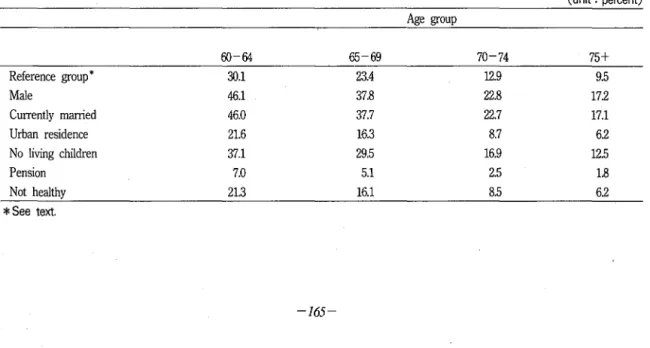
Based upon these estimated results, a profile of the computed agespecific labor force participation rate of the Thai elderly, as displayed in Table 6. For comparative purposes, we have selected as a reference group the following group of old persons : women who are not married, being Buddhists,
having no education, living in rural areas, having 6 living children and 2 modern consumer durable goods, receiving no pension, and being healthy. For each explanatory variable which has a statistically significant effect on participation, we have introdu-ced a value different from the reference group. A c10se examination of these calculated results reveals that the labor force participation rate for the Thai elderly change markedly, depending upon their
de-Table 6. Profile of Computed Age- Specific Labor Force Participation Rates for 삼le Elderly in Thailand. (unit : percent) Age group 60-64 65-69 70-74 75+ Reference group * 30.1 23.4 12.9 9.5 Male 46.1 37.8 22.8 17.2 Currently married 46.0 37.7 22.7 17.1 Urban residence 21.6 16.3 8.7 62 No living children 37.1 29.5 16.9 12.5 Pension 7.0 5.1 2.5 1.8 Not healthy 21.3 16.1 8.5 62
*
See text. -‘ J 4 ωmographic and socioeconomic characteristics. It ra-nges form 1.8 to 46.1 percent.
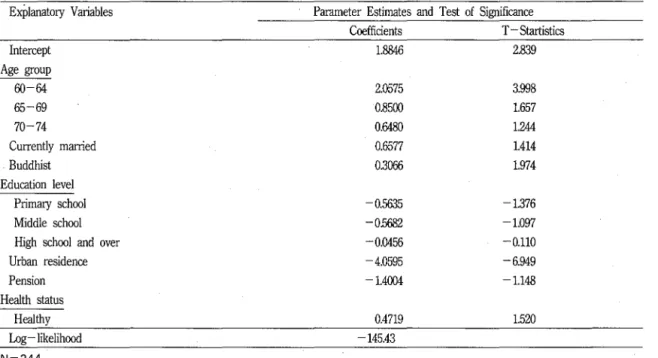
Table 7 compares the differences in the determi-nants of labor force participation between old men and women in Thailnd. Most of the determinants identified in these participation equations are com-parable. It should be emphasized, however, that the impact of health status upon participation varies co-nsiderably between the sexes. The shift of health status from “not healthy" to “healthy" raises elde-rly men‘s probability of being in the labor force by 0.155, while the corresponding figure for elderly women is only 0.052. This implies that the effect of health improvements upon overa11 participation dif-fers substantially, depending upon the extent to which health status improves for each sex.
The pension-inducement effect is significant for males
,
while it is virtua11y negligible for females,
as expected from, our earlier discussion in Section 11. In contrast, the number of modem consumer durable goods affects women ‘s participation considerably, whereas it has no impact on men ‘s. It should be noted that in the women ‘s equation, one of the educational attainment variablesCGrade 4) has a negative coefficient that is statistically significant.Nevertheless, the computed value of - 2 x loglike-lihood is 7.16, compared with a chi-square critical value of 9.49. Thus, women ‘s educational atlain-ment variables as a group have virtua11y no impact upon partlcipatlOn.
If these cross-sectional results hold over time, they have some important implications for future changes in labor force participation among the Thai elderly. Demographically, the estimated results for age and sex su짧est that because the aging process of Thai society is expected to accelerate and the
-166-feminization of the aged population is likely to be-come increasingly pronounced over the next few decades as discussed in the earlier section, the overall labor force participation rate of the elderly may dec1ine substantially as Thailand approaches the end of demographic transition. Improved morta-lity, which is projeted to contitnue in Thai society, is like1y to contribute to increasing the husband-wife joint survivorship, thus leading to a rise in the labor force participation rate. In addition, dec1ining fertility, which has been under way for some time and is expected to persist in the years ahead in Thailand, will reduce the number of living children as well as family structure, which gives rise to a weakening of informa1 familia1 support, consequently motivating the Thai elderly to stay in the labor fo-rce.
Apart from these various demographic impacts,
socioeconomic developmental factors will affect Thailand ‘s future labor supply among 이d people. Further improvements of health status, which are
c10sely intertwined with socioeconomic development, will lead to a rise in the participation of the elderly in the labor force. This positive effect upon labor force participation among the aged is likely to be offset to some extent by an increase in urbanization and the coverage of pension schemes, both of which are expected to grow rapidly in the 1990s and bey-ond CCho and Bauer, 1987; Pemia, 1988; Ki rana-ndana, Wongboonsin and Kiranandana, 1988). The net effect of these positive and negative impacts on participation is directly dependent upon Thailand ‘s future demographic and socioeconomic developme-nts.
Let us tum our attention to the estimated results for South Korea. Parallel to the Thai case, we have
Table 7. Logit Regressions Coefficient for 1ρbor Force Participation of Old Males Aged 60 때d Over
,
Sou삼1 Korea Explanatory Variables Intercept Age group 60 없 65-69 70-74 Currently married Buddhist Education level Primary school Middle school High school and over Urban residence Pension Health status Healthy I..og-likelihood N=344.P'arameter Estimates and Test of Signifκ때ce Coefficients T -S때rtistics 1.8846 2.839 2.0575 0.8500 O.없80 0.6577 0.3066 0.5않5 -0.5682 -0.0456 4.0595 -1.4004 0.4719 145.43 3.998 1.657 1μ4 1.414 1.974 -1.376 1.097 -0.110 -6.949 1.148 1.520
*
Both means and standard de끼ations of the e잉:planatory v때a비es are provided in Appendix Table 3. estimated three labor force participation equations,i.e., one for the whole sample, the other for males only, and another for females only. Because the health status variable has proved to have a signifi-cant effect upon participation only in the male equation, we confine ourselves to discussing the es-timated results for the male case.
As indicated in Table 7, the estimated coefficient for the health status variable has a positive sign, and it is statistically significant at the 10-percent level with a one - tail test. The elderly with good health status, compared with those having poor health status, have a higher probability(0.112) of being in the work force. Although this computed probability is slightly lower than that for the Thai male case, it is still substantial. Thus, further health investment uφn the Korean elderly is likely to lead to a considerable increase in labor supply, all
167
else being equal.
A large impact upon participation is generated by the urban-rural classificatory variable. Those resi-ding in urban areas
,
compared with their counter-parts in rural areas, have a much lower probability (-0.962) of working in the labor force. Similar to the Thai case, both a respondent ‘s age and marital status have a considerable impact on participation. Unlike the results for the Th떠 analysis,
neither the pension variable nor the number of living children has entered into the equation.Although we have estimated the female participa-tion equaparticipa-tion for the South Korean case, only age and urban-rural residence have shown statistically significant effect. In the case of Thailand, the effect of women ‘s health status variable upon their parti-cipation was rather small but statistically s방üficant.
significantly different from zero. Moreover, the logit regressions have been undertaken for urban and rural samples separately, but the results have re-mained unchanged.
In addition to these logit regressions, we have attempted to estimate a few altemative cases for both the Thai and South Korean data sets. For ins-tance, we have incorproated in the regression the health status variable that measures a respondent‘s ADL, but the computed resu1ts are basically the same with those presented. Following some of the earlier studiesCStem, 1989), we have tested the 'presence of interaction between sex and marital status. No significant effect, however, has been de-tected.
N. Concluding Remarks
In the first half of the present paper, we have discussed ci) the trends and prospects of popula-tion aging and Cii) the demographic profile of the 1". elderly in selected countries along the Asia-Pacific rim. We have also reviewed how both family and public support systems available for the elderly have been changing in these rapidly-aging countries.
Based upon these discussions developed in the first half, we have analyzed, in the second half of the present paper, how and to what extent the labor force participation of the elderly and their changing health status are related with each other in the ra-pid demographic and socioeconomic developments in these developing nations. To facilitate the empi-rical analyses, we have heavily drawn 때on micrc• ’ level data collected in Thailand and South Korea.
The discussions and analyses presented in this
-168-paper have indicated the predominant role played by families in providing both economic and noneco-nomic support to the elderly in the developing cou-ntries along the Asia-Pacific rim. However, as rep-resented by their high labor force participation rates by intemational standards, a substantial proportion of old Asians along the rim support themselves th-rough employment.
The emprirical results show that the health status of the elderly is one of the key variables affecting whether or not they participate in the labor force. This impact of the health variable upon participa-tion is particularly pronounced in the case of old men in both Thailand and South Korea. In view of the fact that life expectancy at birth for both sexes combined is 65 years for Thailand and 70 years for South KoreaCUnited Nations, 1989), both countries are likely to undergo substantial improvements of mortality and morbidity at older ages in the years to come. For this reason, the positive impact of the improved health status of the elderly upon their participation will be increasingly important in these countries.
However, the estimated results also show that there are several other factors likely to affect signi-ficantly the labor supply of the elderly. These fac-tors include the age and sex compositional shifts of the aged, their marital status, the declining informal family support by adult children for the eldrly, ur-banization, and the gradual improvements of pen-sion programs. Because the labor force participation rate of the elderly declines with age, and the aging process of these countries is expected to accelerate in the 1990s and beyond, the overall labor force participation rate of old persons in each country may decline substantially as they approach the end
of demographic transiton. Moreover, because old men show a higer participation rate than old wo-men, the pr,이ected predominance of the laìter rela-tive to the former is likely to further depress the overall labor force participation rate among the el-derly. In contrast, both the elderly ‘s marital status and the number of their living children, if their re-cent trends persist, are likely to contribute to rai-sing the probability of old persons being in the la-bor foce. The last two factors, which are influenced by socioeconomic development, generate an opposite force. If these cross-sectional results hold over time, the net effect of these variables upon the labor su-pply of old people is subject to the extent to which each of them will change in the years ahead.
It is often argued that older individuals have fe-wer years of life remaining and thus, less time to
e띠oy the flow of utility resulting from a health in-vestment(Grossman, 1972). There is no doubt, ho-wever, that elderly manpower constitutes one of the vital components of human resources( Clark
,
Kreps and Spengler, 1978). In order to maximize the uti-lization of an old but useful work force, therefore, appropriate policy measures and programs designed for keeping labor fòrce participation among the el-derly at a high level should be implemented in the course of future development in the developing countries along the rim. A gradual shift in retire-ment age is a salient example. In most of the coun-tries along the rim, the current retirement age is 60. As their a밍ng process advances, it should be raised to a higher age. This shift, however, requires changes in various factors related to the labor mar-ket, including the wage system. In view of }apan‘s recent experience on the extension of retirement age, however, this is not an easy task(Martin andOgawa, 1988). In this context, }apanese experiences can be used as a lesson for other Asian countries along the rim whose populations are expected to age rapidly over the next few decades.
As mentioned earlier, there are a number of in-dications that as a consequence of fertility and mo-rtality declines, coupled with rapid industrialization and urbanization, family size and structure have al-ready been shifting in many Asian countries along the rim, and thus, the pattem of support systems, both personal and public, has been shifting in re-cent years. In the years to come, the role of public
sUI꾸ort for the elderly is likely to become increasi-ngly important, relative to family support. However, the availability of resources through the public sup-port system is still severely limited in most of these developing nations. For instance, advocates for the expansion of health and social services for the el-derly face tough questioning from those responsible for national budgets, who must weigh many compe-ting claims on scarce budgetary resources(Gibson, 1988). In the case of Malaysia, for instance, owing to the high cost of hospital use and technology in the care of an ever-increasing elderly population, the share of the total govemment medical expendi-ture in GNP increased from 1.51 percent in 1970 to 3.53 percent in 1980. As a result, the Malaysian govemment has recently started exploring the pos-sibility of privatizing medica1 care services(Ogawa, 1985b). Similarly, the privatization of medica1 care services is one of the policy options being conside-red by the govemment of Thailand ; total govem-ment health care e앵enditures were 1.17 percent of GNP in 1979, growing to 1.43 percent in 1983 co뿔wa, Poapongsakom and Mason, 1989). Depen-ding upon policies to be adopted by these
169-riously affected, which will, in turn,뼈uence the future pattern of their labor supply.
Appendix Table 1. Means and Standard Deviations of Explanatory Variables Introduced into the Logit Regressions. Explanatory Variables Male Age group 60-64 65-69 70-74
Currentiy married(yes= 1; no=O)
B뼈dhist(yes=l; no=O) E:ducationa1 attainment
Grade 1-3 Grade 4 Grade 5 and over Other education
Urban residence(urban=l; rur해 =0) Number of consumer durable goods Number of living children Pension
(m때1 income source=l; ofuetWise=O) Health status
H않lthy(yes=l; no=O) Excellent(yes= 1; no=O) Good(yes=l; no=O)
F외r(yes= 1; no=O) N=2,999.
ping nations along the rim, further improvements of the health status of the elderiy is likely to be
se-Standard Deviation 0.4931 0.3262 0.4197 α잃64 0.1880 O.갱62 2.’5071 2.7169 0.1716 α4890 0.1976 0.4663 α4298 0.4733 O.따39 0.3884 0.4959 02891 Mean 0.4168 0.1210 0.2281 0.0707 0.0367 0.2554 3.9480 4.잃86 0.0303
願
뼈
願
爛
O.잃85 02698 0.1851 0.5649 0.9078Appendix Table 2. Means and Standard Deviations of Explanatory Variables Introduced in Male and Female Participation Equations. Female 2/ Mean Standard Deviatiα1 Male 1/ Mean Standard Deviation Esplanatory Variables 0.4767 O.갱31 0.3927 0.4903 0.2826 O.앓88 0.2499 0.1904 0.4014 0.9125 짧 m뼈 없 때 % M빠 M 써 Mω M mι 0.3깡0 0.2976 0.1776 0.7936 0.9016 0.2916 0.3756 0.0938 0.1698 0.3660 0.4625 0.1592 0.3096 -170-Age group 60-64 65-69 70-74
Currentiy married(yes=l; no=O)
Buddh염t(yes=l; no=O) Educational attainment
Grade 1-3 Grade 4
Grade 5 and over Other education
Urban residenceCurban=l ; rur떠 =0) Number of consumer durable goods Number of living children Pension
Cm때J mcome so따'ce=l; otherwise=O) Health status
Healthy Cyes=l; no=O) 1/ N= 1 ,250. 2/ N=1,749. 0.1328 0.3395 0.0263 0.1601 0.0688 0.2532 0.0137 0.1164 0.2456 0.4306 0.2624 0 .. μ01 4.0880 2.5010 3.8479 2.5074 5.1080 2.8291 4.없61 2.6177 0.0608 0.2391 0.0858 0.0922 0.6312 0.4827 O.잃55 0.4928
Appendix Table 3. Means and Standard Deviations of Explanatory Variables lntroduced into Participation Equation for South Korea.
Explanatory Variables Age group
60-64 65-69 70-74
Currently married Cyes=l; no=O) Buddhist (yes=l; no=O)
Eduιation le때
Primary school Middle school Hi힘J school and over
Urban residenι:e (urban=l; rural=O) Pension
(m밍n income source = 1 ; 아he때ise=O)
Health status
Healthy (yes=l ; no=O) N=344.
REFERENCE
Andrews, Gary R., Adrian ]. Estennan, Annette ]. Braunack-Mayer, and Cam M. Rungie. 1986.
A웰;ng iη the Western Pac힘'c :A Foμr-Couηtηl Stμdy. World Health Organization Regional
oκice for the Westem Pacific. Manila. BoskiIl Michael ]. 1977. “Social security and
retire-ment decisions." Economic Inquψ 15: 2-25.
Mean Standard Deviation 0.3314 0.4714 0.2936 0.4516 0.2α% 0.4010 0.8808 0.3249 0.2791 α.4492 0.3081 0.4624 0.0988 02989 0.1686 0.3750 O.않37 0.4825 0.0145 0.1199 0.6599 0.47.44
Chayovan, Napapom, Malinee Wongsith, and Chan-pen Saengtienchai. 1988. Socψ -Economic
Co-ηsequences 01 the Ageing 01 the Populatψη :
Thailand. Bangkok: Institute of Population Studies, Chulalon양om University.
Chen, AJ, and Ga띠n W. Jones. 1989. 쟁ing in ASEAN aηd Its Socio -Economic
Conseqμα1-ces. Singapore : Institute of Sorth - East Asian Studies.
Cho, Lee- Jay, and John G. Bauer. 1987. “
tion growth and urbanization : what does the future hold? " Pp. 15-37 in Roland ]. Fuchs,
Gavin W. Jones and Emesto M. Pemia (eds.), Urbaη잉:ation and Urban Policies in
Pa-αific Asia. Boulder and 1ρndon : Westview Press.
Choe, Ehn Hyun. 1988. “Survey of population aging in the Republic of Korea. “Paper prepared for ESCAP. Seoul.
Choi, Hoil. 1985. “Selected characteristics on popu-lation and aging in the Republic of Korea." Paper presented at the Sixteenth Summer Seminar on Population. Honolulu.
Clark Robert, Juanita Kreps, and Joseph Spengler. 1978. “Econonmics of aging : a survey."
Jour-ηal 01 Economic Literature 16: 919-962.
Cow밍 11, Donald 0., and 1ρ,well D. Holmes. 1972.
Aging and Modernization. Meredith.
Davis, Kingsley, and Pietronella van den Oever. 19 81. “Age relations and public policy in advan-ced industrial societies." Pop싸'atψ'n aηd Deve-lopment Review 7, no. 1: 1 -18.
GibsoI} Mary Jo. 1988. "Public health and social po-licy." Paper presented at the Expert Group Meeting on the Role of the Family in Care of the Elderly, Mexico City.
Gross man, Michael. 1972. "On the concept of hea-lth capital and the demand for heahea-lth ‘,! our-nal 01 Political Economy 80, no. 2 : 223 - 255. Hauser, Philip M. 1982. “Labor force, urbanization,
migration and development. “Paper presented at the Conference on Urbanization and Natio-nal Development. Honolulu.
lntemational Labour Office. 1988. The Cost 01 50cial
5e,αrity. Geneva
Japan Management and Coordination Agency. 1987.
-172
Rojin ηo 5eikatsμ to Ishiki : Kokμsai Hikakμ
Chosa Kekka Hokokusho(Life aηd Perception.s
01 the Elderly : Report 01 the Results 0η the
In-terηatiαlal Compαrative 5μrvey).Tokyo : Japa-nese Govemment Printing Office.
Jones, Gavin W. 1985. “Socio-economic consequences of the ageing of the population." Phase III ASEAN Population Pr이ect, Inter-Country Re-port.
.1988. “Consequences of rapid fertit1ity decline for old age security. “Paper presented at the IUSSP Seminar on Fertility Transiton in
Asia : Diversity and Change. Bangkok Kiran andana, Thienchay, Kua Wongboonsin, and
Suchada Kiranandana. 1988. “Population as-pects of development in Thailand: helath/ nutrition, education and old age security." Report prepared for ESCAP in connection with the project “Development of Analytica1
Framework for Population and Development Research and Planning." Bangkok
Leete, Richard. 1987. “The post demographic transi-tion in East and South Asia : similarities and contrasts with Europe." Popμlation 5tμdies 41, no. 2: 187 - 206.
Livi Bacci, Massimo. 1982. “Social and biological aging : contradictions of development." Popμ latψη aηdDevelopmeηt Review 8, no. 4 : 771-781.
Maddα, George L. 1982. "Cha11enges for hea1th po-licy and Planning. “Pp. 127 -158 in R. Bins-tock, W.S. Chow and ]. Schulz(eds.), Interηa
tional Perspectives on Aging: Population and Policy Chazz,α19es. New York: United Nations Fund for Population Activities.
87. “Morbidity and disability pattems in four developing countries: their implications for social and economic intergration of the elde-rly. ‘'journal of Cross - Cμltμral Gerontology 2
: 115-119.
Mantin, Linda G. 1988. “The a밍ng of Asia" Journ찌
of Geroηtolo양 : 50cial 5cieηce 43, no.4: S99 -S113.
_.1989a. “Emerging issues in crossnational sur-vey research on a,횡ng in Asia." International Population Conference : New Delhi 1989 3: 69
-80.
_ _ ' 1989b. "Living arrangements of the elderly in Fiji, Korea, Malaysia, and the Philppines."
DemograPhy 26, no. 4 : 627-없3.
_ _ ' and Suzanne Culter. 1983. "Mortality decline and Japanese family structure." Popμlatioη aηd Developmeηt Review 9, no. 4 : 633 - 650. _ _ ' and Naohiro Ogawa. 1988. “The effect of
co-hort size on relative wages in Japan." Pp. 59 -75 in Ronald D. Lee, W. Brian Arthur and
Gerry Rodgers(eds.), Economics of Cha뺑쟁
Age Distributψηs zη Developed Countries.
Ox-ford : Clarendon Press.
MyersGeorge C. 1988. "Demographic aging and fa-mily support for older persons." Paper prese-nted at the Expert Group Meeting on the Role of the Family in Care of the Elderly, Mexico City.
Ogaw:잉aohiro. 1985a. “Urbanization and intemal migration in selected ASEAN countries : tre-nds and prospects." Pp. 83 -107 in Philip M. Hauser, Daniel B. Suits and Naohiro Ogawa (eds.) , Urbanization aηd Migratioη in A5EAN
Developmeηt. Honolulu: University of Hawaii Press.
_.1985b. “Population growth and the costs of health care : the case of Malaysia." EPU Dis-cussion Paper no. 13. Kual<i Lumpur: Prime Minister ‘s Office, Govemment of Malaysia. . 1988a. “Population change aI1d welfare of the
aged." Pp. 105-132 in Frameworks φr Popμ
lation and Deveüψmeηt flηtegγ'(Jtion. Asian
Po-p비ation Studies Series no. 92. Ban향ok:
United Nations ESCAP.
__ ' 1988b. "Aging in China: demographic a1 ter-natives." Asian-Paαψ Population Joμrnal 3,
no. 3 : 21 -64.
_ _ .1989a. “Population aging and household stru-ctural change in Japan" Pp. 75-98 in John Eekelaar and David Pearl(des.), Aη Agiηg
World: Dil,αnmas and Challenges for Law and 50cial Policy. 0화órd : Clarendon Press. _ _ ' 1989b. "Population aging and its impact upon
hea1th resource requirements at govemment and familial levels in Japan." Ageing aηd 50-ciety 9, no. 4 : 383 - 405.
_ _ .l990a. “Economic factors affecting the health of the elderly." Pp. 627-646 in Robert 1.
Kane, J. Grimley Evans and David Macfadyen (eds.) , Improvi:쟁 the Health of Older PeoPle : A World View. Oxford: Oxford University
Press .
. 1990b. forthcoming. “Resources for the elde-rly in economic development." Hal Kendig,
A피ko Hashimoto 때d Larry C. Coppard (eds.), Famψ 52φ'Port ψr the Elderly : The
Int,αηational E;t.ψerzeηce. London: Cambridge University Press.
__ ' Nipon Poapongsakom, and Andrew Mason. 1989. “Forecasts of hea1th care cost in Thai-land." Paper prepared for the National