ICCAS2005 June 2-5, KINTEX, Gyeonggi-Do, Korea
1. INTRODUCTION
Digital watermarking has been proposed as an effective tool for protecting and authenticating the copyright of multimedia such as music, picture and video [1]. The watermarking is a process of inserting data into the multimedia content. The watermarking schemes can be classified into two classes. The first is non-blind scheme [2, 3], which an original image is provided. Using the original image, a synchronization problem can be resolved effectively by the difference. The other is blind scheme [4-8], which does not use the original image in watermark detection. This scheme is obviously more interesting and more widely used. The prominent problem of watermarking is that it must remain after unintended distortion or hostile attacks. A distortion such as rotation, scaling, shearing or changing aspect ratio, can defeat most of existing watermarking schemes [9]. Such distortions can destroy the synchronization, which is required for watermark detection.
In this paper, we propose a blind watermarking scheme, which based on the tree structure of the discrete wavelet transform. The tree structure is similar to the embedded zerotree wavelet (EZW) compression. We adapt an imperceptibility of watermark by using a perceptual model of Just-Noticeable distortion (JND). In addition to the watermark, a desired template is inserted into the watermarked image. The template consists of a set of peaks, which is inserted into the discrete Fourier transform (DFT) domain. The cross-ratio of four peaks is kept as key, which is required in detection.
2. EMBEDDING METHOD
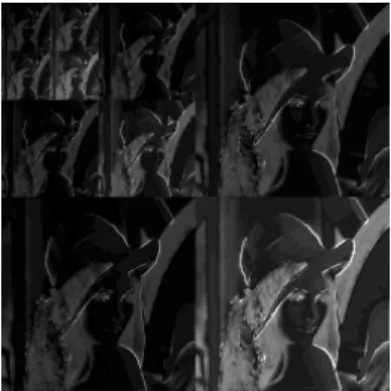
2.1 Watermark EmbeddingAccording to the EZW concept, the wavelet coefficients across different scales are correlated. In Fig. 1, the concept can
be described as parent-children relationship [5], where a coefficient of a coarser scale is the parent of the four coefficients of the next finer scale at the same spatial location and orientation, and so on. It can be assumed with a high probability that if a parent is smaller than a certain threshold then all its descendants are smaller than the threshold.
Fig.1 The parent-children relationship of wavelet coefficients The watermark embedding process receives an original image f(x,y) and a secret key Ke . An output of the process is a watermarked imagef ′(x,y), as illustrated in Fig. 2. The procedure of embedding process is as follows:
1. Compute the DWT of the original image. The Daubeshies 8-tap filter is used for obtain three levels decomposition.
2. The lowest sub-band (sub-band 1 in Fig. 1) is excluded in watermarking. Let S={s1,s2,...,sK}be the set of significant coefficients in sub-band 2, 3 and 4, where a wavelet coefficient is significant if its magnitude is larger than a threshold T . e
Each significant coefficient is identified by a
Template Recovery of DWT-DFT Composite Watermarking Scheme
Using Collinear Cross-Ratio
Kasemsuk Sepsirisuk*, Kiyoaki Atsuta** and Shozo Kondo***
Graduate School of Engineering, Tokai University, Kanagawa, Japan * (Tel: +81-463-58-1211ext.4053; Email: [email protected])
** (Tel: +81-463-58-1211ext.4059; Email: [email protected]) *** (Tel: +81-463-58-1211 ext.4053; Email: [email protected])
Abstract: According to a popularization of the Internet and digital lifestyle, digital watermarks have been proposed for protection of copyrighted multimedia content. In blind watermark detection, which an original image is not provided, robustness against geometric distortion and compression remains challenging. In this paper, we propose a new perceptual blind discrete wavelet transform - discrete Fourier transform (DWT-DFT) composite watermarking scheme that is robust against both general linear transform and JPEG compression. This algorithm constructs an image-dependent watermark in the most significant DWT coefficients, which is determined by using a hierarchical tree structure. Strength of watermark is determined from a just-noticeable difference (JND) profile of a perceptual model. Furthermore, a desired template is inserted into DFT domain of the watermarked image. In new manner, a cross-ratio of four collinear points is used for detecting the template. Experimental results have showed that the proposed scheme is robust against general linear distortion, JPEG compression and various general kinds of attacks in the Stirmark 3.1 watermark evaluation tool.
Keywords: Watermarking, Blind Watermarking, Cross-Ratio of Length, Wavelet, Fourier
2 1 3 4 5 6 7 8 10 9
225
quadruplet sk =(bk,xk,yk,vk) , where b is the sub-band k
number (sub-band 2…10 in Fig.1), x and k y are the position k
in the sub-band and vk is the value of the coefficient.
Fig. 2 Flowchart of the embedding process. 3. For each sk∈ : S
(a) A zero-mean and unit-variance Gaussian pseudo-random number (PN) generator is seeded with
) , , , (Kebk xk yk func seed= (1)
where func is a function that depends only on the embedding key and the sub-band and position of s . k
(b) Each sk is watermarked by
(
k k)
k k v jnd v' = + α⋅ ⋅ρ (2) where ' kv is the value of s after embedding, k α is the JND
scaling factor, jnd is the JND value of each spatial position, k
and ρk is a value produced by the pseudo-random number
generator. The JND and JND scaling factor will be discussed in Sec. 2.2.
(c) Let Ck =
{
ck,1,ck,2,ck,3,ck,4}
be the children ofk
s in the wavelet decomposition. (d) The children are watermarked:
(
ki ki)
i k i k v jnd v', = , + α⋅ , ⋅ρ , (3)where vk′ is the value of ,i ck,i after embedding, α is the JND scaling factor, jndk,i is the JND value of each spatial position, and ρk ,i is a value produced by the pseudo-random number generator.
(e) If the magnitude of any ck,i is larger thanTe/2,
then the watermark is embedded in the children ofck,i. The 3(d) and 3(e) step are repeated for all the children of ck,i and all their descendants as necessary.
(f) The threshold is halved for each sub-band level. The inverse DWT is performed to obtain the watermarked image.
2.2 Perceptual model
According to the fact that JND can be quite accurately estimated from the watermarked image [2]. The JND value obtained from the perceptual model are used to determine the maximum strength of the watermark that can be embedded in every portion of image without affecting the image quality. The model used here can be described in terms of three properties of
the human visual system that have been studied in the context of image coding: frequency sensitivity, luminance sensitivity and contrast masking [10, 11]. Our JND profile is shown in Fig.3, where the bright pixels indicate that the strong watermarks can be embedded.
Fig.3 The JND value of the Lena image.
2.3 Template Embedding
Since the DWT coefficients are not invariant under geometric transformation. To achieve the robustness to affine transform, we produced a template in DFT domain [5, 6]. The template embedding is as follows:
1. In order to have a high resolution, the image )
, (x y
f ′ is padded with zeros to be extended to the size of 1024x1024. Then the fast Fourier transform (FFT) is performed.
2. Two sets of four points randomly distributed along two lines in the upper half (Fig.4) are selected by the key Ke . Each line lies at different angles. All of the points are between
1
h andh shown in Fig.4. The strength of template points is 2
equal to the local average magnitude plus 3 times of the standard deviation.
3. The Corresponding sets of collinear points are also embedded in the lower half plane to fulfill the symmetry constraint.
4. Perform the inverse FFT to produce the complete watermarked image.
Fig.4 The template in DFT domain.
As defined template, the cross-ratio of length of four collinear points (CR) is kept for detection. The CR of four points located at(ri,1,θi),...,(ri,4,θi)in polar form is defined as follows: ) )( ( ) )( ( 2 , 3 , 1 , 4 , 2 , 4 , 1 , 3 , i i i i i i i i i r r r r r r r r CR − − − − = (4) 1
h
2h
)
,
(
r
i,jθ
i 1θ
2θ
U
V
w JND DWT W ate rmark embedding IDW T DFT Te mplate embedding IDFT f(x,y) f''(x,y) PN Ke f'(x,y)226
3. DETECTION METHOD
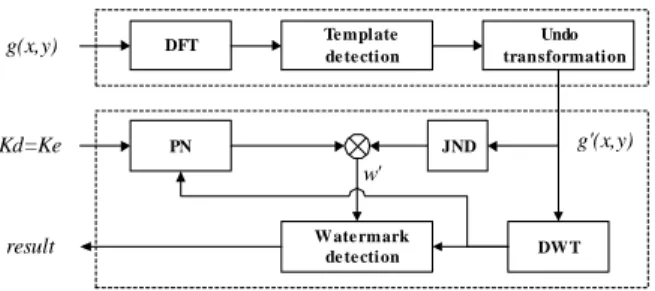
Since the watermarked image is possibly distorted with the affine transform. The watermark detection process has two phases, template detection and watermark detection, as shown in Fig.5.
Fig. 5 Flowchart of the detection process.
3.1 Template Detection
Since a linear transform applied in spatial domain results in a corresponding linear transform in DFT domain [6, 8]. To avoid high computational payload, we use the mean square error (MSE) of the affine transformation matrix. The procedures are performed as follows:
1. The image is padded with zero to the size of 1024x1024.Then the Fast Fourier Transform (FFT) is applied.
2. Extract and record the position of all local peaks in DFT magnitude. According to the angle, divide the peaks into equally spaced bins. This procedure reduces time consumption of the exhaustive search.
3. Search for sets of four collinear peaksΓ={θ1,θ2,...}, ) , , , (i,1 i,2 i,3 i,4 i = r r r r
θ which are arranged according to their radius.
4. The cross-ratio of each θi∈Γ is computed by
Eq.(4). Then each matched template is used for estimating the affine matrix Ai, and finding the MSE as follows: i
) ( ) ( eT e 1 eT d,i i P P P P A = − (5) 2 , 4 1 e i i d i P AP MSE = − (6)
where P is the set of original points, e P is the set of detected d
point.
5. An A , which produces the smallest i MSE is i
chosen for reversing the transformation.
3.2 Watermark Detection
The watermark detector is correlation-based, similar to 1-bit detection [5, 7]. The result of the detection is only a presence or absent of the watermark. The watermark detection process is similar to the embedding process in Sec.2.1. We obtain the watermark from an input image with detection keyKd=Ke. But the significance of wavelet coefficients is determined by a threshold T whichd Td ≥Te. That is, T is larger than d T to e
avoid correlating coefficients that are not watermarked. Once the watermark is detected, it is correlated with the significant coefficients of the test image:
∑
= ′ = M i i i V M Z 1 ˆ 1 ρ (7)where Vˆ is the i i−thwavelet coefficient of the test image,
Mis the total number of the watermark, ρi′ is PN which is
corresponding to the i− wavelet coefficient. The detection th threshold is similar to Dugad method [7],
∑
= ′ = M i i d jn M S 1 2 1 (8)If Z≥ , it means the watermark is present in the test S image.
4. EXPERIMENTAL RESULTS
We have tested the proposed algorithm. In our tests, we chooseα=3.0,Te=30, Td=45, 25h1=0. normalized frequency and h2=0.35 normalized frequency. We use C language as programming tool on 664 MHz Pentium PC.
Fig. 6(a) shows a watermarked image that has been undergone rotation by 30 degree, while Fig. 6(b) shows the distorted image by general linear transform of the Stirmark 3.1; linear_1.01_0.013_0.009_1.011. Fig 6(c) and Fig. 6(d) show the images after recovered with our template detection, respectively. Fig. 7 shows a result of robustness against JPEG compression that can be detected under high compression. Table 1 shows results of our algorithm by using the StirMark 3.1. In Table 1, “1” represents the embedded watermark can be detected successfully while “0” means the watermark can not be detected successfully. However, robustness against translation is not included in this paper yet.
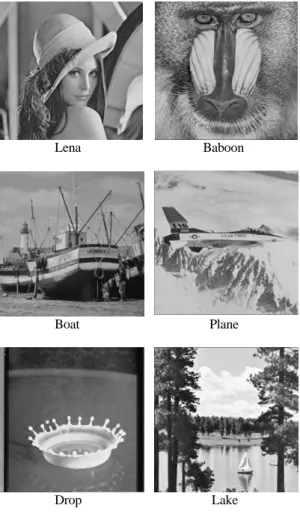
We observed that the PSNR of the watermarked images, as in Fig. 8, are higher than 40 dB. From the advantage of JND, the watermarks are perceptually invisible. The embedding process takes time about 5 seconds, while the detection process take about 10~20 seconds.
(a) (b)
(c) (d) Fig.6 Images before (a, b) and after (c, d) template recovery. w' DFT Te mplate de te ction Undo transformation JND W ate rmark de te ction DW T Kd=Ke PN g(x,y) result g'(x,y)
227
Fig. 7 The result of JPEG compression evaluation
Lena Baboon
Boat Plane
Drop Lake Fig. 8 Test images.
TABLE 1 The results evaluated with Stirmark 3.1
Lena Baboon Boat Plane Dro
p Lake JPEG 10%-100% 1 1 1 1 1 1 Crop 10% 1 1 1 1 1 1 Jitter 1 1 1 1 1 1 Rotation (crop) 1 1 1 1 1 1 General transformation 1 1 1 1 1 1 Gauss filtering 1 1 1 1 1 1 Sharpening 1 0 1 1 1 1 FMLR 1 1 1 1 1 1 3x3 median 1 0 1 1 1 0
5. CONCLUSIONS
This paper described a new watermarking technique based on the DWT-DFT composite scheme. The technique uses a perceptual model and collinear cross-ratio for synchronization template. Since the advantage of perceptual model, the watermarked image is imperceptible. The results show that the proposed scheme is robust against various signal processing attacks and JPEG compression. However, the proposed scheme does not provide a method against the translation attack. It needs to be improved.
REFERENCES
[1] F. Hartung and M. Kutter, “Multimedia watermarking techniques,” Proc. of the IEEE, Vol. 87, pp. 1079-1107, 1999.
[2] C. I. Podilchuk and W. Zeng, “Image-Adaptive Watemarking Using Visual Models,” IEEE Journal on Selected Area in Communications, Vol, 16, No. 4, pp. 525-539, 1998.
[3] R. B. Wolfgang, C. I. Podilchuk, and E. J. Delp, “Perceptual watermarking for images and video,” Proc. of the IEEE, Vol. 87, No. 7, pp. 1108-1126, 1999.
[4] A. Piva, M. Barni, F. Bartolini, and V. Cappellini, “DCT-based watermark recovering without resorting to the uncorrupted original image,” Proc. of the IEEE International Conference on Image Processing, Vol. 3, pp. 520-523, 1997.
[5] O. G. Pla, E. T. Lin, and E. J. Delp, “A Wavelet Watermarking Algorithm Based on a Tree Structure,”Proc. of the SPIE International Conference on Security, Steganography, and Watermarking of Multimedia Contents VI, vol. 5306, pp. 571-580, 2004.
[6] X. Kang, J. Huang, Y. Q. Shi, and Y. Lin, “A DWT-DFT Composite Watermarking Scheme Robust to Both Affine Transform and JPEG Compression,” IEEE Trans. On Circuits and System for Video Technology, Vol. 13, No. 8, pp. 776-786, 2003.
[7] R. Dugad, K. Ratakonda, and N. Ahuja, “ A new wavelet-based scheme for watermarking images,” Proc. of the IEEE International Conference on Image Processing, pp. 357-372, 1998.
[8] S. Pereira and T. Pun, “Robust template matching for affine resistant image watermarks,” IEEE Tran s . on Image Processing, Vol. 9, No. 6, pp. 1123-1129, 2000. [9] F. A. P. Petitcolas. R. J. Anderson, and M. G. Kuhn,
“Attacks on copy-right marking systems,” Proc. of Workshop Information Hiding, Vol. 1525, pp. 218-238, 1998.
[10] C. H. Chou and K. C. Liu, “Color image watermarkin g based on a color visual model,” IEEE Workshop on Multimedia Signal Processing, pp. 367-370, 2002. [11] C. H. Chou and K. C. Liu, “A perceptually tuned
subband image coder based on the measure of just-noticeable-distortion profile , ” I E E E Tr a n s . o n Circuits and Systems for Video Technology, Vol. 5, Issue 6, pp. 467-476, 1995.