Thrombus formation is one of the common causes of tran-sient ischemic attacks and stroke. Platelet aggregation is thought to play an essential role in these processes.1)Platelets are blood cells that participate in the human primary hemo-static mechanism. Platelets need to be activated to perform all their functions and this activation can be initially pro-duced after an endothelial injury that exposes subendothelial structures to the blood flow. Aggregation (platelets-platelets interaction) has as the final purpose to produce a platelet thrombus that constitutes the primary hemostatic plug. It in-volves a sequence of biochemical reactions that are initiated by the contact of an agonistic agent with receptors on the platelet membrane. This is followed by fibrinogen binding to glycoprotein (GP) IIb/IIIa complex serving as a link with other surrounding platelets. The aggregation process is then amplified and becomes irreversible with the secretion of platelet intragranular substances through the release reac-tion.2)These reactions have their own mechanisms of control that regulate or modulate platelet activation such as the elevation of cyclic-39,59-adenosine monophosphate (cAMP) contents, cytosolic Ca21 mobilization and Ca21/cAMP2—5)
related secretion of dense granule adenosine-5-diphosphate (ADP) and adenosine-5-triphosphate (ATP) etc.6,7)
Some naphthoquinone derivatives such as vitamin K have antiplatelet activities.8) Chang et al.9) reported that a
syn-thetic naphthoquinone derivative, NQ-Y15, showed a con-centration-dependent inhibitory effect on platelet aggregation and cytosolic calcium and also affected the production of second messengers.
In the previous study, we reported that NQ301, a naphtho-quinone derivative, showed potent inhibitory effects on platelet aggregation in vitro and ex vivo, and in animal pul-monary thrombosis.10)It is thus presumed that as it is a
naph-thoquinone derivative,9)the antiplatelet effect of NQ301 may result from the inhibition of cytosolic Ca21mobilization and the second signals modulation. Therefore, to determine what the antiplatelet mechanism of NQ301 is, this study was un-dertaken to evaluate the effects of NQ301 on the washed human platelet aggregation in vitro, binding of fibrinogen to GPIIb/IIIa complex, cytosolic Ca21 concentration, cAMP levels and ATP release in activated platelets.
MATERIALS AND METHODS
Materials NQ301, 2-chloro-3-(4-acetophenyl)-amino-1,4-naphthoquinone, was synthesized and characterized as previously described.11)Thrombin and arachidonic acid were
purchased from Chrono-Log Co. (PA, U.S.A.). ADP, ATP, collagen, A23187, bovine serum albumin (BSA), thapsigar-gin, ethylene glycol-bis (b-aminoethyl ether)-N,N,N 9,N9-tetraacetic acid (EGTA) and dimethylsulfoxide (DMSO) were purchased from Sigma Chemical Co. (St. Louis, MO, U.S.A.). The penta-ammonium salt of fluo-3 was from Mole-cular Probes (Eugene, OR, U.S.A.). cAMP enzyme im-munoassay kit was purchased from Amersham Pharmacia Biotech (Little Chalfont, Buckinghamshire, U.K.). The other chemicals were of analytical grade.
Preparation of Washed Human Platelets Blood from healthy volunteers who had not taken any drug for at least 15 d was collected by venipuncture in a plastic flask contain-ing 3.15% sodium citrate (1 : 9 v/v). Washed platelets were prepared as previously described.10) After centrifugation at 6003g for 15 min at room temperature, the platelet pellets were washed with modified Tyrode–HEPES buffer (129 mM NaCl, 2.8 mM KCl, 8.9 mM NaHCO3, 0.8 mM MgCl2, 0.8 mM KH2PO4, 2 mM EGTA, 5.6 mM glucose, 10 mM HEPES,
∗To whom correspondence should be addressed. e-mail: [email protected] © 2001 Pharmaceutical Society of Japan
Antiplatelet Effect of
2-Chloro-3-(4-acetophenyl)-amino-1,4-naphthoquinone (NQ301): A Possible Mechanism through
Inhibition of Intracellular Ca
21Mobilization
Yong-He ZHANG,aKwang-Hoe CHUNG,bChung-Kyu RYU,cMyong-Hwa KO,aMyung-Koo LEE,aand Yeo-Pyo YUN*, a
College of Pharmacy, Chungbuk National University,a 48 Gaesin-Dong, Heungduk-Gu, Cheongju 361–763, Korea, Cardiovascular Research Institute, Yonsei University College of Medicine,b 134 Shinchon-Dong, Seodaemun-Gu, Seoul 120–752, Korea, and College of Pharmacy, Ewha Womans University,c 11–1 Daehyun-Dong, Seodaemun-Gu, Seoul 120–750, Korea. Received October 10, 2000; accepted February 7, 2001
The effects of 2-chloro-3-(4-acetophenyl)-amino-1,4-naphthoquinone (NQ301), an antithrombotic agent, on aggregation, binding of fibrinogen to glycoprotein (GP)IIb/IIIa complex and intracellular signals were investi-gated using human platelets. NQ301 significantly inhibited the collagen-, thrombin-, arachidonic acid-, thapsi-gargin- and calcium ionophore A23187-induced aggregation of washed human platelets with IC50 values of
13.060.1, 11.260.5, 21.060.9, 3.860.1 and 46.260.8 mmM, respectively. NQ301 also significantly inhibited
FITC-conjugated fibrinogen binding to human platelet surface GPIIb/IIIa complex, but failed to inhibit the fibrinogen binding to purified GPIIb/IIIa complex. These data demonstrate that NQ301 inhibits platelet aggregation by suppression of the intracellular pathway, rather than by direct inhibition of fibrinogen-GPIIb/IIIa complex bind-ing. NQ301 significantly inhibited the increase of cytosolic Ca21concentration and ATP secretion, and also
sig-nificantly increased platelet cAMP levels in the activated platelets. These results suggest that the antiplatelet ac-tivity of NQ301 may be mediated by inhibition of cytosolic Ca21mobilization, enhancement of cAMP production
and inhibition of ATP secretion in activated platelets.
0.35% BSA, pH 7.4) and centrifuged at 6003g for 15 min. Finally, platelets were gently resuspended in Tyrode–HEPES buffer (129 mMNaCl, 2.8 mMKCl, 8.9 mMNaHCO3, 0.8 mM MgCl2, 0.8 mMKH2PO4, 1 mMCaCl2, 5.6 mMglucose, 10 mM
HEPES, 0.35% BSA, pH 7.4). The platelets were counted using a Coulter Counter (Coulter Electronics, Hialeah, FL, U.S.A.) and adjusted to a concentration of 33108platelets/
ml.
Aggregation of Washed Human Platelets Platelet ag-gregation was measured using an aggregometer (Chrono-Log Co., PA, U.S.A.) as previously described.10) Briefly, washed
human platelet suspension was incubated at 37 °C in an ag-gregometer with stirring at 1000 rpm and then NQ301 was added. After 3 min preincubation, the platelet aggregation was induced by addition of collagen (50mg/ml), AA (50 mM), thrombin (0.5 U/ml), thapsigargin (1mM) or A23187 (1mM). The resulting aggregation, measured as the change in light transmission, was recorded for 10 min. The extent of inhibi-tion of platelet aggregainhibi-tion is expressed as % inhibiinhibi-tion (X ) using the following equation:
X5[(A2B)/A]3100
A: maximal aggregation of control
B: maximal aggregation of sample treated washed platelets
FITC-Labelled Fibrinogen Binding to Platelet GPIIb/ IIIa Complex FITC-labelled fibrinogen binding to platelet GPIIb/IIIa complex was assayed as previously described.12)
Briefly, fibrinogen was conjugated with fluorescein isothio-cyanate (FITC) by incubating the protein (1 mg/ml) at 4 °C overnight in 50 mMcarbonate buffer (pH 9.5) containing 0.1 mg/ml FITC. Free FITC molecules were eliminated by dialy-sis overnight against carbonate buffer. The preparation of conjugated compounds contained 3.2 mg/ml FITC-conju-gated fibrinogen.13)The effect of NQ301 on fibrinogen
bind-ing to the GPIIb/IIIa complex in ADP-stimulated platelets was examined by flow cytometric analysis. Histograms were obtained by quantitating the fluorescence intensity of 10000 platelets, with the peak height indicative of the number of platelets showing a given intensity. Washed platelets were ad-justed to 33108 platelets/ml with modified Tyrodes buffer (pH 7.4) and NQ301 was used at a final concentration of 50 mM. Following incubation for 5 min with FITC-labelled fib-rinogen (10mg/ml) and ADP (20 mM), the fluorescence sig-nals from ADP-stimulated platelets were analyzed by flow cytometry (FACS Caliber, Beckton Dickinson, U.S.A.).
Binding of Fibrinogen to Purified GPIIb/IIIa Complex The peptide Gly-Arg-Gly-Asp-Ser-Pro (GRGDSP), a selec-tive inhibitor of GPIIb/IIIa complex was synthesized using f-Moc chemistry and purified on a reverse phase C18column
using a 0.1% trifluoroacetic acid/acetonitrile gradient.12,14—16)
GPIIb/IIIa complex was purified briefly as follows. Detergent lysate of the membrane proteins with 50 mM octylglucopyra-noside was followed by GRGDSP-Sepharose chromatogra-phy and eluted with GRGDSP (1.0 mg/ml). They were fur-ther purified by wheat germ lectin-sepharose chromatogra-phy. Fibrinogen (500 ng) in carbonate/bicarbonate buffer (pH 9.0) was coated onto microtiter wells overnight at 4 °C. Puri-fied GPIIb/IIIa complex was co-incubated in the wells with either NQ301 or GRGDSP and the fibrinogen-GPIIb/IIIa ELISA was performed by a modified method of Nachman and Leung.17)
Measurement of Cytosolic Ca21 Concentration Cy-tosolic Ca21 concentration ([Ca21]i) was measured using
a laser scanning confocal microscope.18) Washed human
platelets were allowed to adhere to fibrinogen at room tem-perature and immobilized to a glass coverslip during 40 min. Non-adhered platelets were removed by rinsing with washing buffer, pH 7.45. Then adhered platelets were incubated with 4 mM fluo-3 in washing buffer for 40 min and washed three times with washing buffer, and then treated with NQ301 for 3 min. Each coverslip containing stained platelets was mounted on a perfusion chamber, subjected to a confocal laser scanning microscope (Carl Zeiss LSM 410, Germany), and then scanned every second with a 488 nm excitation argon laser and a 515 nm long pass emission filter. Collagen was added to the platelets using an automatic pumping sys-tem. All images from the scanning were processed to analyze changes of [Ca21]iin a single cell level. The results were
ex-pressed as the relative fluorescence intensity.
Assay of Platelet cAMP Level Washed human platelets (33108platelets/ml) were warmed at 37 °C for 2 min in an
aggregometer with stirring at 1200 rpm prior to incubation with NQ301 for 3 min, and then platelets were activated by addition of collagen (50mg/ml) or thrombin (0.5 U/ml) for 4 min. The reaction was stopped by addition of 10 mM EDTA and then boiled for 3 min. cAMP was then extracted from platelets according to the method of Meurs et al.,19) and
quantitated using a commercial EIA kit (Amersham Pharma-cia Biotech, Little Chalfont, Buckinghamshire, U.K.).
ATP Secretion from Platelets The released ATP as an indicator of dense granule secretion was measured by the lu-ciferin–luciferase method.13,20,21)The basis of this reaction is
the emission of light following the interaction of the firefly extract substrate luciferin with the enzyme luciferase in the presence of ATP and the emitted light can be detected and quantitated using a dual channel Whole Blood Lumi-ionized Calcium Aggregometer (Chrono-Log Co., PA, U.S.A.).
Statistics Differences between the sample-treated group and control group were analyzed by Student’s t-test.
RESULTS
Effect of NQ301 on Washed Human Platelet Aggrega-tion NQ301 inhibited the washed human platelet aggrega-tion induced by collagen (50mg/ml), thrombin (0.5 U/ml), AA (50mM), thapsigargin (1mM) and A23187 (1mM) in a dose-dependent manner with IC50 values of 13.060.1,
11.260.5, 21.060.9, 3.860.1 and 46.260.8 mM, respectively (Fig. 1).
Effect of NQ301 on Platelet GPIIb/IIIa Complex Bind-ing When FITC-labelled fibrinogen was allowed to bind to human platelet surface GPIIb/IIIa complex, the mean fluores-cence intensity value was below 5 in untreated platelets (data not shown) and increased to about 90 after stimulation of the platelets by ADP. NQ301 (50mM) inhibited the binding by 77% relative to controls (Fig. 2). Increased exposition of the GPIIb/IIIa complex at the platelet surface was confirmed by flow cytometric analysis using FITC-labelled mouse anti-human GPIIb/IIIa complex antibody.
In order to determine whether NQ301 directly interacted with platelet surface GPIIb/IIIa complex, the binding assay was performed using purified GPIIb/IIIa complex. A
syn-thetic peptide containing the RGD sequence, GRGDSP, was used as a positive control, since RGD peptides are potent in-hibitors of the interaction between GPIIb/IIIa complex and fibrinogen.16,22,23) The peptide GRGDSP potently inhibited
GPIIb/IIIa complex binding to fibrinogen at a concentration of 10mg/ml, whereas NQ301 did not inhibit this binding at concentrations up to 100mM(Fig. 3).
Effect of NQ301 on [Ca21]
i In order to study the effect
of NQ301 on the [Ca21]imobilization in activated platelets, the level of [Ca21]iwas measured in washed human platelets
after treatment with collagen (50mg/ml). As shown in Fig. 4, collagen caused a rapid, but transient increase in [Ca21]i, and
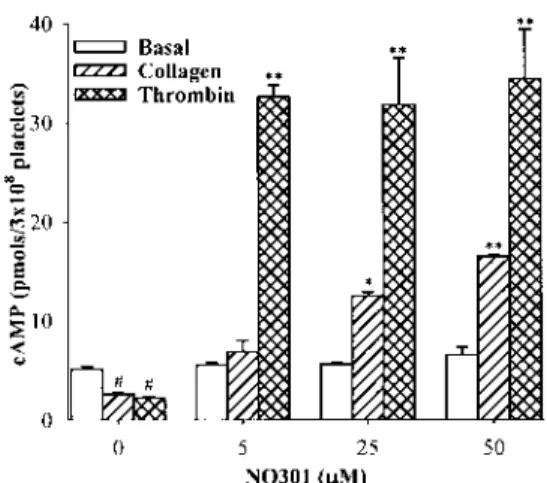
NQ301 (10mM) completely blocked this increase of [Ca21]i. Effect of NQ301 on cAMP Level The effects of NQ301 on cAMP level in basal and activated human platelets are shown in Fig. 5. The cAMP level in resting human plate-lets was 5.160.3 pmols/33108 platelets and was reduced
to 2.660.1 and 2.260.1 pmol/33108 platelets by collagen (50m g/ml) and thrombin (0.5 U/ml) activation. NQ301 showed no effect on the basal cAMP levels in resting platelets, but significantly increased the cAMP level in colla-gen- or thrombin-stimulated human platelets in a dose-de-pendent manner (Fig. 5).
Fig. 1. Effect of NQ301 on Washed Human Platelet Aggregation Washed human platelets suspension was incubated at 37 °C in an aggregometer with stirring at 1000 rpm and then NQ301 was added. After 3 min preincubation, the platelet aggregation was induced by addition of collagen (50mg/ml), AA (50 mM), thrombin (0.5 U/ml), thapsigargin (1mM) or A23187 (1mM), respectively. The aggregation per-cents shown are the percent of maximal aggregation induced by the respective inducer. Data are expressed as mean6S.E.M. (n54).
Fig. 2. Effect of NQ301 on Binding of FITC-Labelled Fibrinogen to Human Platelet GPIIb/IIIa
The curves show the fluorescence signal of ADP-activated platelets in the presence (A) or absence (B) of NQ301 at a concentration of 5mM. Light scattering and fluores-cence signals were analyzed by flow cytometry for 10000 platelets per sample. The rel-ative fluorescence intensity (X-axis) is plotted logarithmically.
Fig. 3. Effect of NQ301 on Binding of Purified Human Platelet GPIIb/IIIa to Fibrinogen
Fibrinogen was coated overnight onto microtiter wells. Purified GPIIb/IIIa was co-in-cubated in the wells with NQ301 or GRGDSP (Gly-Arg-Gly-Asp-Ser-Pro). The amount of receptor bound was determined by ELISA. Data are expressed as the mean ab-sorbance of two experiments performed in duplicate.
Fig. 4. Effect of NQ301 on Collagen-Induced Ca21Influx
Adhered human platelets were incubated with 4 mMfluo-3, AM in washing buffer for 40 min, and treated with 10mMNQ301 for 3 min, and then the collagen (50mg/ml) was added at the indicated time. The [Ca21]
iwas monitored by using a confocal laser scan-ning microscope. The results are expressed as the relative fluorescence intensity (RFI). Each trace was a single cell representative from at least three separate experiments.
Fig. 5. Effect of NQ301 on cAMP Level in Collagen-Activated Washed Human Platelets
Platelets and NQ301 were incubated for 3 min at 37 °C and collagen (50mg/ml) or thrombin (0.5 U/ml) was added to induce activation for 4 min. The reaction was stopped by addition of 10 mMEDTA and immediate boiling for 5 min. cAMP content was mea-sured by using EIA kit. Data are represented as mean6S.E.M. (n53). #p,0.01 vs. basal control; * and ** p,0.01 vs. collagen control.
Effect of NQ301 on ATP Secretion from Platelets The effect of NQ301 on ATP release in collagen (50 mg/ml)-stim-ulated human platelets is shown in Fig. 6. Thrombin-induced ATP release from dense granule in human platelets was sig-nificantly inhibited by NQ301 in a dose-dependent manner. DISCUSSION
Among various categories of antiplatelet drugs, cAMP-el-evating agents, GPIIb/IIIa complex and calcium antagonists have been reported to inhibit platelet aggregation stimulated by a wide variety of platelet agonists.24)
GPIIb/IIIa complex is the most abundant glycoprotein on the platelet surface and its binding sites must be exposed by platelet activation.22) The exposure of functional GPIIb/IIIa
complex on the surface of the activated platelets and its bind-ing to fibrinogen is a common pathway by which physiologic platelet aggregating agents lead to platelet aggregation.23)
Fibrinogen binds in a calcium dependent way to GPIIb/IIIa complex, and its binding to GPIIb/IIIa complex also evokes certain intracellular reactions.24—26)
NQ301 showed potent inhibitory effects on the washed human platelet aggregation induced by collagen, thrombin, AA and A23187. On the binding assay, NQ301 significantly inhibited ADP-stimulated binding of FITC-labelled fibrino-gen to platelet GPIIb/IIIa complex, but failed to inhibit the binding of fibrinogen to the purified GPIIb/IIIa complex. This result suggests that the antiplatelet activity of NQ301 may be mediated by interfering with the intracellular path-way leading to GPIIb/IIIa complex exposure, but not by in-hibiting the binding of fibrinogen to GPIIb/IIIa complex di-rectly.
It is well known that cAMP is one of the most potent platelet function inhibitors.24)cAMP stimulates a protein
ki-nase that mediates phosphorylation of an ATP-dependent cal-cium-pumping system and removes calcium from the cy-tosol. In sufficient concentration, cAMP inhibits not only platelet aggregation, secretion and shape change, but adhe-sion to the surfaces as well. In the activated platelets, the cAMP level was decreased much more than that of control. NQ301 raised the level of cAMP in collagen- or
thrombin-activated platelets, but did not affect the cAMP contents in the resting platelets (Fig. 5).
Many processes involved in platelet activation are Ca21 -dependent. Ca21acts as a second messenger in the intracellu-lar signal pathway and the decrease in [Ca21]i level in
platelets may lead to the inhibition of aggregation.27—30)
Calcium ionophore A23187 can penetrate membranes, di-rectly mobilize the intracellular Ca21 and result in the in-crease in the cytosolic Ca21concentration.31,32)Thapsigargin, a selective inhibitor of the endoplasmic reticulum Ca21 -ATPase pump, may cause Ca21levels to increase from intra-cellular stores and influx from outside and induce platelet ag-gregation in the extracellular Ca21-dependent way.33,34) NQ301 inhibited A23187- and thapsigargin-induced platelet aggregation in a dose-dependent manner. In addition, the increase of cytosolic Ca21 mobilization induced by collagen was also significantly inhibited by NQ301. These results indicate that NQ301 may inhibit either the Ca21influx from outside or the release from Ca21 pools in the activated platelets.
Platelet aggregation resulting from the reaction of com-plex signal transduction cascade is brought about by stimuli. One of the components in the cascade is the release of ATP from activated platelets.33)At low concentration (1—10 nM), ATP was found to significantly enhance the thromboxane A2
analog, U46619-, collagen- and thrombin-induced platelet aggregations. Conversely, at high concentration (1—100mM), ATP inhibited these same reactions.7) The secreted dense granule ADP and ATP contribute to the maintenance of ele-vated [Ca21]ilevels, but not to the initial [Ca21]iincreases.6)
However, NQ301 significantly inhibited thrombin-induced ATP release at the concentrations that inhibit platelet aggre-gation in a dose-dependent manner (Fig. 6).
The mobilization of cytosolic Ca21 contents is known to play a central role in the response of platelets to activating agents.27,35) It is essential for the activation of platelet GPIIb/IIIa complex. The increase in intracellular Ca21 con-centration mediates the activation of platelet GPIIb/IIIa com-plex leading to binding of fibrinogen. The elevation of cAMP levels inhibits platelet aggregation as well as most other platelets response including the release of ATP and the rise of [Ca21]i.36) Ca21 antagonists, cAMP-elevating agents and
GP IIb/IIIa antagonists have an inhibitory effect on platelet aggregation stimulated by a wide variety of platelet agonists, and cAMP-elevating agents possess wider inhibitory effects on platelet responses evoked by strong agonists than GPIIb/ IIIa complex antagonists.24)
Therefore, the present study suggests that the antiplatelet activity of NQ301 may result partially from the inhibition of platelet GPIIb/IIIa complex exposure by inhibition of cytoso-lic Ca21 mobilization directly or arising from enhancement of cAMP production and inhibition of ATP release in acti-vated Platelets.
Acknowledgment This work was supported by the Brain Korea 21 Project.
REFERENCES
1) Noriyuki K., Takeshi T., Sunao N., Tomoya A., Keiko M., Rieko I., Azuaki I., Yutaka M., Yukio K., Thromb. Res., 96, 261—268 (1999). Fig. 6. Effect of NQ301 on ATP Release in Collagen (50m g/ml)-Induced
Platelet Aggregation
Each bar represents the released ATP level calculated from the luminescence peak in the treatment of NQ301. Results are expressed as mean6S.E.M. (n54). * p,0.01, ** p,0.01.
2) Vizcáino-Salazar G., Rev. Invest. Clin., 35, 41—62 (1994). 3) Siess W., Physiol. Rev., 69, 58—178 (1989).
4) Rink T. J., Sage S. O., Annu. Rev. Physiol., 52, 431—449 (1990). 5) Blockmans D., Deckmyn H., Vermylen J., Blood Rev., 9, 143—156
(1995).
6) Soslau G., Youngprapakorn D., Biochim. Biophys. Acta, 1355, 31—40 (1997).
7) Lages B., Weiss H. J., Thromb. Haemost., 81, 286—292 (1999). 8) Shen A. Y., Huang M. H., Teng C. M., Wang J. S., Life Sci., 65, 45—
53 (1999).
9) Chang T. S., Kim H. M., Lee K. S., Khil L. Y., Mar W. C., Ryu C. K., Moon C. K., Biochem. Pharmacol. 54, 259—268 (1997).
10) Kang W. S., Ryu C. K., Chung K. H., Ko M. W., Joo J. C., Yuk D. Y., Yoo H. S., Yun Y. P., Biol. Pharm. Bull., 22, 1284—1287 (1999). 11) Ryu C. K., Yakhak Hoeji, 32, 245—250 (1988).
12) Yuk D. Y., Ryu C. K., Hong J. T., Chung K. H., Kang W. S., Kim Y. S., Yoo H. S., Lee M. K., Lee C. K., Yun Y. P., Biochem. Pharmacol., 60, 1001—1008 (2000).
13) Rand M. L., Packham M. A., Taylor D. M., Yeo E. L., Gemmell C. H., Patil S., Lam S. C., Thromb. Haemost., 82, 1680—1686 (1999). 14) Lindal T. L., Festin F., Larsson A., Thromb. Haemost., 68, 221—225
(1992).
15) Karczewski J., Connolly T. M., Biochem. Biophys. Res. Commun., 241, 744—748 (1997).
16) Gawaz M., Brand K., Dickfeld T., Pogatsa-Murray G., Page S., Bogner C., Koch W., Schömig A., Neumann F., Atherosclerosis, 148, 75—85 (2000).
17) Nachman R. L., Leung L. L. K., J. Clin. Invest., 69, 263—269 (1982). 18) Lee Z. W., Kweon S. M., Kim B. C., Leem S. H., Shin I., Kim J. H.,
Ha K. S., J. Biol. Chem., 273, 12710—12715 (1998).
19) Meurs H., Kauffman H. F., Koeter G., Devries K., Clin. Chim. Acta,
106, 91—97 (1980).
20) Knofler R., Weissbach G., Kuhlisch E., Semin. Thromb. Haemost., 24, 513—521 (1998).
21) Suggs L. J., West J. L., Mikos A. G., Biomaterials, 20, 683—690 (1999).
22) Phillips D. R., Charo I. F., Parise L. V., Fitzgerald L. A., Blood, 71, 831—843 (1988).
23) Plow E. F., Pierschbacher M. D., Rouslahti E., Marguerie G. A., Gins-berg M. H., Proc. Natl. Acad. Sci. U.S.A., 82, 8057—8061 (1985). 24) Matsumoto Y., Marukawa K., Okumura H., Adachi T., Tani T., Kimura
Y., Thromb. Res., 95, 19—29 (1999).
25) Ferrell J. E., Jr., Martin G. S., Proc. Natl. Acad. Sci. U.S.A., 86, 2234—2238 (1989).
26) Plow E. F., D’Souza S. E., Ginsberg M. H., Thromb. Haemost., 18, 324—332 (1992).
27) Haller H., Elliott H. L., J. Hum. Hypertens., 10, 143—155 (1996). 28) Hjemdahl P., Wallén N. H., Eur. Heart. J., 18 (Suppl A), A36—50
(1997).
29) Sage S. O., Exp. Physiol., 82, 807—823 (1997).
30) Thaulow E., J. Cardiovasc. Pharmacol., 33 (Suppl 2), S12—16 (1999).
31) Jan¨cinová V., Nosál R., Petríková M., Cell Signal, 4, 525—530 (1992). 32) Fuse I., Higuchi W., Uesugi Y., Hattori A., Aizawa Y., Clin. Lab.
Haematol., 21, 29—32 (1999).
33) Huang S. J., Kwan C. Y., Eur. J. Pharmacol., 341, 343—347 (1998). 34) Sun B., Kambayashi J., J. Biomed. Sci., 7, 35—41 (2000).
35) Teijeiro R. G., Silveira J. R., Sotelo J. R., Benech J. C., Mol. Cell Biochem., 199, 7—14 (1999).
36) Tertyshnikova S., Fein A., Proc. Natl. Acad. Sci. U.S.A., 95, 1613— 1617 (1998).