INTRODUCTION
Centipedegrass scientifically known as Eremochloa ophiu-roides (Munro) Hack, belongs to family Poaceae. Centipede-grass is widely distributed in South-east Asia, USA, South America, Europe, West Indies, Africa and North and East part of Australia (Hook et al. 1992; Duble 1996). Centipede-grass is more feasible to use in lawns, parks and golf course turfs. It is reported that this grass is convenient to use on the road sides, industrial and other low maintenance areas (Lan-dry and Murphy 2002; Islam and Hirata 2005b). Centipede-grass is light green in color, with leafy stolons and com-pressed sheath, which lie flat against or on the soil surface
and resemble centipede (Islam and Hirata 2005a; Bao and Hirata 2006). It has been reported that centipedegrass is dormant during winter and rejuvenates growth slowly in spring and expands rapidly in summer (Cai et al. 2004).
Due to its rapidly growing leafy stolon and high dense forming sward, this grass is convenient to use in soil conser-vation, particularly in high rainfall and sloping areas (Islam and Hirata 2005b). In recent times in Japan, this grass is used as ground cover in rice fields to inhibit weeds (Fuke et al. 2006). Besides the above uses, the leaf of this grass contains important compounds such as chlorogenic acid (CA) (Fig. 1), luteolin and maysin (Wiseman et al. 1990). All these com-pounds are very effective against fall army worm larvae. It has been demonstrated that CA and maysin are the major factors responsible for the antibiotic resistance of centipede-grass to larvae of the fall armyworm (Johnson et al. 2002). In the present study, we have attempted to evaluate the
res-─ ─ 47 ──
Chlorogenic Acid was Specifically Induced among Phenolic
Compounds in Centipedegrass by Gamma Irradiation
Byung Chull An†, Shyamkumar Barampuram†, Seung Sik Lee, Eun Mi Lee and Byung Yeoup Chung*
Advanced Radiation Technology Institute, Korea Atomic Energy Research Institute, Jeongeup 580-185, Korea
Abstract -- Centipedegrass is a warm season turfgrass in the world. Chlorogenic acid (CA) is one of the important compounds present in the leaf of centipedegrass and already known as an antioxi-dant, CA has become a key resistance against insect pests and bacteria pathogens of agricultural and horticultural plants during seedling stage. Furthermore, CA is accumulated by abiotic stress such as an UV irradiation. In present study, we investigated enhancement of the level of CA upon gamma irradiation in centipedegrass. The high performance liquid chromatography (HPLC) data analysis showed an approximately increasing of the CA levels from among the irradiated samples. However, plants irradiated at 50 Gy showed a constant increase in the CA level (0.0066 to 0.114 mg ml--1 and 0.0258 to 0.2211 mg ml--1, respectively) from 3rdto 15thday among one and three month irradiated plants compared to control. The present study, indicates an increase in the CA level upon gamma irradiation, suggests strategy for conferment of strong resistance in seedling stage plants by gamma irradiation as simplicity and cheaply method.
Key words : Centipedegrass, Chlorogenic acid, HPLC, Gamma irradiation, Seedlings
†An BC and Barampuram S. contributed equally to this work.
* Corresponding authors: Byung Yeoup Chung, Tel. +82-63-570-3331, Fax. +82-63-570-3339, E-mail. [email protected]
ponse of seedling plants to gamma irradiation and change in the CA content in centipedegrass.
MATERIALS AND METHODS
Seeds of centipedegrass were obtained from Fukukaen nursery and Bulb Co. Ltd, Japan. A plastic pot of 6 cm dia-meter and 10 cm length in size was filled with compost soil mixture before sowing of seeds. Approximately 100 seeds were sown in each pot and watered regularly whenever soil found dry. All the pots were kept in glasshouse at 24�C± 2�C, relative humidity 90% under natural light conditions. Seeds started germination after 10~12 days of sowing. Exactly, from the date of seeds sown, the pots with one month and three month old seedlings were subjected to gamma irradiation. Exposure to gamma irradiation was carried out at various dose levels i.e. 25 Gy, 50 Gy and 100 Gy using a gamma irradiator (IR-222, MDS Nordion Inc., Kanata, Canada) in the Advanced Radiation Technology Institute (ARTI). Under each dose level, a single pot was taken from the one and three month old seedling plants cate-gory and subjected to gamma radiation for 4 h. Similarly, a single pot from one and three month old seedling plants were used as control and placed outside the gamma ray facility chamber at ambient temperature for similar duration time (i.e. 4 h).
After gamma irradiation, immediately all the pots includ-ing control and irradiated samples were transferred to the glasshouse conditions and watered regularly. Leaf samples weighing 0.25 g were collected randomly from control and irradiated samples exposed to various dose levels. Leaf
sam-ple collection was carried out from 3rdday of gamma irradia-tion at time interval such as 3rd, 6th, 9th, 12th and 15th day. On harvest, leaf samples were immediately, cut into pieces and placed in vial containing 10 ml of 100% methanol. All the samples were kept under shaking condition at 120 rpm for 2 days at ambient temperature. The upper layer of the me-thanol extracts were removed and filtered to new fresh vial using 0.45μm sterile syringe (Corning, USA). All the filter-ed samples were subjectfilter-ed to the high performance liquid chromatography (HPLC) analysis separately along with an authentic compound of CA. The authentic compound was prepared in methanol at the concentration of 0.5 mg ml-1and
1 mg ml-1. HPLC analysis was performed using a Beckman
Coulter C18 ODS column, 25 cm×4.6 mm I.D using an Agilent 1050 diode array HPLC system (Agilent Technolo-gies, Palo Alto, CA, USA). The solvent gradient was: linear from methanol-water (20 : 80) (Solvent A) to methanol (Sol-vent B) in 50 min, with a flow-rate of 1 ml min-1and a 5 min
recycle time. Both solvents contained 0.1% (v/v) orthophos-phoric acid. From each sample, the peak related to the CA was calibrated with standard CA and values are recorded in terms of mg ml-1. liquid chromatography-mass
spectrome-try (LC-MS) was carried out using an Agilent (Agilent Technologies, Palo Alto, CA, USA) LC-MSD. Negative ion electrospray ionization (ESI) was used to form depro-tonated molecules at m/z 353 of CA. The optimum ESI conditions for these compounds included a nitrogen nebuli-zer pressure of 40 psi, a nitrogen drying gas temperature of 350�C at 11 l min-1, spray voltage of 4500 V, a detector
gain of 1600 V, fragmentation voltage 100 V for CA. Select-ed ion monitoring (SIM) was usSelect-ed with a dwell time of 1.00 s. All analyses are canducted in triplicate.
RESULTS AND DISCUSSION
Germination of seeds was observed from 10~12 days of sowing. All the seedlings were found normal and no growth inhibition was observed before exposure to gamma irradia-tion (data not shown). As shown in Fig. 2, the peak of authentic CA was detected at 340 nm with a 9.55 retention time min, using a same solvent system as used for leaf sam-ple analysis. The calibration curve was linear and used to confirm CA peaks in control and gamma irradiated leaf sam-ples. Furthermore, the HPLC peak of CA was confirmed by
Fig. 1. Chemical structure of CA.
HO HO O O HOOC OH OH OH
a LC-MS. The previous report has shown that the depro-tonated molecule ([M-H]-) form of CA was predominantly
detected at m/z 353 by a LC-MS (Wang et al. 2006). The CA in centipedegrass was also detected at m/z 353 (Fig. 3). In the Tables 1 and 2, these show the observed levels of CA in control and gamma irradiated leaf samples of one and three month old seedlings collected at different time inter-val.
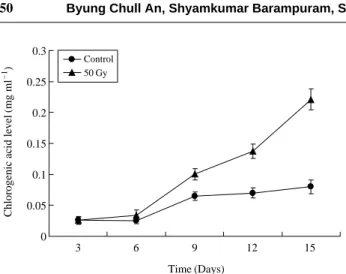
The level of CA is enhanced among gamma irradiated leaf samples collected at different time duration, when compared to the control samples (Tables 1 and 2). Particularly, the level of CA was gradually increased in three-month old seedlings irradiated at dose level 50 Gy and 100 Gy (Table 2). However, the level of CA was not gradually increased in irradiated samples of one month, when compared to control samples (Table 1). The increasing of CA level was uniquely found in irradiated samples exposed at dose level 50 Gy compared to control, irrespective of age group (Fig. 4). A comparison between chromatograms of control and irra-diated leaf samples at 50 Gy clearly showed a strong in-crease in the CA peak level in three-month old seedlings observed at various time periods (Fig. 5).
In the present study, exactly the one and three-month old seedlings were used for gamma irradiation experiment. The nature of the seedlings was found healthy and fresh prior to gamma irradiation. The CA is one of the important phenolic compounds in the leaf of centipedegrass. In the present study, the CA was used as biomarker to evaluate its level of change upon gamma irradiation. In some of the reports the plant Fig. 2. Chromatogram showing peak of the authentic CA (retention
time: 9.55±0.3 min) observed at the concentration level,
0.5 mg ml-1.
Fig. 3. Mass spectrum of CA. The deprotonated molecule ([M-H]-) form of CA was predominantly detected at m/z 353 by a LC-MS.
Table 1. HPLC data analysis of non-irradiated and gamma irradiated leaf samples of one month old seed derived plants collected at different
time intervals in centipedegrass
Dose (Gy) Chlorogenic acid concentration (mg ml
-1)
3 Days 6 Days 9 Days 12 Days 15 Days
0 0.0059±0.0017a 0.0062±0.0026a 0.0073±0.0029a 0.0071±0.0028a 0.0066±0.0025a
25 0.0063±0.0028a 0.0063±0.0038a 0.0082±0.031a 0.0080±0.0027a 0.0081±0.0029a
50 0.0066±0.0027a 0.0062±0.0027a 0.0072±0.0028a 0.0150±0.0041a 0.0114±0.0043a
100 0.0060±0.0026a 0.0063±0.0018a 0.0078±0.0029a 0.0121±0.0042a 0.0123±0.0041a
a: All data are the means±S.D. of triplicate experiments.
Table 2. HPLC data analysis of non-irradiated and gamma irradiated leaf samples of three-month old seed derived plants collected at different
time intervals in centipedegrass
Dose (Gy) Chlorogenic acid concentration (mg ml
-1)
3 Days 6 Days 9 Days 12 Days 15 Days
0 0.0259±0.0055a 0.0254±0.0047a 0.0645±0.0069a 0.07±0.0083a 0.08±0.0111a
25 0.0265±0.0068a 0.0347±0.0094a 0.1±0.0098a 0.0765±0.0085a 0.0250±0.0109a
50 0.0258±0.0063a 0.034±0.0009a 0.1002±0.0092a 0.1374±0.0114a 0.2211±0.0171a
100 0.0236±0.0062a 0.0255±0.0058a 0.0735±0.0079a 0.0980±0.0094a 0.1440±0.0131a
a: All data are the means±S.D. of triplicate experiments. mAu 600 500 400 300 200 100 0 0 10 20 30 40 min 1.654 8.932 9.541 13.321 21.501 100 80 60 40 20 0 200 300 400 500 m/z 353.1 354.1
metabolite was taken as marker to elucidate its change of content upon gamma irradiation as studied in Hordeum vulgare and Allium sativum (Sato and Matsui 1995; Wu et al. 1996). The increased levels of CA upon gamma irradia-tion either in one and three-month old seedlings, may be due to the enhancement in phenylalanine ammonia-lyase (PAL) activity. In one of the report, irradiation has enhanced the synthesis of total phenolic compounds and is correlated with PAL activity during storage. Accumulation of phenolic compounds in cells is demonstrated and may be explained by the enhancement of PAL activity (Oufedjikh et al. 2000). In addition, in another report about transgenic of PAL gene showed particularly increased levels of CA in Nicotiana tabacum (Shadle et al. 2003).
Even though there are many peaks observed in the chro-matograms of control and irradiated leaf samples (Fig. 5), the aim of our study is specific to only CA peak (Rt. 9.55 min). In control and gamma irradiated three-month old seed-lings, the peak of CA was observed between retention times 9.55 and 9.88, this might be due to noise and we assume this as negligible error in HPLC analysis. The one and three-month old seedlings irradiated at 50 Gy showed a gradual increase in the CA level in leaf samples collected from 3rd
day to 15thday of irradiation (Fig. 4). However, the gamma
radiation has been used useful technique for alteration of the levels of useful compounds in Angelica gigas and Mikania glomerata (Peregrino and Leitao 2005; Seo et al. 2007). In contrast, in one of the report the growth and plant
metabolite content was reduced upon irradiation at 100 Gy in Nicotiana tabacum (Sato and Matsui 1995). The increase in the CA level in irradiated samples at 100 Gy, suggest that one and three-month old seedlings of centipedegrass are not sensitive to gamma radiation. However, in the present study, the growth of the seedlings was found normal up to one month after irradiation, irrespective of various dose levels treated. Overall, this study reveals that increase in the CA level among seedlings upon gamma irradiation without major change in the growth profile of the plant.
0 0.05 0.1 0.15 0.2 0.25 0.3 3 6 9 12 15 Time (Days)
Chlorogenic acid level
(mg ml
-1)
Control 50 Gy
Fig. 4. The quantification of CA calculated on the peak intensities
in HPLC chromatograms relative to area. ●, CA concen-tration of control; ▲, CA concenconcen-tration of 50 Gy irradida-tion, respectively. The data shown are the means (± the standard error of the mean) of at least three independent experiments.
Fig. 5. Chromatograms showing the peak of CA (retention time:
9.55±0.3 min) levels of one month old leaf samples
collect-ed from 15thday after irradiation (A, control; B, 50 Gy
irra-diation) and three-month old semples old (C, control; D, 50 Gy irradiation). 8 6 4 2 0 8 6 4 2 0 80 60 40 20 0 200 175 150 125 100 75 50 25 0 mAU mAU mAU mAU 0 10 20 30 40 min 0 10 20 30 40 min 0 10 20 30 40 min 0 10 20 30 40 min (A) (B) (C) (D)
CONCLUSION
The increase in the level of CA was observed upon gamma irradiation in one and three-month old seedlings of centipede-grass. Consequently, gamma irradiation of 50 Gy provides nearly 3 folds increasing of CA and no growth inhibition after irradiation. The increase in the CA level obtained with this procedure can be considered as beneficial, since CA is one of the major compounds and acts as antioxidant and antibiotics in this plant.
ACKNOWLEDGMENT
This project has been carried out under the Nuclear R&D Program of the Ministry of Science and Technology, Repub-lic of Korea.
REFERENCES
Bao GZ and Hirata M. 2006. Effects of defoliation frequency on the development and establishment of a vegetatively planted turfgrass Eremochloa ophiuroides (centipedegrass). Trop. Grasslands 40:102-110.
Cai Q, Wang S, Cui Z, Sun J and Ishil Y. 2004. Changes in freezing tolerance and its relationship with the contents of carbohydrates and proline in over wintering centipedegrass [Eremochloa ophiuroides (Munro) Hack.]. Plant Prod. Sci. 7:421-426.
Duble RL. 1996. Turfgrasses: Their management and use in the Southern Zone, 2nded., Texas A & M University Press,
College station, Texas, pp. 1-336
Fuke K, Hozumi N, Enami Y, Matsuura K and Tajimi Y. 2006. Anthracnose of centipedegrass caused by Colletotrichum caudatum. J. Gen. Plant Pathol. 72:74-75.
Hook JE, Hanna W and Maw BW. 1992. Quality and growth response of centipedegrass to extended drought. Agron. J. 84:606-612.
Islam MA and Hirata M. 2005a. Leaf appearance, death and detachment, and tillering in centipedegrass [Eremochloa ophiuroides (Munro) Hack.] in comparison with bahiagrass
(Paspalum notatum Flugge): A study at a small sod scale. Grassl. Sci. 51:121-127.
Islam AM and Hirata M. 2005b. Centipedegrass [Eremochloa ophiuroides (Munro) Hack.]: Growth behaviour and multi-purpose usages. Grassl. Sci. 51:183-190.
Johnson AW, Snook ME and Wiseman BR. 2002. Green leaf chemistry of various turfgrasses: Differentiation and resis-tance to fall armyworm. Crop Sci. 42:2004-2010.
Landry G and Murphy T. 2002. Centipede lawns. Leaflet 313, cooperative extension service. The university of georgia col-lege of agricultural and environmental sciences, Georgia, pp. 1-4.
Oufedjikh H, Mahrouz M, Amiot MJ and Lacroix M. 2000. Effect of γ-irradiation on phenolic compounds and pheny-lalanine ammonia-lyase activity during storage in relation to peel injury from peel of citrus clementina hort. Ex. Ta-naka, J. Agric. Food Chem. 48:559-565.
Peregrino CAF and Leitao SG. 2005. Chromatographical pro-files of fluid extracts and tinctures obtained from Mikania glomerata sprengel sterilized by gamma ray irradiation. Rev. Bras. Farmacogn. Braz J. Pharmacogn. 15:237-242. Sato M and Matsui T. 1995. Differential radiosensitivity
bet-ween seeds and seedlings of Nicotiana debneyi in respect of chlorogenic acid content. Plant Science 109:139-144. Seo H-Y, Kim H, Song H-P, Kim D-H, Byun M-W, Kwon
J-H and Kim K-S. 2007. Effects of gamma irradiation on the yields of volatile extracts of Angelica gigas Nakai. Rad. Phy. Chem. 76:1869-1874.
Shadle LG, Wesley SV, Korth KL, Cheng F, Lamb C and Dixon RA. 2003. Phenylpropanoid compounds and disease resist-ance in transgenic tobacco with altered expression of L-phenylalanine ammonia lyase. Phytochemistry 64:153-161. Wang SJ, Zhang ZQ, Zhao YH, Ruan JX and Li JL. 2006. Simultaneous quantification of chlorogenic acid and caffeic acid in rat plasma after an intravenous administration of mai-luoning injection using liquid chromatography/mass spec-trometry. Rapid Commun. Mass Spectrom. 20:2303-2308. Wiseman BR, Gueldner RC, Lynch RE and Severson RF. 1990.
Biochemical activity of centipedegrass against fall army-worm larvae. J. Chem. Ecol. 16:2677-2690.
Wu J-J, Yang J-S and Liu M-S. 1996. Effects of irradiation on the volatile compounds of Garlic (Allium sativum L.). J. Sci. Food Agric. 70:506-508.
Manuscript Received: February 18, 2010 Revision Accepted: February 19, 2010